52-Week Money Challenge 2027: Free Printable, $1,378 by Dec. 27
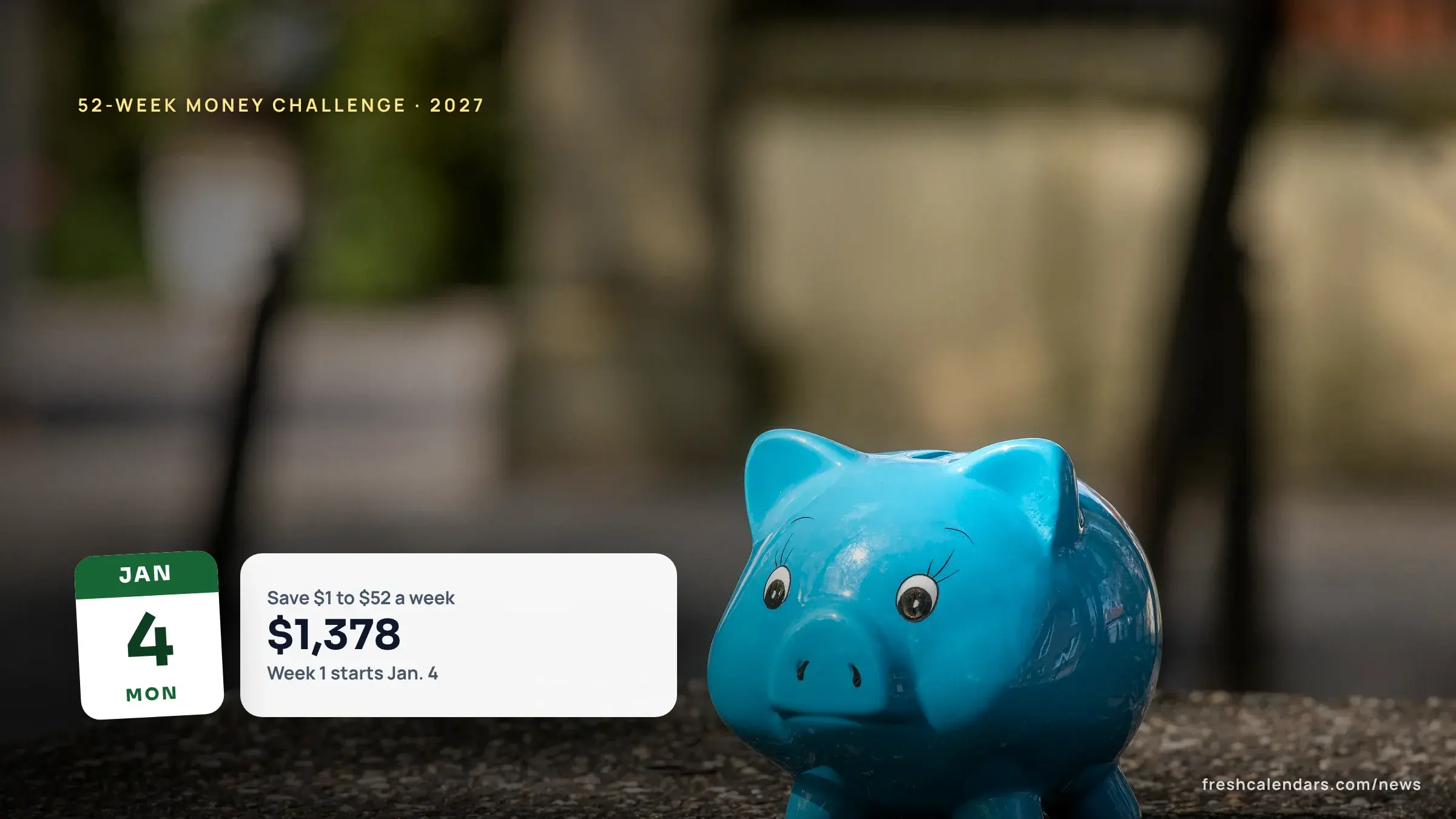
Save $1 to $52 a week in 2027 and reach $1,378 by Dec. 27, starting Mon., Jan. 4. A dated tracker for all 52 weeks, plus reverse and half versions.

Published 5 min read
Key dates
In this article
The 52-week money challenge saves $1 in week 1, $2 in week 2 and $52 in week 52, which totals $1,378; in 2027 week 1 is the week of Monday, Jan. 4 and week 52 is the week of Monday, Dec. 27. Fresh Calendars computed the dates from the 2027 calendar and the total as the sum of 1 to 52. The free printable tracker lists every date, and the reverse and half versions are below.
2027 starts on a Friday, so a Monday start puts week 1 on Jan. 4, and 2027 has 52 Mondays. Pair the tracker with our 2027 printable yearly calendar or the printable weekly calendar.
52 week challenge chart 2027 with dates
Each row is one week, named by its Monday. The classic columns save $1 more each week. The reverse columns start at $52 and save $1 less each week. Both reach $1,378 on Dec. 27.
| Week | Week of (Monday) | Classic deposit | Classic total | Reverse deposit | Reverse total |
|---|---|---|---|---|---|
| 1 | Jan. 4 | $1 | $1 | $52 | $52 |
| 2 | Jan. 11 | $2 | $3 | $51 | $103 |
| 3 | Jan. 18 | $3 | $6 | $50 | $153 |
| 4 | Jan. 25 | $4 | $10 | $49 | $202 |
| 5 | Feb. 1 | $5 | $15 | $48 | $250 |
| 6 | Feb. 8 | $6 | $21 | $47 | $297 |
| 7 | Feb. 15 | $7 | $28 | $46 | $343 |
| 8 | Feb. 22 | $8 | $36 | $45 | $388 |
| 9 | March 1 | $9 | $45 | $44 | $432 |
| 10 | March 8 | $10 | $55 | $43 | $475 |
| 11 | March 15 | $11 | $66 | $42 | $517 |
| 12 | March 22 | $12 | $78 | $41 | $558 |
| 13 | March 29 | $13 | $91 | $40 | $598 |
| 14 | April 5 | $14 | $105 | $39 | $637 |
| 15 | April 12 | $15 | $120 | $38 | $675 |
| 16 | April 19 | $16 | $136 | $37 | $712 |
| 17 | April 26 | $17 | $153 | $36 | $748 |
| 18 | May 3 | $18 | $171 | $35 | $783 |
| 19 | May 10 | $19 | $190 | $34 | $817 |
| 20 | May 17 | $20 | $210 | $33 | $850 |
| 21 | May 24 | $21 | $231 | $32 | $882 |
| 22 | May 31 | $22 | $253 | $31 | $913 |
| 23 | June 7 | $23 | $276 | $30 | $943 |
| 24 | June 14 | $24 | $300 | $29 | $972 |
| 25 | June 21 | $25 | $325 | $28 | $1,000 |
| 26 | June 28 | $26 | $351 | $27 | $1,027 |
| 27 | July 5 | $27 | $378 | $26 | $1,053 |
| 28 | July 12 | $28 | $406 | $25 | $1,078 |
| 29 | July 19 | $29 | $435 | $24 | $1,102 |
| 30 | July 26 | $30 | $465 | $23 | $1,125 |
| 31 | Aug. 2 | $31 | $496 | $22 | $1,147 |
| 32 | Aug. 9 | $32 | $528 | $21 | $1,168 |
| 33 | Aug. 16 | $33 | $561 | $20 | $1,188 |
| 34 | Aug. 23 | $34 | $595 | $19 | $1,207 |
| 35 | Aug. 30 | $35 | $630 | $18 | $1,225 |
| 36 | Sept. 6 | $36 | $666 | $17 | $1,242 |
| 37 | Sept. 13 | $37 | $703 | $16 | $1,258 |
| 38 | Sept. 20 | $38 | $741 | $15 | $1,273 |
| 39 | Sept. 27 | $39 | $780 | $14 | $1,287 |
| 40 | Oct. 4 | $40 | $820 | $13 | $1,300 |
| 41 | Oct. 11 | $41 | $861 | $12 | $1,312 |
| 42 | Oct. 18 | $42 | $903 | $11 | $1,323 |
| 43 | Oct. 25 | $43 | $946 | $10 | $1,333 |
| 44 | Nov. 1 | $44 | $990 | $9 | $1,342 |
| 45 | Nov. 8 | $45 | $1,035 | $8 | $1,350 |
| 46 | Nov. 15 | $46 | $1,081 | $7 | $1,357 |
| 47 | Nov. 22 | $47 | $1,128 | $6 | $1,363 |
| 48 | Nov. 29 | $48 | $1,176 | $5 | $1,368 |
| 49 | Dec. 6 | $49 | $1,225 | $4 | $1,372 |
| 50 | Dec. 13 | $50 | $1,275 | $3 | $1,375 |
| 51 | Dec. 20 | $51 | $1,326 | $2 | $1,377 |
| 52 | Dec. 27 | $52 | $1,378 | $1 | $1,378 |
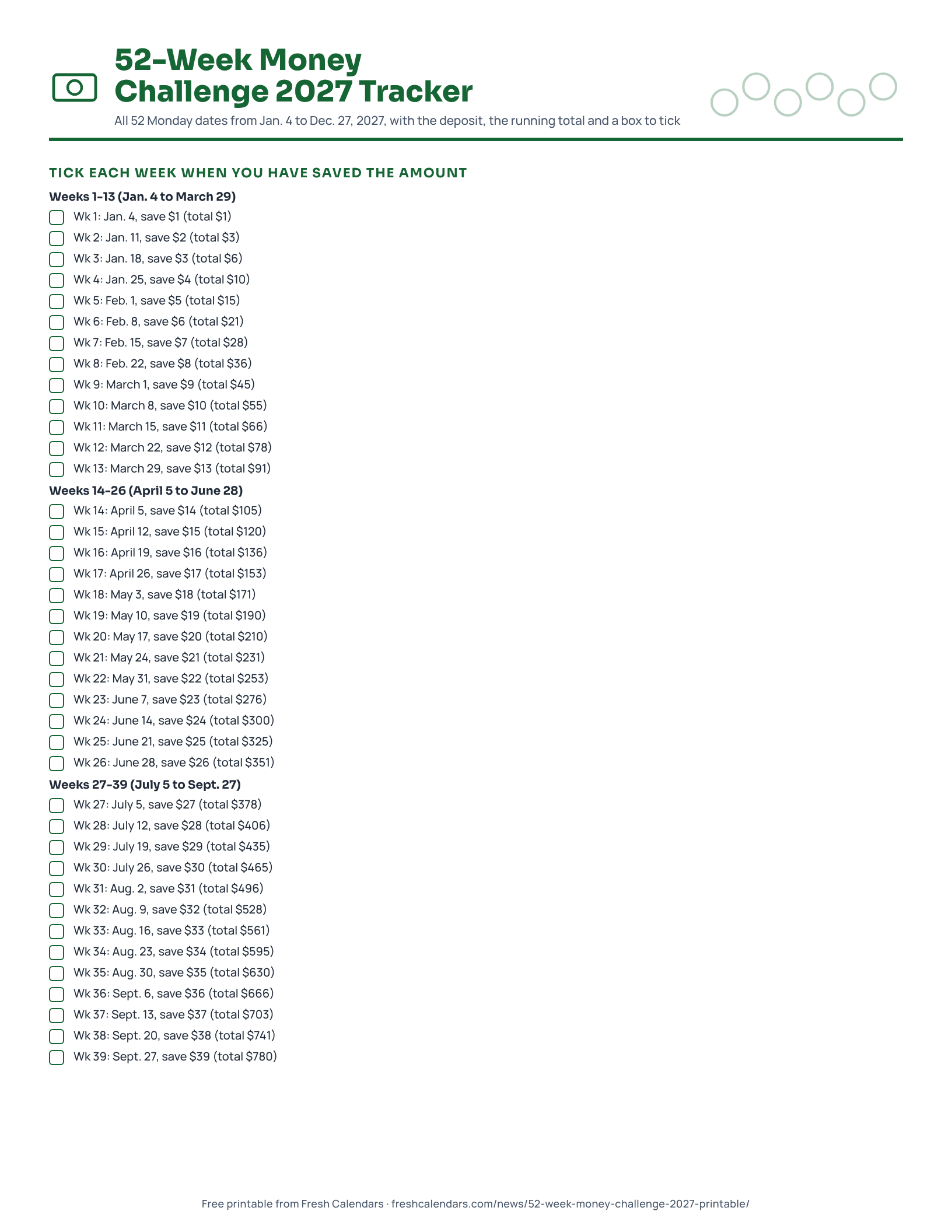
The printable tracker holds the classic column: 52 dated rows, each with the deposit, the running total and a tick box. The January printable calendars show where Jan. 4 falls.
How much do you save each quarter?
The classic order saves the most in the last 13 weeks. The reverse order saves the most in the first 13. The half version saves half of each classic amount, from $0.50 in week 1 to $26 in week 52, for $689 in all.
| Weeks | Dates | Classic | Reverse | Half |
|---|---|---|---|---|
| 1-13 | Jan. 4 to March 29 | $91 | $598 | $45.50 |
| 14-26 | April 5 to June 28 | $260 | $429 | $130 |
| 27-39 | July 5 to Sept. 27 | $429 | $260 | $214.50 |
| 40-52 | Oct. 4 to Dec. 27 | $598 | $91 | $299 |
| Year | Jan. 4 to Dec. 27 | $1,378 | $1,378 | $689 |
By the week of June 28 (week 26), the classic order has saved $351 and the reverse order $1,027.
How does the reverse 52-week challenge work?
The reverse challenge puts $52 in the week of Jan. 4, $51 in the week of Jan. 11 and ends with $1 in the week of Dec. 27. In January alone, weeks 1 to 4 add up to $202, against $10 for the classic order. If you expect December to cost more than January, the reverse order saves the large amounts first. The classic order suits a smaller start.
How much interest would the money earn?
The Federal Deposit Insurance Corporation (FDIC) publishes national average deposit rates. Its October 2026 table, last updated Oct. 19, 2026, lists these:
| Account type | National rate, October 2026 |
|---|---|
| Savings | 0.38% |
| Interest checking | 0.07% |
| Money market | 0.63% |
| 12-month certificate of deposit (CD) | 1.76% |
The FDIC says the money market rate represents an average of the $10,000 and $100,000 product tiers. These are national averages, and no bank is shown to pay them.
As a simple-interest illustration at 0.38%, with each deposit made on its Monday and held to Dec. 31, 2027, the classic order earns about $1.78 and the reverse order about $3.49. The reverse order earns more because its large deposits are held longer. Real accounts differ in rate, compounding and fees, so treat these as estimates.
Is the money insured?
The FDIC says deposit insurance “covers $250,000 per depositor, per FDIC-insured bank, for each account ownership category.” The National Credit Union Administration (NCUA) says “the $250,000 in coverage applies to each share owner, per insured credit union, for each account ownership category.” A challenge total of $1,378 sits well inside both limits.
TreasuryDirect lists a composite rate of 5.51% and a fixed rate of 1.40% for I bonds issued Nov. 1, 2026 to April 30, 2027. We left out the rules for holding I bonds; read them on TreasuryDirect before you buy.
Where does the challenge come from?
For tax dates and paycheck months beside it, see our 2027 monthly budget planner, the 2027 tax brackets and retirement limits and the year-end money deadlines.
Free printable downloads
Every template is free, needs no sign-up and prints on US Letter paper. Choose PDF for printing or PNG for screens and documents.
52-Week Money Challenge 2027 Tracker printables
-
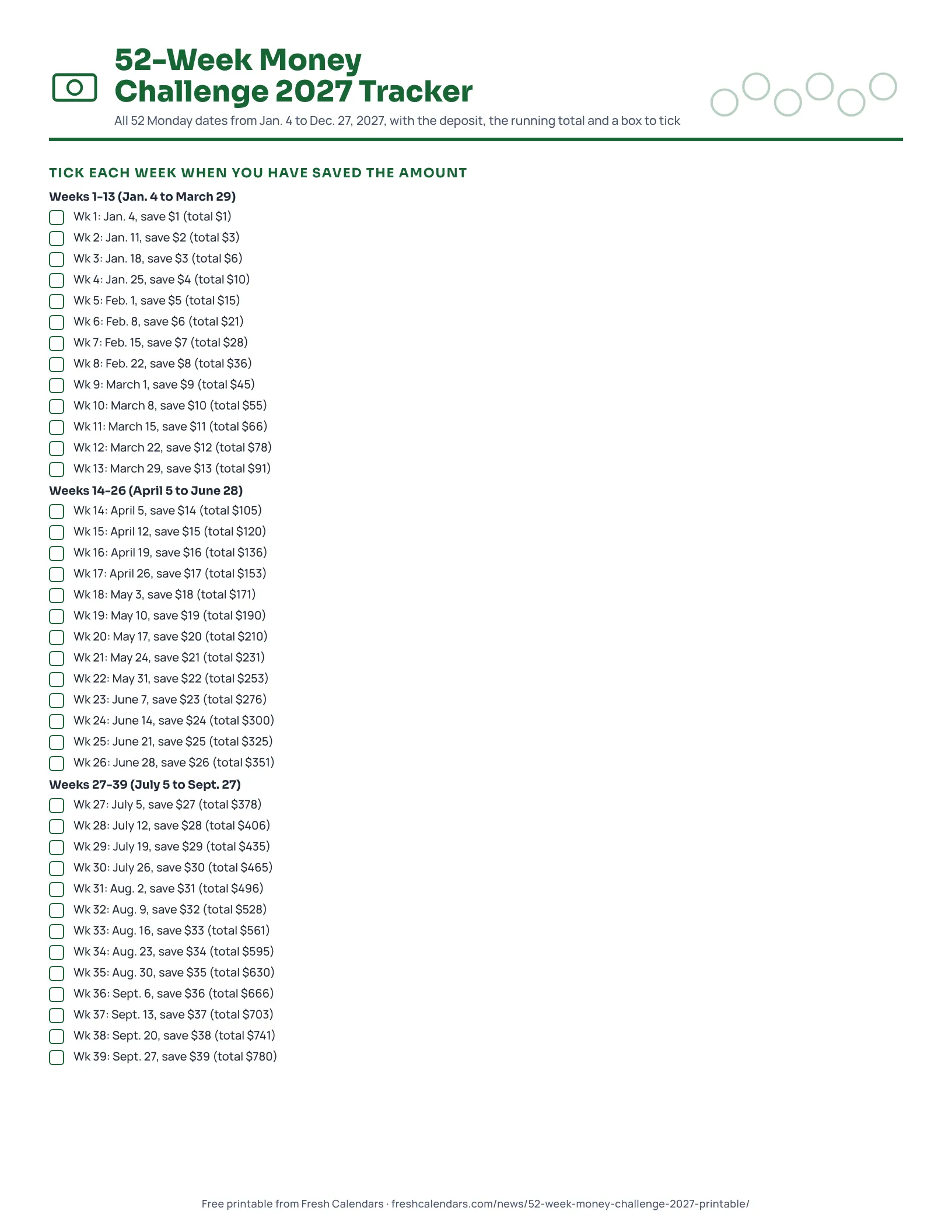
52-Week Money Challenge 2027 Tracker
A two-page 2027 tracker for the 52-week money challenge: every week's Monday date from Jan. 4 to Dec. 27, the deposit, the running total to $1,378 and a tick box.
Frequently asked questions
What if you start the 52-week challenge a week late?
Week 1 moves to Mon., Jan. 11, 2027 and week 52 to Mon., Jan. 3, 2028. The amounts stay the same, so the last $52 lands in the new year.
What if you miss a week?
Add the missed amount to a later week. The $1,378 total holds only when all 52 amounts are saved, in any order.
Do you have to deposit on Mondays?
No. The Monday date marks the week. Any day of that week counts for the tracker.
Is a savings account the only place to keep the money?
No. Interest checking, money market accounts and certificates of deposit appear in the FDIC's national rate table, and TreasuryDirect lists I bond rates. The challenge itself does not say where the money goes.
Sources
- National Rates and Rate Caps - October 2026 (Federal Deposit Insurance Corporation, 2026-10-19)
- Understanding Deposit Insurance (Federal Deposit Insurance Corporation, 2024-04-01)
- Your Insured Funds (National Credit Union Administration, 2024-10-29)
- I bonds interest rates (TreasuryDirect)
Related news




More in Money & Benefits
All Money & Benefits stories →- Federal Use-or-Lose Leave 2026: Schedule It by Saturday, Nov. 28
- Gift Tax Exclusion 2027: $20,000 per Person, Form 709 Due April 15
- Tricare Open Season 2026: Nov. 9 to Dec. 8, Changes Start Jan. 1
- SALT Deduction Cap 2026: $40,400, Phase-Out Above $505,000
- Senior Deduction 2026: $6,000 at Age 65, Phase-Out Table
Trending now
- Veterans Day Free Meals 2026: 101 Chains and a Printable List
- Closed for Veterans Day 2026: Post Offices Shut, Stocks Trade
- Spotify Wrapped 2026 Release Date: Not Announced, Past Dates
- Black Friday Ads 2026: Date Is Nov. 27, Walmart Deals Nov. 23-29
- Black Friday 2026 Canada: Nov. 27; Canadian Tire Deals From Nov. 5