
Arizona Propositions 2026: The 8 Measures on the Nov. 3 Ballot, What They Do, and Arizona's Early Voting Rules
Arizona's Nov. 3, 2026 ballot has eight propositions, all referred by the Legislature, plus governor and judicial retention. What each does, and key dates.
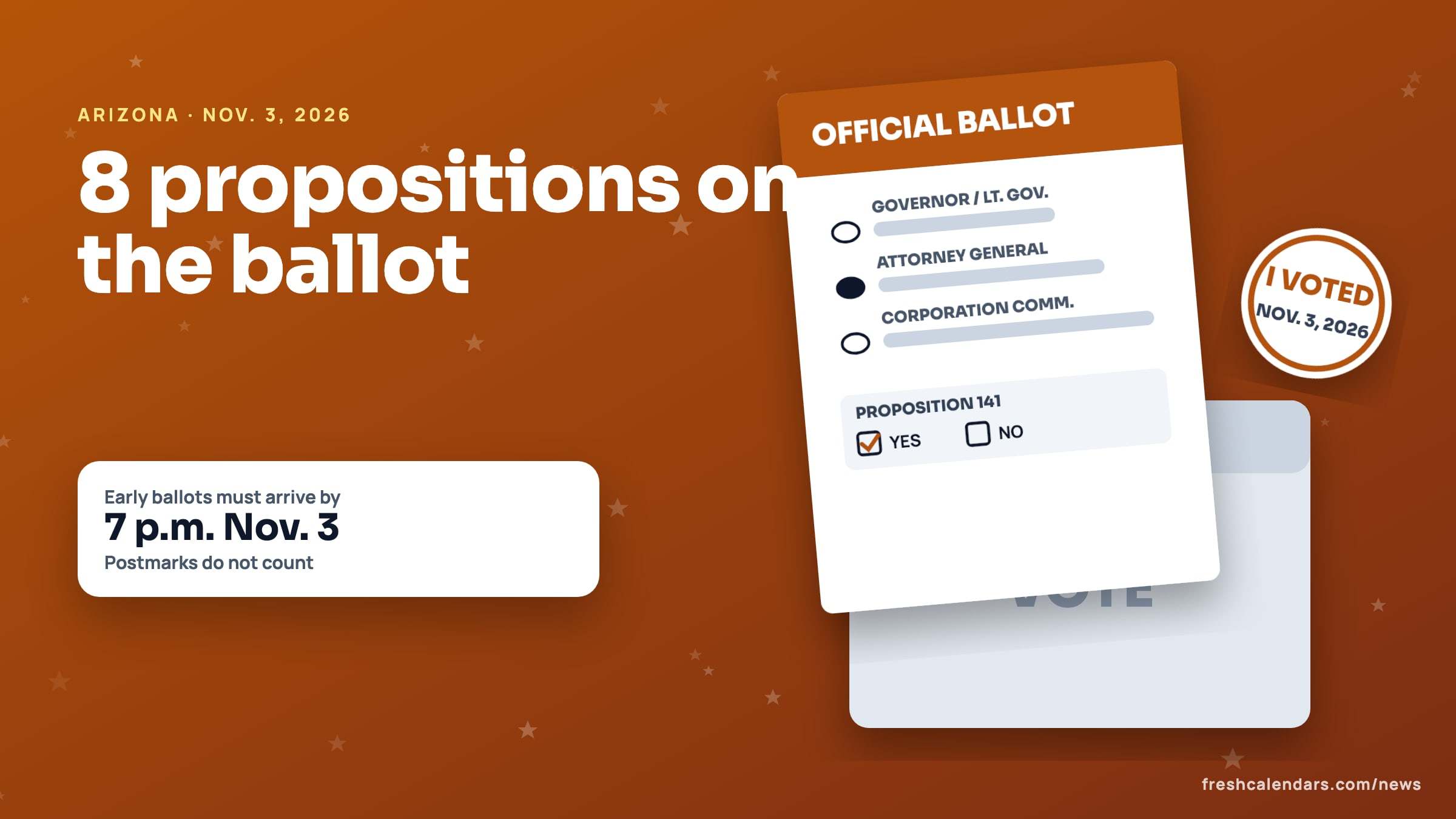
Arizona voters will decide eight statewide propositions on Tuesday, Nov. 3, 2026, all sent to the ballot by the Legislature. Three would amend the state constitution and five would change state law. No citizen initiative qualified this year, and courts struck two other legislative referrals over the summer, according to the Secretary of State’s final ballot language and reporting by Axios Phoenix.
The eight propositions
| Prop. | Type | What it would do |
|---|---|---|
| 141 | Constitutional amendment | Bar state and local governments from taxes or fees based on miles a vehicle travels, and limit monitoring of mileage without the owner’s consent |
| 142 | Constitutional amendment | Bar government bodies, including public schools and universities, from giving preferential treatment based on race or ethnicity, restricting certain diversity programs |
| 144 | Constitutional amendment | State that only citizens may register and vote, bar foreign contributions to influence elections, require government-issued ID to vote and guarantee tabulation at the voting location |
| 316 | Statute | Bar cities and towns from imposing or raising grocery taxes without voter approval, and cap the rate at 2% |
| 317 | Statute | Designate drug cartels as terrorist organizations under Arizona law |
| 318 | Statute | Require school restrooms, locker rooms and showers to be used according to the sex recorded at birth, and strengthen limits on transgender athletes on single-sex teams |
| 319 | Statute | Ban photo radar traffic enforcement by state and local governments; existing contracts could continue only with voter approval |
| 320 | Statute | Require school districts in the largest counties, or with at least 7,500 students, to spend at least 60% of operating budgets on direct instruction |
A yes vote enacts each change; a no vote leaves current law in place. Because the Legislature referred all eight, they cannot be vetoed by the governor, and a measure that passes can only be changed later under Arizona’s voter-protection rules. The official publicity pamphlet mailed to every household includes the full text, legislative analysis and arguments for and against.
Numbers that start with 1 are constitutional amendments; numbers in the 300s are statutes. The gaps in the numbering come from measures that were removed or did not qualify.
Statewide races
- Governor and lieutenant governor, elected for the first time as a joint ticket under a 2022 voter-approved change that created the lieutenant governor’s office.
- Secretary of state, attorney general, state treasurer, superintendent of public instruction and state mine inspector.
- Corporation Commission, two seats.
- Judicial retention: voters decide whether to keep Arizona Supreme Court justices, Court of Appeals judges and, in larger counties, Superior Court judges. The Commission on Judicial Performance Review publishes its evaluations online.
There is no U.S. Senate race in Arizona in 2026. All nine U.S. House seats and the Legislature are on the ballot. Your sample ballot from the county lists the certified candidates.
Key dates
| Date | What |
|---|---|
| Oct. 5 | Registration deadline (passed); Arizona has no same-day registration |
| Wed., Oct. 7 | Early voting began and early ballots were mailed |
| Fri., Oct. 23 | Last day to request an early ballot by mail |
| Fri., Oct. 30, 7 p.m. | End of in-person early voting |
| Tue., Nov. 3, 6 a.m.-7 p.m. | Election Day; early ballots must be received by 7 p.m. |
Arizona counts an early ballot only if it arrives by 7 p.m. on Election Day; a postmark is not enough. Mail it by about Oct. 27, or drop it off at a voting location or drop box. Sign the affidavit on the envelope, since the county checks that signature against your voter record and will contact you if it is missing or does not match. Arizona stays on Mountain Standard Time all year, so its 7 p.m. closing is 9 p.m. Eastern.
ID at the polls
Arizona requires identification to vote in person, in one of three ways: one valid photo ID with your name and address, such as an Arizona driver license, a non-operating ID or a tribal ID; two documents without a photo that show your name and address, such as a recent utility bill, a bank statement or a vehicle registration; or a photo ID plus one of those documents, for example a U.S. passport, which has no address, with a utility bill.
More election guides
California also has a long list of measures this year; see our guide to California’s 14 propositions. For every state’s rules, see mail ballot deadlines by state, and to look up your exact ballot by address, use our sample ballot guide. Print the Arizona checklist below and mark the dates on our October and November printable calendars or a weekly planner.
Free printable downloads
Every template is free, needs no sign-up and prints on US Letter paper. Choose PDF for printing or PNG for screens and documents.
Election 2026 printables
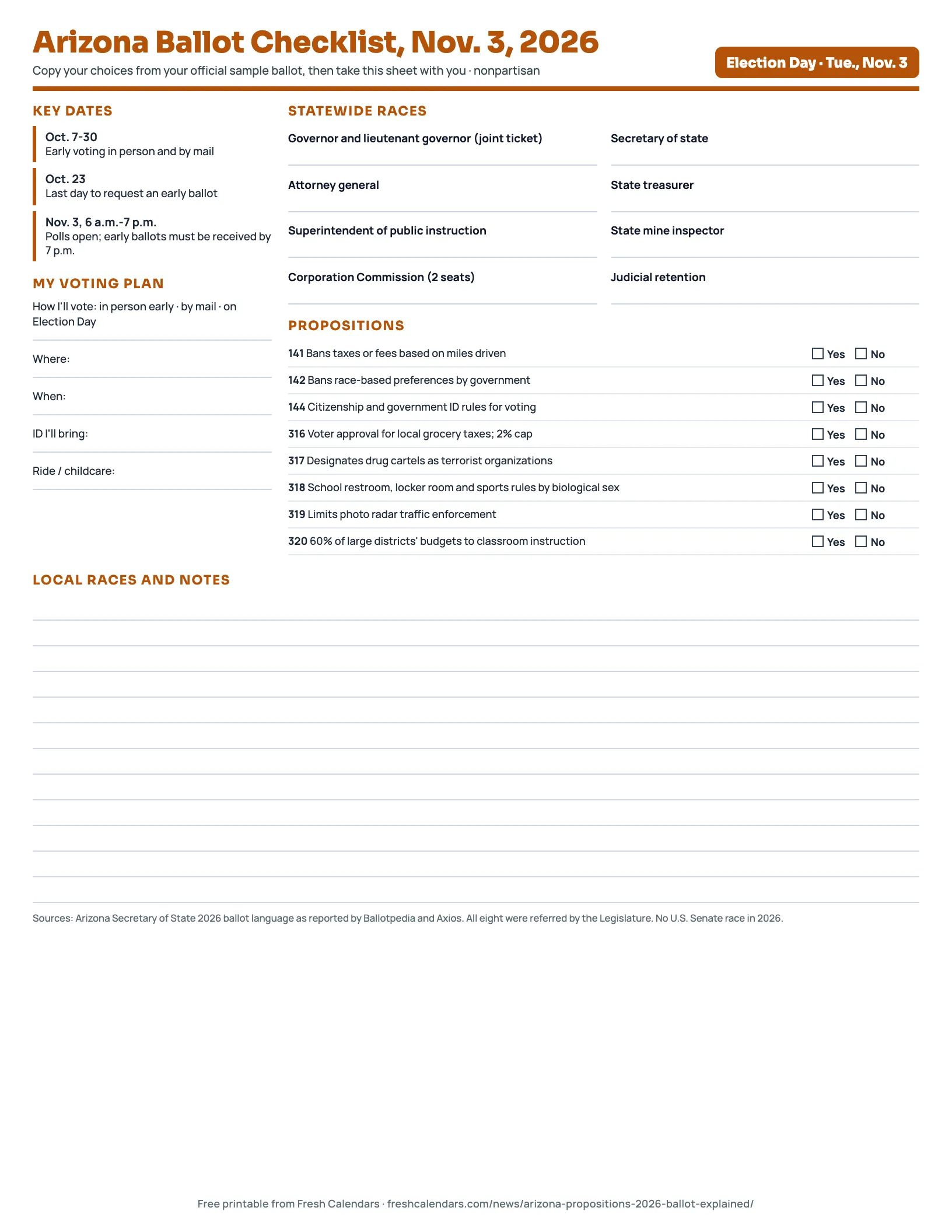
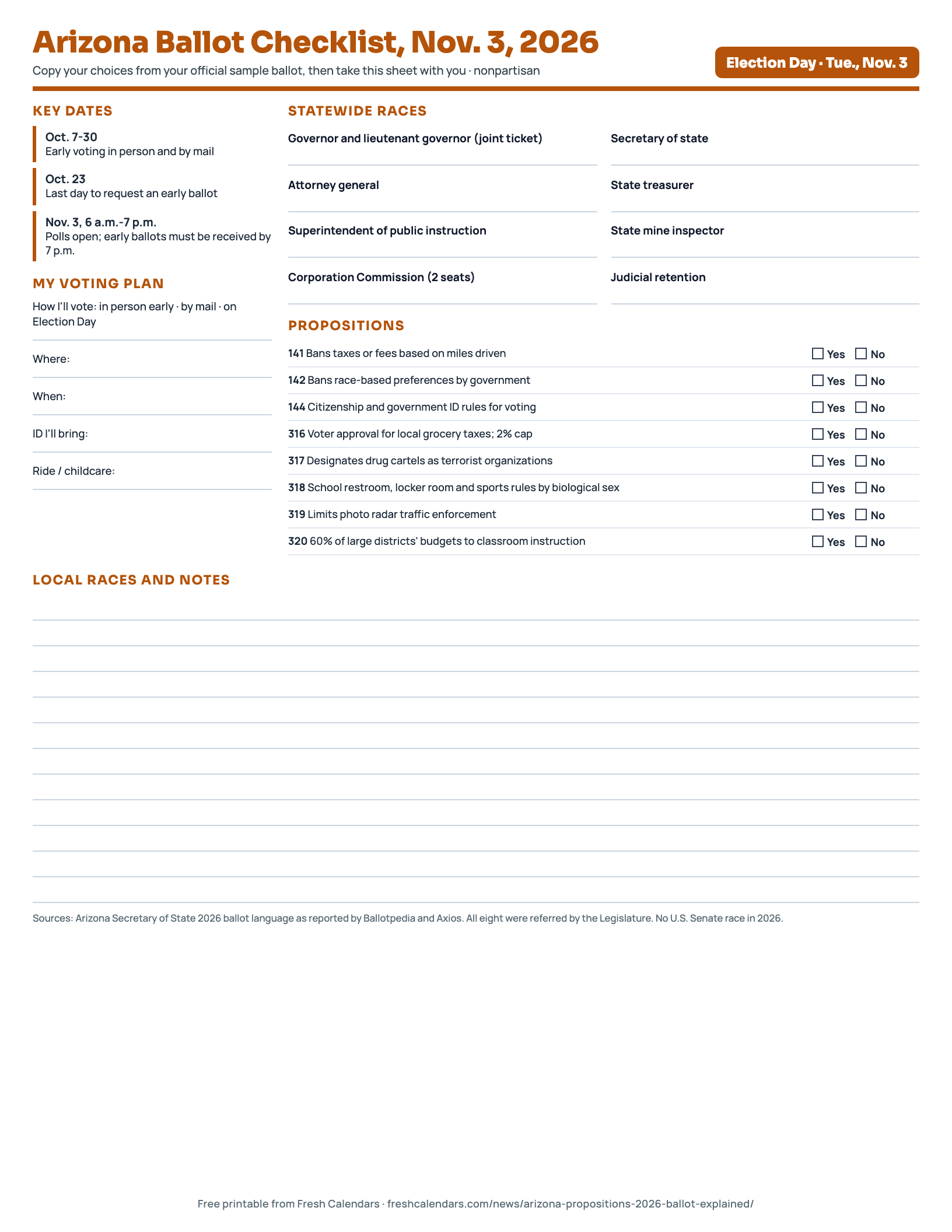
Arizona Ballot Checklist, Nov. 3, 2026
All eight propositions with yes and no boxes, the statewide races, early voting dates and a voting plan on one page.
Frequently asked questions
How many propositions are on the Arizona ballot in 2026?
Eight: Propositions 141, 142 and 144, which would amend the state constitution, and Propositions 316, 317, 318, 319 and 320, which would change state law. All were referred by the Legislature.
What is Prop 144 in Arizona?
A constitutional amendment that would state that only citizens may register and vote, bar foreign nationals from contributing to influence Arizona elections, require voters to provide government-issued identification to cast a ballot, and give voters a right to have their vote tabulated at their voting location.
Do Arizona propositions numbered in the 100s and 300s differ?
Yes. Numbers starting with 1 are constitutional amendments; numbers starting with 3 change state law. Measures referred by the Legislature cannot be vetoed by the governor.
Is there a U.S. Senate race in Arizona in 2026?
No. Arizona's Senate seats are next on the ballot in 2028 and 2030. The top race is governor, which this year is elected on a joint ticket with the new office of lieutenant governor.
When is my Arizona early ballot due?
It must be received by your county recorder or a drop-off location by 7 p.m. on Tuesday, Nov. 3. Mail it by about Oct. 27, or drop it off at a voting location or drop box on or before Election Day.
What ID do I need to vote in person in Arizona?
One valid photo ID with your name and address, such as an Arizona driver license or tribal ID; or two documents without a photo that show your name and address, such as a utility bill and a bank statement; or a mix of a photo ID and one such document.
Sources
- 2026 Ballot Language (final) (Arizona Secretary of State)
- The 8 ballot propositions to know for Arizona's election (Axios Phoenix)
- Eight Statewide Ballot Measures Set for Arizona's November Election (Arizona Medical Association)
- Arizona Voter Information (Arizona Secretary of State)
- Judicial Performance Review (Arizona Commission on Judicial Performance Review)
Related news
 California Propositions 2026: All 14 Measures on the Nov. 3 Ballot, What Yes and No Mean, and Key Dates
 Mail Ballot Deadlines 2026 by State: When Your Ballot Must Arrive, and Where a Nov. 3 Postmark Still Counts
 Sample Ballot by ZIP Code: How to See Your Nov. 3, 2026 Ballot, Plus a Texas Guide as Early Voting Opens