2026 Election Results and Certification Dates by State, With Sample Ballot Lookup
See where each state posts official election results, when the Nov. 3 vote is certified, any runoff dates, and how to look up your sample ballot.

Published Updated 13 min read

In this article
- Where to see official results and what comes next
- Find your sample ballot by ZIP code
- Why a ZIP code is not enough
- How to read your sample ballot
- Research the candidates
- Official sample ballot lookup in every state
- Polling place lookups and the Can I Vote tool
- Texas: results, certification and vote centers
- Early voting used the same ballot
- Bring your choices on paper
- State ballot guides
- Key dates
Voting has ended. Election Day was Tuesday, Nov. 3, 2026, and Texas early voting ran Oct. 19 to Oct. 30. This guide now covers where each state posts official results, when counties and states certify the count, which states hold a runoff, and how to look up your sample ballot for your records or a runoff.
Now that voting is over, the next steps are the official count and its certification. Each state election office posts returns on its own results page, then county and state boards canvass and certify the totals over the following weeks, and a few states hold a runoff when no candidate wins outright. The table below links the official results page for six states and gives the certification or canvass deadline and any runoff date, each taken from that state’s own election office. Further down, the sample ballot lookup stays available so you can still pull your ballot by ZIP code or address, for your records or for a runoff.
Where to see official results and what comes next
Each state election office runs its own results page. After Election Day, county boards canvass the returns and then the state certifies them, which is when the totals become official; a few states hold a runoff if no candidate reaches the required share of the vote. The table below covers six of the states in the lookup further down. Each entry comes from that state’s own election office, read on Nov. 5, 2026. Where a state’s official page does not give a date, the table says “not yet announced”; where a state holds no runoff for the general election, it says “none listed.”
| State | Official results page | Certification or canvass deadline | Runoff date |
|---|---|---|---|
| Texas | Texas Election Night Returns | Local canvass by Tuesday, Nov. 17; the Governor may begin the state canvass Saturday, Nov. 21 | Saturday, Dec. 12, 2026 (runoff elections) |
| Florida | Florida election results | Not yet announced | None listed |
| Louisiana | Louisiana Voter Portal results | Not yet announced | Not yet announced |
| Minnesota | Minnesota election results | State Canvassing Board certifies Thursday, Nov. 19 | None listed |
| North Carolina | North Carolina election results | Not yet announced | None listed |
| Washington | Washington election results | Not yet announced | None listed |
Early numbers on these pages are unofficial until the canvass is complete. For the full rules and the exact dates where you live, open your state’s official results page above or its election office in the lookup table further down.
Find your sample ballot by ZIP code
Voting for the general election is done, but you can still look up your sample ballot for your records or for a runoff. Enter your ZIP code to reach your state’s official lookup, then search by street address.
The finder matches the first three digits of your ZIP code to a state using Postal Service prefixes and points you to that state’s official lookup in the table below. It does not store or send your ZIP code anywhere. A handful of ZIP codes near state lines cross into a neighboring state; if the result looks wrong, pick your state in the table.
Why a ZIP code is not enough
ZIP codes are drawn by the Postal Service for delivering mail, and election districts are drawn separately, so one ZIP code can cross two congressional districts, several state legislative districts, different school boards and city limits. Two neighbors with the same ZIP code can have different ballots. That is why official lookups ask for your street address, or for your name and date of birth, to match you to your precinct; if a site asks only for a ZIP code, treat its ballot as a rough preview.
How to read your sample ballot
A sample ballot shows the same contests, in the same order, as the ballot you will vote on. Each race tells you how many choices you can make, such as one candidate for governor or more than one for a school board. Ballot measures, called propositions, amendments or questions depending on the state, are a yes-or-no choice, so read the measure’s own wording, not just its number.
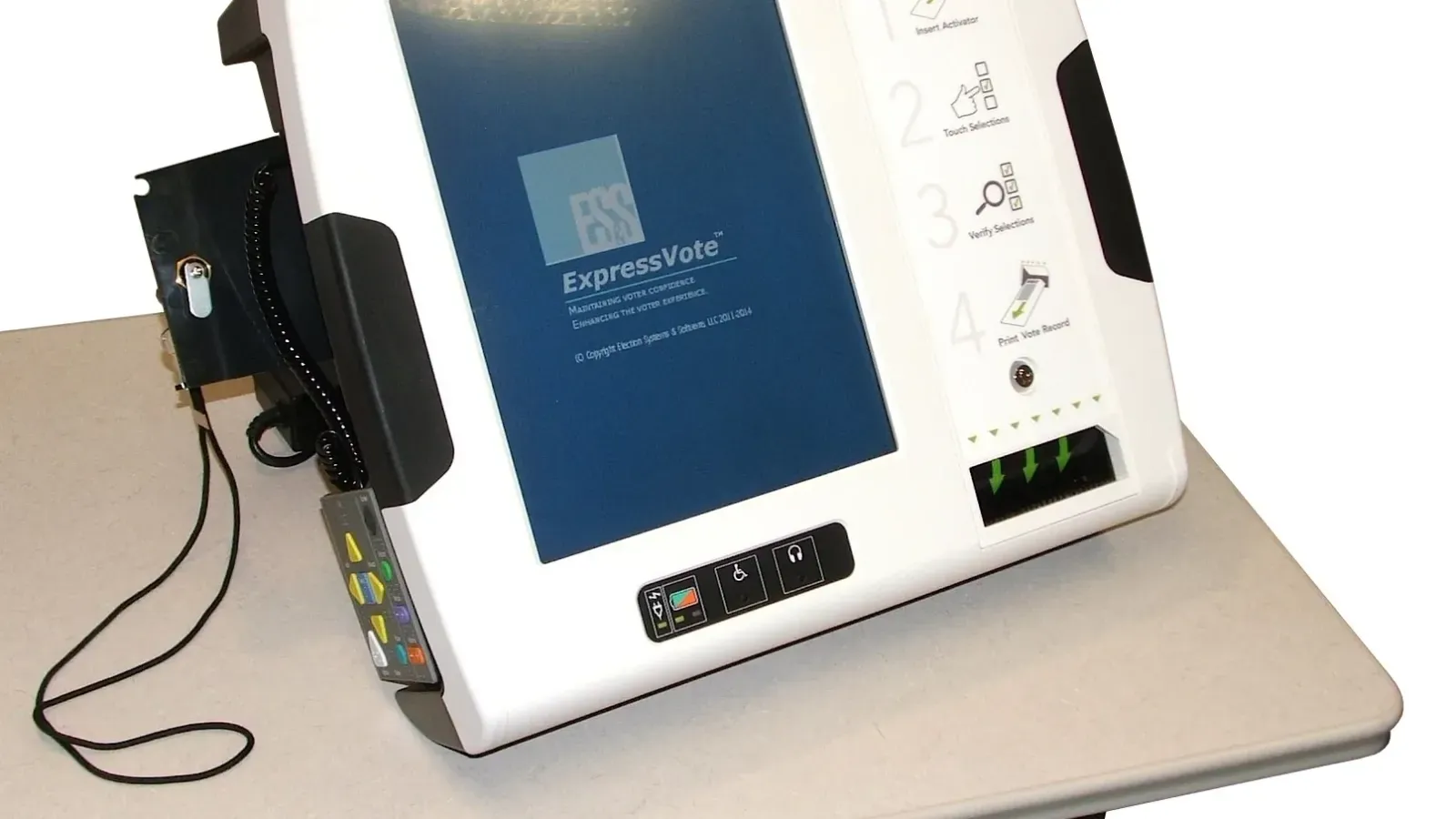
A touch-screen ballot-marking device of the kind many counties use; voters touch their choices, review them and print the record. Your sample ballot lists the same races in the same order. Photo: Douglas W. Jones, CC0, via Wikimedia Commons.

In Texas there is no straight-ticket option. The Legislature ended straight-party voting starting Sept. 1, 2020, so the Secretary of State tells voters who want to back one party’s candidates to select each one at a time. Plan every race on your sample ballot, from the top of the ticket to the local offices at the end.
Research the candidates
Start with the candidate list on your official sample ballot, then read what the candidates and measures say for themselves. VOTE411, run by the League of Women Voters Education Fund, collects candidates’ answers to the same questions, and Ballotpedia lists the candidates and measures for an address. Both are nonpartisan. For measures, your county or city usually publishes the full text with the sample ballot; read it before you vote, because the summary on the ballot is short.
Official sample ballot lookup in every state
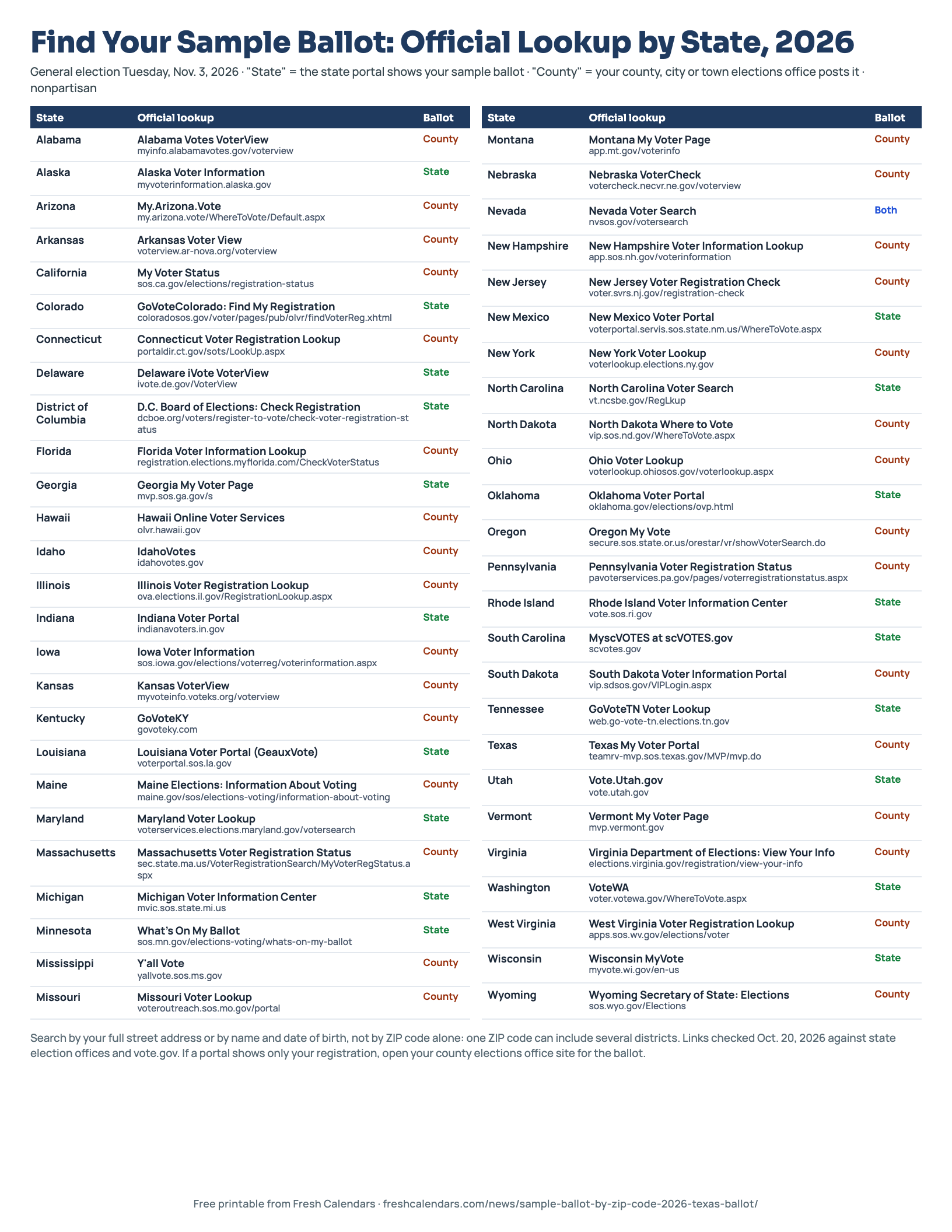
Each state’s election office runs a voter lookup. In 18 states and Washington, D.C., that portal shows a personalized sample ballot; elsewhere it shows your registration and polling place, and your county, city or town elections office posts the ballot. Nevada does both. Links were checked on Oct. 20, 2026, against each state election office and Vote.gov; some portals block automated checks but open normally in a browser.
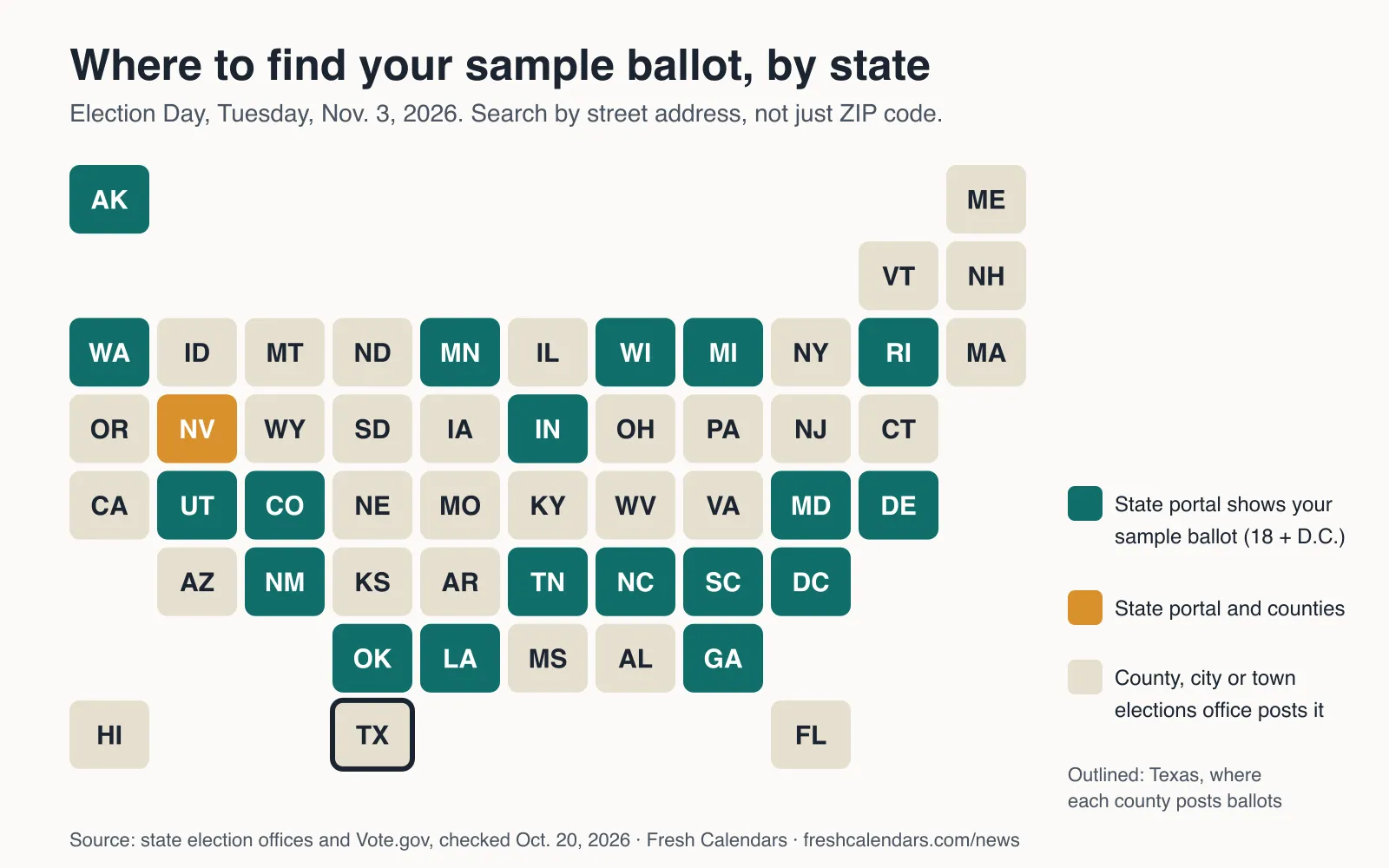
Teal states show a personalized sample ballot on the state portal; in the rest, search your county, city or town elections office. Chart: Fresh Calendars, from the table below.
| State | Official lookup | Sample ballots from |
|---|---|---|
| Alabama | Alabama Votes VoterView | County or local office |
| Alaska | Alaska Voter Information | State portal |
| Arizona | My.Arizona.Vote | County or local office |
| Arkansas | Arkansas Voter View | County or local office |
| California | My Voter Status | County or local office |
| Colorado | GoVoteColorado: Find My Registration | State portal |
| Connecticut | Connecticut Voter Registration Lookup | County or local office |
| Delaware | Delaware iVote VoterView | State portal |
| District of Columbia | D.C. Board of Elections: Check Registration | State portal |
| Florida | Florida Voter Information Lookup | County or local office |
| Georgia | Georgia My Voter Page | State portal |
| Hawaii | Hawaii Online Voter Services | County or local office |
| Idaho | IdahoVotes | County or local office |
| Illinois | Illinois Voter Registration Lookup | County or local office |
| Indiana | Indiana Voter Portal | State portal |
| Iowa | Iowa Voter Information | County or local office |
| Kansas | Kansas VoterView | County or local office |
| Kentucky | GoVoteKY | County or local office |
| Louisiana | Louisiana Voter Portal (GeauxVote); races in our Louisiana sample ballot guide | State portal |
| Maine | Maine Elections: Information About Voting | County or local office |
| Maryland | Maryland Voter Lookup | State portal |
| Massachusetts | Massachusetts Voter Registration Status | County or local office |
| Michigan | Michigan Voter Information Center | State portal |
| Minnesota | What’s On My Ballot | State portal |
| Mississippi | Y’all Vote | County or local office |
| Missouri | Missouri Voter Lookup | County or local office |
| Montana | Montana My Voter Page | County or local office |
| Nebraska | Nebraska VoterCheck | County or local office |
| Nevada | Nevada Voter Search | State portal and counties |
| New Hampshire | New Hampshire Voter Information Lookup | County or local office |
| New Jersey | New Jersey Voter Registration Check; races in our New Jersey sample ballot guide | County or local office |
| New Mexico | New Mexico Voter Portal | State portal |
| New York | New York Voter Lookup; races in our New York ballot guide | County or local office |
| North Carolina | North Carolina Voter Search; races in our North Carolina sample ballot guide | State portal |
| North Dakota | North Dakota Where to Vote | County or local office |
| Ohio | Ohio Voter Lookup; races in our Ohio sample ballot guide | County or local office |
| Oklahoma | Oklahoma Voter Portal | State portal |
| Oregon | Oregon My Vote | County or local office |
| Pennsylvania | Pennsylvania Voter Registration Status | County or local office |
| Rhode Island | Rhode Island Voter Information Center | State portal |
| South Carolina | MyscVOTES at scVOTES.gov | State portal |
| South Dakota | South Dakota Voter Information Portal | County or local office |
| Tennessee | GoVoteTN Voter Lookup | State portal |
| Texas | Texas My Voter Portal | County or local office |
| Utah | Vote.Utah.gov | State portal |
| Vermont | Vermont My Voter Page | County or local office |
| Virginia | Virginia Department of Elections: View Your Info | County or local office |
| Washington | VoteWA | State portal |
| West Virginia | West Virginia Voter Registration Lookup | County or local office |
| Wisconsin | Wisconsin MyVote | State portal |
| Wyoming | Wyoming Secretary of State: Elections | County or local office |
If your state portal shows only your registration, search for your county name plus “elections.” Nonpartisan guides such as VOTE411, run by the League of Women Voters Education Fund, and Ballotpedia’s sample ballot lookup also build a ballot from your address. If an official sample ballot and a third-party guide disagree, the official version is the one that counts.
Polling place lookups and the Can I Vote tool
Most state portals in the table above also show your polling place next to your registration. Four states run a separate official polling-place page, confirmed Oct. 28, 2026, and you can use them again for a runoff or a later election:
| State | Official polling-place lookup | What the page says |
|---|---|---|
| California | My Voter Status, California Secretary of State | Lists “Find your polling place.” |
| Pennsylvania | Polling Place Information, Pennsylvania Department of State | “The Polling Place Search tool will help you locate a polling place for Election day.” |
| North Carolina | Election Day Polling Place Search, North Carolina State Board of Elections | Search by address or precinct. |
| Virginia | Virginia Voter Information Citizen Portal, Virginia Department of Elections | Lets you view your polling place. |
For any other state, the National Association of Secretaries of State (NASS) runs the Can I Vote page; canivote.org redirects there. NASS says the tool “links directly to state election websites and trusted resources” and “does not capture any information.” On its polling place page, you “select your place of residence in the drop down menu.” Many states offer an online lookup for your voting site there, and others list contact details for local election officials. Early voting sites can differ from Election Day sites, so check which kind your lookup shows.
Texas: results, certification and vote centers
Texas sample ballots are posted by counties, and the state’s My Voter Portal shows your registration and polling places once you enter your name, county, date of birth and ZIP code. For the 12 most populous counties, the official elections offices are:
Texas went into Nov. 3 with a record 19,041,684 registered voters, the Secretary of State said on Oct. 16, 2026. More than 4.2 million Texans voted in the first six days of early voting, through Saturday, Oct. 24, about 22 percent of registered voters, according to an Oct. 26 release. For the Nov. 3 election, 103 counties were approved to run the Countywide Polling Place Program, which let voters cast a ballot at any vote center in the county; in counties that were not in the program, voters went to an assigned polling place. Polls were open 7 a.m. to 7 p.m. statewide, the Secretary of State confirmed on Oct. 27. Under the state’s November 3, 2026 Election Law Calendar, each political subdivision had until Tuesday, Nov. 17 to finish its official canvass, and the Governor may begin the state canvass of state and county races on Saturday, Nov. 21; the Secretary of State set Saturday, Dec. 12 as the date for runoff elections. The table below lists each county’s year in the program (the first year it was approved) from the state’s list.
| County | Elections office | Vote at any vote center on Nov. 3? |
|---|---|---|
| Harris | HarrisVotes.com sample ballots | Yes (since 2019) |
| Dallas | Dallas County Elections | Yes (2019) |
| Tarrant | Tarrant County Elections | Yes (2019) |
| Bexar | Bexar County Elections Department | Yes (2019) |
| Travis | VoteTravis.gov | Yes (2012) |
| Collin | Collin County Elections | Yes (2013) |
| Denton | Denton County Elections | Not on the state’s Nov. 3 list; check the county |
| Fort Bend | Fort Bend County Elections and Voter Registration | Yes (2016) |
| El Paso | El Paso County Elections | Yes (2021) |
| Hidalgo | Hidalgo County Elections Department | Yes (2018) |
| Williamson | Williamson County Elections | Yes (2014) |
| Montgomery | Montgomery County Elections | Not on the state’s Nov. 3 list; check your assigned polling place |
Your precinct. Your precinct number is printed next to your year of birth on your voter registration certificate, according to VoteTexas.gov, and My Voter Portal lists your early voting and Election Day polling places. Your county’s sample ballot is matched to that precinct.
Dates. Early voting ran Oct. 19 to Oct. 30; during it, voters could use any early voting location in their county of registration. The deadline for a mail ballot application to arrive was Friday, Oct. 23. A mailed ballot counted if it arrived by 7 p.m. on Nov. 3, or if it was postmarked by 7 p.m. that day and arrived by 5 p.m. on Wednesday, Nov. 4. On Election Day, polls were open 7 a.m. to 7 p.m. Counties in the state’s Countywide Polling Place Program let voters use any vote center in the county; in other counties voters went to their assigned precinct.
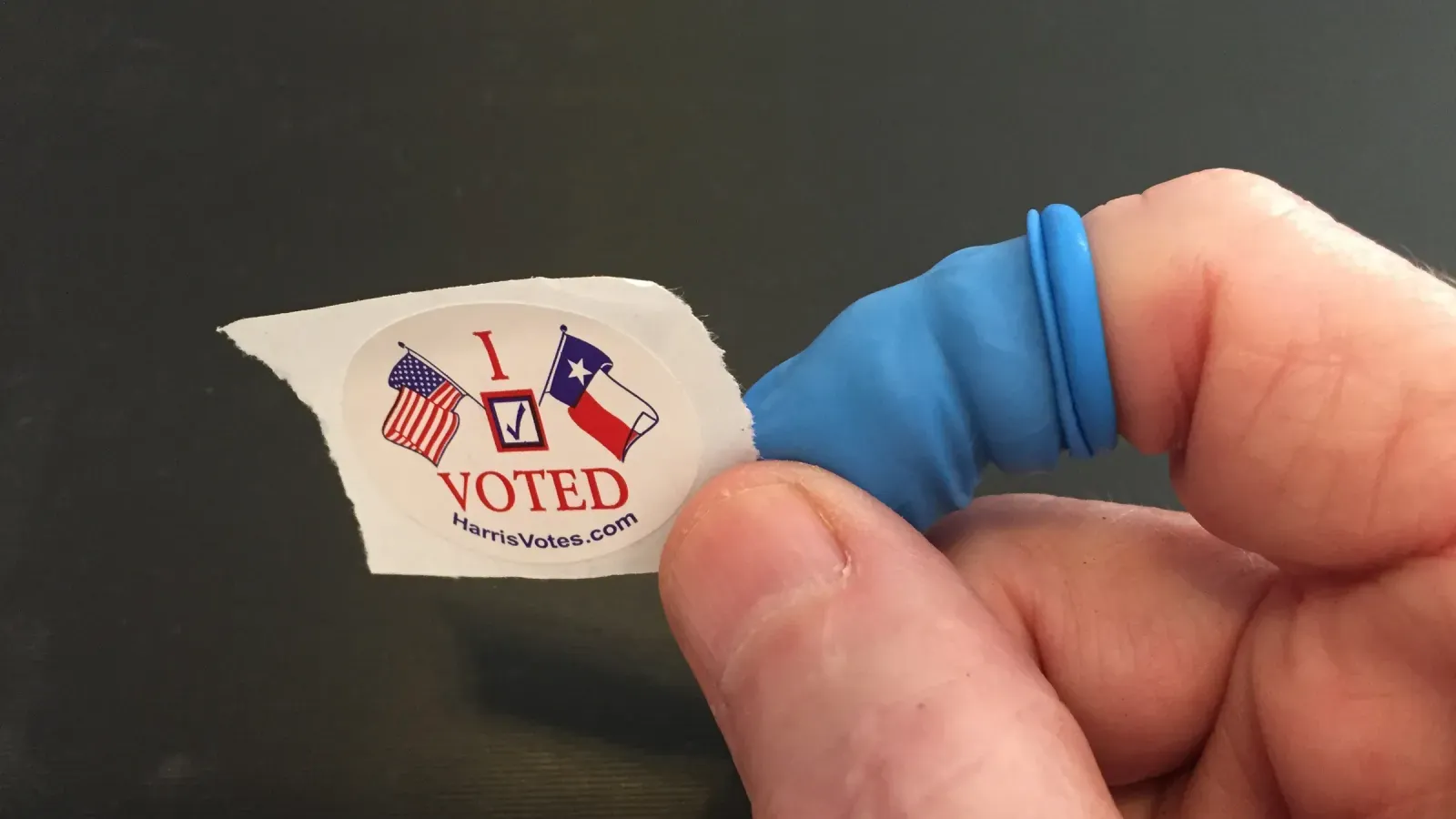
A Harris County “I Voted” sticker after early voting in July 2020 (file photo). Harris County posts its sample ballots at HarrisVotes.com. Photo: Patrick Feller, CC BY 2.0, via Wikimedia Commons.

What is on the ballot. Texas voted this year for governor and other statewide executive offices, a U.S. Senate seat, all 38 U.S. House seats, the Texas Legislature, judges and local offices. Every certified statewide candidate is in our Texas ballot 2026 guide. Your county sample ballot adds any city, county or school district measures for your address.
ID. You need one of seven photo IDs: a Texas driver license, Texas Election Identification Certificate, Texas personal ID card or Texas handgun license (all from the Department of Public Safety), a U.S. military ID with a photo, a U.S. citizenship certificate with a photo, or a U.S. passport. For voters 18 to 69, the ID may be expired by up to four years; for voters 70 and older, any expired but otherwise valid ID is accepted. If you do not have one and cannot reasonably get one, you can sign a Reasonable Impediment Declaration and show a supporting document such as a utility bill or bank statement.
Your notes and phone. “Voters may bring printed notes or a paper sample ballot to help them make their selections,” the Secretary of State said in an Oct. 16 release. Texas law does not allow wireless devices such as phones, tablets or laptops to be used in the room where voting takes place, the Secretary of State says. Phones can be used outside that room as long as they are not recording. So if you plan your choices on a sample ballot app, write or print them first.
Early voting used the same ballot
The ballot at an early voting site was the same ballot style as your precinct’s on Election Day, so the sample ballot you look up matches what was on the Nov. 3 ballot. Early voting dates differed by state: Texas ran through Oct. 30, while Michigan’s statewide minimum period was Oct. 24 to Nov. 1. Our mail ballot deadline list covers the states that vote mostly by mail.
Bring your choices on paper
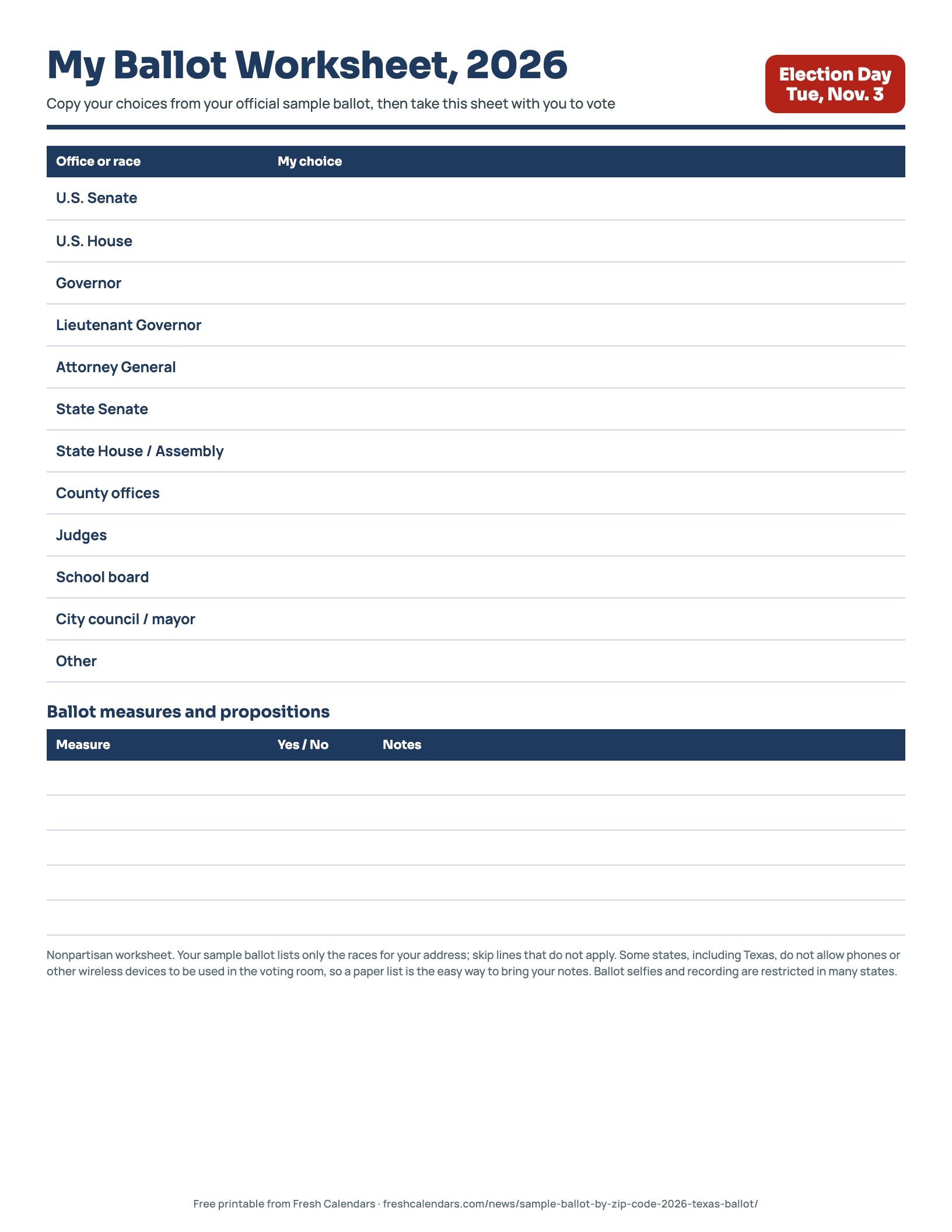
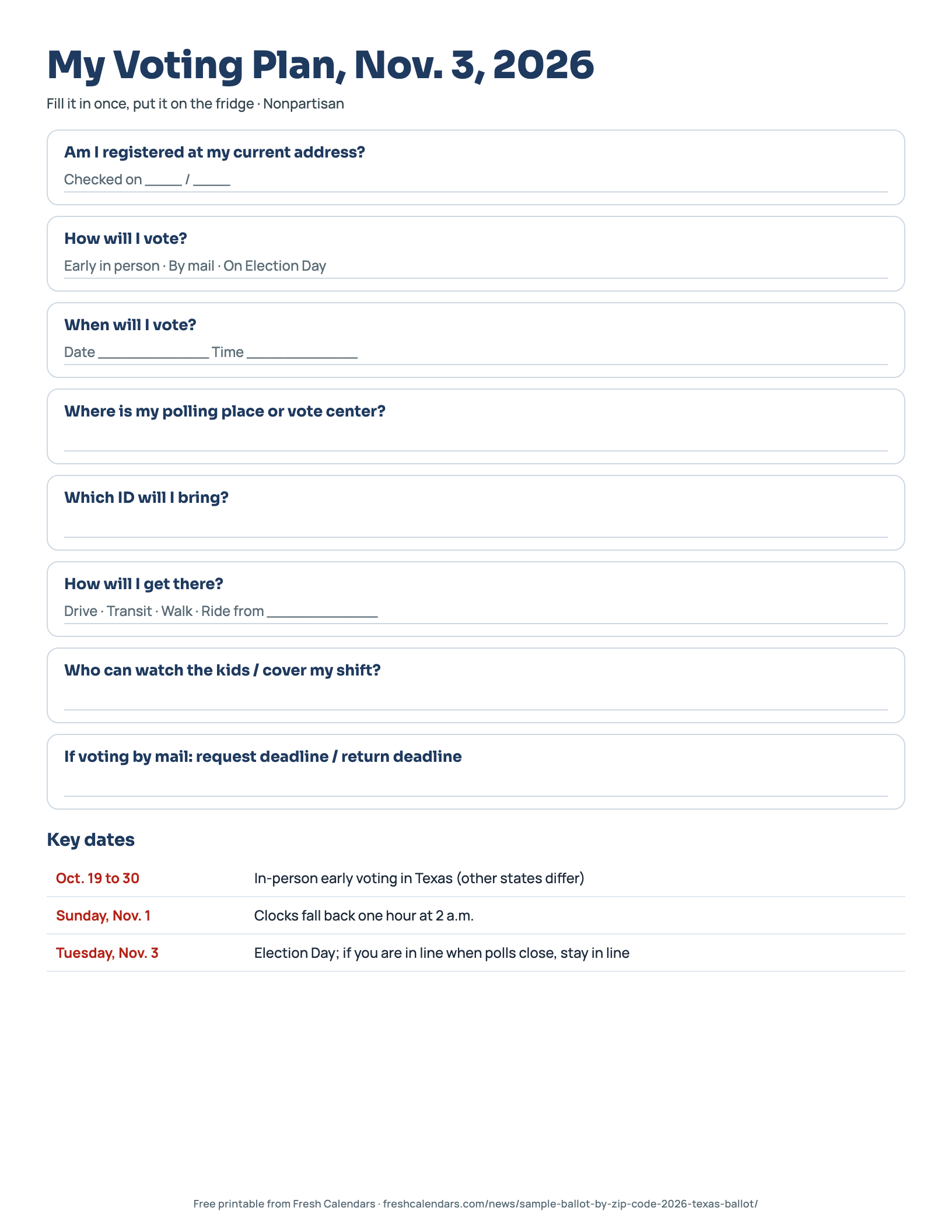
Our free ballot worksheet has a line for each common office and five lines for ballot measures. Copy your picks from the official sample ballot and take the sheet with you; that works in Texas and in states that are just as strict about phones. The one-page state lookup sheet puts every official portal on paper, and the voting plan covers the rest: when and where you will vote, the ID you will bring and how you will get there.
Our voter registration deadline report lists the deadlines that have passed and the states that still allow same-day registration. Clocks fell back on Sunday, Nov. 1, two days before the election; the daylight saving time story has the details.
State ballot guides
For Texas candidates, see our Texas ballot guide. For what is on the ballot in other large states, with free printable checklists, see our guides to California’s 14 propositions, Florida’s amendments and Senate special, Georgia, Michigan, New York, New Jersey, North Carolina, Ohio, Louisiana, Pennsylvania and Arizona’s eight propositions. For every state, check poll closing times and mail ballot deadlines, see whether Election Day is a holiday where you work, and follow the results with our 2026 midterm tracker.
Key dates
| Date | What happens |
|---|---|
| Friday, Oct. 23 | Texas: last day for a mail ballot application to arrive (passed) |
| Saturday, Oct. 24 | Early voting opens statewide in Michigan (passed) |
| Friday, Oct. 30 | Last day of early voting in Texas (passed) |
| Sunday, Nov. 1 | Clocks fell back one hour at 2 a.m. (passed) |
| Tuesday, Nov. 3 | Election Day (passed); Texas polls were open 7 a.m. to 7 p.m. |
| Wednesday, Nov. 4, 5 p.m. | Texas: last arrival for a mailed ballot postmarked by Nov. 3 (passed) |
| Tuesday, Nov. 17 | Texas: last day for the county canvass of returns |
| Thursday, Nov. 19 | Minnesota: State Canvassing Board certifies results |
| Saturday, Nov. 21 | Texas: Governor may begin the state canvass |
| Saturday, Dec. 12 | Texas: date set for runoff elections |
Keep the canvass and any runoff circled on the November 2026 calendar, and map the weeks ahead on a weekly planner; the October 2026 calendar shows the early voting weeks that have ended. If you are ever in line when polls close, stay in line: you can still vote.
Free printable downloads
Every template is free, needs no sign-up and prints on US Letter paper. Choose PDF for printing or PNG for screens and documents.
Election 2026 printables
-
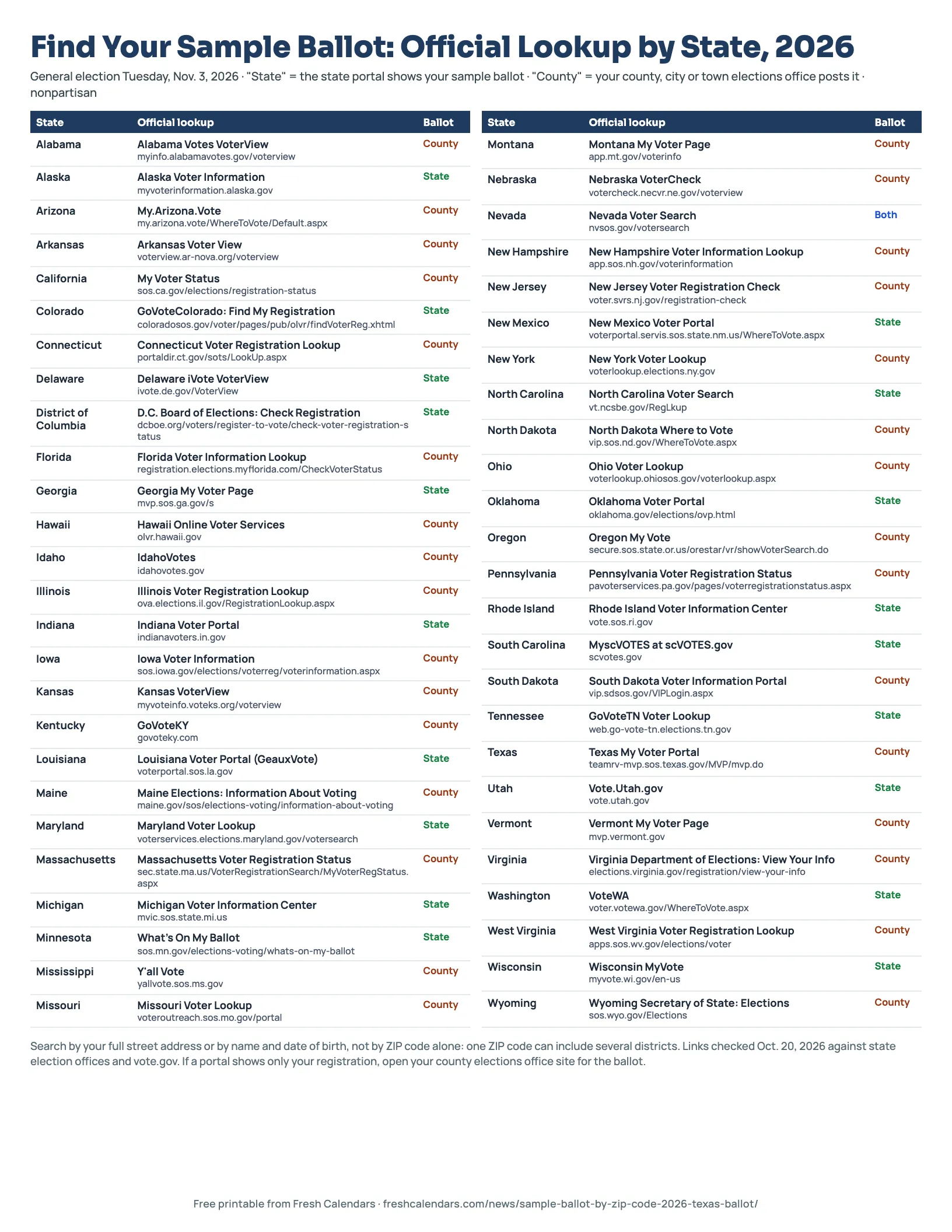
Find Your Sample Ballot: Official Lookup by State, 2026
All 50 states and D.C. on one page: the official voter lookup, its web address and whether the state or your county posts the sample ballot.
-
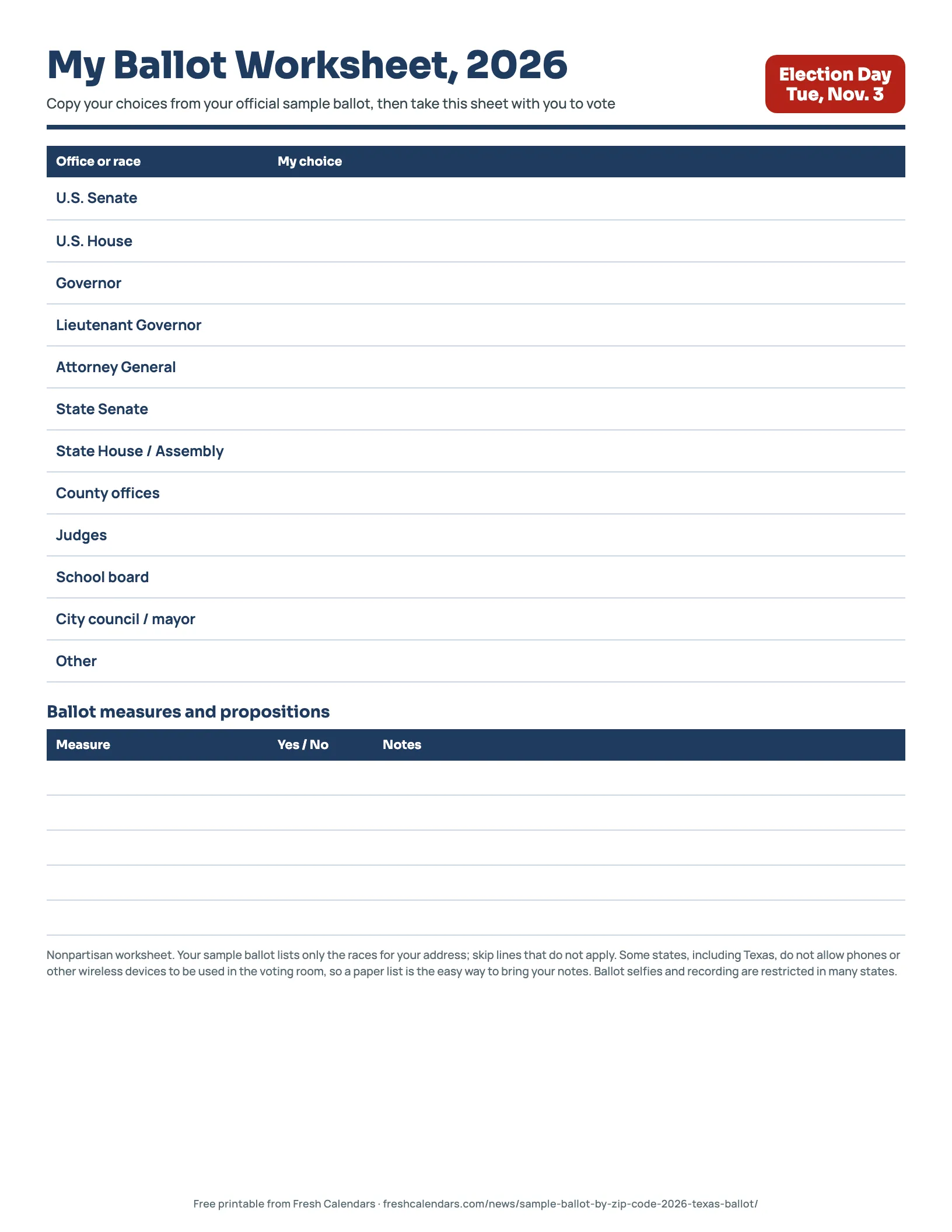
My Ballot Worksheet: Printable Sample Ballot Sheet, 2026
A blank, nonpartisan sheet to copy your choices from your official sample ballot and take with you to vote.
-
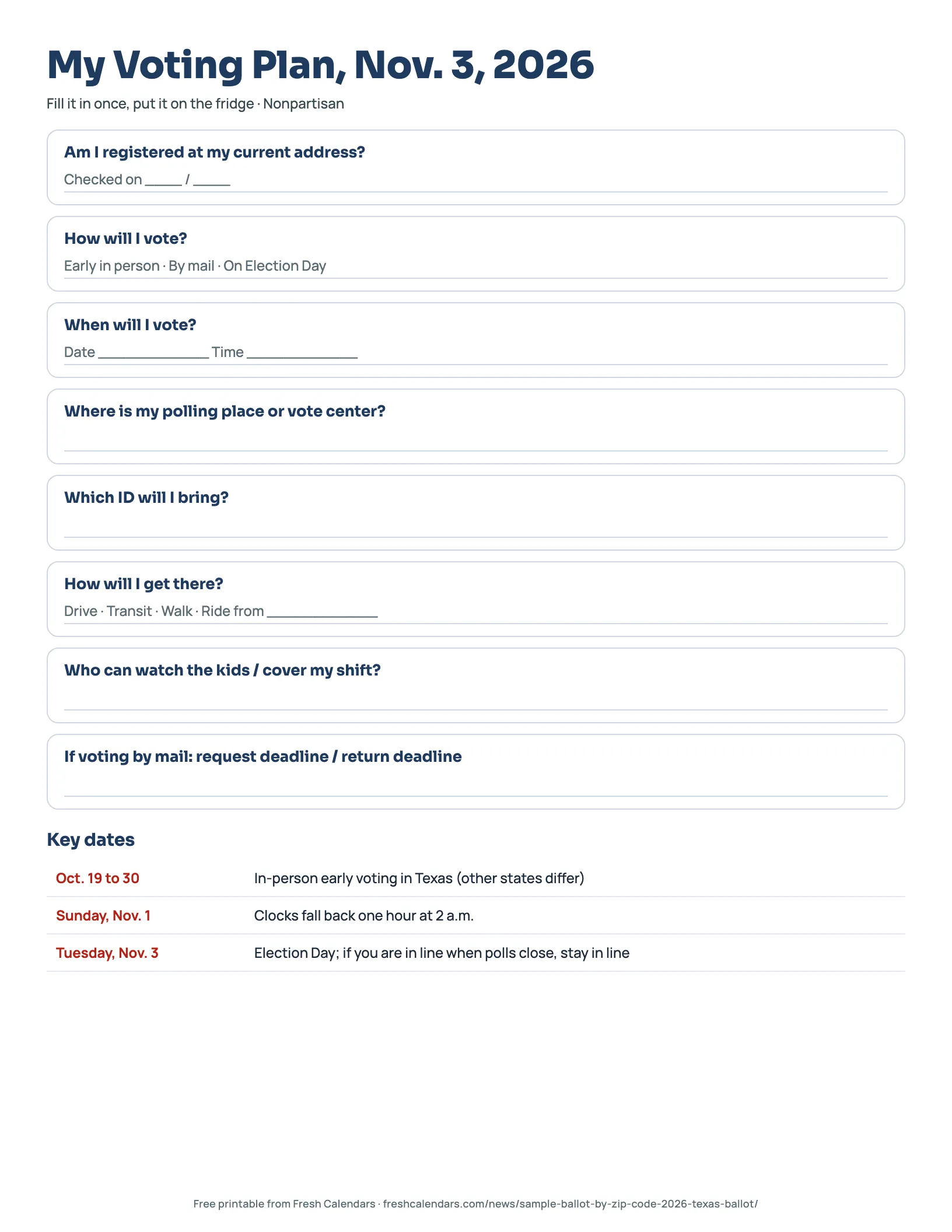
My Voting Plan, Nov. 3, 2026
Fill in when, where and how you will vote, the ID you will bring and how you will get there, with key dates.
Frequently asked questions
Where can I see the official 2026 election results?
On your state election office's own results page. The table near the top of this story links the official results page for Texas, Florida, Louisiana, Minnesota, North Carolina and Washington. Each state's county and state boards then certify the totals over the following weeks, so early numbers are unofficial until that canvass.
How do I find my sample ballot by ZIP code?
Enter your ZIP code in the finder in the sample ballot lookup section below to get your state's official lookup, then search there by full street address or by name and date of birth. A ZIP code tells you the state, but only your address tells the county which precinct ballot you get.
Where is the sample ballot for my ZIP code?
Type your ZIP code into the finder in the lookup section below. It points you to your state's official lookup, where you enter your address to see and print the sample ballot for your precinct.
Why doesn't my ZIP code show one ballot?
ZIP codes are drawn for mail delivery, not elections. A single ZIP code can include parts of different congressional, state legislative, city, school and judicial districts, so neighbors can have different ballots.
How do I read a sample ballot?
Go race by race from the top. Each race says how many choices you can make, and ballot measures are yes-or-no questions. Read each measure's own wording. In Texas there is no straight-ticket option, so you choose a candidate in each race.
How do I find my voting precinct in Texas?
Your precinct number is printed next to your year of birth on your voter registration certificate. The Secretary of State's My Voter Portal lists your polling places once you enter your name, county, date of birth and ZIP code.
Can I print my sample ballot?
Yes. Most county sample ballots are PDFs you can print. You can also copy your choices onto our free My Ballot Worksheet, a one-page printable with lines for each office and ballot measure.
Is the sample ballot the same for early voting and Election Day?
Yes. Early voting used the same ballot style as Election Day for your precinct, so the sample ballot matched what was on the ballot on Nov. 3. If a race goes to a runoff, look up the sample ballot again for that date.
Where is my Texas sample ballot?
On your county elections office website. Harris County lists it at HarrisVotes.com, and Dallas, Tarrant, Bexar, Travis and other large counties have their own lookups; the table in this story links 12 of them. The Texas Secretary of State's My Voter Portal shows your registration and polling places.
When was early voting in Texas for November 2026?
Monday, Oct. 19 through Friday, Oct. 30, 2026, and it has ended. Early voters could use any early voting location in their county of registration. On Election Day, Tuesday, Nov. 3, polls were open 7 a.m. to 7 p.m.
Can I bring my sample ballot into the voting booth in Texas?
Yes. The Texas Secretary of State says voters may bring printed notes or a paper sample ballot to help them make their selections. You cannot use a phone, tablet or other wireless device in the room where voting takes place, so print or write your choices first.
Do I have to vote at my precinct on Election Day in Texas?
It depended on your county. For the Nov. 3 election, 103 counties were approved for the Countywide Polling Place Program, including Harris, Dallas, Tarrant, Bexar and Travis, so voters could use any vote center in the county. In other counties voters went to an assigned polling place. The Secretary of State's My Voter Portal lists polling places for any future election.
What ID do I need to vote in Texas?
One of seven photo IDs, including a Texas driver license, Texas Election Identification Certificate, Texas ID card, handgun license, U.S. military ID, U.S. citizenship certificate or U.S. passport. Voters who cannot reasonably obtain one may sign a Reasonable Impediment Declaration and show a supporting document such as a utility bill.
Sources
- HB 25 (2017): Elimination of Straight-Party Voting (Election Advisory No. 2020-29) (Texas Secretary of State)
- Frequently Asked Questions (Texas Secretary of State (VoteTexas.gov))
- Where to Vote (Texas Secretary of State (VoteTexas.gov))
- Identification Requirements for Voting (Texas Secretary of State (VoteTexas.gov))
- What's Allowed and Not Allowed at the Polling Place (Texas Secretary of State (VoteTexas.gov))
- Early Voting FAQs (Texas Secretary of State (VoteTexas.gov))
- Important 2026 Election Dates (Texas Secretary of State)
- November 3, 2026 Election Law Calendar (Election Advisory No. 2026-21) (Texas Secretary of State, 2026-11-05)
- Texas Election Night Returns (Texas Secretary of State, 2026-11-05)
- Election Results (Minnesota Secretary of State, 2026-11-05)
- Florida Department of State: Election Results (Florida Department of State, Division of Elections, 2026-11-05)
- Louisiana Voter Portal (Louisiana Department of State, 2026-11-05)
- Election Results (Washington Secretary of State, 2026-11-05)
- North Carolina Election Results (North Carolina State Board of Elections, 2026-11-05)
- Register to vote and check your registration, by state (U.S. General Services Administration (Vote.gov))
- Counties Approved to Use the Countywide Polling Place Program (CWPP) for the November 3, 2026 General Election (Texas Secretary of State)
- Secretary Howden Announces Texas Has a Record 19 million Registered Voters (Texas Secretary of State, 2026-10-16)
- More Than 4.2 Million Texans Cast Ballots in First Half of Early Voting (Texas Secretary of State, 2026-10-26)
- Election Day Is Nov. 3 and Secretary Howden Encourages Texans to Vote with Confidence (Texas Secretary of State, 2026-10-27)
- VOTE411 Voter Guide (League of Women Voters Education Fund)
- Sample Ballot Lookup (Ballotpedia)
- Voters (U.S. Election Assistance Commission)
- Can I Vote (National Association of Secretaries of State, 2026-10-25)
- Find Your Polling Place (National Association of Secretaries of State, 2026-10-25)
- My Voter Status (California Secretary of State, 2026-10-28)
- Polling Place Information (Pennsylvania Department of State, 2026-10-28)
- Election Day Polling Place Search (North Carolina State Board of Elections, 2026-10-28)
- Virginia Voter Information - Citizen Portal (Virginia Department of Elections, 2026-10-28)
Related news
-
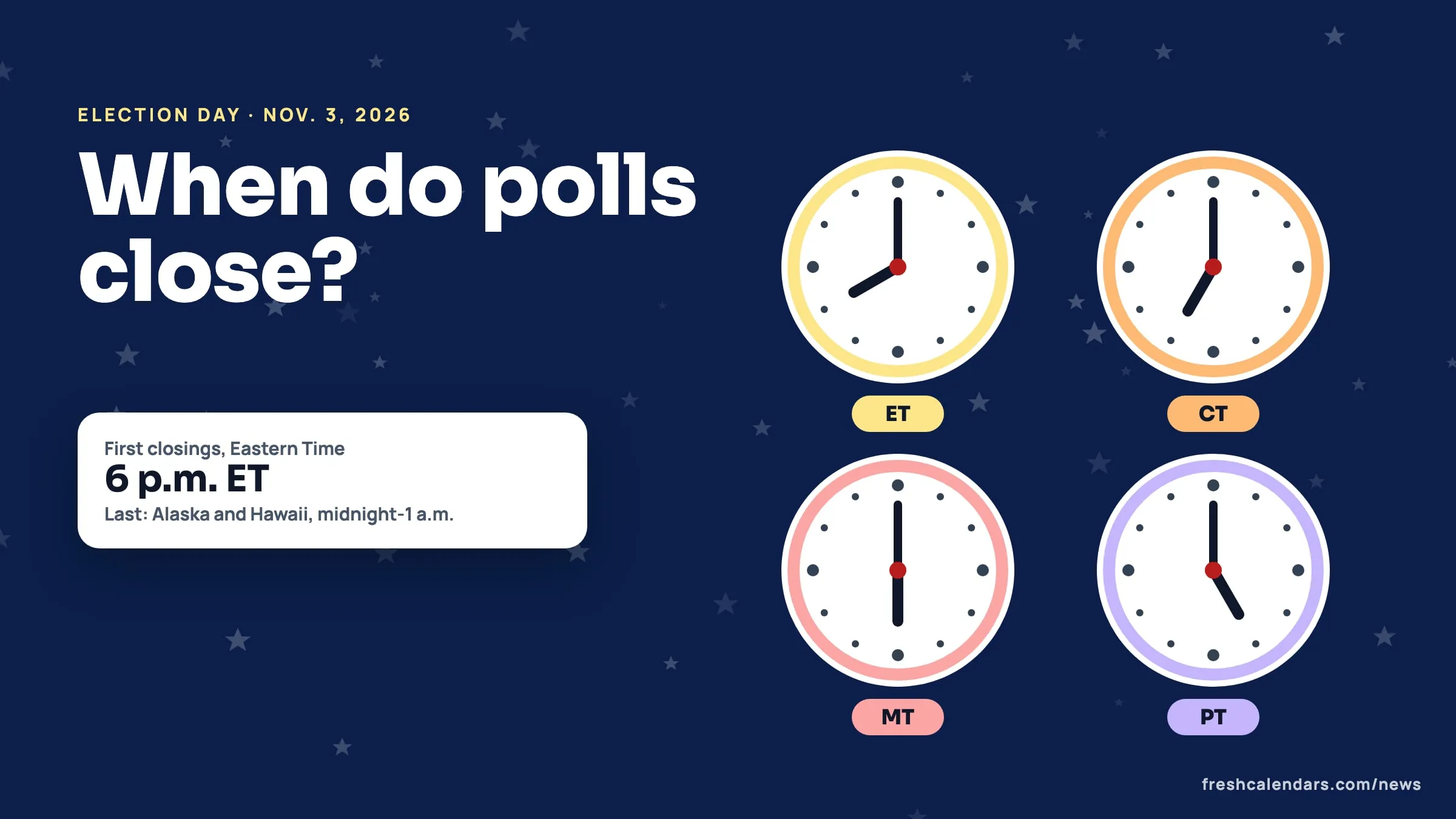 What Time Do Polls Close on Election Day 2026? Every State's Closing Time in Eastern Time
-
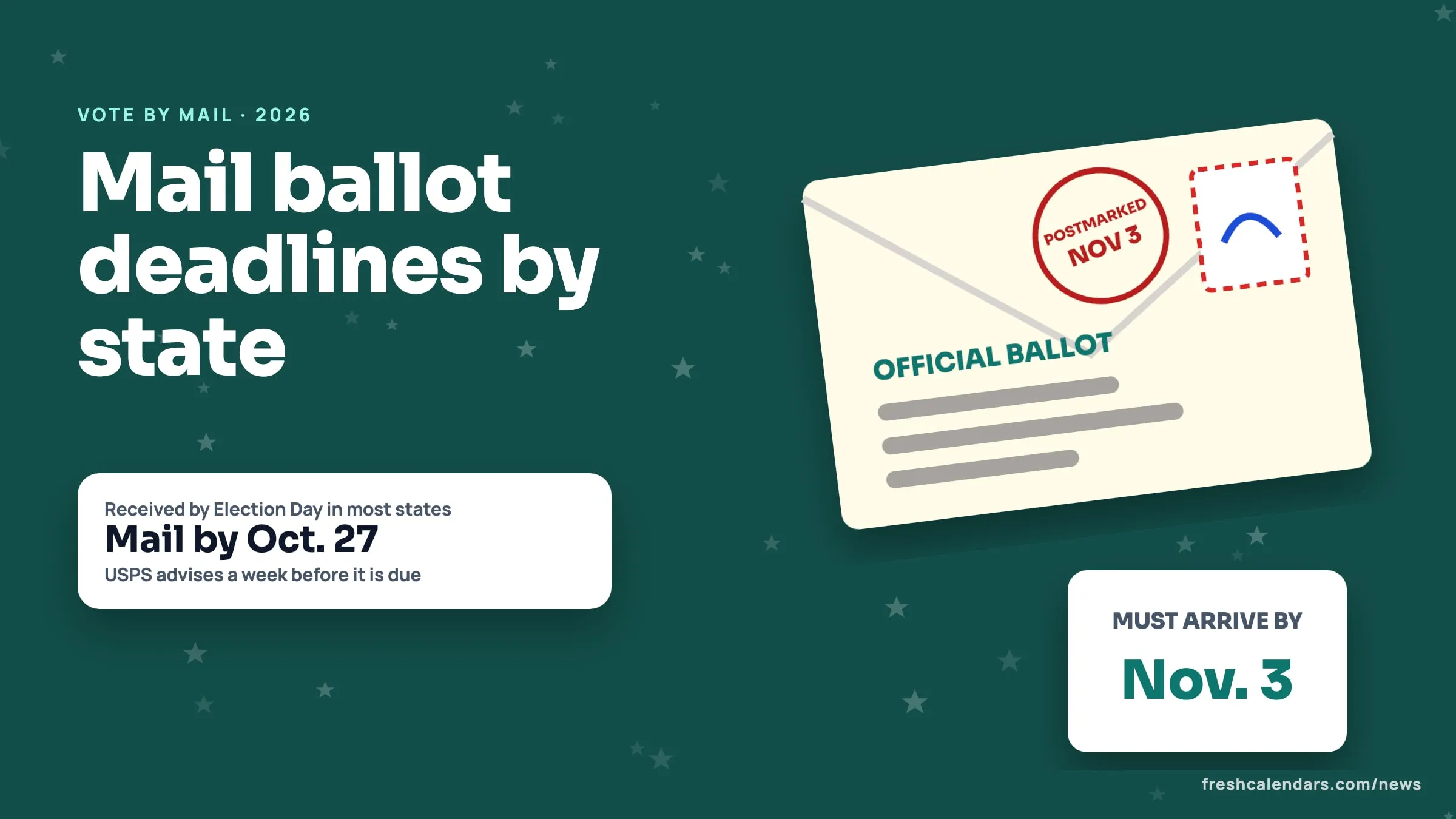 Mail Ballot Deadlines 2026 by State: When Your Ballot Must Arrive, and Where a Nov. 3 Postmark Still Counts
-
 Oct. 19 Voter Registration Deadline Has Passed; Same-Day Options Remain and Election Day Is Nov. 3
-
 New Jersey Sample Ballot 2026: How to Get Yours, the U.S. Senate Candidates and Mail Ballot Rules
More in Elections
All Elections stories →- 2027 Elections Calendar: Governor Races in Kentucky, Mississippi and Louisiana, Key Dates
- Recount Rules 2026: The Margins That Trigger a Recount in 6 States, and the Deadlines
- Kentucky 2027 Election Calendar: Jan. 8 Filing Deadline, May 18 Primary, Nov. 2 General
- Election Night 2026 Live Blog: Results Map, Senate, House and Governor Races
- Election Day 2026 Weather: Mississippi Valley Storms, Florida Flooding and Moved Polls
Trending now
- Diwali 2026 in the USA Is Sunday, Nov. 8: Lakshmi Puja Time in Your Time Zone
- Black Friday 2026 Deals: Date Is Friday, Nov. 27, Live Countdown and Ad Tracker
- Veterans Day Free Meals 2026: 48 Chains, Freebies and a Printable List
- Holiday Menus 2026: Every Chain's Christmas Drinks and Treats, With Launch Dates
- Spotify Wrapped 2026 Release Date: Not Announced Yet, With Every Launch Date Since 2020