
California Propositions 2026: All 14 Measures on the Nov. 3 Ballot, What Yes and No Mean, and Key Dates
California's Nov. 3, 2026 ballot has 14 propositions, from housing bonds to voter ID and a billionaire tax. What yes and no mean, plus mail ballot rules.
In this article
California voters decide 14 statewide propositions on Tuesday, Nov. 3, 2026, according to the Secretary of State’s Official Voter Information Guide. Five were placed on the ballot by the Legislature and are numbered 1 through 5; the other nine, numbered 37 through 45, qualified mostly by petition. The same ballot carries an open race for governor, because Gavin Newsom is term-limited, and every other statewide executive office.
All 14 propositions at a glance
| Prop. | Official title | Type |
|---|---|---|
| 1 | Authorizes Bonds for Housing Affordability Programs | Legislative statute |
| 2 | Increases State’s Rainy Day Fund | Legislative constitutional amendment |
| 3 | Provides Permanent Funding for Schools and Health Care by Extending Existing Tax on High Incomes | Initiative constitutional amendment |
| 4 | Repeals Prohibition Against Public Funding of Election Campaigns | Legislative statute |
| 5 | Changes Recall Election Process for Statewide Officers | Legislative constitutional amendment |
| 37 | Creates Loan Program for Middle-Income Buyers of Qualified New Homes | Initiative statute |
| 38 | Authorizes Bonds for Immunology Medical Research | Initiative statute |
| 39 | Prohibits Citizens from Voting Unless They Present Government-Issued Identification | Initiative constitutional amendment |
| 40 | Imposes One-Time Tax on Certain Taxpayers | Initiative constitutional amendment and statute |
| 41 | Prohibits New State Taxes That Exclude Revenues from State Spending Limit; Requires Audits for New State Special Taxes | Initiative constitutional amendment |
| 42 | Prohibits New State Personal Property Taxes and Certain Retroactive State Taxes | Initiative constitutional amendment |
| 43 | Limits Voters’ Ability to Raise Revenues for Local Government Services | Legislative constitutional amendment |
| 44 | Requires Community Health Clinics Spend 90% of Revenue on Program Services | Initiative statute |
| 45 | Modifies Environmental Review for Certain Projects | Initiative statute |
Each proposition passes with a simple majority of the votes cast on it.
What a yes or no vote means
These summaries follow the quick-reference guide in the official voter guide.
Prop. 1, housing bonds. Yes: the state may borrow $11.25 billion for affordable housing and veterans’ housing programs. No: it may not.
Prop. 2, rainy day fund. Yes: the state must set aside more money in its budget reserve. No: current reserve rules stay.
Prop. 3, high-income tax. Yes: the income tax rates on high earners first approved in 2012 become permanent, for schools and health care. No: they expire at the end of 2030.
Prop. 4, public campaign financing. Yes: state and local governments may create public financing programs for election campaigns. No: the current ban stays.
Prop. 5, recall elections. Yes: a recall of a statewide officer would no longer include a second question choosing a replacement. No: the current two-part recall ballot stays.
Prop. 37, home loans. Yes: up to $25 billion in revenue bonds, repaid by borrowers, would fund loans to middle-income buyers of qualified new homes. No: no program.
Prop. 38, immunology research bonds. Yes: the state may borrow $8.4 billion for immunology medical research. No: it may not.
Prop. 39, voter ID. Yes: voters would have to present government-issued identification to vote. No: voters’ identity would continue to be confirmed by signature and other existing checks.
Prop. 40, one-time tax. Yes: a one-time 5% tax on the wealth of billionaires. No: no new tax.
Prop. 41, taxes and spending limit. Yes: new state taxes would have to count under the state spending limit, and new special taxes would require audits. No: current rules stay.
Prop. 42, personal property and retroactive taxes. Yes: the state could not adopt new personal property taxes or certain retroactive taxes. No: the state keeps that option.
Prop. 43, local special taxes. Yes: certain local special taxes proposed by voters would need a two-thirds vote. No: a simple majority is enough.
Prop. 44, clinic spending. Yes: community health clinics would have to spend at least 90% of revenue on program services. No: no such requirement.
Prop. 45, environmental review. Yes: faster environmental review and litigation timelines under the California Environmental Quality Act for eligible projects. No: current rules stay.
Several measures overlap. Props. 3, 40, 41, 42 and 43 all deal with taxes, and Props. 4, 5 and 39 change how elections work. Read the full arguments and fiscal analysis for each in the official guide your county mails you or online at voterguide.sos.ca.gov.
Statewide offices on the ballot
Governor, lieutenant governor, attorney general, secretary of state, controller, treasurer, insurance commissioner and superintendent of public instruction are all on the ballot, along with all 52 U.S. House seats, which use new district lines approved by voters in Proposition 50 in November 2025. There is no U.S. Senate race in California this year. Under the top-two primary system, the two highest finishers in the June primary advanced regardless of party; your county sample ballot lists the certified candidates.
Key dates and how to vote
| Date | What |
|---|---|
| Oct. 5 | Ballots mailed to every active registered voter |
| Oct. 19 | Regular registration deadline (passed) |
| Through Nov. 3, 8 p.m. | Conditional (same-day) registration at county offices, vote centers and polling places |
| Nov. 3, 7 a.m.-8 p.m. | Polls, vote centers and drop boxes open |
| Nov. 10 | Last day for a ballot postmarked by Nov. 3 to arrive |
Mailed ballots must be postmarked on or before Election Day and received within seven days. You can track your ballot with the state’s Where’s My Ballot service. Most voters do not need ID at the polls; first-time voters who registered without a driver’s license or Social Security number may be asked for identification, and many documents count.
Counties count ballots for up to 30 days after the election, so close races can take time; see our midterm guide. For deadlines in other states, see mail ballot deadlines by state, and to look up your exact ballot by address, use our sample ballot guide.
Print the one-page checklist below to mark your choices on all 14 propositions, and add the dates to our October and November printable calendars or a weekly planner.
Free printable downloads
Every template is free, needs no sign-up and prints on US Letter paper. Choose PDF for printing or PNG for screens and documents.
Election 2026 printables
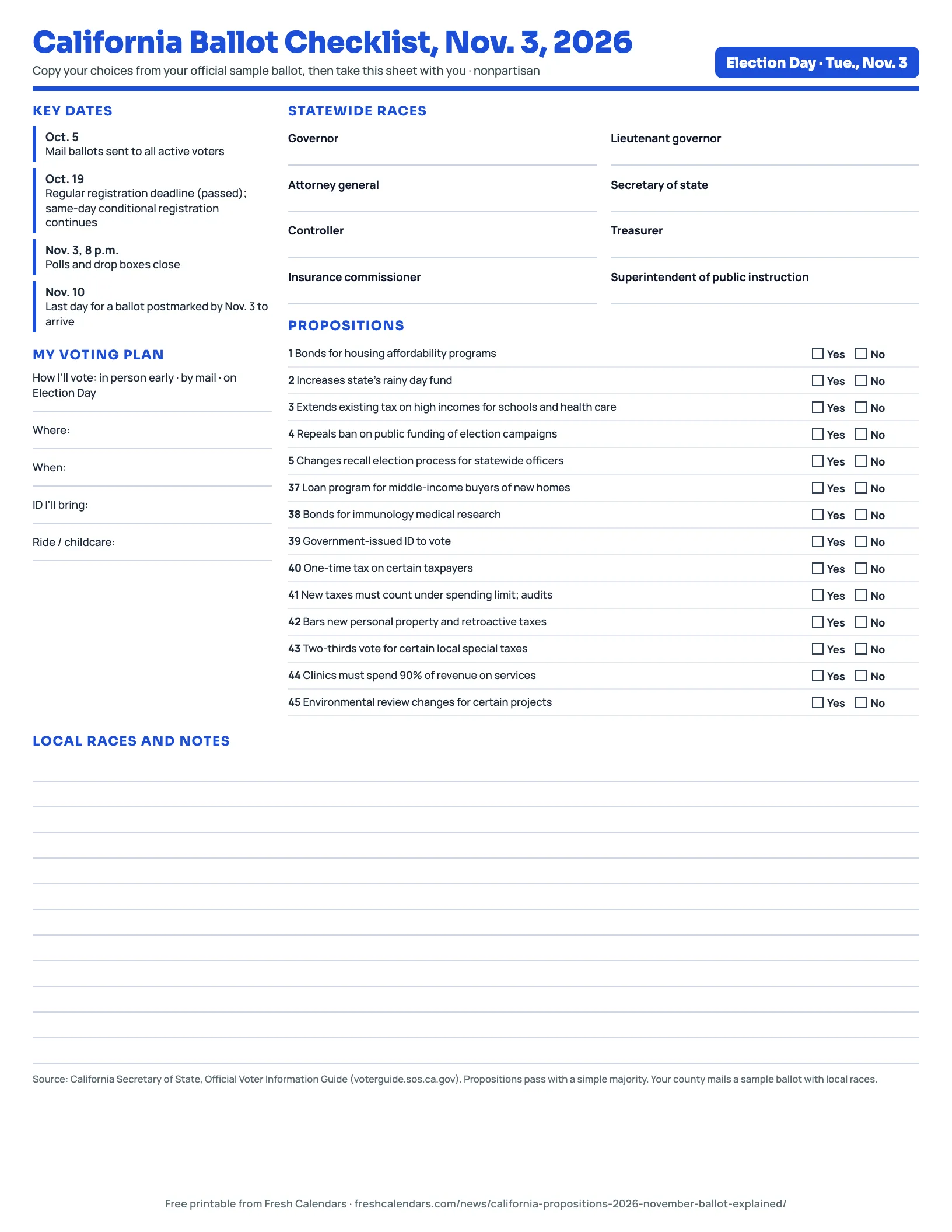
California Ballot Checklist, Nov. 3, 2026
All 14 propositions with yes and no boxes, the statewide offices, key dates and a voting plan on one page.
Frequently asked questions
How many propositions are on the California ballot in 2026?
Fourteen: Propositions 1 through 5, placed by the Legislature, and Propositions 37 through 45, mostly citizen initiatives, according to the Secretary of State's Official Voter Information Guide.
What is Proposition 1 in California 2026?
A $11.25 billion general obligation bond for affordable housing and veterans' housing programs. A yes vote lets the state borrow the money; a no vote does not.
What is Prop 40?
A one-time 5% tax on the wealth of billionaires, placed as a constitutional amendment and statute. A yes vote imposes the tax; a no vote does not.
When is my California ballot due?
Mailed ballots must be postmarked on or before Nov. 3 and arrive by Nov. 10. You can also drop your ballot at a drop box, vote center or polling place by 8 p.m. on Nov. 3.
Can I still register to vote in California?
Yes. The regular deadline was Oct. 19, but conditional voter registration lets you register and vote a provisional ballot at your county elections office, a vote center or a polling place through 8 p.m. on Election Day.
Is there a U.S. Senate race in California in 2026?
No. California's Senate seats are next on the ballot in 2028 and 2030. The 2026 ballot has the governor's race, the other statewide offices, all 52 House seats and legislative races.
Sources
- Official Voter Information Guide, Nov. 3, 2026: Propositions (California Secretary of State)
- Secretary of State Shirley N. Weber certifies measures for the Nov. 3, 2026 General Election ballot (California Secretary of State)
- Vote by Mail (California Secretary of State)
- Same Day Voter Registration (Conditional Voter Registration) (California Secretary of State)
- Governor Newsom issues proclamation declaring California's 2026 General Election (Office of the Governor of California)
Related news
 Sample Ballot by ZIP Code: How to See Your Nov. 3, 2026 Ballot, Plus a Texas Guide as Early Voting Opens
 Mail Ballot Deadlines 2026 by State: When Your Ballot Must Arrive, and Where a Nov. 3 Postmark Still Counts
 2026 Midterm Elections: 35 Senate Seats, 435 House Seats and 36 Governors on the Ballot Nov. 3, Plus a Tracker