Bonus Tax Rate 2026: The 22% Flat Rate, the 37% Rule and a Take-Home Table
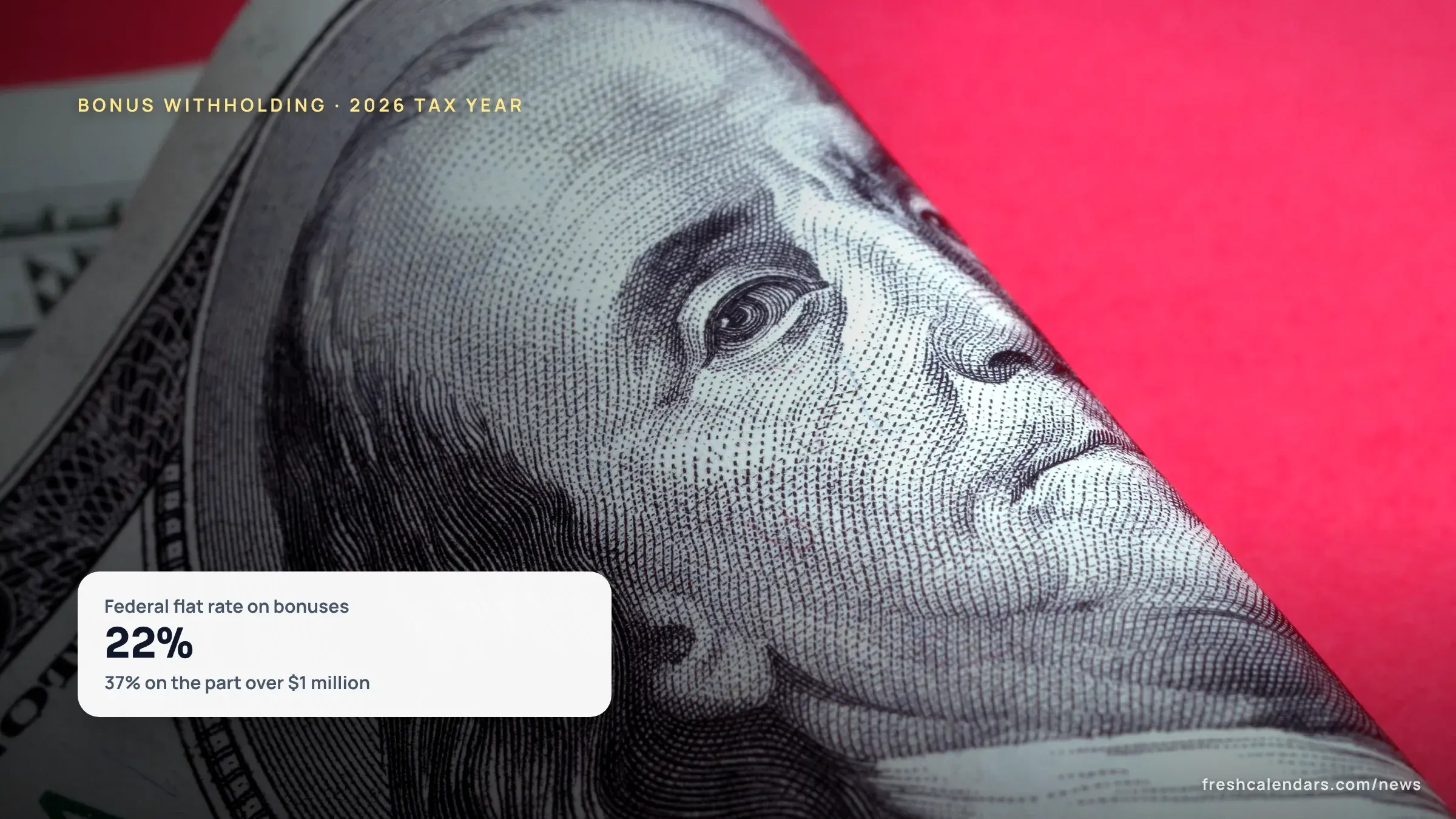
The Internal Revenue Service (IRS) says employers may withhold a flat 22% federal rate on 2026 bonuses, and 37% on supplemental pay over $1 million.

Published 4 min read

In this article
IRS Publication 15 (2026), the Internal Revenue Service (IRS) employer’s tax guide, says the withholding rate on supplemental wages, which include bonuses, remains 22%, rising to 37% on supplemental wages paid to an employee during the calendar year above $1 million. The 22% is the optional flat rate for the employer, and it is only the amount held back, not your final tax. The take-home table below shows what is left of a $500 to $10,000 bonus, and the one-page printable at the end keeps it on your desk.
How is a bonus taxed in 2026?
Publication 15 lists bonuses, commissions and overtime pay among supplemental wages: they “include, but aren’t limited to, bonuses, commissions, overtime pay.” Tips and vacation pay are listed too. For 2026 the guide’s “What’s New” section says the rate “remains 22% (37% if supplemental wages paid to an employee during the calendar year exceed $1 million) because P.L. 119-21 permanently extended the individual tax rates enacted in P.L. 115-97.” P.L. stands for Public Law.
An employer has two ways to withhold federal income tax on a bonus:
| Method | How it works | Result |
|---|---|---|
| Flat rate (optional) | “Withhold a flat 22% (no other percentage allowed).” Available when income tax was withheld from the employee’s regular wages in the current or immediately preceding calendar year and the bonus is separately identified | 22% of the bonus |
| Aggregate | The employer adds the bonus to regular wages for the payroll period, figures withholding on the total as if one payment, and subtracts the tax already withheld from the regular wages | Can be more or less than 22%, depending on your Form W-4 and pay |
If the conditions for the flat rate are not met, the employer uses the aggregate method. Which one your payroll uses is the employer’s choice, so check your pay stub.
How much of a $1,000 bonus do you keep?
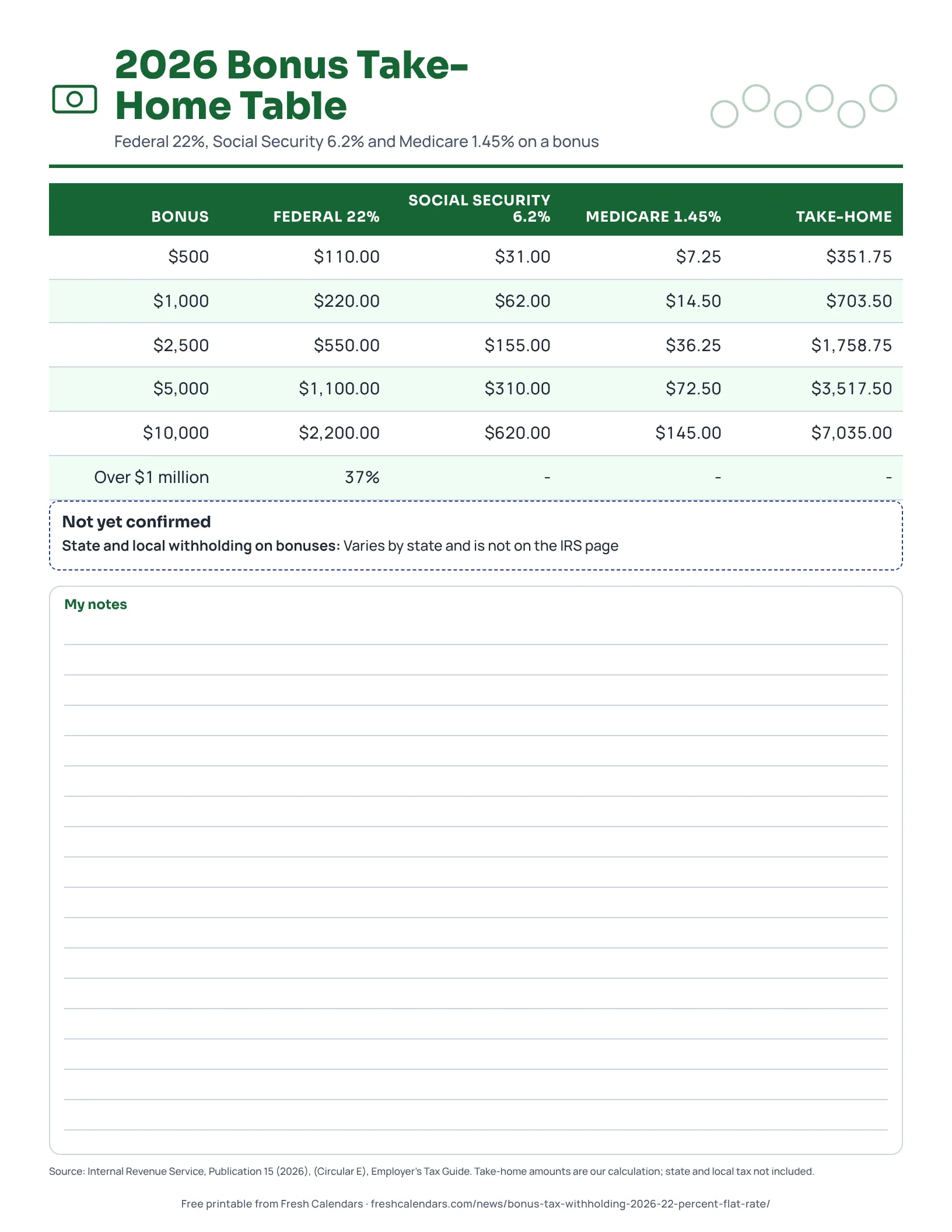
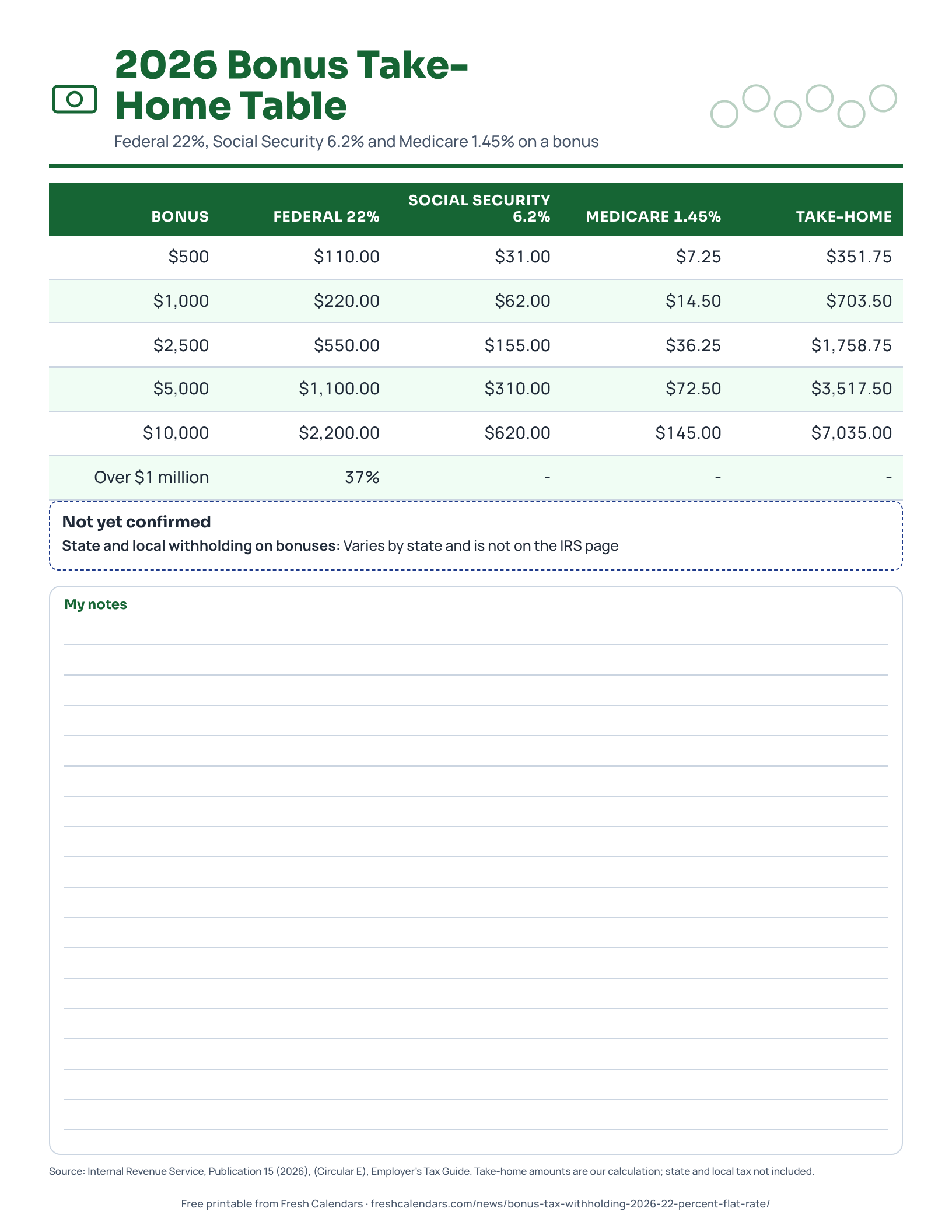
Federal income tax is not the only deduction. Publication 15 sets the Social Security tax at 6.2% for the employee and the Medicare tax at 1.45%, so the three together take 29.65% of the bonus. The table is our calculation from those rates, for an employee under the 2026 Social Security wage base of $184,500 and under $200,000 in wages, with no state or local tax.
| Bonus | Federal 22% | Social Security 6.2% | Medicare 1.45% | Take-home |
|---|---|---|---|---|
| $500 | $110.00 | $31.00 | $7.25 | $351.75 |
| $1,000 | $220.00 | $62.00 | $14.50 | $703.50 |
| $2,500 | $550.00 | $155.00 | $36.25 | $1,758.75 |
| $5,000 | $1,100.00 | $310.00 | $72.50 | $3,517.50 |
| $10,000 | $2,200.00 | $620.00 | $145.00 | $7,035.00 |
State and local withholding is not included and varies by state. If your employer uses the aggregate method, your federal amount will differ from the 22% column.
What changes above the Social Security and Medicare limits?
Publication 15 says “the social security wage base limit is $184,500” for 2026, so the 6.2% stops once an employee’s taxable wages reach that figure. Medicare has no such limit: “there is no wage base limit for Medicare tax,” and the rate is 1.45% each for employee and employer, unchanged from 2025. Employers must also withhold a 0.9% Additional Medicare Tax on wages above $200,000 in a calendar year.
A bonus paid in January 2027 falls in a different year. Publication 15 (2026) is marked for use in 2026, and we have not checked the 2027 edition. As reported by Al Jazeera and the Journal of Accountancy on Oct. 14, 2026, citing the Social Security Administration (SSA), the 2027 wage base rises to $192,300.
What is the 37% rule for bonuses over $1 million?
Publication 15 sets a separate rule for very large supplemental pay: “Special rules apply to the extent supplemental wages paid to any one employee during the calendar year exceed $1 million.” The excess “is subject to withholding at 37% (or the highest rate of income tax for the year),” and the employer must “withhold using the 37% rate without regard to the employee’s Form W-4.” Unlike the 22% flat rate, this part is not optional: the guide says the method is “optional with employer, except to the extent employee’s supplemental wages during the year exceed $1 million.”
Worked example, assuming a $1.2 million bonus is the only supplemental pay in the year and the employer uses the flat rate on the first million:
| Part of the bonus | Rate | Federal withholding |
|---|---|---|
| First $1,000,000 | 22% | $220,000 |
| Remaining $200,000 | 37% | $74,000 |
| Total on $1,200,000 | $294,000 |
Is the withholding the final tax on a bonus?
No. Withholding is a prepayment toward your tax for the year. The actual tax on the bonus is settled on your 2026 return, filed in 2027, where it is taxed along with the rest of your income. Whether you get a refund or owe more depends on your bracket. Our 2027 refund schedule covers when refunds arrive.
Overtime pay is also a supplemental wage under Publication 15. The separate deduction for qualified overtime pay is a different item from a bonus; our W-2 box 12 story explains it, and this story does not say how the IRS treats bonuses under that deduction.
When should you check your bonus withholding?
The year-end money deadlines are a companion list, and the W-2 and 1099 deadline story covers when the form that reports the bonus arrives. Mark pay dates on the December 2026 printable calendar or the printable yearly calendar.
- Look at the pay stub for the federal income tax line on the bonus check.
- Divide the federal amount by the bonus: 22% points to the flat rate, any other figure to the aggregate method.
- Check that Social Security (6.2%) and Medicare (1.45%) match the table.
- If you expect a large refund or balance due, revisit your Form W-4 with your employer.
Print the take-home table below to compare against your stub.
Free printable downloads
Every template is free, needs no sign-up and prints on US Letter paper. Choose PDF for printing or PNG for screens and documents.
2026 Bonus Take-Home Table printables
-
2026 Bonus Take-Home Table
A one-page table of what is left of a $500 to $10,000 bonus in 2026 after 22% federal withholding, Social Security and Medicare tax.
Frequently asked questions
How much is a bonus taxed in 2026?
With the optional flat rate method, the employer withholds 22% federal income tax from a bonus, per IRS Publication 15 (2026). Social Security tax (6.2%) and Medicare tax (1.45%) come out as well. State and local withholding varies and is not covered here.
Is the 22% bonus rate the final tax on my bonus?
No. It is the amount withheld. Your actual tax on the bonus is settled on your 2026 return, filed in 2027, and the refund or balance due depends on your bracket.
What is the 37% rule for bonuses?
When an employee's supplemental wages during the calendar year exceed $1 million, the excess is subject to withholding at 37%, without regard to the employee's Form W-4.
Can my employer withhold something other than 22% on a bonus?
Yes. The flat rate is optional. If the employer uses the aggregate method, it adds the bonus to regular wages, figures withholding on the total and subtracts the tax already withheld, which can come out above or below 22%.
Does the Social Security wage base affect a bonus?
Social Security tax of 6.2% applies to taxable wages up to the 2026 wage base limit of $184,500. Pay above it is not subject to that tax, according to Publication 15.
Sources
- Publication 15 (2026), (Circular E), Employer's Tax Guide (Internal Revenue Service)
- US Social Security benefits to rise by 3.6 percent in 2027 (Al Jazeera, 2026-10-14)
- Social Security wage base and COLA announced for 2027 (Journal of Accountancy, 2026-10-14)
Related news
-
 Year-End Money Deadlines 2026: What Must Be Done by December 31 and What Can Wait
-
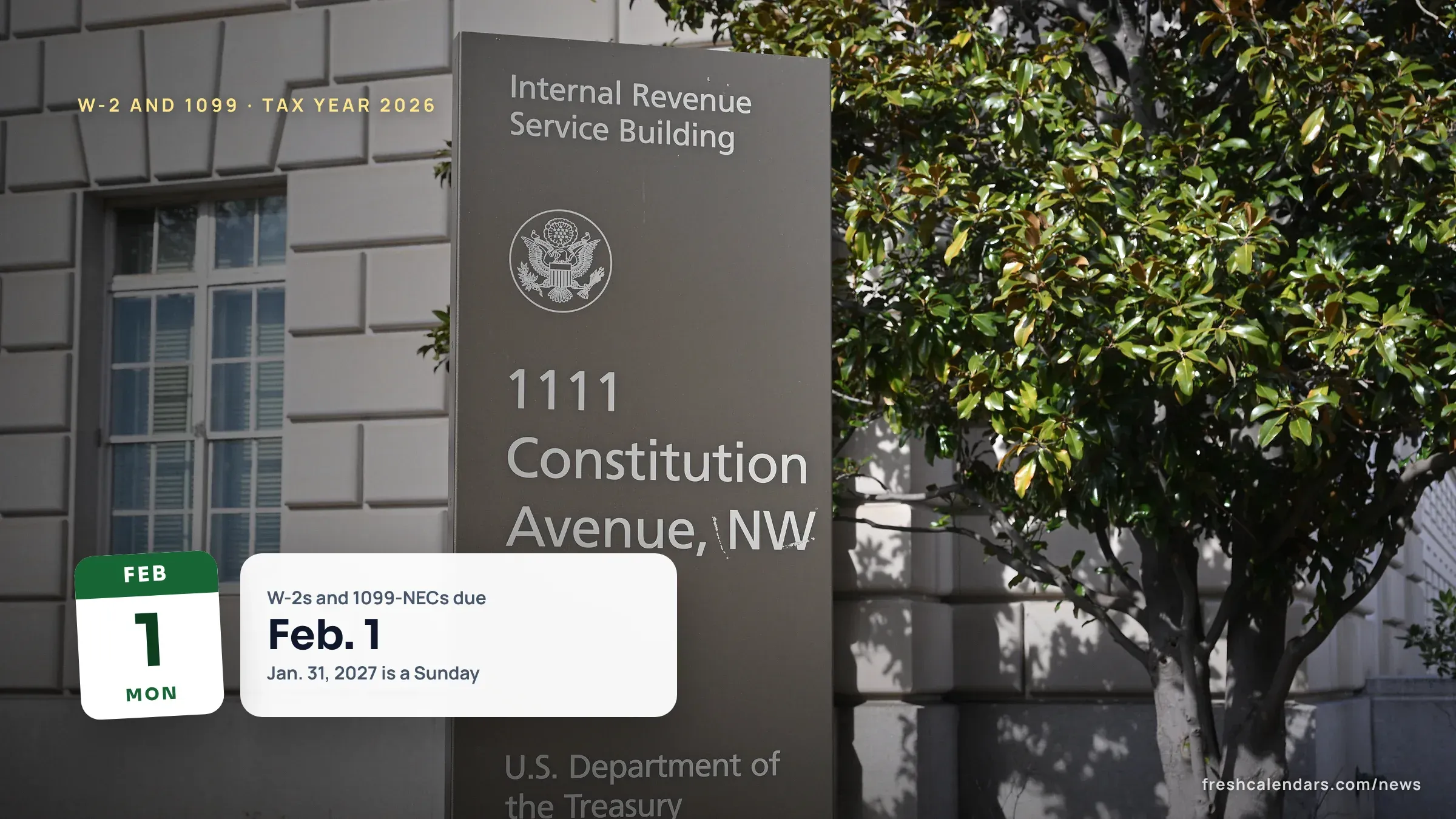 W-2 and 1099 Deadline 2027: Forms Due Feb. 1 Because Jan. 31 Falls on a Sunday
-
 W-2 Box 12 Codes TP and TT: How Tips and Overtime Show on Your 2026 W-2
-
 Christmas Bonus 2026: £10 Payment Date, Qualifying Week and the 24 Benefits That Count
More in Money & Benefits
All Money & Benefits stories →- Car Loan Interest Deduction 2026: Up to $10,000, Who Qualifies and a Phase-Out Table
- Medicaid Work Requirements Start Jan. 1, 2027: The 80-Hour Rule and Who Is Exempt
- ACA Open Enrollment 2027 Deadlines by State: When Each State Exchange Closes
- Dependent Care FSA Limit Is $7,500 in 2026: What Changes for 2027 Open Enrollment
- How to Prove You're a Veteran for Discounts: VA ID Card, VHIC and Your Driver's License
Trending now
- Black Friday 2026 Canada: Nov. 27 Sale Dates by Store, From Canadian Tire to Amazon.ca
- Black Friday 2026 Deals: Date Is Friday, Nov. 27, Live Countdown and Ad Tracker
- Veterans Day Free Meals 2026: 44 Chains Confirmed, 13 Discounts and a Printable List
- SNAP Payment Schedule November 2026: Deposit Dates for Every State, With Weekend Days Flagged
- Holiday Menus 2026: Every Chain's Christmas Drinks and Treats, With Launch Dates