Car Loan Interest Deduction 2026: Up to $10,000, Who Qualifies and a Phase-Out Table
The Internal Revenue Service (IRS) lets buyers deduct up to $10,000 a year of car loan interest for 2025 to 2028, phasing out above $100,000 income.

Published 5 min read

In this article
The Internal Revenue Service (IRS) says individuals may deduct interest on a loan for a qualified vehicle for 2025 through 2028, up to $10,000 a year, and the deduction shrinks above $100,000 of modified adjusted gross income (MAGI), or $200,000 for joint filers. The rule is in IRS fact sheet FS-2025-03 and, for the phase-out rate, in the final regulations published in Internal Revenue Bulletin 2026-39 on Sept. 21, 2026. Below is a table we computed from that rule, a buyer’s checklist and a printable to keep with your loan papers.
Who qualifies for the car loan interest deduction?
The fact sheet limits the deduction to a loan that meets four conditions. It must be “originated after December 31, 2024,” “used to purchase a vehicle, the original use of which starts with the taxpayer (used vehicles do not qualify),” “for a personal use vehicle (not for business or commercial use)” and “secured by a lien on the vehicle.” The IRS also says lease payments do not qualify.
| Requirement | What the IRS says |
|---|---|
| Tax years | 2025 through 2028 (Public Law 119-21, Sec. 70203: taxable years beginning after Dec. 31, 2024 and before Jan. 1, 2029) |
| Maximum deduction | $10,000 a year |
| Loan | Originated after Dec. 31, 2024 and secured by a lien on the vehicle |
| Vehicle use | Personal, not business or commercial |
| New or used | The taxpayer must be the first user; used vehicles do not qualify |
| Leases | Lease payments do not qualify |
| Refinanced loan | Interest on the refinanced amount is generally eligible |
Which vehicles count?
The IRS defines a qualified vehicle as a car, minivan, van, sport utility vehicle (SUV), pick-up truck or motorcycle “with a gross vehicle weight rating of less than 14,000 pounds, and that has undergone final assembly in the United States.”
To check where a vehicle was assembled, the fact sheet points to the vehicle information label attached to each vehicle on a dealer’s premises. A taxpayer may instead rely on the plant of manufacture reported in the vehicle identification number (VIN). The IRS says the VIN Decoder website of the National Highway Traffic Safety Administration (NHTSA) provides plant of manufacture information.
How does the income phase-out work?
The fact sheet says the deduction phases out for taxpayers with MAGI over $100,000 ($200,000 for joint filers). Internal Revenue Bulletin 2026-39 sets the rate: the deduction is “reduced (but not below zero) by $200 for each $1,000 (or portion thereof)” by which MAGI exceeds $100,000, or $200,000 for a married couple filing jointly.
That gives a formula: allowed deduction = the smaller of your interest and $10,000, minus $200 for every $1,000 (rounded up) of MAGI over the line, never below zero. The table below applies it to three interest amounts. These are our computations from the IRS rule, not figures the IRS published.
| Interest paid | MAGI $100,000 (joint $200,000) | MAGI $110,000 (joint $210,000) | MAGI $125,000 (joint $225,000) | MAGI $150,000 (joint $250,000) |
|---|---|---|---|---|
| $2,000 | $2,000 | $0 | $0 | $0 |
| $5,000 | $5,000 | $3,000 | $0 | $0 |
| $10,000 | $10,000 | $8,000 | $5,000 | $0 |
For example, a single filer with $10,000 of interest and a MAGI of $110,000 is $10,000 over the line, so the reduction is 10 x $200 = $2,000 and the deduction is $8,000. At $125,000 the excess is $25,000 and the reduction $5,000. At $150,000 the reduction is $10,000, which wipes out the deduction: $10,000 of interest is fully phased out at $150,000 for a single filer and $250,000 for joint filers.
The “or portion thereof” wording matters between the round numbers:
| Single filer, $10,000 of interest | Excess over $100,000 | Steps of $1,000 | Reduction | Allowed deduction |
|---|---|---|---|---|
| MAGI $100,500 | $500 | 1 | $200 | $9,800 |
| MAGI $105,000 | $5,000 | 5 | $1,000 | $9,000 |
A MAGI of $100,500 is only $500 over, yet the rule counts a portion of $1,000 as a full step, so the deduction drops by $200.
What is a deduction worth in tax dollars?
A deduction lowers taxable income, not the tax bill dollar for dollar. Its value is the deductible interest times your tax bracket rate. As a hypothetical example, not an IRS figure: if a filer in a 22% bracket deducts $10,000, taxable income falls by $10,000 and federal income tax by $2,200 ($10,000 x 0.22). The same $10,000 would be worth $1,000 at a 10% rate.
Do you need to itemize, and what goes on the return?
No. The fact sheet says the deduction is available for both itemizing and non-itemizing taxpayers. The IRS fact sheet FS-2026-04 on the new form says eligible taxpayers can claim it “whether they itemize deductions or claim the standard deduction,” and that car loan interest is Part IV of Schedule 1-A. The VIN of the purchased vehicle “must be reported on Schedule 1-A,” and the fact sheet says the VIN must be included for any year in which the deduction is claimed. When your return can be filed is covered in when tax season starts in 2027.
What will your lender send?
The fact sheet says lenders or other recipients of qualified interest must file information returns with the IRS and furnish statements to taxpayers showing the total interest received during the taxable year.
For 2025, IRS news release IR-2025-105 (Oct. 21, 2025) gave transition relief: lenders can avoid penalties if “they make a statement available to the buyer indicating the total amount of interest received.” For 2026, the IRS instructions for the vehicle loan interest (VLI) statement, Form 1098-VLI (12/2026), apply “for calendar year 2026 and subsequent years.” They set a $600 threshold, and say it applies separately to each covered loan. In plain terms, a lender reports on the form when the interest on a loan reaches $600. We did not confirm the date lenders must furnish 2026 statements; check the Form 1098-VLI instructions for it.
Car loan interest deduction checklist for buyers
Run through this list before you rely on the deduction, whether you bought in 2025 or are shopping now. The IRS rules above are the source for every item.
- The vehicle is new to you, not used.
- The loan was originated after Dec. 31, 2024.
- You bought it for personal use, not business or commercial use.
- The loan is secured by a lien on the vehicle.
- It is a car, minivan, van, SUV, pick-up truck or motorcycle under 14,000 pounds gross vehicle weight rating.
- Final assembly was in the United States: check the vehicle information label or the plant in the VIN through the NHTSA VIN Decoder.
- It is a loan, not a lease.
- You have the VIN to report on Schedule 1-A.
- You know your MAGI, because the deduction shrinks above $100,000 ($200,000 joint).
Mark tax-prep dates on the January 2027 printable calendar and see the December 2026 printable calendar alongside the year-end money deadlines. Another new deduction with its own form codes is covered in our W-2 box 12 codes guide. Print the one-page rules sheet below for your loan folder.
Free printable downloads
Every template is free, needs no sign-up and prints on US Letter paper. Choose PDF for printing or PNG for screens and documents.
2026 Car Loan Interest Deduction Rules printables
-
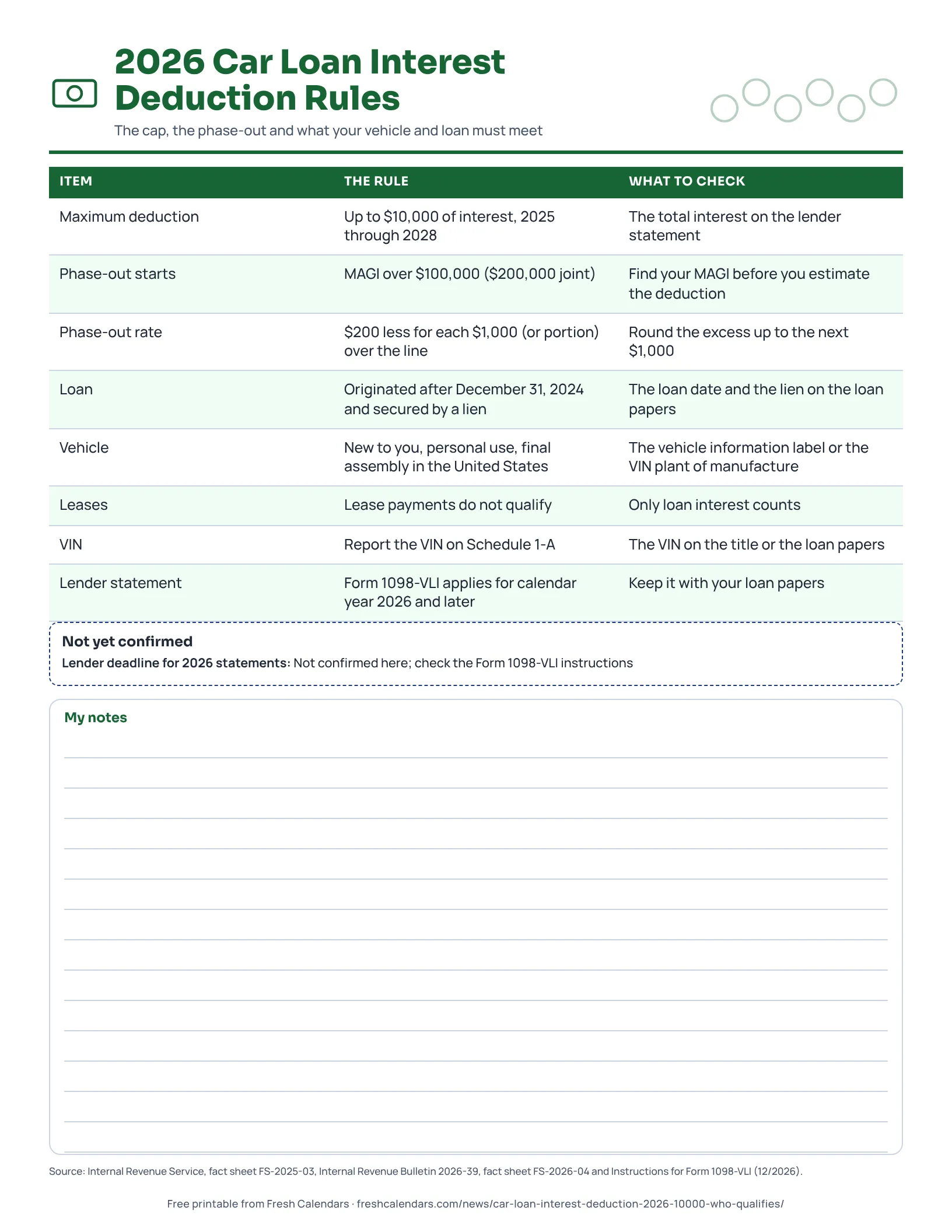
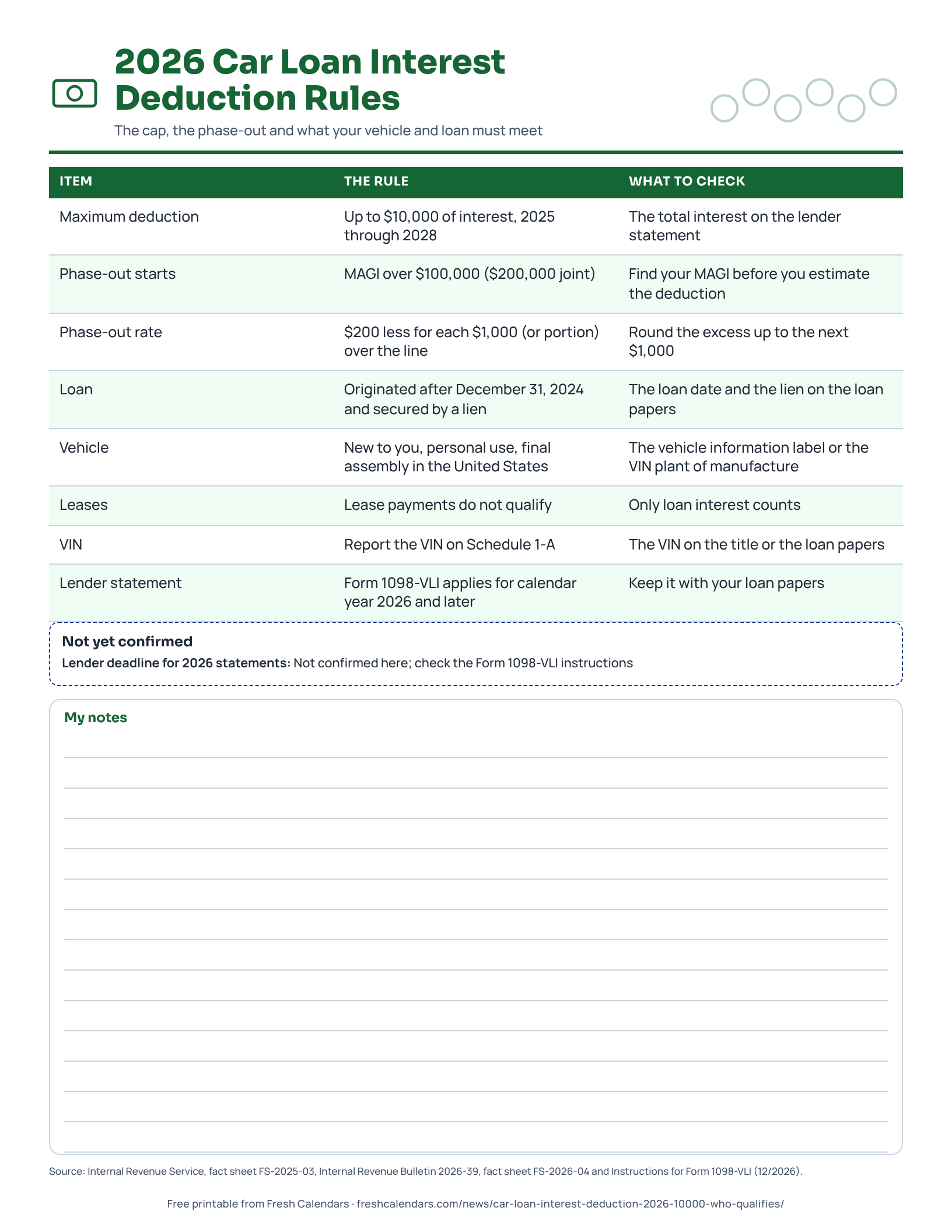
2026 Car Loan Interest Deduction Rules
A one-page sheet of the 2025 to 2028 car loan interest deduction: the $10,000 cap, the phase-out and a checklist for your loan and vehicle.
Frequently asked questions
Is car loan interest tax deductible for 2026?
Yes, for qualifying loans. The IRS says that effective for 2025 through 2028, individuals may deduct interest paid on a loan used to purchase a qualified vehicle, up to $10,000 a year, if the vehicle is for personal use and meets the other rules.
Do I have to itemize to claim it?
No. The IRS fact sheet says the deduction is available to both itemizing and non-itemizing taxpayers. Schedule 1-A states the same, whether you itemize or claim the standard deduction.
Does a used car qualify?
No. The loan must be used to buy a vehicle whose original use starts with the taxpayer, and the IRS says used vehicles do not qualify.
Does a lease qualify?
No. The IRS says lease payments do not qualify.
How do I find where my car was assembled?
The vehicle information label on the dealer's lot lists the location of final assembly. The IRS also lets taxpayers rely on the plant of manufacture in the VIN, which the NHTSA VIN Decoder website provides.
Can I deduct interest if I refinance the loan?
The IRS says that if a qualifying vehicle loan is later refinanced, interest paid on the refinanced amount is generally eligible. We did not find more detail on special cases in the sources we used.
Sources
- Working Families Tax Cuts: Tax deductions for working Americans and seniors (FS-2025-03) (Internal Revenue Service, 2025-07-25)
- Internal Revenue Bulletin 2026-39 (T.D. 10054, final regulations) (Internal Revenue Service, 2026-09-21)
- Schedule 1-A, Additional Deductions: What to know about the new form (FS-2026-04) (Internal Revenue Service, 2026-03-01)
- Treasury, IRS provide transition relief for 2025 for businesses reporting car loan interest (IR-2025-105) (Internal Revenue Service, 2025-10-21)
- Instructions for Form 1098-VLI (12/2026) (Internal Revenue Service, 2026-10-06)
- Public Law 119-21, Sec. 70203 (U.S. Government Publishing Office)
Related news
-
 Year-End Money Deadlines 2026: What Must Be Done by December 31 and What Can Wait
-
 When Does Tax Season Start in 2027? What the IRS Has Said About Opening Day
-
 W-2 Box 12 Codes TP and TT: How Tips and Overtime Show on Your 2026 W-2
-
 2027 Tax Brackets Are Out: IRS Sets the Standard Deduction; 401(k) Limits Still Pending
More in Money & Benefits
All Money & Benefits stories →- Bonus Tax Rate 2026: The 22% Flat Rate, the 37% Rule and a Take-Home Table
- Medicaid Work Requirements Start Jan. 1, 2027: The 80-Hour Rule and Who Is Exempt
- ACA Open Enrollment 2027 Deadlines by State: When Each State Exchange Closes
- Dependent Care FSA Limit Is $7,500 in 2026: What Changes for 2027 Open Enrollment
- How to Prove You're a Veteran for Discounts: VA ID Card, VHIC and Your Driver's License
Trending now
- Black Friday 2026 Canada: Nov. 27 Sale Dates by Store, From Canadian Tire to Amazon.ca
- Black Friday 2026 Deals: Date Is Friday, Nov. 27, Live Countdown and Ad Tracker
- Veterans Day Free Meals 2026: 44 Chains Confirmed, 13 Discounts and a Printable List
- SNAP Payment Schedule November 2026: Deposit Dates for Every State, With Weekend Days Flagged
- Holiday Menus 2026: Every Chain's Christmas Drinks and Treats, With Launch Dates