Dependent Care FSA Limit Is $7,500 in 2026: What Changes for 2027 Open Enrollment
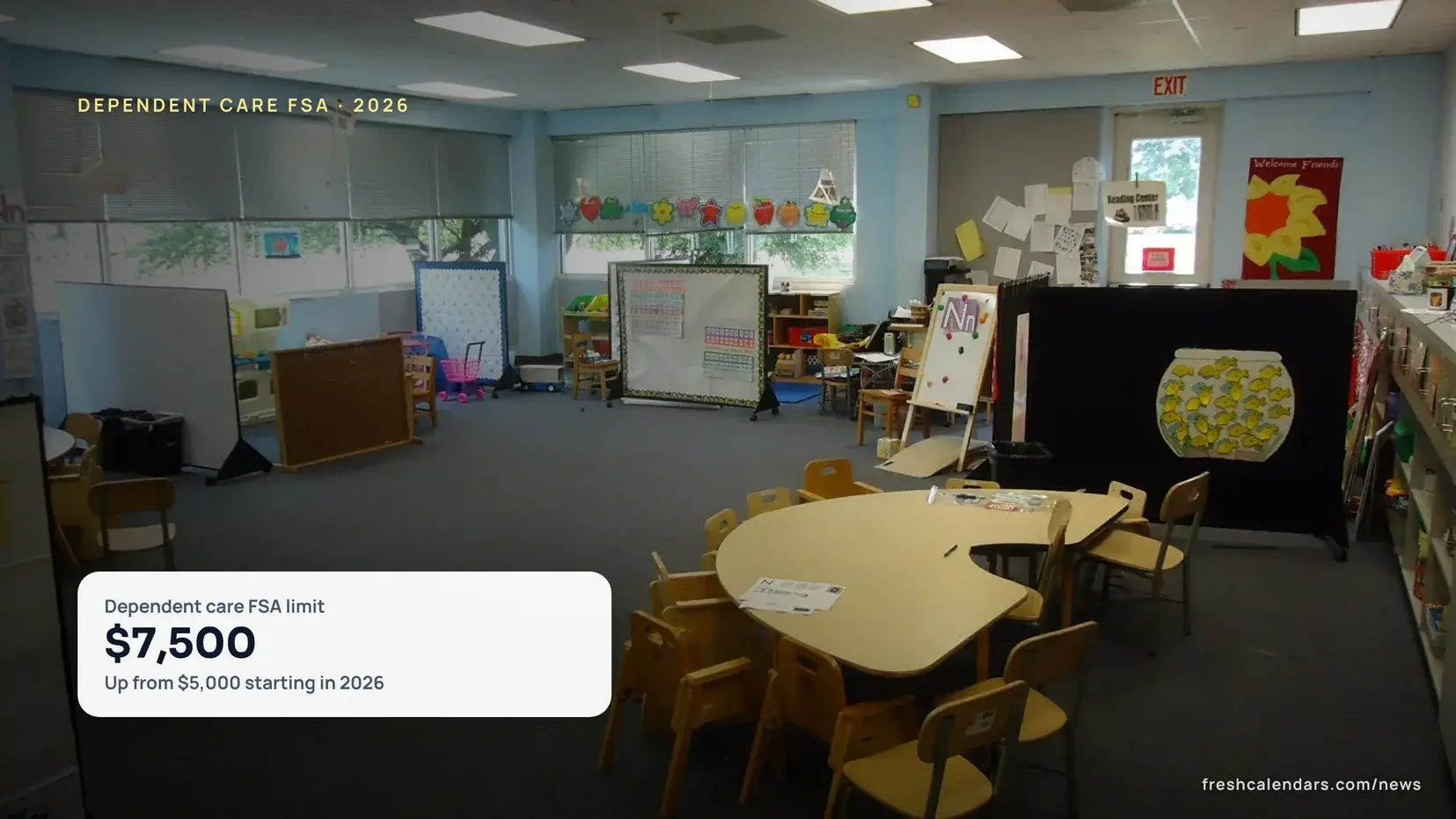
The dependent care flexible spending account (FSA) limit is $7,500 in 2026, up from $5,000, under federal law, and the amendment has no inflation adjustment.

Published 5 min read

Key dates
In this article
- Dependent care FSA limit: 2025, 2026 and 2027
- How much a family can set aside: $7,500 vs $5,000
- How do FSA dollars affect the child and dependent care credit?
- Who qualifies and what the provider paperwork needs
- Dependent care FSA open enrollment dates for federal employees
- What about the health FSA and the use-it-or-lose-it deadline?
- Dependent care FSA open enrollment checklist to print
The dependent care flexible spending account (FSA) limit is $7,500 for 2026, or $3,750 for a married employee filing a separate return, according to Internal Revenue Service (IRS) Publication 15-B (2026). Before 2026 the limit was $5,000 ($2,500). Public Law 119-21, signed July 4, 2025, made the change for taxable years beginning after Dec. 31, 2025. The amendment is a fixed dollar amount with no inflation adjustment in its text, so the legal maximum for 2027 open enrollment stays $7,500 unless Congress changes it. That is the statute, not an IRS 2027 figure, and your employer’s plan may set a lower limit.
This story gives the numbers for 2026 and 2027, a table of what $7,500 means per paycheck, how FSA money interacts with the child and dependent care credit, and a printable checklist for open enrollment.
Dependent care FSA limit: 2025, 2026 and 2027
| Before 2026 | 2026 | 2027 | |
|---|---|---|---|
| Dependent care FSA limit | $5,000 | $7,500 | $7,500 unless Congress changes it |
| Married filing separately | $2,500 | $3,750 | $3,750 unless Congress changes it |
| Source | Publication 503 (2025) | Publication 15-B (2026) | Public Law 119-21, section 70404 |
Section 70404 amends Internal Revenue Code section 129(a)(2)(A) by striking “$5,000 ($2,500” and inserting “$7,500 ($3,750”, and applies to taxable years beginning after Dec. 31, 2025. Publication 15-B (2026) lists the exclusion as “$7,500 ($3,750 for married employee filing separate return).” Publication 503 (2025), written for 2025 returns, still shows the old $5,000 ($2,500) maximum.
Your employer sets the limit your plan allows, up to that legal maximum. This applies to the Federal Flexible Spending Account Program (FSAFEDS) too: its own limit page could not be read for this story, so check the plan documents for your 2027 amount.
How much a family can set aside: $7,500 vs $5,000
These are our calculations from the two annual limits, rounded to the cent. The pay-period counts (26 and 24) and monthly pay are examples; use the number of pay periods in your own plan year.
| Annual set-aside | Per paycheck, 26 pay periods | Per paycheck, 24 pay periods | Per month |
|---|---|---|---|
| $7,500 (2026 limit) | $288.46 | $312.50 | $625.00 |
| $5,000 (limit before 2026) | $192.31 | $208.33 | $416.67 |
| $3,750 (married filing separately, 2026) | $144.23 | $156.25 | $312.50 |
| $2,500 (married filing separately, before 2026) | $96.15 | $104.17 | $208.33 |
The extra room is $2,500 a year, or $208.33 a month, compared with the old limit ($1,250 a year for a spouse filing separately). Your election is your choice up to your plan’s limit; the table is a ceiling, not a recommendation.
How do FSA dollars affect the child and dependent care credit?
IRS Publication 503 (2025) says that if you exclude dependent care benefits from your income, the excluded amount “isn’t included in your work-related expenses” and “reduces the dollar limit.” The credit’s expense limit is $3,000 for one qualifying person or $6,000 for two or more, per Publication 503 and the Form 2441 instructions (both for 2025).
A worked example for a family with two qualifying children, using the $6,000 limit:
| Dependent care FSA dollars excluded | Dollar limit left for the credit | Calculation |
|---|---|---|
| $0 | $6,000 | No exclusion |
| $3,000 | $3,000 | $6,000 minus $3,000 |
| $5,000 | $1,000 | $6,000 minus $5,000 |
| $7,500 | $0 | $6,000 minus $7,500 leaves nothing |
This is our arithmetic from the Publication 503 rule, not an IRS example. With one qualifying child the limit is $3,000, so a $3,000 election uses all of it. The 2026 edition of Publication 503 was not available for this story, so recheck the limits when the IRS publishes it.
Public Law 119-21 also changed the credit for 2026. Section 70405 sets the applicable percentage at 50 percent, reduced by one point for each $2,000 of adjusted gross income (AGI) above $15,000 but not below 35 percent, then reduced further above $75,000 ($150,000 for joint filers) but not below 20 percent. It applies to taxable years beginning after Dec. 31, 2025. Publication 503 (2025) still prints the older schedule, so do not mix the two. We do not give a dollar amount for the credit, because the IRS pages used here do not.
Who qualifies and what the provider paperwork needs
Publication 503 (2025) lists a qualifying child who is your dependent and “was under age 13 when the care was provided.” It also covers a spouse or another dependent who was not physically or mentally able to care for themselves. For a married couple, the earned income that counts is “the smaller of your or your spouse’s earned income,” and married couples generally must file a joint return to take the credit.
The IRS page for Form W-10 (last updated April 29, 2026) says to get each provider’s name, address and taxpayer identification number (TIN). If the provider is an organization, Publication 503 says the number is its employer identification number (EIN).
Dependent care FSA open enrollment dates for federal employees
The Office of Personnel Management (OPM) says Federal Benefits Open Season runs Nov. 9 to Dec. 14, 2026. For FSAFEDS, enrollment ends at 11:59 p.m. Eastern Time (ET) on Monday, Dec. 14, 2026. OPM’s FSA page says enrollment takes effect Jan. 1 of the following year. See the federal benefits Open Season dates and 2027 premiums for the full list, and mark Nov. 9 and Dec. 14 on a December 2026 printable calendar. The elections take effect in the January 2027 printable calendar month; the printable yearly calendar shows the whole plan year.
What about the health FSA and the use-it-or-lose-it deadline?
This story covers dependent care. The health FSA limit is $3,400 for 2026, per Publication 15-B (2026), and the IRS had not announced a 2027 health FSA limit when this story was published. Carryover, grace period and year-end rules for health FSAs are in our FSA year-end deadline story. For dependent care FSAs, the use-by, grace period and claim deadlines come from your plan, so ask the administrator. The IRS limits for next year’s retirement and health savings accounts are in the 2027 IRS limits story.
Dependent care FSA open enrollment checklist to print
The printable checklist has tick boxes for the limit, the child age rule, provider TIN or EIN, the credit offset and the FSAFEDS date, plus lines for your 2027 amount and per-paycheck figure.
Free printable downloads
Every template is free, needs no sign-up and prints on US Letter paper. Choose PDF for printing or PNG for screens and documents.
Dependent Care FSA Open Enrollment Checklist 2027 printables
-
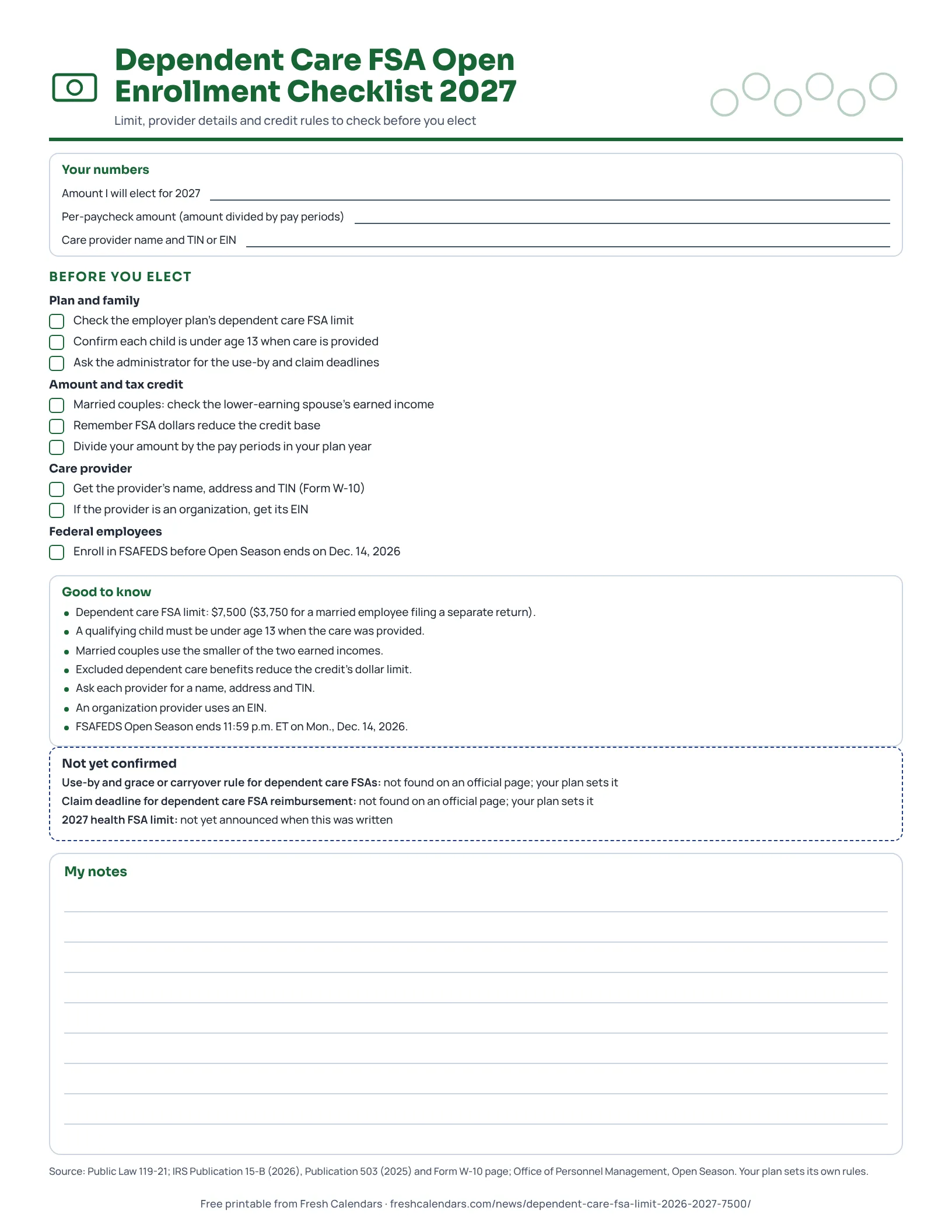
Dependent Care FSA Open Enrollment Checklist 2027
One-page open enrollment checklist for a dependent care FSA: the $7,500 limit, child age rule, provider TIN or EIN, credit offset and the Dec. 14 FSAFEDS date.
Frequently asked questions
What is the dependent care FSA limit for 2026?
$7,500, or $3,750 for a married employee filing a separate return, per IRS Publication 15-B (2026). It was $5,000 and $2,500 before.
What is the dependent care FSA limit for 2027?
Public Law 119-21 sets $7,500 ($3,750 married filing separately) for taxable years beginning after Dec. 31, 2025, with no inflation adjustment in the amendment. So $7,500 stays the legal maximum for 2027 unless Congress changes it. Your employer's plan can set a lower limit.
What is the 2027 health FSA limit?
It had not been announced when this story was published. The 2026 health FSA limit is $3,400, per IRS Publication 15-B (2026).
Can I use dependent care FSA money and claim the child and dependent care credit?
Yes, but the same dollars cannot count twice. IRS Publication 503 says excluded benefits reduce the work-related expenses and the dollar limit.
Does my employer have to offer the full $7,500?
The IRS pages used here do not say so. They give the legal maximum; your plan document sets the limit your plan allows, so check it before you choose an amount.
When is the deadline to spend dependent care FSA money?
Your plan sets its own use-by and claim dates. The IRS pages used for this story do not give one, so ask your plan administrator.
Sources
- Public Law 119-21 (One Big Beautiful Bill Act), sections 70404 and 70405 (U.S. Government Publishing Office, 2025-07-04)
- Publication 15-B (2026), Employer's Tax Guide to Fringe Benefits (Internal Revenue Service)
- Publication 503 (2025), Child and Dependent Care Expenses (Internal Revenue Service)
- Instructions for Form 2441 (2025) (Internal Revenue Service)
- About Form W-10, Dependent Care Provider's Identification and Certification (Internal Revenue Service, 2026-04-29)
- Open Season (Office of Personnel Management)
Related news
-
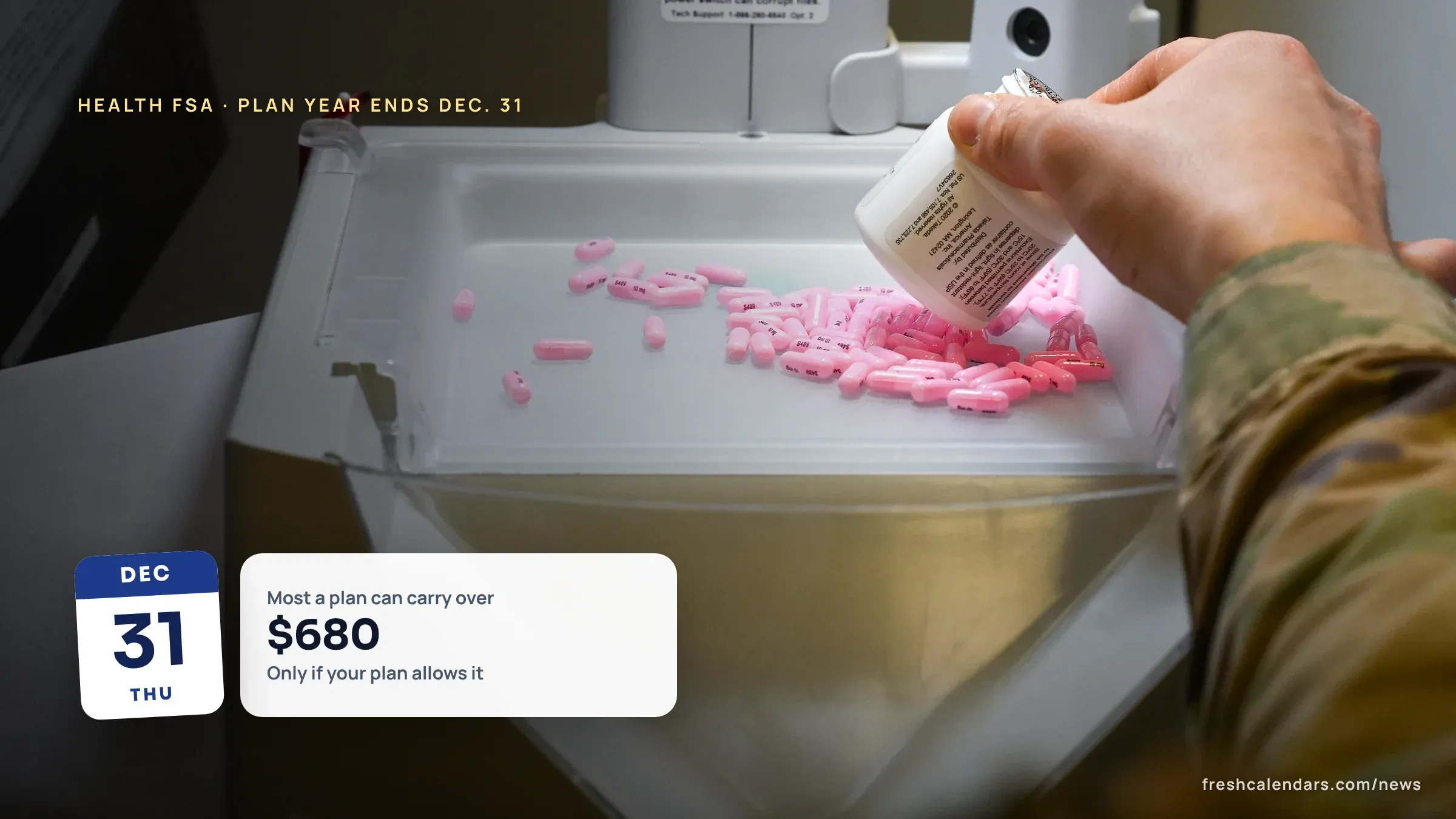 FSA Deadline 2026: Use-It-or-Lose-It Rules, the $680 Carryover and Grace Period
-
 Federal Benefits Open Season 2026 Runs Nov. 9 to Dec. 14: FEHB Dates, 2027 Premiums and Effective Dates
-
 2027 Tax Brackets and 401(k) Limits: What the IRS Has Confirmed and What Is Still Pending
-
 2026 HSA Contribution Deadline Is April 15, 2027: Limits, Catch-Up and Who Qualifies
More in Money & Benefits
All Money & Benefits stories →- How to Prove You're a Veteran for Discounts: VA ID Card, VHIC and Your Driver's License
- W-2 Box 12 Codes TP and TT: How Tips and Overtime Show on Your 2026 W-2
- Medicare Part D 2027: $700 Deductible, $2,400 Out-of-Pocket Cap and the Dec. 7 Deadline
- EITC 2026: Earned Income Tax Credit Tops Out at $8,231, Filed in 2027
- Debt Payoff Planner 2027: Snowball vs. Avalanche Worked Example and Printable Tracker
Trending now
- November 2026 Meteor Showers: Taurid Fireballs Under Dark Skies, Then the Leonids on Nov. 16-17
- Black Friday Canada 2026: Nov. 27 Date, Canadian Tire Deals From Nov. 5, Who Hasn't Announced
- SNAP Payment Schedule November 2026: Deposit Dates for Every State, With Weekend Days Flagged
- Black Friday 2026 Deals: Date Is Friday, Nov. 27, Live Countdown and Ad Tracker
- Veterans Day Free Meals 2026: 44 Chains Confirmed, 13 Discounts and a Printable List