Election Day 2026 in Michigan: Nov. 3, Polls Open 7 a.m. to 8 p.m.
Election Day 2026 in Michigan was Tuesday, Nov. 3. Polling hours, the absentee deadline, certified candidates and both statewide ballot proposals.

Published Updated 4 min read
In this article
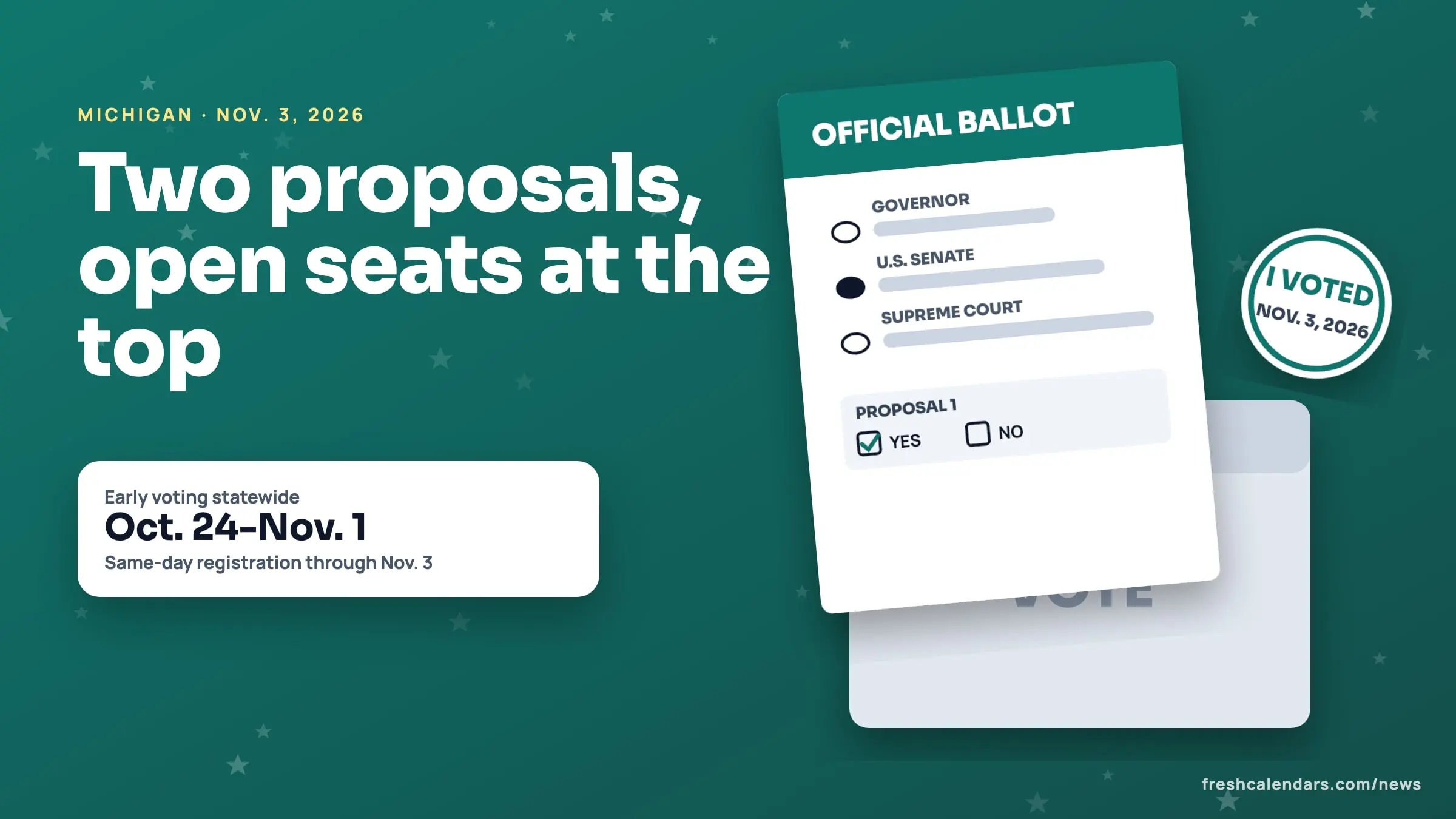
Election Day 2026 in Michigan was Tuesday, Nov. 3, with polls open from 7 a.m. to 8 p.m. The ballot had two statewide proposals and an unusually open top of the ticket. Gov. Gretchen Whitmer, Secretary of State Jocelyn Benson and Attorney General Dana Nessel are term-limited, and U.S. Sen. Gary Peters did not seek reelection, so all four offices had new nominees. Results are unofficial until the state canvass ends: county canvassers must certify by Tuesday, Nov. 17, and the Board of State Canvassers must vote to certify by Monday, Nov. 23, according to the Michigan Secretary of State. The candidates below come from the Michigan Bureau of Elections’ certified general election listing, in the order the parties appear.
Michigan election timeline: voting and certification
| Date | What happened or happens next |
|---|---|
| Oct. 24 | Early in-person voting began (at least nine days) |
| Nov. 1 | Early in-person voting ended |
| Nov. 3 | Election Day; polls open 7 a.m. to 8 p.m. |
| Nov. 17 | County boards of canvassers must certify the results |
| Nov. 23 | Board of State Canvassers must vote to certify; results are then final and official |
Proposal 1: a constitutional convention
The Michigan Constitution requires voters to be asked every 16 years whether to hold a convention to rewrite it. The 2026 question read, in part: “Shall a convention of elected delegates be convened in 2027 to draft a general revision of the State Constitution for presentation to the state’s voters for their approval or rejection?”
- Yes: delegates would be elected to draft a revised constitution, which voters would then approve or reject.
- No: no convention; the question returns automatically in 2042.
Voters rejected the same question in 1978, 1994 and 2010.
Proposal 2: utility and contractor contributions
Proposal 2 is a citizen-initiated law. It would bar regulated electric and gas utilities, companies with more than $250,000 a year in state government contracts, and people closely connected to them from contributing to officials and candidates whose decisions affect them. It would also extend disclosure rules to political communications that clearly identify a candidate or ballot question, including online ads.
- Yes: enact the contribution limits and disclosure rules.
- No: keep current campaign finance law.
The Michigan Supreme Court rejected a last-minute challenge to keep it off the ballot. A separate proposed amendment requiring proof of citizenship to register did not make the ballot.
The statewide races
| Office | Candidates (certified, in ballot order) |
|---|---|
| Governor / Lieutenant governor | Jocelyn Benson / Winnie Brinks (Democratic); John James / Jay DeBoyer (Republican); Anthony Hudson / Beau Parmenter (Libertarian); Donna Brandenburg / Robert Donald Cowper II (U.S. Taxpayers); Doug Campbell / Bobbie Clay (Green) |
| U.S. Senate | Abdul El-Sayed (Democratic); Mike Rogers (Republican); Lydia Christensen (Libertarian); Tim Long (U.S. Taxpayers); Douglas P. Marsh (Green); Walter P. Kristy (Natural Law) |
| Secretary of state | Garlin Gilchrist II (Democratic); Anthony G. Forlini (Republican); plus Libertarian, U.S. Taxpayers and Green nominees |
| Attorney general | Eli Savit (Democratic); Doug Lloyd (Republican); plus Libertarian, U.S. Taxpayers, Green and Natural Law nominees |
| Supreme Court (vote for two) | Megan Kathleen Cavanagh (incumbent); Noah P. Hood (incumbent); Thomas W. Howe; Casandra Morse-Bills; Michael Warren; Jody White |
Supreme Court candidates are nominated at party conventions but appeared on the ballot without party labels. Ballots also had two seats each on the State Board of Education and the governing boards of the University of Michigan, Michigan State University and Wayne State University, plus all 13 U.S. House seats and every seat in the state Senate and House.
Key dates
| Date | What |
|---|---|
| Sat., Oct. 24-Sun., Nov. 1 | Early in-person voting, at least nine days statewide |
| Oct. 20-Nov. 3 | Register in person at your clerk’s office with proof of residency |
| Fri., Oct. 30, 5 p.m. | Recommended last day to request an absentee ballot by mail or online |
| Mon., Nov. 2, 4 p.m. | Last day to request and vote an absentee ballot in person at your clerk’s office |
| Tue., Nov. 3, 7 a.m.-8 p.m. | Election Day; absentee ballots had to be received by 8 p.m. |
| Tue., Nov. 17 | Deadline for county boards of canvassers to certify |
| Mon., Nov. 23 | Deadline for the Board of State Canvassers to vote to certify |
Michigan voters approved a nine-day minimum for early voting in 2022, and some communities started earlier. Absentee ballots had to be in the clerk’s hands by 8 p.m. on Election Day; a postmark did not count. Unofficial results are on county clerk websites, and the Secretary of State lists them at mi.gov/vote once all counties report. The rules for the nine days are in our Michigan and New York early voting guide.
ID at the polls
Voters are asked to show photo ID, such as a Michigan driver’s license or state ID, a passport, a military ID, a student ID or a tribal ID. Voters without one can sign an affidavit and vote a regular ballot that counts like any other.
More on the 2026 election
Four counties in the Upper Peninsula are on Central Time and closed an hour later in Eastern Time; see poll closing times by state. The Senate race was one of 35 nationwide; follow them with the tracker in our 2026 midterm guide. For another Great Lakes battleground, see the Pennsylvania ballot guide. To find the official sample ballot lookup in any state from a ZIP code, use our sample ballot finder. Illinois voters can check our Illinois Election Day 2026 guide.
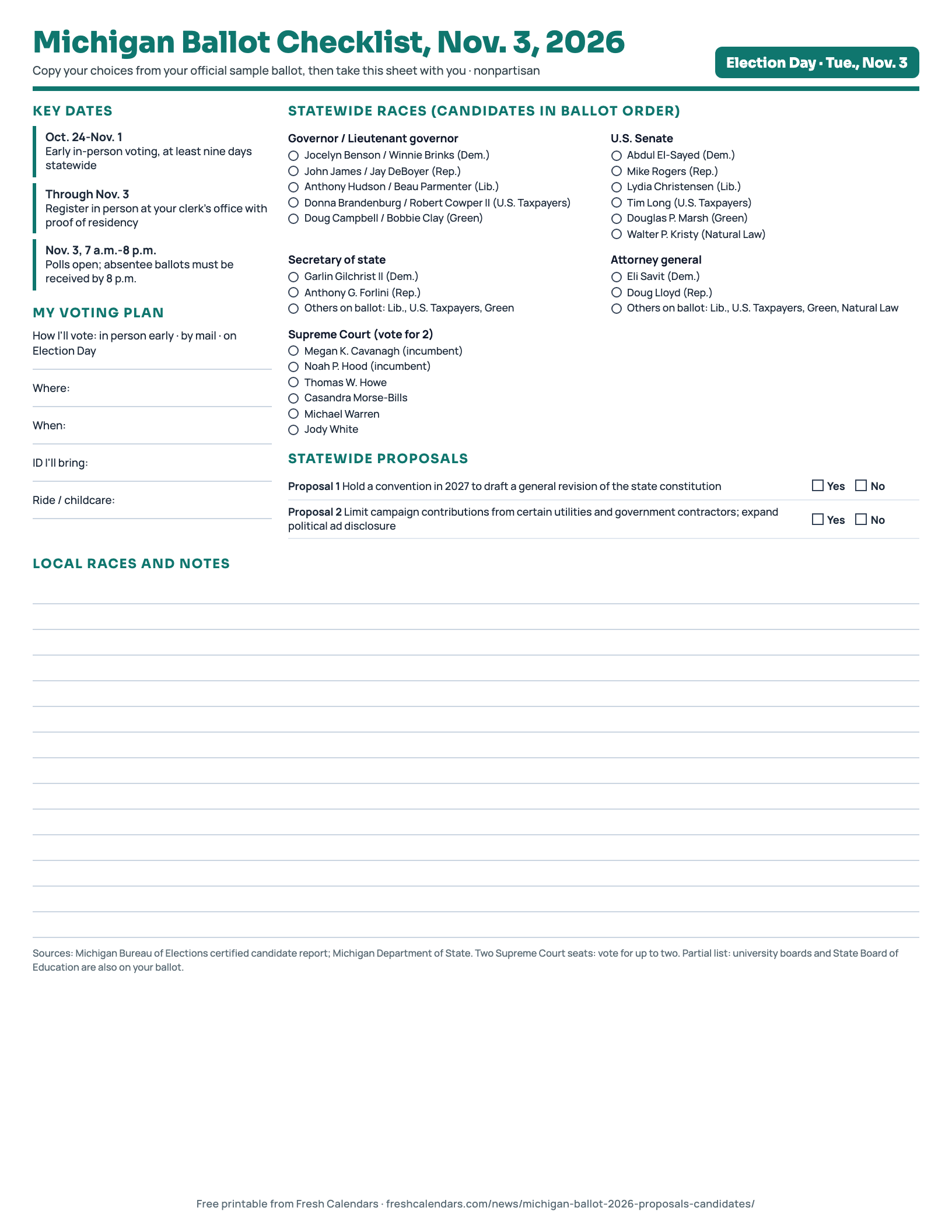
Print the checklist below, and add Nov. 17 and Nov. 23 to our November printable calendar or a weekly planner; the October calendar shows the early voting days.
Free printable downloads
Every template is free, needs no sign-up and prints on US Letter paper. Choose PDF for printing or PNG for screens and documents.
Election 2026 printables
-
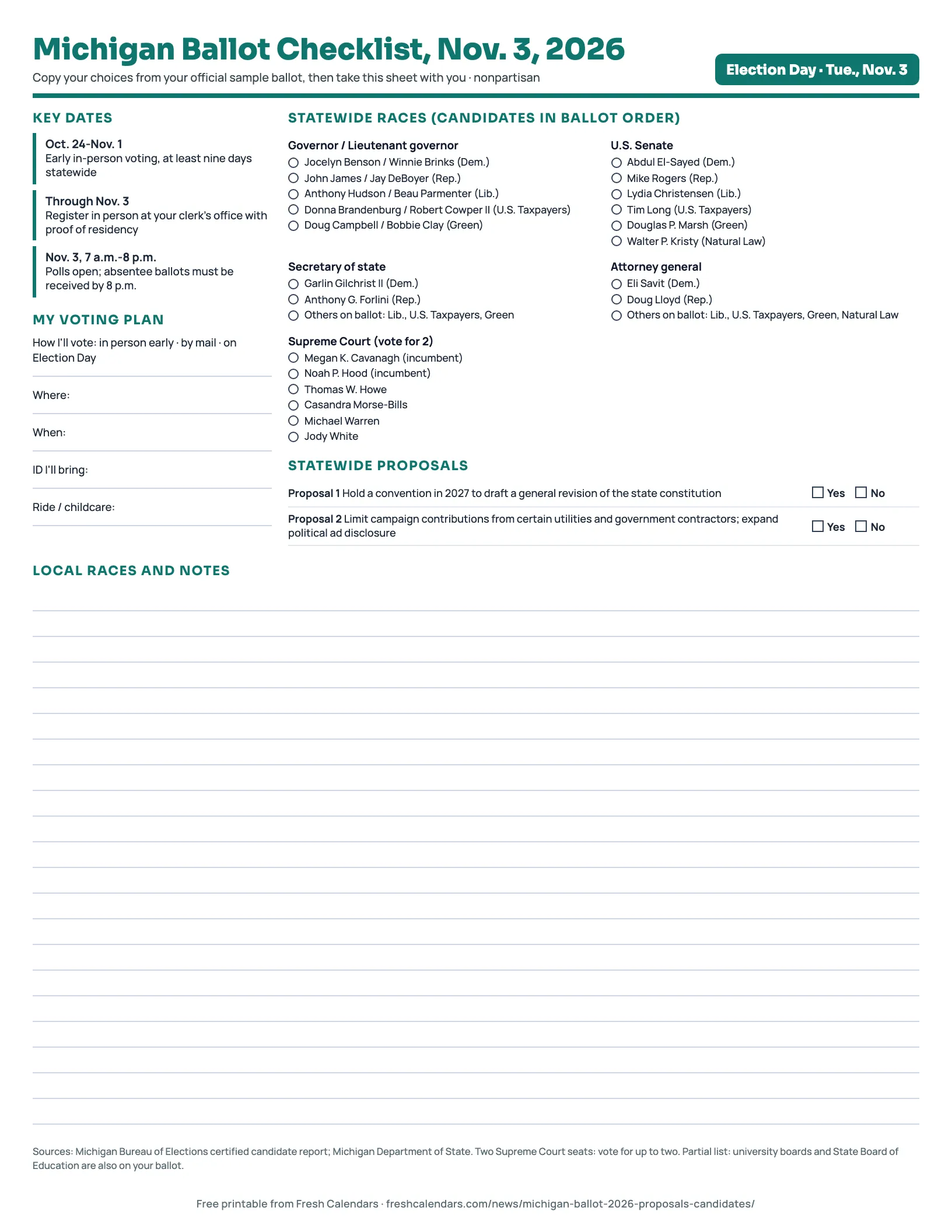
Michigan Ballot Checklist, Nov. 3, 2026
The certified candidates for governor, U.S. Senate, secretary of state, attorney general and Supreme Court, both proposals and key dates on one page.
Frequently asked questions
When was Election Day 2026 in Michigan?
Tuesday, Nov. 3, 2026. Polls were open from 7 a.m. to 8 p.m. Absentee ballots had to be received by 8 p.m.; a postmark did not count.
When are Michigan's 2026 election results official?
After the Board of State Canvassers certifies them. County canvassers must certify by Tuesday, Nov. 17, and the state board must vote to certify by Monday, Nov. 23, according to the Michigan Secretary of State. Until then, county clerk results are unofficial.
What are the Michigan ballot proposals for 2026?
Proposal 1 asked whether to hold a convention in 2027 to draft a general revision of the state constitution, a question the constitution requires every 16 years. Proposal 2 is a citizen-initiated law that would bar campaign contributions from certain regulated utilities and large government contractors and expand disclosure rules for political ads.
Who is running for governor of Michigan in 2026?
The Bureau of Elections' certified list shows Democrat Jocelyn Benson with Winnie Brinks, Republican John James with Jay DeBoyer, Libertarian Anthony Hudson with Beau Parmenter, U.S. Taxpayers Party nominee Donna Brandenburg with Robert Donald Cowper II and Green Party nominee Doug Campbell with Bobbie Clay.
Who is running for U.S. Senate in Michigan?
Democrat Abdul El-Sayed, Republican Mike Rogers, Libertarian Lydia Christensen, U.S. Taxpayers Party nominee Tim Long, Green Party nominee Douglas P. Marsh and Natural Law Party nominee Walter P. Kristy, for the seat Gary Peters is leaving.
When was early voting in Michigan for November 2026?
At least Saturday, Oct. 24 through Sunday, Nov. 1. The state constitution requires nine days of early voting; some cities and townships offered more.
Could you register to vote on Election Day in Michigan?
Yes. From Oct. 20 through 8 p.m. on Nov. 3, voters could register in person at their city or township clerk's office with proof of residency, then vote.
Do I need ID to vote in Michigan?
Voters are asked for photo ID. If you do not have one, you can sign an affidavit and vote a regular ballot.
Sources
- 2026 General Election Candidate Listing (Michigan Bureau of Elections)
- Elections (Michigan Department of State)
- Michigan Voter Information Center (Michigan Department of State)
- NEWS RELEASE: Deputy Secretary Edevbie: Strong Election Day voter turnout; over 84% of all requested absentee ballots returned (Michigan Department of State, 2026-11-03)
- Michigan's November 2026 ballot is official, and includes two questions for all voters (Michigan Public)
- MCL 168.523, Identification of voters (Michigan Legislature)
Related news
More in Elections
All Elections stories →- Wisconsin Spring Election 2027: April 6, Nomination Papers From Dec. 1
- Nevada Legislative Session 2027: Feb. 1 Start, Must End May 31
- Arkansas Legislative Session 2027: Prefiling Nov. 16, Starts Jan. 11
- Minnesota Legislative Session 2027: Opens Jan. 12, Ends by May 17
- Iowa Legislative Session 2027: Jan. 11 Start, Funnel March 5
Trending now
- Black Friday Ads 2026: Date Is Nov. 27, Walmart Deals Nov. 23-29
- November 2026 Meteor Showers: Leonids Nov. 16-17, Taurids Nov. 4-5
- Winter Tires in Canada 2026-27: Quebec Rule Starts Dec. 1
- Thanksgiving 2026 School Break: 52 of 81 Districts Off Nov. 23-27
- Ulta Black Friday 2026: Online Nov. 21; Sephora Sale Ended Nov. 9