Voter ID on the Ballot 2026: North Carolina, Ohio, Arizona, Nevada and Colorado Compared
Voters in five states decide voter ID measures on Nov. 3, 2026: North Carolina, Ohio, Arizona, Nevada and Colorado. Compare each, plus the federal rule.

Published 5 min read
In this article
- Voter ID measures on the Nov. 3, 2026 ballot
- What does North Carolina’s amendment change?
- What would Ohio’s Issue 3 do?
- What is Arizona’s Proposition 144?
- What would Nevada’s Question 7 require?
- What would Colorado’s Amendment 84 require?
- What does federal law already require of first-time mail registrants?
- How can I check my own state’s rules?
Voters in five states, North Carolina, Ohio, Arizona, Nevada and Colorado, decide measures on voter identification on Tuesday, Nov. 3, 2026, according to each state’s official ballot language. North Carolina, Ohio, Arizona and Nevada have constitutional amendments on the ballot, as does Colorado, where Amendment 84 is a citizen initiative. This guide puts them in one table and adds the federal rule that already applies to first-time voters who registered by mail.
Voter ID measures on the Nov. 3, 2026 ballot
| State | Measure | In-person rule in the measure | Mail rule in the measure | When it would apply |
|---|---|---|---|---|
| North Carolina | Constitutional amendment (Session Law 2024-58) | Photo identification before voting | Covered: “all voters, not just those presenting to vote in person” | Not stated in the sources we used |
| Ohio | Issue 3, constitutional amendment | Photo identification; Ballot Board language refers to government-issued photo ID for in-person voting | Not stated in the sources we used | Not stated in the sources we used |
| Arizona | Proposition 144, constitutional amendment | Government-issued identification to cast a ballot | Not stated in the sources we used | Not stated in the sources we used |
| Nevada | Question 7 (Initiative Petition C-02-2023), constitutional amendment | Photo identification | Last four digits of Nevada driver’s license number, or of Social Security number if none | Legislature could act in 2027; changes for the 2028 election cycle |
| Colorado | Amendment 84, constitutional amendment by citizen initiative; needs at least 55% of votes cast | Not stated in the sources we used | Last four digits of Social Security number, or Colorado driver’s license or ID number, included with the mail ballot | Not stated in the sources we used |
Where a cell says “not stated,” the source we reviewed does not say. Check your state election office before you rely on a detail the table leaves open.
What does North Carolina’s amendment change?
The North Carolina State Board of Elections says on its Voter ID page: “Voters will be asked to show photo ID when voting in North Carolina.” The same page says: “All voters will be allowed to vote with or without a photo ID.” Voters without ID can fill out an ID exception form, as covered in our North Carolina sample ballot guide.
The Nov. 3 question comes from Session Law 2024-58, published by the North Carolina General Assembly. It reads in part: “Constitutional amendment to require all voters, not just those presenting to vote in person, to present photo identification before voting.” The wording names mail voters explicitly. Each amendment on the North Carolina ballot is a For or Against vote.
What would Ohio’s Issue 3 do?
Issue 3 is the only statewide issue on Ohio’s ballot. Signal Cleveland reported the ballot title: it would require voters to present photo identification in order to vote. The Statehouse News Bureau, on Aug. 3, 2026, described the Ohio Ballot Board’s approved language as asking voters whether they should have to show government-issued photo ID for any in-person voting.
Ohio already requires an unexpired photo ID to vote in person, per the state’s guidance summarized in our Ohio sample ballot guide. The amendment would put the rule in the constitution. This story does not cover Ohio’s mail-voting rules because the sources above do not address them.
What is Arizona’s Proposition 144?
Proposition 144 is one of eight measures the Legislature referred to Arizona voters. Per the Arizona Secretary of State’s final ballot language, it would state that only citizens may register and vote, bar foreign nationals from contributing to influence Arizona elections, require voters to provide government-issued identification to cast a ballot, and give voters a right to have their vote tabulated at their voting location.
Today, Arizona voters show identification in person in one of three ways: one valid photo ID with name and address; two documents without a photo that show name and address; or a photo ID plus one such document. Our Arizona propositions guide lists all eight measures. Arizona counts an early ballot only if it arrives by 7 p.m. on Election Day, and the county checks the signature on the affidavit envelope against the voter record.
What would Nevada’s Question 7 require?
Question 7 would amend the Nevada Constitution. According to the Clark County Election Department’s 2026 General Election Guide, in-person voters would present photo identification, and mail voters would provide the last four digits of their Nevada driver’s license number, or of their Social Security number if they have no license.
This is a second vote: the measure was approved in 2024 and must pass again. If voters approve it, the Legislature could pass related laws in 2027, and the changes would take effect for the 2028 election cycle. Our guide to Nevada’s Question 6 and Question 7 covers both measures.
What would Colorado’s Amendment 84 require?
Amendment 84 is a citizen initiative to amend the Colorado constitution, and it needs at least 55% of votes cast to pass. The Colorado Legislative Council’s 2026 State Ballot Information Booklet, dated Sept. 10, 2026 (page 8), says it would require voters to include ID information with mail ballots: the last four digits of their Social Security number, or their Colorado driver’s license or ID number. The sources we used do not describe an in-person rule or a start date. Colorado’s other measures are in our Colorado ballot measures guide.
What does federal law already require of first-time mail registrants?
Separate from any state measure, the Help America Vote Act (HAVA) has a rule for one group. Under 52 U.S.C. §21083(b), as published by the Legal Information Institute at Cornell Law School, a first-time voter who registered by mail and has not been verified must show a current and valid photo ID, or a copy of a current utility bill, bank statement, government check, paycheck or other government document showing name and address. A voter without one of these may cast a provisional ballot.
| If you are | Federal rule under 52 U.S.C. §21083(b) |
|---|---|
| A first-time voter who registered by mail and has not been verified | Show a current and valid photo ID, or a copy of a utility bill, bank statement, government check, paycheck or other government document with your name and address |
| Unable to show either | You may cast a provisional ballot |
The statute describes the federal minimum for this group. State rules for other voters are set by each state.
How can I check my own state’s rules?
The National Association of Secretaries of State (NASS) runs a “Can I Vote” page at nass.org/can-i-vote that links to each state’s election office. This story does not give a count of states with voter ID laws, because we did not confirm one from an official source.
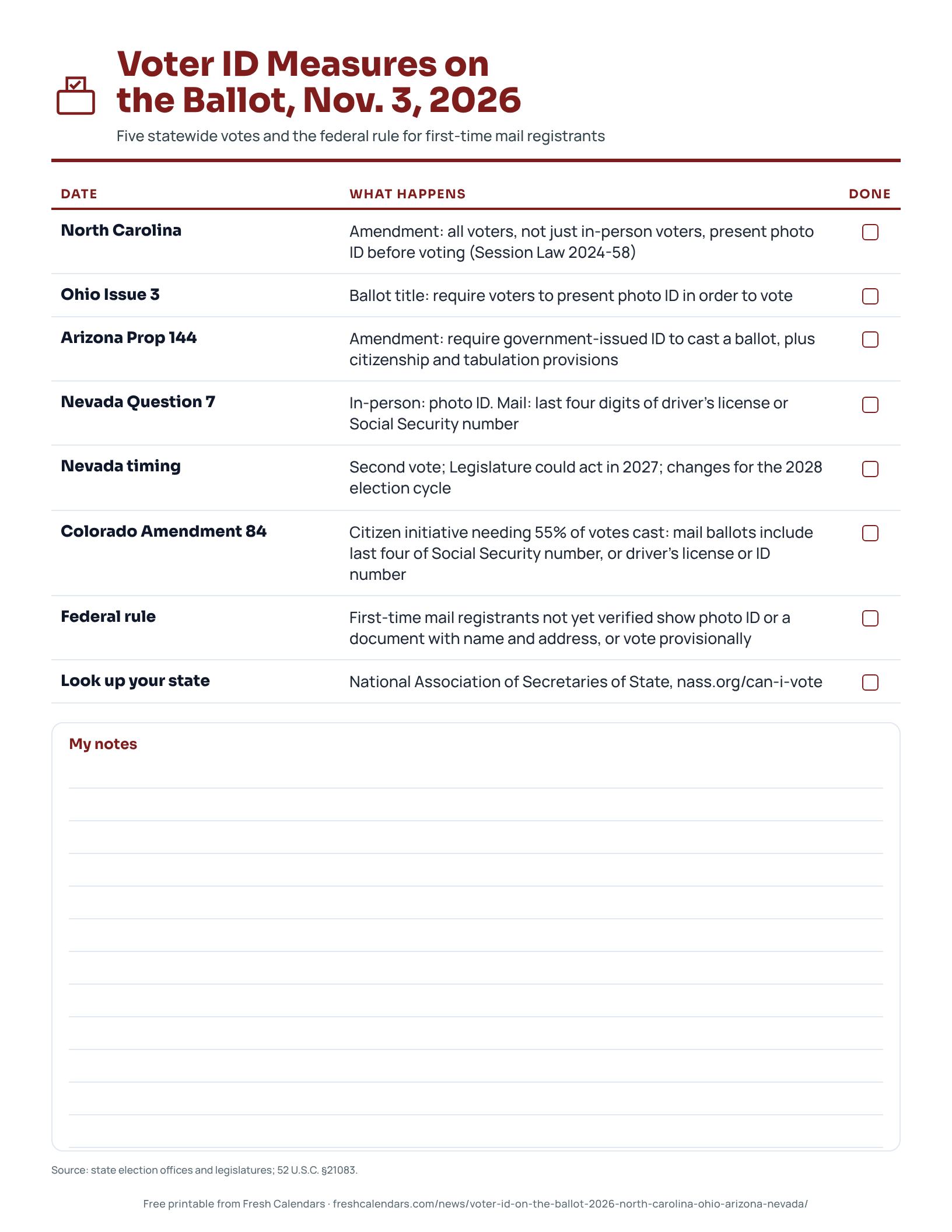
Voting on Nov. 3 also means checking dates, hours and deadlines in your state. Mark them on the November 2026 printable calendar or a printable weekly planner, and use the one-page printable below to keep the five measures in one place.
Free printable downloads
Every template is free, needs no sign-up and prints on US Letter paper. Choose PDF for printing or PNG for screens and documents.
Voter ID Measures on the Ballot printables
-
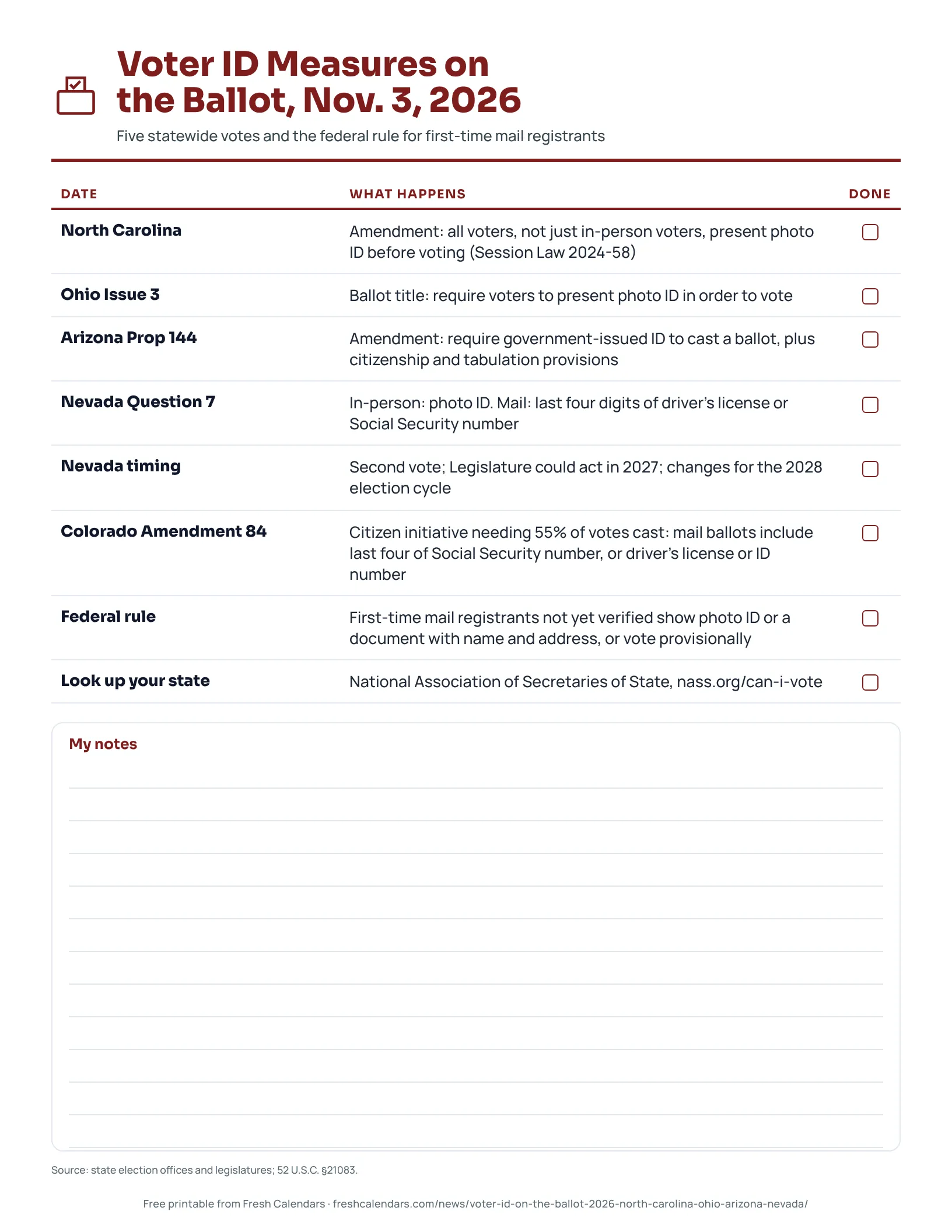
Voter ID Measures on the Ballot, Nov. 3, 2026
One page listing the voter ID measures in five states on Nov. 3, 2026, with the federal rule for first-time mail registrants.
-
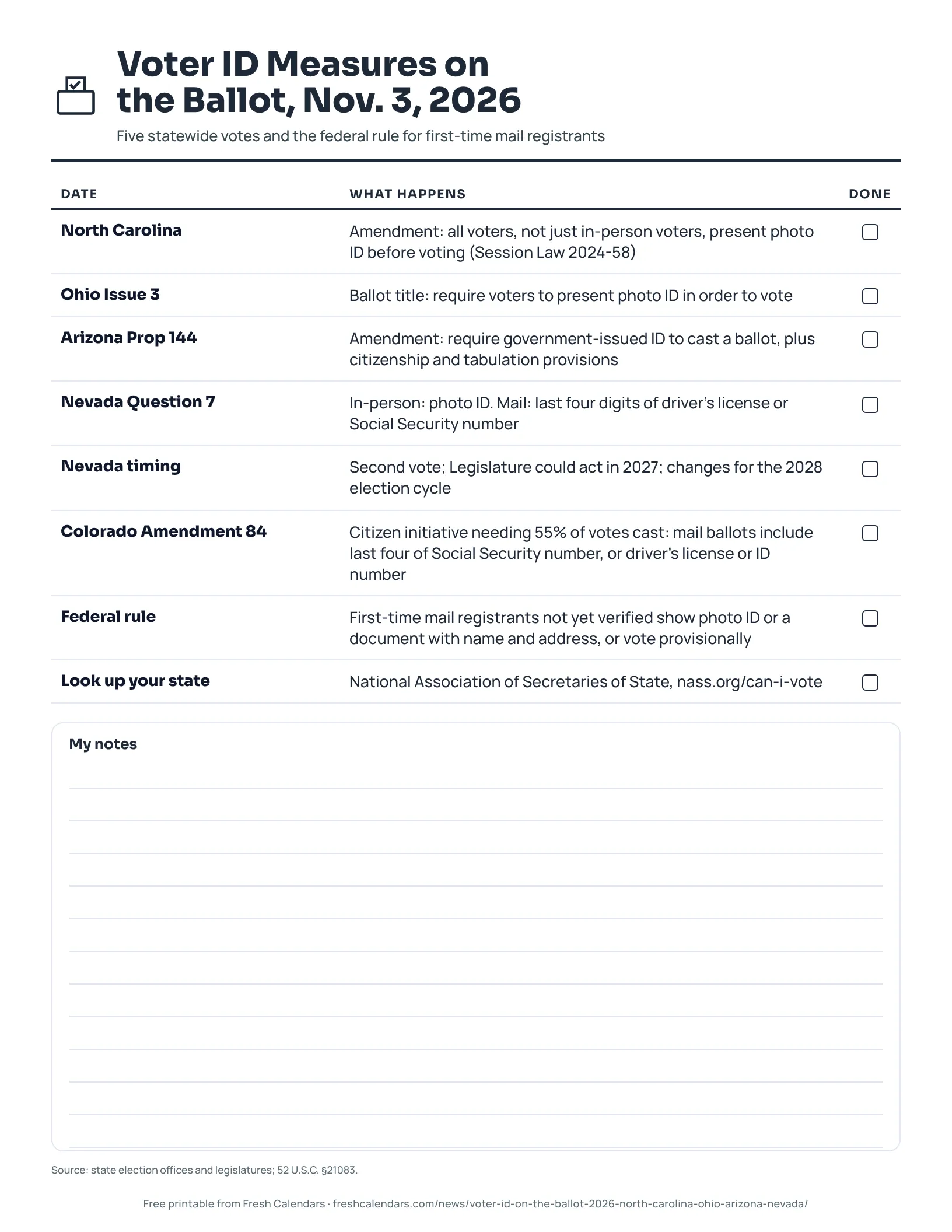
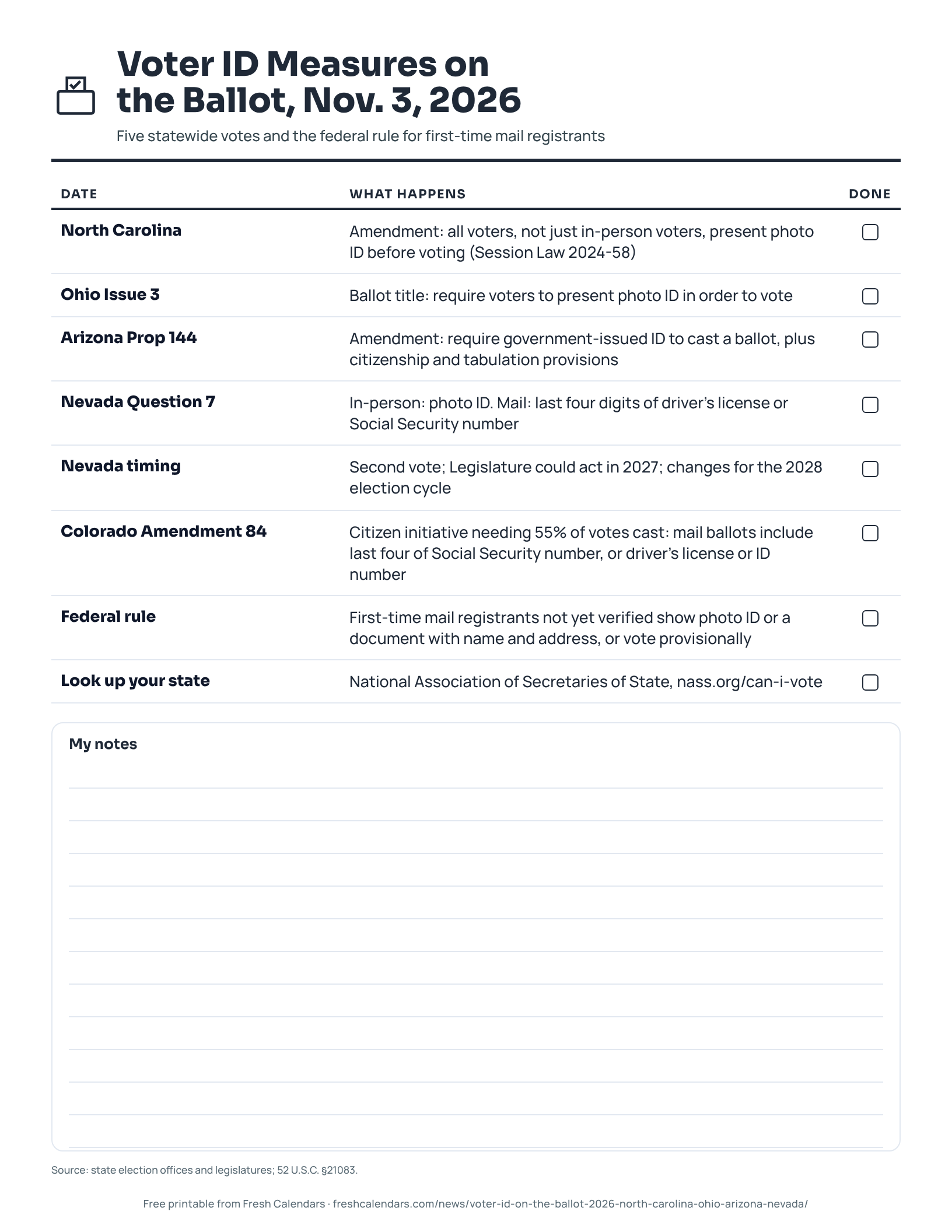
Voter ID Measures on the Ballot, Nov. 3, 2026 (ink saver)
One page listing the voter ID measures in five states on Nov. 3, 2026, with the federal rule for first-time mail registrants. Ink-saver version.
Frequently asked questions
Which states vote on voter ID on Nov. 3, 2026?
North Carolina (a constitutional amendment), Ohio (Issue 3), Arizona (Proposition 144), Nevada (Question 7) and Colorado (Amendment 84).
What would Colorado's Amendment 84 do?
Per the Colorado Legislative Council's 2026 State Ballot Information Booklet, it would require voters to include ID information with mail ballots: the last four digits of their Social Security number, or their Colorado driver's license or ID number. It is a citizen initiative and needs at least 55% of votes cast.
Does Nevada Question 7 cover mail voters?
Yes. According to the Clark County Election Department's 2026 General Election Guide, it would require mail voters to give the last four digits of their Nevada driver's license number, or of their Social Security number if they have no license.
When would Nevada's voter ID changes start?
If voters approve Question 7, the Legislature could pass related laws in 2027 and the changes would take effect for the 2028 election cycle, per the Clark County guide.
Do I need ID the first time I vote after registering by mail?
Federal law, 52 U.S.C. §21083, asks a first-time voter who registered by mail and has not been verified to show a current and valid photo ID or a document with name and address. Without it, the voter may cast a provisional ballot.
Where can I look up my own state's voter ID rules?
The National Association of Secretaries of State runs a Can I Vote page at nass.org/can-i-vote.
Sources
- Voter ID (North Carolina State Board of Elections)
- Session Law 2024-58 (North Carolina General Assembly)
- Ballot language set for Ohio Issue 3 voter ID amendment (Signal Cleveland)
- Ohio Ballot Board OKs language that puts Issue 3, or photo ID, on ballot (WYSU / Statehouse News Bureau, 2026-08-03)
- 2026 Ballot Language (final) (Arizona Secretary of State)
- 2026 General Election Guide (Clark County Election Department)
- 52 U.S. Code § 21083, Computerized statewide voter registration list requirements and requirements for voters who register by mail (Legal Information Institute, Cornell Law School)
- 2026 State Ballot Information Booklet (Blue Book), p. 8 (Colorado Legislative Council, 2026-09-10)
- Can I Vote (National Association of Secretaries of State)
Related news


More in Elections
All Elections stories →- Colorado Ballot Measures 2026: All 14 Amendments and Propositions on the Nov. 3 Ballot
- Virginia Constitutional Amendments 2026: 3 Ballot Questions on Nov. 3, What Each Changes
- Runoff Election 2026 Dates: Georgia Dec. 1, Louisiana Dec. 12, Mississippi Dec. 1
- Massachusetts Ballot Questions 2026: What Yes and No Votes Do, Early Voting Ends Oct. 30
- When Do 2026 Election Winners Take Office? Congress on Jan. 3 and 36 Governors' Dates