24-Hour Time Conversion Chart: Military Time to a.m. and p.m., Printable
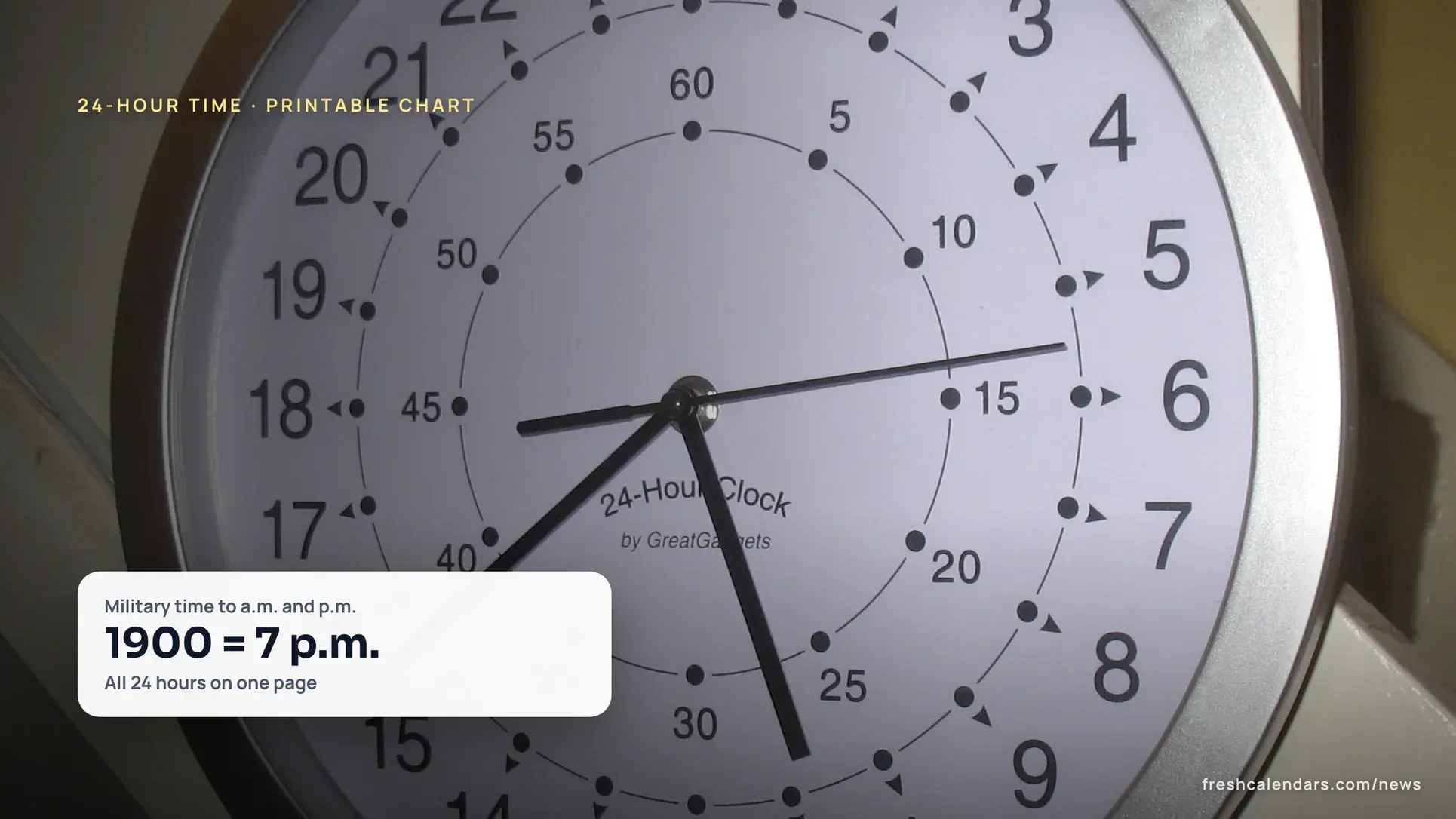
1900 is 7 p.m.: a 24-hour chart from 0000 to 2300 with a.m. and p.m. times, plus the National Institute of Standards and Technology (NIST) midnight rule.

Published 3 min read

In this article
To convert 24-hour time to a.m. and p.m., keep 0100 to 1159 as a.m. and subtract 12 from 1300 to 2359: 1900 is 7 p.m., and 1430 is 2:30 p.m. The National Institute of Standards and Technology (NIST) Time and Frequency Division describes the 24-hour clock in its “Times of Day FAQs,” and the table below is our own arithmetic from that rule. A printable one-page version is at the end.
24-hour time conversion chart, 0000 to 2300
The four-digit form without a colon is the one commonly called military time. The second column shows the same hour with a colon, the way many clocks and schedules print it. The a.m. and p.m. labels for the two 12 o’clock rows follow the Government Publishing Office (GPO) style; the next section explains why NIST disagrees.
| Military time | With colon | a.m. or p.m. |
|---|---|---|
| 0000 | 00:00 | 12 a.m. (midnight) |
| 0100 | 01:00 | 1 a.m. |
| 0200 | 02:00 | 2 a.m. |
| 0300 | 03:00 | 3 a.m. |
| 0400 | 04:00 | 4 a.m. |
| 0500 | 05:00 | 5 a.m. |
| 0600 | 06:00 | 6 a.m. |
| 0700 | 07:00 | 7 a.m. |
| 0800 | 08:00 | 8 a.m. |
| 0900 | 09:00 | 9 a.m. |
| 1000 | 10:00 | 10 a.m. |
| 1100 | 11:00 | 11 a.m. |
| 1200 | 12:00 | 12 p.m. (noon) |
| 1300 | 13:00 | 1 p.m. |
| 1400 | 14:00 | 2 p.m. |
| 1500 | 15:00 | 3 p.m. |
| 1600 | 16:00 | 4 p.m. |
| 1700 | 17:00 | 5 p.m. |
| 1800 | 18:00 | 6 p.m. |
| 1900 | 19:00 | 7 p.m. |
| 2000 | 20:00 | 8 p.m. |
| 2100 | 21:00 | 9 p.m. |
| 2200 | 22:00 | 10 p.m. |
| 2300 | 23:00 | 11 p.m. |
How do you convert military time to a.m. and p.m.?
Read the first two digits as the hour and the last two as the minutes. The minutes never change.
- 0100 to 1159: the hour is the same, with a.m. Example: 0730 is 7:30 a.m.
- 1200 to 1259: the hour stays 12, with p.m. Example: 1205 is 12:05 p.m.
- 1300 to 2359: subtract 12 from the hour, with p.m. Example: 1430 is 2:30 p.m.
- 0000 to 0059: the hour reads 12 on a 12-hour clock, with a.m. Example: 0005 is 12:05 a.m.
To go the other way, add 12 to any p.m. hour from 1 to 11 (7 p.m. becomes 19, so 1900) and keep the minutes.
| Military time | Working | a.m. or p.m. |
|---|---|---|
| 0005 | 00 reads as 12 | 12:05 a.m. |
| 0730 | Under 12, keep | 7:30 a.m. |
| 1205 | 12, keep | 12:05 p.m. |
| 1430 | 14 - 12 = 2 | 2:30 p.m. |
| 1900 | 19 - 12 = 7 | 7 p.m. |
| 2245 | 22 - 12 = 10 | 10:45 p.m. |
| 2359 | 23 - 12 = 11 | 11:59 p.m. |
What do 0000, 2400 and 12:01 a.m. mean at midnight?
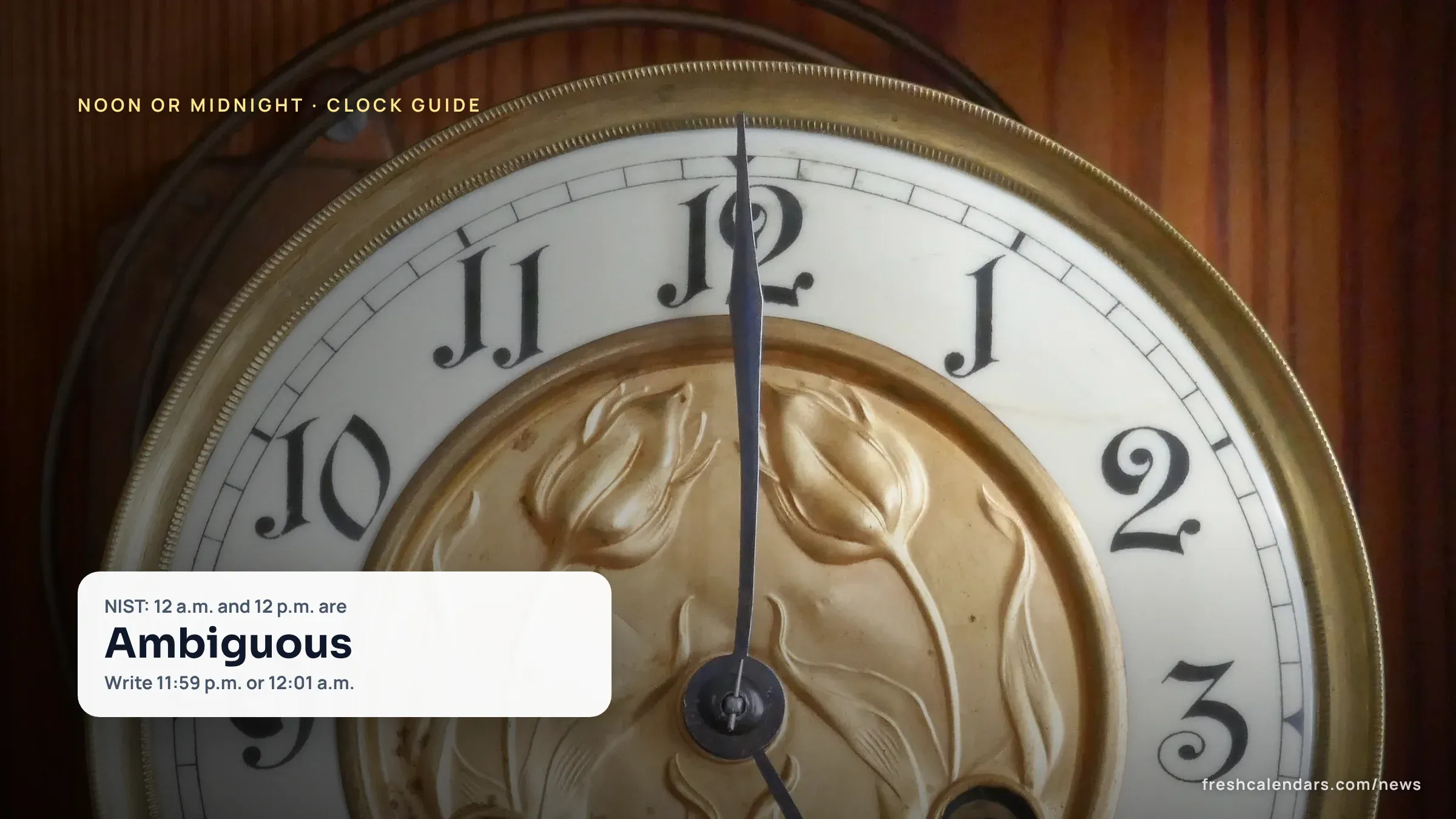
NIST says of the 12-hour labels: “This is a tricky question because 12 a.m. and 12 p.m. are ambiguous and should not be used.” It adds that “midnight is both twelve hours before noon and twelve hours after noon.” On the 24-hour clock, NIST describes “using the designation of 0000 to refer to midnight at the beginning of a given day” and 2400 for the end of a day.
So 0000 on a date and 2400 on the day before it name the same instant. NIST’s advice for writing a time yourself: “To avoid ambiguity, specification of an event as occurring on a particular day at 11:59 p.m. or 12:01 a.m. is a good idea.” In four digits, that is 2359 or 0001.
The GPO Style Manual, 2008 edition, rule 9.54, lists “12 p.m. (12 noon)” and “12 a.m. (12 midnight).” That differs from NIST’s advice, which is why the table writes “midnight” and “noon” beside those two rows. Our explainer on whether 12 noon is a.m. or p.m. covers that question and a federal agency’s midnight deadline in full. For the date half of a timestamp, see what International Organization for Standardization (ISO) 8601 is, and for midnight at the turn of the year, the New Year countdown by time zone.
Printable 24-hour time conversion chart
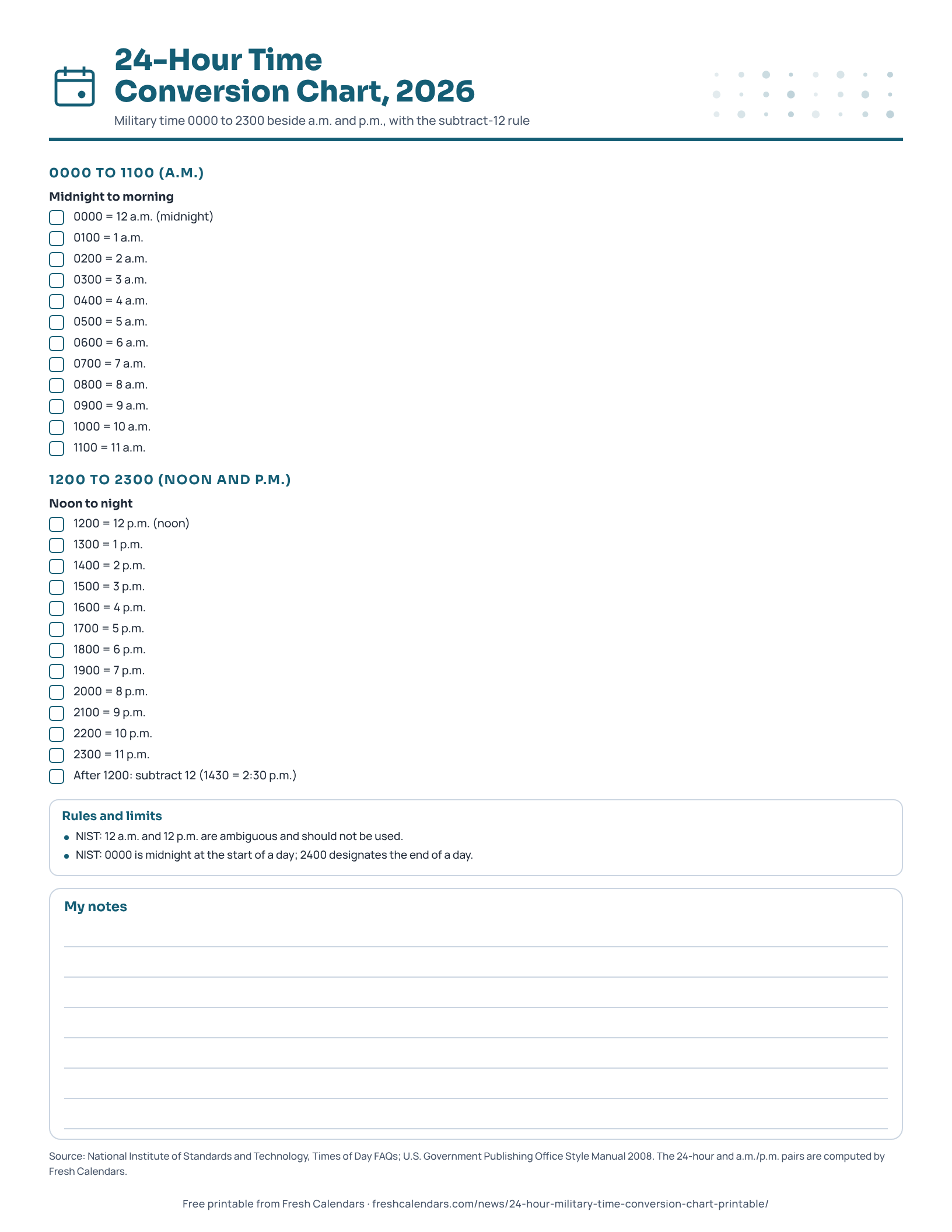
The free one-page chart lists all 24 hours from 0000 to 2300 beside their a.m. and p.m. times, the subtract-12 rule and NIST’s midnight note. Keep it by a schedule, or pair it with a printable weekly calendar or the 2027 printable yearly calendar.
Free printable downloads
Every template is free, needs no sign-up and prints on US Letter paper. Choose PDF for printing or PNG for screens and documents.
24-Hour Time Conversion Chart printables
-
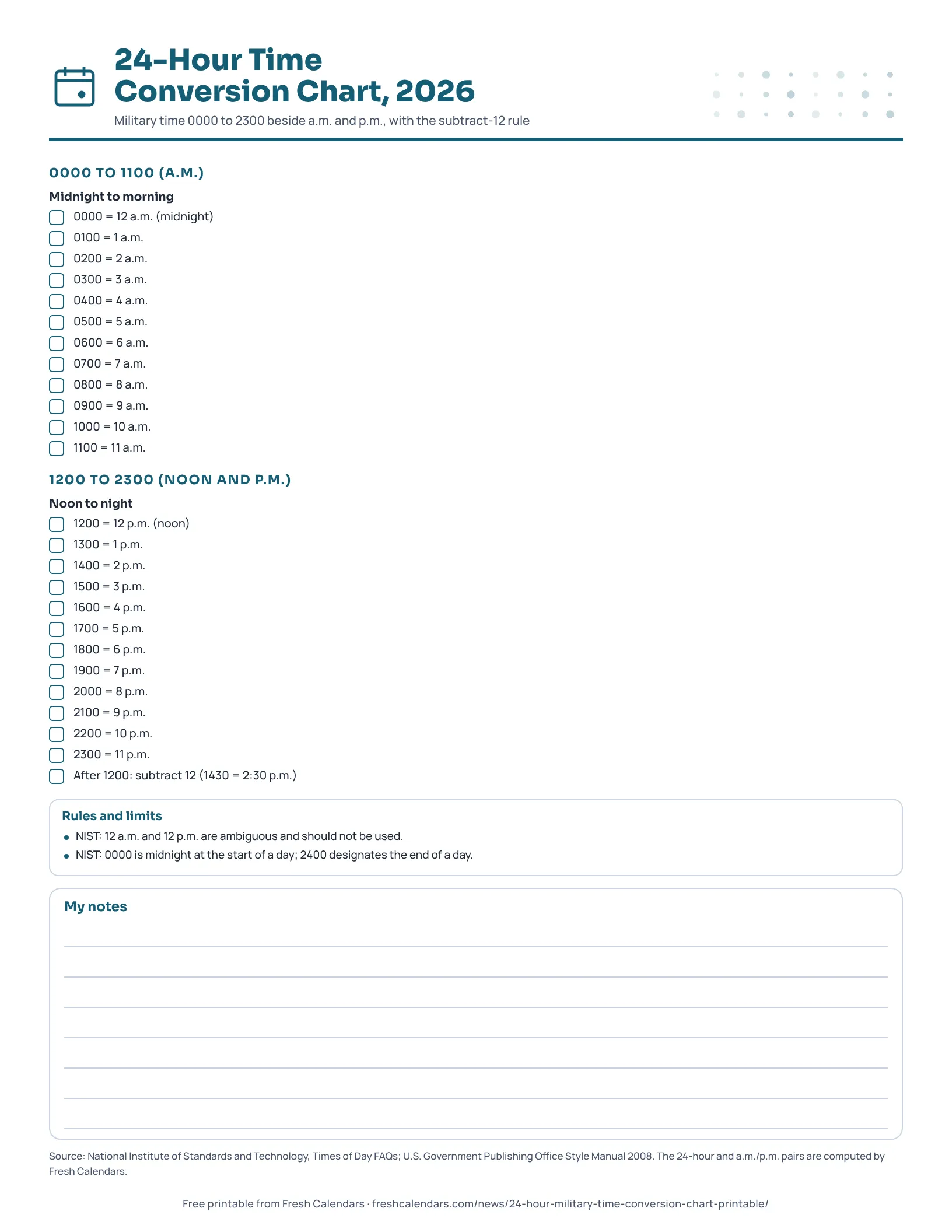
24-Hour Time Conversion Chart, 2026
A one-page 24-hour conversion chart: military time 0000 to 2300 beside a.m. and p.m., the subtract-12 rule and the NIST midnight note.
Frequently asked questions
What is 1900 in military time?
1900 is 7 p.m. Subtract 12 from 19 to get 7, and the minutes stay the same.
How do you convert 1430 to regular time?
Subtract 12 from the hour: 14 minus 12 is 2, so 1430 is 2:30 p.m.
What is 0000 in standard time?
0000 is midnight at the start of a day. NIST describes it as the designation 'to refer to midnight at the beginning of a given day.' The common 12-hour label is 12 a.m., which NIST calls ambiguous.
Is 2400 the same as 0000?
NIST describes 2400 as the designation for the end of a given day, and 0000 as the start of a day, so 2400 on one date is the same instant as 0000 on the next.
Do I subtract 12 for 1200?
No. 1200 is 12 in the 12-hour clock too, written 12 p.m. (noon) in the style the GPO manual lists.
Sources
- Times of Day FAQs (National Institute of Standards and Technology, Time and Frequency Division)
- U.S. Government Publishing Office Style Manual 2008, chapter 9, Numerals (rule 9.54) (U.S. Government Publishing Office, 2008-01-01)
Related news
-
 Is 12 Noon a.m. or p.m.? Midnight, Noon and How to Avoid the Mix-Up
-
 What Is ISO 8601? The YYYY-MM-DD Date Format, With Examples
-
 New Year’s Countdown 2027: When Midnight Arrives in Every Time Zone
-
 Julian Date Calendar 2027 and 2026: Free Printable Day-of-Year Charts, Date Codes and Julian Day Numbers
More in Calendar Guides
All Calendar Guides stories →- US Time Zones Explained: The Nine Zones, Who Sets Them and Where the Lines Run
- Seasons 2027: First Day of Spring, Summer, Fall and Winter With Exact Times
- UK Tax Year 2027-28: Starts 6 April 2027, and the Key HMRC Dates
- UTC vs GMT: What the Difference Is and Which One Your Clock Uses
- How Many Fridays Are in 2027? 53, With Every Weekday and Weekend Count
Trending now
- November 2026 Meteor Showers: Taurid Fireballs Under Dark Skies, Then the Leonids on Nov. 16-17
- Black Friday Canada 2026: Nov. 27 Date, Canadian Tire Deals From Nov. 5, Who Hasn't Announced
- SNAP Payment Schedule November 2026: Deposit Dates for Every State, With Weekend Days Flagged
- Black Friday 2026 Deals: Date Is Friday, Nov. 27, Live Countdown and Ad Tracker
- Veterans Day Free Meals 2026: 44 Chains Confirmed, 13 Discounts and a Printable List