Is 12 Noon a.m. or p.m.? Midnight, Noon and How to Avoid the Mix-Up
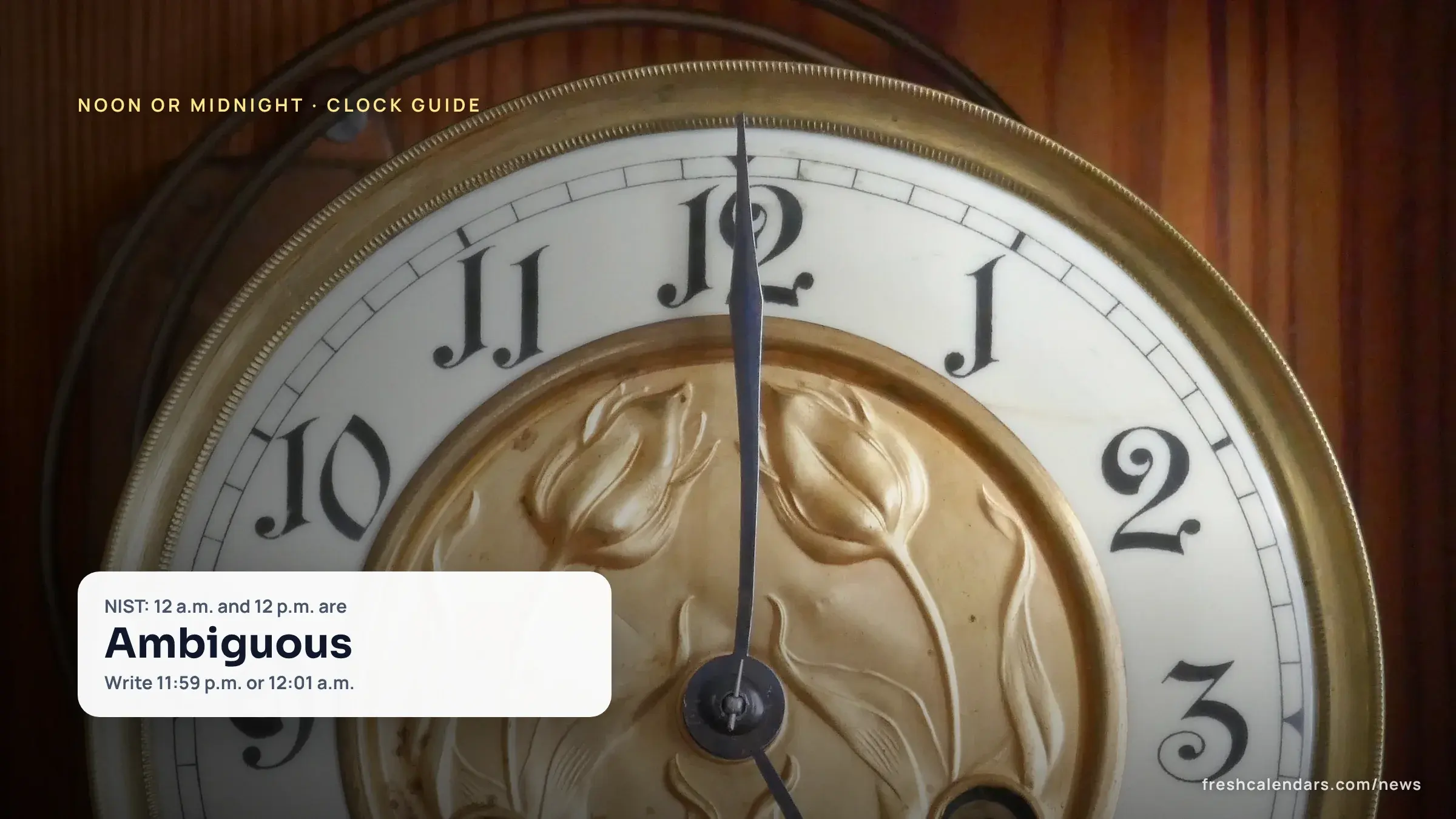
12 p.m. is noon in Government Publishing Office (GPO) style, but the National Institute of Standards and Technology (NIST) calls 12 a.m. and 12 p.m. ambiguous.

Published 5 min read

In this article
- Is 12 noon a.m. or p.m.?
- Is 12 a.m. midnight, and which day does it belong to?
- Does a midnight deadline mean the start or the end of the day?
- 24-hour clock card: 00:00 to 24:00 next to a.m. and p.m.
- How should you write noon, midnight and deadlines so nobody misreads them?
- Printable clock card for noon and midnight
The U.S. Government Publishing Office (GPO) style manual writes 12 p.m. as noon and 12 a.m. as midnight, but the National Institute of Standards and Technology (NIST) says 12 a.m. and 12 p.m. are ambiguous and should not be used. That is from NIST’s “Times of Day FAQs” (page updated Oct. 11, 2024) and the GPO Style Manual 2016. Below: a 24-row clock card, how a “midnight” deadline gets misread, and a table of safe ways to write a time. A one-page clock card to print is at the end.
Is 12 noon a.m. or p.m.?
Neither, according to NIST. The agency says “a.m.” and “p.m.” abbreviate “ante meridiem” and “post meridiem,” which mean “before noon” and “after noon,” respectively. In NIST’s words: “Since noon is neither before noon nor after noon, a designation of either a.m. or p.m. is incorrect.”
The GPO Style Manual, chapter 12 on numerals, rule 12.9b (clock time), takes the everyday convention instead and lists “12 p.m. (12 noon)” and “12 a.m. (12 midnight).” Both are federal sources, and they point different ways, so the safe move is the one NIST suggests: write “noon” and “midnight” as words, as in its example of a business open “from 8 a.m. to noon or weekends from 3:30 p.m. until midnight.”
| Source | Noon | Midnight | What it says |
|---|---|---|---|
| GPO Style Manual 2016 | 12 p.m. (12 noon) | 12 a.m. (12 midnight) | The style the manual lists for clock time |
| NIST Times of Day FAQs | “noon,” not a.m. or p.m. | “Midnight is both twelve hours before noon and twelve hours after noon” | “12 a.m. and 12 p.m. are ambiguous and should not be used” |
Is 12 a.m. midnight, and which day does it belong to?
GPO’s style says yes, 12 a.m. is midnight. The trouble is the date. NIST says midnight is both 12 hours before noon and 12 hours after noon, so one clock reading can mean the end of one day or the start of the next. NIST describes using “the designation of 0000 to refer to midnight at the beginning of a given day (or date) and 2400 to designate the end of a given day (or date).”
NASA’s Goddard page, which hosts Markus Kuhn’s summary of the international date and time standard, says the same thing: “As every day both starts and ends with midnight, the two notations 00:00 and 24:00 are available to distinguish the two midnights that can be associated with one date.” Its example: 1995-02-04 24:00 is the same instant as 1995-02-05 00:00. It adds that “00:00 is usually the preferred notation for midnight and not 24:00.” Our explainer on what International Organization for Standardization (ISO) 8601 is covers the date format those pages use.
Does a midnight deadline mean the start or the end of the day?
The word alone does not say, and one agency changed its rule over it. In a final rule published in the Federal Register on Nov. 17, 2023 (88 FR 80091), the Federal Labor Relations Authority (FLRA) changed its electronic filing deadline from midnight Eastern Time on the due date to “11:59 p.m.” on the due date, and wrote that “the 11:59 eFiling deadline is 11:59 p.m. Eastern Time.” In its Sept. 29, 2023 proposal, the FLRA gave the reason: “because midnight technically starts a new day.”
That is one agency’s rule, not a general legal test. If a form, contract or notice says “midnight,” read its own definition or ask. NIST’s advice for what you write yourself: “specification of an event as occurring on a particular day at 11:59 p.m. or 12:01 a.m. is a good idea.” The same logic applies to a countdown: the new year begins at 00:00 on the first day of the year. Our New Year’s Eve date page has the day, and the midnight countdown by time zone has the clocks.
24-hour clock card: 00:00 to 24:00 next to a.m. and p.m.
The 12-hour labels below follow the GPO convention for the two 12 o’clock rows. The 24-hour column is the way NIST and NASA describe the day, and the pairs are our arithmetic.
| 24-hour | 12-hour | In words |
|---|---|---|
| 00:00 | 12 a.m. | Midnight, start of the date |
| 01:00 | 1 a.m. | |
| 02:00 | 2 a.m. | |
| 03:00 | 3 a.m. | |
| 04:00 | 4 a.m. | |
| 05:00 | 5 a.m. | |
| 06:00 | 6 a.m. | |
| 07:00 | 7 a.m. | |
| 08:00 | 8 a.m. | |
| 09:00 | 9 a.m. | |
| 10:00 | 10 a.m. | |
| 11:00 | 11 a.m. | |
| 12:00 | 12 p.m. | Noon |
| 13:00 | 1 p.m. | |
| 14:00 | 2 p.m. | |
| 15:00 | 3 p.m. | |
| 16:00 | 4 p.m. | |
| 17:00 | 5 p.m. | |
| 18:00 | 6 p.m. | |
| 19:00 | 7 p.m. | |
| 20:00 | 8 p.m. | |
| 21:00 | 9 p.m. | |
| 22:00 | 10 p.m. | |
| 23:00 | 11 p.m. | |
| 23:59 | 11:59 p.m. | Last minute of the date |
| 24:00 | 12 a.m. the next day | Midnight, end of the date (same instant as 00:00 the next date) |
How should you write noon, midnight and deadlines so nobody misreads them?
The table applies NIST’s advice and the NASA notation to everyday cases. The “write this” column is our wording of that advice, not a quote.
| Situation | Risky | Write this |
|---|---|---|
| Deadline | “Due midnight” | “11:59 p.m. on the due date” (the FLRA wording) |
| Start of an event just after the date changes | “12 a.m. Friday” | “12:01 a.m. Friday” |
| Store or office hours | “12 p.m. to 8 p.m.” | “Noon to 8 p.m.” |
| Closing at the end of the day | “Open until 12 a.m.” | “Open until midnight” |
| Schedules and timestamps | “12 a.m.” | “00:00” for the start of a date, “24:00” for its end, with the date |
Computers avoid the question by stopping short of 24. The Internet Engineering Task Force (IETF) says in Request for Comments (RFC) 3339, section 5.7, that “this profile of ISO 8601 only allows values between “00” and “23” for the hour in order to reduce confusion.” The ISO 8601 standard itself is described by the NASA and IETF pages cited here; our guide to it has the full date forms.
Printable clock card for noon and midnight
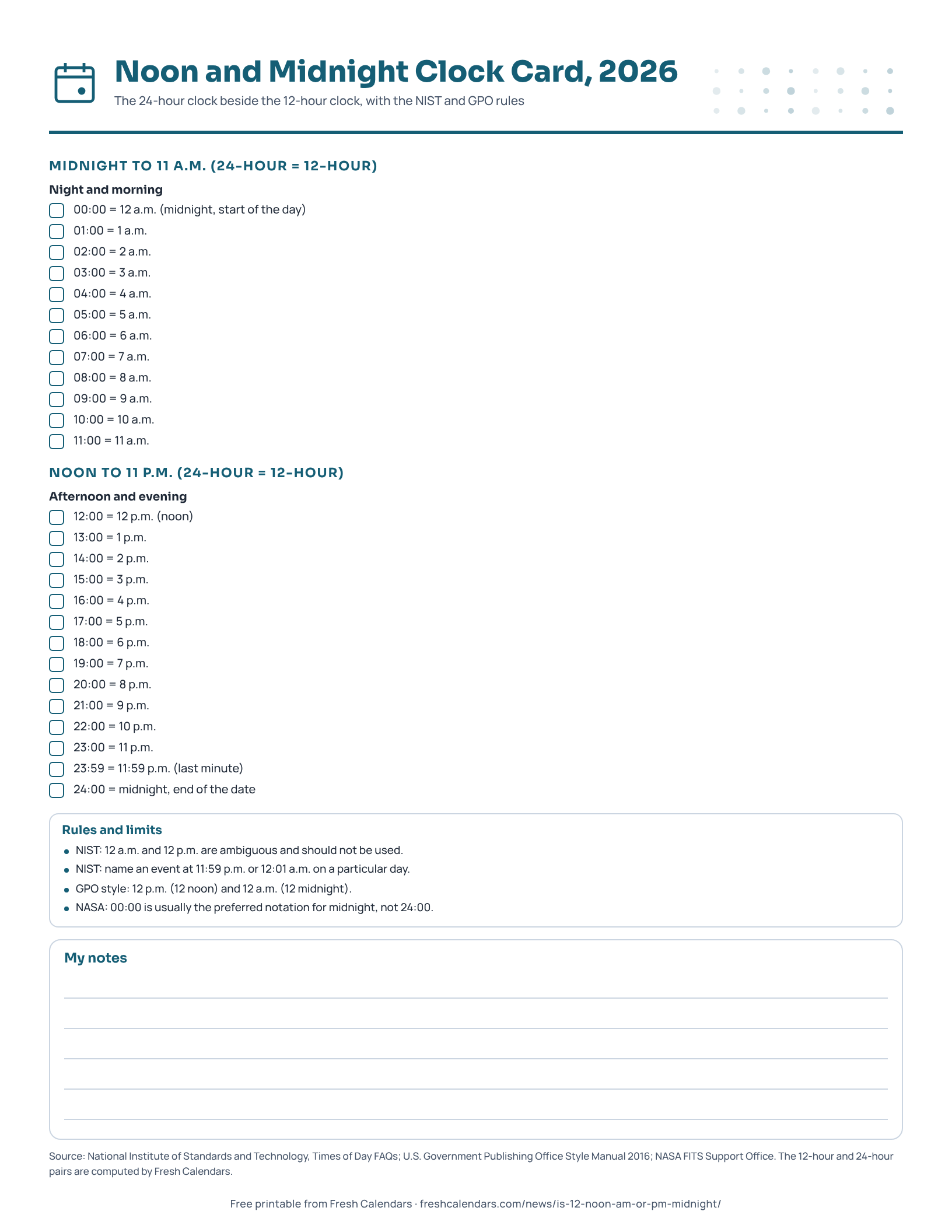
The free one-page card lists the 24-hour and 12-hour times side by side, marks noon, 11:59 p.m. and the two midnights, and prints the NIST, GPO and NASA rules in short form. Pair it with a printable weekly calendar for deadlines, or the 2027 printable yearly calendar to mark due dates in advance. For another way to number a date, see the Julian date calendar for 2027.
Free printable downloads
Every template is free, needs no sign-up and prints on US Letter paper. Choose PDF for printing or PNG for screens and documents.
Noon and Midnight Clock Card printables
-
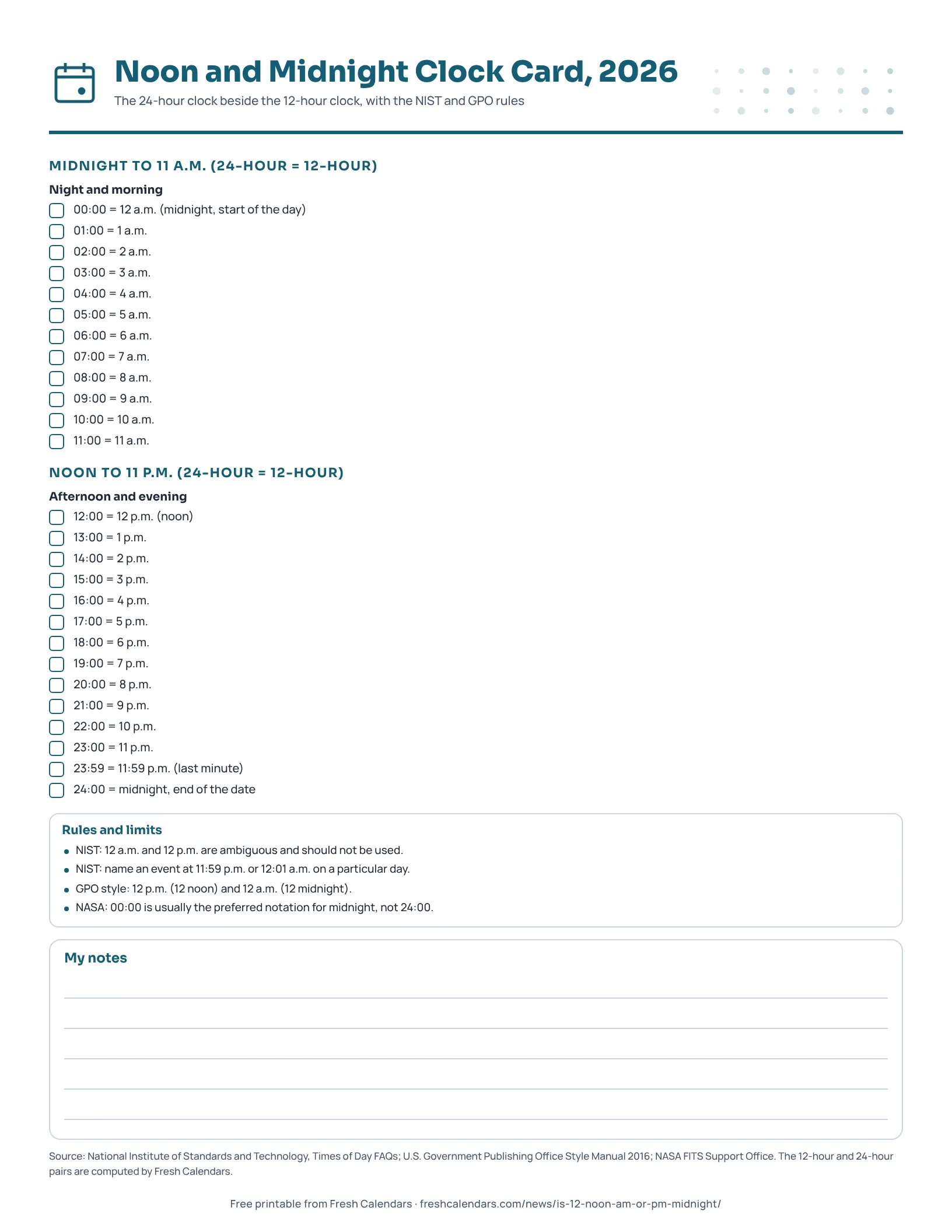
Noon and Midnight Clock Card, 2026
A one-page clock card pairing the 24-hour clock with the 12-hour clock, marking noon, midnight and 11:59 p.m., with the NIST and GPO rules.
Frequently asked questions
Is 12 p.m. noon or midnight?
In the GPO style, 12 p.m. is noon. NIST says 12 p.m. is ambiguous and should not be used; it suggests writing noon.
Is 12 a.m. the start or the end of the day?
In the GPO style, 12 a.m. is midnight. NIST says midnight is both 12 hours before and 12 hours after noon, so the label does not say which midnight is meant.
Is noon a.m. or p.m.?
Neither. NIST says a.m. means before noon and p.m. means after noon, so a designation of either one on noon is incorrect.
What is 24:00?
NASA's Goddard page on date and time notation says 24:00 is the midnight that ends a date, and gives 1995-02-04 24:00 as equal to 1995-02-05 00:00. It adds that 00:00 is usually the preferred notation for midnight.
Sources
- Times of Day FAQs (National Institute of Standards and Technology, Time and Frequency Division, 2024-10-11)
- U.S. Government Publishing Office Style Manual 2016, chapter 12, Numerals (U.S. Government Publishing Office, 2016-01-01)
- Federal Labor Relations Authority final rule, 88 FR 80091 (Federal Register, 2023-11-17)
- Federal Labor Relations Authority proposed rule (Federal Register, 2023-09-29)
- International standard date and time notation (Markus Kuhn, hosted by NASA) (NASA FITS Support Office)
- RFC 3339: Date and Time on the Internet: Timestamps (Internet Engineering Task Force (IETF), 2002-07-01)
Related news
-
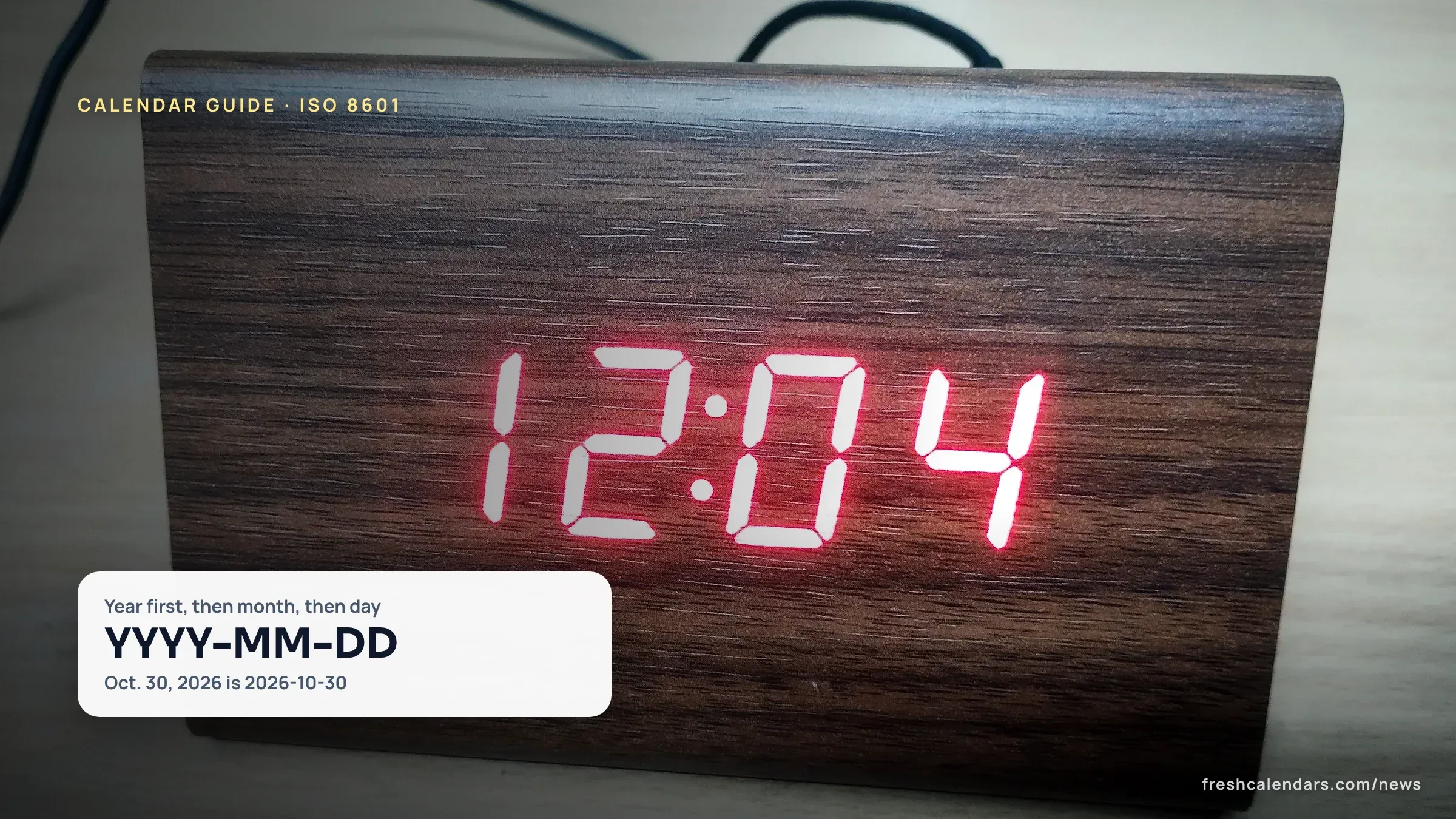 What Is ISO 8601? The YYYY-MM-DD Date Format, With Examples
-
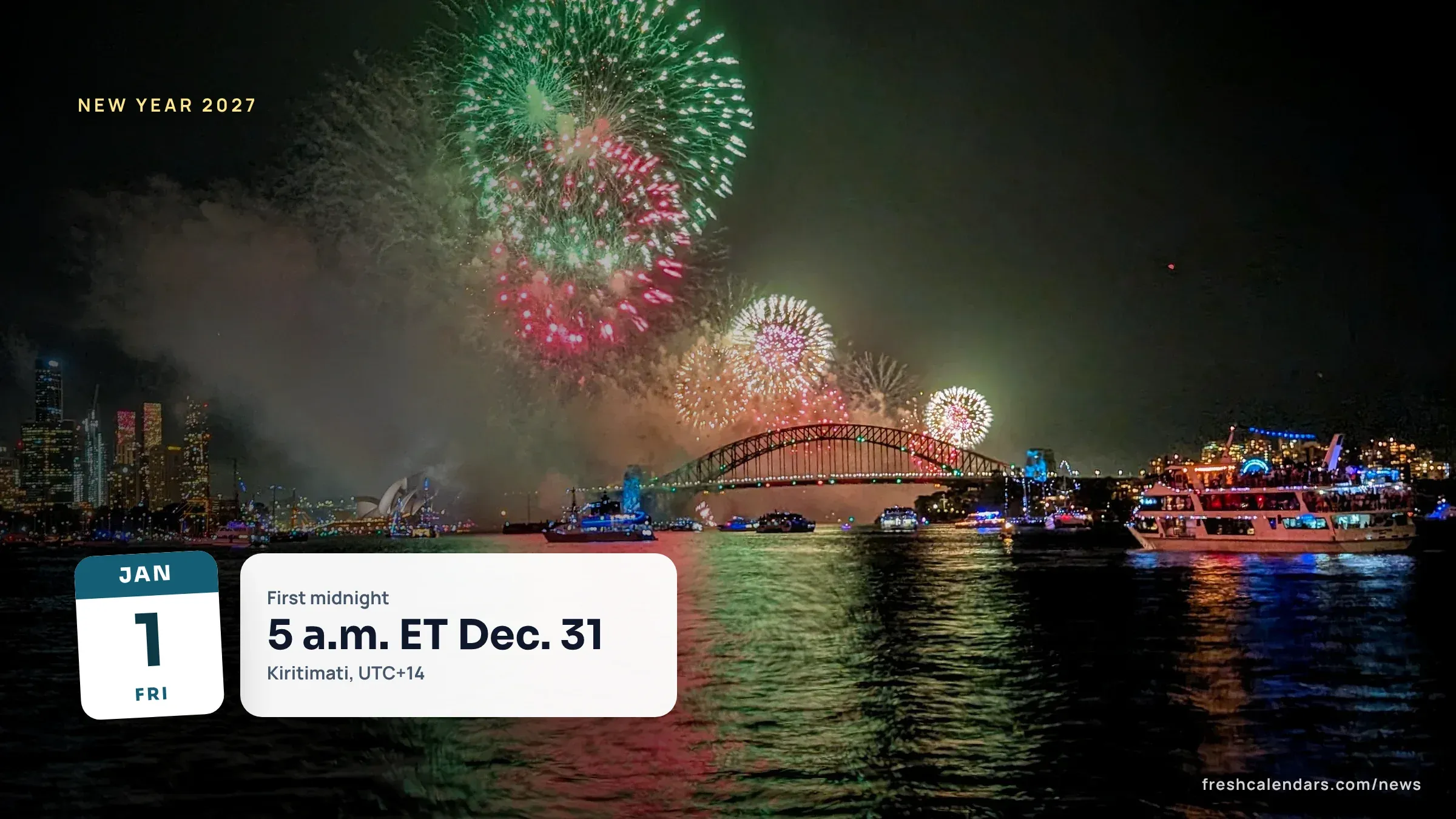 New Year’s Countdown 2027: When Midnight Arrives in Every Time Zone
-
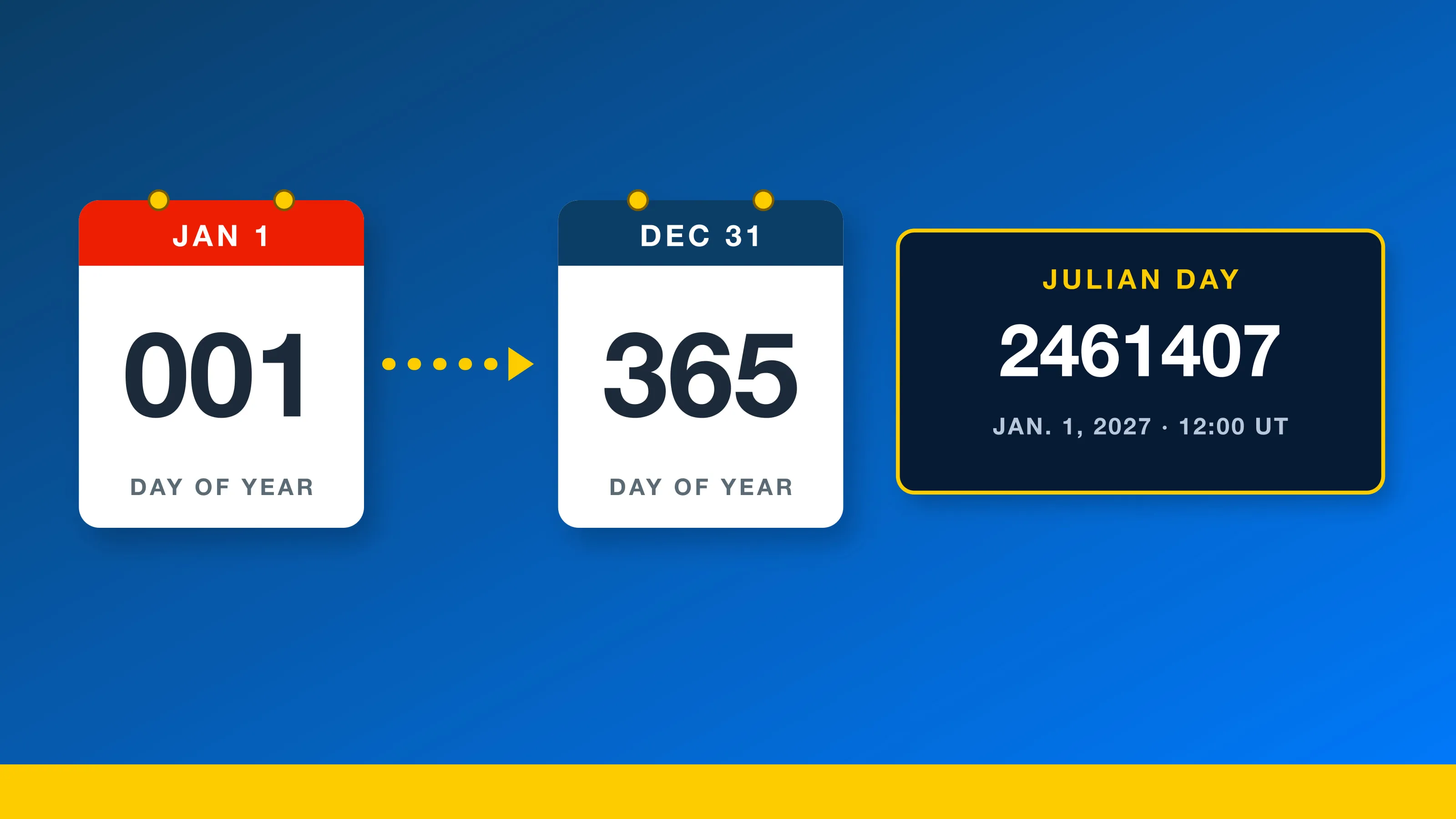 Julian Date Calendar 2027 and 2026: Free Printable Day-of-Year Charts, Date Codes and Julian Day Numbers
-
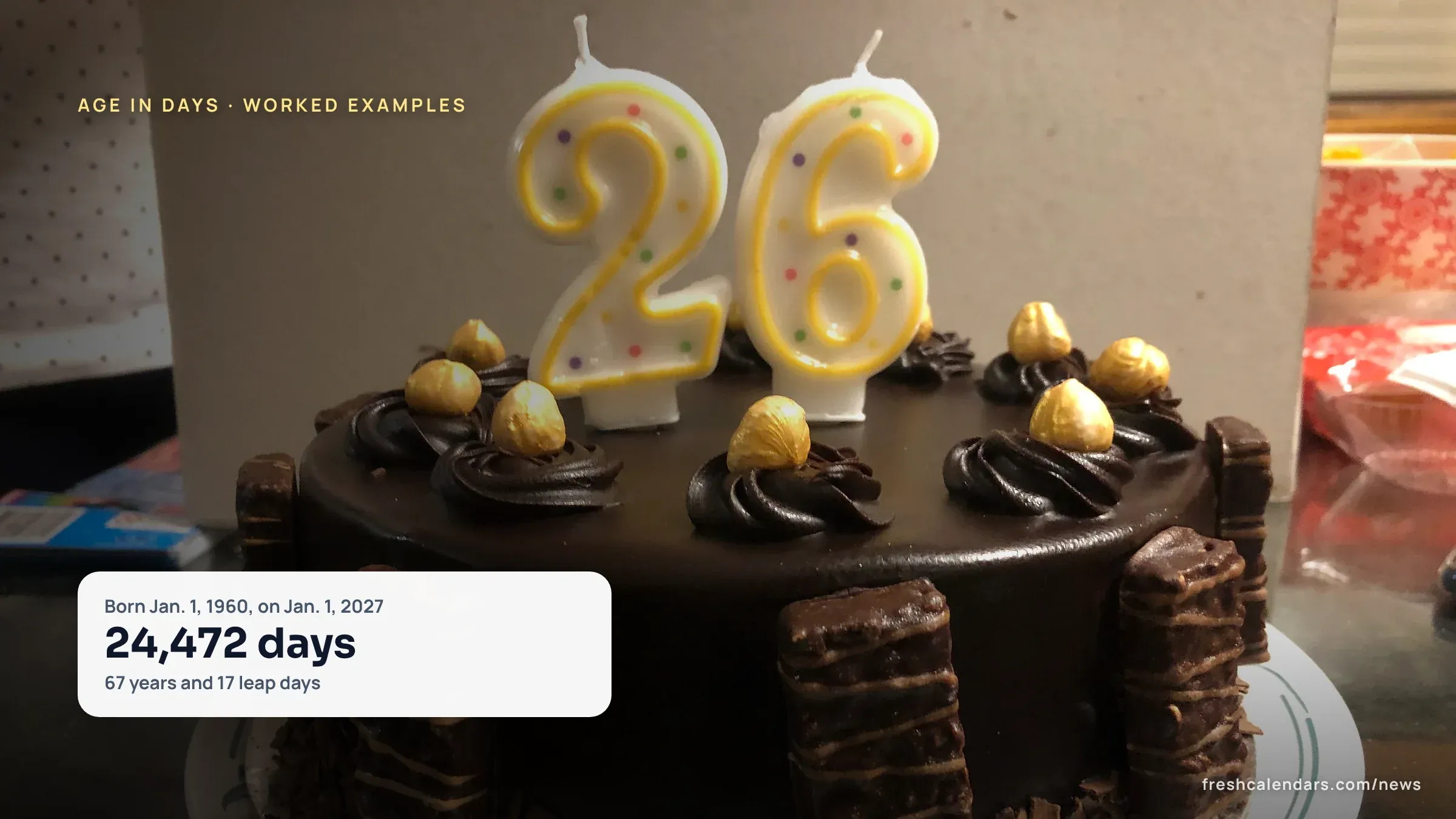 How to Calculate Your Age in Days, Weeks and Months, With Leap Years
More in Calendar Guides
All Calendar Guides stories →- MM/DD or DD/MM? How Countries Write Dates, and the ISO Fix
- Hebrew Year 5787 Is a Leap Year: Adar I, Adar II and Purim 2027
- Chinese Lunar Calendar 2027: Every Month's Start Date and No Leap Month
- Nowruz 2027: The Equinox Time and Why the Persian New Year Is March 21
- When a Deadline Falls on a Weekend: The IRS, Court and Agency Rules
Trending now
- Black Friday Canada 2026: Nov. 27 Date, Canadian Tire Deals From Nov. 5, Who Hasn't Announced
- November 2026 Meteor Showers: Taurid Fireballs Under Dark Skies, Then the Leonids on Nov. 16-17
- SNAP Payment Schedule November 2026: Deposit Dates for Every State, With Weekend Days Flagged
- Election Night 2026 Live Blog: Results Map, Senate, House and Governor Races
- Black Friday 2026 Deals: Date Is Friday, Nov. 27, Live Countdown and Ad Tracker