Leap Seconds End: UTC Goes Continuous on May 20, 2027, Not 2035
Continuous Coordinated Universal Time (UTC) takes effect May 20, 2027, the General Conference on Weights and Measures (CGPM) decided. 2035 was the 2022 limit.

Published 4 min read
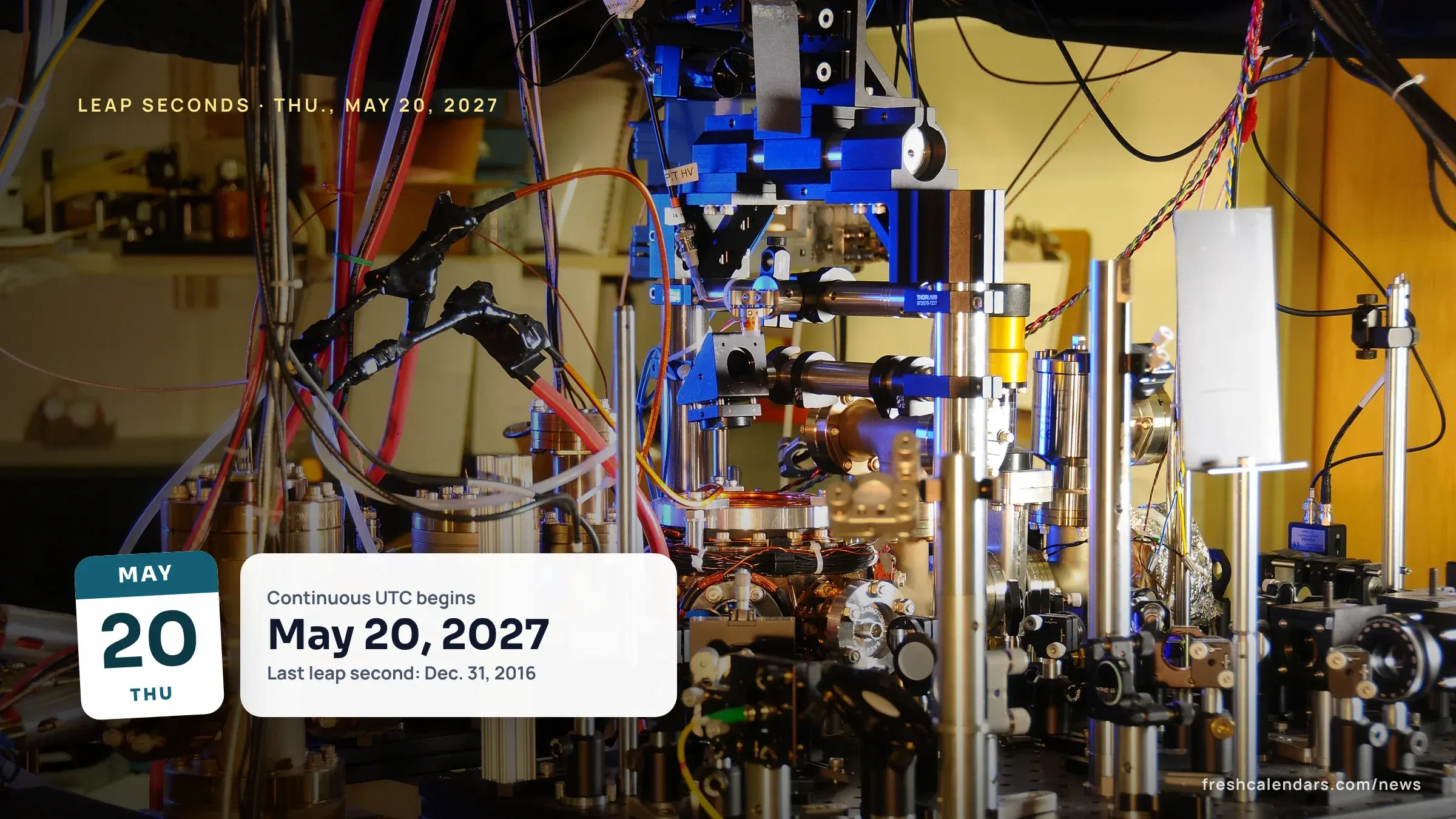
Key date
- May 20Thu Continuous UTC takes effect (no more leap seconds) In 196 days + Google
In this article
Continuous Coordinated Universal Time (UTC) becomes effective on May 20, 2027, according to Resolution 5 (2026) of the 28th General Conference on Weights and Measures (CGPM), published by the International Bureau of Weights and Measures (BIPM). The year 2035 was the outer limit in a 2022 resolution; the 2026 text sets the actual start, which is earlier. May 20, 2027 is a Thursday. Below: the official wording, a timeline back to 1972, and what the resolution does and does not say. A printable timeline is at the end.
What did the CGPM decide about leap seconds?
Resolution 5 decides that “continuous UTC will become effective on 20 May 2027.” It also decides that “the maximum value for the difference |UT1-UTC| will be 3 600 seconds (1 hour).” UT1 is time measured by Earth’s rotation; UTC is the atomic-clock-based scale used for civil time. Until now the gap between them has been kept small by adding leap seconds. The resolution says the new limit ensures “the long term continuity for UTC for several centuries.”
The BIPM page for the CGPM says the 28th meeting ran “From 13 to 15 October 2026.” The official version of the resolution is in French; the full text is on the BIPM resolution page and at doi.org. The sources we read do not give the day the CGPM adopted Resolution 5, so this story does not either.
Why did the CGPM act before 2035?
The preamble gives the reason. It says the CGPM “estimated that the probability of a negative leap second will increase rapidly in the near future.” It adds that “a negative leap second has not previously been applied” and that “it is considered to pose a high risk of causing anomalies and disruption to critical infrastructures.”
Adding a leap second has its own costs. The National Institute of Standards and Technology (NIST) says in its Leap Seconds FAQs (Oct. 11, 2024) that “adding a second to UTC can create problems for some systems,” and names data logging, telecommunications and time distribution as examples.
Leap second timeline from 1972 to May 20, 2027
| Date | What happened | Source |
|---|---|---|
| Jan. 1, 1972 | Start of the leap-second table: 10-second gap between UTC and atomic time | International Earth Rotation and Reference Systems Service (IERS) table |
| Dec. 31, 2016 | Last leap second, at the end of the day | NIST table; IERS history |
| Jan. 1, 2017 | Gap to atomic time fixed at 37 seconds “until further notice” | IERS Bulletin C 72 |
| 2022 | Resolution 4: the UT1-UTC maximum “will be increased in, or before, 2035” | BIPM |
| July 6, 2026 | Bulletin C 72: “NO leap second will be introduced at the end of December 2026.” | IERS |
| Oct. 13 to 15, 2026 | 28th CGPM meeting | BIPM |
| May 20, 2027 | Continuous UTC becomes effective | BIPM, Resolution 5 |
The IERS table runs from 10 seconds on Jan. 1, 1972 to 37 seconds on Jan. 1, 2017. By our computation from that table (37 minus 10), 27 leap seconds were added in those 45 years. NIST’s page, updated Oct. 28, 2026, confirms the current figure for UTC and International Atomic Time (TAI): “The current difference between UTC and TAI is 37 seconds.”
Is a leap second still possible before May 2027?
The IERS announces leap seconds in its Bulletin C, issued twice a year. Bulletin C 72, dated July 6, 2026, says leap seconds can be introduced “at the end of the months of December or June” and that none will be introduced at the end of December 2026. The next bulletin is due in January 2027. How the IERS will change its bulletins is not yet announced; Resolution 5 asks it “to take all necessary measures to change its operational provision for, and its announcement of, leap seconds according to the CGPM resolutions,” and to keep monitoring UT1-UTC.
What changes for you after May 20, 2027?
Resolution 5 still speaks of UTC: it makes UTC continuous rather than naming a new time standard. What changes is the rule that has kept UTC within 0.9 seconds of Earth-rotation time. NIST’s current wording is “Leap seconds ensure that UT1 - UTC will always be held within ±0.9 s.” Under Resolution 5 the allowed gap becomes 3,600 seconds, so UTC and Earth-rotation time can drift apart by up to an hour over the centuries the resolution mentions.
The pages we read do not say how individual phones, computers or software will handle the change, so this story does not either. For the difference between UTC and Greenwich Mean Time, see UTC vs GMT. The leap second is also a different thing from the extra day in the calendar: see what a leap year is and when the next leap day falls.
Printable: leap second timeline to May 20, 2027
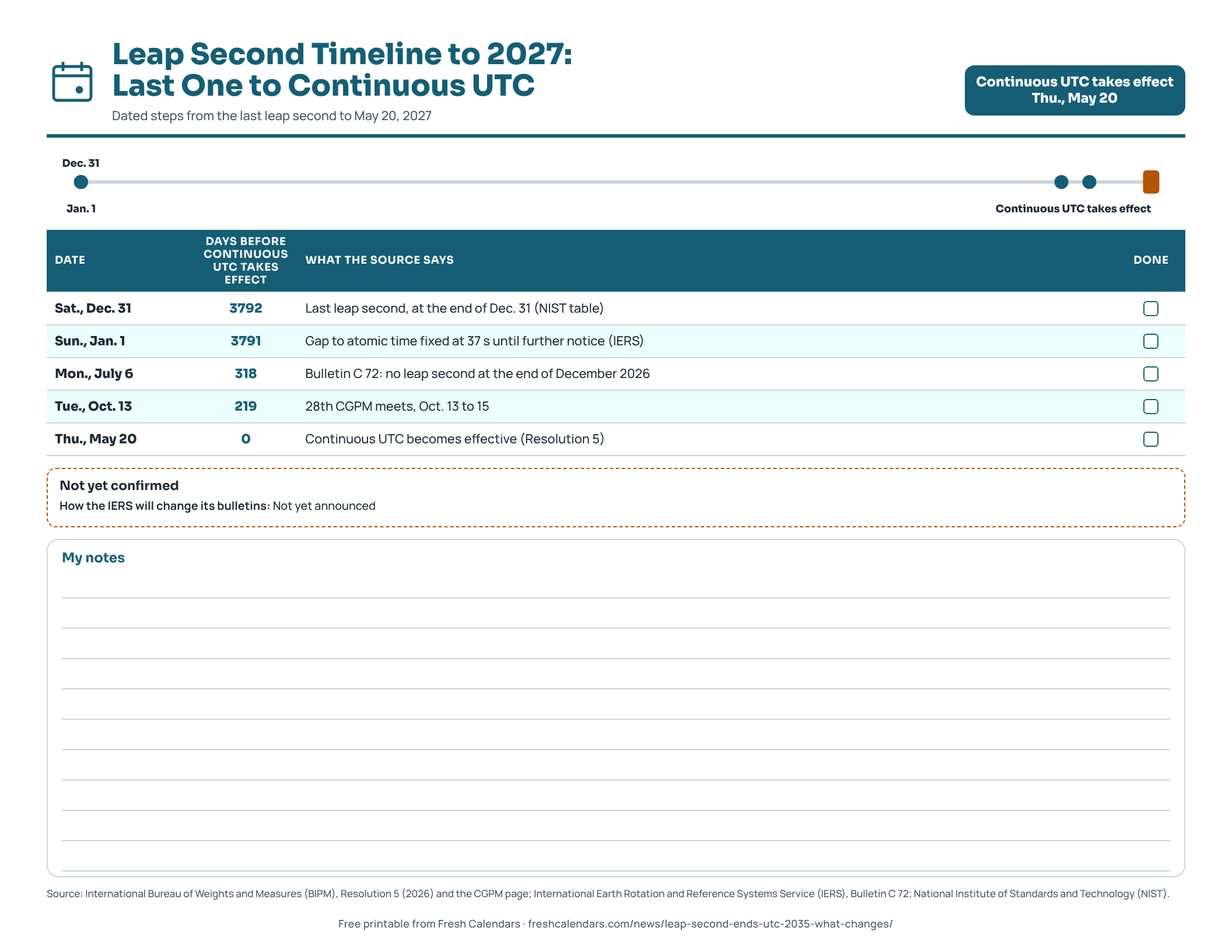
The one-page sheet lists five dated steps, from the last leap second to continuous UTC, with each source’s own words. It leaves a line for the IERS bulletin changes, which are not yet announced. Keep it beside the 2027 printable yearly calendar; May 20 is on the May printable calendar.
Free printable downloads
Every template is free, needs no sign-up and prints on US Letter paper. Choose PDF for printing or PNG for screens and documents.
Leap Second Timeline to 2027 printables
-
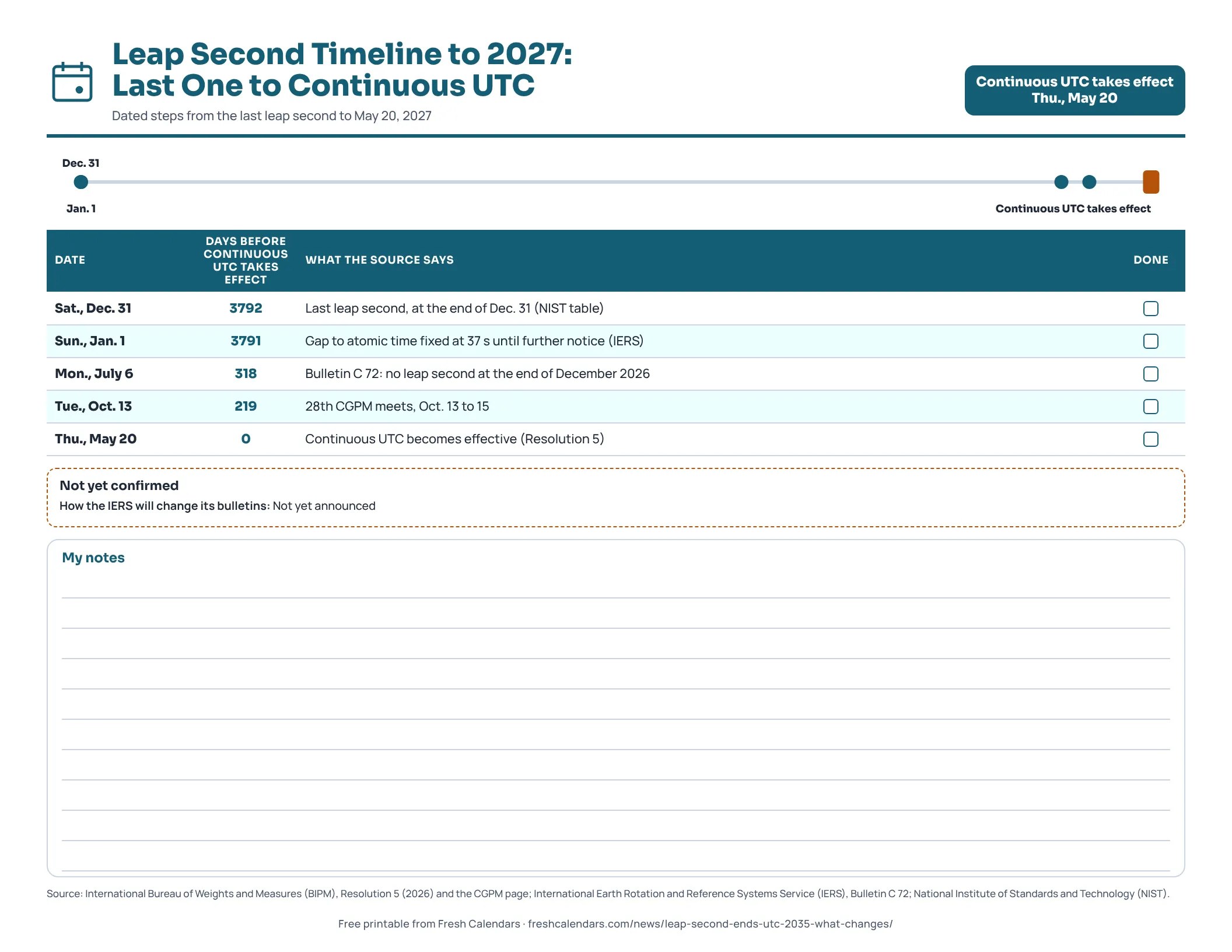
Leap Second Timeline to 2027: Last One to Continuous UTC
One page of the dated steps from the last leap second on Dec. 31, 2016 to continuous UTC on May 20, 2027, each with the source's own words.
Frequently asked questions
Have leap seconds been abolished?
The CGPM decided that continuous UTC will become effective on 20 May 2027 (Resolution 5, 2026). Continuous means no more leap seconds are needed to keep UTC close to Earth-rotation time: the allowed gap grows to 3,600 seconds.
Is it 2035 or 2027?
2035 was the outer limit in the 2022 Resolution 4, which said the maximum UT1-UTC difference will be increased "in, or before, 2035." Resolution 5 (2026) names 20 May 2027.
When was the last leap second?
At the end of Dec. 31, 2016, per the NIST table. From Jan. 1, 2017 the difference between UTC and International Atomic Time (TAI) has been 37 seconds, per IERS Bulletin C 72.
Will there be a leap second in December 2026?
No. IERS Bulletin C 72, dated July 6, 2026, says "NO leap second will be introduced at the end of December 2026."
What is a negative leap second?
The resolution's preamble says a negative leap second has not previously been applied, and that it is considered to pose a high risk of causing anomalies and disruption to critical infrastructures.
Sources
- Resolution 5 (2026) of the 28th CGPM (International Bureau of Weights and Measures (BIPM))
- General Conference on Weights and Measures (CGPM) (International Bureau of Weights and Measures (BIPM))
- Resolution 4 (2022) of the 27th CGPM (International Bureau of Weights and Measures (BIPM))
- Bulletin C 72 (International Earth Rotation and Reference Systems Service (IERS), 2026-07-06)
- UTC-TAI history (International Earth Rotation and Reference Systems Service (IERS))
- Leap second and UT1-UTC information (National Institute of Standards and Technology (NIST), 2026-10-28)
- Leap Seconds FAQs (National Institute of Standards and Technology (NIST), 2024-10-11)
Related news

More in Calendar Guides
All Calendar Guides stories →- Net 30, 60 and 90 Due Dates in 2027: A Calendar for Invoices
- US Time Zones Explained: The Nine Zones, Who Sets Them and Where the Lines Run
- Seasons 2027: First Day of Spring, Summer, Fall and Winter With Exact Times
- UK Tax Year 2027-28: Starts 6 April 2027, and the Key HMRC Dates
- 24-Hour Time Conversion Chart: Military Time to a.m. and p.m., Printable
Trending now
- Black Friday Canada 2026: Nov. 27 Date, Canadian Tire Deals From Nov. 5, Who Hasn't Announced
- SNAP Payment Schedule November 2026: Deposit Dates for Every State, With Weekend Days Flagged
- November 2026 Meteor Showers: Taurid Fireballs Under Dark Skies, Then the Leonids on Nov. 16-17
- Black Friday 2026 Deals: Date Is Friday, Nov. 27, Live Countdown and Ad Tracker
- Veterans Day Free Meals 2026: 44 Chains Confirmed, 13 Discounts and a Printable List