Why Does February Have 28 Days? Roman Calendar History and the Leap Day
February has 28 days, or 29 in a leap year. Ancient writers trace the 28 to the Roman calendar of King Numa, and the leap day to Julius Caesar's reform.

Published 6 min read

In this article
- How many days does February have each year?
- What did February look like in the Roman calendar of Romulus and Numa?
- Why did the Romans leave February short?
- How did Julius Caesar change February?
- Why does the leap day go in February?
- What changed in the 1582 Gregorian reform?
- Did every country adopt the new calendar at once?
- February history timeline to print or keep
February has 28 days in a common year and 29 in a Gregorian leap year, and the 28 traces back to the Roman calendar as the University of Chicago’s Encyclopaedia Romana summarizes it from ancient authors. The U.S. Naval Observatory (USNO) gives today’s rule: years evenly divisible by 4 are leap years, with the exception of centurial years that are not evenly divisible by 400. This guide follows February from the early Roman year to 2100 and ends with a timeline you can print.
The Roman part of the story rests on writers such as Livy and Censorinus, who lived long after the events they describe. We report what the Encyclopaedia Romana says they wrote, not a verified record, and we leave out the popular one-reason explanations.
How many days does February have each year?
Eleven months of the Gregorian year have 30 or 31 days. February is the one that changes, so a common year has 365 days and a leap year 366, as NASA’s page on calendars states. The table below is computed from the USNO rule and checked two ways, with a date library and with a Julian day number formula.
| Year | Days in February | Days in the year | Leap year? |
|---|---|---|---|
| 2024 | 29 | 366 | Yes |
| 2025 | 28 | 365 | No |
| 2026 | 28 | 365 | No |
| 2027 | 28 | 365 | No |
| 2028 | 29 | 366 | Yes |
| 2029 | 28 | 365 | No |
| 2030 | 28 | 365 | No |
| 2031 | 28 | 365 | No |
| 2032 | 29 | 366 | Yes |
| 2033 | 28 | 365 | No |
| 2034 | 28 | 365 | No |
| 2035 | 28 | 365 | No |
| 2036 | 29 | 366 | Yes |
Because the leap day sits at the end of February, March 1 is day 60 of a leap year, one day later than in a common year. Our guide to calculating the day of the year shows how to account for it, and the February printable calendars come in both lengths.
What did February look like in the Roman calendar of Romulus and Numa?
According to the Encyclopaedia Romana, the Roman calendar was attributed to Romulus himself and followed the cycles of the moon and the agricultural year. It began in March and ended in December, so the year was ten months long, and the winter months were not counted.
The same page says that, according to Livy, Numa Pompilius, the second king of Rome (715 to 673 BC), divided the year into twelve lunar months. Censorinus wrote that fifty days were added to the calendar and a day was taken from each month of thirty days, to provide for the two winter months, Januarius (January) and Februarius (February). Both of those months had 28 days.
That made a lunar year of 354 days. The Encyclopaedia Romana adds that, because of Roman superstition about even numbers, a day was added to January to make a 355-day year. Every month then had an odd number of days except February, which kept its 28. So February started short.
Why did the Romans leave February short?
The Encyclopaedia Romana gives a reason tied to the month’s role: February was considered unlucky and was devoted to rites of purification, called februa, and expiation, as suited the last month of the year. In that account the year still ended in February.
That is one ancient explanation, not a documented decision with a date. The page does not say a king shortened February to lengthen other months, and we do not either. What it does say is narrower: February had 28 days when it entered the calendar, and it stayed even while the others were odd.
How did Julius Caesar change February?
The Julian calendar was introduced by Julius Caesar in 45 BC, according to both USNO and NASA. USNO says its average year is 365.25 days, which means one leap day every four years. NASA describes the leap day as an intercalary day, designated February 29, preceding March 1.
It did not work at first. The Encyclopaedia Romana says that after Caesar the pontiffs mistakenly adjusted for leap year every three years, having counted inclusively. In 8 BC, it says, Augustus was obliged to omit any further intercalations until AD 8. Only then did the Julian calendar function as intended, with February gaining an extra day every four years.
Why does the leap day go in February?
The Rice University Galileo Project, writing about the Gregorian calendar in 1995, says the additional day that occurred every fourth year was given to February, as being the shortest month. Royal Observatory of Belgium says the Gregorian calendar adds, as in the Julian calendar, a leap day in February.
Those sources give the convention and one reason for it. They do not say it was the only reason, so we present it as the explanation they offer, not a complete one.
What changed in the 1582 Gregorian reform?
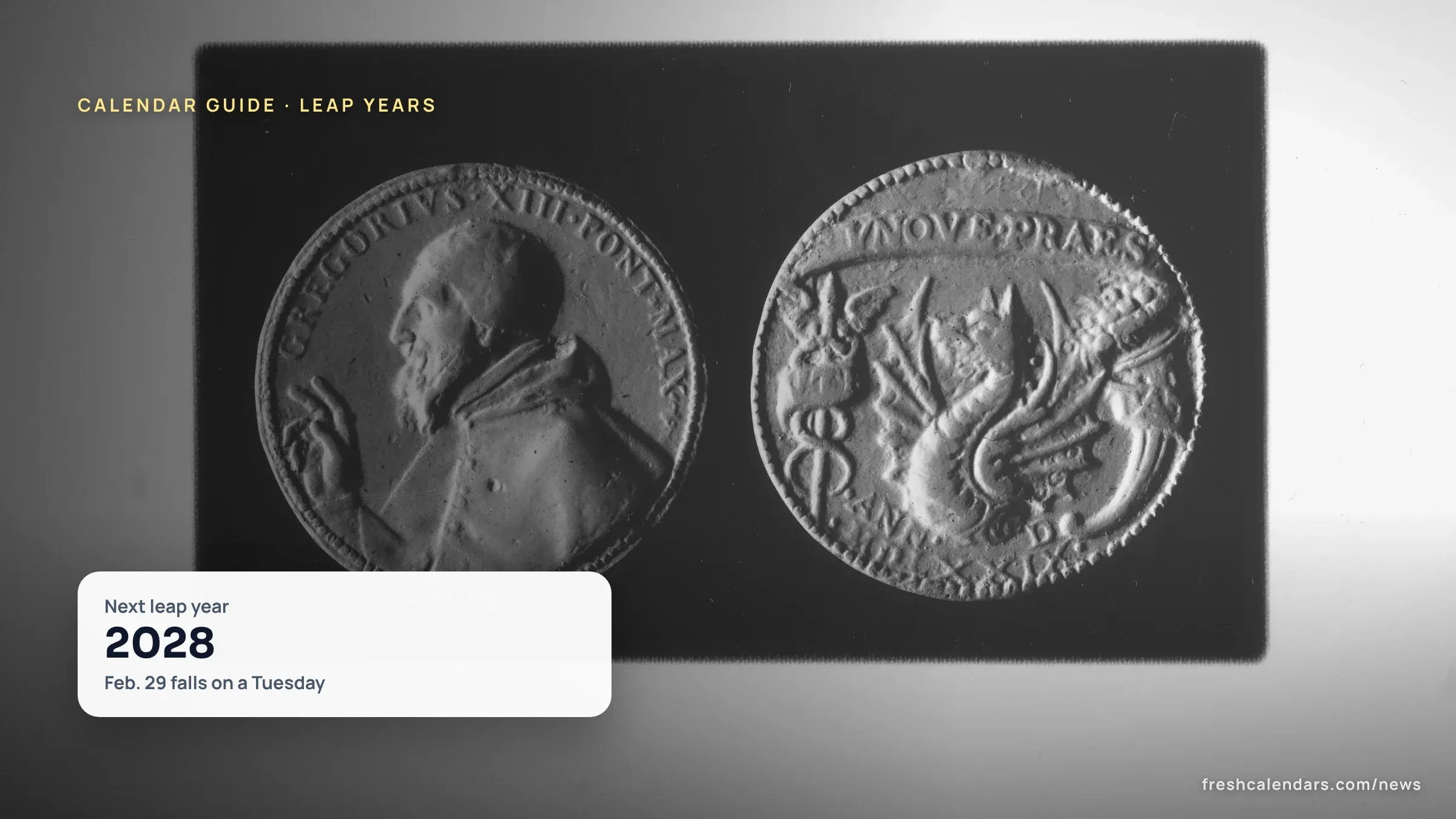
The Julian year averaged 365.25 days, but USNO puts the tropical year, the cycle of the seasons, at about 365.2422 days. The Gregorian calendar, first introduced in 1582 by the pope whose name it carries, per USNO, is 365.2425 days long on average.
It keeps February’s two lengths and changes only which years are leap years. A year divisible by 100 is a normal year unless it is also divisible by 400. National Research Council Canada (NRC) gives the example that 1900 divided by 100 is 19, so 1900 is a normal year of 365 days, while 2000 is a leap year. Over 400 years that gives 97 leap years, our computation from the rule, and 146,097 days, which NASA notes is evenly divisible by 7. Our explainer on what makes a leap year walks through the rule, and the story on how often the calendar repeats uses that 400-year cycle.
NASA says the bull Inter Gravissimus was signed on 1582 February 24, and that ten days were deleted so that 1582 October 4 was followed by 1582 October 15. The Royal Observatory of Belgium gives October 15, 1582, as the official date of the introduction.
Did every country adopt the new calendar at once?
No. Royal Museums Greenwich says Britain and her colonies made the change in 1752, when 2 September was followed by 14 September; 11 days were “lost” from September. It adds that New Year’s Day moved from 25 March to 1 January.
Sweden took a stranger path. The Royal Observatory of Belgium says Sweden became so confused in the 18th century that it had to give 30 days to February in 1712. Those two entries show that a historical date can differ by country.
February history timeline to print or keep
| When | What happened | Source |
|---|---|---|
| Attributed to Romulus | Ten-month Roman year, March to December | Encyclopaedia Romana |
| Reign of Numa, 715 to 673 BC | Twelve lunar months; January and February each 28 days (Livy, Censorinus) | Encyclopaedia Romana |
| Later | A day added to January for a 355-day year | Encyclopaedia Romana |
| 45 BC | Julius Caesar introduces the Julian calendar | USNO, NASA |
| 8 BC to AD 8 | Augustus omits intercalations; extra day every four years afterward | Encyclopaedia Romana |
| 1582 | Gregorian reform; October 4 is followed by October 15 | NASA, Royal Observatory of Belgium |
| 1712 | Sweden gives February 30 days | Royal Observatory of Belgium |
| 1752 | Britain and its colonies change; 2 September is followed by 14 September | Royal Museums Greenwich |
| 2100 | Not a leap year; February has 28 days | USNO |
The one-page version is the free printable “Why February Has 28 Days: Timeline (2026 Guide)”, with an ink-saver copy. For a year of dates beyond February, use the printable yearly calendar.
Free printable downloads
Every template is free, needs no sign-up and prints on US Letter paper. Choose PDF for printing or PNG for screens and documents.
Why February Has 28 Days printables

Why February Has 28 Days: Timeline (2026 Guide)
A one-page timeline of how February came to have 28 days, from the Roman year through the Julian and Gregorian reforms to the 2100 skipped leap day.

Why February Has 28 Days: Timeline (2026 Guide) (ink saver)
A one-page timeline of how February came to have 28 days, from the Roman year through the Julian and Gregorian reforms to the 2100 skipped leap day. Ink-saver version.
Frequently asked questions
Why does February have only 28 days?
The Encyclopaedia Romana, which summarizes ancient authors, says that when the Roman year grew to twelve months, Censorinus wrote that January and February both had 28 days, and that February was the only month left with an even count. The Gregorian calendar kept that 28.
Why does February have 29 days every four years?
The USNO says years evenly divisible by 4 are leap years, with the exception of centurial years not evenly divisible by 400. The Royal Observatory of Belgium says the leap day is added in February, as in the Julian calendar.
Is 2100 a leap year?
No. The USNO lists 1700, 1800, 1900 and 2100 as years that are not leap years, because centurial years must also be divisible by 400. February 2100 has 28 days.
Was February always the shortest month?
Not as a month. The Encyclopaedia Romana says the early Roman year was ten months long and did not count the winter months. After January and February were added, both had 28 days, and January then gained a day to reach 355 days.
Did every country change calendars at the same time?
No. NASA dates the Gregorian reform to October 1582, when October 4 was followed by October 15. Royal Museums Greenwich says Britain and its colonies changed in 1752, when 2 September was followed by 14 September.
Sources
- Leap Years (U.S. Naval Observatory, 2026-10-30)
- Introduction to Calendars (U.S. Naval Observatory, 2026-10-30)
- Roman calendar (Encyclopaedia Romana, University of Chicago, 2026-10-30)
- Calendars and their History (NASA, 2012-10-14)
- The Gregorian calendar (Royal Observatory of Belgium, 2022-04-12)
- Which years are leap years and can you have leap seconds? (Royal Museums Greenwich, 2026-10-30)
- The Gregorian Calendar (Rice University Galileo Project, 1995-01-01)
Related news



More in Calendar Guides
All Calendar Guides stories →- What Is the 100th Day of the Year? April 10, or April 9 in Leap Years
- How Many Days Are Left in the Year? The Formula, Plus the Count From Oct. 30, 2026
- How to Print a Calendar PDF at Actual Size: Print Settings for Edge, Mac and Home Printers
- Monday Start vs Sunday Start Calendar: Same Dates, Different First Column
- What Is a Fiscal Year? Federal, State and UK Dates With Quarter Tables