What Is a Leap Year? The 4, 100 and 400 Rule, With Every Leap Year to 2100
A leap year has 366 days, with Feb. 29 added. The U.S. Naval Observatory (USNO) says years divisible by 4 qualify, except century years not divisible by 400.

Published 5 min read
In this article
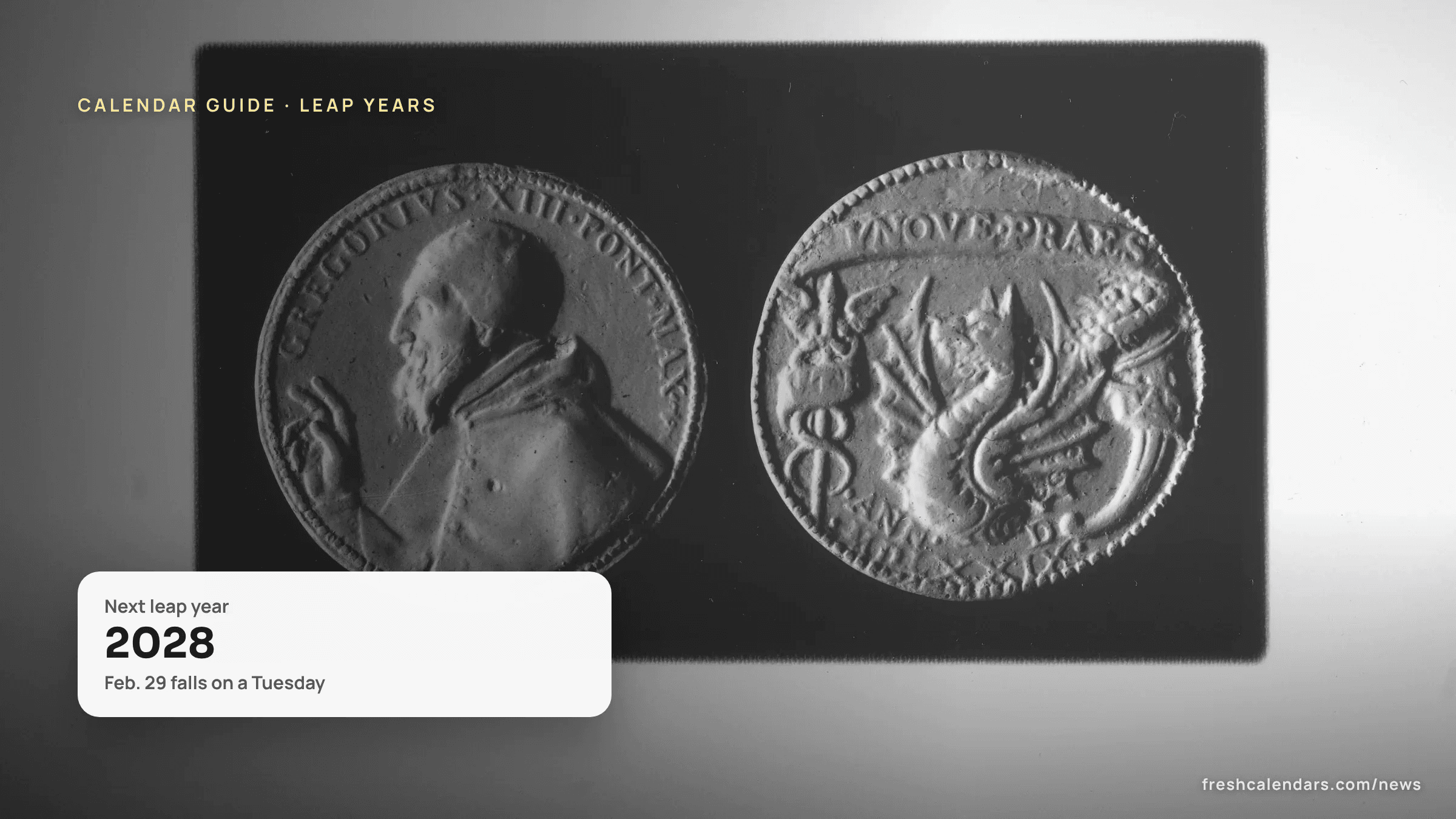
A leap year has 366 days instead of 365, and the extra day is Feb. 29, according to NASA’s calendar reference. The U.S. Naval Observatory (USNO) gives the Gregorian rule: “years evenly divisible by 4 are leap years, with the exception of centurial years that are not evenly divisible by 400.” The next one is 2028, and the table below lists every leap year to 2100 with the weekday of its Feb. 29.
How does the leap year rule work?
The test takes three steps, in this order:
- Divide the year by 4. If it does not divide evenly, it is a common year with 365 days.
- If it divides by 4, divide it by 100. If it does not divide evenly by 100, it is a leap year.
- If it divides by 100, divide it by 400. The National Research Council Canada (NRC) says a year divisible evenly by 400 is a leap year, so 2000 is one. A year divisible by 100 but not by 400 is a normal year.
Stopping after step 1 gives wrong answers for century years. The NRC works the example: 1900 divided by 100 is 19, so 1900 is a normal year of 365 days. The USNO lists 1700, 1800, 1900 and 2100 as years that are common, and 1600, 2000 and 2400 as leap years.
| Year | Divisible by 4? | By 100? | By 400? | Result |
|---|---|---|---|---|
| 2025 | No | n/a | n/a | Common year, 365 days |
| 2024 | Yes | No | n/a | Leap year, 366 days |
| 1900 | Yes | Yes | No | Common year, 365 days |
| 2000 | Yes | Yes | Yes | Leap year, 366 days |
| 2100 | Yes | Yes | No | Common year, 365 days |
| 2400 | Yes | Yes | Yes | Leap year, 366 days |
Royal Museums Greenwich makes the same point: the year 2000 was a leap year, although 1900 was not. Our one-page leap year test puts the three steps and these examples on a sheet.
Why does the calendar need leap years?
The USNO says the cycle of the seasons, the tropical year, is approximately 365.2422 days. A calendar year has to be a whole number of days, so a plain 365-day year falls about 0.2422 day short each year. Four such years leave a gap of almost a full day (4 x 0.2422 = 0.9688), which is what one leap day makes up.
The Julian calendar added a leap day every fourth year, an average year of 365.25 days, the USNO says. That is slightly longer than the tropical year, and the difference adds up. NASA says 10 days were deleted in 1582, so that October 4 was followed by October 15. The Royal Observatory of Belgium gives Oct. 15, 1582, as the official date the Gregorian calendar began, and the USNO credits its introduction to a pope named Gregory.
The Gregorian rule drops three leap days every 400 years, which sets the average year at 365.2425 days, the USNO says. Subtracting the two USNO figures leaves 0.0003 day a year, so the Gregorian calendar drifts by one day only after a little over 3,000 years. That subtraction is our arithmetic, not a figure the USNO publishes.
Which years are leap years from 2024 to 2100?
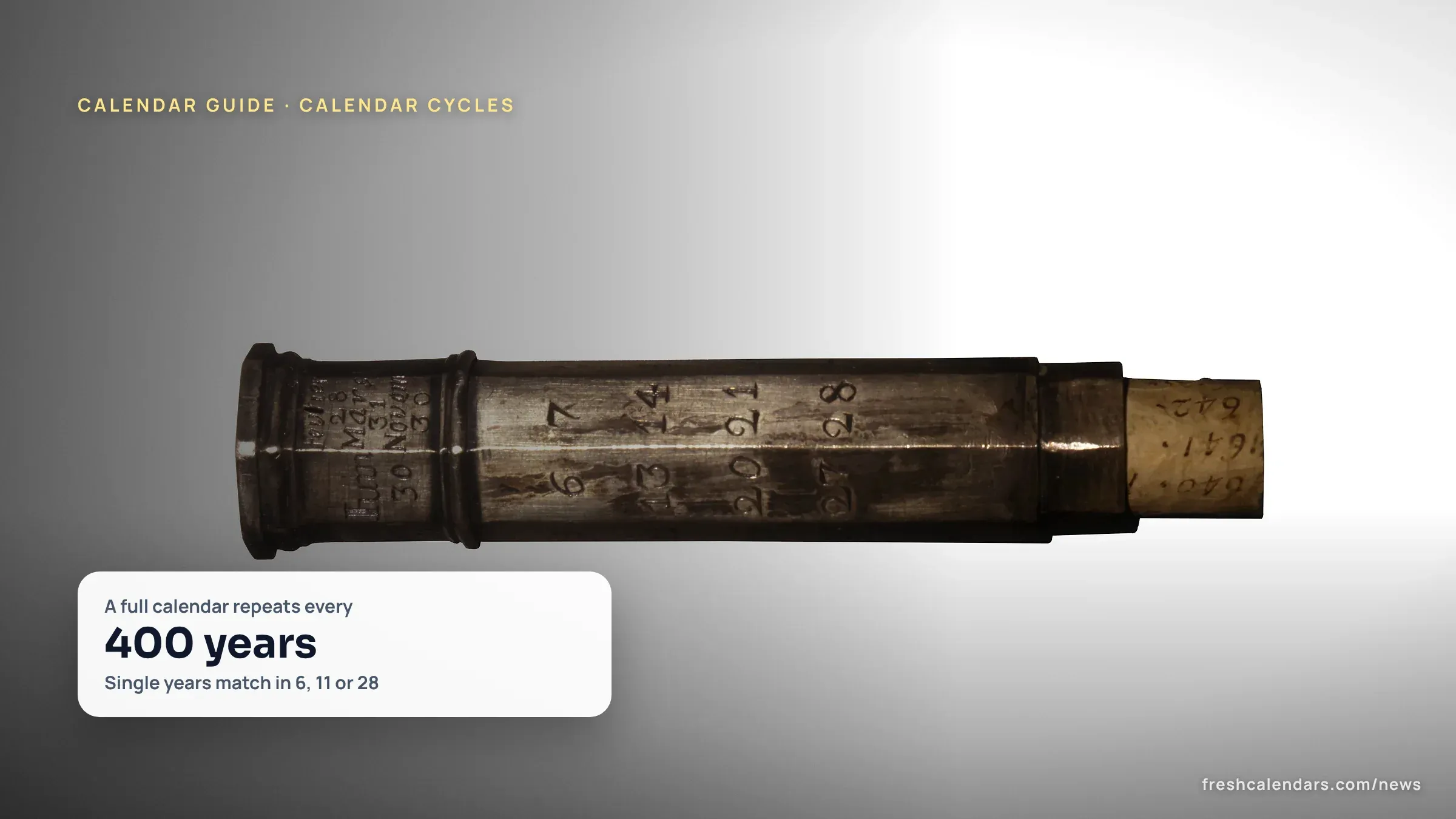
NASA’s reference describes the Gregorian calendar as a cycle of 400 years with 146,097 days. We counted 97 leap years in that cycle, so 97 x 366 plus 303 x 365 equals 146,097. Because 146,097 is evenly divisible by 7, NASA says the calendar repeats exactly after 400 years: 20,871 whole weeks. For the shorter repeats inside a century, see how often the calendar repeats.
The weekdays below are computed by Fresh Calendars with two independent methods (JavaScript dates and Zeller’s congruence), and both agree on every row.
| Leap year | Weekday of Feb. 29 |
|---|---|
| 2024 | Thursday |
| 2028 | Tuesday |
| 2032 | Sunday |
| 2036 | Friday |
| 2040 | Wednesday |
| 2044 | Monday |
| 2048 | Saturday |
| 2052 | Thursday |
| 2056 | Tuesday |
| 2060 | Sunday |
| 2064 | Friday |
| 2068 | Wednesday |
| 2072 | Monday |
| 2076 | Saturday |
| 2080 | Thursday |
| 2084 | Tuesday |
| 2088 | Sunday |
| 2092 | Friday |
| 2096 | Wednesday |
| 2100 | No Feb. 29: not a leap year (Feb. 28 is followed by Mar. 1) |
In the 2028 to 2096 rows, each leap year’s Feb. 29 falls two weekdays earlier in the week than the one four years before it: 2024 Thursday, 2028 Tuesday, 2032 Sunday. That follows from 1,461 days in four years, which is 208 weeks and 5 days. The step breaks only at 2100, which has no leap day.
Is 2028 the next leap year?
Yes. Today is Oct. 30, 2026, so the next Feb. 29 is in 2028, on a Tuesday. February has 28 days in 2026 and 2027, and 29 in 2028. The following leap years are 2032, 2036 and 2040. If you plan across a leap day, the day-of-year calculation shifts by one from March 1 onward. The February printable calendars show the month’s layout, and the printable yearly calendar has a year view.
Why does February get the extra day?
The Rice University Galileo Project says the additional day that came every fourth year was given to February “as being the shortest month.” The NASA reference describes the leap day as an intercalary day, designated Feb. 29, that comes before Mar. 1. The Royal Observatory of Belgium says the Gregorian calendar adds, as in the Julian calendar, a leap day in February.
The Encyclopaedia Romana at the University of Chicago, which summarizes ancient authors, says Censorinus wrote that Januarius and Februarius were added to the Roman calendar with 28 days each. Why February has 28 days in the first place has its own story: why February has 28 days.
Which leap year mistakes are common?
- Dividing by 4 and stopping. 1900 and 2100 divide by 4 and are still common years.
- Treating every century as common. 2000 and 2400 divide by 400 and are leap years.
- Expecting a longer year to change other months. The leap day is the Feb. 29 that NASA describes; the year then has 366 days.
- Applying the Gregorian rule to older dates. Royal Museums Greenwich says the Julian calendar averaged 365.25 days a year, and that Britain and its colonies changed calendars in 1752, when 2 September was followed by 14 September.
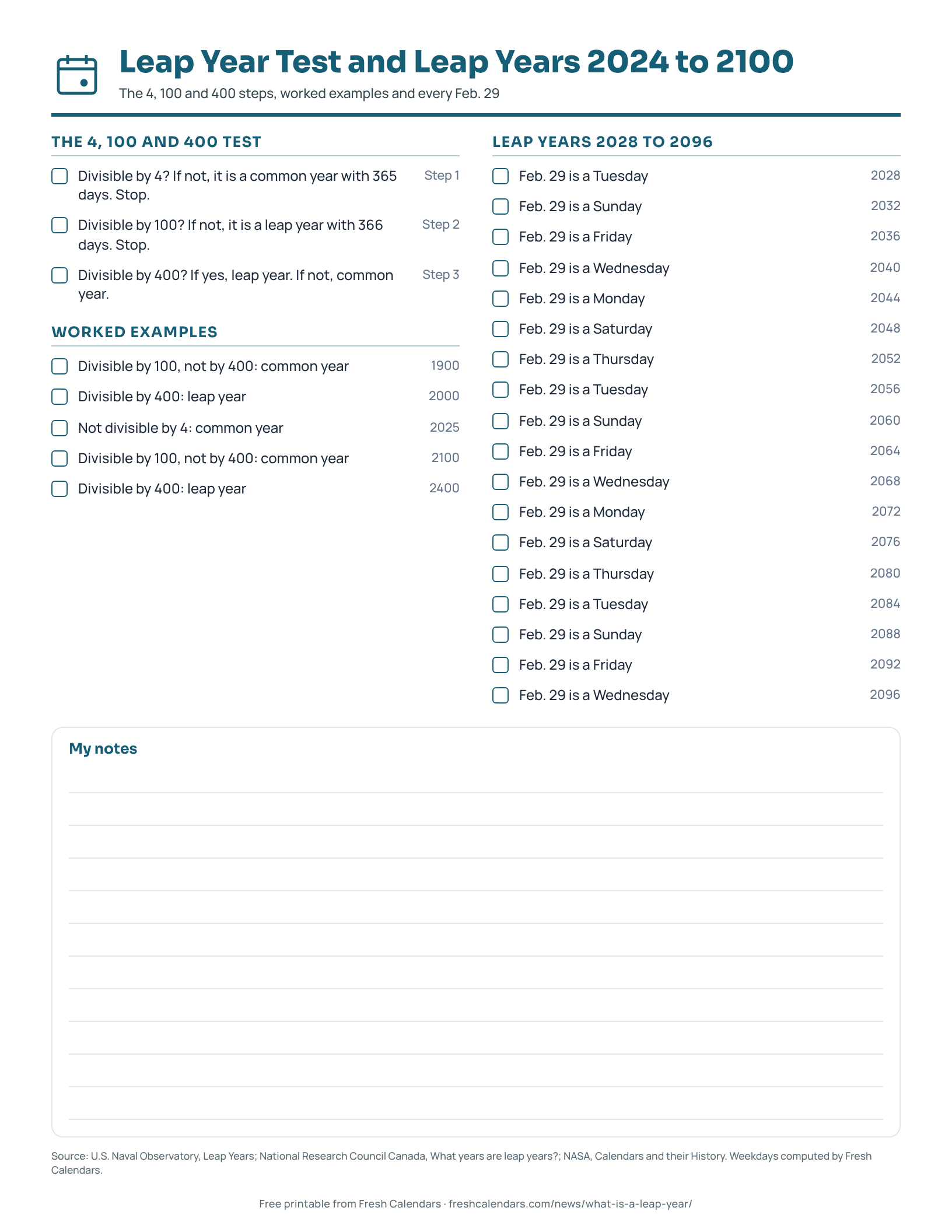
Leap year test printable
The printable on this page holds the three test steps, six worked examples and the Feb. 29 weekday for each leap year from 2028 to 2096. It prints on US Letter, with an ink-saver version for home printers.
Free printable downloads
Every template is free, needs no sign-up and prints on US Letter paper. Choose PDF for printing or PNG for screens and documents.
Leap Year Test and Leap Years 2024 to 2100 printables
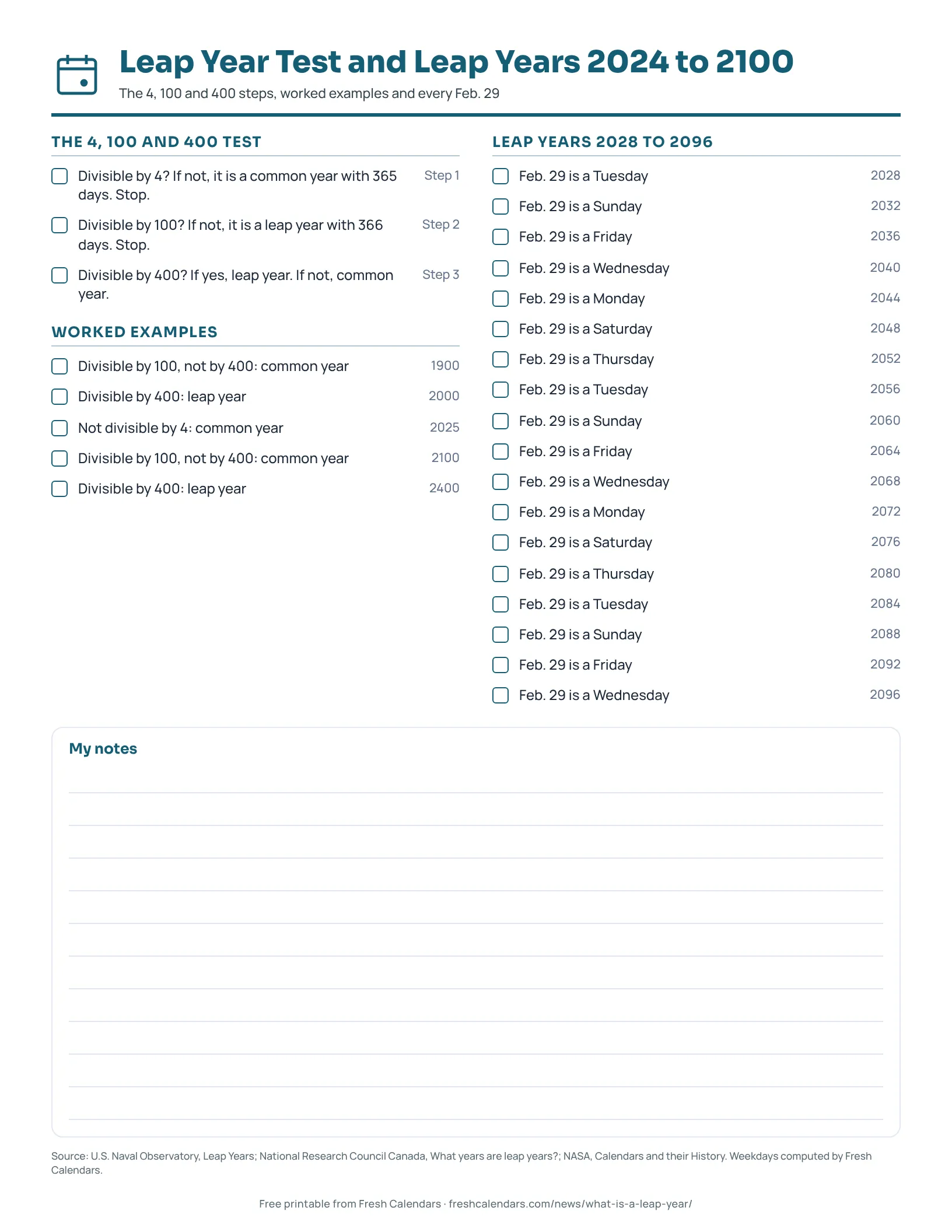
Leap Year Test and Leap Years 2024 to 2100
One-page leap year test with the 4, 100 and 400 steps, worked examples and the weekday of Feb. 29 in every leap year from 2028 to 2096.
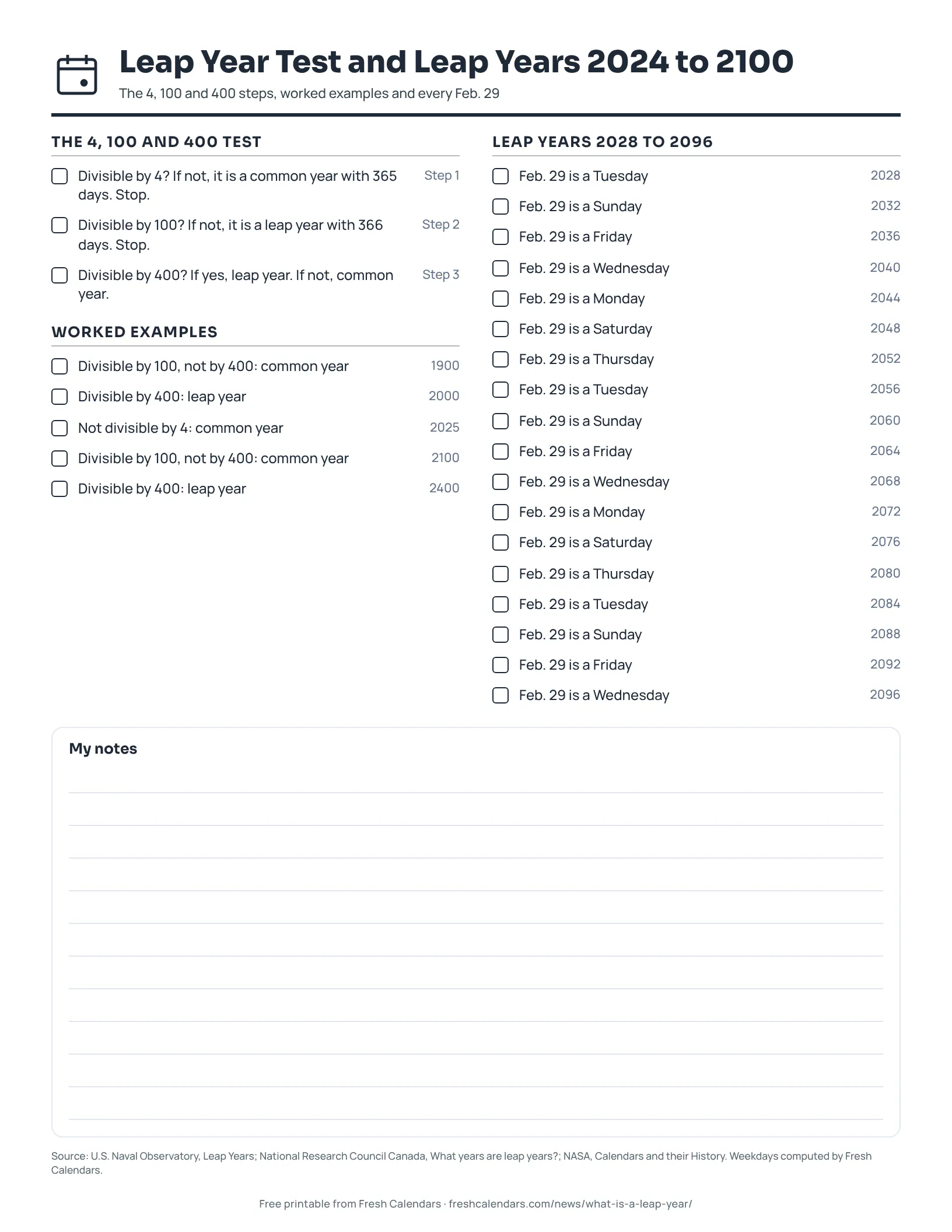
Leap Year Test and Leap Years 2024 to 2100 (ink saver)
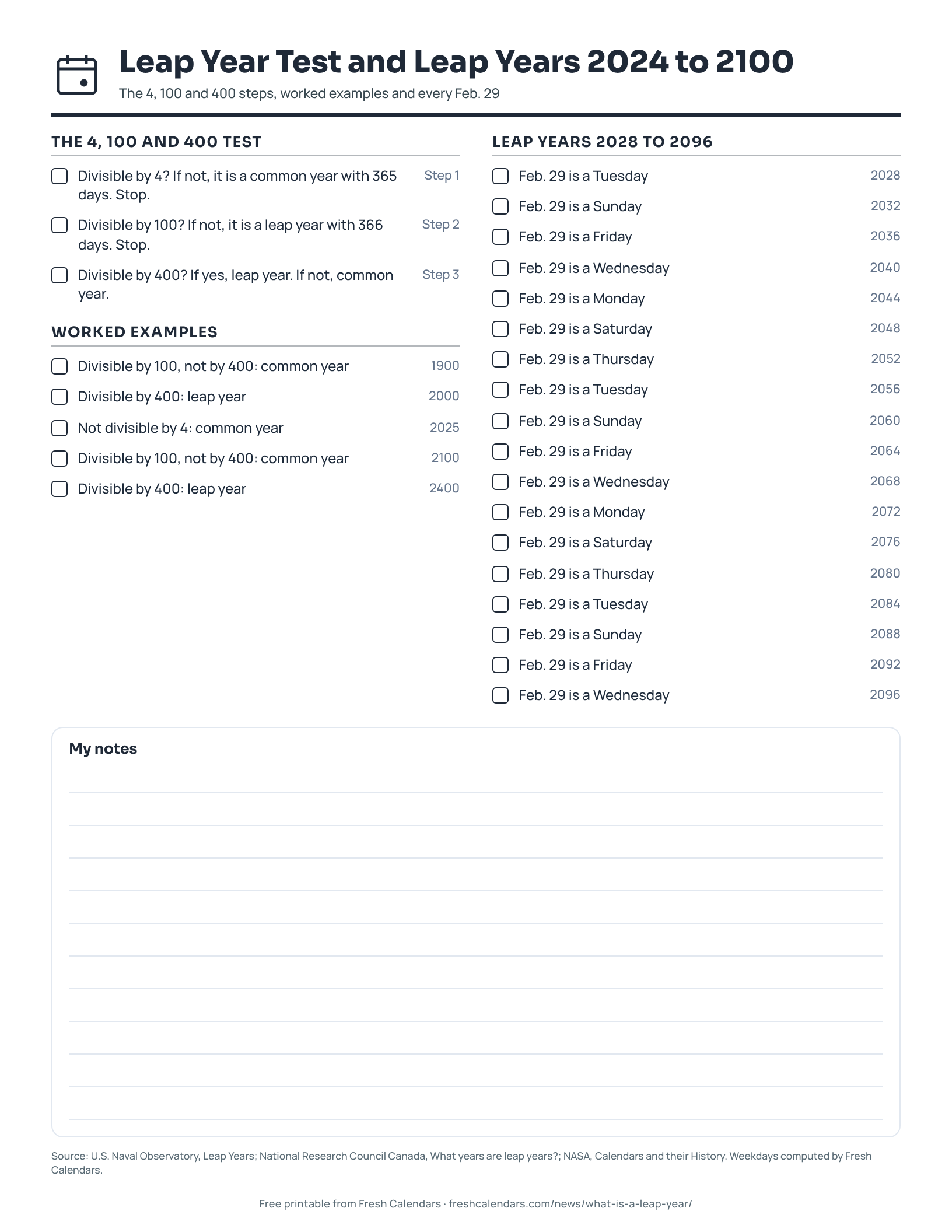
One-page leap year test with the 4, 100 and 400 steps, worked examples and the weekday of Feb. 29 in every leap year from 2028 to 2096. Ink-saver version.
Frequently asked questions
Is 2028 a leap year?
Yes. 2028 divides evenly by 4 and is not a century year, so it has 366 days and a Feb. 29, which falls on a Tuesday. February has 28 days in 2026 and 2027.
Is 2100 a leap year?
No. The USNO lists 2100 with 1700, 1800 and 1900 as years that are not leap years, because each is divisible by 100 but not by 400.
Why was 2000 a leap year but 1900 was not?
Both are century years. 2000 divides evenly by 400, so it is a leap year, as the National Research Council Canada (NRC) says. 1900 divides by 100 but not by 400, so it is a normal year of 365 days.
Does every leap year have 366 days?
Yes. NASA's calendar reference says a common year is 365 days and a leap year is 366.
Why does February get the extra day?
The Rice University Galileo Project says the extra day that came every fourth year in the Julian calendar was given to February as the shortest month. The Royal Observatory of Belgium says the Gregorian calendar keeps adding a leap day in February.
Sources
- Leap Years (U.S. Naval Observatory)
- Introduction to Calendars (U.S. Naval Observatory)
- What years are leap years? (National Research Council Canada, 2026-09-14)
- The Gregorian calendar (Royal Observatory of Belgium, 2022-04-12)
- Calendars and their History (NASA, 2012-10-14)
- Which years are leap years and can you have leap seconds? (Royal Museums Greenwich)
- The Gregorian Calendar (Rice University Galileo Project, 1995-01-01)
Related news


More in Calendar Guides
All Calendar Guides stories →- What Is the 100th Day of the Year? April 10, or April 9 in Leap Years
- How Many Days Are Left in the Year? The Formula, Plus the Count From Oct. 30, 2026
- How to Print a Calendar PDF at Actual Size: Print Settings for Edge, Mac and Home Printers
- Monday Start vs Sunday Start Calendar: Same Dates, Different First Column
- What Is a Fiscal Year? Federal, State and UK Dates With Quarter Tables