Medicaid Work Requirements Start Jan. 1, 2027: The 80-Hour Rule and Who Is Exempt
Medicaid work requirements start Jan. 1, 2027 for adults 19 to 64 in expansion states, per the Centers for Medicare & Medicaid Services (CMS): 80 hours monthly.

Published 5 min read


Key dates
In this article
Medicaid work requirements begin Jan. 1, 2027, unless a state starts sooner, and ask adults to show at least 80 hours a month of work, community service, a work program or school, according to the bulletin of Dec. 8, 2025 from the Center for Medicaid and Children’s Health Insurance Program (CHIP) Services (CMCS). CMCS is part of the Centers for Medicare & Medicaid Services (CMS). The requirement comes from Public Law 119-21, signed July 4, 2025 (section 71119). It applies to adults at least 19 and under 65 who are not pregnant and not on Medicare, in the adult expansion group.
This story gives the one-month tests with their exact thresholds, the exclusions as a checklist, a timeline with weekdays, what states can start earlier or delay, and a printable 2027 tracker. It reports the federal guidance and the rule; it does not predict who will keep or lose coverage.
What is the 80-hour rule?
CMCS says a person meets the requirement in a month by doing any one of the following.
| Way to qualify in one month | Threshold | Notes from the bulletin |
|---|---|---|
| Work | At least 80 hours | |
| Community service | At least 80 hours | |
| Work program | At least 80 hours | |
| Education | Enrolled at least half-time | |
| A combination | Hours totaling at least 80 | Of the activities above |
| Income | At least the federal minimum wage times 80 hours | “e.g., currently, $7.25 x 80 = $580 per month” |
| Seasonal work | Average monthly income over the preceding 6 months | Seasonal workers may use this in place of the monthly test |
The income test is the only one that does not count hours. At the current federal minimum wage of $7.25, the bulletin’s own example is $580 a month.
Who has to meet the Medicaid work requirement?
The bulletin (page 4) describes people “at least 19 and under 65 years of age, not pregnant, not entitled to or enrolled for benefits under Medicare Part A or Part B,” who are in the adult expansion group or in a section 1115 demonstration that covers that group. The rule does not apply in states that have not adopted the adult group and have no such demonstration. The CMS fact sheet of June 1, 2026 says “43 states and the District of Columbia provide coverage to these populations.” The bulletin leaves out U.S. territories. People under 19 and Medicare enrollees are outside the rule.
Who is excluded from Medicaid work requirements?
The bulletin (pages 5 and 6) lists groups that states must exclude from the requirement. Use this as a checklist; your state’s notice says how to claim one.
- Young adults in the Medicaid group for people who were in state child-welfare care, section 1902(a)(10)(A)(i)(IX) of the Social Security Act (the federal text in the bulletin gives no age; Nebraska’s page adds “under 26” for its program)
- American Indians and Alaska Natives, including Urban Indian, California Indian and Indian Health Service (IHS)-eligible people
- Parents, guardians, caretaker relatives or family caregivers “of a dependent child who is 13 years of age and under or of a disabled individual” (the CMS fact sheet also says “under 14”)
- “A veteran with a disability rated as total”
- People who are medically frail or have special medical needs: blind or disabled, a substance use disorder, a disabling mental disorder, or a serious or complex medical condition
- People complying with Temporary Assistance for Needy Families (TANF) work requirements, or in a Supplemental Nutrition Assistance Program (SNAP) household that is not exempt from SNAP’s work requirement and is meeting it
- Participants in drug or alcohol treatment and rehabilitation programs
- Inmates of a public institution, and people released in the previous three months (the period ending on the first day of a month)
- Pregnant or postpartum people
States may also grant short-term hardship exemptions, according to the bulletin (pages 6 and 7): inpatient or similar care; living in a county with a presidential emergency declaration, or where unemployment is “at or above the lesser of eight percent or 1.5 times the national unemployment rate”; and travel outside the community for a serious or complex medical condition. These are optional for the state.
Medicaid work requirement timeline with weekdays
| Date | What happens | Source |
|---|---|---|
| Fri., July 31, 2026 | Effective date of the interim final rule; comments closed the same day | Federal Register, June 3, 2026 |
| Tue., Dec. 1, 2026 | Iowa: certain Iowa Health and Wellness Plan members must meet monthly requirements | Iowa Health and Human Services |
| Fri., Jan. 1, 2027 | National start, unless a state opts in sooner; six-month renewals begin for renewals initiated on or after this date | CMCS bulletin |
| Sun., Dec. 31, 2028 | Latest day a state’s good-faith exemption can run | CMCS bulletin, page 11 |
The July 31, 2026 date is not the start of the requirement. The CMS fact sheet says states “must generally implement this requirement no later than January 1, 2027.” A state may ask for a good-faith exemption and must show a good-faith effort; CMS had not posted an approval for any state on its pages as of Nov. 6, 2026.
Which states start before 2027?
| State | Date on its own agency page | Detail |
|---|---|---|
| Nebraska | “Medicaid work requirements start on May 1, 2026” (a Friday) | Checks start for members whose coverage periods end on or after July 31, 2026, per Nebraska Department of Health and Human Services (DHHS) |
| Iowa | “By December 1, 2026” | Certain Iowa Health and Wellness Plan members; current members at renewal dates on or after February 2027, per Iowa Health and Human Services (HHS) |
Montana and Georgia could not be confirmed from official pages for this story, so check your state’s Medicaid agency for dates. Pages are linked in the sources above.
How does a state check the hours?
At application, a person must show compliance “for at least one month immediately preceding the month during which the individual applies,” and a state may require up to three consecutive months, according to the bulletin (pages 7 to 9). Between renewals, states check “one or more months” as the state sets.
Separately, Public Law 119-21 section 71107 starts six-month renewals for these adults, for renewals initiated on or after Jan. 1, 2027. That is a different change from the work requirement.
If the state finds a person has not complied, it sends a notice. The person then has “30 calendar days from the date such notice is received to demonstrate compliance.” If they do not, the state must “deny the application or terminate eligibility,” and the person cannot receive Marketplace premium tax credits (the advance premium tax credit and premium tax credit), per page 9 of the bulletin. For Marketplace dates, see the Affordable Care Act (ACA) open enrollment story; SNAP households can see allotments in the 2027 SNAP maximum benefit story; Medicare enrollees are outside this rule, and Medicare open enrollment has its own dates.
Medicaid 80-hour tracker for 2027 to print
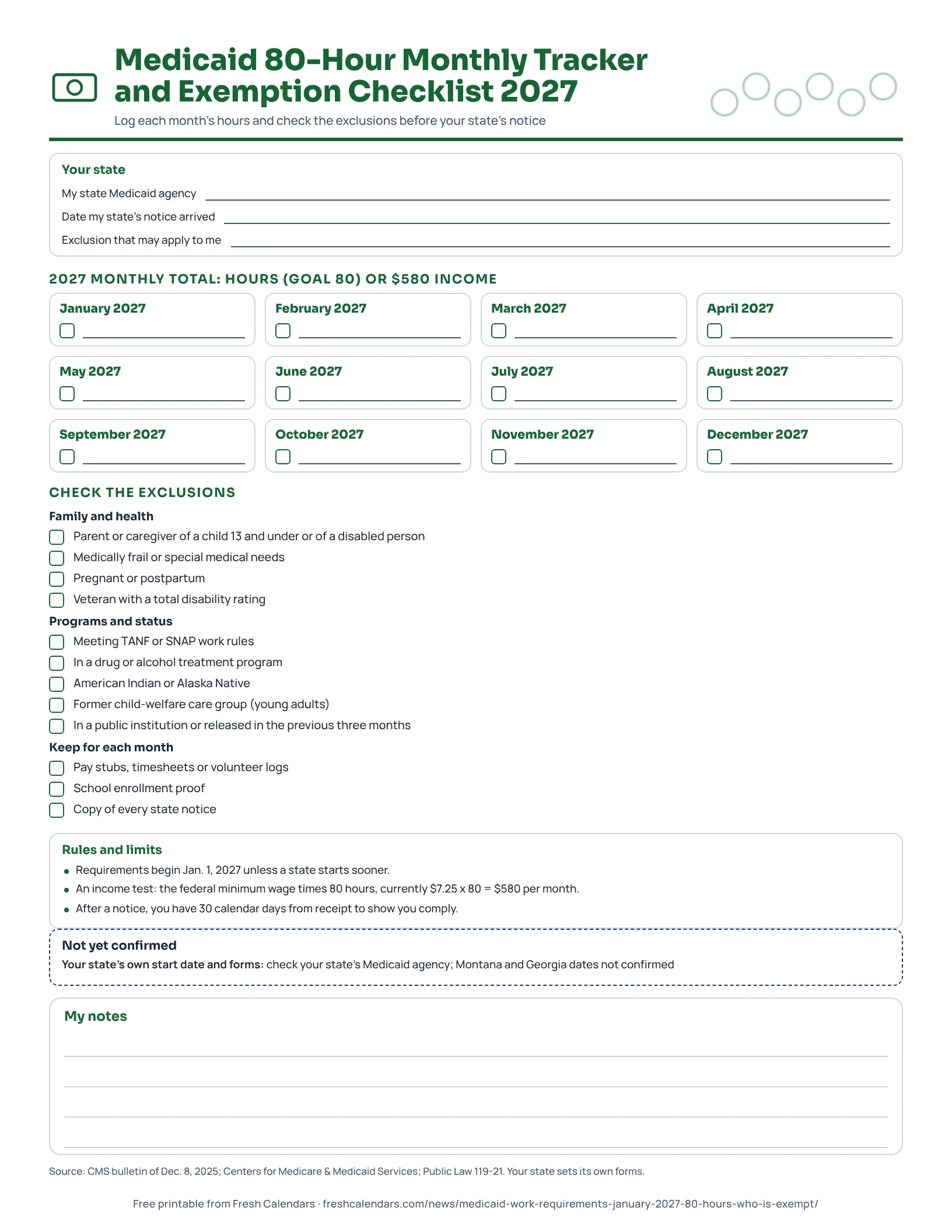
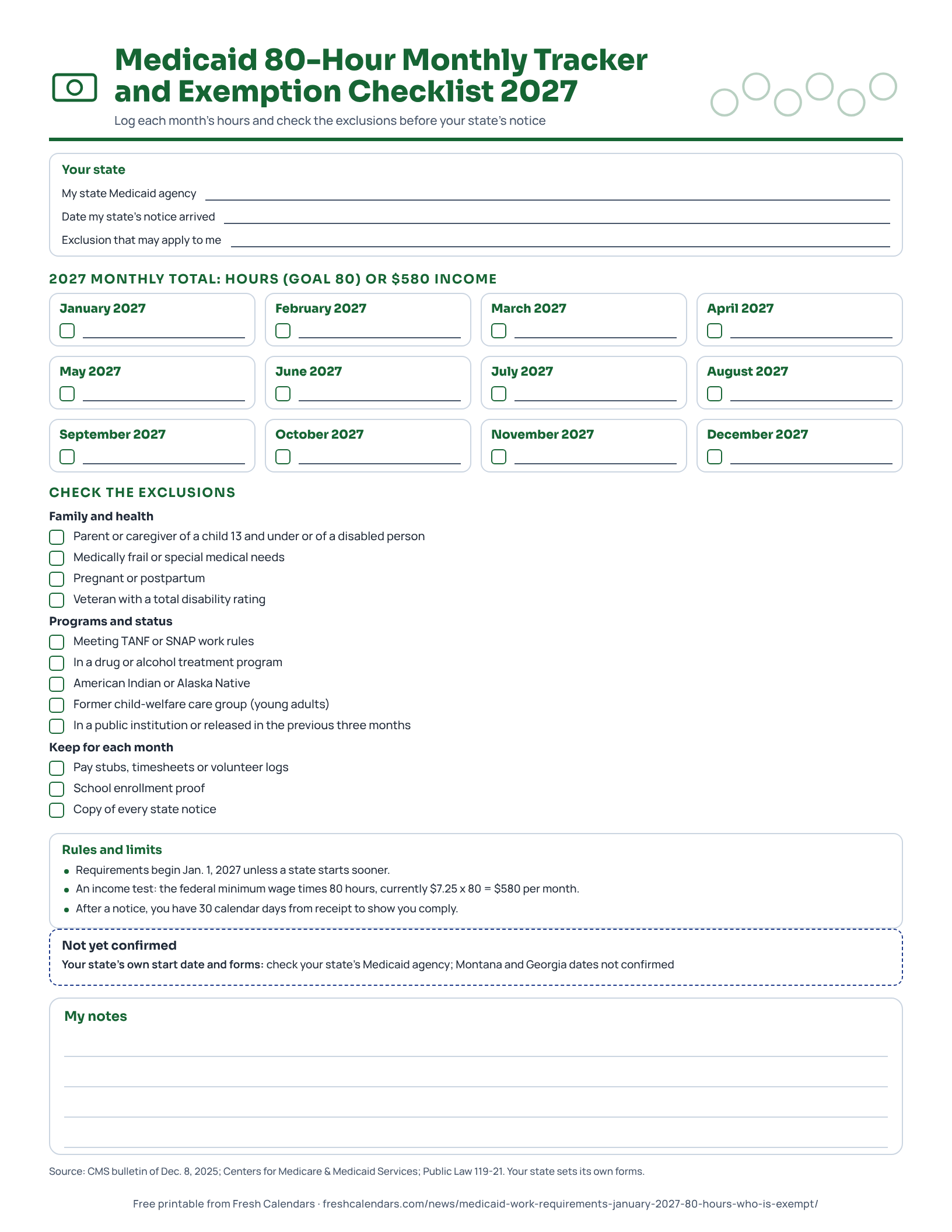
The free printable has twelve boxes for 2027, one per month, with the 80-hour goal and the $580 income line, plus a checklist of the exclusions and lines for your state agency and the date a notice arrives. Hang it beside the January 2027 printable calendar and the printable yearly calendar; the December 2026 printable calendar covers the weeks before the national start.
Free printable downloads
Every template is free, needs no sign-up and prints on US Letter paper. Choose PDF for printing or PNG for screens and documents.
Medicaid 80-Hour Monthly Tracker and Exemption Checklist 2027 printables
-
Medicaid 80-Hour Monthly Tracker and Exemption Checklist 2027
One-page tracker for the 80 hours a month Medicaid work requirements ask from Jan. 1, 2027, with the $580 income line and a checklist of exclusions.
Frequently asked questions
When do Medicaid work requirements start?
Jan. 1, 2027, per the CMS bulletin of Dec. 8, 2025, unless a state opts to start sooner. The July 31, 2026 date is when the interim final rule took effect, not the start of the requirement.
How many hours a month does Medicaid require?
At least 80 hours in a month of work, community service or a work program, or enrollment in education at least half-time, or a combination totaling at least 80 hours. Monthly income of at least the federal minimum wage times 80 hours also counts ($580 at $7.25).
Does the rule apply to children or people on Medicare?
No. It covers adults at least 19 and under 65 who are not pregnant and not entitled to or enrolled in Medicare Part A or Part B, per the CMS bulletin.
What happens if a person cannot show compliance?
The state sends a notice and the person has 30 calendar days from receipt to demonstrate compliance. If they do not, the state must deny the application or terminate eligibility, per the CMS bulletin.
Do U.S. territories have to follow the requirement?
No. The CMCS bulletin of Dec. 8, 2025 says the requirement does not apply in U.S. territories. The CMS fact sheet counts 43 states and the District of Columbia that cover the affected group.
Which states start before 2027?
Nebraska and Iowa say so on their own agency pages. Montana and Georgia could not be confirmed from official pages for this story, so check your state's Medicaid agency.
Sources
- CMS Informational Bulletin on the Medicaid community engagement requirement (Centers for Medicare & Medicaid Services, 2025-12-08)
- Medicaid Program; Community Engagement Requirement for Certain Individuals (interim final rule, CMS-2454-IFC), Federal Register vol. 91, no. 106 (Federal Register, U.S. Government Publishing Office, 2026-06-03)
- Medicaid Community Engagement Requirement for Certain Individuals Interim Final Rule with Comment Period (Centers for Medicare & Medicaid Services, 2026-06-01)
- Public Law 119-21, sections 71119 and 71107 (U.S. Government Publishing Office, 2025-07-04)
- Work Requirements (Nebraska Department of Health and Human Services)
- IHAWP Community Engagement Requirements (Iowa Health and Human Services)
Related news
-
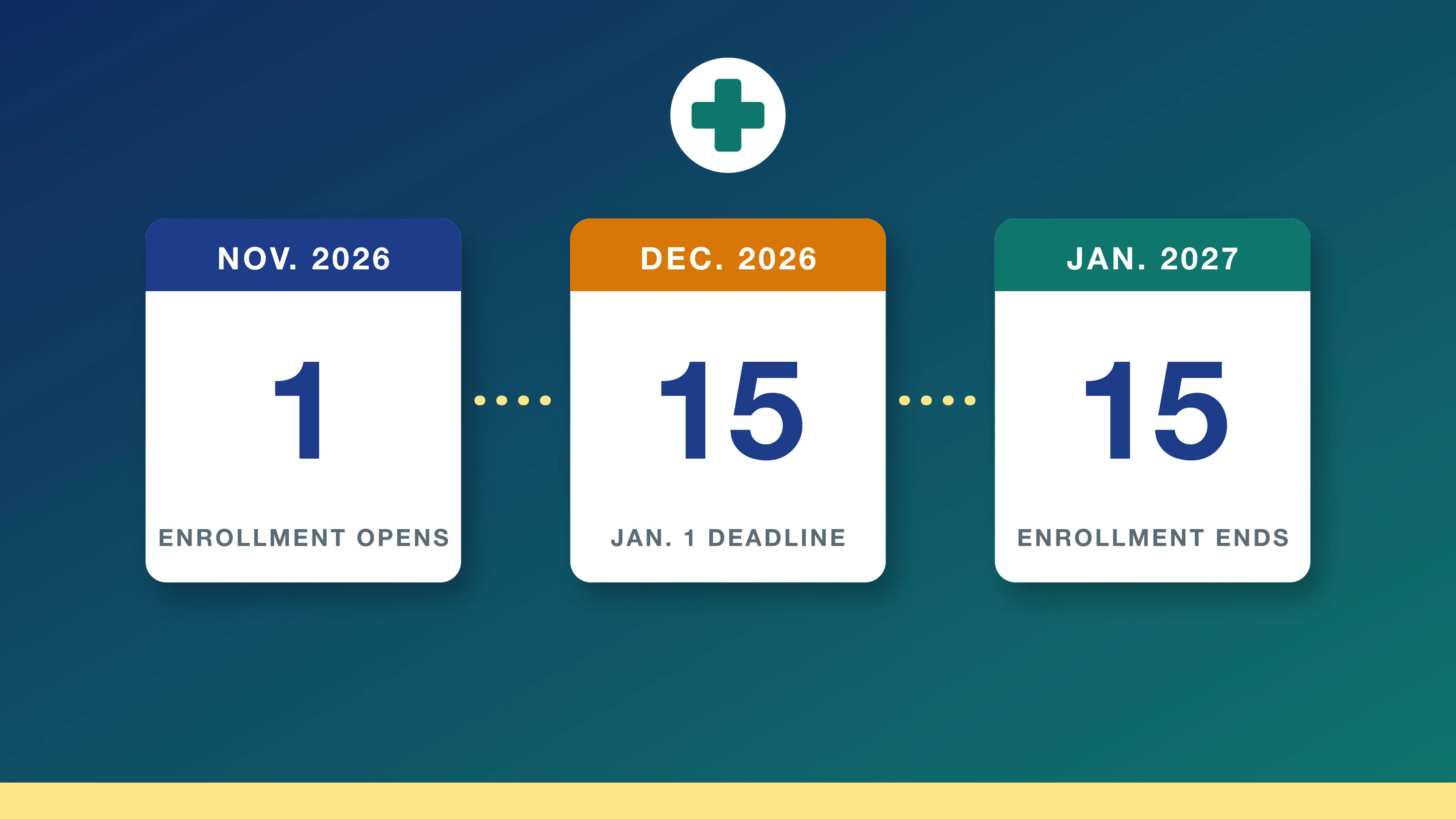 ACA Open Enrollment for 2027 Runs Nov. 1 to Jan. 15 After a Court Blocked a Shorter Window
-
 SNAP Benefit Amounts 2027: Maximum Allotments and Income Limits by Household Size
-
 Medicare Open Enrollment 2026 Deadline Is Dec. 7: Key Dates, Countdown and the $90 Part B Rebate
-
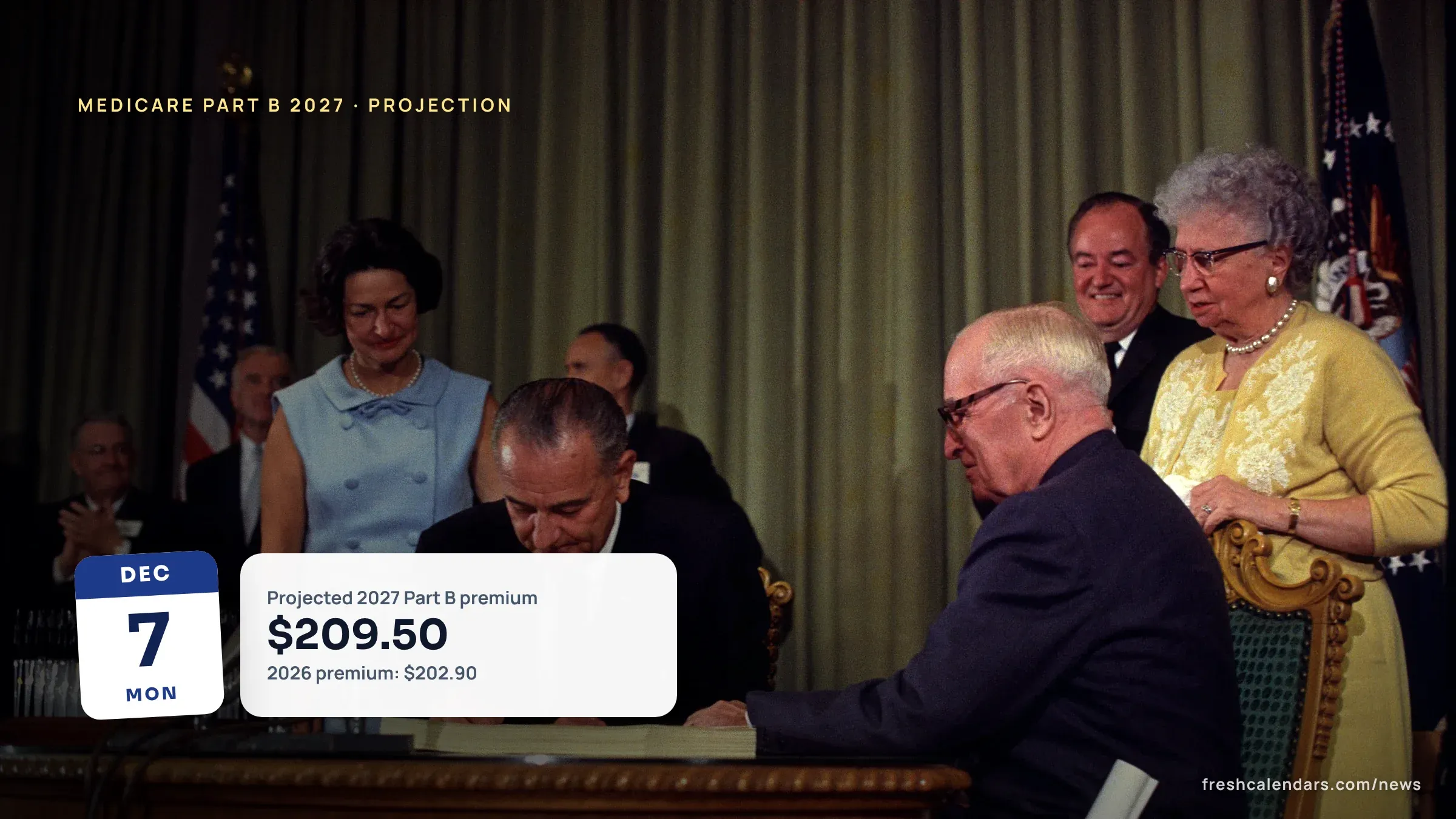 Medicare Part B Premium 2027: Trustees Project $209.50, CMS Has Not Yet Announced the Official Amount
More in Money & Benefits
All Money & Benefits stories →- Bonus Tax Rate 2026: The 22% Flat Rate, the 37% Rule and a Take-Home Table
- Car Loan Interest Deduction 2026: Up to $10,000, Who Qualifies and a Phase-Out Table
- ACA Open Enrollment 2027 Deadlines by State: When Each State Exchange Closes
- Dependent Care FSA Limit Is $7,500 in 2026: What Changes for 2027 Open Enrollment
- How to Prove You're a Veteran for Discounts: VA ID Card, VHIC and Your Driver's License
Trending now
- Black Friday 2026 Canada: Nov. 27 Sale Dates by Store, From Canadian Tire to Amazon.ca
- Black Friday 2026 Deals: Date Is Friday, Nov. 27, Live Countdown and Ad Tracker
- Veterans Day Free Meals 2026: 44 Chains Confirmed, 13 Discounts and a Printable List
- SNAP Payment Schedule November 2026: Deposit Dates for Every State, With Weekend Days Flagged
- Holiday Menus 2026: Every Chain's Christmas Drinks and Treats, With Launch Dates