When Do They Start Counting Votes 2026? 17-State Timeline
When counting starts in 2026 varies: Florida can process mail ballots 22 days early, Pennsylvania and Wisconsin at 7 a.m. Election Day. 17-state timeline.

Published Updated 11 min read
Key dates
- Nov 10Tue Oklahoma State Election Board certifies state and federal results Today + Google
- Nov 10Tue Oregon receipt deadline for ballots postmarked by Election Day Today + Google
- Nov 10Tue Pennsylvania receipt deadline for military and overseas absentee ballots Today + Google
- Nov 12Thu Colorado signature cure deadline; last day for county clerks to receive military and overseas ballots In 2 days + Google
- Nov 13Fri Nevada county canvass deadline In 3 days + Google
- Nov 16Mon California counties finish reporting all ballots In 6 days + Google
- Nov 17Tue Florida Elections Canvassing Commission meets at 8 a.m. In 7 days + Google
- Nov 17Tue Michigan county canvass deadline In 7 days + Google
- Nov 18Wed Alaska ranked-choice tabulation scheduled In 8 days + Google
- Nov 19Thu Arizona county canvass deadline In 9 days + Google
- Nov 23Mon Arizona state canvass In 13 days + Google
- Nov 23Mon Michigan Board of State Canvassers certification deadline In 13 days + Google
- Nov 24Tue Colorado county audit boards report Risk Limiting Audit results In 14 days + Google
- Nov 24Tue Nevada Supreme Court canvasses the vote In 14 days + Google
- Nov 24Tue North Carolina State Board of Elections canvass at 11 a.m. In 14 days + Google
- Nov 24Tue Oregon signature-challenge deadline In 14 days + Google
- Nov 25Wed Alaska election results set to be certified In 15 days + Google
- Nov 25Wed Colorado county canvass boards complete canvass and submit official abstract In 15 days + Google
- Nov 27Fri Colorado deadline to order a statutory recount, if required In 17 days + Google
- Dec 3Thu California counties complete final official results In 23 days + Google
- Dec 4Fri California counties report final results for state and federal contests to the Secretary of State In 24 days + Google
- Dec 10Thu Oregon certifies final election results In 30 days + Google
- Dec 11Fri California Secretary of State certifies the results In 31 days + Google
In this article
The first results arrived minutes after polls closed on Tuesday, Nov. 3, 2026, but they are unofficial, and in some states the count runs for days. Election-night totals keep changing as officials add mail, provisional and overseas ballots, the U.S. Election Assistance Commission says. News organizations project winners when the trailing candidate can no longer catch up; states make results official later, through the canvass and certification. How fast each state reports depends mostly on its mail-ballot rules, which are laid out below for 17 states.
Where the 2026 count stands on Saturday, Nov. 7
Election-night totals are unofficial, and counting continues on Saturday, Nov. 7. It goes on in states that accept late mail ballots (California and New York through Nov. 10; Nevada’s deadline, 5 p.m. Saturday, Nov. 7, and Texas’s 5 p.m. Nov. 4 deadline have passed) and in ranked-choice states such as Maine and Alaska. California’s Secretary of State says counties “must count and report on all ballots (with some exceptions) by the 13th day after the election,” that its office “will post this ‘unprocessed ballots report’ online and provide daily updates,” and that “the frequency of updated results will vary based on the size of each county.”
California’s Secretary of State now prints the main dates on its elections page: vote-by-mail ballots “must be postmarked on or before Election Day and received by November 10, 2026,” “County elections officials must complete final official results by December 3, 2026,” and “The Secretary of State will certify results on December 11, 2026.” Its canvass page adds one more step, computed from its 13-day rule: counties must count and report all ballots, with some exceptions, by Monday, Nov. 16.
In Clark County, Nevada, voters can fix a mail ballot signature problem until 5 p.m. on Nov. 9, according to the county Election Department.
Three more states are still receiving or curing ballots. Oregon’s Secretary of State now lists the dates on its current-election page: the “Last day for counties to receive valid postmarked ballots by mail” is Tuesday, Nov. 10, the “Last day to resolve ballot challenges” is Tuesday, Nov. 24, and Oregon says final results “will be certified and made available on December 10.” In Colorado, the Secretary of State’s Nov. 2 release says results “will be updated at least once every weekday by 4:00 PM MT through the cure deadline on November 12, with the exception of Veteran’s Day, November 11,” which is 4 p.m. Mountain Time (MT), or 6 p.m. ET, and that “after that, election workers will continue to count ballots.” Its Nov. 6 release repeats the cure deadline: “Voters have until November 12 to correct any signature or ID issue with their 2026 General Election ballot,” through their county or the Colorado BallotCure tool on GoVoteColorado.gov. Nov. 12 is also the “Last day for military and overseas ballots to be received by county clerks,” the release says. It lists four later dates: Monday, Nov. 16, the “Deadline for the Secretary of State’s Office to establish the 20-digit random seed for the bipartisan Risk Limiting Audit and notify counties of the ballots selected for audit”; Tuesday, Nov. 24, the “Deadline for county audit boards to report results of the bipartisan Risk Limiting Audit to the Secretary of State’s Office”; Wednesday, Nov. 25, the “Deadline for county canvass boards to complete canvass and submit official election abstract to Secretary of State’s Office”; and Friday, Nov. 27, the “Deadline for Secretary of State’s Office to order a statutory recount, if required.”
The Pennsylvania Department of State lists Nov. 10 as the last day for county election offices to receive completed military and overseas absentee ballots that were submitted for delivery no later than 11:59 p.m. on Nov. 2, so Pennsylvania counties can still receive those ballots.
In Oklahoma, the State Election Board says it “meets Tuesday, November 10 to certify state and federal elections.” County election boards met Friday, Nov. 6, at 5 p.m. to certify county-level results, the board says. Results on its page were still labeled unofficial, and it says they “are unofficial until certified.”
California’s Secretary of State says on its unprocessed ballots status page for the Nov. 3, 2026 election that “it typically takes weeks for counties to process and count all of the ballots”; in its Nov. 5 unprocessed ballot report, the Secretary of State said “California’s county elections officials have already processed and counted 8,906,017 ballots” and “County elections officials estimate 4,816,722 outstanding ballots remain to be processed and counted.” The Secretary of State has not posted a newer statewide estimate in its news releases as of Nov. 9. We could not confirm from most state election offices how many ballots remain to be counted, and as of Nov. 10 no state other than Oklahoma has announced a complete or certified count. Check your state’s election office through our live blog for the latest.
We are tracking the returns state by state in our Election Night 2026 live blog, with a results map, a scoreboard and a link to every state’s election office.
When do election results start coming in?
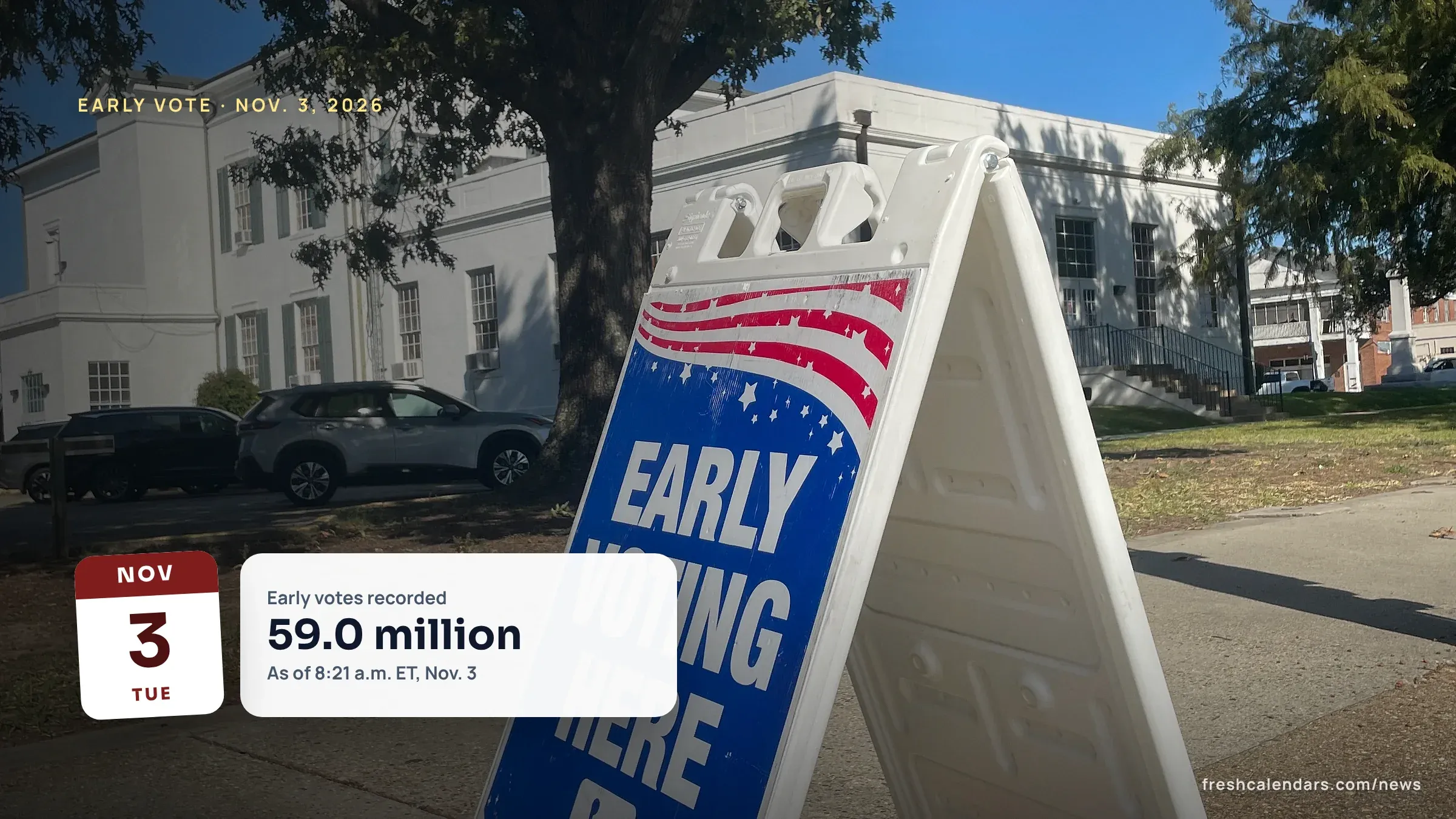
The first results came at 6 p.m. Eastern Time (ET) on Tuesday, Nov. 3, when polls closed in most of Indiana and Kentucky, and the flow built as each state’s polls closed. No state releases results before its own polls close.
| Eastern Time | Polls closed in |
|---|---|
| 6 p.m. | Most of Indiana and Kentucky |
| 7 p.m. | Florida, Georgia, South Carolina, Vermont, Virginia |
| 7:30 p.m. | North Carolina, Ohio, West Virginia |
| 8 p.m. | 18 states and the District of Columbia, including Michigan, Pennsylvania and Texas |
| 9 p.m. | Ten states, including Arizona, New York and Wisconsin |
| 11 p.m. | California, Oregon, Washington |
What the first numbers contain differs by state. In California, the Secretary of State says “the first election results posted are typically ballots received before Election Day,” and counties keep counting for up to 30 days. For the two biggest state questions, see Texas election results: when polls close and where to follow the count and California election results: the vote count timeline.
How a result goes from projection to official
- Polls close and counting starts. The first states close at 6 p.m. Eastern Time (ET) and the last at 1 a.m. ET; see poll closing times by state. No results may be released before a state’s polls close.
- Races are called. The Associated Press declares a winner only when it is certain the trailing candidate cannot win. One-sided races can be called at poll closing; close ones take longer.
- Late ballots are added. Mail ballots that arrive within a state’s grace period, provisional ballots that are verified, and ballots whose signature problems voters “cure” are counted in the following days.
- The canvass. Local officials reconcile ballot counts and check totals, then certify, usually within a few days to about four weeks.
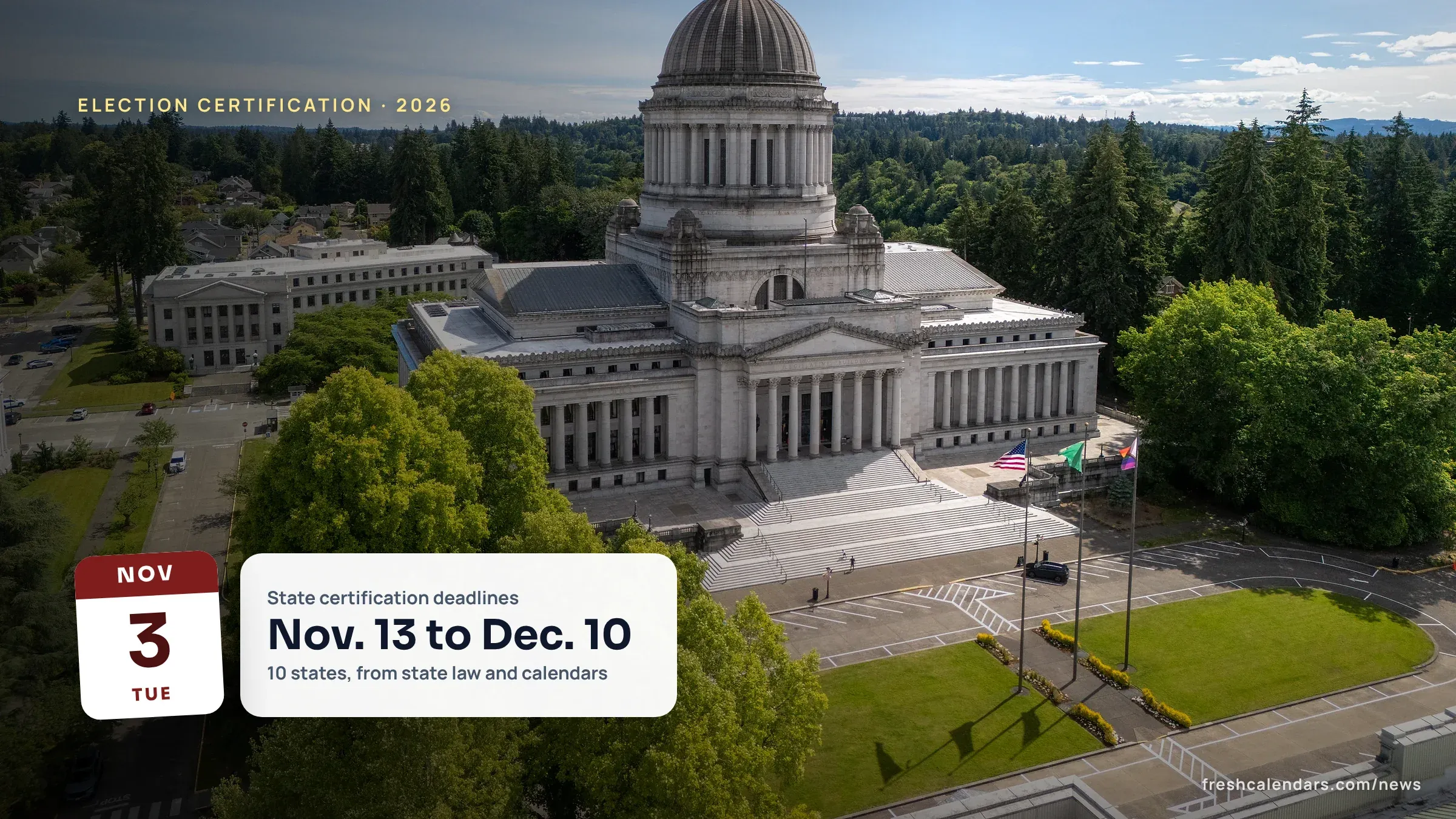
- State certification. The state certifies the final results, from mid-November into December depending on the state.
Why some states take longer
- When mail ballots can be processed. Opening envelopes and checking signatures takes time. Pennsylvania and Wisconsin cannot start until 7 a.m. on Election Day, so their mail ballots pile up; Florida, Arizona and Michigan can start days or weeks earlier.
- Late-arriving ballots. Some states count ballots postmarked by Election Day that arrive afterward, so their totals keep growing for days.
- Cure periods and provisional ballots. Voters may get a few days to fix a missing or mismatched signature.
- Ranked-choice voting. In Maine and Alaska, if no candidate wins a majority, later rounds are tabulated after all ballots are in; in Alaska, the Anchorage Daily News and Alaska Public Media both report that the ranked-choice tabulation is scheduled for Wednesday, Nov. 18, 2026, and the Anchorage Daily News adds that results are set to be certified Wednesday, Nov. 25. The tabulation applies only to races where no candidate passes 50% of first-choice votes.
- Recounts. Very close margins can trigger automatic or requested recounts.
The timeline in 17 key states
| State | Mail ballots can be processed | Postmarked ballots that arrive late | State certification |
|---|---|---|---|
| Alaska | Reviewed 7 days before; counted from 8 p.m. Nov. 3 | Counted if received within 10 days | Ranked-choice tally Nov. 18; certification Nov. 25 (target) |
| Arizona | 14 days before Election Day | Not counted; due 7 p.m. Nov. 3 | Mon., Nov. 23; county canvass by Thu., Nov. 19 |
| California | As they arrive, up to 29 days before | Counted if received by Nov. 10 | Dec. 11 |
| Florida | 22 days before Election Day | Not counted; due 7 p.m. Nov. 3 | Tue., Nov. 17, 8 a.m. (Elections Canvassing Commission) |
| Georgia | Scanned from the third Monday before; tallied after polls close | Not counted; due 7 p.m. Nov. 3 | About Nov. 20 |
| Iowa | The day before Election Day | Not counted; due 8 p.m. Nov. 3 | About Nov. 30 |
| Maine | Before Election Day with notice; counted after polls close | Not counted; due when polls close | By Nov. 23 |
| Michigan | Up to 8 days before | Not counted; due 8 p.m. Nov. 3 | County canvass by Tue., Nov. 17; Board of State Canvassers by Mon., Nov. 23 (Michigan Compiled Laws (MCL) 168.842) |
| Minnesota | Before Election Day | Not counted; due 8 p.m. Nov. 3 | Nov. 19 |
| Nevada | Before Election Day | Counted if received by 5 p.m. Nov. 7 | Tue., Nov. 24 (Supreme Court canvass); county canvass by Fri., Nov. 13 |
| New Hampshire | On Election Day | Not counted; due 5 p.m. Nov. 3 | No fixed deadline |
| New York | Reviewed as they arrive; tabulated from 1 hour before polls close | Counted if received by Nov. 10 | By Dec. 15 |
| North Carolina | Approved before Election Day; counted on Election Day | No longer counted; due 7:30 p.m. Nov. 3 | Tue., Nov. 24, 11 a.m. (state board canvass) |
| Ohio | Before Election Day | No longer counted; due 7:30 p.m. Nov. 3 | Canvass Nov. 8-18 |
| Pennsylvania | Not before 7 a.m. Nov. 3 | Not counted; due 8 p.m. Nov. 3 (military and overseas ballots received by Nov. 10) | About Nov. 23 |
| Texas | Before Election Day | Counted if postmarked by 7 p.m. and received by 5 p.m. Nov. 4 | Local canvass by Nov. 17 |
| Wisconsin | Not before 7 a.m. Nov. 3 | Not counted; due 8 p.m. Nov. 3 | By Dec. 1 |
Processing rules come from each state’s election law as compiled by the National Conference of State Legislatures; certification dates are computed from state law, as summarized by the Brennan Center’s State Court Report, Ohio’s from the Secretary of State’s 2026 canvass directive, and Arizona’s and Nevada’s from the state statutes: county boards in Arizona canvass “not later than the third Thursday after the election” and the Secretary of State “on the third Monday following a general election” (Arizona Revised Statutes, sections 16-642 and 16-648); in Nevada “the canvass must be completed on or before the 10th day following the election” and the Supreme Court justices canvass the vote on “the fourth Tuesday of November” (Nevada Revised Statutes 293.387 and 293.395). “About” marks dates that depend on how a statutory deadline falls on the calendar. Every state’s mail deadline is in our mail ballot deadlines list.
What past elections show
States that count everything on election night and accept no late mail, such as Iowa, Minnesota and New Hampshire, are usually close to complete by Wednesday morning, pending the canvass. Others are slower by design. In Arizona’s 2022 governor’s race, roughly 70% of the vote had been counted by the Thursday after Election Day, The Associated Press reported, and California routinely counts for weeks because ballots arrive by mail for a week after Election Day.
The Supreme Court and late ballots
In Watson v. Republican National Committee, decided June 29, 2026, the U.S. Supreme Court upheld, 5-4, Mississippi’s law counting mail ballots postmarked by Election Day that arrive afterward. The justices held that federal law sets the day voters choose, not a deadline for ballots to arrive, so states may keep grace periods. Two states went the other way on their own: North Carolina and Ohio now require mail ballots to arrive by the close of polls.
Dates after Nov. 3
| Date | What happens |
|---|---|
| Nov. 4-10 | Late mail ballots arrive in grace-period states (Texas Nov. 4, Nevada Nov. 7, California, New York and Oregon Nov. 10); Pennsylvania receives military and overseas ballots until Nov. 10 |
| Nov. 10 | Oklahoma State Election Board meets to certify state and federal results, per the board |
| Nov. 12 | Colorado signature cure deadline and last day for county clerks to receive military and overseas ballots; Colorado’s weekday results updates by 4 p.m. MT run through this date (none on Veterans Day, Nov. 11) |
| Nov. 16 | California counties finish reporting all ballots, with some exceptions (computed from the Secretary of State’s 13-day rule); Colorado’s Secretary of State sets the random seed for the Risk Limiting Audit and tells counties which ballots to audit |
| Nov. 17 | Florida’s Elections Canvassing Commission meets at 8 a.m., per Fla. Stat. 102.111; Michigan county canvasses are due, per MCL 168.822 |
| Mid-November | Counties finish canvassing; ranked-choice rounds in Maine; Alaska’s tabulation is scheduled for Nov. 18 |
| Nov. 23 | Michigan’s Board of State Canvassers deadline to certify, per MCL 168.842 |
| Nov. 24 | North Carolina’s State Board of Elections meets at 11 a.m. for the state canvass, per G.S. 163-182.5; Oregon’s last day to resolve ballot challenges, per the Secretary of State; Colorado county audit boards report Risk Limiting Audit results, per the Colorado Secretary of State |
| Nov. 25 | Colorado county canvass boards complete the canvass and submit the official election abstract, per the Colorado Secretary of State |
| Nov. 27 | Colorado’s deadline for the Secretary of State to order a statutory recount, if one is required |
| Dec. 1 | Georgia runoff, if needed |
| Dec. 3 | California counties complete final official results, per the Secretary of State |
| Dec. 4 | Deadline for California counties to report final results for state and federal contests to the Secretary of State, per its Nov. 5 release |
| Dec. 10 | Oregon certifies final results |
| Dec. 11 | California’s Secretary of State certifies the results, per its Nov. 5 release |
| Late Nov.-Dec. | States certify results |
| Jan. 3, 2027 | The new Congress is sworn in |
You can follow these dates on our November and December printable calendars.
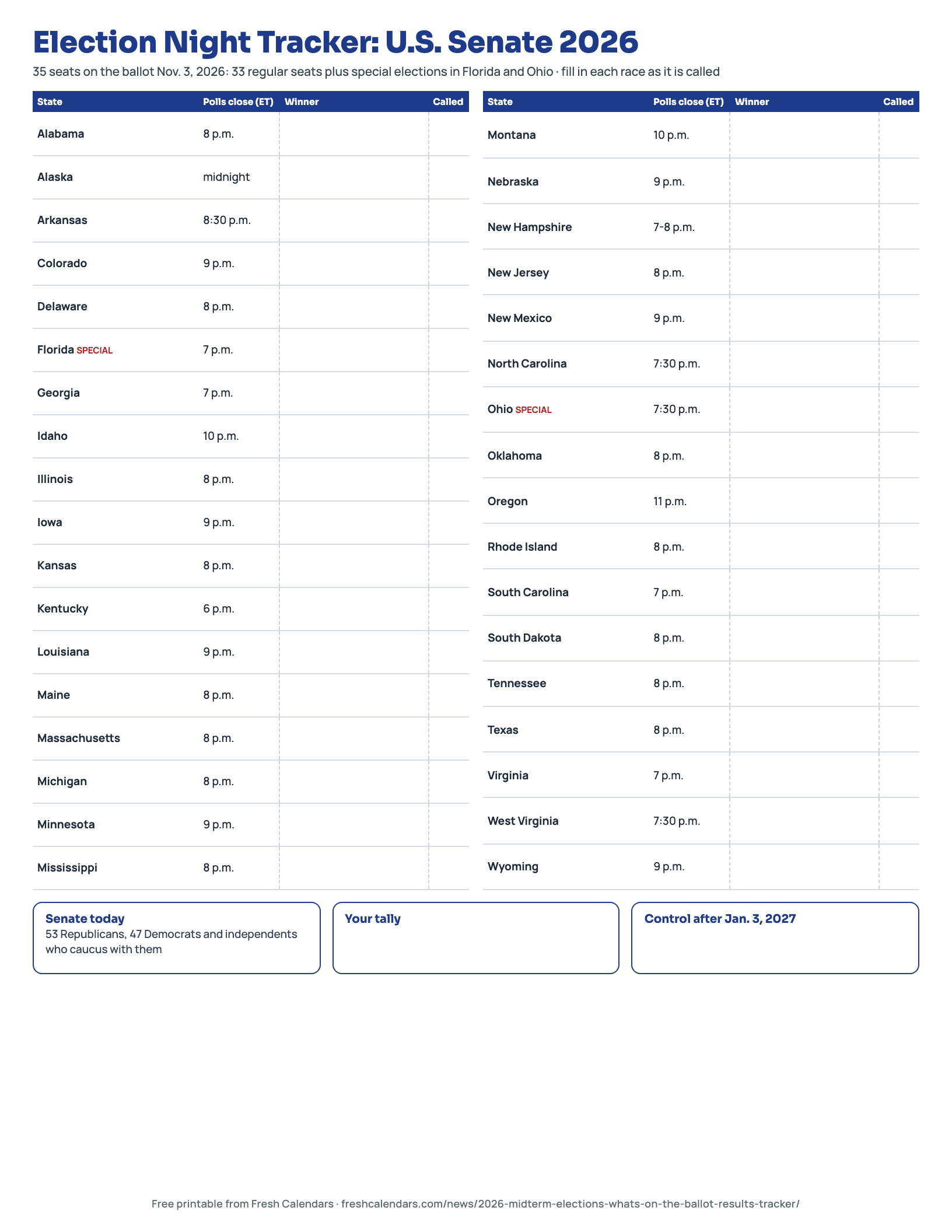
Louisiana holds December runoffs for races in which no candidate wins a majority; check dates with the Louisiana Secretary of State. Follow every Senate and governor’s race with our 2026 midterm tracker and the free printable below, which lists each race with its poll closing time in ET. For future elections, find your sample ballot by ZIP code, and see whether Election Day is a holiday where you live.
Free printable downloads
Every template is free, needs no sign-up and prints on US Letter paper. Choose PDF for printing or PNG for screens and documents.
Election 2026 printables
-
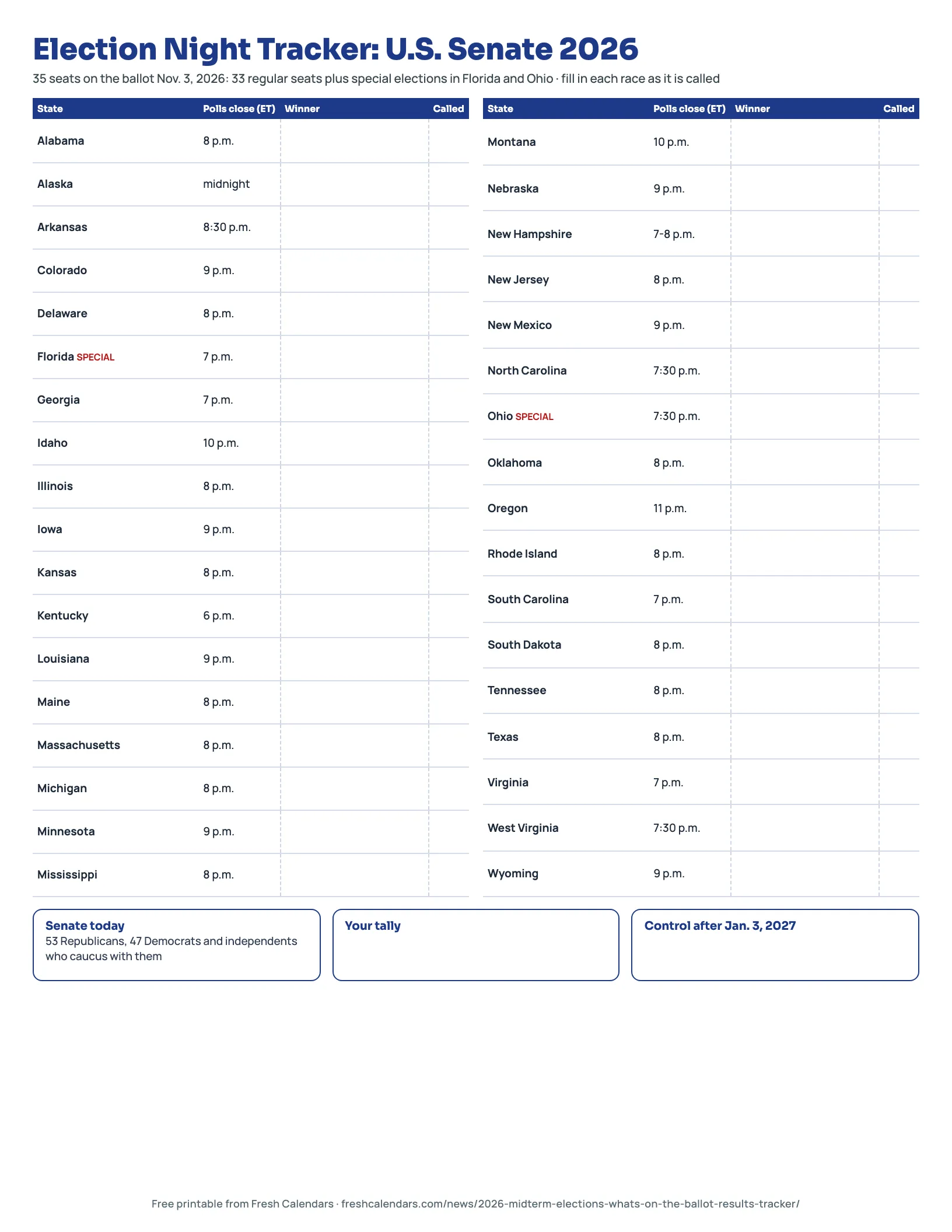
Election Night Tracker: Senate and Governors 2026
Two pages to fill in on election night: every Senate and governor's race with the poll closing time in Eastern Time and boxes for the winner and the call.
Frequently asked questions
When will we know who won the 2026 midterms?
Many races were projected on election night, Nov. 3, 2026, but close contests and states that count mail ballots slowly can take days. Control of the House or Senate may not be clear until enough close races are called, and official results come only when states certify, mostly in late November and December.
Why do election results change after election night?
Election-night totals are unofficial and grow as officials add mail ballots, provisional ballots and overseas ballots, according to the U.S. Election Assistance Commission. In some states, ballots postmarked by Election Day can still arrive and be counted for several days.
Who declares the winner of an election?
News organizations such as The Associated Press project winners when they determine the trailing candidate cannot catch up. The official result comes from state and local election officials when they certify the canvass.
Which states are slowest to count votes?
States that cannot process mail ballots before Election Day, such as Pennsylvania and Wisconsin, and states that accept late-arriving mail ballots or vote mostly by mail, such as California, Nevada and Alaska, usually take longer. California routinely counts for weeks.
When is the Georgia runoff in 2026?
Tuesday, Dec. 1, 2026, for any race in which no candidate wins a majority on Nov. 3.
Can ballots that arrive after Election Day be counted?
Yes, where state law allows it. In Watson v. Republican National Committee, decided June 29, 2026, the U.S. Supreme Court upheld Mississippi's law counting ballots postmarked by Election Day that arrive later, so states may keep such grace periods.
Sources
- Why do election results change after election night? (U.S. Election Assistance Commission)
- Election Results, Canvass, and Certification (U.S. Election Assistance Commission)
- How does AP call races? (The Associated Press via KERA)
- Table 16: When Absentee/Mail Ballot Processing and Counting Can Begin (National Conference of State Legislatures)
- Directive 2026-48: Canvass and certification of the Nov. 3, 2026 general election (Ohio Secretary of State)
- How elections are certified in battleground states (State Court Report (Brennan Center for Justice))
- Supreme Court says mail ballots can arrive after Election Day (Bloomberg Law, 2026-06-29)
- Election Results | Official Voter Information Guide | California Secretary of State (California Secretary of State, 2026-11-04)
- Official Canvass - Vote Counting Process (California Secretary of State, 2026-11-04)
- Mail ballot signature cure notice, 2026 general election (Clark County (Nevada) Election Department, 2026-11-04)
- Carrier envelope and mail ballot return (Texas Secretary of State (VoteTexas.gov))
- Upcoming Elections (Oregon Secretary of State, 2026-11-04)
- Secretary Griswold Reminds Voters of Election Results Reporting Process for the 2026 General Election (Colorado Secretary of State, 2026-11-02)
- Elections and Voter Information (California Secretary of State, 2026-11-07)
- Voters can Fix Signature, ID issues using Colorado BallotCure for the 2026 General Election (Colorado Secretary of State, 2026-11-06)
- Unprocessed Ballots Status | 2026 General Election | California Secretary of State (California Secretary of State, 2026-11-05)
- The Office of the California Secretary of State Issues Unprocessed Ballot Report (California Secretary of State, 2026-11-05)
- Nov. 3, 2026, is the General Election. (Pennsylvania Department of State, 2026-11-05)
- Preliminary results from Alaska's 2026 general election (Anchorage Daily News, 2026-11-04)
- What to know about Alaska's general election (Alaska Public Media, 2026-10-05)
- 2026 Election Results (Oklahoma State Election Board, 2026-11-10)
- Arizona Revised Statutes, Section 16-642 (Arizona Legislature)
- Arizona Revised Statutes, Section 16-648 (Arizona Legislature)
- NRS: Chapter 293 - Elections (Nevada Legislature)
- N.C. Gen. Stat. 163-182.5 (North Carolina General Assembly)
- Fla. Stat. 102.111 (Florida Senate)
- MCL 168.822 (Michigan Legislature)
- Michigan Election Law, Section 168.842 (Michigan Legislature)
Related news
More in Elections
All Elections stories →- Virginia General Assembly 2027: Session Opens Wed., Jan. 13
- Florida Legislative Session 2027: March 2 to April 30, Committee Weeks
- Texas Legislative Session 2027: Jan. 12 to May 31 and Key Deadlines
- 2027 Governor Elections: Kentucky May 18, Mississippi Aug. 3
- Recount Rules 2026: Margins That Trigger One in 6 States
Trending now
- Closed for Veterans Day 2026: Post Offices Shut, Stocks Trade
- Veterans Day Free Meals 2026: 101 Chains and a Printable List
- King Tides Schedule 2026: California Nov. 24-26, Dec. 23-25
- BLS CPI Release Schedule: Nov. 10, 2026 at 8:30 a.m. ET
- Black Friday Ads 2026: Date Is Nov. 27, Walmart Deals Nov. 23-29