Canada Time Change 2026: Which Provinces Skipped Nov. 1
Canada's 2026 time change was 2 a.m. Sunday, Nov. 1, in Ontario, Quebec and Atlantic Canada. A table lists each province and territory, plus a printable.

Published Updated 6 min read
In this article
Clocks went back one hour at 2 a.m. local time on Sunday, Nov. 1, 2026, in Ontario’s Eastern Time zone, Quebec and Atlantic Canada, but British Columbia (BC), Alberta, Saskatchewan, Manitoba, Yukon and the Northwest Territories (NWT) did not change, according to their governments. For BC, Alberta, Manitoba and the NWT it was the first fall in which the change did not happen. Our table below lists every province and territory, and a second table shows what that does to the time differences across Canada this winter.
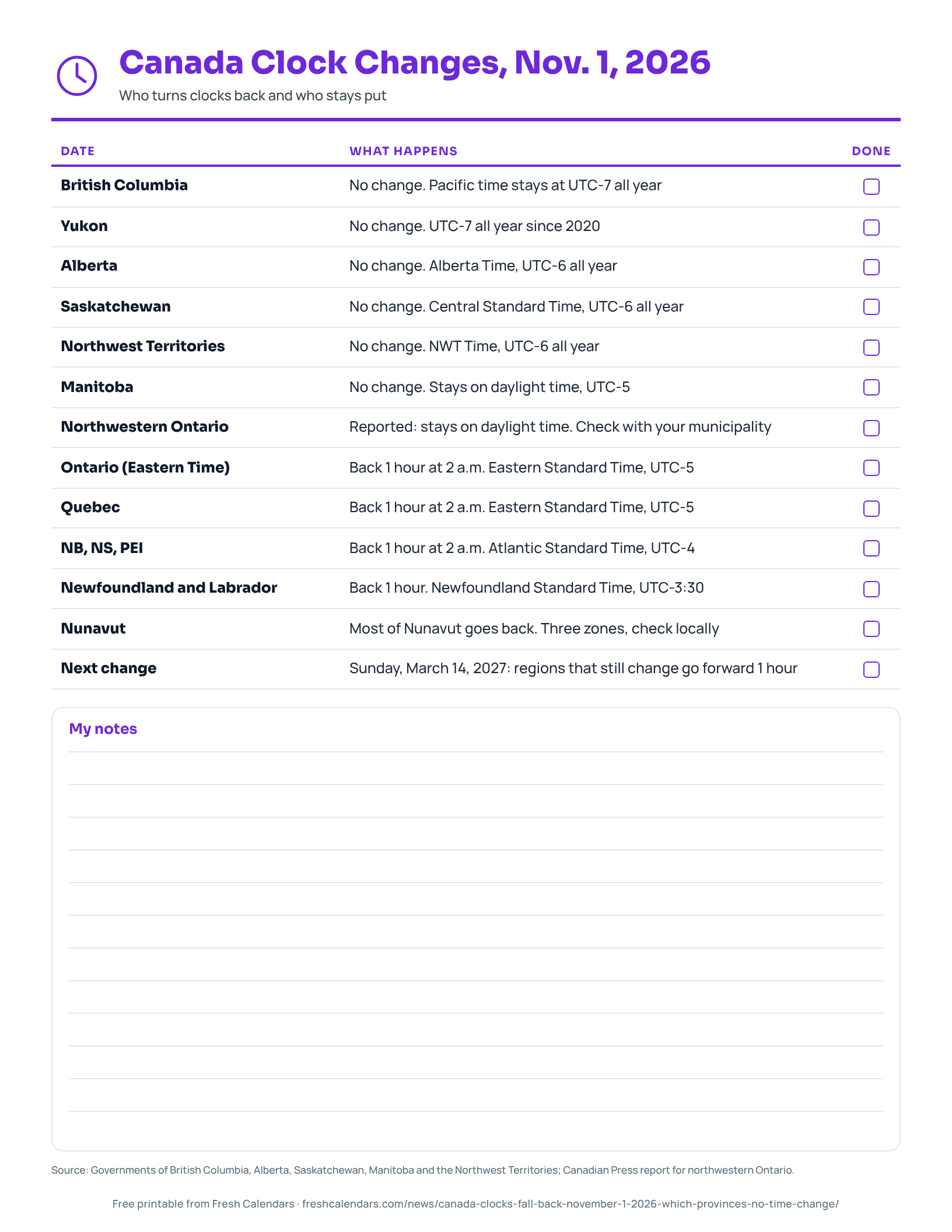
A one-page printable list of the Nov. 1 changes is on this page for the fridge or the office wall.
Which provinces changed clocks on Nov. 1, 2026?
Times are given in Coordinated Universal Time (UTC) offsets, so a reader can compare any two places. “UTC-7” means seven hours behind UTC.
| Province or territory | Clocks change Nov. 1? | Time from Nov. 1 | UTC offset | Source |
|---|---|---|---|---|
| British Columbia | No | Pacific time, kept at daylight saving time (DST) all year | UTC-7 | BC Ministry of Attorney General, March 2, 2026 |
| Yukon | No | Same time all year since 2020 | UTC-7 | Manitoba release of Sept. 17, 2026 lists Yukon with permanent time |
| Alberta | No | Alberta Time, all year | UTC-6 | Government of Alberta |
| Saskatchewan | No | Central Standard Time (CST), all year | UTC-6 | Government of Saskatchewan |
| Northwest Territories | No | Northwest Territories Time, all year | UTC-6 | Government of the NWT, Sept. 23, 2026 |
| Manitoba | No | Stays on daylight time | UTC-5 | Province of Manitoba, Sept. 17, 2026 |
| Northwestern Ontario (for example Kenora) | No | Stays on daylight time | UTC-5 | City of Kenora, Oct. 13, 2026; CP24 / Canadian Press |
| Ontario (Eastern Time zone) | Yes, 2 a.m. | Eastern Standard Time (EST) | UTC-5 | No change announced |
| Quebec | Yes, 2 a.m. | Eastern Standard Time | UTC-5 | No change announced |
| New Brunswick, Nova Scotia, Prince Edward Island | Yes, 2 a.m. | Atlantic Standard Time | UTC-4 | No change announced |
| Newfoundland and Labrador | Yes, 2 a.m. | Newfoundland Standard Time (Labrador mostly Atlantic Standard Time, UTC-4) | UTC-3:30 | No change announced |
| Nunavut | Yes, in most of the territory | Three zones, including Eastern Standard Time and Central Standard Time | Varies | No change announced |
Where the last column says “No change announced”, the provincial governments have said nothing about ending the clock change, so clocks went back as usual.
What each government says
British Columbia. A March 2, 2026, release from the Ministry of Attorney General called the March 8 spring-forward “the final time change in British Columbia.” It adds: “On Nov. 1, 2026, when previously clocks would have been turned back an hour, no change will be made, and the adjustment will not be required.” Pacific time “will be set seven hours behind co-ordinated universal time (UTC-7), matching the current offset used during daylight saving time.”
Alberta. The Government of Alberta said the province “officially moves to Alberta Time on November 1, 2026.” Alberta Time, “previously called Mountain Daylight Time or MDT in Alberta,” is equivalent to UTC-6. “Beginning in November 2026, clocks will no longer reset to Mountain Standard Time (MST), and Alberta will remain on Alberta Time year-round.”
Saskatchewan. Under The Time Act, 2026, “All of Saskatchewan observes Central Standard Time (CST), or Universal Coordinated Time (UTC) -6, year-round,” and there are “currently no time option areas.” Until 2026, Lloydminster and the surrounding area followed Mountain Standard Time (UTC-7) from November to March to stay aligned with Alberta. With Alberta now at UTC-6, Saskatchewan, Alberta and the Northwest Territories share one time all year.
Manitoba. On Sept. 17, 2026, Premier Wab Kinew announced that Manitoba “has decided to remain on daylight saving time (DST) permanently,” meaning “clocks will not revert to standard time on Nov. 1.” The province said 92 per cent of Manitobans surveyed wanted an end to seasonal changes; 58 per cent preferred permanent DST and 34 per cent preferred staying on standard time. Manitoba stays on Central Daylight Time, UTC-5.
Northwest Territories. Regulations creating Northwest Territories Time (UTC-06:00) came into force on Aug. 21, 2026. The Sept. 23 release says that on Nov. 1, “when clocks would normally be turned back by one hour, no time change will occur in the NWT.”
Yukon. Yukon has kept UTC-7 all year since 2020.
What about eastern British Columbia and northwestern Ontario?
The BC release says mountain-time communities in eastern BC “will not be affected by these changes.” Dawson Creek observes Mountain Standard Time (MST) year-round and will share the time of most of BC in winter and summer. Cranbrook, which switches between standard and daylight time, was described as aligned with the rest of the province in winter. Because Alberta itself is moving to UTC-6 all year, communities on mountain time in eastern BC should check with their municipality.
In northwestern Ontario, the City of Kenora said on Oct. 13, 2026, that the Province of Ontario announced Kenora and the northwestern regions will move to permanent daylight saving time, aligning with Manitoba, from Nov. 1; the Canadian Press reported the same. We could not find the Ontario government’s own release. Communities in the region that wonder whether they are included should check with their municipality. Ontario announced no change for the Eastern Time zone, so Toronto went back.
How big is the time difference across Canada this winter?
The gaps changed on Nov. 1 because some places moved and others did not. This table compares each city with Toronto, which is on Eastern Daylight Time (UTC-4) until Oct. 31 and Eastern Standard Time (UTC-5) after. U.S. clocks also went back at 2 a.m. local time on Nov. 1, as our report on the U.S. change explains.
| City | UTC offset from Nov. 1 | Behind or ahead of Toronto until Oct. 31 | Behind or ahead of Toronto from Nov. 1 | Same time as, this winter |
|---|---|---|---|---|
| Vancouver | UTC-7 | 3 hours behind | 2 hours behind | Denver (Mountain Standard Time) |
| Calgary | UTC-6 | 2 hours behind | 1 hour behind | Chicago (CST) |
| Regina | UTC-6 | 2 hours behind | 1 hour behind | Chicago (CST) |
| Winnipeg | UTC-5 | 1 hour behind | Same time | New York (EST) |
| Toronto | UTC-5 | Not applicable | Not applicable | New York (EST) |
| Halifax | UTC-4 | 1 hour ahead | 1 hour ahead | One hour ahead of New York |
| St. John’s | UTC-3:30 | 1.5 hours ahead | 1.5 hours ahead | One and a half hours ahead of New York |
Computed from the offsets above. Vancouver at UTC-7 is one hour ahead of Seattle on Pacific Standard Time (PST, UTC-8) and one hour behind Calgary.
When do clocks go forward next?
For regions that still change clocks, the next change is on Sunday, March 14, 2027, the second Sunday in March. Our daylight saving time guide has the U.S. dates, and the 2027 clock change story covers the spring change. In Europe, clocks went back a week earlier; see how the UK and Europe time difference shifts.
Checklist after the Nov. 1 change
- Check the row for your province in the table, or print the list of Canadian clock changes.
- If you schedule calls with the East or the United States, recheck the gap in the second table.
- On devices in the NWT, the territorial government says some older devices and computers running Windows will need a manual update.
- Find Nov. 1 on a November 2026 printable calendar; Canadian statutory days are on our Canada holidays calendar.
Free printable downloads
Every template is free, needs no sign-up and prints on US Letter paper. Choose PDF for printing or PNG for screens and documents.
Canada Clock Changes printables
-
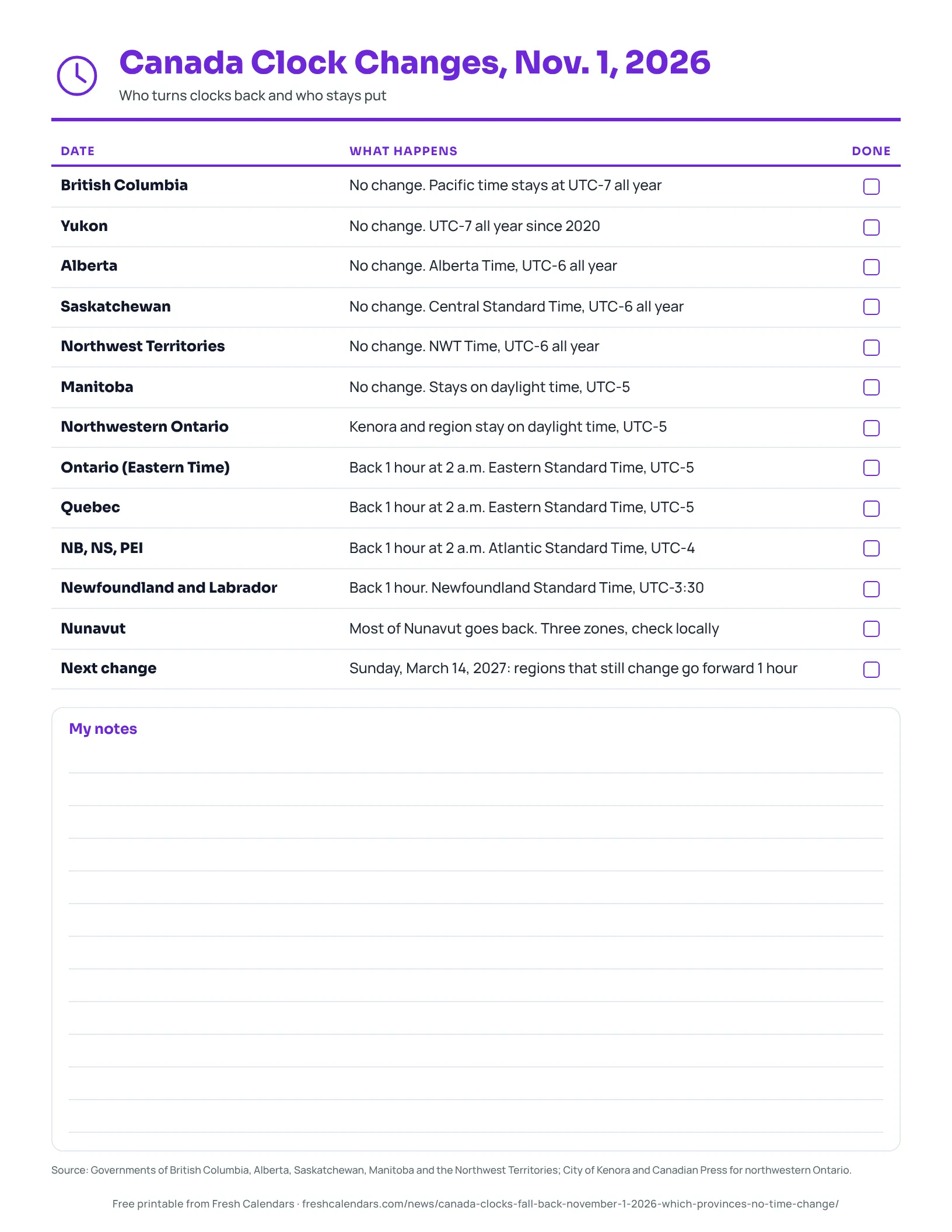
Canada Clock Changes, Nov. 1, 2026
One-page list of which Canadian provinces and territories turn clocks back on Nov. 1, 2026, and the time each one keeps this winter.
Frequently asked questions
Did Toronto change its clocks on Nov. 1, 2026?
Yes. Ontario had announced no change for the Eastern Time zone, so Toronto clocks went back one hour at 2 a.m. on Sunday, Nov. 1, 2026, to Eastern Standard Time (EST), which is UTC-5.
Is Winnipeg on the same time as Toronto this winter?
Yes, from Nov. 1. Manitoba stays on daylight time at UTC-5, and Toronto returned to Eastern Standard Time at UTC-5. Until Oct. 31, Winnipeg was one hour behind Toronto.
Will my phone update?
The Northwest Territories government says some older devices and computers running Windows will need a manual update for its new time. Check that your device shows the right time.
When do clocks go forward in 2027?
In regions that still change clocks, on Sunday, March 14, 2027, the second Sunday in March.
What about my community in eastern British Columbia or northwestern Ontario?
Both are covered by the notes in this story. Kenora and the northwestern regions of Ontario stay on daylight time, per the City of Kenora. Communities that observe mountain time in eastern British Columbia should check with their municipality.
Sources
- City Welcomes Ontario's Decision to Adopt Permanent Daylight Saving Time in Northwestern Ontario (City of Kenora, 2026-10-13)
- Adopting permanent daylight saving time (Government of British Columbia, Ministry of Attorney General, 2026-03-02)
- Alberta's new time system (Government of Alberta)
- Saskatchewan time system (Government of Saskatchewan)
- Manitoba to remain on daylight saving time permanently (Province of Manitoba, 2026-09-17)
- Northwest Territories ends Seasonal Time Change (Government of the Northwest Territories, 2026-09-23)
- Ontario to move northwest regions to permanent daylight time (CP24 / Canadian Press, 2026-10-13)
Related news

More in UK & Canada
All UK & Canada stories →- Tube Strike Dates: 8 Walkouts From Nov. 26, Noon to Noon
- Labour Day 2027 Is Monday, Sept. 6: What's Closed in Canada
- Wetherspoon Christmas Menu 2026: 12 Nov to 31 Dec, Every Dish
- Cavalcade of Lights 2026: Toronto Tree Lighting Nov. 28, 6:30 p.m.
- YMPE 2027: CPP Earnings Ceiling Rises to $76,700, Rate Falls to 5.75%
Trending now
- Thanksgiving Travel 2026: Best Days to Fly and Drive, Nov. 21 to 30
- Black Friday Ads 2026: Date Is Nov. 27, Walmart Deals Nov. 23-29
- Botanical Garden Holiday Lights 2026: Opening Dates at 5 Gardens
- November 2026 Meteor Showers: Leonids Nov. 16-17, Taurids Nov. 4-5
- New Movies in Theaters November 2026: Hunger Games on Nov. 20