November 2026 Meteor Showers: Taurid Fireballs Under Dark Skies, Then the Leonids on Nov. 16-17
The Southern Taurids peak Nov. 4-5 and the Northern Taurids Nov. 11-12 under a thin moon; the Leonids peak Nov. 16-17. Best times to watch in the U.S.

Published Updated 4 min read
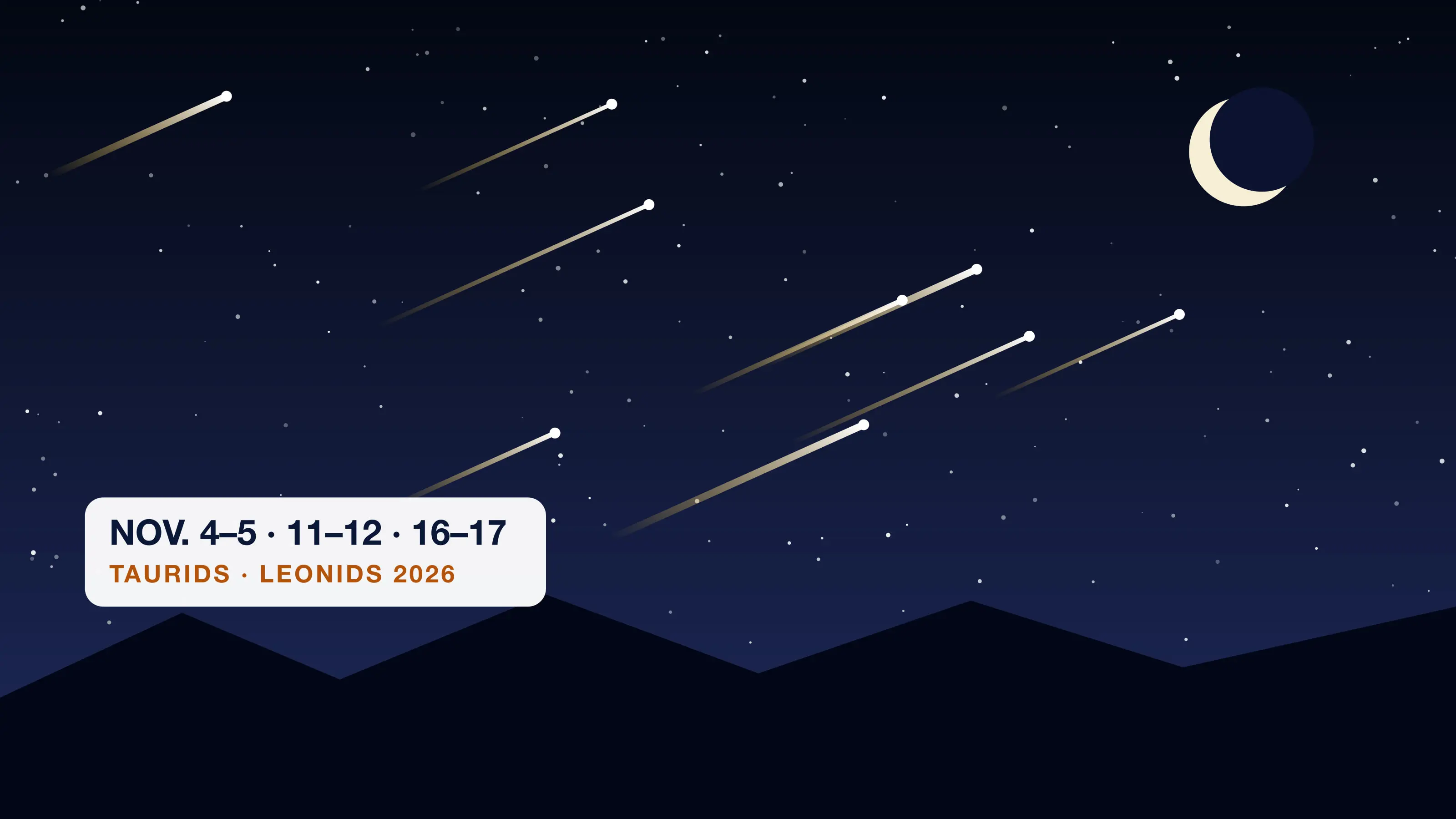
Key dates
In this article
Halloween night, Sat., Oct. 31: Taurids were already active. The Southern Taurids are active Sept. 20 to Nov. 20 and the Northern Taurids Oct. 20 to Dec. 10, according to the American Meteor Society, so a bright Taurid fireball was possible that night. In New York the waning gibbous Moon (63% lit) rose at 10:59 p.m. Eastern Daylight Time (EDT), per the U.S. Naval Observatory, which left the evening hours before moonrise as the darkest window. For planets and Moon pairings this month, see our November 2026 night sky calendar.
November 2026 brings three meteor shower peaks, and two of them land under a crescent Moon. The Southern Taurids peak on the night of Nov. 4-5 and the Northern Taurids on Nov. 11-12, according to the American Meteor Society (AMS). The Leonids follow on the night of Nov. 16-17. The rates are modest, but the Taurids are known for bright fireballs, and the thin Moon this year leaves them a dark sky.
November 2026 meteor shower calendar
| Shower | Peak night | Moon | Rate under dark skies |
|---|---|---|---|
| Southern Taurids | Wed.-Thu., Nov. 4-5 | Waning crescent, about 25% lit | A few per hour, with fireballs |
| Northern Taurids | Wed.-Thu., Nov. 11-12 | Thin crescent, about 4% lit | A few per hour, with fireballs |
| Leonids | Mon.-Tue., Nov. 16-17 | About 39% lit, sets before midnight in 11 of 12 U.S. cities | Often fewer than 3 per hour |
Peak dates and Moon figures are from the AMS; the Leonid rate is from NASA.
The Taurids: few meteors, big fireballs
The two Taurid showers come from debris left by Comet 2P/Encke. The Southern Taurids are active Sept. 20 to Nov. 20 and the Northern Taurids Oct. 20 to Dec. 10, so they overlap in late October and early November. Their rates are modest, a handful an hour, but the particles are relatively large and slow, which is why the Taurids produce more fireballs, meteors brighter than Venus, than most showers.
This year the timing is kind. The new moon falls at 2:02 a.m. Eastern Standard Time (EST) on Monday, Nov. 9, according to the U.S. Naval Observatory, so the Moon is only a crescent for both Taurid peaks. The AMS says the Southern Taurids’ fireball-swarm component peaks on Nov. 5. The Taurids’ radiant, in the constellation Taurus, rises in the evening, so meteors appear all night, with the best hours around midnight when Taurus is high.
The Leonids: fast and after midnight
The Leonids come from Comet 55P/Tempel-Tuttle and are among the fastest meteors, with a speed of 43.5 miles (69.7 kilometers) per second in NASA’s fast facts. NASA describes a spectacular Leonid storm in 1966 and says the last Leonid meteor storm took place in 2002. The AMS says Earth will not encounter any dense clouds of debris until 2099, though the comet’s returns in 2031 and 2064 may bring good displays with rates above 100 meteors an hour.
On the peak night the Moon is about 39% lit (first quarter comes at 6:48 a.m. EST on Nov. 17). The U.S. Naval Observatory has it setting at 10:53 p.m. EST in New York on Mon., Nov. 16, so it is below the horizon from then until dawn. The next night is different: the Moon sets at 11:56 p.m. EST in New York and at 12:11 a.m. on Wed., Nov. 18 in Washington, D.C. The Leonid radiant in Leo rises late in the evening, so the best window on Nov. 16-17 is from moonset until dawn. Our Leonid meteor shower 2026 guide has moonset and moon-free hours for both nights in 12 U.S. cities.
How to watch
- Get away from lights. A park or rural area makes more difference than any equipment.
- Give your eyes 20 minutes. Avoid looking at your phone; red light preserves night vision.
- Look up, not at the radiant. Meteors appear all over the sky; look about halfway up in the darkest direction.
- Dress for November. Clear nights are cold. A reclining chair and a blanket help you stay out longer.
Clocks fell back on Nov. 1, so evening viewing starts an hour earlier on the clock than in October; see when daylight saving time ends.
More sky events
October’s Orionids peak Oct. 21-22; our Orionid guide has the details. The full Moon follows on Nov. 24 at 9:53 a.m. EST. NASA’s November 2026 skywatching guide, last updated Nov. 2, puts the Southern Taurid peak around Nov. 5, the Northern Taurids around Nov. 12 and the Leonids in the early mornings of Nov. 17 and 18, after the Moon sets. For every full moon of next year, see our moon phases 2027 calendar. Mark the peak nights on a November 2026 printable calendar, or plan next year’s sky watching on a 2027 yearly calendar.
Free printable downloads
Every template is free, needs no sign-up and prints on US Letter paper. Choose PDF for printing or PNG for screens and documents.
November 2026 sky printable
-
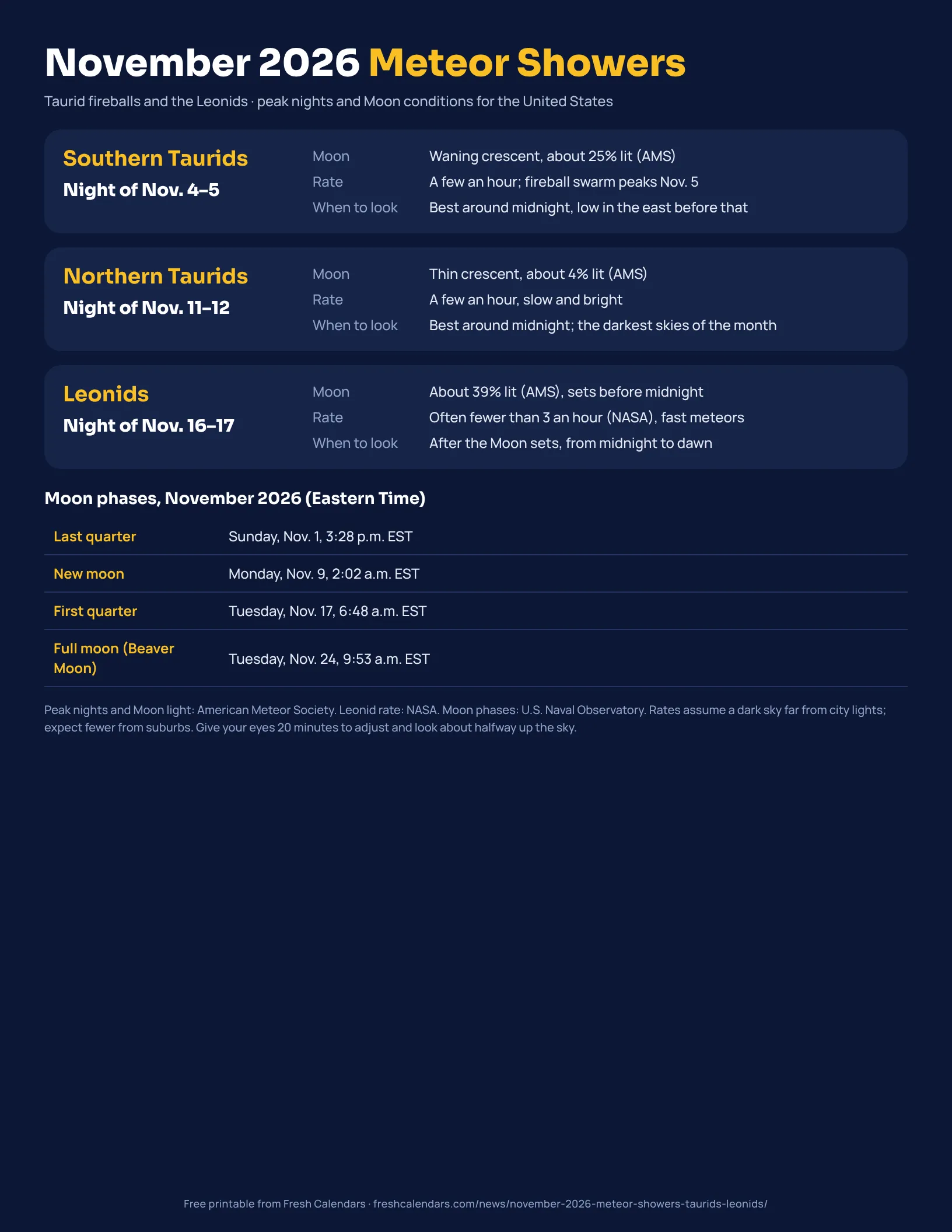
November 2026 Meteor Showers
Peak nights, Moon conditions and the best hours for the Southern Taurids, Northern Taurids and Leonids, with November's moon phases.
Frequently asked questions
When is the Taurid meteor shower in 2026?
There are two Taurid showers. The Southern Taurids peak on the night of Nov. 4-5, 2026 and the Northern Taurids on Nov. 11-12, according to the American Meteor Society. Both are active for weeks around their peaks.
When do the Leonids peak in 2026?
On the night of Monday, Nov. 16 into Tuesday, Nov. 17, 2026. The best viewing is after the Moon sets around midnight and before dawn.
How many meteors will I see?
Only a few. The Taurids give a handful an hour under dark skies, and NASA says Leonid rates are often as low as about three meteors per hour.
Will the Moon interfere?
Hardly. The Moon is a crescent for both Taurid peaks, and on the Leonid night it sets before midnight (10:53 p.m. Eastern Standard Time (EST) in New York on Nov. 16, per the U.S. Naval Observatory), before the best hours. The next night it sets later, at 11:56 p.m. EST in New York.
Will there be a Leonid meteor storm in 2026?
NASA says the last Leonid meteor storm took place in 2002. The Leonids' parent comet, 55P/Tempel-Tuttle, returns in 2031, and the American Meteor Society says Earth will not encounter any dense clouds of debris until 2099.
Sources
- Meteor Shower Calendar 2026-2027 (American Meteor Society)
- Leonids (NASA)
- What's Up: November 2026 Skywatching Tips from NASA (NASA, 2026-11-02)
- Phases of the Moon (U.S. Naval Observatory, Astronomical Applications Department)
Corrections
- : Moon illumination at the Taurid and Leonid peaks now follows the American Meteor Society (25%, 4% and 39%). The Leonid rate was given as up to about 15 an hour; NASA puts it at fewer than three an hour in a typical year. The Leonid Moon sets before midnight, not around midnight.
Related news
-
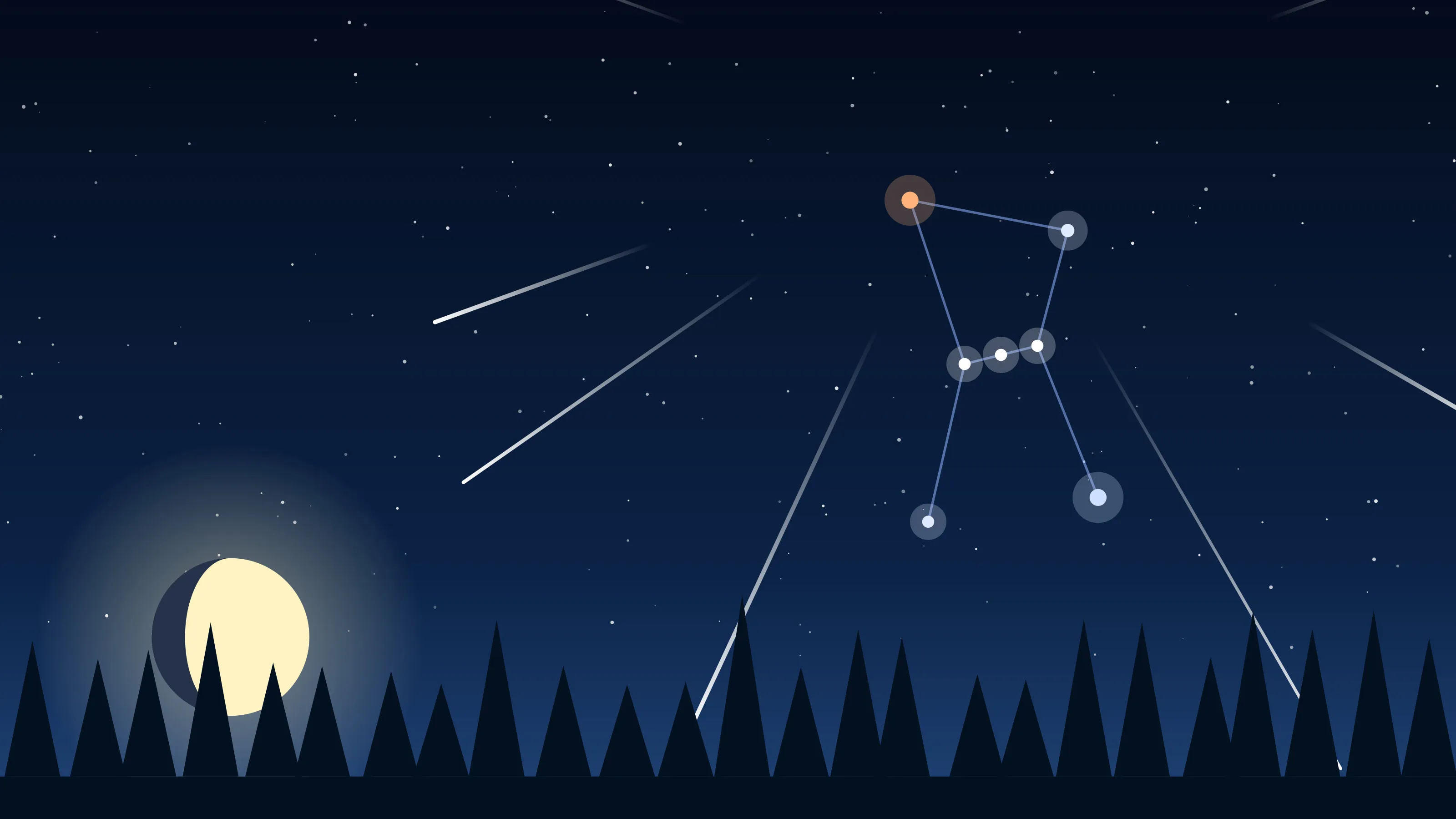 Orionid Meteor Shower 2026 Stays Active Through Nov. 7 After Its Oct. 22 Peak
-
 Northern Lights UK on Nov. 1, 2026: Met Office Aurora Chance in Scotland
-
 Northern Lights in November 2026: After the Halloween G1 Storm, the Kp 4 Dates to Watch
-
 Leonid Meteor Shower 2026 Peaks Nov. 16-17: Moonset and Moon-Free Hours in 12 U.S. Cities
More in Sky Events
All Sky Events stories →- Moon Phase Tonight: December 2026 Moon Calendar With Every Phase, Full Moon Dec. 23
- Planets Visible in January 2027: Night Sky Calendar With Moon and Quadrantids
- Ursid Meteor Shower 2026: Peak Night Dec. 21-22, Moonset Times for 10 U.S. Cities
- New Year's Eve 2026 Moon: Waning Crescent Rises After Midnight, 1:46 a.m. in New York
- Latest Sunrise 2027: It Comes in Early January, With Dates for 20 U.S. Cities
Trending now
- Diwali 2026 in the USA Is Sunday, Nov. 8: Lakshmi Puja Time in Your Time Zone
- Black Friday 2026 Deals: Date Is Friday, Nov. 27, Live Countdown and Ad Tracker
- Veterans Day Free Meals 2026: 48 Chains, Freebies and a Printable List
- Holiday Menus 2026: Every Chain's Christmas Drinks and Treats, With Launch Dates
- Spotify Wrapped 2026 Release Date: Not Announced Yet, With Every Launch Date Since 2020