How to Count a Court Deadline: Federal Rule 6 and the Weekend Rule
Federal Rule of Civil Procedure (FRCP) 6(a): skip the trigger day, count every day, and move a weekend or holiday last day ahead. 2027 examples inside.

Published 5 min read

In this article
- What are the three counting steps in Rule 6(a)?
- Which days are legal holidays under Rule 6(a)(6)?
- What do 2027 deadlines look like when counted this way?
- What does Rule 6(d) add for mail service?
- What about Juneteenth on Saturday, June 19, 2027?
- How do the clock and the clerk’s office affect the last day?
- Do state courts count days the same way?
Under Federal Rule of Civil Procedure (FRCP) 6(a), a court deadline counted in days starts the day after the triggering event, counts every calendar day and, if the last day is a Saturday, Sunday or legal holiday, runs to the next day that is not one. This is a plain-language guide, not legal advice: check your court’s local rules and orders, or ask a lawyer, before you rely on a date.
The rule text below is quoted from the Legal Information Institute (LII) at Cornell Law School, which mirrors the rules. The Administrative Office of the U.S. Courts lists the current Civil Rules and says they were last amended in 2025. The table of 2027 examples is our own calculation from that text and the Office of Personnel Management (OPM) 2027 holiday list.
What are the three counting steps in Rule 6(a)?
Rule 6(a)(1) tells you to:
- “exclude the day of the event that triggers the period;”
- “count every day, including intermediate Saturdays, Sundays, and legal holidays;” and
- “include the last day of the period, but if the last day is a Saturday, Sunday, or legal holiday,” continue the period until the end of the next day that is not a Saturday, Sunday, or legal holiday.
So a 14-day period triggered on a Monday has its day 1 on Tuesday and its raw last day two weeks after the trigger, on another Monday. Weekends in the middle are counted. Only the last day gets the roll-forward.
The Federal Rules of Appellate Procedure (Rule 26(a)) and the Federal Rules of Criminal Procedure (Rule 45(a)) use the same three steps in the same wording, according to LII’s copies of Appellate Rule 26 and Criminal Rule 45.
Which days are legal holidays under Rule 6(a)(6)?
Rule 6(a)(6) lists three kinds. First, “the day set aside by statute for observing New Year’s Day, Martin Luther King Jr.’s Birthday, Washington’s Birthday, Memorial Day, Juneteenth National Independence Day, Independence Day, Labor Day, Columbus Day, Veterans’ Day, Thanksgiving Day, or Christmas Day.” Second, “any day declared a holiday by the President or Congress.” Third, “for periods that are measured after an event, any other day declared a holiday by the state where the district court is located.”
OPM’s 2027 list gives the weekday for each of those holidays. The Fresh Calendars federal holidays 2027 story has the full list with the observed dates.
| 2027 holiday | Date on OPM’s list |
|---|---|
| New Year’s Day | Friday, Jan. 1 |
| Martin Luther King Jr.’s Birthday | Monday, Jan. 18 |
| Washington’s Birthday | Monday, Feb. 15 |
| Memorial Day | Monday, May 31 |
| Juneteenth National Independence Day | Friday, June 18 (the holiday falls on Saturday, June 19) |
| Independence Day | Monday, July 5 (July 4 is a Sunday) |
| Labor Day | Monday, Sept. 6 |
| Columbus Day | Monday, Oct. 11 |
| Veterans Day | Thursday, Nov. 11 |
| Thanksgiving Day | Thursday, Nov. 25 |
| Christmas Day | Friday, Dec. 24 (Dec. 25 is a Saturday) |
What do 2027 deadlines look like when counted this way?
We counted each period with the three steps above, treating Saturdays, Sundays and the holiday dates in the table as days that do not count as a last day. The trigger dates were chosen so the results show the rule at work; they are examples, not real cases.
| Trigger date | Period | Raw last day | Due day |
|---|---|---|---|
| Thursday, Feb. 18, 2027 | 30 days | Saturday, March 20 | Monday, March 22 |
| Monday, Jan. 4, 2027 | 14 days | Monday, Jan. 18 (Martin Luther King Jr. Day) | Tuesday, Jan. 19 |
| Monday, May 10, 2027 | 21 days | Monday, May 31 (Memorial Day) | Tuesday, June 1 |
| Saturday, June 5, 2027 | 14 days | Saturday, June 19 (Juneteenth) | Monday, June 21 |
| Tuesday, Oct. 26, 2027 | 30 days | Thursday, Nov. 25 (Thanksgiving Day) | Friday, Nov. 26 |
| Monday, March 1, 2027 (served by mail) | 14 days, plus 3 under Rule 6(d) | Monday, March 15 (then 3 days added) | Thursday, March 18 |
In the first row, day 1 is Friday, Feb. 19, and the 30th day is a Saturday, so the period runs to Monday. In the last row the 14 days end on Monday, March 15, and Rule 6(d) adds 3 days after that.
What does Rule 6(d) add for mail service?
Rule 6(d) reads: “When a party may or must act within a specified time after being served and service is made under Rule 5(b)(2)(C) (mail), (D) (leaving with the clerk), or (F) (other means consented to), 3 days are added after the period would otherwise expire under Rule 6(a).” The order matters: work out the Rule 6(a) end date first, then add the 3 days.
The 2016 committee note says “Rule 6(d) is amended to remove service by electronic means under Rule 5(b)(2)(E) from the modes of service.” Electronic service is therefore not on the Rule 6(d) list.
What about Juneteenth on Saturday, June 19, 2027?
Rule 6(a)(6)(A) names “the day set aside by statute for observing” Juneteenth National Independence Day. In 2027 that day is a Saturday, and a Saturday last day already rolls forward, so the June 5 example above ends on Monday, June 21 either way.
OPM’s footnote says that “If a holiday falls on a Saturday, for most Federal employees, the preceding Friday will be treated as a holiday for pay and leave purposes.” That rule is about federal employees’ pay and leave. It is not part of the Rule 6 text, and Rule 6 does not say what a court does with Friday, June 18, 2027. If a period would end that Friday, ask the court’s clerk or check its local rules before you assume either answer.
How do the clock and the clerk’s office affect the last day?
Rule 6(a)(4) says the last day ends “for electronic filing, at midnight in the court’s time zone,” and, for filing by other means, when the clerk’s office is scheduled to close. Rule 6(a)(3) opens with “Unless the court orders otherwise, if the clerk’s office is inaccessible:” and extends the period. Periods stated in hours follow Rule 6(a)(2): counting begins immediately on the triggering event, every hour counts, and a last hour that falls on a weekend or holiday continues “until the same time on the next day that is not a Saturday, Sunday, or legal holiday.”
Do state courts count days the same way?
Not necessarily. State courts have their own rules. As one example, New York General Construction Law Section 25-a, published by the New York State Senate, says that when a period “computed from a certain day” ends “on a Saturday, Sunday or a public holiday, such act may be done on the next succeeding business day.” The statute excepts contracts, which section 25 governs. We did not read other states’ rules for this story, so check your own court’s rules.
For counting plain business days instead of court days, see our guide to how many business days are in a year. The printable worksheet below holds the three steps and a blank table for your own dates.
Free printable downloads
Every template is free, needs no sign-up and prints on US Letter paper. Choose PDF for printing or PNG for screens and documents.
Court Deadline Counting Worksheet 2027 printables
-
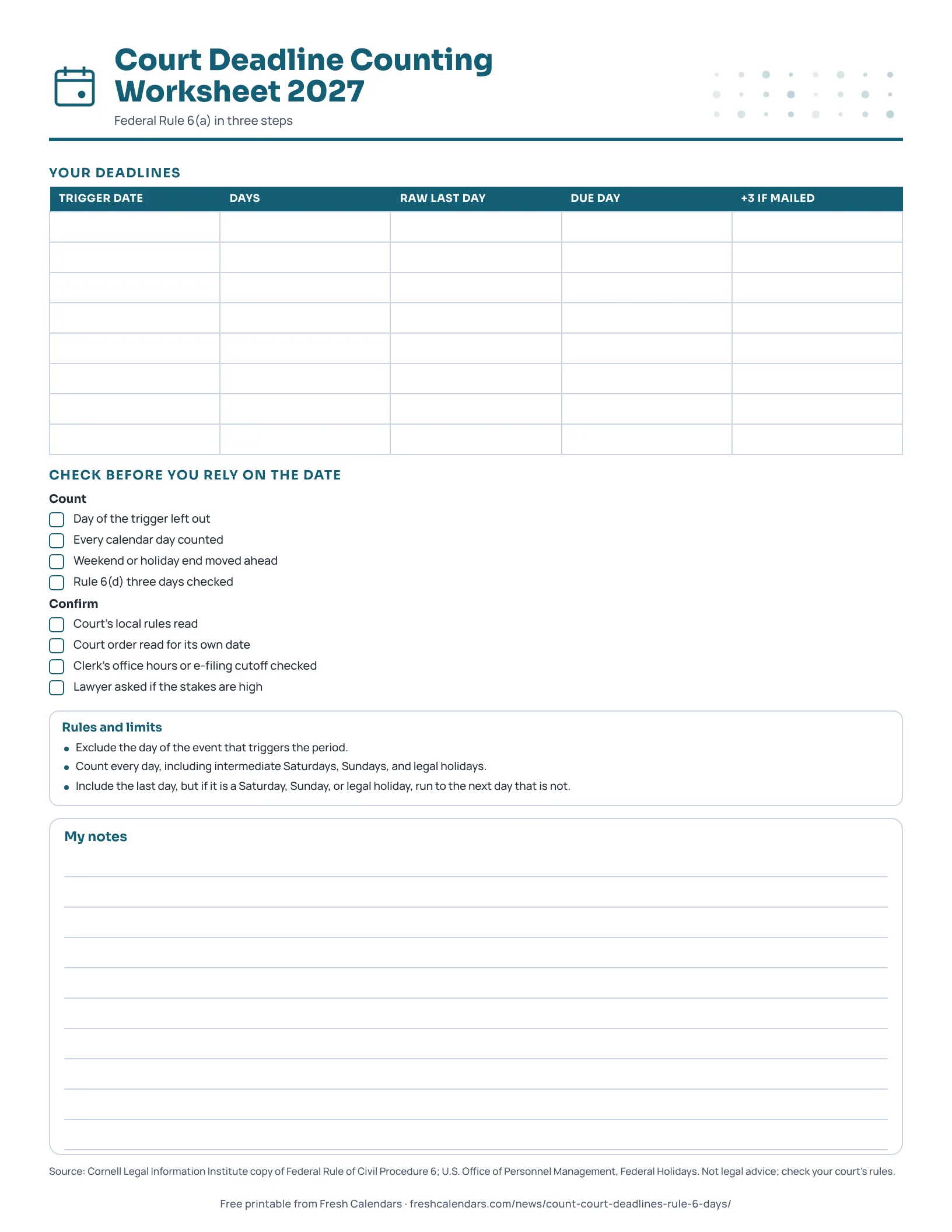
Court Deadline Counting Worksheet 2027
Fill-in worksheet for counting a court deadline under Federal Rule of Civil Procedure 6(a), with the three counting steps, a blank table for 2027 dates and a check list.
Frequently asked questions
Do you count the day a court deadline is triggered?
No. Rule 6(a)(1)(A) says to exclude the day of the event that triggers the period, so day 1 is the next day.
Do weekends count in a 14-day or 30-day deadline?
Yes while counting. Rule 6(a)(1)(B) says to count every day, including intermediate Saturdays, Sundays, and legal holidays. Only the last day can roll forward.
Does mail service add 3 days?
Under Rule 6(d), 3 days are added after the period would otherwise expire when service is by mail, by leaving it with the clerk, or by other means the person consented to. Since the 2016 amendment, electronic service is not on that list.
Is the Friday before Juneteenth 2027 a legal holiday for a court deadline?
Rule 6(a)(6)(A) names the day set aside by statute for observing Juneteenth National Independence Day. The Office of Personnel Management (OPM) treats Friday, June 18, 2027 as the holiday for federal employees' pay and leave. How a particular court treats that Friday is a question for the clerk or the court's rules.
Sources
- Rule 6. Computing and Extending Time; Time for Motion Papers (Legal Information Institute, Cornell Law School)
- Federal Rules of Civil Procedure (Administrative Office of the U.S. Courts)
- Rule 26. Computing and Extending Time (Federal Rules of Appellate Procedure) (Legal Information Institute, Cornell Law School)
- Rule 45. Computing and Extending Time (Federal Rules of Criminal Procedure) (Legal Information Institute, Cornell Law School)
- Federal Holidays (U.S. Office of Personnel Management)
- New York General Construction Law, Section 25-a (New York State Senate)
Related news
-
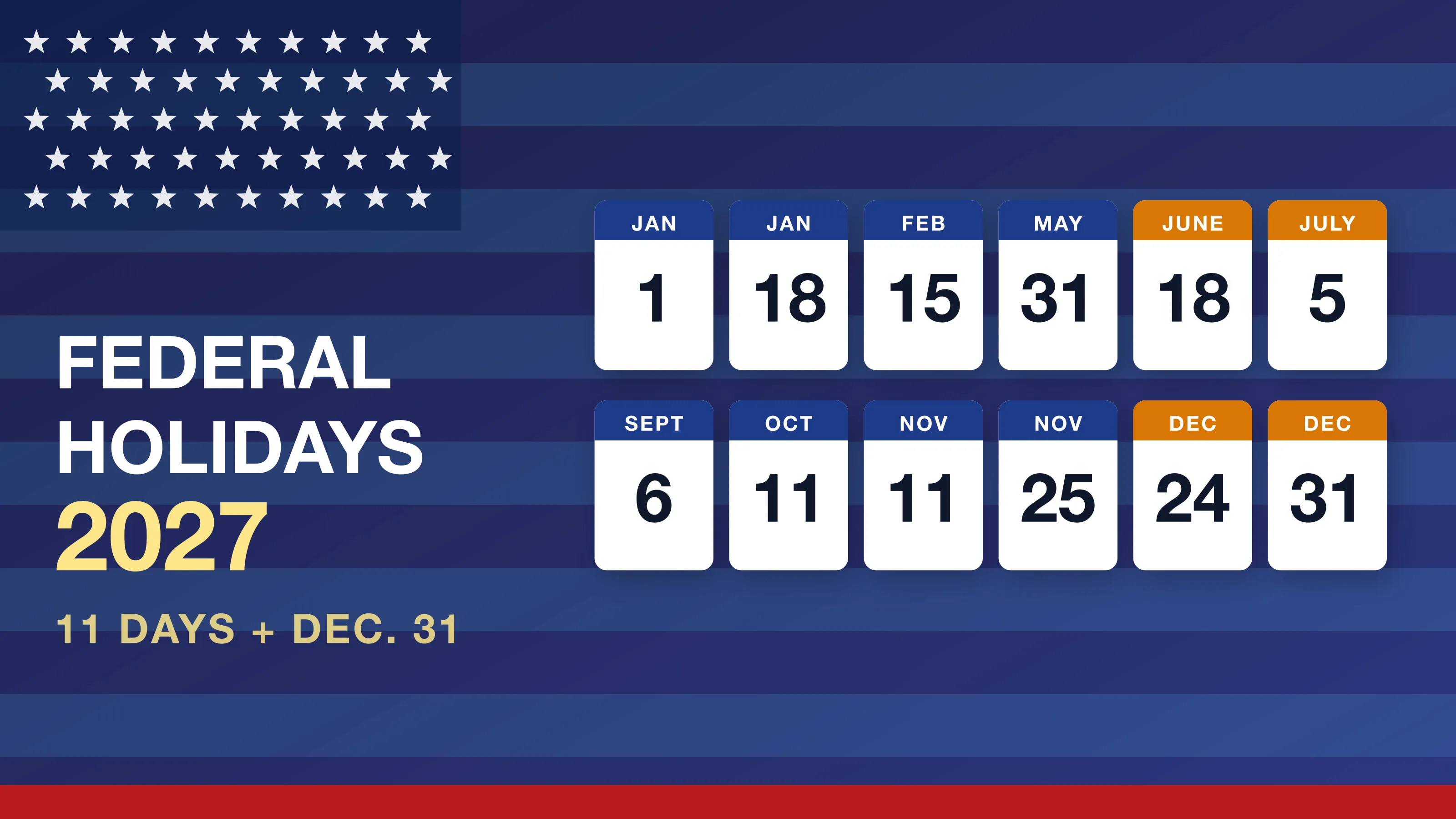 Federal Holidays 2027: All 11 Observed Dates, a Printable List and a Bonus Day Off on Dec. 31
-
 How Many Business Days Are in a Year? 260 to 262 Weekdays, Federal Counts 2024-2035
-
 Working Days in 2027: 249 Federal, 251 NYSE Trading Days, Month by Month
-
 When a Deadline Falls on a Weekend: The IRS, Court and Agency Rules
More in Calendar Guides
All Calendar Guides stories →- MM/DD or DD/MM? How Countries Write Dates, and the ISO Fix
- Hebrew Year 5787 Is a Leap Year: Adar I, Adar II and Purim 2027
- Chinese Lunar Calendar 2027: Every Month's Start Date and No Leap Month
- Nowruz 2027: The Equinox Time and Why the Persian New Year Is March 21
- The Year 2038 Problem: Why Some 32-Bit Clocks Run Out on Jan. 19, 2038
Trending now
- Black Friday Canada 2026: Nov. 27 Date, Canadian Tire Deals From Nov. 5, Who Hasn't Announced
- November 2026 Meteor Showers: Taurid Fireballs Under Dark Skies, Then the Leonids on Nov. 16-17
- SNAP Payment Schedule November 2026: Deposit Dates for Every State, With Weekend Days Flagged
- Election Night 2026 Live Blog: Results Map, Senate, House and Governor Races
- Black Friday 2026 Deals: Date Is Friday, Nov. 27, Live Countdown and Ad Tracker