EI Premiums 2027: $1.64 Rate and $70,800 Maximum Insurable Earnings
Employment Insurance (EI) premiums for 2027 are $1.64 per $100 earned up to $70,800, a $1,161.12 maximum, Employment and Social Development Canada says.

Published 4 min read


Key dates
In this article
Employment Insurance (EI) premiums for 2027 are $1.64 per $100 of insurable earnings outside Quebec, on earnings up to $70,800, according to Employment and Social Development Canada (ESDC). The rate and the new maximum take effect Jan. 1, 2027, and the most an employee pays in the year is $1,161.12. This story adds what that means on a paycheque at three salaries, in and outside Quebec.
What are the EI premium rate and maximum for 2027?
ESDC’s notice, modified Oct. 27, 2026, says: “The maximum insurable earnings is $70,800 ($68,900 in 2026).” The Canada Revenue Agency (CRA) lists the same figures in its EI premium table. Employers pay a share on top of the employee’s premium, shown in the last row.
| Item | Outside Quebec, 2026 | Outside Quebec, 2027 | Quebec, 2026 | Quebec, 2027 |
|---|---|---|---|---|
| Maximum insurable earnings | $68,900 | $70,800 | $68,900 | $70,800 |
| Employee rate per $100 | $1.63 | $1.64 | $1.30 | $1.29 |
| Maximum employee premium | $1,123.07 | $1,161.12 | $895.70 | $913.32 |
| Maximum employer premium | $1,572.30 | $1,625.57 | $1,253.98 | $1,278.65 |
Sources: ESDC notice (employee figures), CRA “EI premium rates and maximums” (employer figures). ESDC’s 2027 actuarial report summary puts the 2027 employer rate at $2.30 per $100 of insurable earnings, and $1.81 per $100 for employers in Quebec.
Maximum insurable earnings rise $1,900 ($70,800 minus $68,900). Because the rate also rises one cent, the maximum employee premium goes up $38.05 ($1,161.12 minus $1,123.07) outside Quebec. In Quebec it goes up $17.62 ($913.32 minus $895.70) even though the rate falls.
Why is the EI rate lower in Quebec?
Quebec has its own parental insurance plan, so its workers pay a lower federal EI rate. In 2027 that rate is $1.29 per $100 in Quebec, one cent lower than the $1.30 of 2026.
How much will EI cost me per paycheque in 2027?
The premium is the rate times insurable earnings, up to the maximum. We worked it out for three yearly salaries, with 26 biweekly pays, and rounded to the cent. A pay of exactly half a cent rounds up. The 2026 column uses the 2026 rate and the $68,900 cap.
Outside Quebec, employee premium
| Yearly salary | 2026 per year | 2027 per year | Change | 2027 per biweekly pay |
|---|---|---|---|---|
| $40,000 | $652.00 | $656.00 | +$4.00 | $25.23 |
| $60,000 | $978.00 | $984.00 | +$6.00 | $37.85 |
| $90,000 | $1,123.07 | $1,161.12 | +$38.05 | $44.66 |
For example, $60,000 times $1.64 per $100 is $984.00, and $984.00 divided by 26 is $37.85. The $90,000 earner is capped: only the first $70,800 counts.
Quebec, employee premium
| Yearly salary | 2026 per year | 2027 per year | Change | 2027 per biweekly pay |
|---|---|---|---|---|
| $40,000 | $520.00 | $516.00 | -$4.00 | $19.85 |
| $60,000 | $780.00 | $774.00 | -$6.00 | $29.77 |
| $90,000 | $895.70 | $913.32 | +$17.62 | $35.13 |
Employer premium at the same salaries. CRA’s maximums imply that employers pay 1.4 times the employee premium: $1,161.12 times 1.4 is $1,625.57 after rounding. Applying 1.4 to the employee premiums above gives these 2027 amounts per employee per year.
| Yearly salary | Outside Quebec, 2027 | Change from 2026 | Quebec, 2027 | Change from 2026 |
|---|---|---|---|---|
| $40,000 | $918.40 | +$5.60 | $722.40 | -$5.60 |
| $60,000 | $1,377.60 | +$8.40 | $1,083.60 | -$8.40 |
| $90,000 | $1,625.57 | +$53.27 | $1,278.65 | +$24.67 |
At what salary do I stop paying EI in 2027?
At $70,800 of yearly earnings. Anything above that is not subject to the premium. In 2026 the cutoff is $68,900. On 26 equal biweekly pays, $70,800 works out to $2,723.08 per pay, so a worker at exactly that salary pays premiums through the last pay of the year. Someone earning $90,000 a year (about $3,461.54 per pay) passes the cap during the 21st pay, after which no more EI premium comes off.
What are the maximum EI benefit rates from Dec. 27, 2026?
ESDC lists new benefit maximums “for claims beginning on or after December 27, 2026,” a Sunday, five days before the premiums change.
| Benefit | 2026 | For claims from Dec. 27, 2026 |
|---|---|---|
| Maximum weekly EI benefit rate | $729 | $749 |
| Extended parental benefit, weekly | $437 | $449 |
That is $20 a week more on the standard maximum and $12 more on extended parental benefits. Mark both days on the December 2026 printable calendar and the January 2027 printable calendar; the sheet in the downloads box lists them with the rates side by side.
What about Canada Pension Plan contributions in 2027?
The earnings ceilings are out; the payroll maximums are not. The CRA’s page of registered plan limits, modified Oct. 28, 2026, lists the 2027 Year’s Maximum Pensionable Earnings (YMPE) at $76,700, up from $74,600, and the 2027 Year’s Additional Maximum Pensionable Earnings (YAMPE) at $87,400, up from $85,000.
The Canada Pension Plan (CPP) payroll page, “CPP contribution rates, maximums and exemptions,” modified Oct. 30, 2026, had no 2027 row when checked on Nov. 4, 2026, so the 2027 maximum contributions are not yet announced. Its 2026 row reads:
| 2026 CPP item | Amount |
|---|---|
| Year’s Maximum Pensionable Earnings (YMPE) | $74,600 |
| Basic exemption | $3,500 |
| Employee contribution rate | 5.95% |
| Maximum employee contribution | $4,230.45 |
For other dates that shape the new year, see the Registered Retirement Savings Plan (RRSP) deadline for 2027, the benefit payment dates for November and December 2026 and Canada’s federal holidays in 2027.
Free printable downloads
Every template is free, needs no sign-up and prints on US Letter paper. Choose PDF for printing or PNG for screens and documents.
EI Premiums and Benefit Rates printables
-
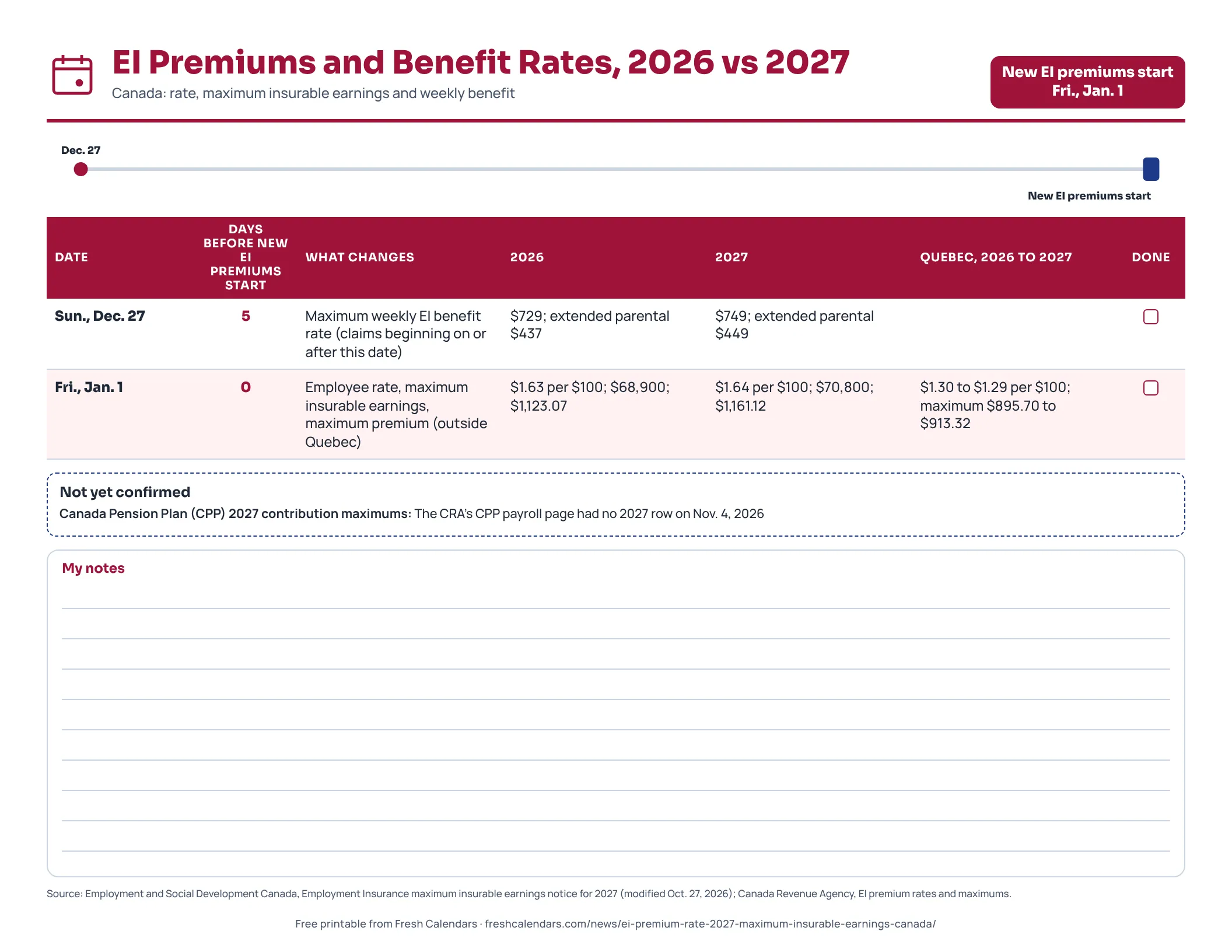
EI Premiums and Benefit Rates, 2026 vs 2027
One-page sheet comparing Canada's 2026 and 2027 Employment Insurance premium rate, maximum insurable earnings, maximum premium and weekly benefit rates.
-
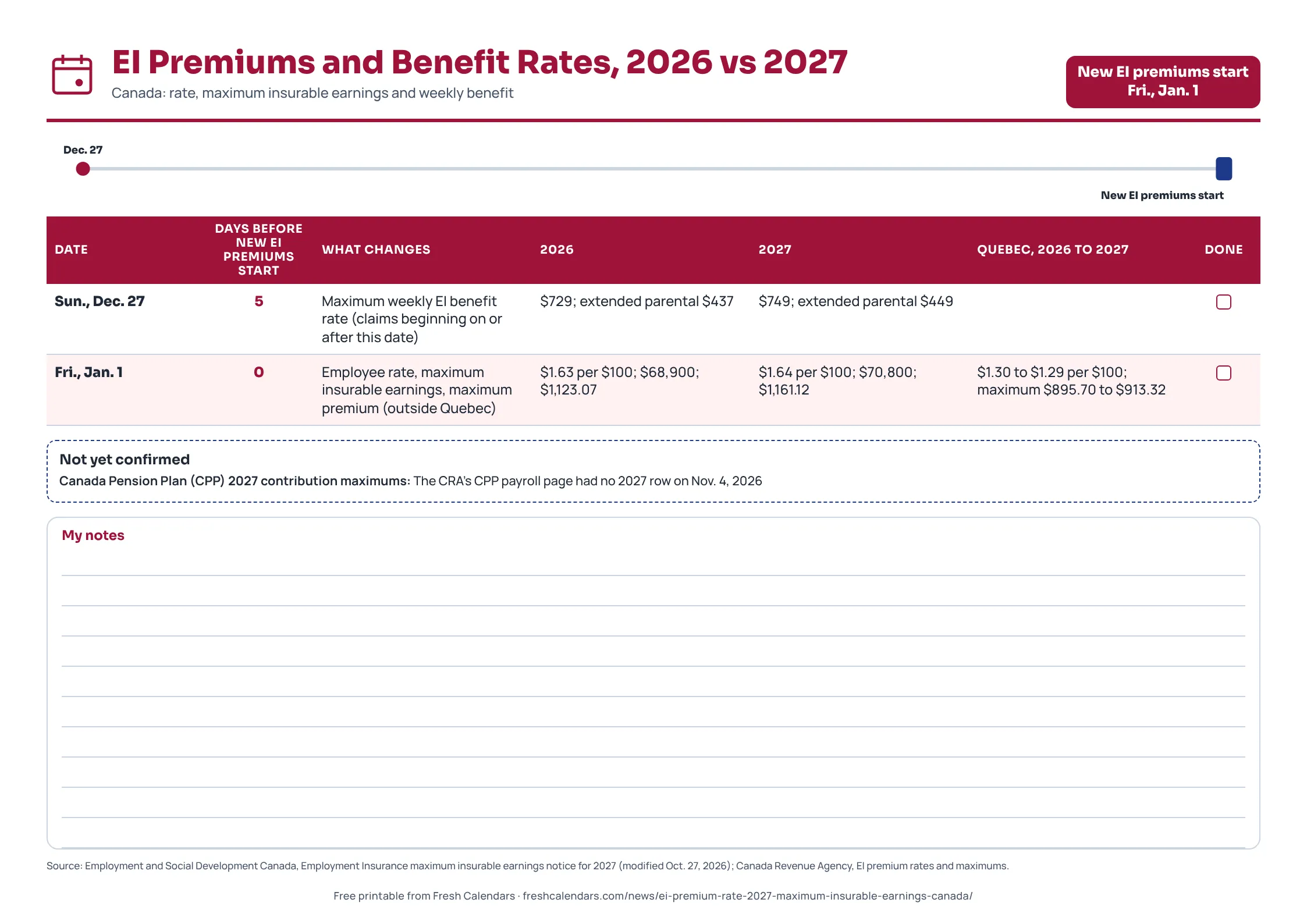
EI Premiums and Benefit Rates, 2026 vs 2027 (A4)
One-page sheet comparing Canada's 2026 and 2027 Employment Insurance premium rate, maximum insurable earnings, maximum premium and weekly benefit rates. A4 paper.
Frequently asked questions
What is the EI premium rate for 2027?
ESDC lists $1.64 per $100 of insurable earnings outside Quebec and $1.29 per $100 in Quebec, effective Jan. 1, 2027.
What is the EI maximum for 2027?
Maximum insurable earnings are $70,800, so the most an employee pays is $1,161.12 outside Quebec and $913.32 in Quebec.
What is the maximum weekly EI benefit in 2027?
ESDC lists $749 a week for claims beginning on or after Dec. 27, 2026, and $449 for extended parental benefits.
Are the 2027 Canada Pension Plan figures out?
Partly. The Canada Revenue Agency lists the 2027 Year's Maximum Pensionable Earnings at $76,700, but its payroll page for CPP contribution maximums had no 2027 row on Nov. 4, 2026.
Sources
- Employment Insurance - Important notice about maximum insurable earnings for 2027 (Employment and Social Development Canada, 2026-10-27)
- Summary of the 2027 Actuarial Report on the Employment Insurance Premium Rate (Employment and Social Development Canada, 2026-09-17)
- EI premium rates and maximums (Canada Revenue Agency)
- CPP contribution rates, maximums and exemptions (Canada Revenue Agency, 2026-10-30)
- MP, DB, RRSP, DPSP, ALDA, TFSA limits, YMPE and the YAMPE (Canada Revenue Agency, 2026-10-28)
Related news
-
 CPP Payment Dates November 2026: CPP and OAS on Nov. 26, CCB on Nov. 20, plus December
-
 RRSP Deadline 2027: Monday, March 1, and the Canada Tax Season Dates for 2026 Returns
-
 Canada Statutory Holidays 2027: 10 Federal Holidays, Thanksgiving on Oct. 11
-
 Medicare Part B Premium 2027: Trustees Project $209.50, CMS Has Not Yet Announced the Official Amount
More in UK & Canada
All UK & Canada stories →- Quebec Winter Carnival 2027: Feb. 5 to 14, Effigie Price and Parade Dates
- Winterlude 2027: Jan. 29 to Feb. 15 in Ottawa-Gatineau, Three Weekends
- Christmas Markets 2026 in York, Bath, Cardiff, Lincoln and Belfast: Dates and Hours
- UK Trains at Christmas 2026: No Trains Dec. 25, Paddington and New Street Closures
- Winter Tires in Canada 2026-27: Quebec's Dec. 1 Deadline, BC Highway Rules, Province Guide
Trending now
- Black Friday Canada 2026: Nov. 27 Date, Canadian Tire Deals From Nov. 5, Who Hasn't Announced
- November 2026 Meteor Showers: Taurid Fireballs Under Dark Skies, Then the Leonids on Nov. 16-17
- Election Night 2026 Live Blog: Results Map, Senate, House and Governor Races
- Black Friday 2026 Deals: Date Is Friday, Nov. 27, Live Countdown and Ad Tracker
- SNAP Payment Schedule November 2026: Deposit Dates for Every State, With Weekend Days Flagged