Arizona Time After Nov. 1, 2026: Phoenix Is 1 Hour Ahead of California, Same as Denver
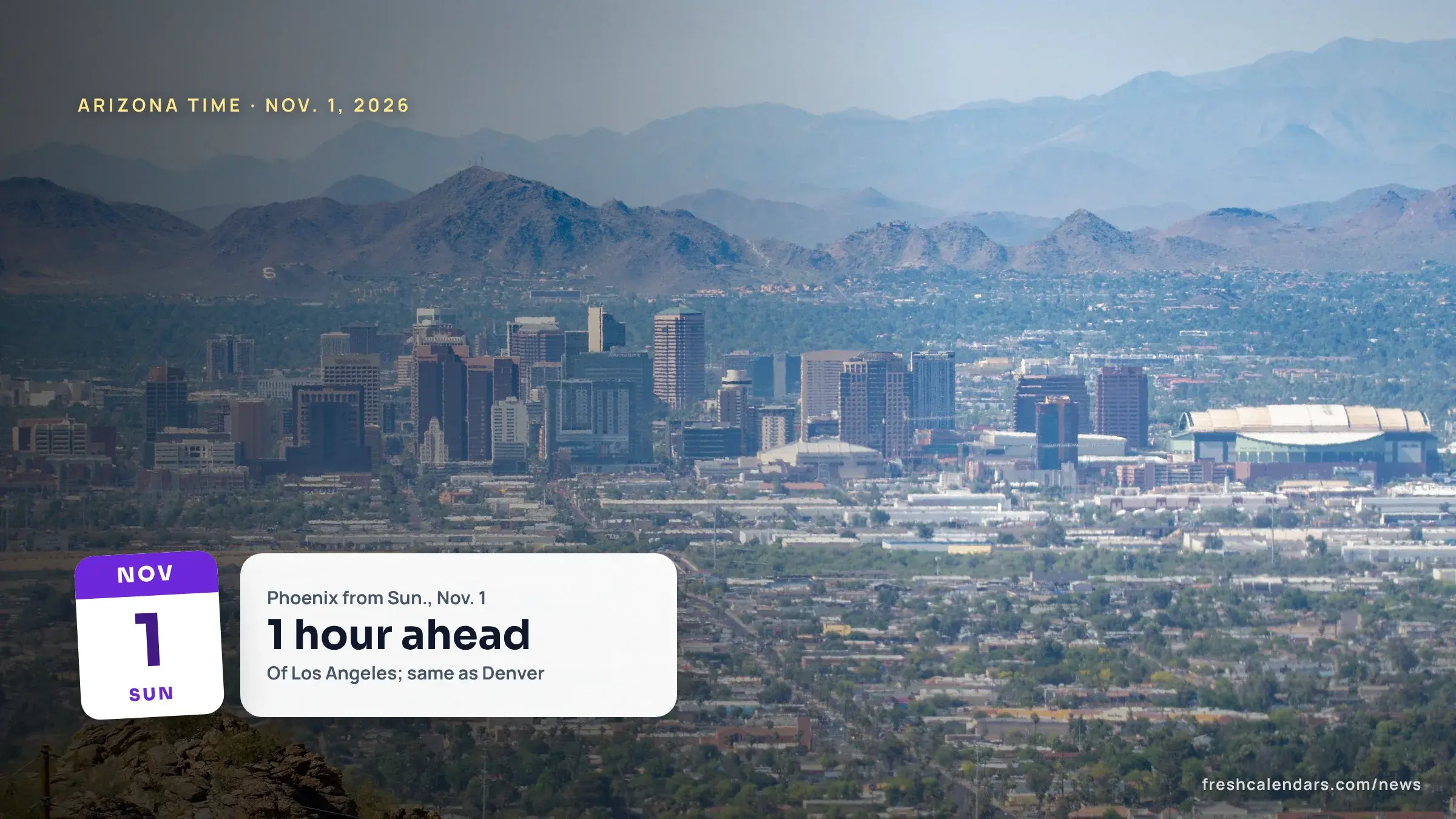
Arizona stays on Mountain Standard Time (MST) when U.S. clocks fall back Nov. 1, 2026, so Phoenix is 1 hour ahead of California and matches Denver.

Published 4 min read
In this article
Arizona does not move its clocks when U.S. clocks fall back at 2 a.m. on Sunday, Nov. 1, 2026, so Phoenix goes from the same time as California to 1 hour ahead of it. Arizona Revised Statutes (A.R.S.) §1-242, published by the Arizona State Legislature, keeps the state on standard mountain time. Below is a table of Phoenix and Honolulu against five U.S. cities, before and after Nov. 1, plus what the change does to TV and game start times.
What time is it in Arizona from Nov. 1, 2026?
Arizona is on Mountain Standard Time (MST), which is Coordinated Universal Time (UTC) minus 7 hours, according to time.gov, run by the National Institute of Standards and Technology (NIST) and the U.S. Naval Observatory. The state law says Arizona “elects to reject” daylight saving time and keeps standard mountain time, based on the 105th meridian. The same section says the rule “may be changed by future legislative action.”
The rest of the country follows federal law. Under 15 U.S.C. §260a, daylight saving time runs from 2 a.m. on the second Sunday of March to 2 a.m. on the first Sunday of November, and a state that lies entirely in one time zone may exempt itself by state law. Arizona has done that. Nov. 1, 2026 is the first Sunday of November, so the other zones drop one hour while Arizona stands still.
That is why the gap to California shifts. Before Nov. 1, Los Angeles was on Pacific Daylight Time (PDT), UTC-7, the same offset as Phoenix. From Nov. 1, Los Angeles is on Pacific Standard Time (PST), UTC-8, and Phoenix is 1 hour ahead. Denver moves from Mountain Daylight Time (MDT), UTC-6, to MST, UTC-7, and lands on Phoenix’s clock.
Phoenix and Honolulu against five U.S. cities
All differences below are our calculation from each zone’s offset from UTC: Eastern -4 then -5, Central -5 then -6, Mountain -6 then -7, Pacific -7 then -8, Alaska -8 then -9, Hawaii -10 all year, Arizona -7 all year. Eastern, Central, Alaska and Pacific clocks all go back an hour on Nov. 1.
| City | Before Nov. 1 (UTC offset) | From Nov. 1, 2026 (UTC offset) |
|---|---|---|
| New York | Phoenix 3 hours behind (-4) | Phoenix 2 hours behind (-5) |
| Chicago | Phoenix 2 hours behind (-5) | Phoenix 1 hour behind (-6) |
| Denver | Phoenix 1 hour behind (-6) | Same time (-7) |
| Los Angeles | Same time (-7) | Phoenix 1 hour ahead (-8) |
| Anchorage | Phoenix 1 hour ahead (-8) | Phoenix 2 hours ahead (-9) |
Phoenix is on UTC-7 in both columns. The same comparison for Honolulu, which sits at UTC-10 all year:
| City | Before Nov. 1 | From Nov. 1, 2026 |
|---|---|---|
| New York | Honolulu 6 hours behind | Honolulu 5 hours behind |
| Chicago | Honolulu 5 hours behind | Honolulu 4 hours behind |
| Denver | Honolulu 4 hours behind | Honolulu 3 hours behind |
| Los Angeles | Honolulu 3 hours behind | Honolulu 2 hours behind |
| Anchorage | Honolulu 2 hours behind | Honolulu 1 hour behind |
| Phoenix | Honolulu 3 hours behind | Honolulu 3 hours behind |
Honolulu and Phoenix stay 3 hours apart because neither moves.
TV and game start times in Phoenix after Nov. 1
A program shown live nationwide keeps its Eastern Time (ET) slot, so the Phoenix clock reading rises by 1 hour on Nov. 1. These conversions are our calculation.
| Start time in New York | Phoenix before Nov. 1 | Phoenix from Nov. 1 | Honolulu from Nov. 1 |
|---|---|---|---|
| 1 p.m. ET kickoff | 10 a.m. | 11 a.m. | 8 a.m. |
| 4:25 p.m. ET game | 1:25 p.m. | 2:25 p.m. | 11:25 a.m. |
| 8 p.m. ET show | 5 p.m. | 6 p.m. | 3 p.m. |
| 8:20 p.m. ET game | 5:20 p.m. | 6:20 p.m. | 3:20 p.m. |
The table lists generic times, not a network schedule; check the broadcaster for the actual start.
When do Arizona and California match again?
The next change is Sunday, March 14, 2027, the second Sunday of March under 15 U.S.C. §260a. At 2 a.m. that day U.S. clocks move forward 1 hour and Phoenix again matches Los Angeles, as it did before Nov. 1. Phoenix is then 1 hour behind Denver. From Nov. 1, 2026 to Mar. 14, 2027, the table above applies. Mark both dates on the November 2026 printable calendar and the March 2027 printable calendar.
For the wider picture of the fall change itself, see daylight saving time ends Nov. 1, 2026, and for next spring, clock changes in 2027. Mexico has its own mix of zones; the Mexico time difference after Nov. 1 is in a separate table.
Do all parts of Arizona use the same clock?
Tribal lands in northeastern Arizona can follow a different clock; check the local time there before you travel. The state law above covers the state itself, and the tables in this story use Phoenix.
Could Arizona or the U.S. change this?
Not for 2026 or 2027. The Sunshine Protection Act of 2025, H.R. 139 in the 119th Congress, is listed by GovInfo as engrossed in the House, with a last action date of July 14, 2026. Its Senate companion, S. 29, was introduced on Jan. 7, 2025, by Sen. Rick Scott and referred to the Senate Commerce Committee. Neither is law, and these sources do not confirm Senate passage, so clocks still change in 2026 and 2027 under current law. Arizona’s own rule would stay in place unless the state legislature acts.
Phoenix printable for Nov. 1, 2026
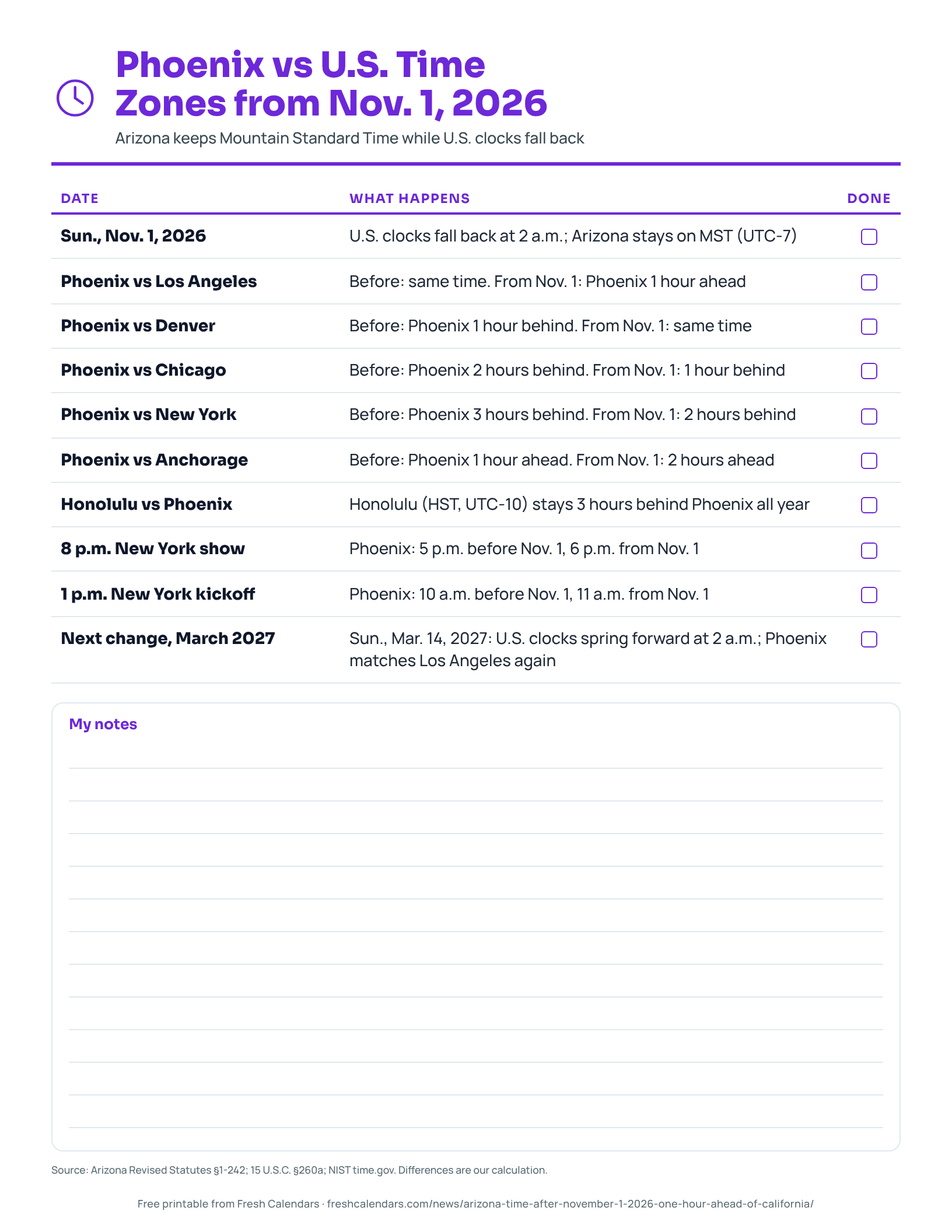
The free printable lists the Phoenix comparison for each U.S. city, the Honolulu gap and both change dates on one page, built from the tables above.
Free printable downloads
Every template is free, needs no sign-up and prints on US Letter paper. Choose PDF for printing or PNG for screens and documents.
Phoenix vs U.S. Time Zones from Nov. 1 printables
-
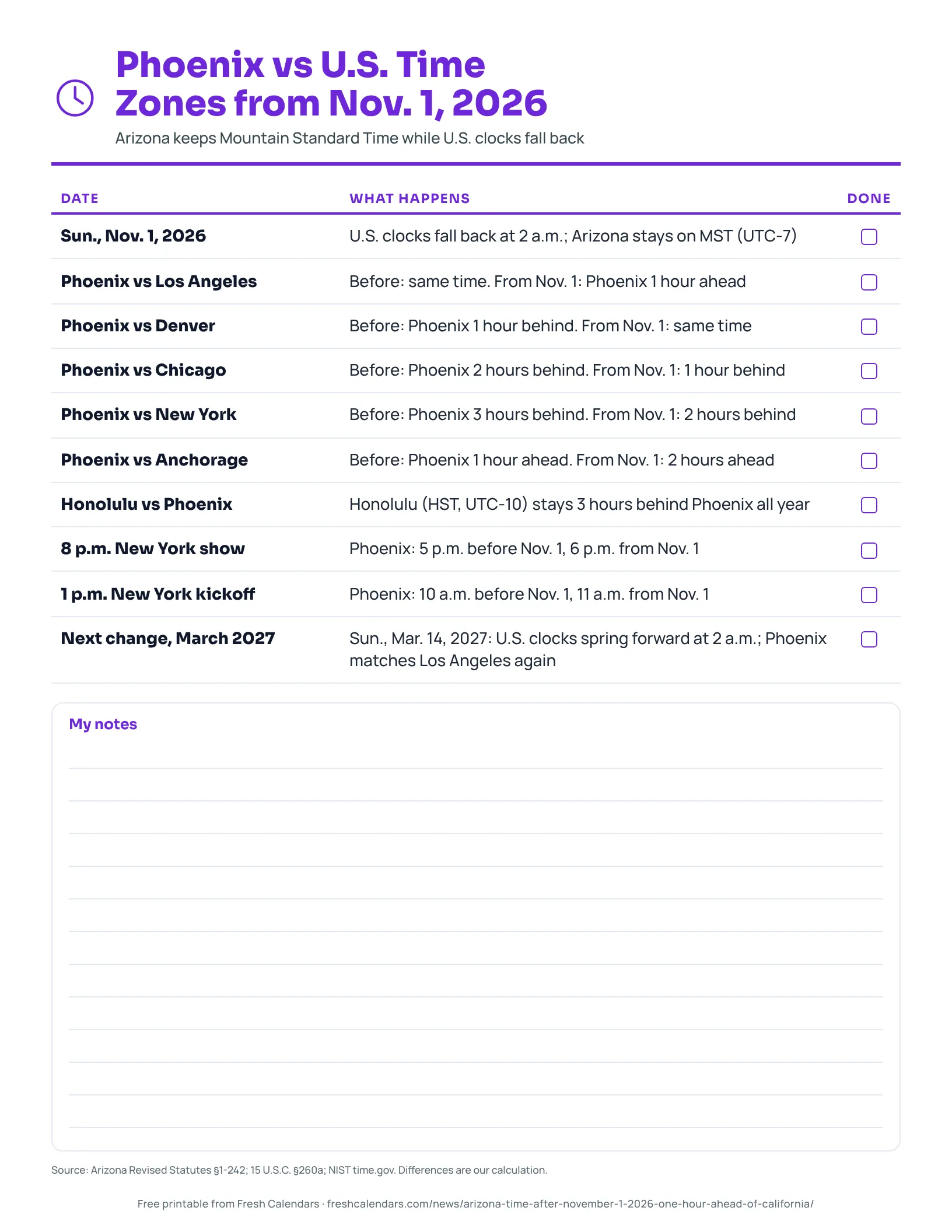
Phoenix vs U.S. Time Zones from Nov. 1, 2026
One-page list of how Phoenix and Honolulu compare with U.S. cities before and after clocks fall back on Nov. 1, 2026.
-
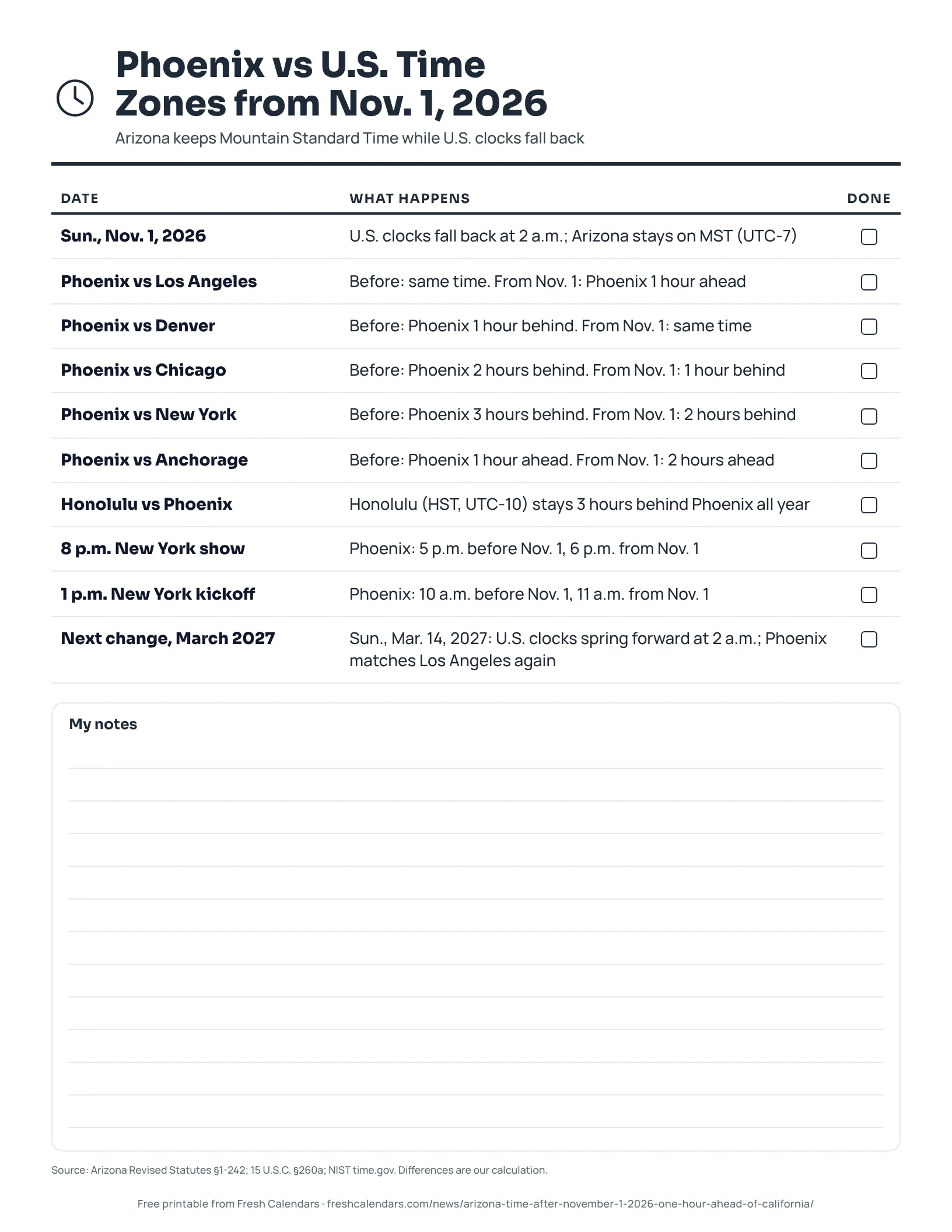
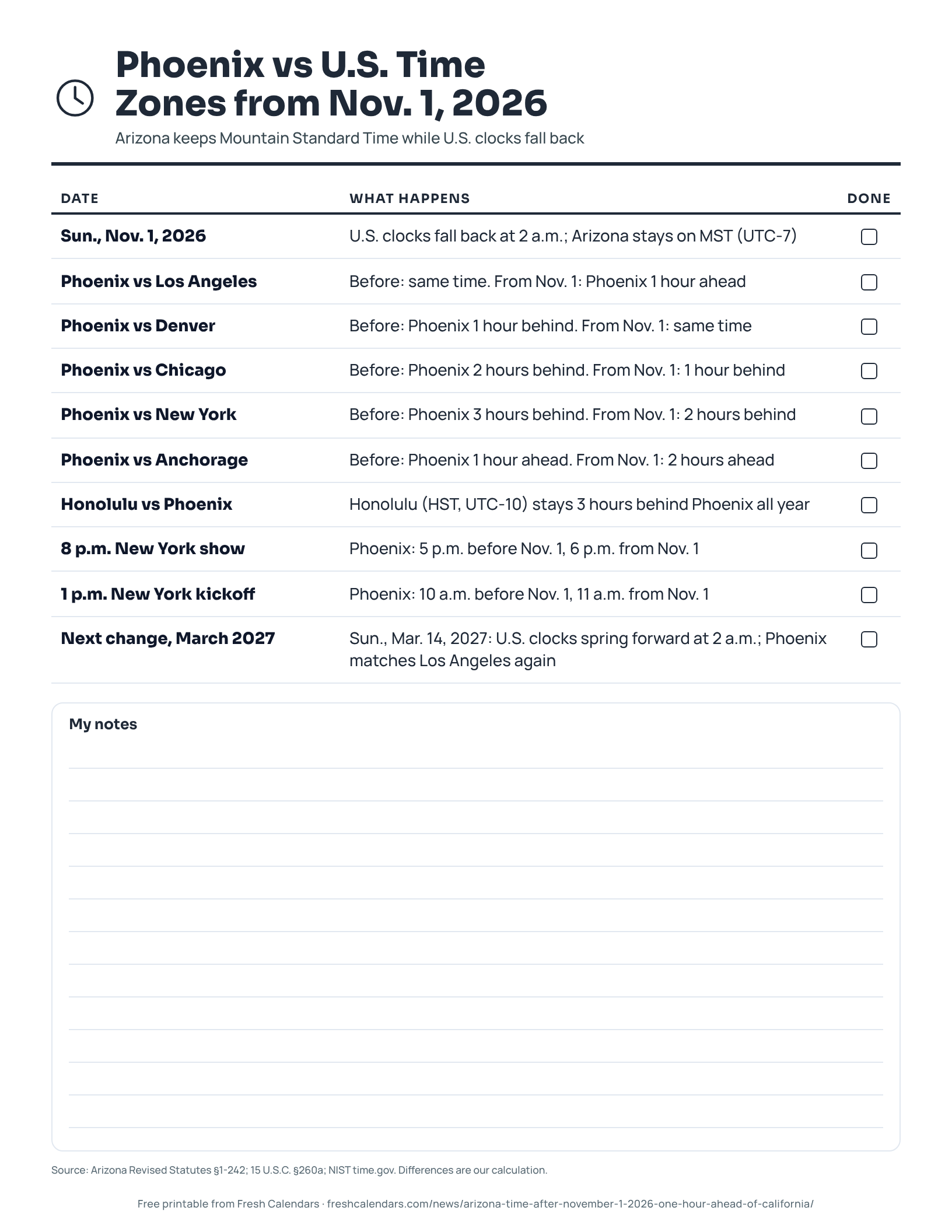
Phoenix vs U.S. Time Zones from Nov. 1, 2026 (ink saver)
One-page list of how Phoenix and Honolulu compare with U.S. cities before and after clocks fall back on Nov. 1, 2026. Ink-saver version.
Frequently asked questions
Does Arizona change its clocks in November 2026?
No. Arizona law keeps the state on standard mountain time all year. U.S. clocks fall back at 2 a.m. on Sunday, Nov. 1, 2026, and Arizona's clocks stay where they are.
What time is it in Phoenix if it is noon in Los Angeles?
From Nov. 1, 2026, it is 1 p.m. in Phoenix. Until Oct. 31 both cities showed the same time. This is our calculation from UTC-7 for Phoenix and UTC-8 for Los Angeles on Pacific Standard Time.
Is Arizona on Pacific or Mountain time?
Mountain. Arizona uses Mountain Standard Time (MST), which is UTC-7 all year, according to time.gov. In summer that matched Pacific Daylight Time (PDT); in winter it matches Denver.
Does Hawaii change its clocks?
Hawaii Standard Time (HST), UTC-10, is listed on time.gov and the clocks stay put. Honolulu is 2 hours behind Los Angeles from Nov. 1, 2026, down from 3 hours.
Could daylight saving time end for good?
Not yet. H.R. 139 is not law, so clocks still change in 2026 and 2027 under current law.
Sources
- A.R.S. §1-242 Standard time (Arizona State Legislature)
- 15 U.S. Code 260a - Advancement of time or changes in time within time belts (Legal Information Institute, Cornell Law School)
- Official U.S. time (National Institute of Standards and Technology (NIST) and U.S. Naval Observatory, 2026-10-31)
- H.R. 139, Sunshine Protection Act of 2025 (engrossed in House) (U.S. Government Publishing Office (GovInfo), 2026-07-14)
- S. 29, Sunshine Protection Act of 2025 (introduced in Senate) (U.S. Government Publishing Office (GovInfo), 2025-01-07)
Related news

More in Time Change
All Time Change stories →- Smoke Alarm Check Before Clocks Fall Back Nov. 1, 2026: Test Now, Replace by Age
- US-Dubai Time Difference After Nov. 1, 2026: New York Is 9 Hours Behind the UAE
- US-Brazil Time Difference After Nov. 1, 2026: New York Is 2 Hours Behind São Paulo
- U.S.-Japan, Korea and China Time Difference After Nov. 1, 2026: Tokyo Is 14 Hours Ahead
- US-Philippines Time Difference After Nov. 1, 2026: New York Is 13 Hours Behind Manila