Smoke Alarm Check: Test Monthly, Replace Every 10 Years, Printable
Test smoke alarms monthly and replace 9-volt and hardwired ones every 10 years, says the U.S. Fire Administration. A table gives each replace-by year.

Published Updated 4 min read
Key date
- Mar 14Sun Clocks spring forward: next smoke alarm check In 113 days + Google
In this article
- What does the U.S. Fire Administration say to check on a smoke alarm?
- Does every smoke alarm need a new battery when the clocks change?
- How old is my smoke alarm? Replace-by years under the 10-year rule
- Where should smoke alarms go in the house?
- Smoke alarm check dates: this clock change and the next two
- Print the smoke alarm checklist
U.S. clocks fell back at 2 a.m. local time on Sunday, Nov. 1, 2026 (daylight saving time ended; Hawaii and most of Arizona did not change), and the U.S. Fire Administration (USFA), part of the Federal Emergency Management Agency (FEMA), says to test smoke alarms monthly. The clock change works as a twice-a-year reminder to do the full check, and the days after the change are a good time for it: test every alarm, look at its age and decide what needs replacing. Our one-page printable below turns that into ticks.
What does the U.S. Fire Administration say to check on a smoke alarm?
The USFA “Smoke alarms” page, which we checked on Nov. 14, 2026, gives four rules in plain terms:
- Test: “Test the alarm monthly.”
- Replace: “Replace the entire smoke alarm every 10 years.”
- Place: put alarms “in every sleeping room, outside each separate sleeping area, and on every level of your home, including the basement.”
- Link: “Choose interconnected smoke alarms so that when one sounds, they all sound.”
If you cannot afford an alarm, the same page says some fire departments will install battery-operated smoke alarms in your home at no cost.
Does every smoke alarm need a new battery when the clocks change?
No. USFA describes two kinds of battery alarm. One runs on “a disposable 9-volt battery”; the other has “a nonreplaceable 10-year lithium-ion (‘long-life’) battery.” A sealed long-life alarm has no battery to swap, so for that alarm the job on Nov. 1 is a test and a look at its age. USFA says to replace the batteries in a 9-volt alarm “at least once every year,” and hardwired alarms “usually have a backup battery that will need to be replaced once a year.”
| Alarm type | What USFA says | What to do on Nov. 1 |
|---|---|---|
| 9-volt battery alarm | Runs on a disposable 9-volt battery; replace batteries at least once every year | Press the test button; replace the battery if it is a year old |
| Sealed 10-year lithium-ion alarm | Battery is nonreplaceable; replace the alarm per the manufacturer | Test it and check its age; no new battery |
| Hardwired alarm | Has a backup battery replaced once a year | Test it and replace the backup battery |
USFA gives the same “replace the entire smoke alarm every 10 years” rule for 9-volt and hardwired alarms. For a sealed long-life alarm it says to replace the alarm “according to the manufacturer’s instructions.”
How old is my smoke alarm? Replace-by years under the 10-year rule
USFA’s handout “Don’t Wait, Check the Date!” says to look at the back of the alarm for the date of manufacture and to replace the alarm 10 years from that date. Because USFA says to replace a 9-volt or hardwired alarm every 10 years (check the maker’s label on a sealed alarm), we computed the year each alarm turns 10 by adding 10 to its year made. This is our arithmetic from the USFA rule, not a USFA table.
| Year made | Turns 10 in | What to do |
|---|---|---|
| 2016 or earlier | 2026 or earlier | Replace now |
| 2017 | 2027 | Replace in 2027 |
| 2018 | 2028 | Replace in 2028 |
| 2019 | 2029 | Replace in 2029 |
| 2020 | 2030 | Replace in 2030 |
| 2021 | 2031 | Replace in 2031 |
| 2022 | 2032 | Replace in 2032 |
| 2023 | 2033 | Replace in 2033 |
| 2024 | 2034 | Replace in 2034 |
| 2025 | 2035 | Replace in 2035 |
| 2026 | 2036 | Replace in 2036 |
Where should smoke alarms go in the house?
Use the printable as a walk-through list. USFA’s placement rule gives these spots to tick:
- Each bedroom (every sleeping room).
- The hallway outside each separate sleeping area.
- Every level of the home.
- The basement.
Interconnected alarms are the USFA’s pick because one alarm sounding sets off all of them.
Smoke alarm check dates: this clock change and the next two
U.S. daylight saving time runs from the second Sunday in March to the first Sunday in November. The Nov. 1, 2026 end date and the 2 a.m. switch are in the daylight saving time story, which cites the National Institute of Standards and Technology (NIST) and the U.S. Naval Observatory. The next two switches, with weekdays computed:
| Clock change | Date | Smoke alarm check |
|---|---|---|
| Daylight saving time ends | Sunday, Nov. 1, 2026 | Test all alarms, check dates |
| Daylight saving time begins | Sunday, March 14, 2027 | Test all alarms |
| Daylight saving time ends | Sunday, Nov. 7, 2027 | Test all alarms; hardwired backup battery |
The March and November dates are the next two changes under current law. Write them on the November 2026 printable calendar and the March 2027 printable calendar. USFA’s monthly test still applies between clock changes. For what the change does to evenings, see sunset times after the clocks fall back, and for Canada, see which provinces skip the change.
Print the smoke alarm checklist
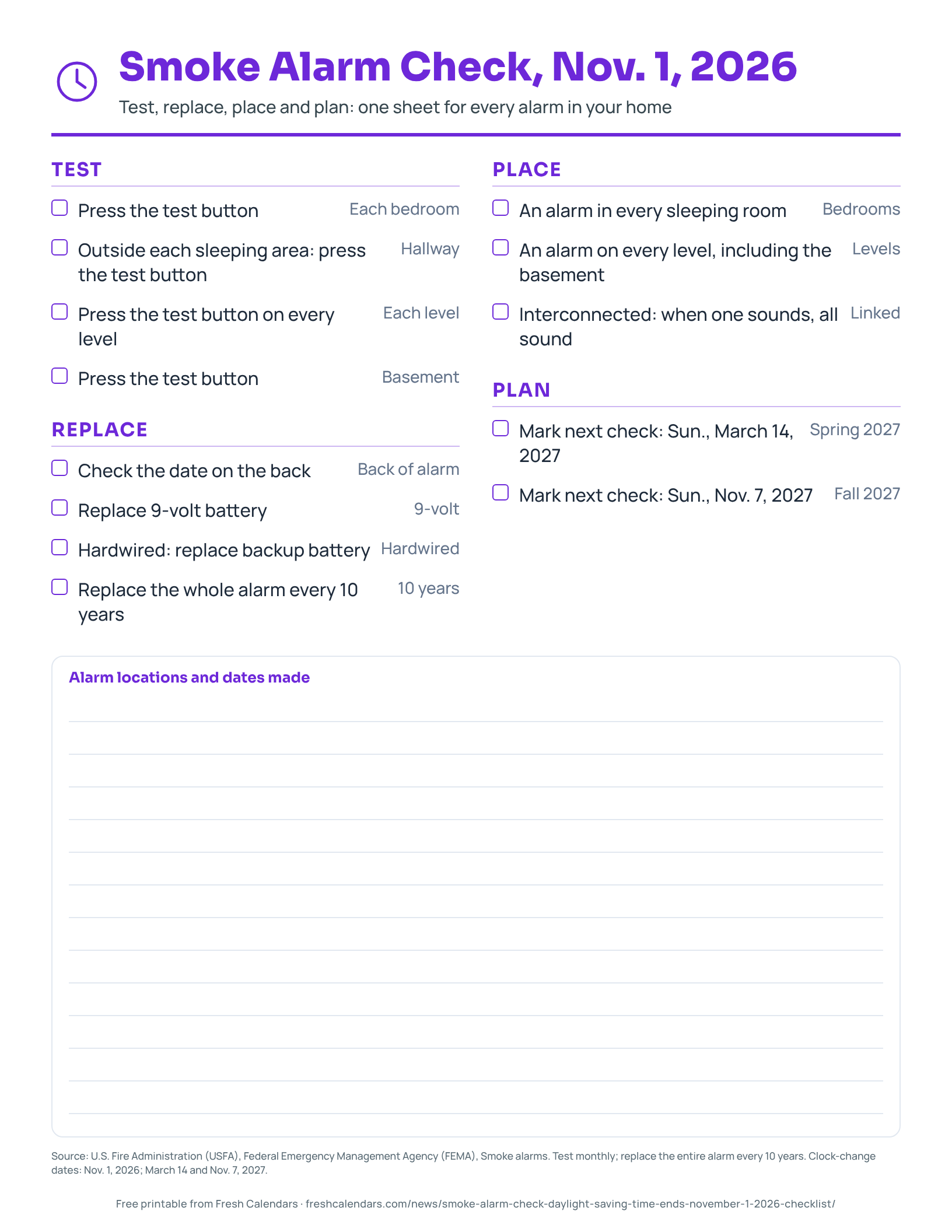
The free sheet has four sections (Test, Replace, Place, Plan), a tick box for each alarm location and a lined area for writing down where each alarm is and the year on its back.
Free printable downloads
Every template is free, needs no sign-up and prints on US Letter paper. Choose PDF for printing or PNG for screens and documents.
Smoke Alarm Check printables
-
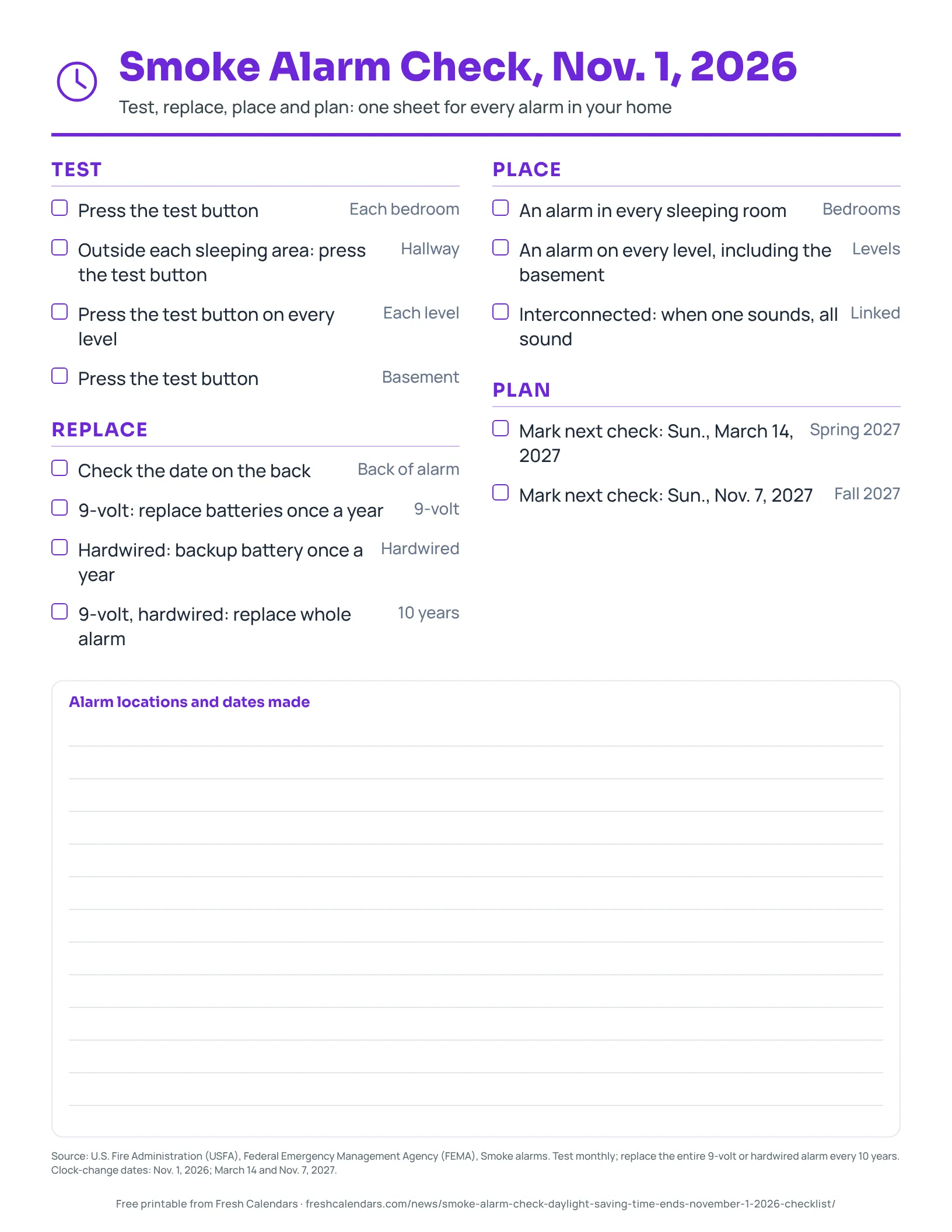
Smoke Alarm Check, Nov. 1, 2026
One-page smoke alarm checklist for the Nov. 1, 2026 clock change: test each alarm, check the date, replace batteries and mark the next check dates.
Frequently asked questions
Do I need a new battery in every smoke alarm on Nov. 1?
Not in a sealed alarm. The U.S. Fire Administration lists a nonreplaceable 10-year lithium-ion battery as one option, with no battery to swap. It says to replace the batteries in a 9-volt alarm, and the backup battery in a hardwired one, at least once every year.
How often should I test a smoke alarm?
The U.S. Fire Administration says to test the alarm monthly. The clock change is a reminder to do the full check twice a year.
When should I replace a smoke alarm?
The U.S. Fire Administration says to replace the entire smoke alarm every 10 years for 9-volt and hardwired alarms, and according to the manufacturer's instructions for a sealed lithium-ion alarm.
Where should smoke alarms go?
In every sleeping room, outside each separate sleeping area and on every level of the home, including the basement, according to the U.S. Fire Administration.
Can I get a smoke alarm installed for free?
Some fire departments will install battery-operated smoke alarms at no cost, the U.S. Fire Administration says. Ask your local department.
Sources
- Smoke alarms (U.S. Fire Administration, Federal Emergency Management Agency, 2026-11-14)
- Don't Wait, Check the Date! Replace smoke alarms every 10 years (U.S. Fire Administration, Federal Emergency Management Agency)
- Daylight Saving Time (DST) (National Institute of Standards and Technology)
- Daylight Saving Time dates for 2026 (U.S. Naval Observatory)
Related news

More in Time Change
All Time Change stories →- US-UK Time Difference, Winter 2026-27: New York 5 Hours Behind London
- US Time Zones 2026-27: Noon ET Is 7 a.m. in Hawaii
- Clocks Go Forward 2027: Sunday 28 March at 1am GMT, to 2am BST
- BC Sunrise Time: Vancouver 8:01 a.m. Nov. 1, Latest 9:08 a.m.
- Arizona vs California Time: Phoenix 1 Hour Ahead Since Nov. 1, 2026
Trending now
- Thanksgiving Travel 2026: Best Days to Fly and Drive, Nov. 21 to 30
- Costco Black Friday 2026: Nov. 27-30 Savings, Deals From Nov. 16
- Black Friday Ads 2026: Date Is Nov. 27, Walmart Deals Nov. 23-29
- Coming to Hulu November 2026: 109 Dated Titles, Percy Jackson Nov. 20
- CPKC Holiday Train 2026 Schedule: 182 Stops, Nov. 19 to Dec. 20