Debt Payoff Planner 2027: Snowball vs. Avalanche Worked Example and Printable Tracker
Consumer Financial Protection Bureau (CFPB) names two ways to reduce debt. We run both on three sample debts and add a free 2027 payoff tracker to print.

Published 4 min read

In this article
The Consumer Financial Protection Bureau (CFPB) says there are “two basic strategies that can help you reduce debt: the highest interest rate method and the snowball method,” and our worked example for 2027 shows what each costs on the same three sample debts. The CFPB post, “How to reduce your debt,” was published July 16, 2019 and is marked as archived content. Our free debt payoff tracker for 2027 has room for six debts and a 12-month payment log.
This is a plain explanation, not financial advice. The debts below are made up, and your own balances, rates and minimums will give different results.
Debt payoff planner 2027 printable
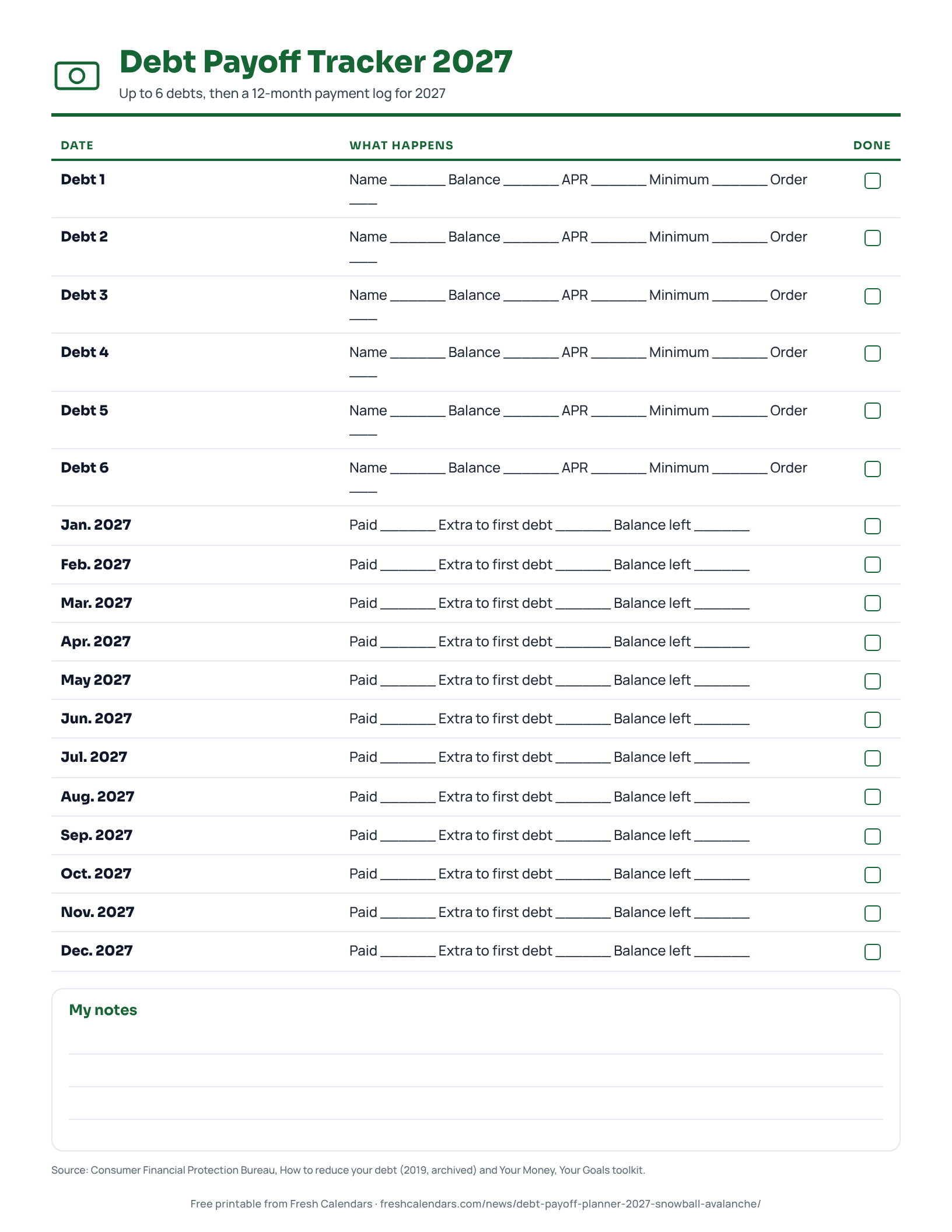
Download the PDF or the PNG. Each of the six debt rows has a name, balance, annual percentage rate (APR), minimum payment and a payoff order. Below them, one line per month from January to December 2027 holds what you paid, the extra you put on your first debt and the balance left. Pin it beside the 2027 yearly calendar or the January calendar.
The CFPB’s Your Money, Your Goals toolkit (last modified April 24, 2026) lists a “Debt log,” a “Debt action plan” and a “Debt-to-income calculator” under “Dealing with Debt.”
What are the snowball and avalanche methods?
The CFPB’s archived post gives two strategies. Of the snowball method it says “This approach focuses on your smallest debt.” It closes with “Choose the strategy that’s best for your situation and put it into action.”
The CFPB does not use the word “avalanche.” That is the common name for its highest interest rate method, which targets the debt with the highest APR first. In both methods, you pay at least the minimum on every debt and send the rest of your monthly budget to one target debt. When a debt is paid off, its minimum moves to the next target.
How do the two methods compare on three sample debts?
We made up three debts, set a fixed budget of $450 a month and ran each method month by month from January 2027. The first payment lands in January 2027. Each month, interest of one-twelfth of the APR is added to the balance, every debt gets its minimum, and everything left goes to the target debt. Freed-up minimums roll over to the next target.
| Sample debt | Balance | APR | Minimum |
|---|---|---|---|
| Card A | $1,200 | 24.99% | $35 |
| Card B | $4,800 | 21.99% | $120 |
| Personal loan | $3,000 | 11.99% | $95 |
The three minimums add up to $250, so $200 a month goes to the target debt at first. For context, the Federal Reserve’s G.19 Consumer Credit release of Oct. 7, 2026 reports that commercial banks charged an interest rate of 21.19% on all credit card accounts and 22.36% on accounts assessed interest in August 2026 (preliminary). Our sample rates are not forecasts.
Which method pays off the sample debts sooner?
Card A is the smallest debt and also has the highest rate, so both methods start with it. They split afterward. The snowball goes to the personal loan ($3,000) next, and the avalanche goes to Card B (21.99%).
| Result (our calculation, hypothetical example) | Snowball (smallest balance first) | Avalanche (highest APR first) |
|---|---|---|
| Card A paid off | June 2027 | June 2027 |
| Personal loan paid off | February 2028 | December 2028 |
| Card B paid off | January 2029 | September 2028 |
| Months to debt-free | 25 | 24 |
| Debt-free month | January 2029 | December 2028 |
| Total interest | $1,994.19 | $1,770.39 |
The avalanche order finishes one month sooner and costs $223.80 less interest in this example. The snowball clears the second debt 10 months before the avalanche does, and the avalanche clears Card B 4 months before the snowball does. The gap is small because the three rates sit within 13 points of each other and the budget is fixed. We rounded interest to the cent each month, and the last payment on each debt is smaller than a full month’s budget.
How do you use the tracker with your own debts?
- Write each debt in a row with its balance, APR and minimum payment from your latest statement.
- Number the rows in the order you choose: smallest balance first for the snowball, highest APR first for the avalanche.
- Set one total monthly amount. Pay the minimums, and put the rest on the debt marked 1.
- Log each month in the 2027 section, and when a debt hits zero, move its minimum to the next debt.
Our monthly budget planner for 2027 can show where the monthly amount comes from. Months with a third paycheck, covered in our three-paycheck months story, and the timing in our tax refund schedule for 2027 are dates some readers use to plan extra payments.
What this debt payoff planner leaves out
Our example has no fees, no promotional rates, no new purchases and no change in rates over time. The CFPB post does not say which method is better; it tells readers to choose the one that fits their situation.
Free printable downloads
Every template is free, needs no sign-up and prints on US Letter paper. Choose PDF for printing or PNG for screens and documents.
Debt Payoff Tracker 2027 printables
-
Debt Payoff Tracker 2027
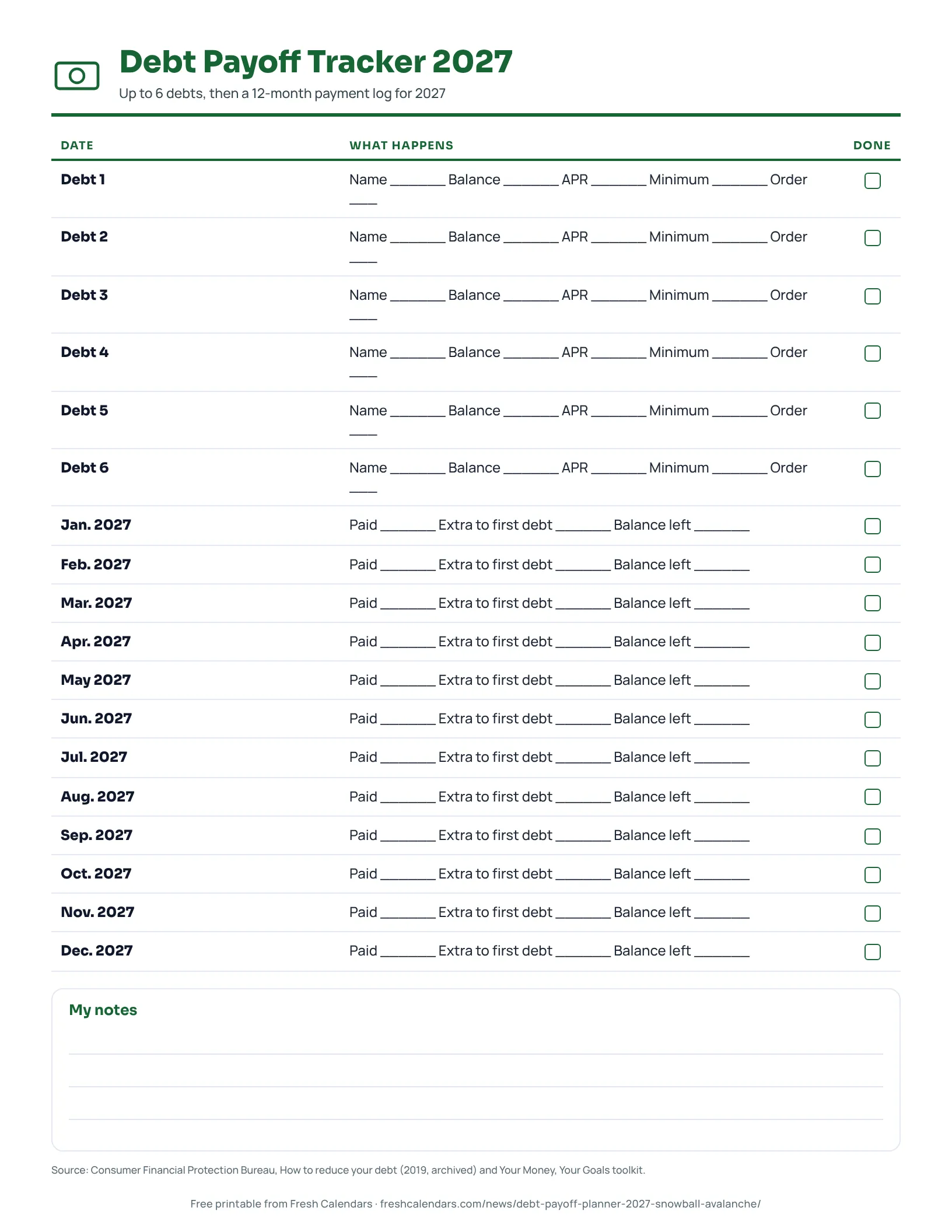
Blank 2027 debt payoff tracker: six debt rows with balance, annual percentage rate, minimum and payoff order, plus a 12-month payment log.
Frequently asked questions
What is the difference between the debt snowball and the debt avalanche?
The snowball puts extra money on your smallest debt first. The avalanche, the common name for the CFPB's highest interest rate method, puts it on the debt with the highest rate first. Both pay the minimum on every other debt.
Does the CFPB use the word avalanche?
No. Its 2019 post calls it the highest interest rate method. The post is marked as archived content.
What does the debt payoff tracker include?
Six debt rows with name, balance, annual percentage rate (APR), minimum and payoff order, and a log for each month of 2027.
Are the numbers in the worked example real?
No. The three debts, the rates and the $450 monthly budget are hypothetical. The results are our calculation, not a forecast for your debts.
Sources
- How to reduce your debt (Consumer Financial Protection Bureau, 2019-07-16)
- Your Money, Your Goals toolkit (Consumer Financial Protection Bureau, 2026-04-24)
- G.19 Consumer Credit (Board of Governors of the Federal Reserve System, 2026-10-07)
Related news
-
 2027 Monthly Budget Planner: Printable Bill Calendar With Tax Dates and Paydays
-
 Three-Paycheck Months 2027: Biweekly Friday Payday Calendar and the 27-Payday Year
-
 Tax Refund Schedule 2027: When to Expect Your Refund, From E-File to Deposit
-
 January 2027 Reset Planner: Goals, Habits and Monthly Review Printables
More in Money & Benefits
All Money & Benefits stories →- EITC 2026: Earned Income Tax Credit Tops Out at $8,231, Filed in 2027
- Child Tax Credit 2026: $2,200 per Child and $1,700 Refundable on Returns Filed in 2027
- SNAP Benefit Amounts 2027: Maximum Allotments and Income Limits by Household Size
- LIHEAP 2026-27: Heating Help Application Dates and Winter Shutoff Rules by State
- Social Security Payment Schedule January 2027: Dates by Birthday and the First 3.6% Raise
Trending now
- Black Friday Canada 2026: Nov. 27 Date, Canadian Tire Deals From Nov. 5, Who Hasn't Announced
- November 2026 Meteor Showers: Taurid Fireballs Under Dark Skies, Then the Leonids on Nov. 16-17
- Election Night 2026 Live Blog: Results Map, Senate, House and Governor Races
- Black Friday 2026 Deals: Date Is Friday, Nov. 27, Live Countdown and Ad Tracker
- SNAP Payment Schedule November 2026: Deposit Dates for Every State, With Weekend Days Flagged