What Is a Midterm Election? 435 House Seats, 35 Senate Seats in 2026
A midterm election falls halfway through a president's term. On Nov. 3, 2026, voters chose all 435 House members and 35 of 100 senators, plus local races.

Published Updated 4 min read
In this article
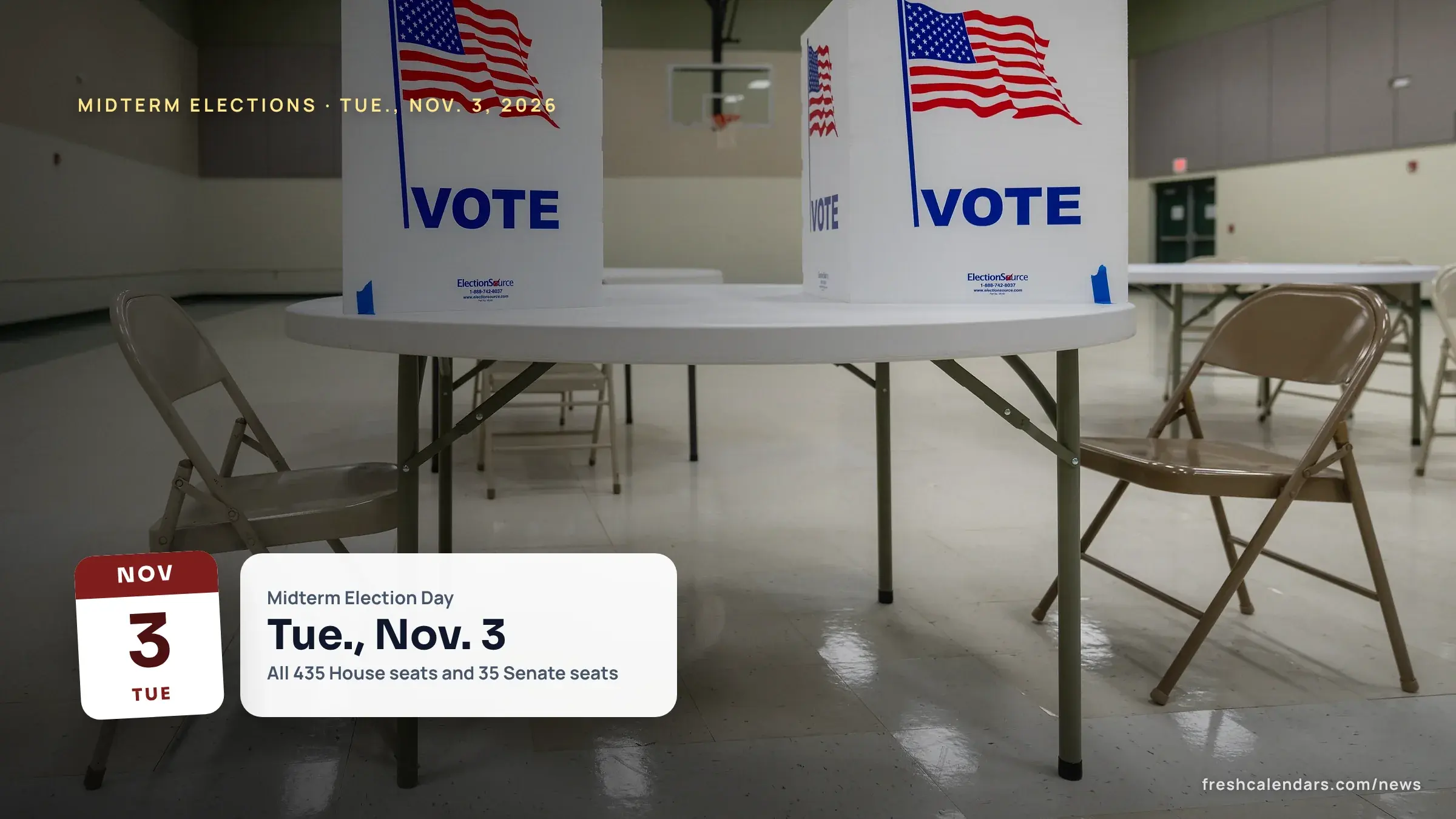
A midterm election is a congressional election held halfway between presidential elections, according to USAGov, and the next one is Tuesday, Nov. 3, 2026. Voters decide all 435 seats in the U.S. House of Representatives and 35 of the 100 seats in the Senate. The president is not on the ballot. Most states also elect governors, state legislators and local officials the same day.
Why is it called a midterm election?
It falls in the middle of a president’s four-year term. The Constitution gives the president a four-year term (Article II), House members two-year terms (Article I, Section 2) and senators six-year terms, divided into three classes so that “one third may be chosen every second Year” (Article I, Section 3), according to the National Archives’ transcription. Because the House stands for election every two years, one House election lands in the middle of each presidential term.
What does the Nov. 3, 2026 election decide?
| Office | On the ballot Nov. 3 | Term | Next regular election |
|---|---|---|---|
| U.S. House | All 435 voting seats | 2 years | November 2028 |
| U.S. Senate, Class II | 33 regularly scheduled seats | 6 years | November 2032 |
| U.S. Senate, special elections | Class III seats in Ohio and Florida | Rest of a term that ends in 2029 | November 2028 |
| President | Not on the ballot | 4 years | November 2028 |
The House has had 435 voting members since Congress capped its size, according to the House’s History, Art & Archives office. The Senate’s own lists show 33 Class II seats with terms expiring in 2027 and Class III seats held by senators from Ohio and Florida. Our midterm tracker explains why those two states hold special elections and lists every Senate and governor’s race.
Beyond Congress, ballots differ by state. Many include governors, state legislators, judges, ballot measures and city or county offices. To see yours, use the official sample ballot lookup for your state. California’s My Voter Status, Pennsylvania’s Voter Registration Status and North Carolina’s Voter Search are three examples.
How many races are on the ballot on Nov. 3?
Ballotpedia, the online encyclopedia of American politics, says in its Nov. 3, 2026 Daily Brew newsletter that it is “following a total of 44,443 races today featuring a total of 80,984 candidates.” That count covers congressional, state and local races in all 50 states. It is Ballotpedia’s count of the races it tracks, so no single voter sees more than a small share of them.
| Level | On the ballot Nov. 3, per Ballotpedia |
|---|---|
| U.S. Senate | 35 seats, including special elections in Florida and Ohio |
| U.S. House | All 435 seats |
| Governors | 36 governorships |
| Other state executive offices | 296 offices in 43 states, including 31 lieutenant governors, 30 attorneys general and 26 secretaries of state |
| State legislatures | 6,139 of 7,386 seats, in 88 of 99 chambers across 46 states |
| State supreme courts | Seats in 25 states |
| Statewide ballot measures | 145 measures in 39 states |
| School boards | 475 districts in Ballotpedia’s coverage |
| Recall elections | 15 recalls of 24 local officials in five states |
Source: Ballotpedia, Daily Brew, Nov. 3, 2026. Ballotpedia says it follows every race on the ballot in 32 states and selected local races elsewhere, so its count does not include every local race in the other 18 states.
How is a midterm different from a presidential election?
In a presidential election year, voters also choose the president and vice president, according to USAGov, along with the House and the Senate class up that year. In a midterm, the president is not on the ballot, so the contests are for Congress and for state and local offices. The same federal rules apply to both: Election Day is “the Tuesday next after the 1st Monday in November, in every even numbered year,” under 2 U.S.C. 7, which gives Nov. 3 this year.
Who can vote on Nov. 3?
USAGov lists three requirements: be a U.S. citizen, be 18 years old on or before Election Day, and be registered by your state’s deadline. North Dakota does not require voter registration. Many state deadlines have passed; our guide to the voter registration deadline and the page on how to check whether you are registered cover what is still open.
What happens after Election Day?
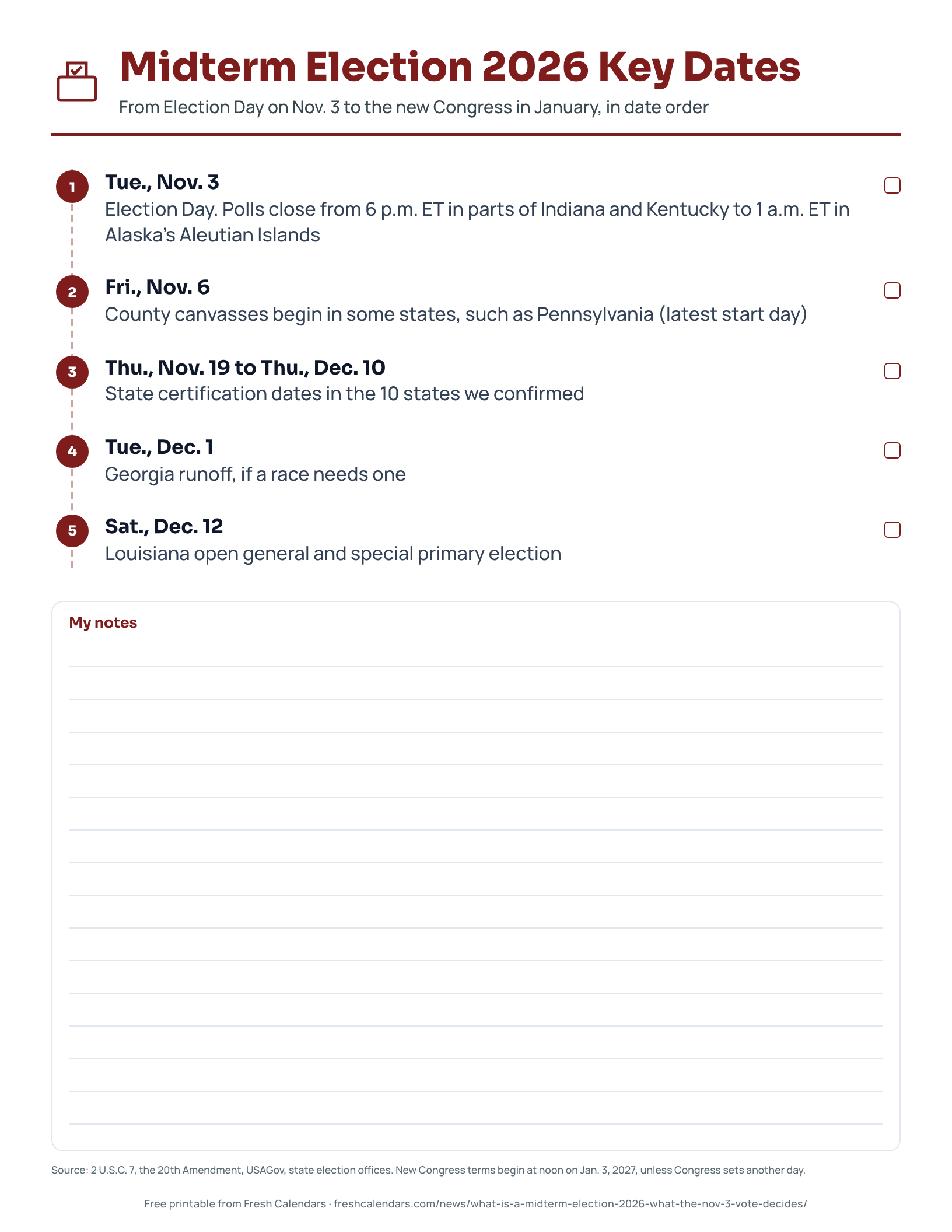
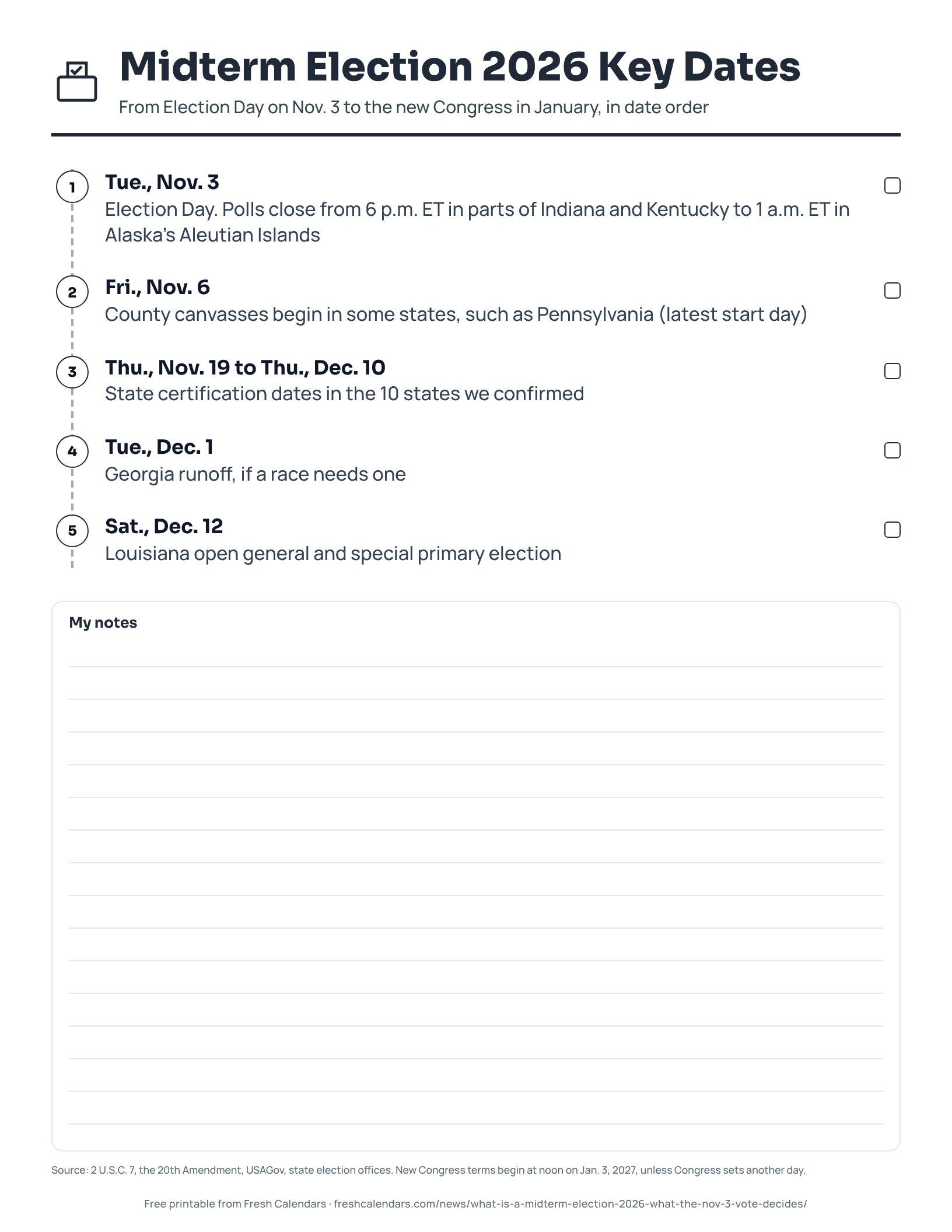
Counts reported on election night are unofficial. States canvass and certify results in the weeks after, and Georgia holds a runoff on Tue., Dec. 1 for races where no candidate wins a majority. See when 2026 election winners take office and when the country will know the results.
The 20th Amendment starts the terms of senators and representatives at noon on Jan. 3, unless Congress sets a different day by law. In 2027 that day is a Sunday. The Senate Historical Office notes that a “new” Congress begins in odd-numbered years, after the elections.
Print the midterm election key dates
The printable below puts the main dates on one page. Add them to our November and December printable calendars.
Free printable downloads
Every template is free, needs no sign-up and prints on US Letter paper. Choose PDF for printing or PNG for screens and documents.
Midterm Election 2026 Key Dates printables
-
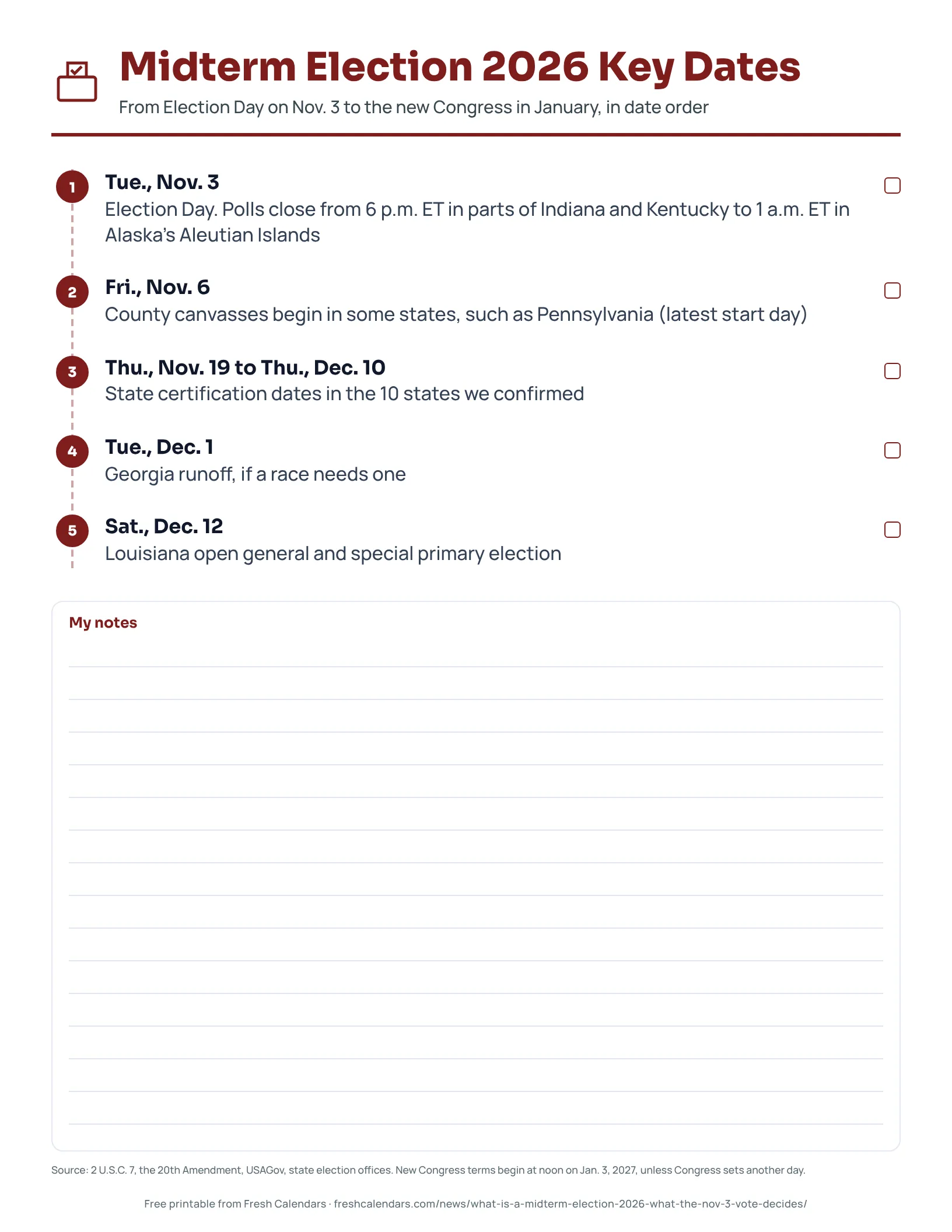
Midterm Election 2026 Key Dates
One page of midterm election 2026 key dates from Election Day on Nov. 3 to state certification and the new Congress.
-
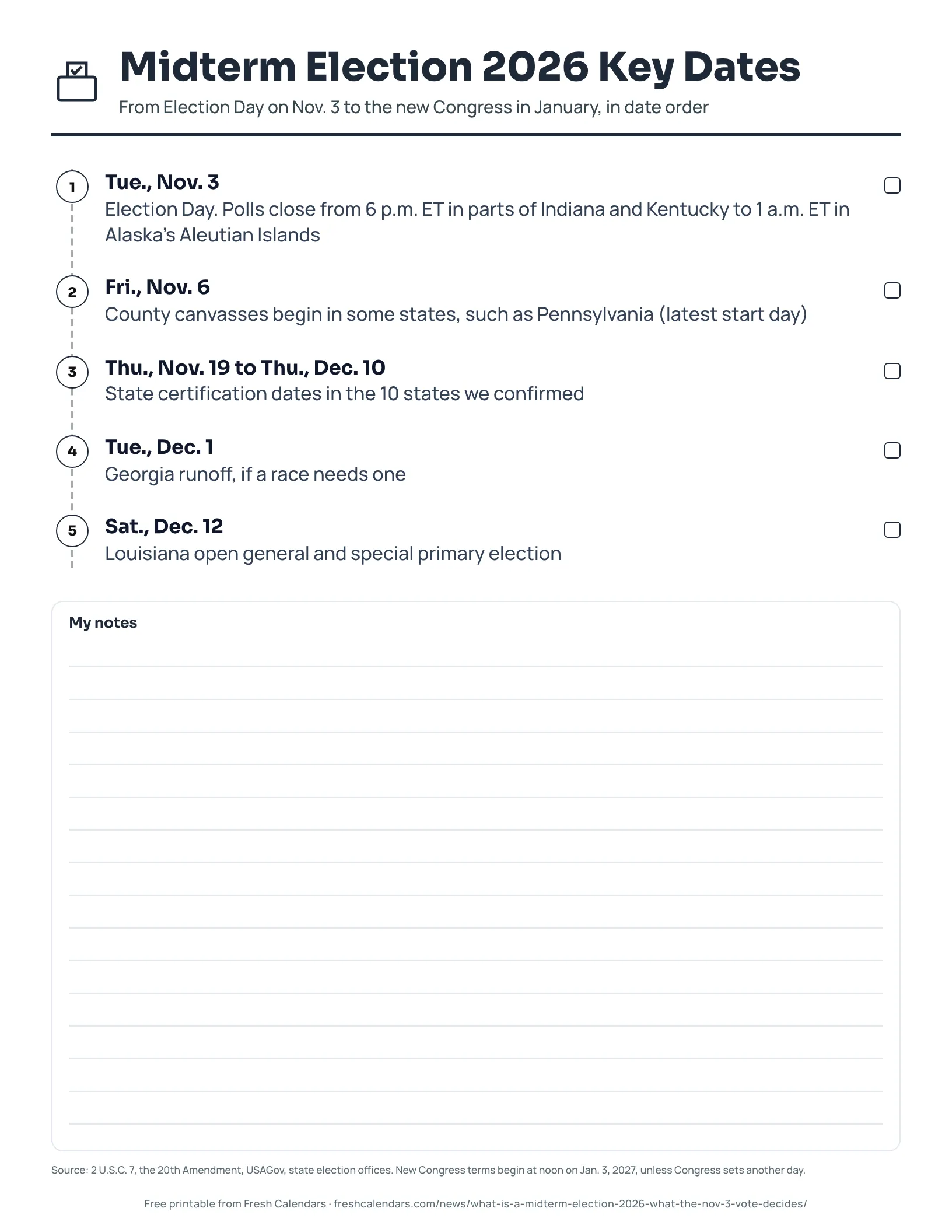
Midterm Election 2026 Key Dates (ink saver)
One page of midterm election 2026 key dates from Election Day on Nov. 3 to state certification and the new Congress. Ink-saver version.
Frequently asked questions
What is a midterm election?
A congressional election that takes place halfway between presidential elections, according to USAGov. Voters choose members of the House of Representatives and about a third of the Senate, and many states hold their own elections the same day.
Why is it called a midterm?
Because it falls in the middle of a president's four-year term. The Constitution sets a four-year term for the president (Article II) and two-year terms for House members (Article I, Section 2).
Is the president on the ballot in 2026?
No. The next presidential election is in November 2028, four years after the last one.
How many Senate seats are up in 2026?
Thirty-five of 100. Thirty-three are the regularly scheduled Class II seats and two are special elections for Class III seats in Ohio and Florida, according to the Senate's class lists and our midterm tracker.
How many races are on the ballot on Nov. 3, 2026?
Ballotpedia says it is following 44,443 races with 80,984 candidates on Nov. 3, 2026, from Congress to school boards, plus 145 statewide ballot measures in 39 states.
What day is Election Day, and who sets it?
Federal law, 2 U.S.C. 7, sets the Tuesday next after the first Monday in November in every even-numbered year. In 2026 that is Tuesday, Nov. 3.
Who can vote in a midterm election?
U.S. citizens who are 18 years old on or before Election Day and registered by their state's deadline, according to USAGov. North Dakota does not require registration.
When does the new Congress start?
The 20th Amendment starts the terms of senators and representatives at noon on Jan. 3 unless Congress sets a different day by law. Jan. 3, 2027 is a Sunday.
Sources
- Congressional elections and midterm elections (USAGov, 2026-10-06)
- Who can and cannot vote (USAGov, 2026-02-23)
- Presidential general election (USAGov, 2026-02-25)
- The Constitution of the United States: A Transcription (National Archives)
- Class II: Senators Whose Terms of Service Expire in 2027 (U.S. Senate)
- Class III: Senators Whose Terms of Service Expire in 2029 (U.S. Senate)
- Determining Apportionment (U.S. House of Representatives, History, Art & Archives)
- 2 U.S.C. 7: Time of election (U.S. Government Publishing Office)
- Twentieth Amendment (U.S. Government Publishing Office)
- When a New Congress Begins (U.S. Senate Historical Office, 2020-12-30)
- Daily Brew: November 3, 2026 (Ballotpedia, 2026-11-03)
- My Voter Status (California Secretary of State)
- Voter Registration Status (Pennsylvania Department of State)
- Voter Search (North Carolina State Board of Elections)
Related news

More in Elections
All Elections stories →- Wisconsin Spring Election 2027: April 6, Nomination Papers From Dec. 1
- Nevada Legislative Session 2027: Feb. 1 Start, Must End May 31
- Arkansas Legislative Session 2027: Prefiling Nov. 16, Starts Jan. 11
- Minnesota Legislative Session 2027: Opens Jan. 12, Ends by May 17
- Iowa Legislative Session 2027: Jan. 11 Start, Funnel March 5
Trending now
- Thanksgiving Travel 2026: Best Days to Fly and Drive, Nov. 21 to 30
- Black Friday Ads 2026: Date Is Nov. 27, Walmart Deals Nov. 23-29
- New Movies in Theaters November 2026: Hunger Games on Nov. 20
- CPKC Holiday Train 2026 Schedule: 182 Stops, Nov. 19 to Dec. 20
- Black Friday 2026 Store Hours: Walmart, Target 6 a.m., Kohl's 5 a.m.