US-Brazil Time Difference After Nov. 1, 2026: New York Is 2 Hours Behind São Paulo
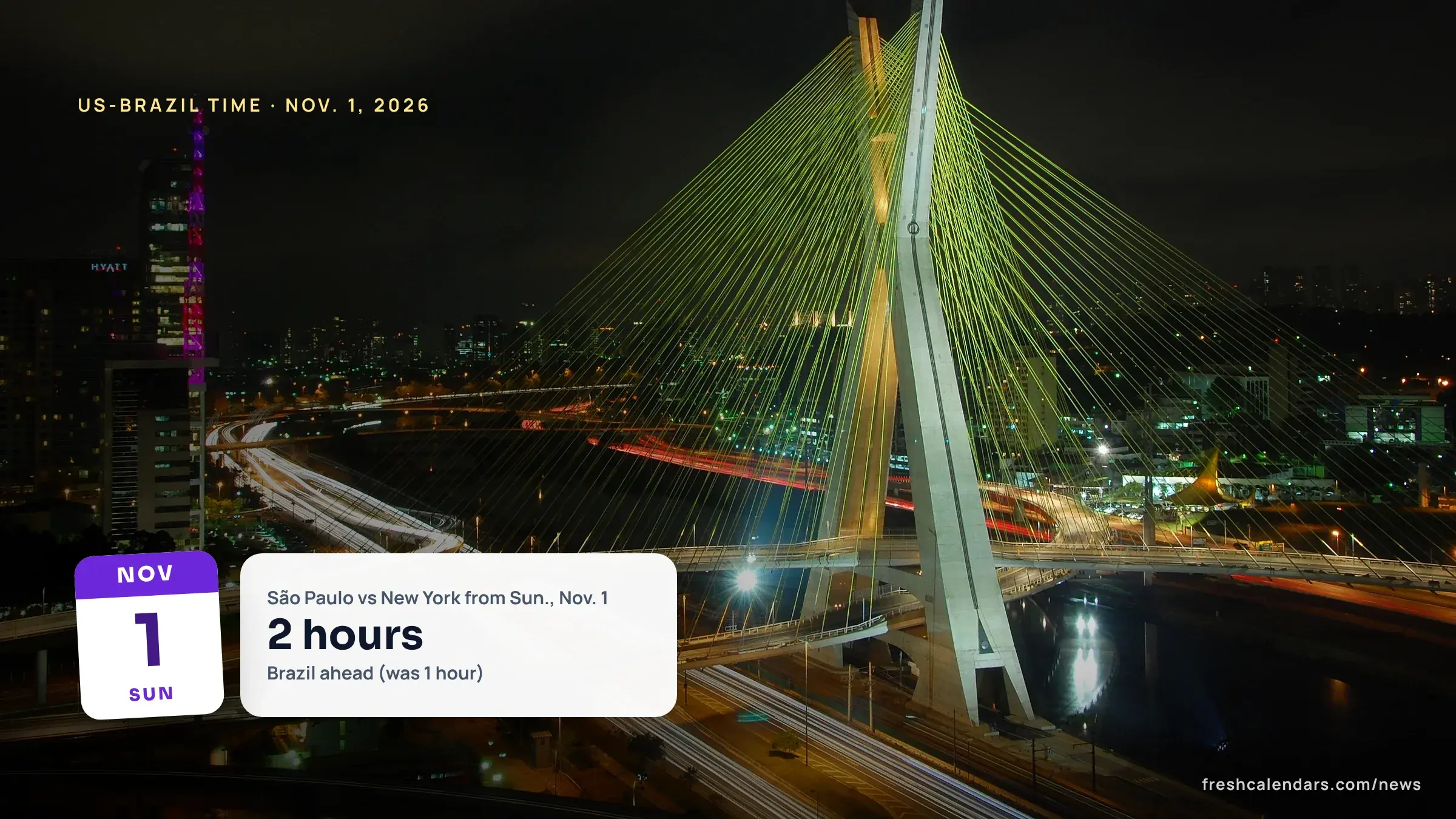
New York is 2 hours behind Brasília Time (BRT) from Nov. 1, 2026, when US clocks fall back and Brazil stays put. Tables for every US and Brazilian zone.

Published 5 min read
Key date
- Nov 1Sun US clocks fall back: New York 2 hours behind São Paulo Tomorrow + Google
In this article
- Does Brazil change its clocks on Nov. 1, 2026?
- Brasília Time: which part of Brazil is 2 hours ahead of New York?
- How far ahead of each U.S. zone is Brazil?
- What time is it in São Paulo when it is 9 a.m. in New York?
- How much of a 9-to-5 workday do New York and São Paulo share?
- How does this affect the São Paulo Grand Prix weekend?
- When does the gap change again?
- Brazil call checklist for Nov. 1
When U.S. clocks fall back at 2 a.m. local time on Sunday, Nov. 1, 2026, New York goes from 1 hour to 2 hours behind São Paulo and Brasília, according to the National Institute of Standards and Technology (NIST) rule for the U.S. side. Brazil does not move its clocks, so the whole one-hour change lands in the United States. A one-page printable US-Brazil time converter is on this page for your desk.
The figures below are our calculation from the Coordinated Universal Time (UTC) offsets.
Does Brazil change its clocks on Nov. 1, 2026?
No. Brazil has not observed daylight saving time (DST) since 2019. The time zone database that phones and computers use, kept by the Internet Assigned Numbers Authority (IANA), records a note dated April 25, 2019: “Brazil no longer has DST changes - decree signed today.” The database links the text of Decree 9,772 on the Brazilian presidency’s website. Its zone for São Paulo, America/Sao_Paulo, sits at UTC-3 all year.
The U.S. side does change. NIST says that “during 2026, daylight saving time is in effect from March 8 at 2 a.m. (local time) to November 1 at 2 a.m. (local time).” Eastern Time (ET) goes from Eastern Daylight Time (EDT, UTC-4) to Eastern Standard Time (EST, UTC-5), and the other zones move the same way. See our report on the U.S. change for the full rule.
Brasília Time: which part of Brazil is 2 hours ahead of New York?
Most of Brazil uses UTC-3, which we call Brasília Time (BRT) here. The IANA file lists four offsets for Brazil, and all four are fixed year-round:
| Brazil zone (IANA name) | UTC offset | Places in the IANA file |
|---|---|---|
| Fernando de Noronha time (America/Noronha) | UTC-2 | Fernando de Noronha islands |
| Brasília time (America/Sao_Paulo) | UTC-3 | São Paulo, Rio de Janeiro and Brasília; the file also lists Bahia, Recife, Fortaleza and Belém at UTC-3 |
| Amazon time (America/Manaus, America/Campo_Grande, America/Cuiaba) | UTC-4 | Manaus, Mato Grosso do Sul, Mato Grosso |
| Acre time (America/Rio_Branco) | UTC-5 | Acre |
The gap to New York depends on which Brazilian zone you call. From Nov. 1, Noronha is 3 hours ahead of New York, Brasília time 2 hours, Amazon time 1 hour, and Acre time has the same clock time as New York. Before Nov. 1 each gap was 1 hour smaller, so Acre was 1 hour behind New York and Amazon time matched it.
How far ahead of each U.S. zone is Brazil?
| U.S. zone | UTC offset until Oct. 31 / from Nov. 1 | Brasília ahead until Oct. 31 | Brasília ahead from Nov. 1 |
|---|---|---|---|
| Eastern (New York) | UTC-4 / UTC-5 | 1 hour | 2 hours |
| Central (Chicago) | UTC-5 / UTC-6 | 2 hours | 3 hours |
| Mountain (Denver) | UTC-6 / UTC-7 | 3 hours | 4 hours |
| Pacific (Los Angeles) | UTC-7 / UTC-8 | 4 hours | 5 hours |
| Alaska (Anchorage) | UTC-8 / UTC-9 | 5 hours | 6 hours |
| Arizona (Mountain Standard Time all year) | UTC-7 / UTC-7 | 4 hours | 4 hours |
| Hawaii | UTC-10 / UTC-10 | 7 hours | 7 hours |
NIST says that “DST is not observed in Hawaii, American Samoa, Guam, Puerto Rico, the Virgin Islands and the state of Arizona” with the exception of the Navajo Indian Reservation, which does observe it. So Arizona and Hawaii keep their gap with Brazil, apart from the Navajo Nation in Arizona, which follows the Nov. 1 change.
For the three other Brazilian zones, add or subtract one hour per step. This table shows each zone against each U.S. zone from Nov. 1 until U.S. daylight saving time starts again:
| U.S. zone (from Nov. 1) | Noronha (UTC-2) | Brasília (UTC-3) | Amazon (UTC-4) | Acre (UTC-5) |
|---|---|---|---|---|
| Eastern, EST | 3 hours ahead | 2 hours ahead | 1 hour ahead | same time |
| Central, CST (UTC-6) | 4 hours ahead | 3 hours ahead | 2 hours ahead | 1 hour ahead |
| Mountain, MST (UTC-7) | 5 hours ahead | 4 hours ahead | 3 hours ahead | 2 hours ahead |
| Pacific, PST (UTC-8) | 6 hours ahead | 5 hours ahead | 4 hours ahead | 3 hours ahead |
| Alaska (UTC-9) | 7 hours ahead | 6 hours ahead | 5 hours ahead | 4 hours ahead |
| Hawaii (UTC-10) | 8 hours ahead | 7 hours ahead | 6 hours ahead | 5 hours ahead |
What time is it in São Paulo when it is 9 a.m. in New York?
From Nov. 1, 2026, 9 a.m. ET is 11 a.m. in São Paulo on the same day. For California, 9 a.m. Pacific Time (PT) is 2 p.m. in São Paulo. The table converts common times and shows where the date flips (each row checked against the UTC offsets, valid from Nov. 1).
| U.S. time | São Paulo time (Brasília) |
|---|---|
| 7 a.m. ET | 9 a.m., same day |
| 9 a.m. ET | 11 a.m., same day |
| 12 p.m. ET | 2 p.m., same day |
| 5 p.m. ET | 7 p.m., same day |
| 10 p.m. ET | 12 a.m., next day |
| 7 a.m. PT | 12 p.m., same day |
| 9 a.m. PT | 2 p.m., same day |
| 8 p.m. PT | 1 a.m., next day |
Going the other way, 9 a.m. in São Paulo is 7 a.m. ET, and 6 p.m. in São Paulo is 4 p.m. ET.
How much of a 9-to-5 workday do New York and São Paulo share?
Taking 9 a.m. to 5 p.m. local time in both cities as the workday (our assumption for the guide, not an official rule), this is the overlap in the cities’ clocks:
| Zone pair | Overlap until Oct. 31 | Overlap from Nov. 1 |
|---|---|---|
| New York and São Paulo | 9 a.m. to 4 p.m. ET (7 hours) | 9 a.m. to 3 p.m. ET (6 hours) |
| Chicago and São Paulo | 9 a.m. to 3 p.m. CT (6 hours) | 9 a.m. to 2 p.m. CT (5 hours) |
| Los Angeles and São Paulo | 9 a.m. to 1 p.m. PT (4 hours) | 9 a.m. to 12 p.m. PT (3 hours) |
From Nov. 1, a New York 9 a.m. start is 11 a.m. in São Paulo, and a São Paulo 5 p.m. finish is 3 p.m. in New York. A standing call at 10 a.m. in São Paulo moves from 9 a.m. to 8 a.m. ET on Nov. 1; on Brazil’s clocks nothing changes. Phones update automatically when the automatic time zone setting is on, but a calendar invite fixed in U.S. time needs a manual check.
How does this affect the São Paulo Grand Prix weekend?
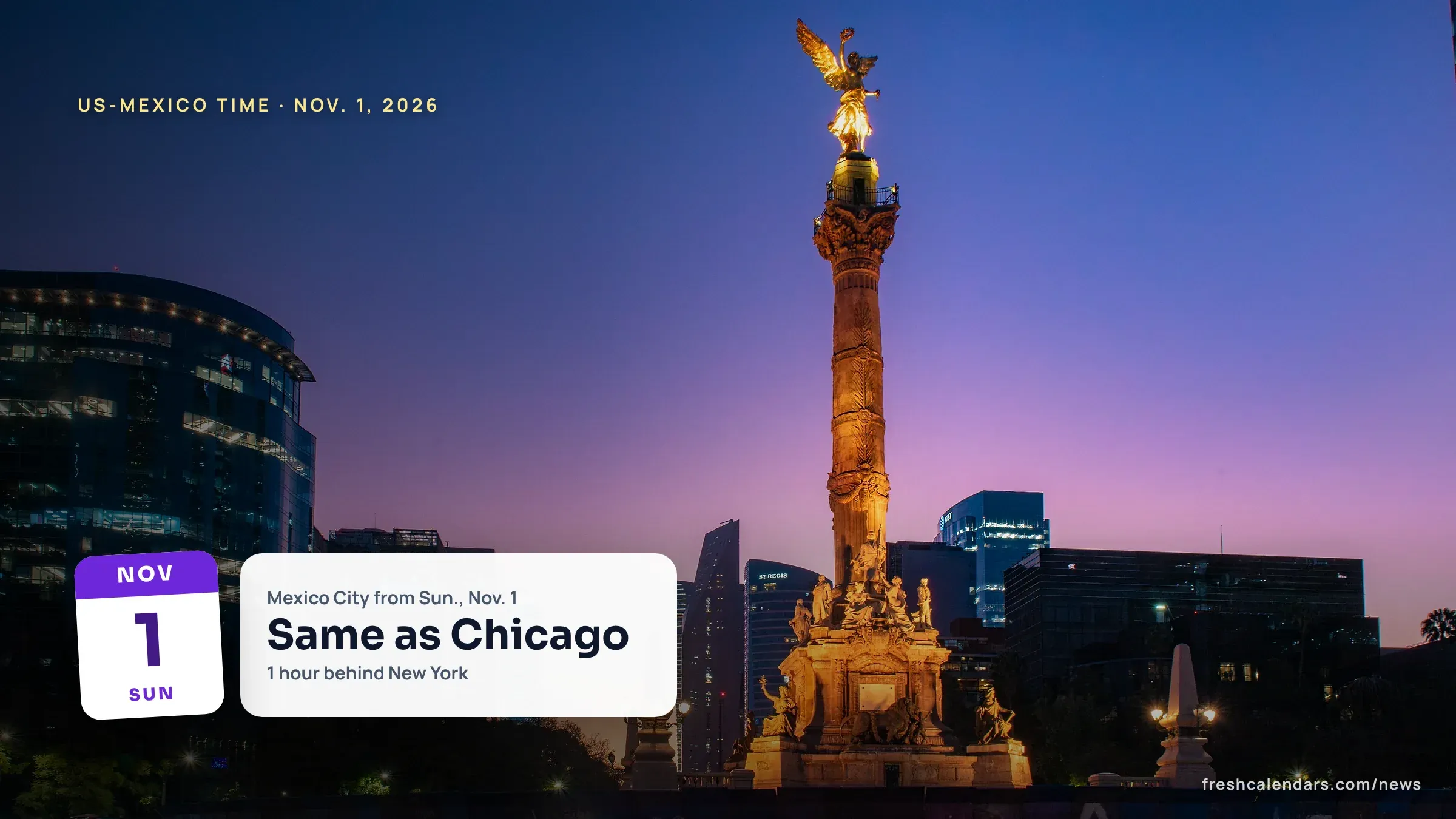
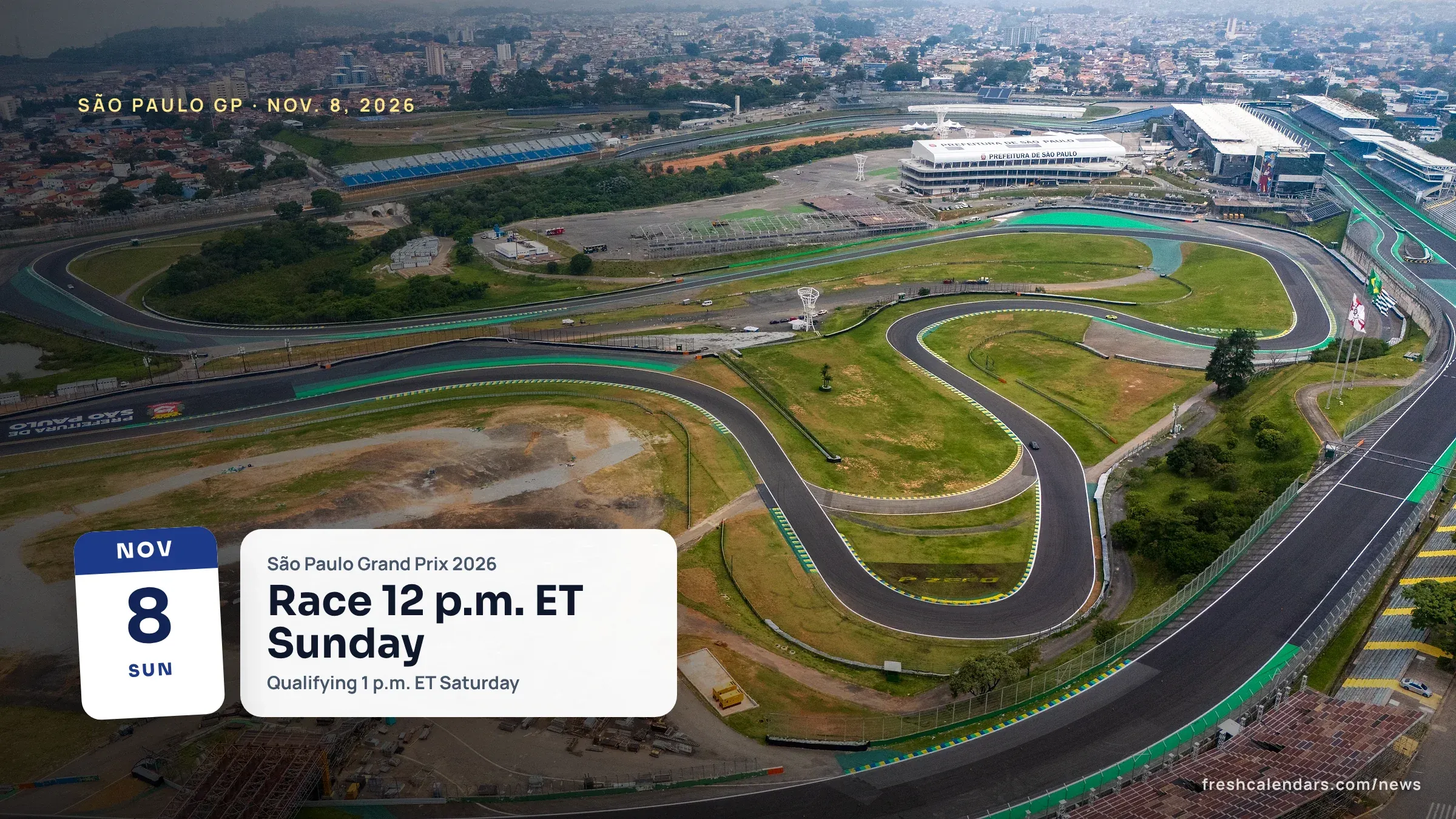
Our São Paulo Grand Prix schedule gives the Formula 1 (F1) race on Sunday, Nov. 8, 2026, at 2 p.m. São Paulo time, which is 12 p.m. EST, by that story’s conversion. It matches the 2-hour gap above. For the Mexico side of the clock change, see our Mexico time-difference story.
When does the gap change again?
Under 15 U.S.C. 260a, daylight saving time starts on the second Sunday of March, which is Sunday, March 14, 2027 (our calculation). New York will then be 1 hour behind São Paulo again, as long as Brazil keeps its zones unchanged. Read when daylight saving time starts again on March 14 for the 2027 dates.
Brazil call checklist for Nov. 1
- Find your U.S. zone in the first table and add the hours to São Paulo time.
- Recheck any recurring call with Brazil: for every U.S. zone that changes, it moves one hour earlier on U.S. clocks.
- Mark Nov. 1 on a November 2026 printable calendar or a printable weekly calendar.
Free printable downloads
Every template is free, needs no sign-up and prints on US Letter paper. Choose PDF for printing or PNG for screens and documents.
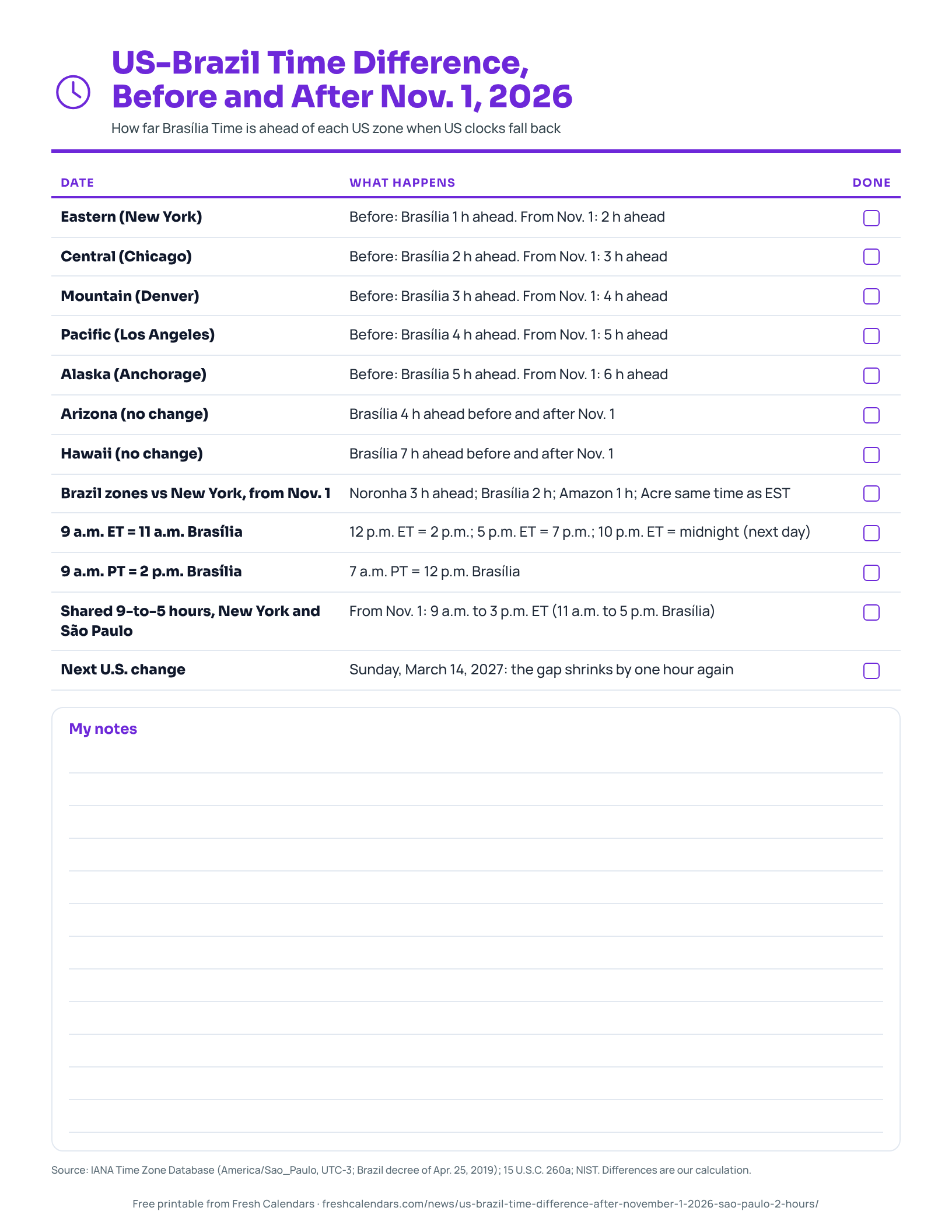
US-Brazil Time Difference printables
-
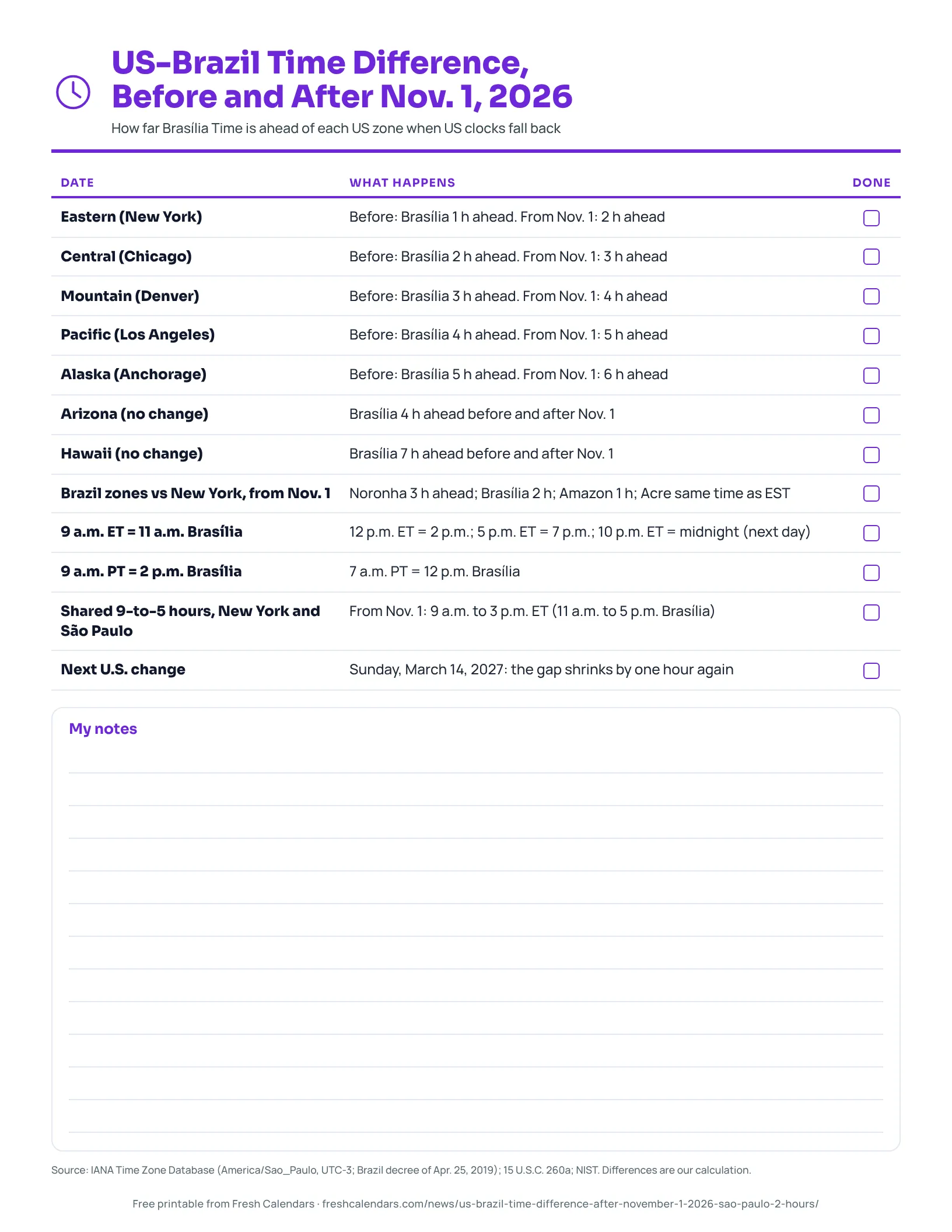
US-Brazil Time Difference, Before and After Nov. 1, 2026
One-page list of how far Brasília Time is ahead of each US zone before and after US clocks fall back on Nov. 1, 2026, with common time conversions.
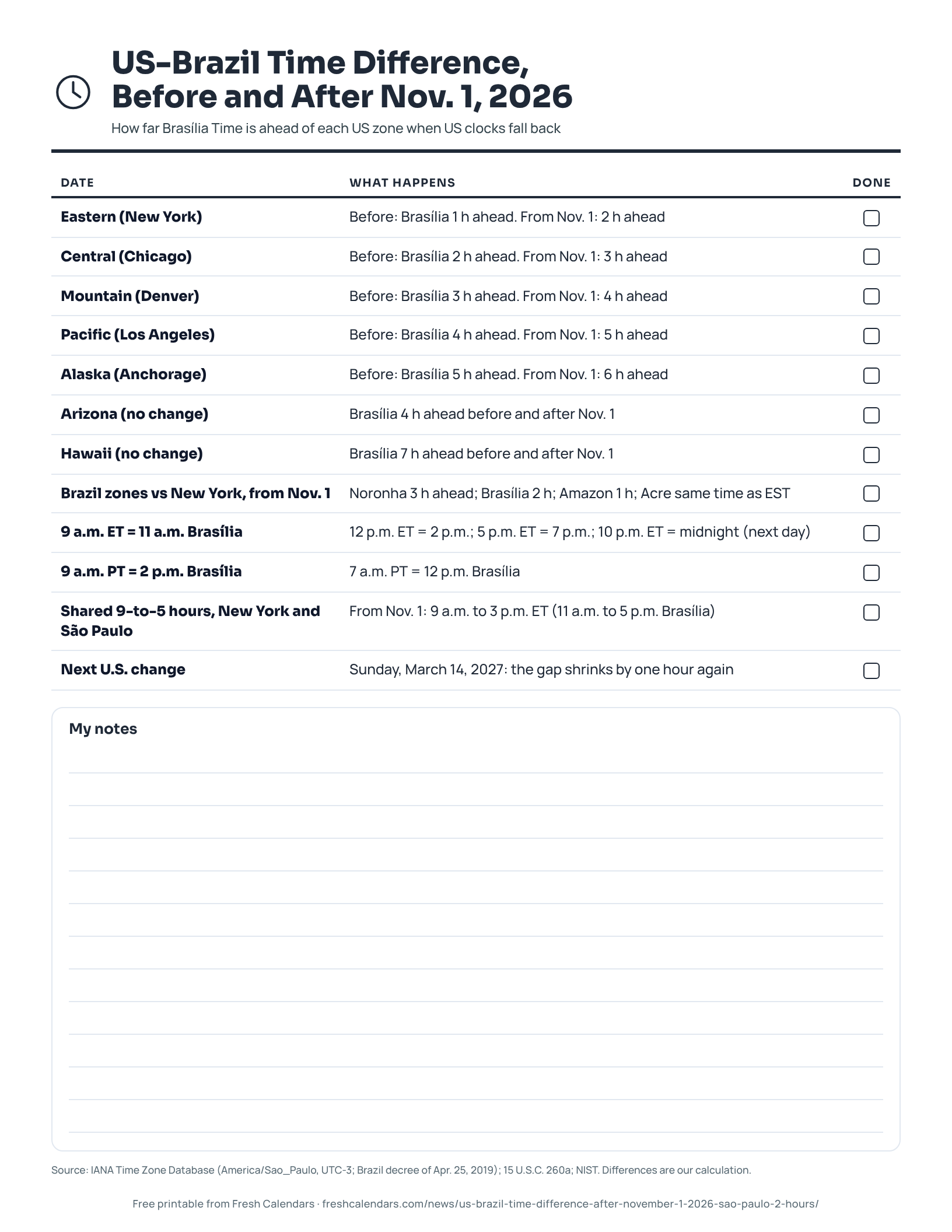
-
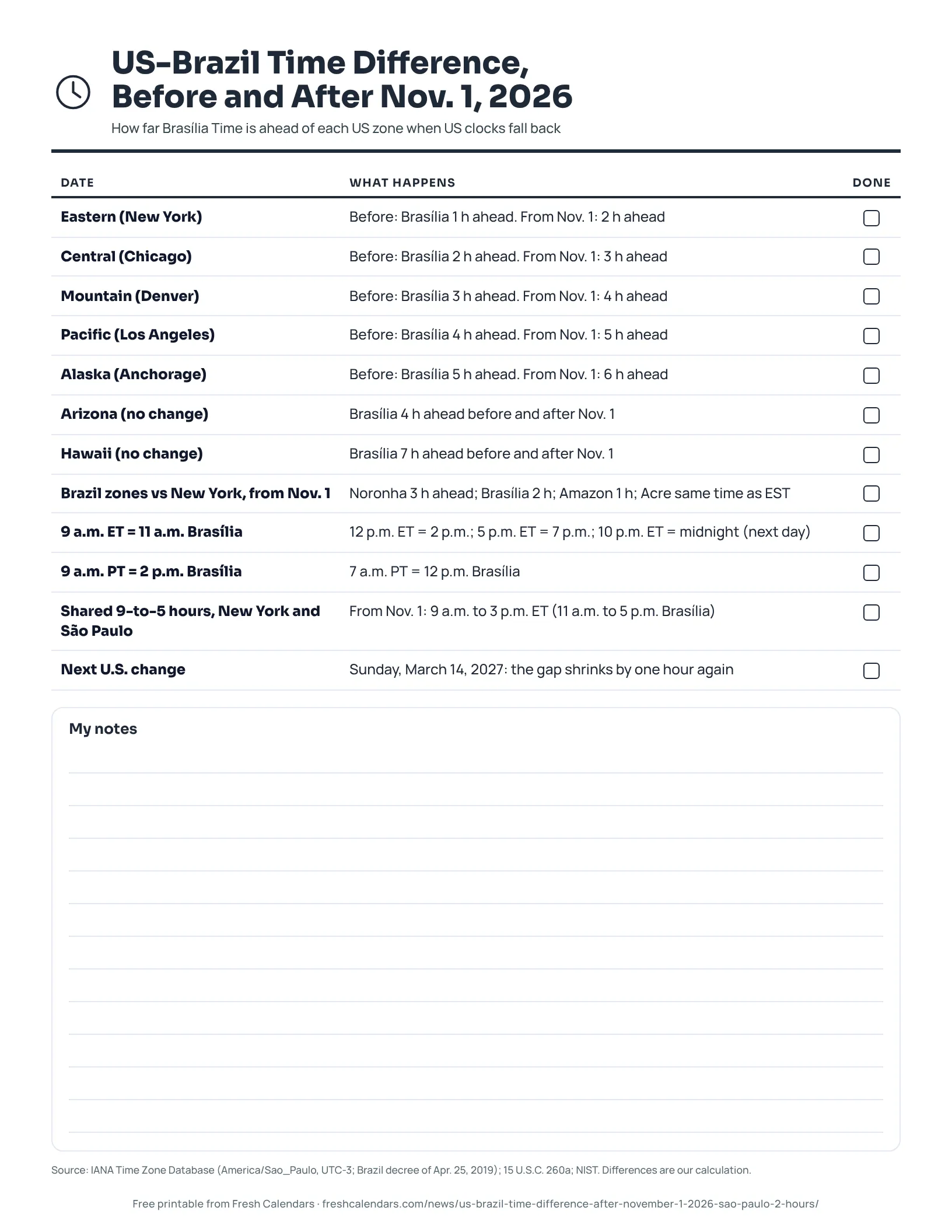
US-Brazil Time Difference, Before and After Nov. 1, 2026 (ink saver)
One-page list of how far Brasília Time is ahead of each US zone before and after US clocks fall back on Nov. 1, 2026, with common time conversions. Ink-saver version.
Frequently asked questions
What is the time difference between Brazil and New York after Nov. 1, 2026?
São Paulo and Brasília are 2 hours ahead of New York from Nov. 1, 2026. This is our calculation: Brasília Time is UTC-3 and New York returns to Eastern Standard Time (EST) at UTC-5. Until Oct. 31 the gap was 1 hour.
Does Brazil change its clocks in November?
No. A decree of April 25, 2019 ended daylight saving time in Brazil, and the IANA time zone database lists America/Sao_Paulo at UTC-3 with no clock changes since.
What time is it in São Paulo when it is 9 a.m. in New York?
From Nov. 1, 2026, it is 11 a.m. in São Paulo the same day. Until Oct. 31 it was 10 a.m.
Which Brazilian zone has the same time as New York in winter?
Acre time, UTC-5, matches Eastern Standard Time from Nov. 1 until U.S. daylight saving time resumes on March 14, 2027. This is our calculation from the IANA offsets.
Sources
- Daylight Saving Time Rules (National Institute of Standards and Technology (NIST), 2026-02-09)
- Time Zone Database, tzdb release 2026f, file southamerica (Brazil zones and the April 2019 decree) (Internet Assigned Numbers Authority (IANA))
- Decreto 9.772 of April 25, 2019 (Brazil) (Presidency of the Republic of Brazil (Planalto), 2019-04-25)
- 15 U.S. Code 260a - Advancement of time or changes in time within time belts (Legal Information Institute, Cornell Law School)
Related news

More in Time Change
All Time Change stories →- U.S.-Japan, Korea and China Time Difference After Nov. 1, 2026: Tokyo Is 14 Hours Ahead
- US-Philippines Time Difference After Nov. 1, 2026: New York Is 13 Hours Behind Manila
- US-India Time Difference After Nov. 1, 2026: New York Is 10.5 Hours Behind India
- US-Australia Time Difference After Nov. 1, 2026: Sydney Is 16 Hours Ahead of New York
- Daylight Saving Time and Halloween: Clocks Fall Back the Night After in 2026, and the Years It Happens Again