ISO Week Numbers Explained: How Week 1, Week 53 and 2026-W44-5 Work
International Organization for Standardization (ISO) week 1 is the Monday-to-Sunday week with Jan. 4. Start dates for 2024-2035, and how to read 2026-W44-5.

Published 6 min read
In this article
ISO week 1 is the Monday-to-Sunday week that contains Jan. 4, according to the first-Thursday rule in the International Organization for Standardization (ISO) 8601 date standard. Weeks are numbered 01 to 53, and the week-year can differ from the calendar year: week 1 of 2026 began on Monday, Dec. 29, 2025. The table below lists the week 1 start date for every year from 2024 to 2035, a ready worked example is further down, and a one-page printable (below) keeps both.
What ISO week numbers are
ISO’s help center describes ISO 8601 as a standard that “provides a clear and unambiguous way to represent dates and times.” One part of it numbers whole weeks, so “week 44” names the same seven days for everyone who uses the system. A summary of the standard hosted by NASA gives the basics: possible ISO week numbers are 01 to 53, and a week starts with Monday (day 1) and ends with Sunday (day 7).
That Monday start separates ISO weeks from the Sunday-start grids on many wall calendars. Our Monday-start calendar guide covers the layout side of that choice, and the ISO standard itself has its own explainer: what ISO 8601 is.
How ISO week 1 is picked
The summary hosted by NASA says week 01 “is per definition the first week that has the Thursday in this year.” Google’s ISOWEEKNUM help page words it the same way: week 1 is the week containing the first Thursday of the year. Both rules land on the same Monday as “the week that contains Jan. 4.” We checked that equivalence for 2024 to 2035 with two independent date calculations, and the table uses it.
The consequence is that Jan. 1 does not have to be in week 1. When Jan. 1 is a Friday, Saturday or Sunday, it sits in the last week of the previous ISO year, and week 1 begins a few days later. When Jan. 1 is a Tuesday, Wednesday or Thursday, week 1 begins in the previous December.
| Year | Jan. 1 is a | ISO week 1 starts (Monday) | Starts in December? | ISO weeks in the year |
|---|---|---|---|---|
| 2024 | Monday | Jan. 1, 2024 | No | 52 |
| 2025 | Wednesday | Dec. 30, 2024 | Yes | 52 |
| 2026 | Thursday | Dec. 29, 2025 | Yes | 53 |
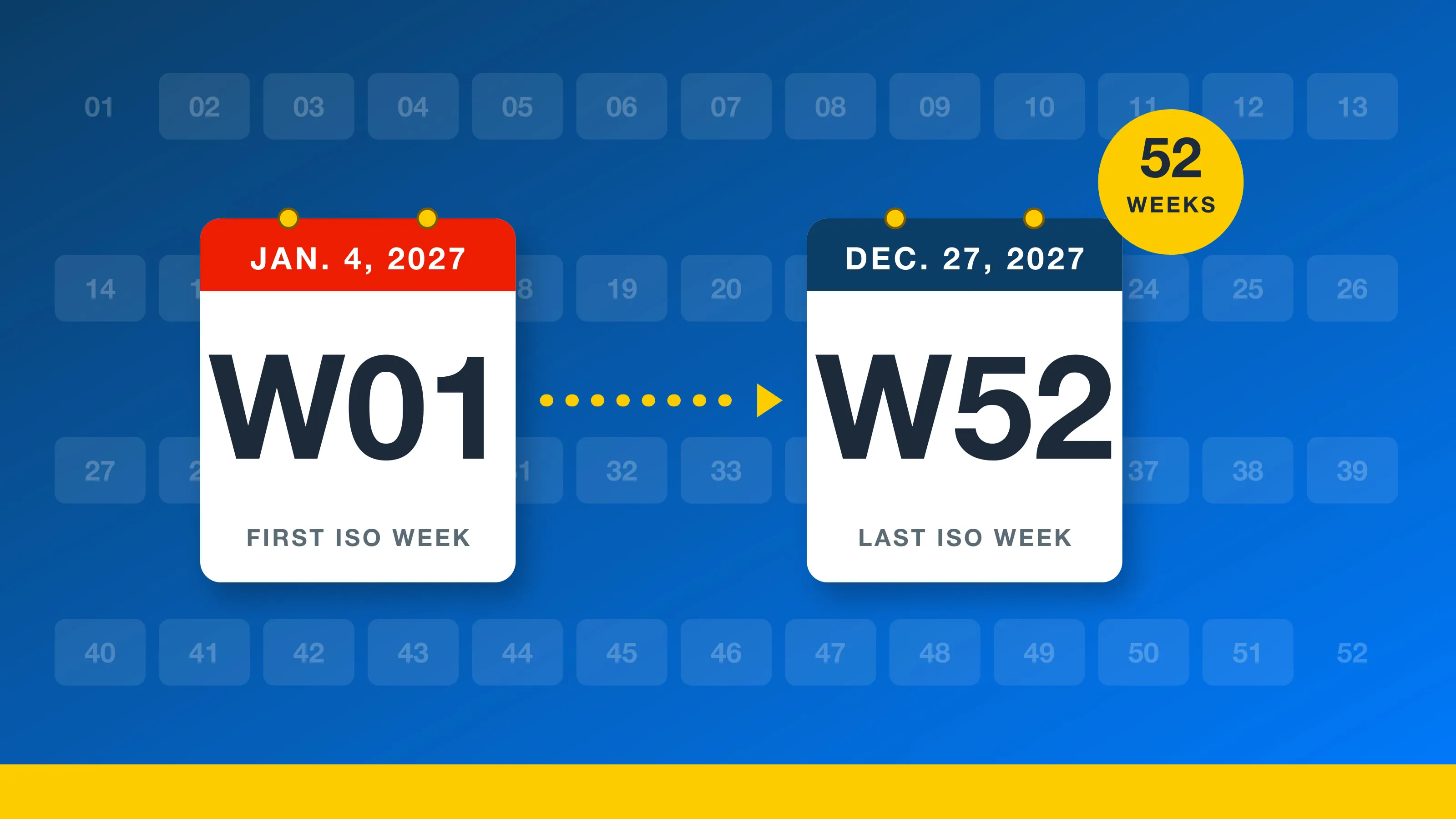
| 2027 | Friday | Jan. 4, 2027 | No | 52 |
| 2028 | Saturday | Jan. 3, 2028 | No | 52 |
| 2029 | Monday | Jan. 1, 2029 | No | 52 |
| 2030 | Tuesday | Dec. 31, 2029 | Yes | 52 |
| 2031 | Wednesday | Dec. 30, 2030 | Yes | 52 |
| 2032 | Thursday | Dec. 29, 2031 | Yes | 53 |
| 2033 | Saturday | Jan. 3, 2033 | No | 52 |
| 2034 | Sunday | Jan. 2, 2034 | No | 52 |
| 2035 | Monday | Jan. 1, 2035 | No | 52 |
Fresh Calendars computation from the week 1 rule above; weekdays and counts checked with two independent methods.
Our year-by-year list of 2027 week boundaries is in the 2027 week numbers printable.
How to read an ISO week date: 2026-W44-5
An ISO week date strings together three numbers. The summary hosted by NASA shows the pattern with the example 1997-W01-2. Applied to a date from this story’s publication day:
| Part | Value in 2026-W44-5 | Meaning |
|---|---|---|
| 2026 | ISO week-year | The year that owns the week, which can differ from the calendar year |
| W44 | Week number | The 44th Monday-to-Sunday week counted from week 1 |
| 5 | Weekday | 1 is Monday and 7 is Sunday, so 5 is Friday |
By our calculation, 2026-W44-5 is Friday, Oct. 30, 2026. Week 44 runs from Monday, Oct. 26 to Sunday, Nov. 1, 2026. The same string is not a calendar date in the YYYY-MM-DD form that ISO’s help center describes, so a system that expects 2026-10-30 will reject 2026-W44-5.
The week-year matters at the edges of the year. Jan. 1, 2027 is a Friday, which puts it in ISO week 53 of 2026: its week date is 2026-W53-5, even though a spreadsheet year function (YEAR) returns 2027. Anyone building a report by week number should take the week-year from the same ISO calculation as the week number, not from the calendar year.
ISO weeks and Sunday-start week numbers
Spreadsheet week numbers are not all ISO. Microsoft’s WEEKNUM function takes a return type: 1 or omitted means the week begins on Sunday under System 1, 2 means it begins on Monday under System 1, and 21 means it begins on Monday under System 2. System 1 counts the week that contains Jan. 1 as week 1; System 2 is the ISO method. Microsoft Outlook’s default first day of the week is Sunday, and calendar apps such as Google Calendar and Apple Calendar let you choose the start day, so two people can see different week labels for one date.
Here is the same set of dates under the three schemes, computed by Fresh Calendars from those rules.
| Date | ISO week date | WEEKNUM, Sunday start (System 1) | WEEKNUM, Monday start (System 1) |
|---|---|---|---|
| Fri., Oct. 30, 2026 | 2026-W44-5 | 44 | 44 |
| Thu., Dec. 31, 2026 | 2026-W53-4 | 1 | 1 |
| Fri., Jan. 1, 2027 | 2026-W53-5 | 1 | 1 |
| Sun., Jan. 3, 2027 | 2026-W53-7 | 2 | 1 |
| Mon., Jan. 4, 2027 | 2027-W01-1 | 2 | 2 |
For late October the three agree. At the turn of 2027 they split: the ISO week that began on Monday, Dec. 28, 2026 is week 53, while System 1 already calls that week 1 because it contains Jan. 1. If a contract, a payroll calendar or a shared planner says “week 1,” ask which system it uses. Our printable weekly calendar and Monday-start printable calendar show the week grid without numbering, so you can add the numbers from the system your team has chosen.
How to find the ISO week number of a date
Microsoft’s ISOWEEKNUM function returns the ISO week number of the year for a given date, with the syntax ISOWEEKNUM(date). Google’s help page documents the same function and states that weeks begin on Monday and end on Sunday. For a date in cell A1, =ISOWEEKNUM(A1) returns 44 for Oct. 30, 2026 and 53 for Jan. 1, 2027.
To confirm a result by hand:
- Write down the date’s weekday and the Monday of its week.
- Find the Monday of week 1 for the year in the table above.
- Count the whole weeks from that Monday, starting at 1.
- If the date falls before that year’s week 1 Monday, it belongs to the last week of the previous ISO year.
For Oct. 30, 2026, the Monday is Oct. 26. Week 1 began on Dec. 29, 2025, and 43 whole weeks later is Oct. 26, 2026, so the week number is 44.
Why some ISO years have 53 weeks
A common year has 365 days and a leap year 366, per NASA’s calendar reference. Since 365 is 52 x 7 + 1 and 366 is 52 x 7 + 2, one or two days are left over each year, and over the years they add up to a whole extra week. By our computation an ISO year has 53 weeks when Jan. 1 is a Thursday, or when it is a leap year that starts on a Wednesday. Equivalently, Dec. 28 always falls in the last ISO week of its year, because it is seven days before Jan. 4.
The 53-week ISO years from 2000 to 2050 are 2004, 2009, 2015, 2020, 2026, 2032, 2037, 2043 and 2048, by our calculation. The full rule, with more years, is in why some years have 53 weeks.
Printable: ISO week 1 start dates, 2024 to 2035
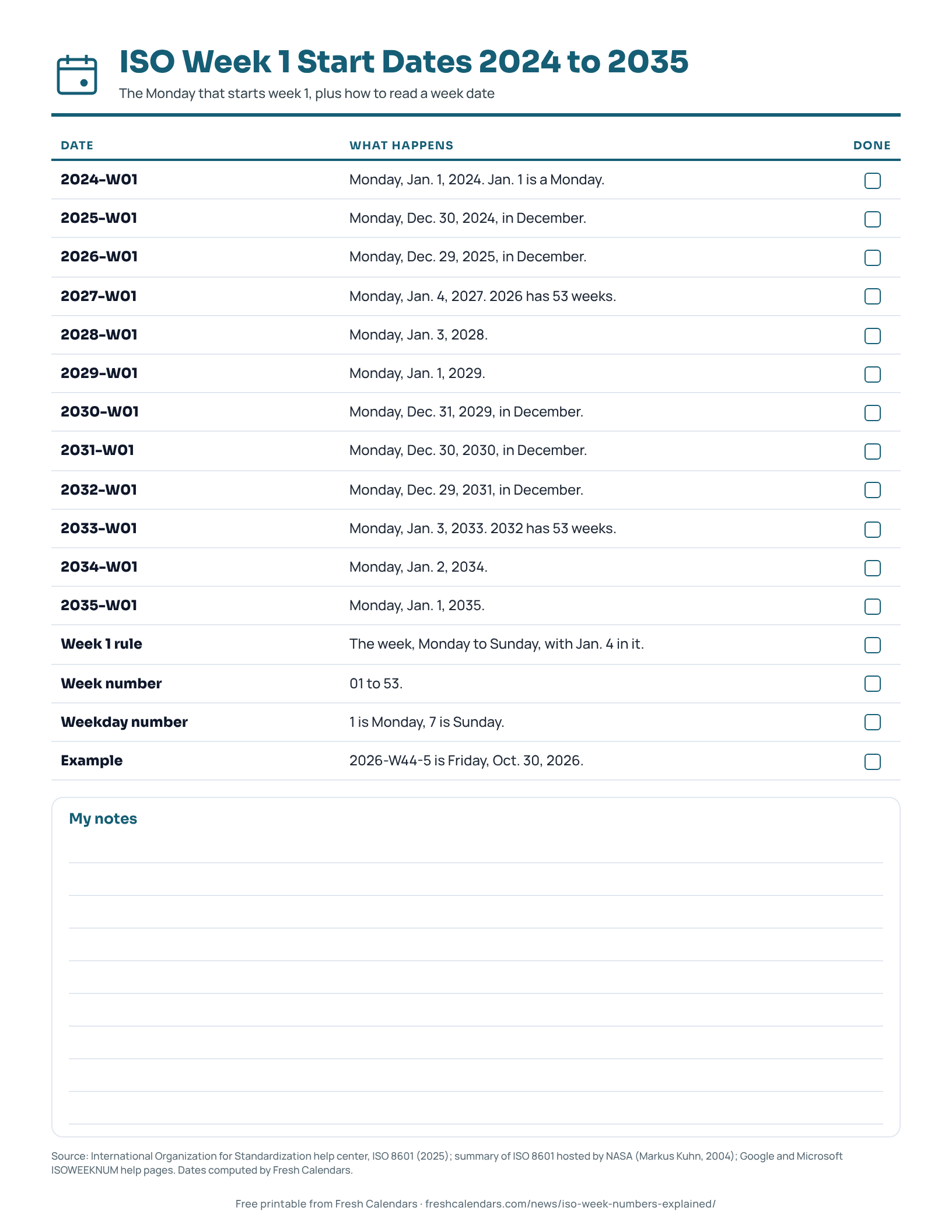
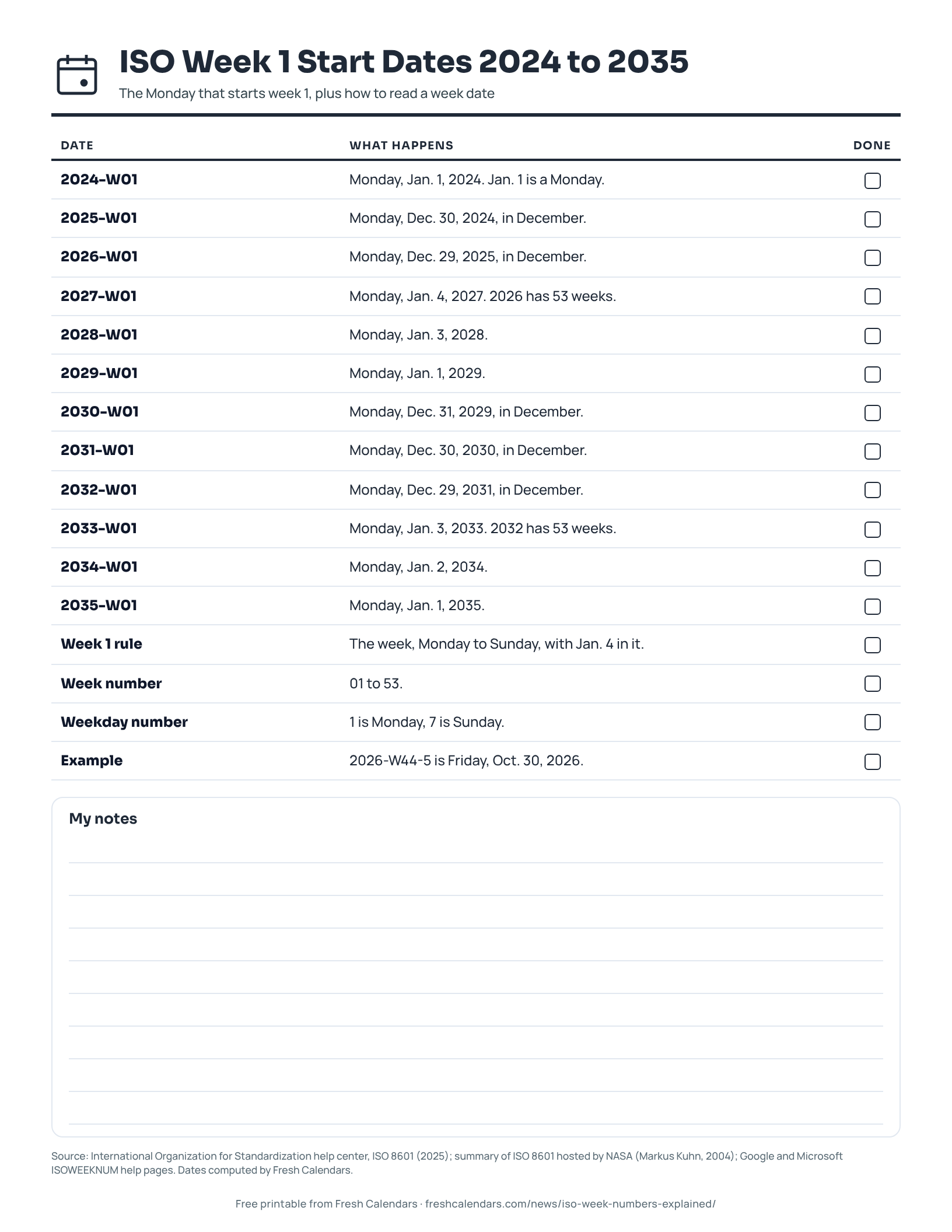
The printable below has the twelve week 1 Mondays from the table plus the reading rules in four lines, on one US Letter page with an ink-saver version. It is built from the same computation as this story.
Free printable downloads
Every template is free, needs no sign-up and prints on US Letter paper. Choose PDF for printing or PNG for screens and documents.
ISO Week 1 Start Dates 2024 to 2035 printables
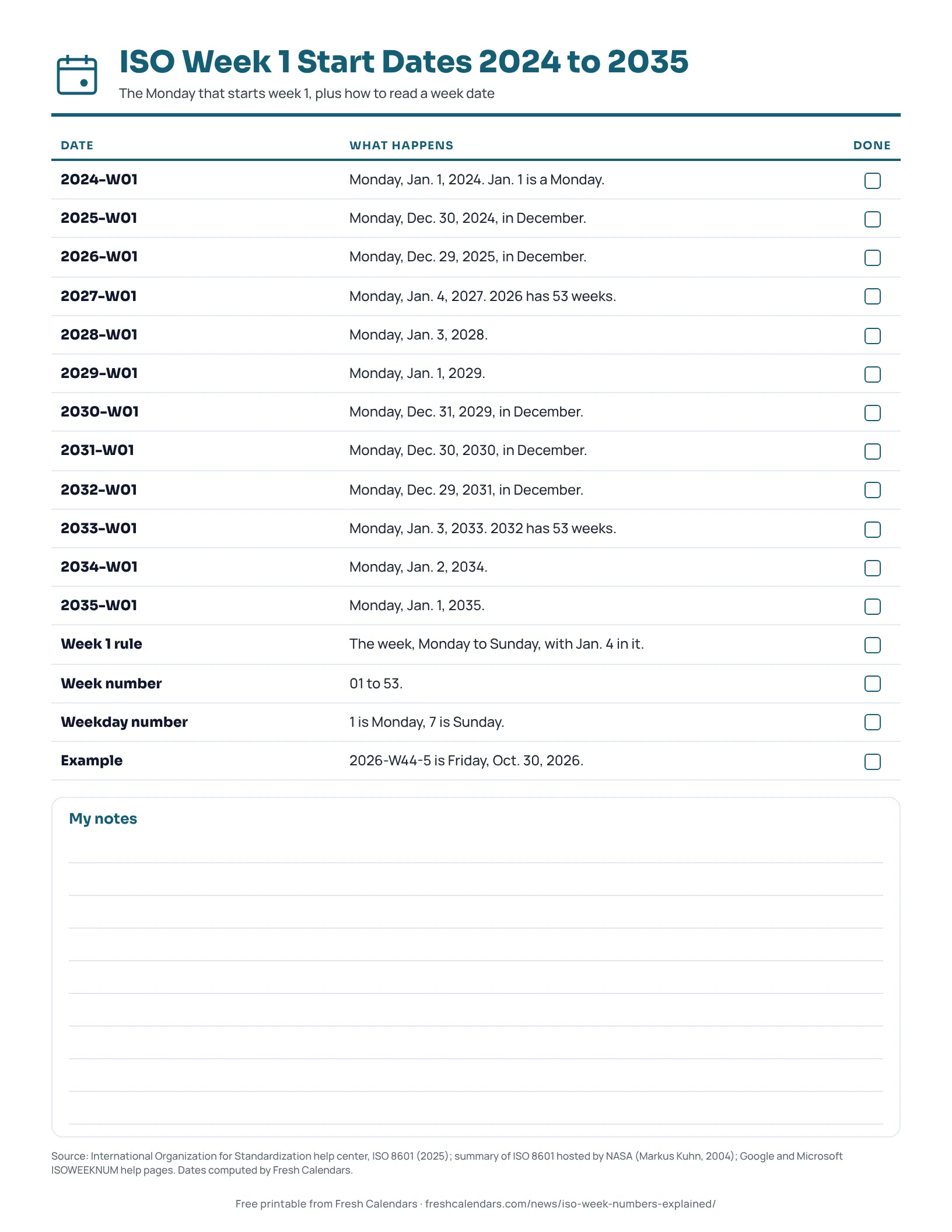
ISO Week 1 Start Dates 2024 to 2035
A one-page list of the Monday that starts ISO week 1 for each year from 2024 to 2035, with the week 1 rule and how to read a week date such as 2026-W44-5.
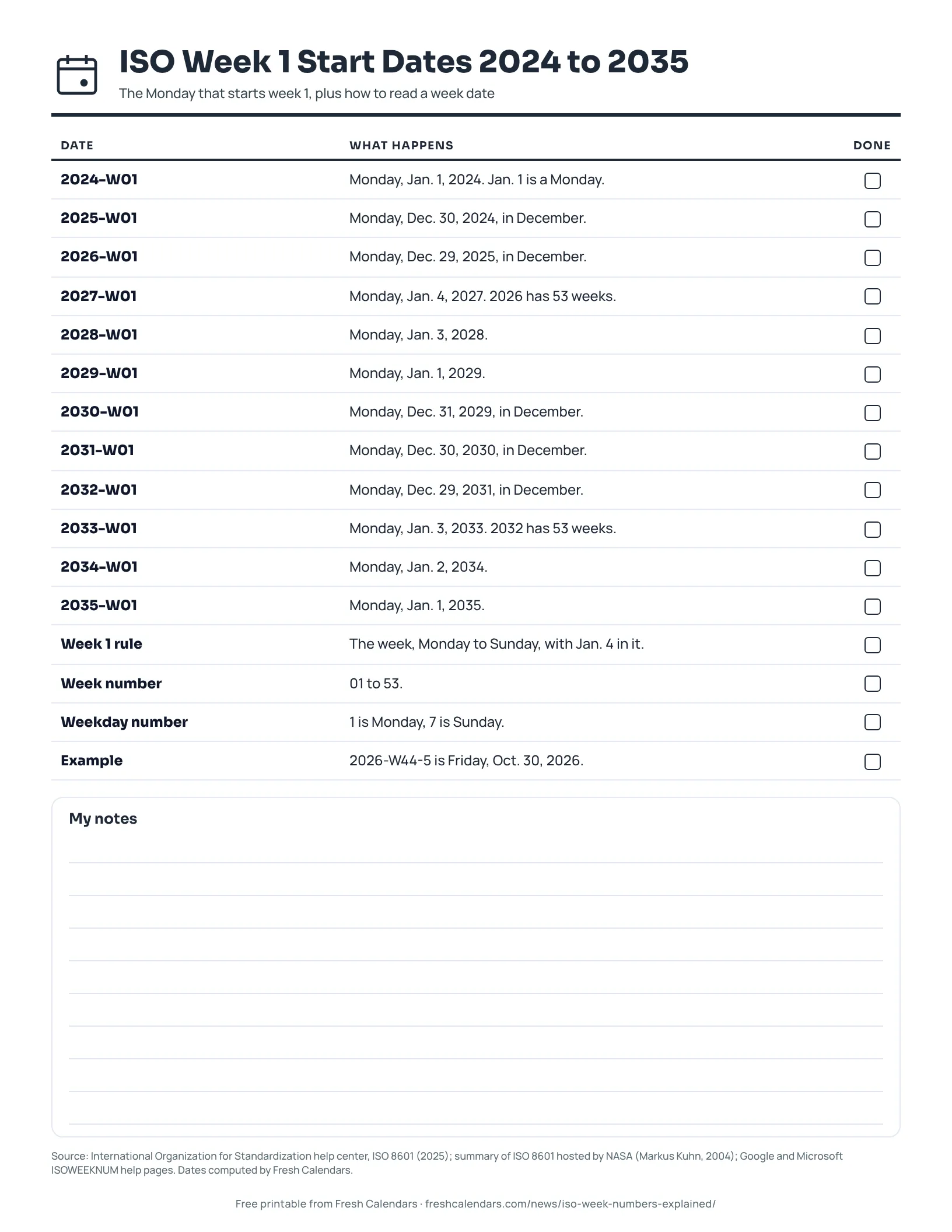
ISO Week 1 Start Dates 2024 to 2035 (ink saver)
A one-page list of the Monday that starts ISO week 1 for each year from 2024 to 2035, with the week 1 rule and how to read a week date such as 2026-W44-5. Ink-saver version.
Frequently asked questions
Does ISO week 1 always start on January 1?
No. It starts on the Monday of the week that contains Jan. 4. In the table above, that Monday falls on Jan. 1 in 2024, 2029 and 2035 and on a different date in the other years.
Does an ISO week start on Sunday or Monday?
Monday. A summary of the standard hosted by NASA says a week starts with Monday (day 1) and ends with Sunday (day 7), and Google's ISOWEEKNUM help page says weeks begin on Monday and end on Sunday.
Is ISO week 1 the first full week of the year?
It is the first week that has its Thursday in the new year, which makes it a full week with at least four of its days in January. It does not have to be the first week that begins in January: in 2026 the Monday of week 1 was Dec. 29, 2025.
Can a year have 53 ISO weeks?
Yes. Possible ISO week numbers run from 01 to 53, per the summary hosted by NASA. By our calculation, 2026 is a 53-week ISO year and so are 2032 and 2037. Our story on why some years have 53 weeks explains the rule.
Why is late December sometimes part of next year's week 1?
Week 1 is the week with Jan. 4 in it, so its Monday can land in the last days of December. Dec. 29, 2025 to Jan. 4, 2026 is 2026-W01, even though Dec. 29 to Dec. 31 are in 2025 on the calendar.
Sources
- ISO 8601: international standard for date and time format (International Organization for Standardization, 2025-07-31)
- ISO 8601 date and time format (standard home page) (International Organization for Standardization)
- International standard date and time notation (Markus Kuhn, summary of ISO 8601:2004) (NASA FITS Support Office (hosted), 2004-01-01)
- ISOWEEKNUM, Google Docs Editors Help (Google)
- ISOWEEKNUM function (Microsoft Support)
- WEEKNUM function (Microsoft Support)
Related news

More in Calendar Guides
All Calendar Guides stories →- How to Calculate the Day of the Year, From 001 to 365 or 366, With a Month Table
- What Is the 100th Day of the Year? April 10, or April 9 in Leap Years
- How Many Days Are Left in the Year? The Formula, Plus the Count From Oct. 30, 2026
- How to Print a Calendar PDF at Actual Size: Print Settings for Edge, Mac and Home Printers
- Monday Start vs Sunday Start Calendar: Same Dates, Different First Column