Why Some Years Have 53 Weeks: The ISO Rule, and Every Week 53 From 2004 to 2060
A year has 53 weeks under the International Organization for Standardization (ISO) when Jan. 1 is a Thursday or a leap year starts on Wednesday.

Published 6 min read
In this article
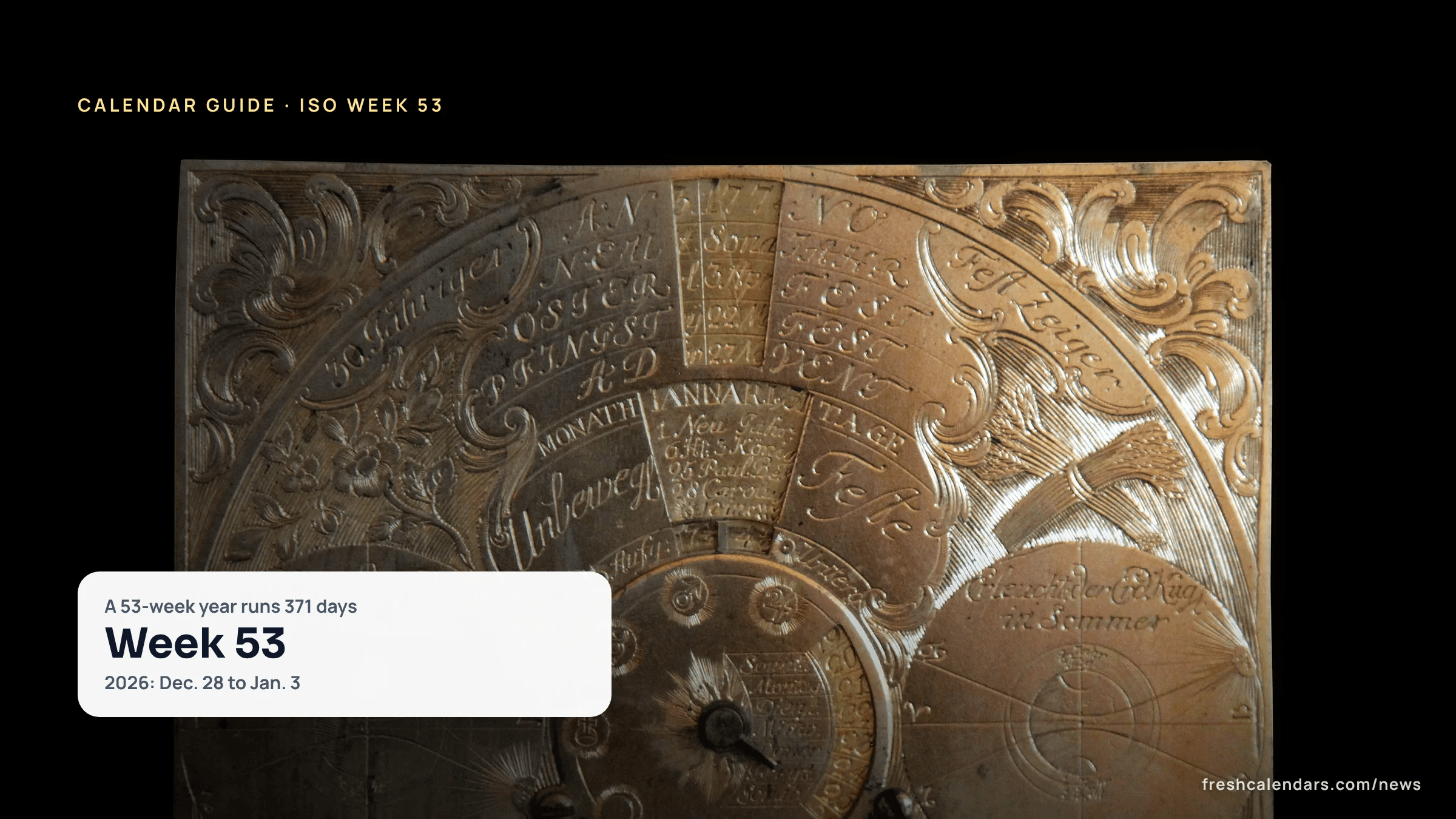
Under the week numbering in the ISO 8601 date standard, a year has 53 weeks when it contains 53 Thursdays: that happens when Jan. 1 is a Thursday, or when it is a leap year that starts on a Wednesday. Google Docs Editors Help describes the system as weeks that begin on Monday and end on Sunday, with Week 1 as “the week containing the first Thursday of the year.” This page works out what that means, lists every week 53 from 2004 to 2060, and shows how to check any year in a few seconds. 2026 is one of them.
Week counts per year are covered in how many weeks are in a year. Here the question is narrower: why the count sometimes reaches 53.
What a 53-week year is
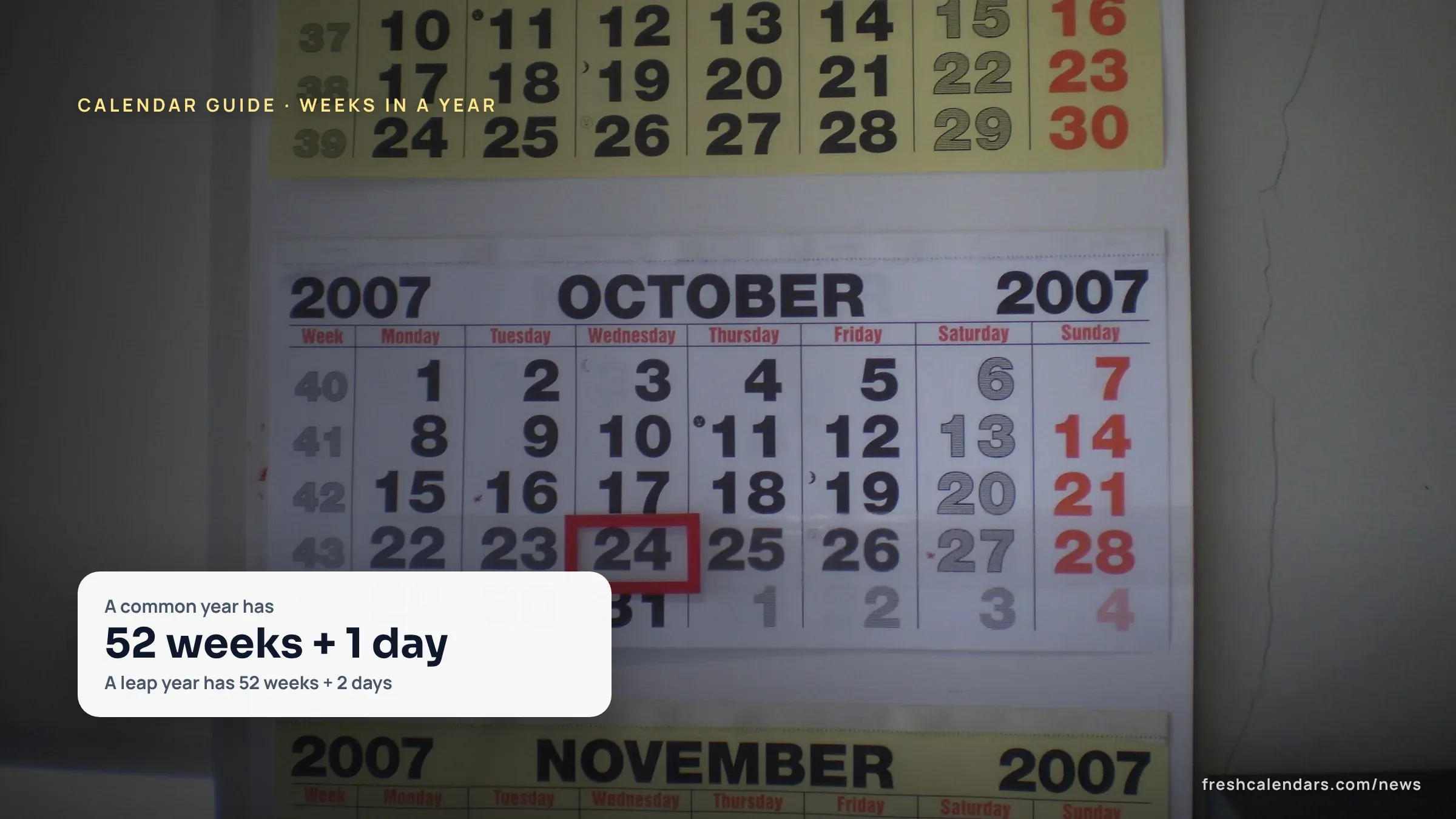
A Gregorian common year has 365 days and a leap year has 366, according to NASA’s calendar notes. Fifty-two full weeks make 364 days, so every year carries one or two days beyond 52 weeks (365 = 52 x 7 + 1, and 366 = 52 x 7 + 2). Those spare days pile up. When enough of them land the right way, the numbering needs a 53rd week.
The 53 weeks belong to an ISO week-year, which is a labeling system and not a calendar year. A 53-week ISO year is 371 days long (53 x 7). The ISO year 2026, for example, runs from Monday, Dec. 29, 2025 to Sunday, Jan. 3, 2027, which is 371 days by our count. Jan. 1, 2027 is a Friday, and it sits in week 53 of 2026 rather than in 2027.
The ISO rule: Week 1 holds the first Thursday
Markus Kuhn’s summary of ISO 8601, hosted by NASA, puts it this way: “Week 01 of a year is per definition the first week that has the Thursday in this year,” a week starts with Monday, and “possible ISO week numbers are in the range 01 to 53.” That Thursday rule is the same as saying Week 1 contains Jan. 4, which is a computed equivalent we checked for every year from 1900 to 2100.
The consequence is simple. A week belongs to the year that holds its Thursday. A year with 52 Thursdays gets 52 weeks, and a year with 53 Thursdays gets 53. Week 1 can start as early as Dec. 29 of the year before, and the last week can end as late as Jan. 3 of the next year.
When a year has 53 ISO weeks
There are two cases, and both come down to the weekday of Jan. 1. The table sets them next to the common alternatives.
| Year type | Jan. 1 falls on | ISO weeks |
|---|---|---|
| Common (365 days) | Thursday | 53 |
| Common (365 days) | any other day | 52 |
| Leap (366 days) | Wednesday or Thursday | 53 |
| Leap (366 days) | any other day | 52 |
A common year that starts on Thursday also ends on a Thursday (Dec. 31), so it holds 53 of them. A leap year has one more day, so it needs only to start on Wednesday (ending Thursday) or on Thursday (with Thursday again on Dec. 30). Put briefly: a year has 53 weeks when Jan. 1 or Dec. 31 is a Thursday. We confirmed this by two independent methods across 1900 to 2100: counting the ISO week of Dec. 28 with date arithmetic, and applying the weekday rule from a separate day-of-week formula. They agreed for every year.
Every ISO week 53 from 2004 to 2060
Between 2000 and 2060 there are 11 years with a week 53. The gap between them is 5 or 6 years in this range. Week 53 starts on a Monday, Dec. 27 or Dec. 28, and ends the following Sunday. All dates below are computed from the rule above.
| ISO week-year | Jan. 1 falls on | Year type | Week 53 (Monday to Sunday) |
|---|---|---|---|
| 2004 | Thursday | Leap | Dec. 27, 2004 to Jan. 2, 2005 |
| 2009 | Thursday | Common | Dec. 28, 2009 to Jan. 3, 2010 |
| 2015 | Thursday | Common | Dec. 28, 2015 to Jan. 3, 2016 |
| 2020 | Wednesday | Leap | Dec. 28, 2020 to Jan. 3, 2021 |
| 2026 | Thursday | Common | Dec. 28, 2026 to Jan. 3, 2027 |
| 2032 | Thursday | Leap | Dec. 27, 2032 to Jan. 2, 2033 |
| 2037 | Thursday | Common | Dec. 28, 2037 to Jan. 3, 2038 |
| 2043 | Thursday | Common | Dec. 28, 2043 to Jan. 3, 2044 |
| 2048 | Wednesday | Leap | Dec. 28, 2048 to Jan. 3, 2049 |
| 2054 | Thursday | Common | Dec. 28, 2054 to Jan. 3, 2055 |
| 2060 | Thursday | Leap | Dec. 27, 2060 to Jan. 2, 2061 |
The next one after 2026 is 2032. The week after 2026’s week 53 is Week 1 of 2027, which starts Monday, Jan. 4, 2027; the week numbers for 2027 story has that year in full. For a Monday-first layout of your own, use the printable Monday-start calendar.
Why a leap year does not always have 53 weeks
A leap year is a Gregorian rule about days: the U.S. Naval Observatory says years evenly divisible by 4 are leap years, except centurial years not divisible by 400. A 53-week ISO year is a rule about Thursdays. The two overlap only when a leap year starts on a Wednesday or Thursday.
From 2000 to 2060 there are 16 leap years, and 5 of them have a week 53 (2004, 2020, 2032, 2048 and 2060). The other 11 have 52 weeks, including 2024, which started on a Monday. Of the 11 week 53 years in the table, 6 are common years. A 366th day neither guarantees nor is needed for a 53rd week.
How to check whether a year has week 53
Use Dec. 28. It is a computed fact that Dec. 28 always lies in the last ISO week of its year, so its week number is the number of weeks that year has. Spreadsheet functions that follow the ISO method return it: Microsoft Support lists ISOWEEKNUM(date), and Google Docs has the same function. Build the date with the date function (DATE) and enter =ISOWEEKNUM(DATE(2026,12,28)) and you get 53; for 2027 you get 52.
Worked examples, all computed:
- 2026: Dec. 28, 2026 is a Monday and starts week 53.
- 2027: Jan. 1, 2027 is a Friday, so 2027 has no week 53. Dec. 28, 2027 is a Tuesday in week 52, which runs Dec. 27, 2027 to Jan. 2, 2028.
- 2020: a leap year starting on a Wednesday, so Dec. 28, 2020 is a Monday in week 53.
Be careful with the plain WEEKNUM function. Microsoft Support documents return types: type 1 or omitted starts weeks on Sunday and counts the week with Jan. 1 as week 1, while type 21 uses Monday and the ISO method. A calendar app that shows Jan. 1 as week 1 is using the first method. Also, the year function (YEAR) gives the calendar year: Jan. 1, 2027 is in calendar year 2027 and ISO week 53 of 2026.
Does 53 ISO weeks mean 53 pay periods or a 53-week fiscal year?
No, these are three different counts that happen to use the same number.
- ISO week 53 is a week label. It depends only on the date and needs no employer decision.
- A 52-53-week tax year is a company choice. The Internal Revenue Service (IRS) describes it as “a fiscal tax year that varies from 52 to 53 weeks” and notes it does not have to end on the last day of a month. Apple’s Form 10-K says its fiscal year “is the 52- or 53-week period that ends on the last Saturday of September,” and ended Sept. 27, 2025 for fiscal 2025.
- Retail 4-5-4 years add the extra week on purpose. The National Retail Federation (NRF) says it is “sometimes necessary to add a 53rd week to the end of the calendar for sales reporting purposes only.” Our NRF 4-5-4 calendar story covers fiscal 2027 and 2028.
Paydays follow a different arithmetic. Because 365 = 52 x 7 + 1, one weekday occurs 53 times in a common year, and two weekdays do in a leap year. A weekly payday on that weekday can fall 53 times, and that depends on the pay schedule, not on the ISO year. The three-paycheck months story shows a biweekly Friday schedule. This page is not payroll advice; your employer’s schedule decides.
The ISO standard’s home page is at iso.org. Fresh Calendars could not read the standard itself, so the rule here rests on the Google and NASA-hosted descriptions above plus our own computation. For a whole-year view, the printable yearly calendar shows all twelve months, and the printable weekly calendar fits week-by-week planning.
Free printable downloads
Every template is free, needs no sign-up and prints on US Letter paper. Choose PDF for printing or PNG for screens and documents.
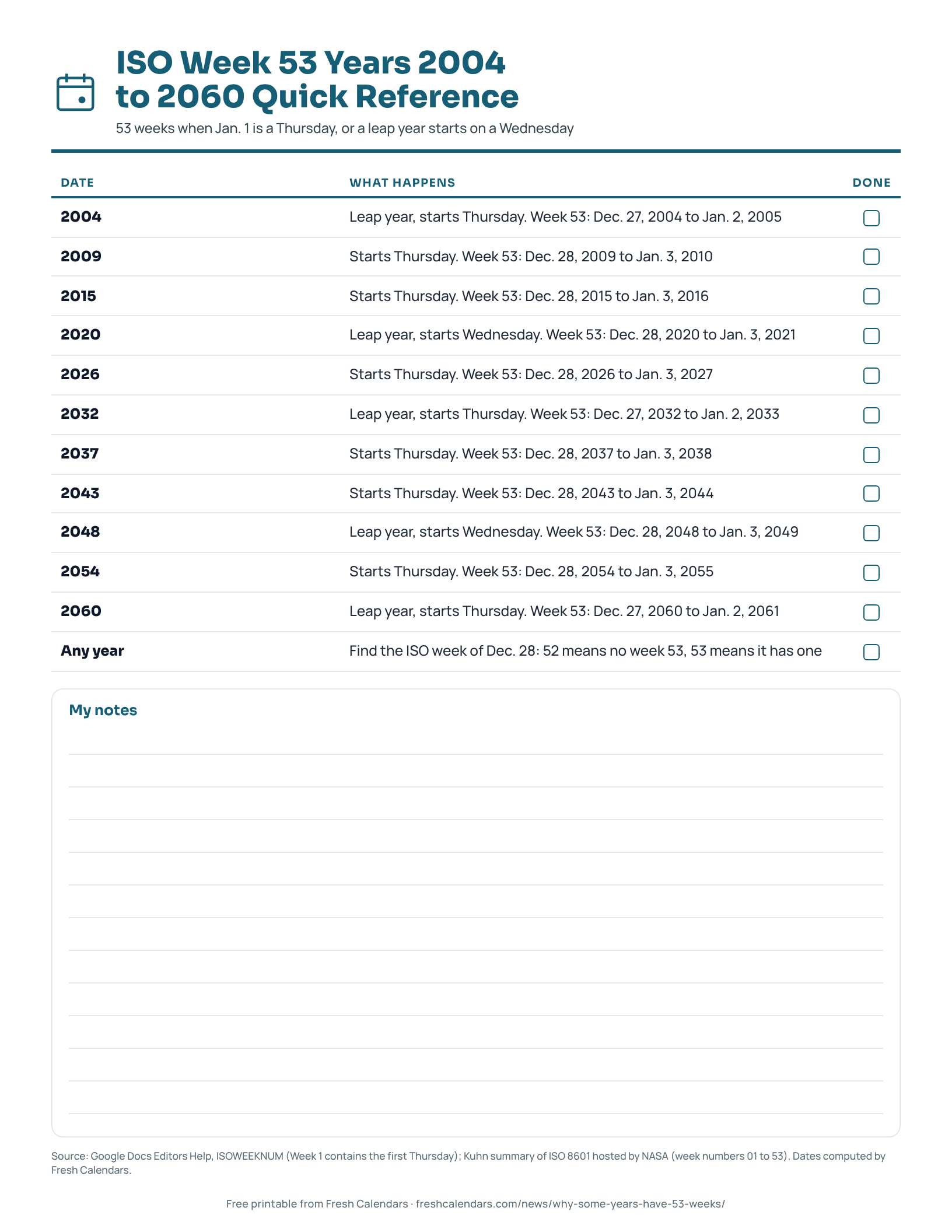
ISO Week 53 Years 2004 to 2060 Quick Reference printables
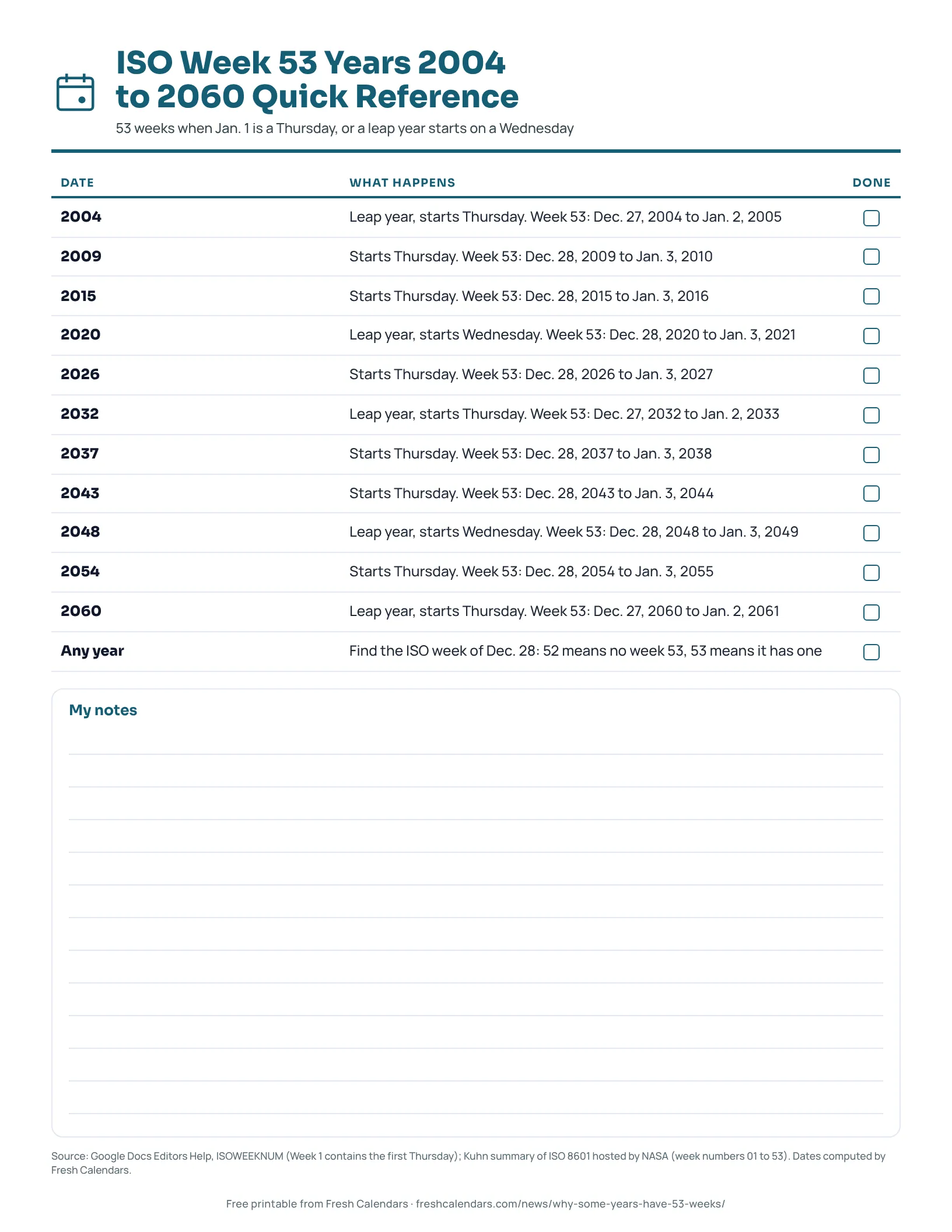
ISO Week 53 Years 2004 to 2060 Quick Reference
One-page list of every ISO week 53 year from 2004 to 2060 with the week's date range, plus the Dec. 28 check for any other year.
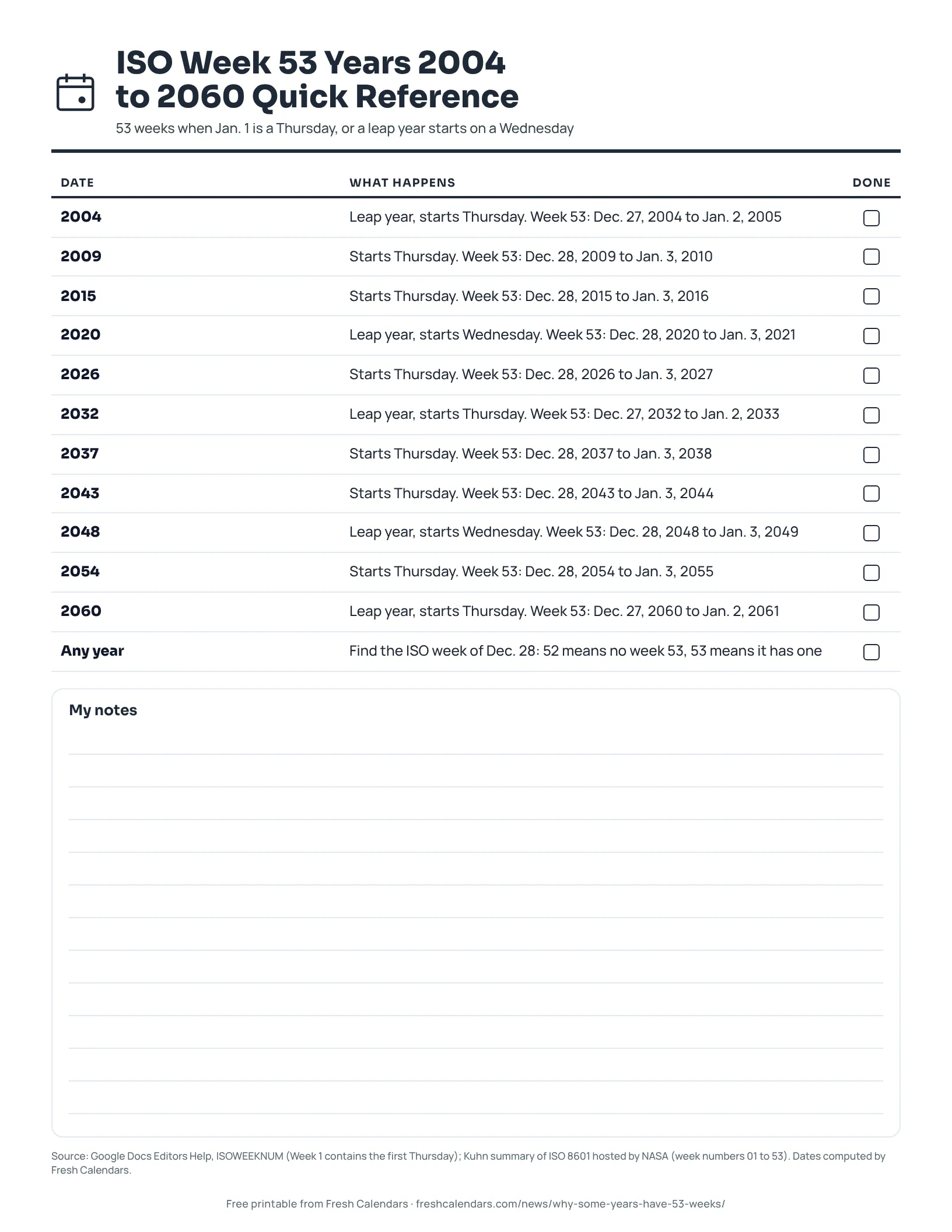
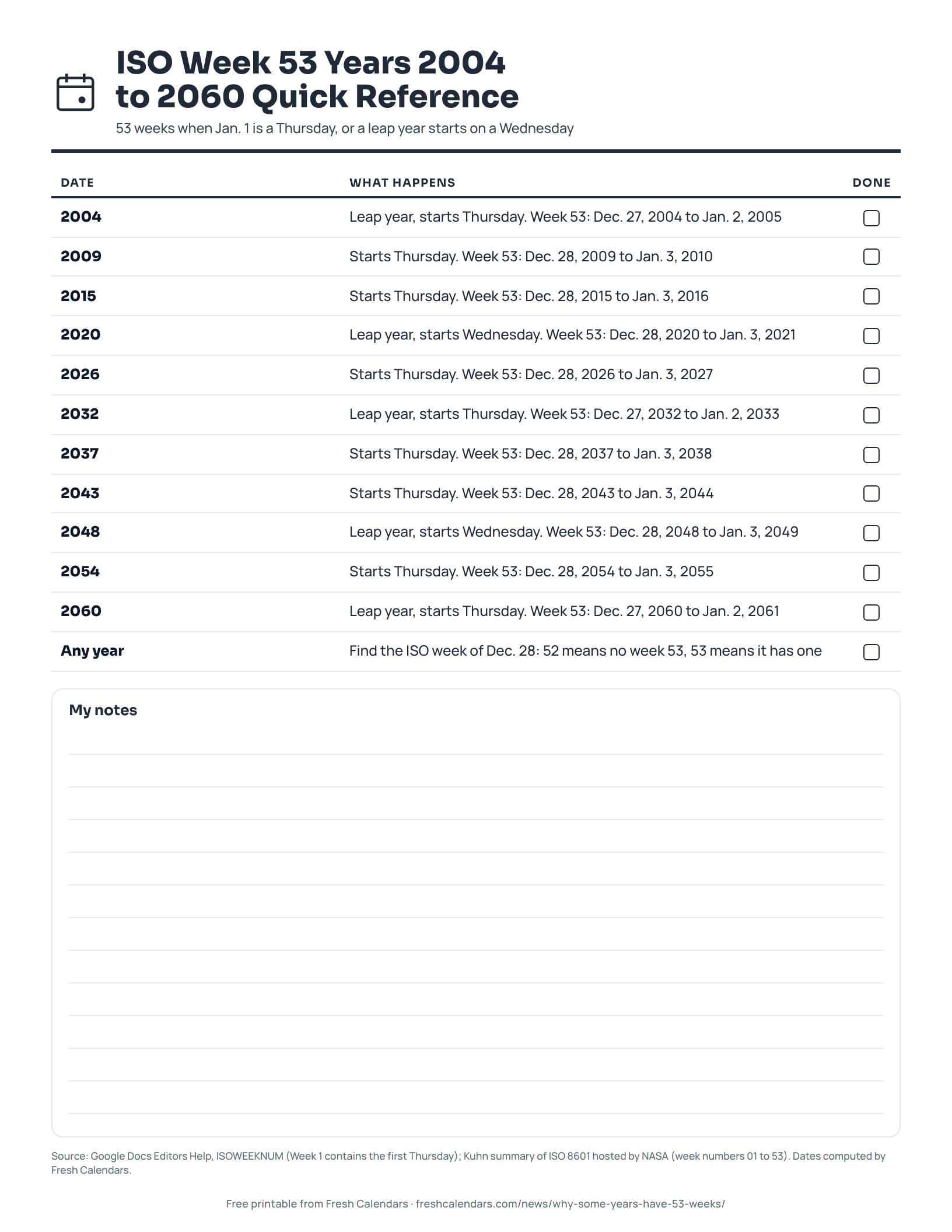
ISO Week 53 Years 2004 to 2060 Quick Reference (ink saver)
One-page list of every ISO week 53 year from 2004 to 2060 with the week's date range, plus the Dec. 28 check for any other year. Ink-saver version.
Frequently asked questions
Does every leap year have 53 weeks?
No. A leap year has 53 ISO weeks only when Jan. 1 is a Wednesday or a Thursday. Between 2000 and 2060 there are 16 leap years and 5 of them have a week 53: 2004, 2020, 2032, 2048 and 2060. The other 11 (2000, 2008, 2012, 2016, 2024, 2028, 2036, 2040, 2044, 2052 and 2056) have 52.
Can a year have 54 weeks?
Not in ISO week numbering. Kuhn's summary of ISO 8601, hosted by NASA, gives the possible week numbers as 01 to 53, and our check of every year from 1900 to 2100 found only 52 or 53.
What is ISO Week 53?
It is the last week of an ISO week-year that has 53 weeks, from a Monday to a Sunday. In 2026 it is Dec. 28, 2026 to Jan. 3, 2027.
Why does Week 1 sometimes begin in December?
Week 1 is the week containing the year's first Thursday, and weeks run Monday to Sunday. When Jan. 1 is a Friday, Saturday or Sunday, that week started in the previous December. ISO week 1 of 2026 begins Monday, Dec. 29, 2025.
Is Week 53 the same as a 53-paycheck year?
No. Week 53 is a label in a numbering system. Whether an employer pays 53 times in a year depends on the pay schedule and the first payday, which is why this page does not give payroll advice.
Sources
- ISOWEEKNUM function (Google Docs Editors Help)
- International standard date and time notation (summary of ISO 8601:2004) (Markus Kuhn, hosted by NASA, 2004-01-01)
- ISOWEEKNUM function (Microsoft Support)
- Leap Years (U.S. Naval Observatory)
- Tax years (Internal Revenue Service, 2026-01-27)
- 4-5-4 Calendar (National Retail Federation)
- Apple Inc. Form 10-K for fiscal 2025 (U.S. Securities and Exchange Commission, 2025-09-27)
- ISO 8601 date and time format (International Organization for Standardization)
Related news


More in Calendar Guides
All Calendar Guides stories →- How to Calculate the Day of the Year, From 001 to 365 or 366, With a Month Table
- What Is the 100th Day of the Year? April 10, or April 9 in Leap Years
- How Many Days Are Left in the Year? The Formula, Plus the Count From Oct. 30, 2026
- How to Print a Calendar PDF at Actual Size: Print Settings for Edge, Mac and Home Printers
- Monday Start vs Sunday Start Calendar: Same Dates, Different First Column