Next Solar Eclipse in the US: Total in Alaska in 2033, Lower 48 on Aug. 22, 2044
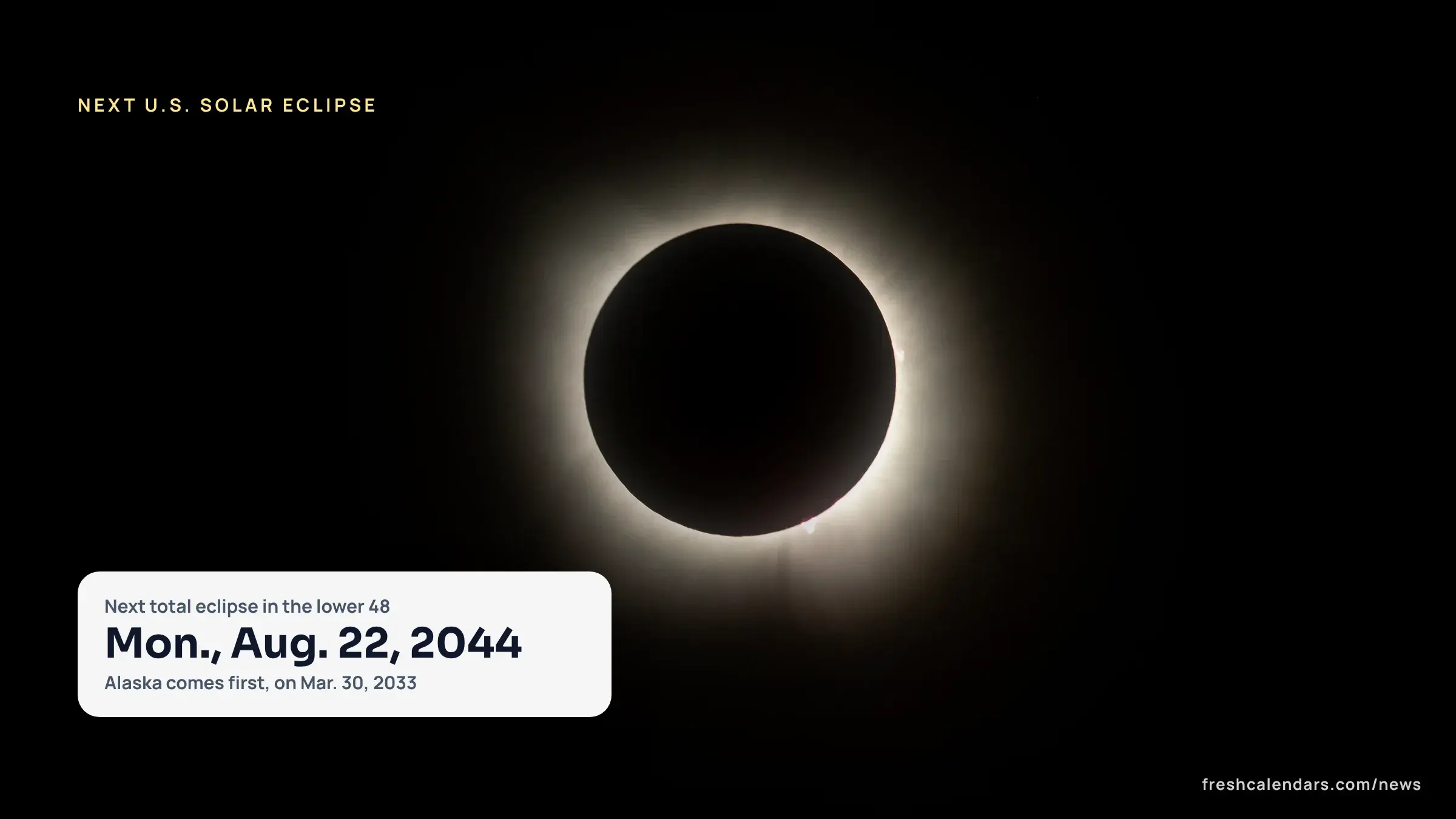
The National Aeronautics and Space Administration (NASA) lists the next U.S. total solar eclipse in Alaska on Mar. 30, 2033, then the lower 48 on Aug. 22, 2044.

Published 6 min read
In this article
- Solar eclipses with a U.S. view, 2027 to 2046
- What is the Mar. 30, 2033 total solar eclipse in Alaska?
- Where is the Aug. 22, 2044 total solar eclipse visible?
- Is the Aug. 12, 2045 total solar eclipse coast to coast?
- When are the next annular solar eclipses in the U.S.?
- Can you see a solar eclipse from the U.S. before 2033?
- Next U.S. solar eclipses printable
The next total solar eclipse in the United States is on Wednesday, Mar. 30, 2033, over Alaska, and the next one in the lower 48 states is on the evening of Monday, Aug. 22, 2044, according to the National Aeronautics and Space Administration (NASA). NASA’s tables date the 2044 eclipse Aug. 23 in Universal Time (UT), which is still Aug. 22 on mainland U.S. clocks. NASA’s Frequently Asked Questions (FAQ) page says totality in 2044 is visible only from North Dakota and Montana, and that the next total eclipse across the lower 48 from coast to coast is in 2045.
Solar eclipses with a U.S. view, 2027 to 2046
The table lists every solar eclipse from 2027 to 2046 whose region in NASA’s decade tables names the U.S., Alaska, Hawaii or North America. For Aug. 2, 2027, the U.S. entry comes from NASA’s Future Eclipses page. Dates are U.S. dates we worked out from NASA’s UT dates, with the weekday computed; the two Alaska-only rows in 2029 and 2030 fall a day earlier on Alaska clocks than in UT. The last column counts the years from Nov. 2, 2026.
| U.S. date | Type | What NASA lists for the U.S. | Central duration worldwide | Years from today |
|---|---|---|---|---|
| Mon., Aug. 2, 2027 | Total | Partial eclipse in northern Maine; totality is in Spain and North Africa | 6 min 23 s | 0.7 |
| Wed., Jan. 26, 2028 | Annular | Region “e N. America”; no U.S. place on the central path | 10 min 27 s | 1.2 |
| Sun., Jan. 14, 2029 | Partial | Region “N. America” | none | 2.2 |
| Mon., June 11, 2029 (June 12 UT) | Partial | Region includes “Alaska” | none | 2.6 |
| Fri., May 31, 2030 (June 1 UT) | Annular | Region includes “Alaska”; the central path is elsewhere | 5 min 21 s | 3.6 |
| Fri., Nov. 14, 2031 | Hybrid | Region “s US”; the central path is the Pacific and Panama | 1 min 8 s | 5.0 |
| Wed., Mar. 30, 2033 | Total | Totality in Alaska | 2 min 37 s | 6.4 |
| Thu., Aug. 21, 2036 | Partial | Region includes “Alaska” | none | 9.8 |
| Tue., Jan. 5, 2038 | Annular | Region “e N. America”; no U.S. place on the central path | 3 min 18 s | 11.2 |
| Fri., July 2, 2038 | Annular | Region “N. & C. America”; no U.S. place on the central path | 1 min 0 s | 11.7 |
| Tue., June 21, 2039 | Annular | Annular path includes Alaska | 4 min 5 s | 12.6 |
| Sun., Nov. 4, 2040 | Partial | Region “N. & C. America” | none | 14.0 |
| Thu., Apr. 9, 2043 | Total | Region “n N. America”; totality is in northeast Russia | not listed | 16.4 |
| Mon., Aug. 22, 2044 (Aug. 23 UT) | Total | Totality in North Dakota and Montana | 2 min 4 s | 17.8 |
| Thu., Feb. 16, 2045 | Annular | Region includes Hawaii; the annular path is New Zealand and the Pacific | 7 min 47 s | 18.3 |
| Sat., Aug. 12, 2045 | Total | Totality across “s US”; coast to coast | 6 min 6 s | 18.8 |
| Mon., Feb. 5, 2046 | Annular | Annular path: Hawaii, California, Oregon, Idaho | 9 min 42 s | 19.3 |
Bold rows have a central path, total or annular, over a U.S. place. Years are days divided by 365.2425, rounded to one decimal. The duration column is NASA’s central duration at greatest eclipse, a figure for the whole eclipse and not for a U.S. town, so it says little about what a U.S. viewer gets. Where a row says “no U.S. place on the central path”, NASA’s bracketed list of central-path places names none; NASA’s wording for the wider region is quoted as printed.
Mark the dates you plan around on a printable yearly calendar. Both the 2044 and 2045 total eclipses fall in August, which the August printable calendars lay out by week.
What is the Mar. 30, 2033 total solar eclipse in Alaska?
NASA’s 2031 to 2040 decade table lists the eclipse as total, with totality in “e Russia, Alaska”. The path page puts greatest eclipse at 18:01:16.4 UT, with a central duration of 2 minutes 37.0 seconds and a path 781.0 kilometers wide at that instant. It falls on a Wednesday.
The NASA pages we used list the path by latitude and longitude at two-minute steps, not by Alaska town, and they give no local times. This story gives none.
Where is the Aug. 22, 2044 total solar eclipse visible?
NASA’s FAQ page, last updated Apr. 1, 2024, says: “After 2024, the next total solar eclipse visible from any point in the contiguous United States will occur in 2044. Totality will only be visible from North Dakota and Montana.” The decade table adds Greenland and northern Canada to the path, and lists a central duration of 2 minutes 4 seconds.
Some news reports add South Dakota as a third state. NASA’s own wording names two, and we follow it.
The date needs care. NASA’s table says Aug. 23, and its path page gives the instant of greatest eclipse as 01:15:33.6 UT. By our conversion that is 9:15 p.m. Eastern Daylight Time (EDT) on Monday, Aug. 22. Either date refers to the same eclipse.
NASA’s longest figure for it, 2 minutes 3.8 seconds, is at 64°34’N, 120°22’W, well north of the U.S. border. NASA’s tables do not give a duration for North Dakota or Montana.
Is the Aug. 12, 2045 total solar eclipse coast to coast?
NASA’s FAQ page says the next total eclipse to travel across the lower 48 states from coast to coast is in 2045. The decade table dates it Saturday, Aug. 12 and lists totality in “s US, Haiti, Dominican Rep., Venezuela, Guyana, Fr. Guyana, Suriname, Brazil”. The path page gives a longest duration of 6 minutes 6.2 seconds, nearly three times the 2044 figure.
NASA’s path pages list coordinates, not state names, so we print no state list for 2045. The interactive map linked from NASA’s decade table shows the track.
When are the next annular solar eclipses in the U.S.?
NASA’s table for 2031 to 2040 includes Alaska in the annular path on Tuesday, June 21, 2039, with a central duration of 4 minutes 5 seconds, alongside northern Canada, Norway, Sweden, Finland, Estonia and Russia.
The 2041 to 2050 table lists Monday, Feb. 5, 2046, with an annular path over Papua New Guinea, Hawaii, California, Oregon and Idaho. Its 9 minutes 42 seconds at greatest eclipse and the path page’s 9 minutes 45.6 seconds are worldwide maxima, found in the Pacific. The longer one is at 1°56’N, 174°39’W, near the equator and far south of Hawaii. NASA’s tables give no annular duration for the U.S. stretch.
NASA’s table for Feb. 16, 2045 names Hawaii in the region but lists only New Zealand and the Pacific for the annular path. In NASA’s decade tables from 2021 to 2050, Hawaii is named only for that eclipse and for Feb. 5, 2046. None of the total eclipses names Hawaii.
Can you see a solar eclipse from the U.S. before 2033?
Only partial ones. NASA’s Future Eclipses page, updated Sep. 28, 2026, lists the Aug. 2, 2027 total eclipse for southern Spain, North Africa, Saudi Arabia and Yemen, with a partial eclipse in eastern Canada and northern Maine. For the other 2027 eclipse dates, see our 2027 eclipse overview, and for the Spain and Egypt totality times, the Aug. 2, 2027 times by city. For a full-moon schedule that fits around these dates, see our 2027 moon phases calendar.
The eclipse of Aug. 12, 2026 is already past. NASA’s Aug. 21, 2026 article says only a partial eclipse was visible in northern Maine, where a NASA photographer captured the International Space Station crossing the Sun near Hodgdon.
After 2027, NASA’s regions are “e N. America” on Jan. 26, 2028, “N. America” on Jan. 14, 2029, Alaska on June 12, 2029 and June 1, 2030, and “s US” on Nov. 14, 2031. All are partial for the U.S., and NASA’s tables give no coverage figures for U.S. cities.
Next U.S. solar eclipses printable
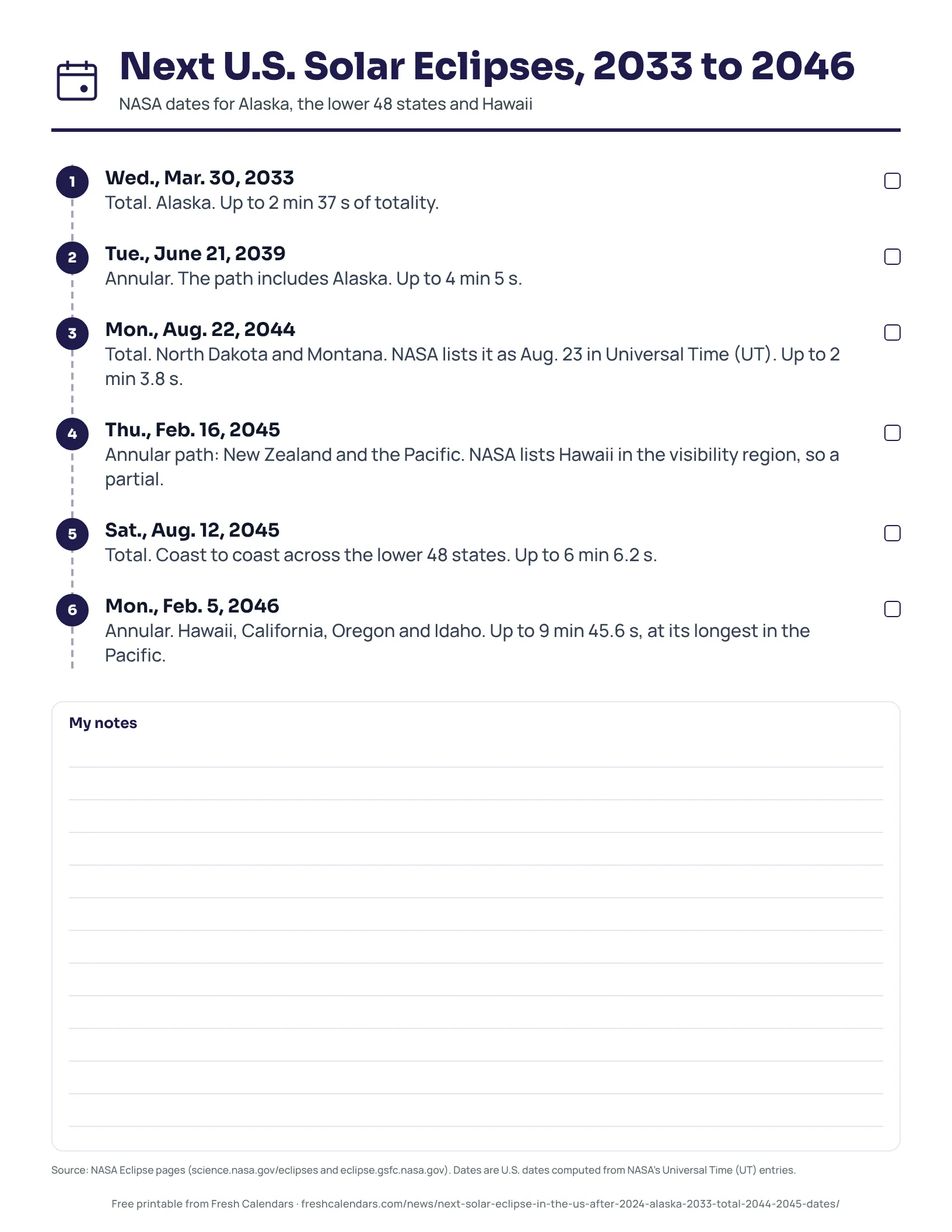
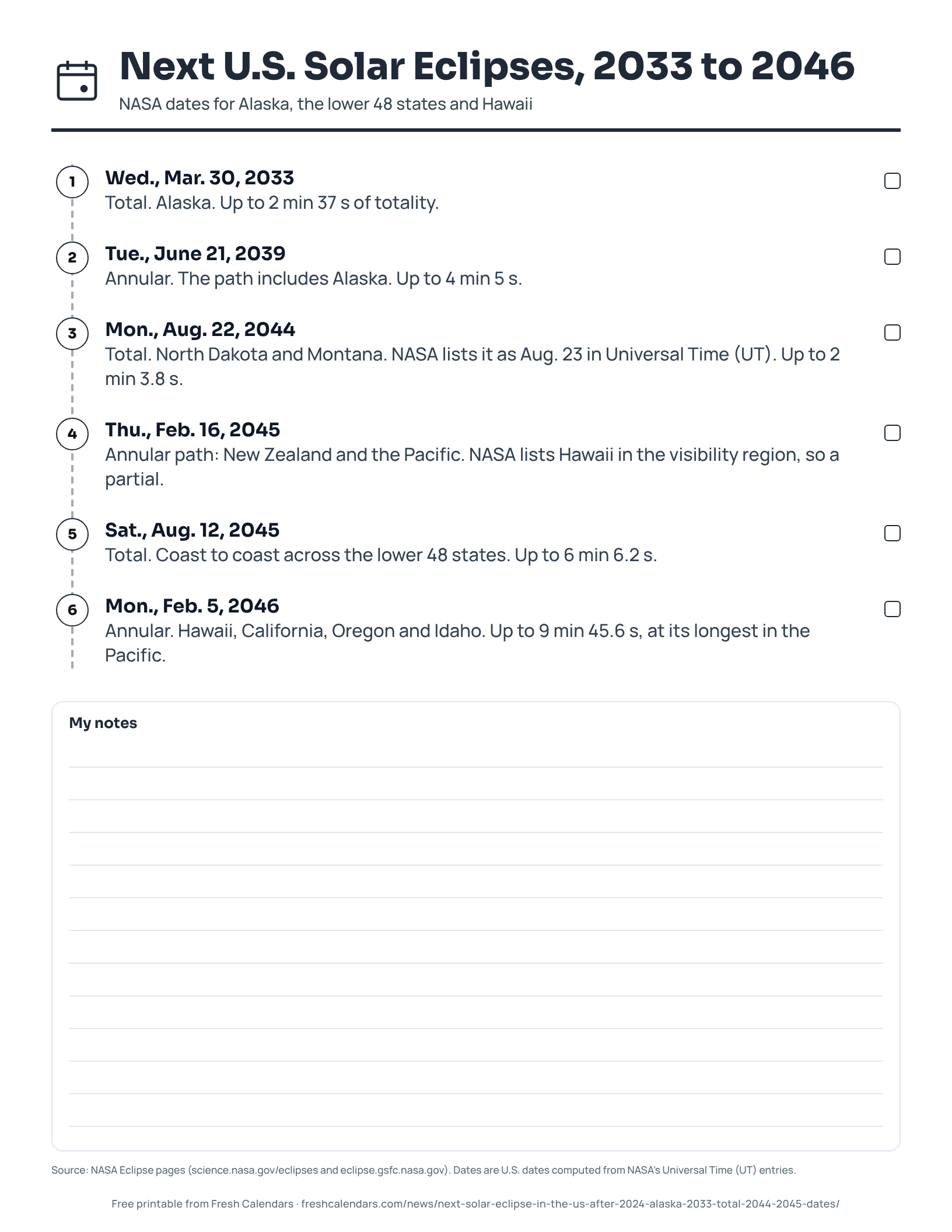
The one-page printable lists the five eclipses from 2033 to 2046 with a central path over a U.S. place, plus the Feb. 16, 2045 annular eclipse that NASA lists for Hawaii. Each row has the U.S. date, the type, the U.S. location and the longest duration NASA gives. Its source note names the same NASA pages as this story.
Free printable downloads
Every template is free, needs no sign-up and prints on US Letter paper. Choose PDF for printing or PNG for screens and documents.
Next U.S. Solar Eclipses printables
-
Next U.S. Solar Eclipses, 2033 to 2046
A one-page list of the next solar eclipses with a U.S. view from 2033 to 2046: date, type, where in the U.S. and the longest duration, from NASA.
-
Next U.S. Solar Eclipses, 2033 to 2046 (ink saver)
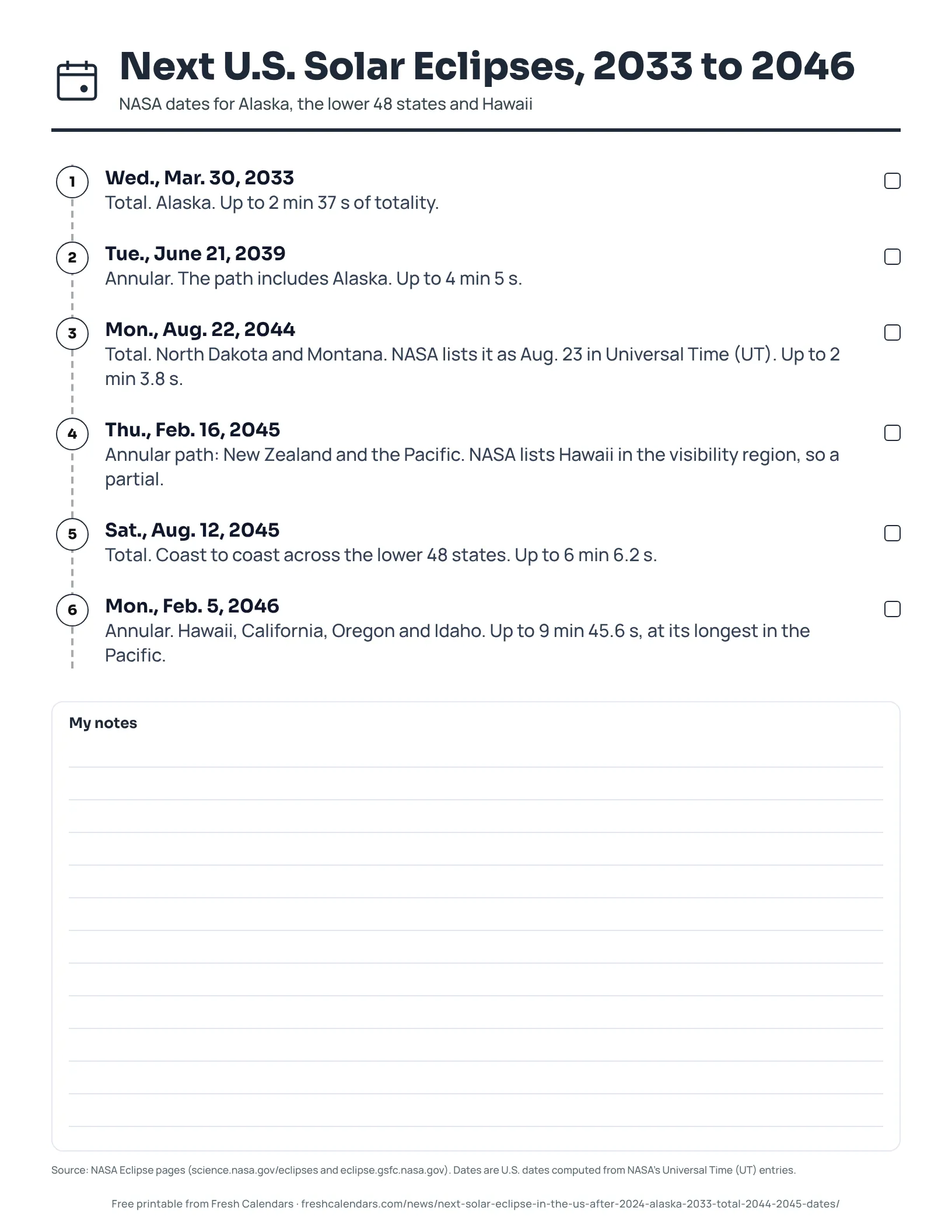
A one-page list of the next solar eclipses with a U.S. view from 2033 to 2046: date, type, where in the U.S. and the longest duration, from NASA. Ink-saver version.
Frequently asked questions
Why is there no total solar eclipse in the lower 48 states between 2024 and 2044?
NASA's Frequently Asked Questions (FAQ) page says that after 2024 the next total solar eclipse visible from any point in the contiguous U.S. occurs in 2044. The totals NASA lists in between have paths elsewhere: the Arctic, Greenland, Iceland and Spain on Aug. 12, 2026, Spain and North Africa on Aug. 2, 2027, and Australia and New Zealand on July 22, 2028. Alaska, on Mar. 30, 2033, is the one U.S. entry. The same page says calculations show it will take about a thousand years for every location in the lower 48 states to be able to view a total solar eclipse.
Can I see the Aug. 2, 2027 total solar eclipse from the U.S.?
Not as a total eclipse. NASA's Future Eclipses page, updated Sep. 28, 2026, lists totality for southern Spain and North Africa and a partial eclipse in eastern Canada and northern Maine. NASA's Goddard decade table summarizes the region as Africa, Europe, the Middle East and west and south Asia, without naming North America.
When is the next annular solar eclipse in the U.S.?
NASA's tables list Alaska in the annular path on June 21, 2039, and Hawaii, California, Oregon and Idaho on Feb. 5, 2046. After 2046, the next entry with a U.S. region in its annular path is June 11, 2048, listed as 'midwest US'.
Sources
- Eclipses: Frequently Asked Questions (NASA Science, 2024-04-01)
- Future Eclipses (NASA Science, 2026-09-28)
- NASA Shares Views of August Solar Eclipse from Ground, Air, Space (NASA, 2026-08-21)
- Solar Eclipses: 2021 - 2030 (NASA Goddard Space Flight Center)
- Solar Eclipses: 2031 - 2040 (NASA Goddard Space Flight Center)
- Solar Eclipses: 2041 - 2050 (NASA Goddard Space Flight Center)
- Path of the Total Solar Eclipse of 2033 Mar 30 (NASA Goddard Space Flight Center)
- Path of the Total Solar Eclipse of 2044 Aug 23 (NASA Goddard Space Flight Center)
- Path of the Total Solar Eclipse of 2045 Aug 12 (NASA Goddard Space Flight Center)
- Path of the Annular Solar Eclipse of 2046 Feb 05 (NASA Goddard Space Flight Center)
Related news
-
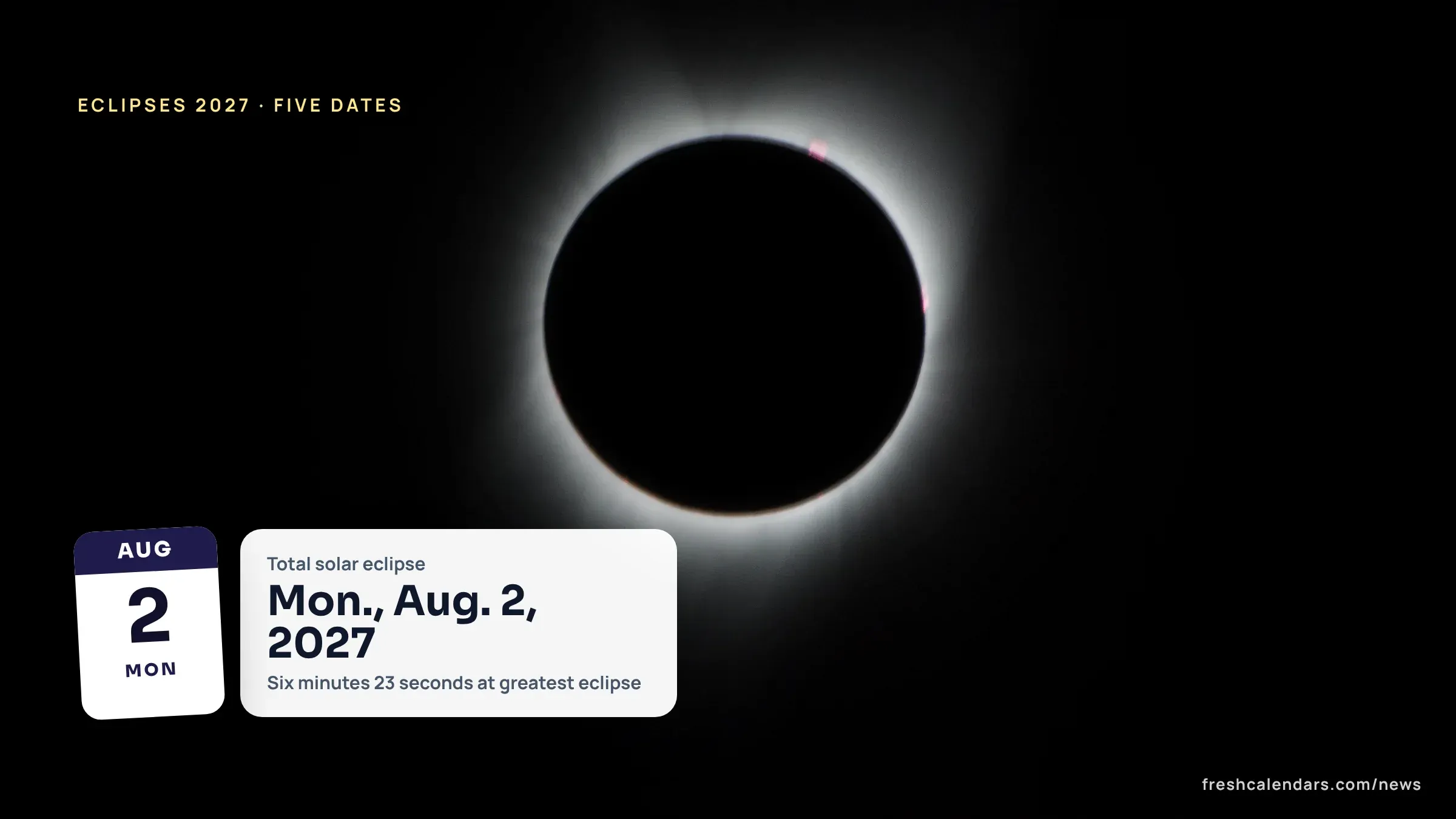 Eclipses 2027: Five Dates and Times, Led by the Total Solar Eclipse on Aug. 2
-
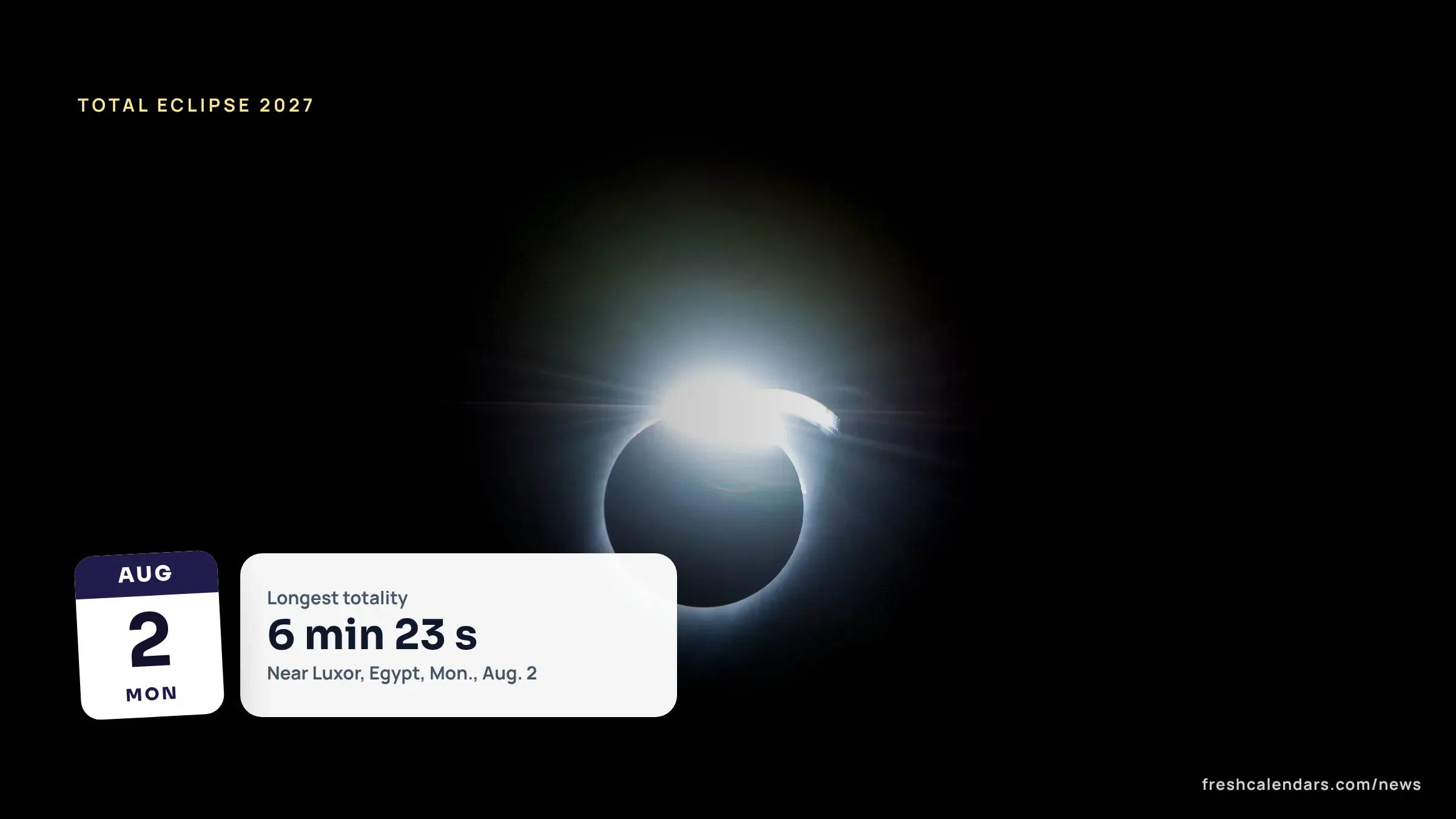 Total Solar Eclipse Aug. 2, 2027: Totality Times by City in Spain and Egypt
-
 Moon Phases 2027: Full Moon Calendar With Dates, Times, Names and Eclipses, Plus Free Printables
-
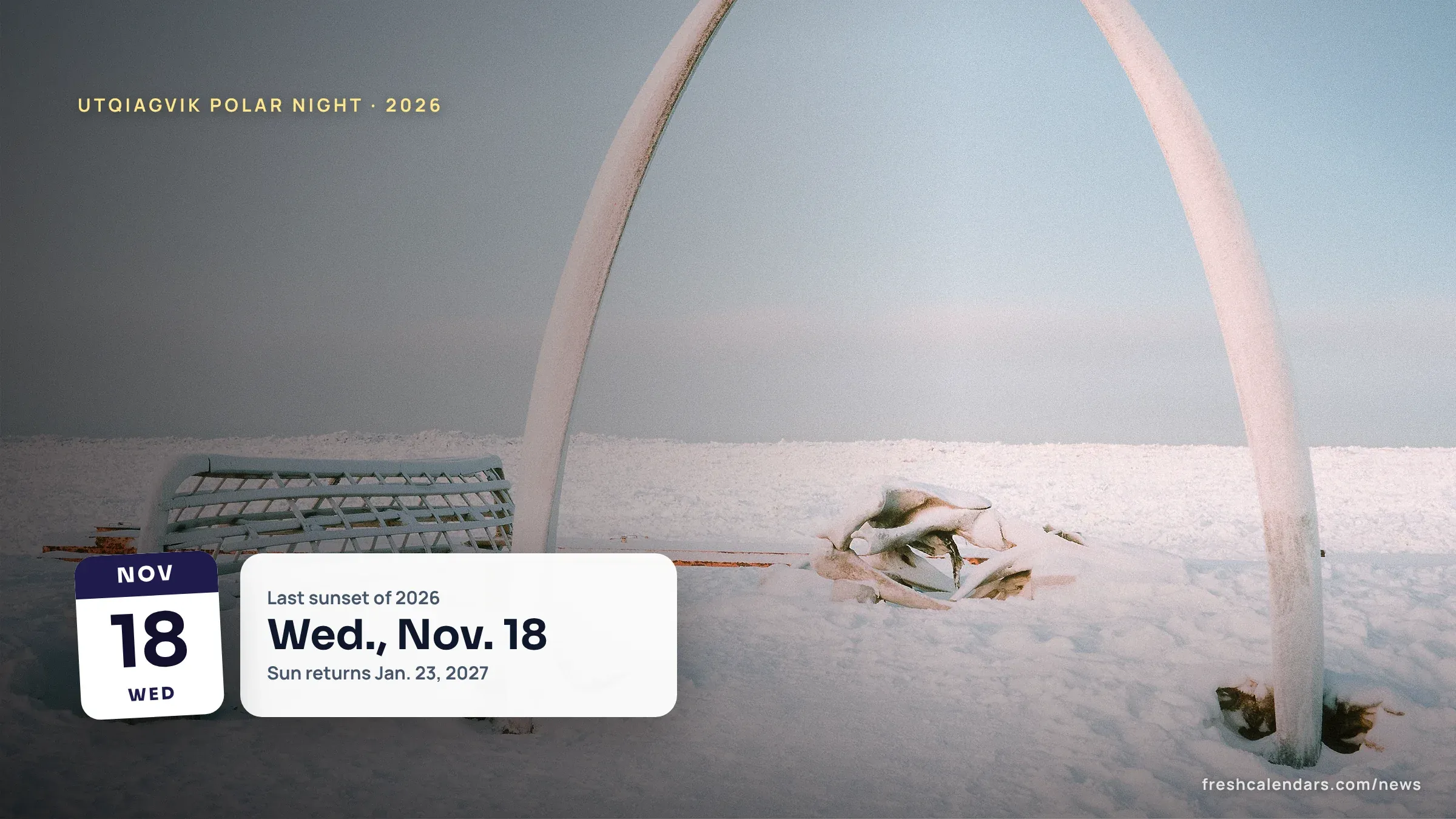 Polar Night 2026 in Utqiagvik, Alaska: Last Sunset Nov. 18, Sun Returns Jan. 23, 2027
More in Sky Events
All Sky Events stories →- Meteor Showers 2027: Peak Dates, Eastern Times and Moon Phase for 12 Showers
- Planets in 2027: Jupiter Opposition Feb. 10, Mars Feb. 19, Saturn Oct. 17 in Eastern Time
- Next Blood Moon in the U.S.: Total Lunar Eclipse June 25, 2029, and Every Eclipse to 2030
- Geminid Meteor Shower 2026 Peaks Dec. 13-14: Moonset Times for 12 U.S. Cities
- Planets Visible in December 2026: Night Sky Calendar With the Geminids and the Solstice
Trending now
- Black Friday 2026 Deals: Date Is Friday, Nov. 27, Live Countdown and Ad Tracker
- Day of the Dead 2026: Día de los Muertos Dates, Traditions and Events
- Veterans Day Free Meals 2026: 44 Chains Confirmed, 13 Discounts and a Printable List
- Black Friday Canada 2026: Nov. 27 Date, Canadian Tire Deals From Nov. 5, Who Hasn't Announced
- November 2026 Meteor Showers: Taurid Fireballs Under Dark Skies, Then the Leonids on Nov. 16-17