Beaver Supermoon 2026 Is Full After It Sets in New York: When to Look
The Beaver Moon is full Tuesday, Nov. 24, 2026, at 9:53 a.m. ET, after moonset in the East. Sunset and moonrise times for 20 U.S. cities on both nights.

Published 5 min read
Key dates
In this article
- When the Beaver Moon is full in each U.S. time zone
- Why the Beaver Moon has already set in the East by 9:53 a.m.
- Beaver Moon sunset and moonrise times for 20 cities on Nov. 23 and 24
- Why the Moon looks bigger near the horizon
- Is the Beaver Moon a supermoon?
- Where the Beaver Moon name comes from
- When is the next full moon after the Beaver Moon?
The Beaver Moon is full on Tuesday, Nov. 24, 2026, at 9:53 a.m. EST, according to the U.S. Naval Observatory (USNO), and by that hour it has already set across the eastern United States. That is why the nights to look are the two evenings around the full moment: sunset on Monday, Nov. 23 and on Tuesday, Nov. 24. NASA calls Nov. 24 a “Full supermoon; first in a series of three consecutive supermoons” and advises, “Look east around sunset to watch it rise.” The full moon falls two days before Thanksgiving on Thursday, Nov. 26.
When the Beaver Moon is full in each U.S. time zone
The Moon reaches its full phase at one instant worldwide, 14:53 Coordinated Universal Time (UTC). On the clock that lands at different morning hours across the country, per the U.S. Naval Observatory.
| Time zone | Beaver Moon full |
|---|---|
| Eastern (EST) | 9:53 a.m. |
| Central (CST) | 8:53 a.m. |
| Mountain (MST) | 7:53 a.m. |
| Pacific (PST) | 6:53 a.m. |
| Alaska (AKST) | 5:53 a.m. |
| Hawaii (HST) | 4:53 a.m. |
Why the Beaver Moon has already set in the East by 9:53 a.m.
A full moon rises near sunset and sets near sunrise, so by mid-morning it is below the horizon in the East. At the 9:53 a.m. EST full moment the Moon has set in New York (moonset 7:05 a.m.), Chicago (7:07 a.m. CST) and Denver (7:13 a.m. MST). In Los Angeles it sets at 6:49 a.m. PST, four minutes before the 6:53 a.m. full moment. Farther west the Moon is still up: Seattle’s moonset is 8:00 a.m. PST, Honolulu’s 7:02 a.m. HST and Anchorage’s 11:04 a.m. AKST.
| City | Full moon (local) | Moonset, Tue. a.m. | Still up at the full moment? |
|---|---|---|---|
| New York | 9:53 a.m. EST | 7:05 a.m. | No, below the horizon |
| Chicago | 8:53 a.m. CST | 7:07 a.m. | No |
| Denver | 7:53 a.m. MST | 7:13 a.m. | No |
| Los Angeles | 6:53 a.m. PST | 6:49 a.m. | No, by four minutes |
| Seattle | 6:53 a.m. PST | 8:00 a.m. | Yes |
| Anchorage | 5:53 a.m. AKST | 11:04 a.m. | Yes |
| Honolulu | 4:53 a.m. HST | 7:02 a.m. | Yes |
Because the full instant comes in daylight for most of the country, the Moon looks just as full the evening before and the evening after. NASA’s skywatching guide notes that a full moon “will appear full for about three days around this time.”
Beaver Moon sunset and moonrise times for 20 cities on Nov. 23 and 24
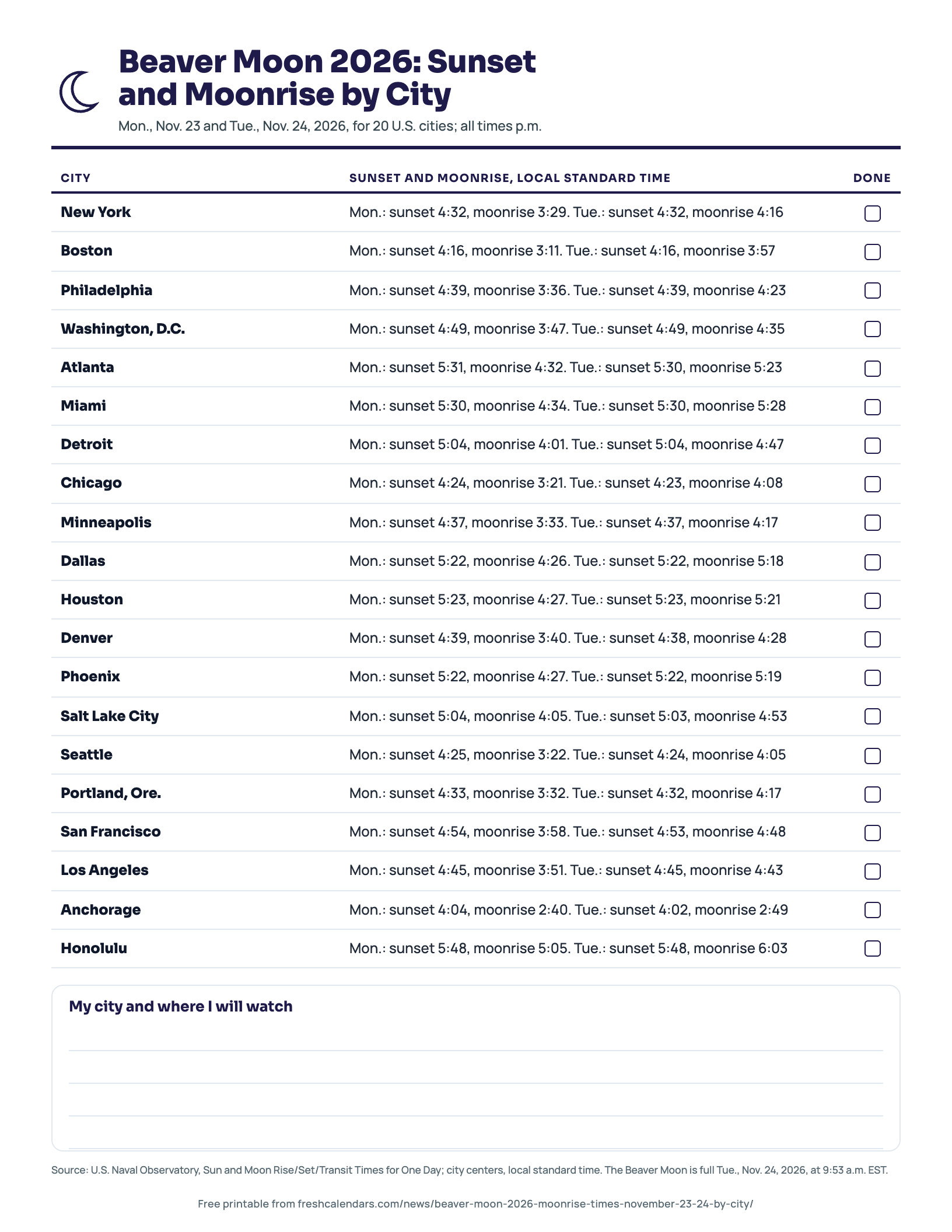
The times below are for city centers, in local standard time, rounded to the minute by the U.S. Naval Observatory. All are p.m. On Monday, Nov. 23 the Moon is 99% lit and rises about an hour before sunset across the Lower 48 (54 to 65 minutes), so it is already well up by nightfall. On Tuesday, Nov. 24 it is 100% lit and rises 2 to 20 minutes before sunset in the Lower 48, clearing the horizon just as the sky darkens, the view NASA points to. In Honolulu, Tuesday’s moonrise comes 15 minutes after sunset, into an already dim sky. In Anchorage the Moon rises more than an hour before sunset on both nights.
| City | Sunset Mon. Nov. 23 | Moonrise Mon. | Sunset Tue. Nov. 24 | Moonrise Tue. |
|---|---|---|---|---|
| New York | 4:32 | 3:29 | 4:32 | 4:16 |
| Boston | 4:16 | 3:11 | 4:16 | 3:57 |
| Philadelphia | 4:39 | 3:36 | 4:39 | 4:23 |
| Washington, D.C. | 4:49 | 3:47 | 4:49 | 4:35 |
| Atlanta | 5:31 | 4:32 | 5:30 | 5:23 |
| Miami | 5:30 | 4:34 | 5:30 | 5:28 |
| Detroit | 5:04 | 4:01 | 5:04 | 4:47 |
| Chicago | 4:24 | 3:21 | 4:23 | 4:08 |
| Minneapolis | 4:37 | 3:33 | 4:37 | 4:17 |
| Dallas | 5:22 | 4:26 | 5:22 | 5:18 |
| Houston | 5:23 | 4:27 | 5:23 | 5:21 |
| Denver | 4:39 | 3:40 | 4:38 | 4:28 |
| Phoenix | 5:22 | 4:27 | 5:22 | 5:19 |
| Salt Lake City | 5:04 | 4:05 | 5:03 | 4:53 |
| Seattle | 4:25 | 3:22 | 4:24 | 4:05 |
| Portland, Ore. | 4:33 | 3:32 | 4:32 | 4:17 |
| San Francisco | 4:54 | 3:58 | 4:53 | 4:48 |
| Los Angeles | 4:45 | 3:51 | 4:45 | 4:43 |
| Anchorage | 4:04 | 2:40 | 4:02 | 2:49 |
| Honolulu | 5:48 | 5:05 | 5:48 | 6:03 |
The U.S. Naval Observatory times do not account for cloud cover, so check a local forecast before you head out. Across the Lower 48, Tuesday is the night to catch the Moon low on the horizon as it rises; print the December 2026 calendar if you want to track the next supermoon as well.
Why the Moon looks bigger near the horizon
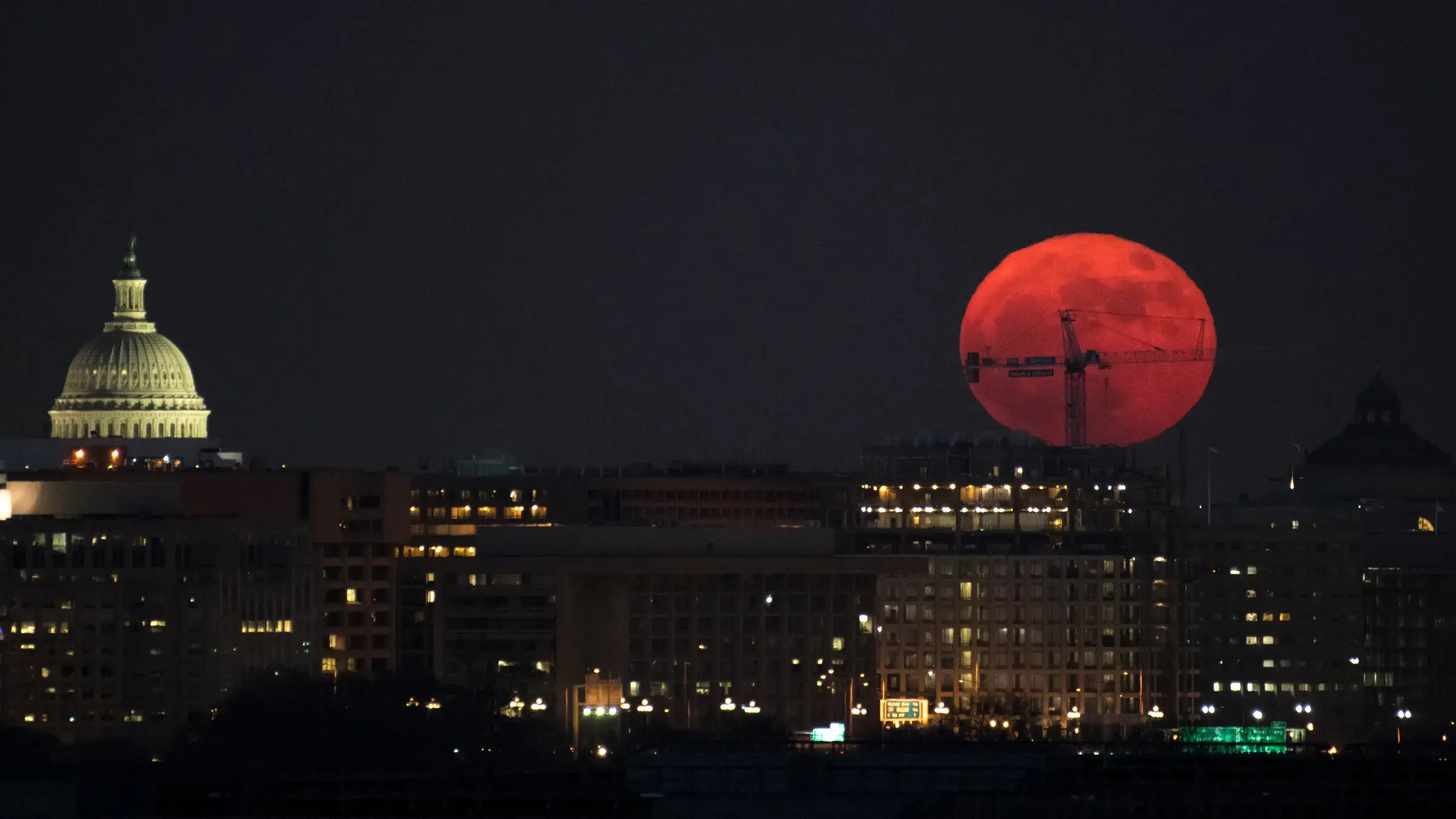
A full moon low in the sky can look large, as in the photo at the top of this story, but NASA says the size is a trick of perception. “The Moon’s seeming bigness is an actual illusion, rather than an effect of our atmosphere or some other physics,” NASA writes. Photograph the Moon at the horizon and again high overhead with the same zoom and, NASA notes, “the Moon is the same width, side to side, in both photos.” That photo shows the Dec. 3, 2017 supermoon rising over Washington.
Is the Beaver Moon a supermoon?
NASA lists Nov. 24 as a “Full supermoon” and the first of three consecutive supermoons. A supermoon, NASA says, “occurs when a full Moon coincides with the Moon’s closest approach to Earth in its elliptical orbit, a point known as perigee,” and it can look “up to 14 percent bigger and 30 percent brighter than the faintest Moon of the year.” Space.com reports that the Moon will be 224,170 miles (360,768 kilometers) from Earth on Nov. 24, and closer still, 221,667 miles (356,740 kilometers), at the Dec. 24 full moon in Universal Time. The calendar site timeanddate marks both the Nov. 24 and Dec. 24 (UTC) full moons as a “Super Full Moon.”
Where the Beaver Moon name comes from
The Old Farmer’s Almanac ties November’s full moon to the season: “This is the time of year when beavers begin to take shelter in their lodges.” The almanac also lists other November names drawn from Native American traditions, including the Digging or Scratching Moon (Tlingit), the Deer Rutting Moon (Dakota and Lakota), the Whitefish Moon (Algonquin), the Frost Moon (Cree and Assiniboine) and the Freezing Moon (Anishinaabe).
When is the next full moon after the Beaver Moon?
The next full moon is the Cold Moon on Wednesday, Dec. 23, 2026, at 8:28 p.m. EST, per the U.S. Naval Observatory. That instant falls on Dec. 24 in Universal Time, which is why some calendars list the December full moon a day later. For the months beyond, see our 2027 full moon calendar or keep a printable yearly calendar handy.
Free printable downloads
Every template is free, needs no sign-up and prints on US Letter paper. Choose PDF for printing or PNG for screens and documents.
Beaver Moon 2026 printables
-
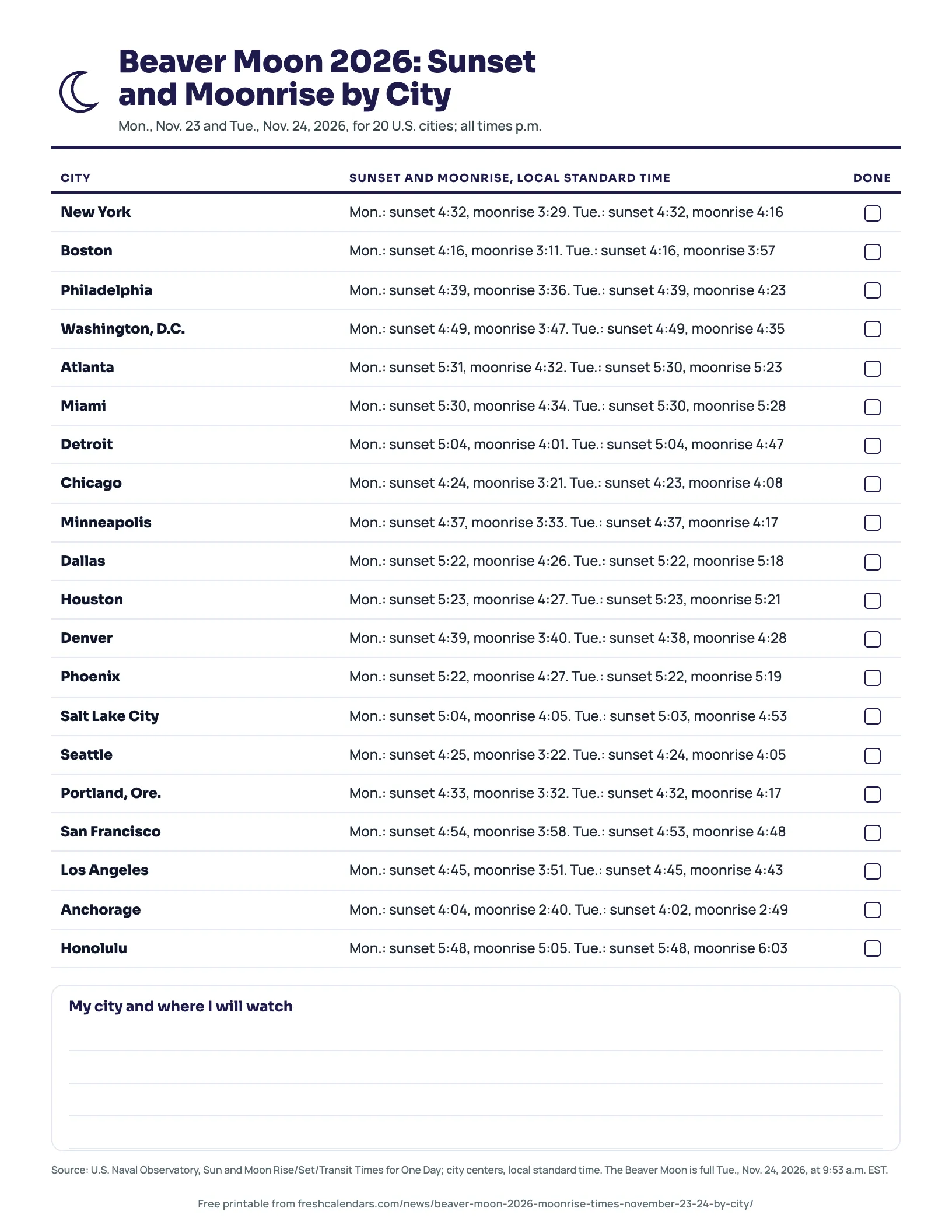
Beaver Moon 2026: Sunset and Moonrise by City
Sunset and moonrise times for 20 U.S. cities on Nov. 23 and 24, 2026, the two evenings to see the Beaver Moon, from U.S. Naval Observatory data.
Frequently asked questions
What time does the Beaver Moon rise on Nov. 24, 2026?
It depends on your city. In New York the Moon rises at 4:16 p.m. EST on Tuesday, Nov. 24, 16 minutes before the 4:32 p.m. sunset; in Chicago at 4:08 p.m. CST and in Los Angeles at 4:43 p.m. PST, per the U.S. Naval Observatory. The table above lists 20 cities.
Is Nov. 23 or Nov. 24 the better night to watch the Beaver Moon?
Both show a Moon that looks full. On Monday, Nov. 23 the Moon is 99% lit and clears the horizon about an hour before sunset in the Lower 48. On Tuesday, Nov. 24 it is 100% lit and rises within about 20 minutes of sunset, so it comes up as the sky darkens.
Why is the Beaver Moon called a supermoon?
NASA says a supermoon is a full moon that lands near perigee, the Moon's closest point to Earth in its orbit. A supermoon can look up to 14% bigger and 30% brighter than the year's faintest full moon, per NASA.
When is the full moon after the November 2026 Beaver Moon?
The next full moon, the Cold Moon, is on Wednesday, Dec. 23, 2026, at 8:28 p.m. EST, according to the U.S. Naval Observatory. It is also a supermoon.
Sources
- Dates and Times of Phases of the Moon, 2026 (U.S. Naval Observatory, Astronomical Applications Department, 2026-11-22)
- Sun and Moon Rise/Set/Transit Times for One Day (U.S. Naval Observatory, Astronomical Applications Department, 2026-11-22)
- What's Up: November 2026 Skywatching Tips from NASA (NASA, 2026-11-02)
- Supermoons (NASA, 2026-02-12)
- The Moon Illusion: Why Does the Moon Look So Big Sometimes? (NASA, 2025-02-13)
- NASA Daily Skywatching Guide (NASA, 2025-03-05)
- What is a supermoon and when can you see the next one in 2026? (Space.com, 2026-01-15)
- Full Beaver Supermoon November 2026 (The Old Farmer's Almanac, 2026-11-18)
Related news
More in Sky Events
All Sky Events stories →- Planets Visible in February 2027: Jupiter and Mars at Opposition
- Ursid Meteor Shower 2026: Peak Dec. 21-22, Moonset in 10 Cities
- Moon on New Year's Eve 2026: Moonrise 1:46 a.m. in New York
- Leonid Meteor Shower 2026: Peak Nov. 16-17, Moon-Free Hours
- Latest Sunrise 2027: New York 7:20 a.m. Dec. 30-Jan. 10, 20 Cities
Trending now
- Thanksgiving Travel 2026: Best Days to Fly and Drive, Nov. 21 to 30
- Black Friday Ads 2026: Date Is Nov. 27, Walmart Deals Nov. 23-29
- Stores Open on Thanksgiving 2026? Walmart, Costco, Target Closed
- New Movies in Theaters November 2026: Hunger Games on Nov. 20
- CPKC Holiday Train 2026 Schedule: 182 Stops, Nov. 19 to Dec. 20