New Year's Eve 2026 Moon: Waning Crescent Rises After Midnight, 1:46 a.m. in New York
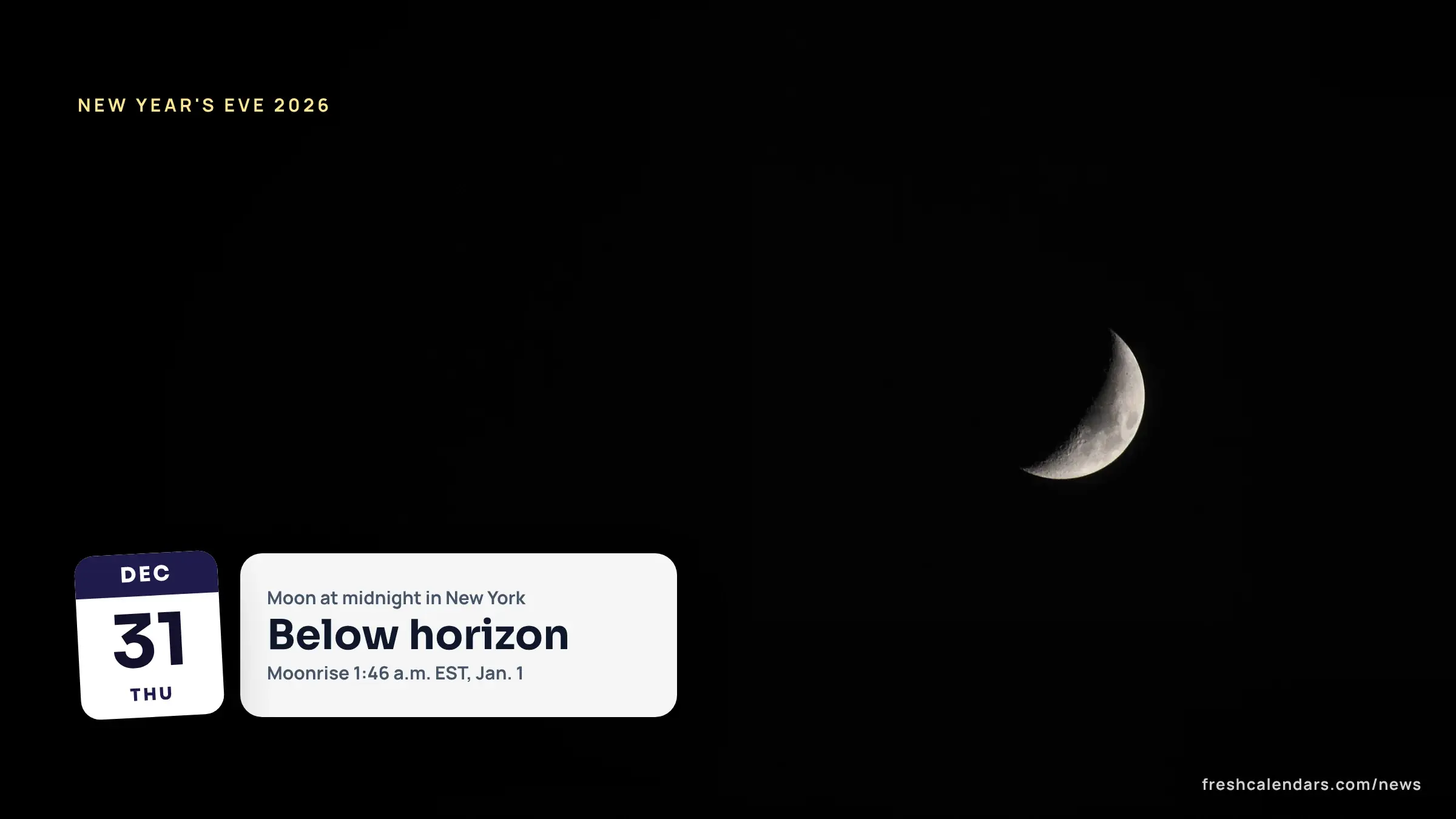
At midnight on New Year's Eve 2026 the Moon is down: U.S. Naval Observatory (USNO) has New York moonrise at 1:46 a.m. Eastern Standard Time (EST) on Jan. 1.

Published 5 min read

In this article
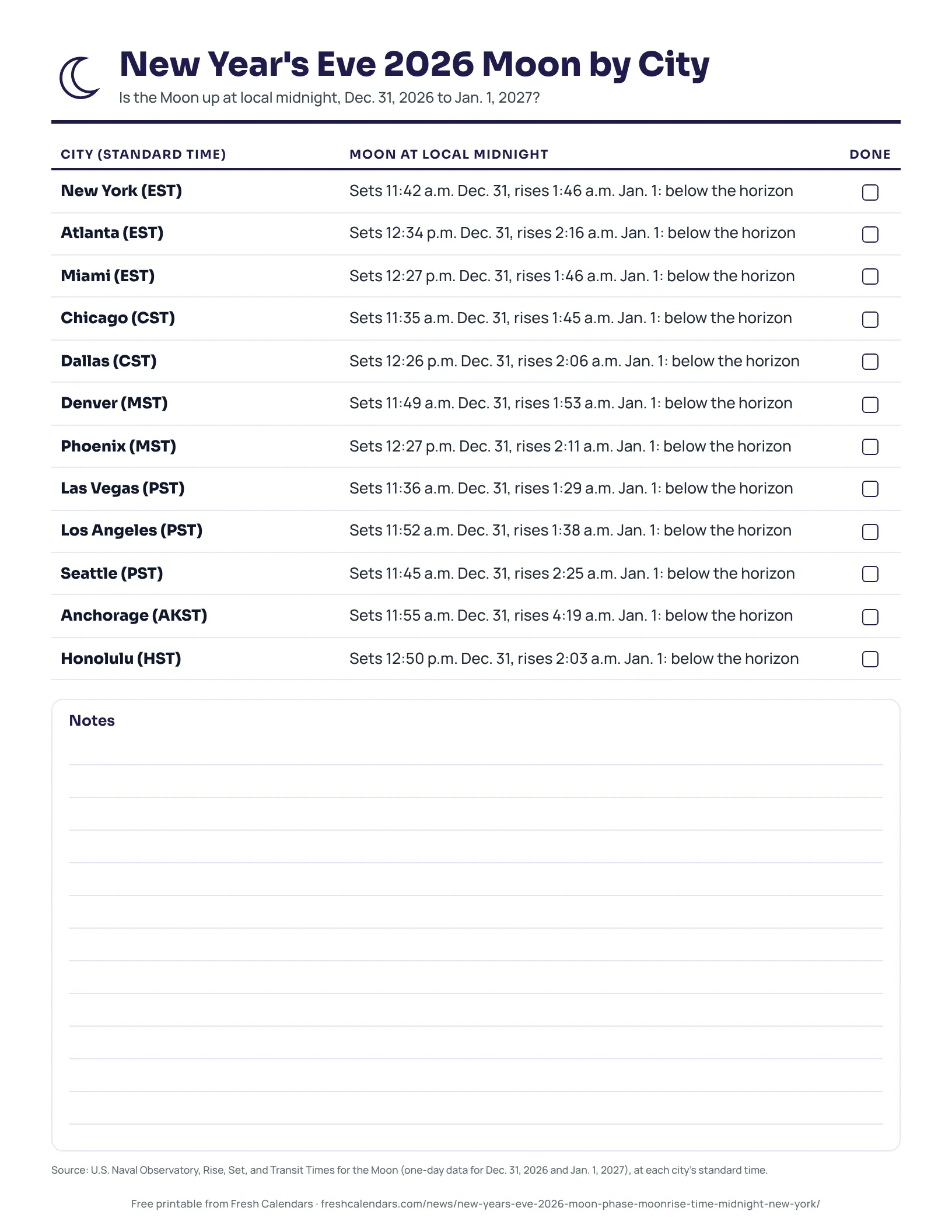
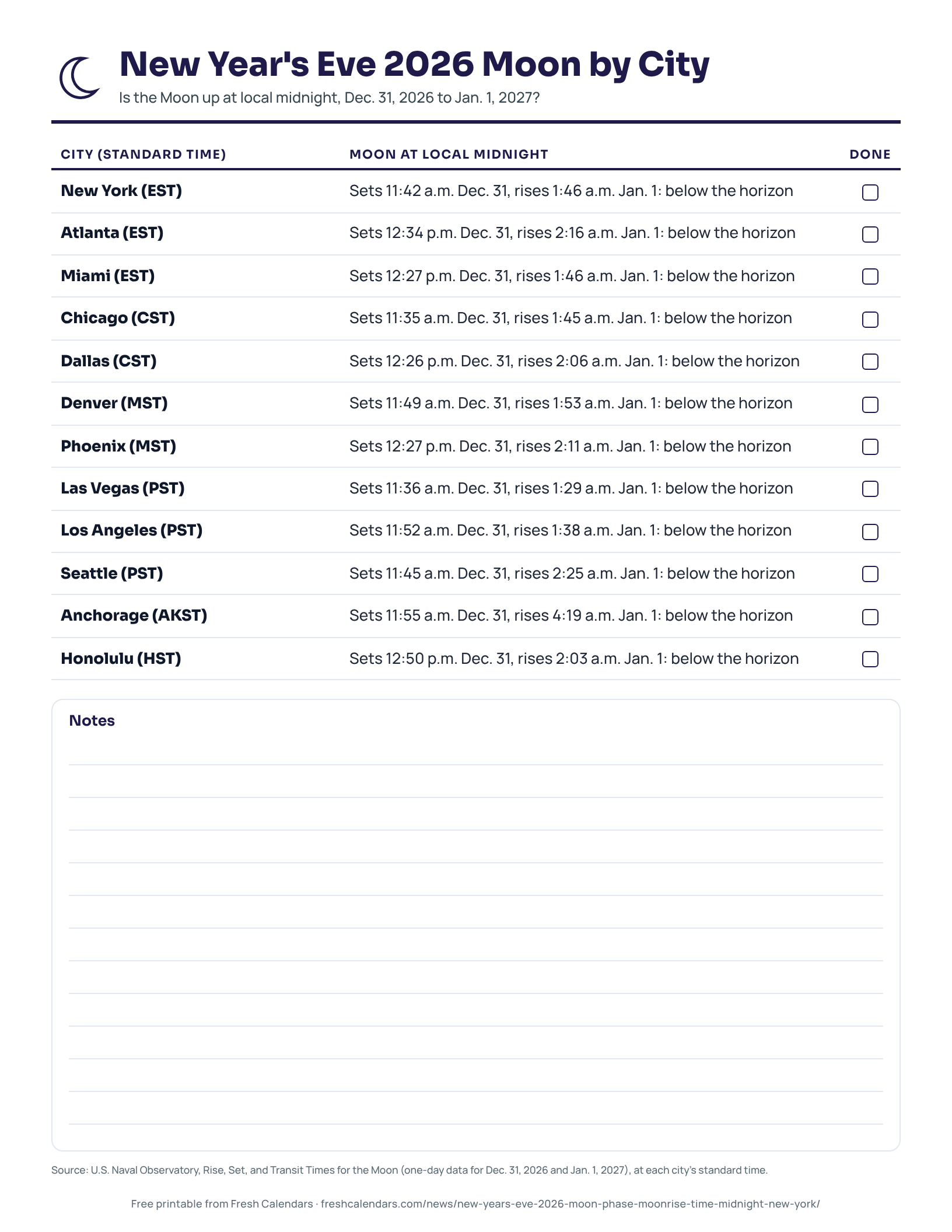
The Moon is below the horizon at midnight on New Year’s Eve 2026 in all 12 U.S. cities checked, and in New York it does not rise until 1:46 a.m. Eastern Standard Time (EST) on Friday, Jan. 1, 2027, according to the U.S. Naval Observatory (USNO). USNO lists the phase as a waning crescent on both dates; the Moon is up on the morning of Dec. 31 (rise 12:40 a.m., set 11:42 a.m. in New York) and rises again at 1:46 a.m. on Jan. 1. The printable for this story lists the moonset and moonrise for each city on one page.
Moonrise and moonset at midnight on New Year’s Eve 2026, by city
All times are local standard time (December is outside daylight time) and come from USNO’s one-day Moon data for Thursday, Dec. 31, 2026 and Friday, Jan. 1, 2027. A Moon that sets before midnight and rises after it is below the horizon at midnight, so the “Moon at midnight” column follows from the two USNO times in each row. The last column counts the time from midnight to moonrise.
| City (time zone) | Moonset, Dec. 31 | Moonrise, Jan. 1 | Moon at local midnight | Moonrise after midnight |
|---|---|---|---|---|
| New York (EST) | 11:42 a.m. | 1:46 a.m. | Below the horizon | 1 h 46 min |
| Atlanta (EST) | 12:34 p.m. | 2:16 a.m. | Below the horizon | 2 h 16 min |
| Miami (EST) | 12:27 p.m. | 1:46 a.m. | Below the horizon | 1 h 46 min |
| Chicago (Central Standard Time, CST) | 11:35 a.m. | 1:45 a.m. | Below the horizon | 1 h 45 min |
| Dallas (CST) | 12:26 p.m. | 2:06 a.m. | Below the horizon | 2 h 06 min |
| Denver (Mountain Standard Time, MST) | 11:49 a.m. | 1:53 a.m. | Below the horizon | 1 h 53 min |
| Phoenix (MST) | 12:27 p.m. | 2:11 a.m. | Below the horizon | 2 h 11 min |
| Las Vegas (Pacific Standard Time, PST) | 11:36 a.m. | 1:29 a.m. | Below the horizon | 1 h 29 min |
| Los Angeles (PST) | 11:52 a.m. | 1:38 a.m. | Below the horizon | 1 h 38 min |
| Seattle (PST) | 11:45 a.m. | 2:25 a.m. | Below the horizon | 2 h 25 min |
| Anchorage (Alaska Standard Time, AKST) | 11:55 a.m. | 4:19 a.m. | Below the horizon | 4 h 19 min |
| Honolulu (Hawaii Standard Time, HST) | 12:50 p.m. | 2:03 a.m. | Below the horizon | 2 h 03 min |
Las Vegas has the earliest moonrise of the dozen at 1:29 a.m. PST, and Anchorage the latest at 4:19 a.m. AKST. Midnight in New York is 9 p.m. PST, so a West Coast watch party that follows the New York countdown is even further from moonrise: Los Angeles does not see the Moon until 1:38 a.m. PST.
Why does New York show a moonrise on Dec. 31 and another on Jan. 1?
On Dec. 31 USNO lists a moonrise at 12:40 a.m. EST and a moonset at 11:42 a.m. EST, so the Moon is up only in the small hours and the morning. Then comes a gap with no Moon, and the next moonrise is at 1:46 a.m. EST on Jan. 1, an hour and six minutes later than the Dec. 31 moonrise. A reader who sees “12:40 a.m.” under Dec. 31 and reads it as the New Year’s Eve moonrise is looking at the wrong night.
The table below gives both days in full for every city. Every moonset falls between 11:35 a.m. and 1:27 p.m., and none lands after midnight, so no moonset needs to be read from the next date’s listing.
| City | Dec. 31 moonrise | Dec. 31 moonset | Jan. 1 moonrise | Jan. 1 moonset |
|---|---|---|---|---|
| New York | 12:40 a.m. | 11:42 a.m. | 1:46 a.m. | 12:07 p.m. |
| Atlanta | 1:15 a.m. | 12:34 p.m. | 2:16 a.m. | 1:04 p.m. |
| Miami | 12:50 a.m. | 12:27 p.m. | 1:46 a.m. | 1:01 p.m. |
| Chicago | 12:39 a.m. | 11:35 a.m. | 1:45 a.m. | 12:00 p.m. |
| Dallas | 1:06 a.m. | 12:26 p.m. | 2:06 a.m. | 12:57 p.m. |
| Denver | 12:48 a.m. | 11:49 a.m. | 1:53 a.m. | 12:15 p.m. |
| Phoenix | 1:10 a.m. | 12:27 p.m. | 2:11 a.m. | 12:58 p.m. |
| Las Vegas | 12:26 a.m. | 11:36 a.m. | 1:29 a.m. | 12:05 p.m. |
| Los Angeles | 12:37 a.m. | 11:52 a.m. | 1:38 a.m. | 12:22 p.m. |
| Seattle | 1:13 a.m. | 11:45 a.m. | 2:25 a.m. | 12:05 p.m. |
| Anchorage | 2:45 a.m. | 11:55 a.m. | 4:19 a.m. | 11:54 a.m. |
| Honolulu | 1:09 a.m. | 12:50 p.m. | 2:03 a.m. | 1:27 p.m. |
What is the Moon phase on New Year’s Eve 2026?
USNO lists the phase as a waning crescent for Dec. 31, 2026 and for Jan. 1, 2027 in every city above. The Moon passed Last Quarter on Dec. 30 and the next New Moon comes on Jan. 7. Illumination percentages are left out of this story: the USNO one-day tool returned different percentages for New York and Los Angeles on the same date, so there is no single figure to quote for New Year’s Eve.
USNO’s phase tables are in Universal Time (UT), the clock the observatory’s notes name for them, and give the phase and time only; Cold Moon and Wolf Moon are folk names, not USNO labels. The table converts each moment to EST, five hours behind UT.
| Phase | USNO time (UT) | Eastern Standard Time (EST) |
|---|---|---|
| Full Moon (Cold Moon, a folk name) | 1:28 UT, Dec. 24, 2026 | 8:28 p.m., Wed., Dec. 23, 2026 |
| Last Quarter | 18:59 UT, Dec. 30, 2026 | 1:59 p.m., Wed., Dec. 30, 2026 |
| New Moon | 20:24 UT, Jan. 7, 2027 | 3:24 p.m., Thu., Jan. 7, 2027 |
| Full Moon (Wolf Moon, a folk name) | 12:17 UT, Jan. 22, 2027 | 7:17 a.m., Fri., Jan. 22, 2027 |
The Cold Moon date is a good example of why the zone matters: it is Dec. 24 in UT and Dec. 23 in New York, as the Cold Moon section of our supermoon story explains. The full list of 2027 phases is in the 2027 full moon calendar.
How long is the Moon up before sunrise on New Year’s Day in New York?
In New York the Moon rises at 1:46 a.m. EST on Jan. 1 and the Sun rises at 7:20 a.m. EST, per USNO, so the Moon is above the horizon for 5 hours 34 minutes before sunrise. It sets at 12:07 p.m. EST, in daylight. For the evening itself, that means no Moon: it is below the horizon from the late-morning moonset on Dec. 31 until after the New Year begins.
The next sky event after the holiday is the Quadrantid meteor shower on the night of Jan. 3-4, 2027; the dates and peak time are in our Quadrantid story. For New Year’s Day plans and midnight times in other places, see the 2027 New Year’s countdown by time zone and what is open on New Year’s Eve and New Year’s Day.
How these New Year’s Eve moon times were computed
Each city’s times come from the USNO one-day rise, set and transit data for the two dates, set to the city’s central coordinates and its standard-time offset: -5 hours for New York, Atlanta and Miami, -6 for Chicago and Dallas, -7 for Denver and Phoenix, -8 for Las Vegas, Los Angeles and Seattle, -9 for Anchorage and -10 for Honolulu. USNO prints the times on a 24-hour clock; this story writes them with a.m. and p.m., so 01:46 in the data is 1:46 a.m. Times were pulled on Nov. 3, 2026. Each city uses a single set of coordinates, so a spot far from the center can differ.
Both months are on one printable each: December 2026 and January 2027. The date of the holiday itself is on the New Year’s Eve page.
Free printable downloads
Every template is free, needs no sign-up and prints on US Letter paper. Choose PDF for printing or PNG for screens and documents.
New Year's Eve 2026 Moon by City printables
-
New Year's Eve 2026 Moon by City
Moonset and moonrise for 12 U.S. cities across Dec. 31, 2026 and Jan. 1, 2027, showing the Moon is below the horizon at local midnight in every one.
Frequently asked questions
Can you see the Moon at midnight on New Year's Eve 2026?
Not in the 12 U.S. cities listed here. In each one the Moon sets in the late morning or early afternoon of Dec. 31 and rises between 1:29 a.m. and 4:19 a.m. local standard time on Jan. 1, according to U.S. Naval Observatory (USNO) data.
What time does the Moon rise on New Year's Day 2027 in New York?
At 1:46 a.m. Eastern Standard Time (EST) on Friday, Jan. 1, 2027, per USNO. It sets at 12:07 p.m. EST the same day.
What is the Moon phase on New Year's Eve 2026?
USNO lists a waning crescent for Dec. 31, 2026 and Jan. 1, 2027. Last Quarter fell on Dec. 30 and the New Moon is Jan. 7, 2027.
Why does the Moon rise at 12:40 a.m. on Dec. 31 in New York if it is down at midnight?
Those are two different moonrises. The 12:40 a.m. rise on Dec. 31 is the one that follows the Dec. 30 night. The Moon sets at 11:42 a.m. that day and the next moonrise, 1:46 a.m. on Jan. 1, falls after the New Year's midnight.
Sources
- Rise, Set, and Transit Times for the Sun and Moon for One Day (U.S. Naval Observatory, Astronomical Applications Department, 2026-11-03)
- USNO one-day Moon rise, set and transit data, New York, Dec. 31, 2026 (U.S. Naval Observatory, Astronomical Applications Department, 2026-11-03)
- USNO one-day Moon rise, set and transit data, New York, Jan. 1, 2027 (U.S. Naval Observatory, Astronomical Applications Department, 2026-11-03)
- USNO moon phase data, December 2026 to January 2027 (U.S. Naval Observatory, Astronomical Applications Department, 2026-11-03)
- Dates of Primary Phases of the Moon (U.S. Naval Observatory, Astronomical Applications Department, 2026-11-03)
Related news
-
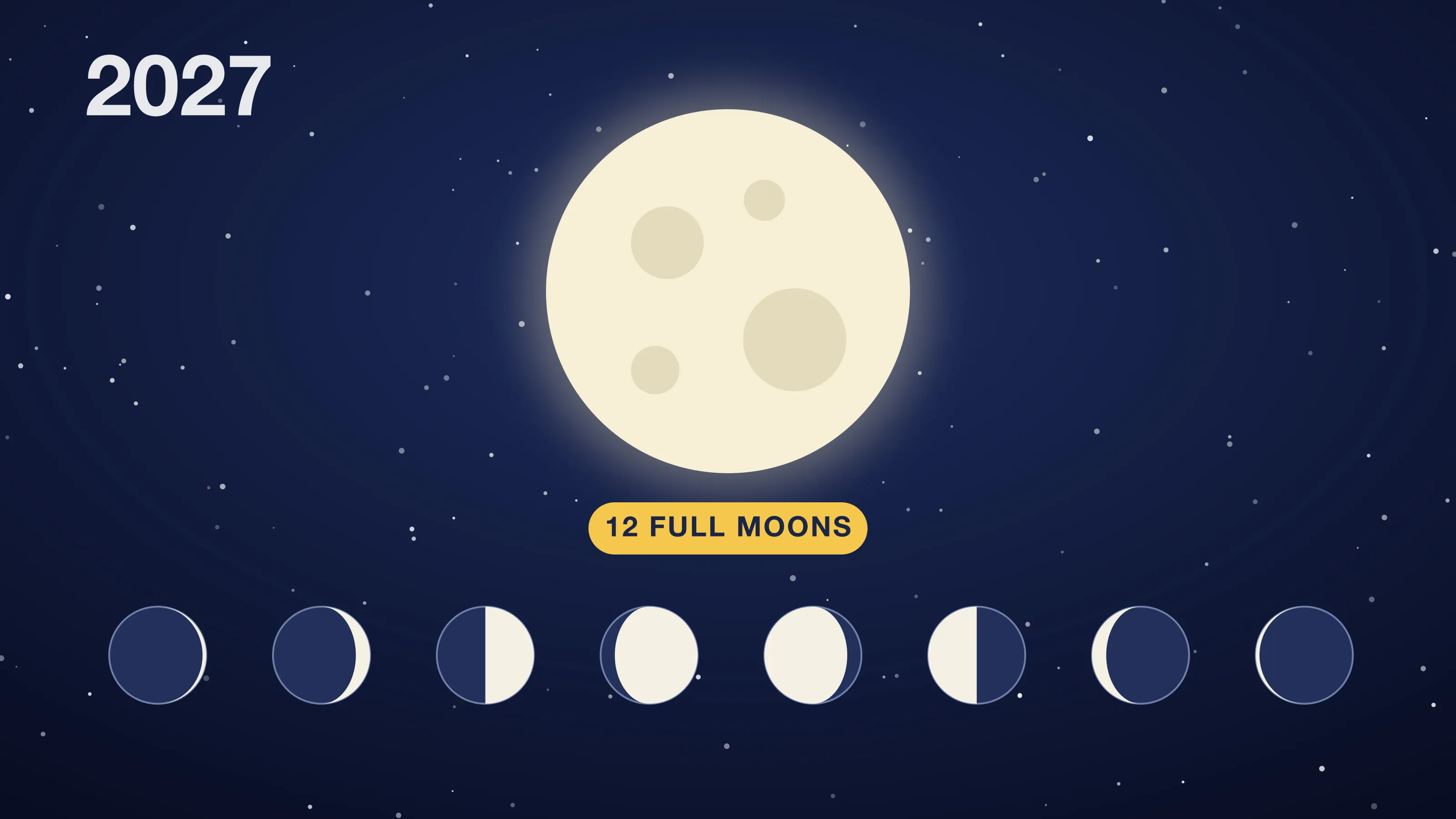 Moon Phases 2027: Full Moon Calendar With Dates, Times, Names and Eclipses, Plus Free Printables
-
 Two Supermoons Close 2026: Beaver Moon Nov. 24, Cold Moon Dec. 23, Plus Geminids and the Solstice
-
 Quadrantid Meteor Shower 2027 Peaks the Night of Jan. 3-4, Then the Wolf Moon Jan. 22
-
 Moon Phase Nov. 2, 2026: Waning Crescent, 41% Lit, Plus a Daily Moon Calendar to Nov. 30
More in Sky Events
All Sky Events stories →- Leonid Meteor Shower 2026 Peaks Nov. 16-17: Moonset and Moon-Free Hours in 12 U.S. Cities
- Latest Sunrise 2027: It Comes in Early January, With Dates for 20 U.S. Cities
- Meteor Showers 2027: Peak Dates, Eastern Times and Moon Phase for 12 Showers
- Planets in 2027: Jupiter Opposition Feb. 10, Mars Feb. 19, Saturn Oct. 17 in Eastern Time
- Next Blood Moon in the U.S.: Total Lunar Eclipse June 25, 2029, and Every Eclipse to 2030
Trending now
- When Will We Know the 2026 Election Results? How Counting Works and the Timeline in 17 Key States
- Black Friday Canada 2026: Nov. 27 Date, Canadian Tire Deals From Nov. 5, Who Hasn't Announced
- Black Friday 2026 Deals: Date Is Friday, Nov. 27, Live Countdown and Ad Tracker
- November 2026 Meteor Showers: Taurid Fireballs Under Dark Skies, Then the Leonids on Nov. 16-17
- New York Ballot 2026: Sample Ballot, the Governor's Race, NYC's 5 Charter Questions and Key Dates