Ursid Meteor Shower 2026: Peak Night Dec. 21-22, Moonset Times for 10 U.S. Cities
The American Meteor Society (AMS) puts the 2026 Ursid peak on Dec. 21-22 with an 89% lit Moon. Moonset times for 10 U.S. cities from the U.S. Naval Observatory.

Published 3 min read
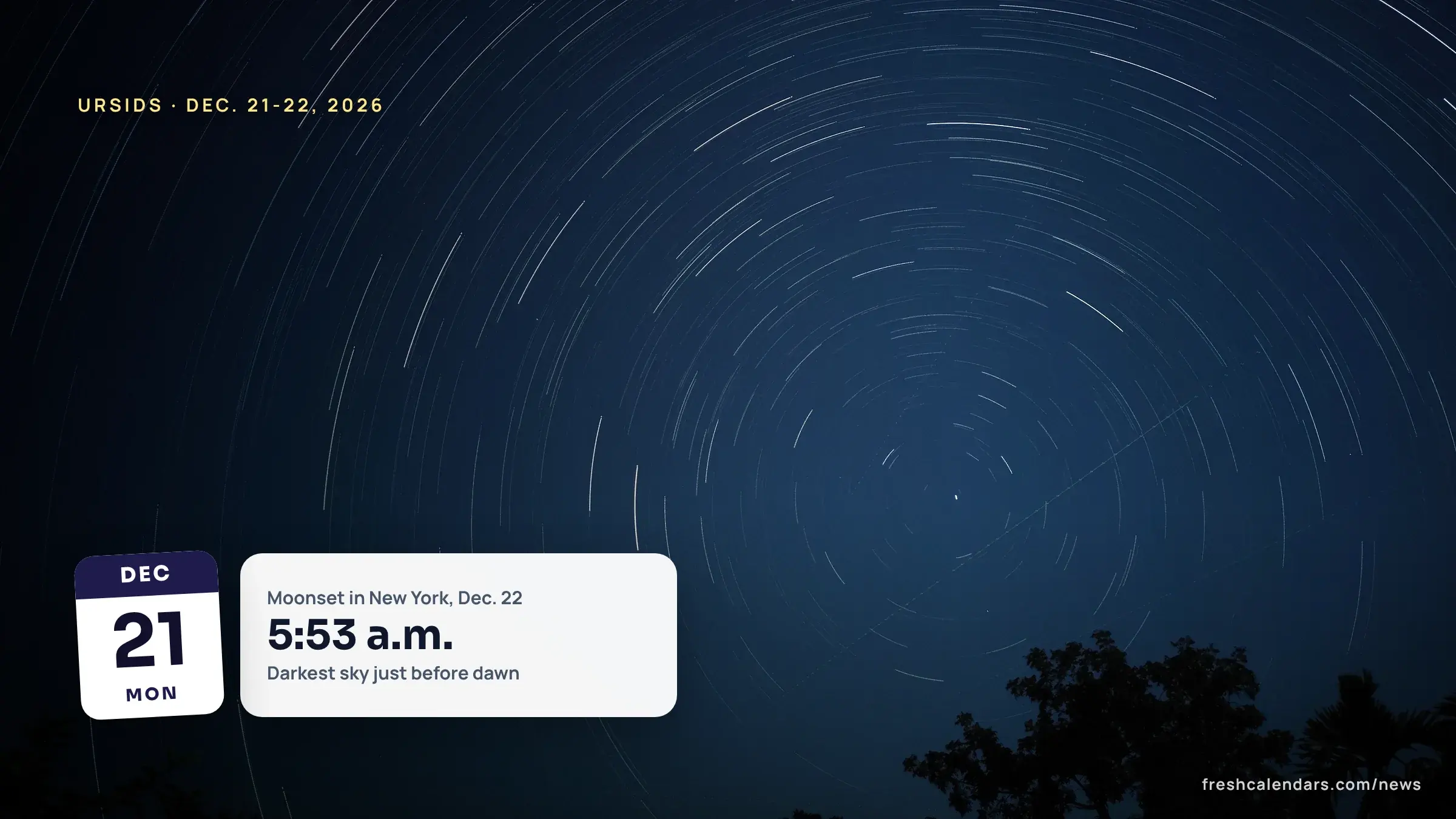

Key date
- Dec 21Mon Ursid meteor shower peak night begins (Dec. 21-22); December solstice at 3:50 p.m. EST In 47 days + Google
In this article
The 2026 Ursid meteor shower peaks the night of Monday, Dec. 21 to Tuesday, Dec. 22, according to the American Meteor Society (AMS). The AMS puts the Moon at 89% lit that night and expects “significant lunar interference.” This story adds the Moon’s setting time for 10 U.S. cities from the U.S. Naval Observatory (USNO), and works out how long the sky stays Moon-free before sunrise.
Ursid peak and active dates for 2026
The AMS lists the Ursids as “Active through December 17–26, 2026,” with the peak night on Dec. 21-22. The peak night starts on the December solstice, which the USNO puts at Dec. 21, 2026, 20:50 Universal Time (UT), or 3:50 p.m. Eastern Standard Time (EST). The solstice is the longest night of the year in the Northern Hemisphere. Our winter solstice 2026 story has sunset times.
| What | Date | Source |
|---|---|---|
| Ursids active | Dec. 17-26, 2026 | AMS |
| Peak night | Dec. 21-22, 2026 | AMS |
| Moon on the peak night | 89% illuminated, waxing gibbous | AMS |
The AMS says observers normally see 5-10 Ursids per hour during the late-morning hours. The AMS page also notes that the radiant, the point the meteors appear to come from, “fails to clear the horizon” from the southern tropics. It lists no other rate for 2026, so this story gives none.
How many minutes of Moon-free sky before sunrise?
The Moon decides how dark the sky is, and on this peak night it is almost full. The AMS gives 89% illuminated. The USNO lists 97% lit on Dec. 22 for most of the cities below and 98% for Los Angeles and Seattle (92% and 93% on the Dec. 21 query). The AMS and USNO figures are for different moments, so we cite each by source and do not merge them.
We pulled each city’s times from the USNO rise and set data service for Dec. 21 and Dec. 22, 2026, using the city’s center coordinates and local standard time. The last column is Fresh Calendars’ arithmetic: the minutes from moonset to sunrise.
| City | Sunset, Mon., Dec. 21 | Moonset, Tue., Dec. 22 | Sunrise, Tue., Dec. 22 | Minutes from moonset to sunrise |
|---|---|---|---|---|
| New York | 4:32 p.m. | 5:53 a.m. | 7:17 a.m. | 84 |
| Boston | 4:15 p.m. | 5:47 a.m. | 7:11 a.m. | 84 |
| Washington, D.C. | 4:50 p.m. | 5:58 a.m. | 7:24 a.m. | 86 |
| Atlanta | 5:33 p.m. | 6:11 a.m. | 7:39 a.m. | 88 |
| Chicago | 4:23 p.m. | 5:55 a.m. | 7:15 a.m. | 80 |
| Dallas | 5:25 p.m. | 6:01 a.m. | 7:26 a.m. | 85 |
| Denver | 4:39 p.m. | 5:59 a.m. | 7:18 a.m. | 79 |
| Phoenix | 5:25 p.m. | 6:07 a.m. | 7:29 a.m. | 82 |
| Los Angeles | 4:48 p.m. | 5:35 a.m. | 6:55 a.m. | 80 |
| Seattle | 4:20 p.m. | 6:49 a.m. | 7:55 a.m. | 66 |
In all 10 cities the Moon sets between 66 and 88 minutes before sunrise on Dec. 22. That is the longest the Moon-free window can be, because it ends no later than sunrise. Times for other places differ; the USNO’s rise and set service takes any U.S. location.
Dates to mark around the Ursid peak
The USNO lists its phase times in UT. The EST conversions below are Fresh Calendars’ arithmetic, five hours behind UT.
| Date | What happens | Source |
|---|---|---|
| Tue., Dec. 8 | New Moon at 7:52 p.m. EST (00:52 UT on Dec. 9) | USNO |
| Thu., Dec. 17 | First Quarter Moon at 12:42 a.m. EST (05:42 UT); Ursids become active | USNO, AMS |
| Mon., Dec. 21 | December solstice at 3:50 p.m. EST (20:50 UT) | USNO |
| Mon., Dec. 21 to Tue., Dec. 22 | Ursid peak night | AMS |
| Wed., Dec. 23 | Full Moon at 8:28 p.m. EST (01:28 UT on Dec. 24) | USNO |
| Sat., Dec. 26 | Last day of the active period | AMS |
Mark them on the December 2026 printable calendar or the printable yearly calendar. For the December shower that comes first, see our Geminid meteor shower 2026 story, and for next year’s showers the 2027 meteor shower calendar.
Ursid viewing sheet to print
The printable lists the 10 cities with moonset, sunrise and Moon illumination from the USNO data, plus a Moon disc, a compass, a tally grid for counting meteors in 15-minute blocks and a checklist. The AMS has not published a peak hour for the Ursids, so the sheet gives the night, not a time.
Free printable downloads
Every template is free, needs no sign-up and prints on US Letter paper. Choose PDF for printing or PNG for screens and documents.
Ursid Meteor Shower 2026 Moonset Sheet printables
-
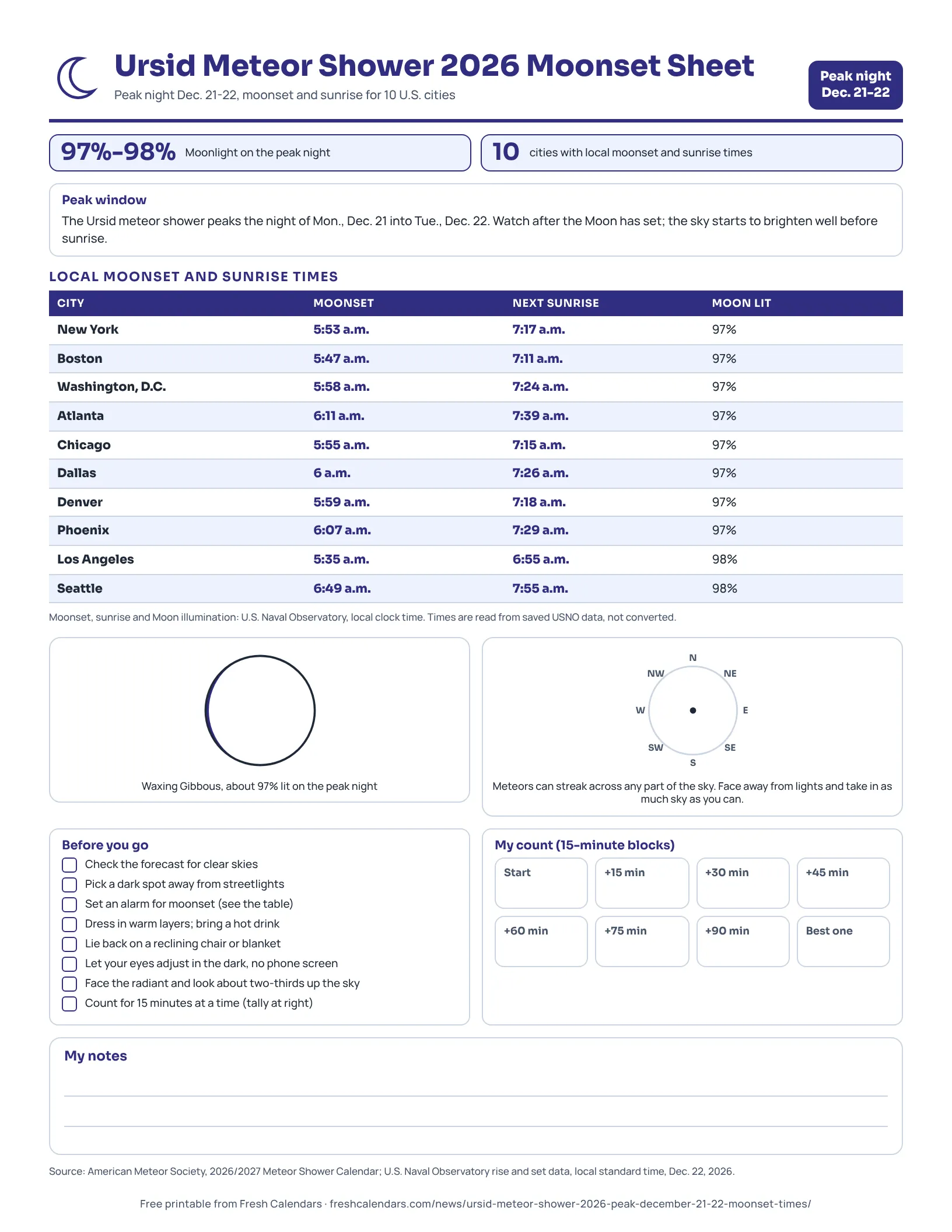
Ursid Meteor Shower 2026 Moonset Sheet
A one-page Ursid meteor shower 2026 sheet: peak night Dec. 21-22, moonset and sunrise times for 10 U.S. cities, a tally grid and a checklist.
Frequently asked questions
When is the Ursid meteor shower in 2026?
The AMS lists the peak night as Dec. 21-22, 2026, which runs from Monday evening to Tuesday morning. The shower is active through Dec. 17-26.
How many Ursids can you see per hour?
The AMS says observers normally see 5-10 Ursids per hour during the late-morning hours. The AMS page lists no other rate.
Will the Moon interfere with the Ursids in 2026?
Yes. The AMS lists the Moon as 89% illuminated and a waxing gibbous, and expects significant lunar interference. USNO times show it setting between 5:35 a.m. and 6:49 a.m. on Dec. 22 in the 10 cities in our table.
Sources
- 2026/2027 Meteor Shower Calendar (American Meteor Society)
- Phases of the Moon 2026 (API) (U.S. Naval Observatory)
- Earth's Seasons (API, year 2026) (U.S. Naval Observatory)
- Sun and Moon Rise/Set/Transit Times for One Day (API) (U.S. Naval Observatory)
Related news
-
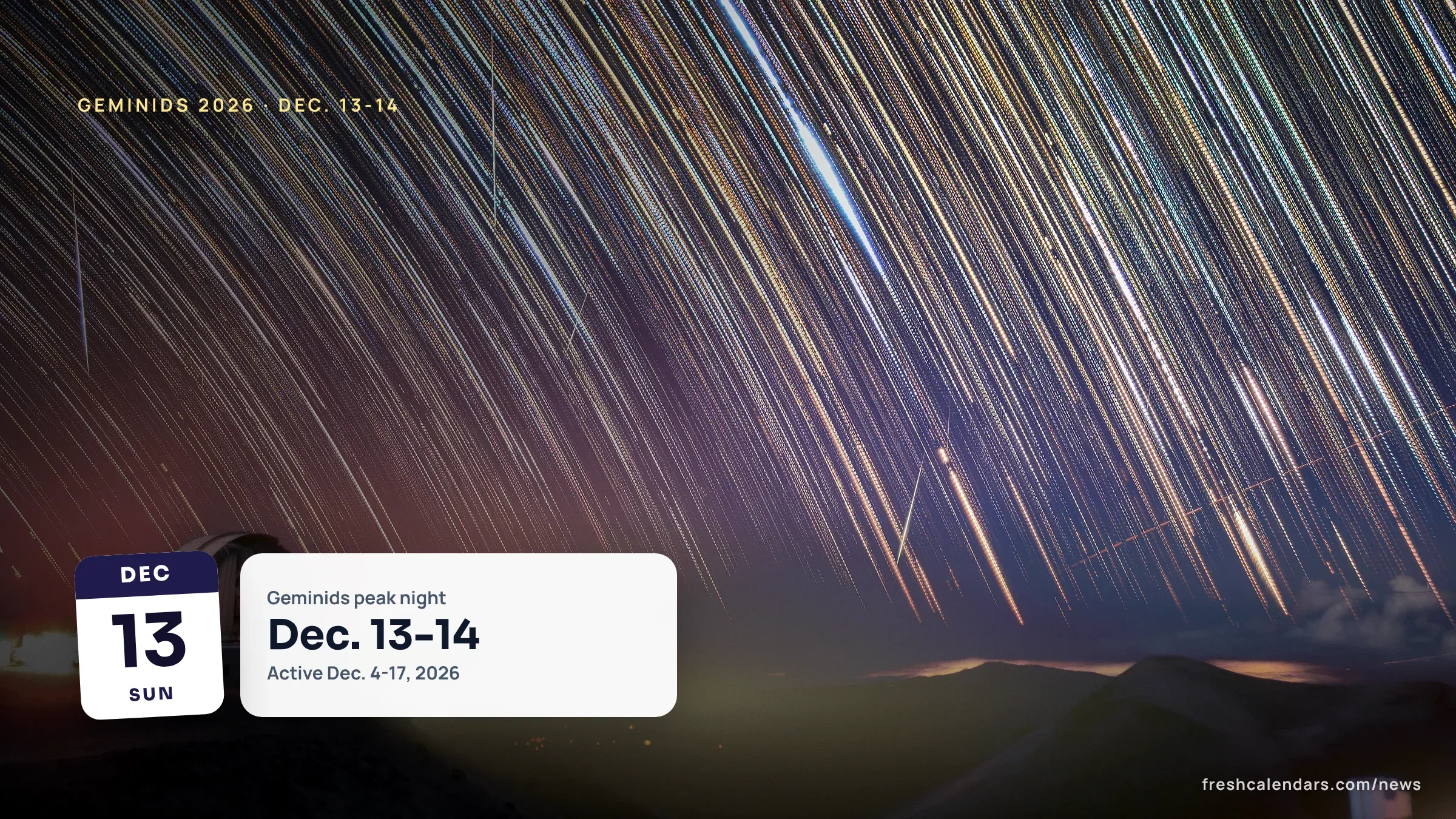 Geminid Meteor Shower 2026 Peaks Dec. 13-14: Moonset Times for 12 U.S. Cities
-
 Meteor Showers 2027: Peak Dates, Eastern Times and Moon Phase for 12 Showers
-
 Winter Solstice 2026: Shortest Day Is Dec. 21 at 3:50 p.m. ET, With Sunset Times for 8 U.S. Cities
-
 Orionid Meteor Shower 2026 Stays Active Through Nov. 7 After Its Oct. 22 Peak
More in Sky Events
All Sky Events stories →- New Year's Eve 2026 Moon: Waning Crescent Rises After Midnight, 1:46 a.m. in New York
- Leonid Meteor Shower 2026 Peaks Nov. 16-17: Moonset and Moon-Free Hours in 12 U.S. Cities
- Latest Sunrise 2027: It Comes in Early January, With Dates for 20 U.S. Cities
- Planets in 2027: Jupiter Opposition Feb. 10, Mars Feb. 19, Saturn Oct. 17 in Eastern Time
- Next Blood Moon in the U.S.: Total Lunar Eclipse June 25, 2029, and Every Eclipse to 2030
Trending now
- Black Friday Canada 2026: Nov. 27 Date, Canadian Tire Deals From Nov. 5, Who Hasn't Announced
- November 2026 Meteor Showers: Taurid Fireballs Under Dark Skies, Then the Leonids on Nov. 16-17
- Election Night 2026 Live Blog: Results Map, Senate, House and Governor Races
- Black Friday 2026 Deals: Date Is Friday, Nov. 27, Live Countdown and Ad Tracker
- SNAP Payment Schedule November 2026: Deposit Dates for Every State, With Weekend Days Flagged