Eclipses 2027: Five Dates and Times, Led by the Total Solar Eclipse on Aug. 2
The National Aeronautics and Space Administration (NASA) lists five eclipses in 2027, led by the Aug. 2 total solar eclipse. Neither solar one reaches the U.S.
Key dates
In this article
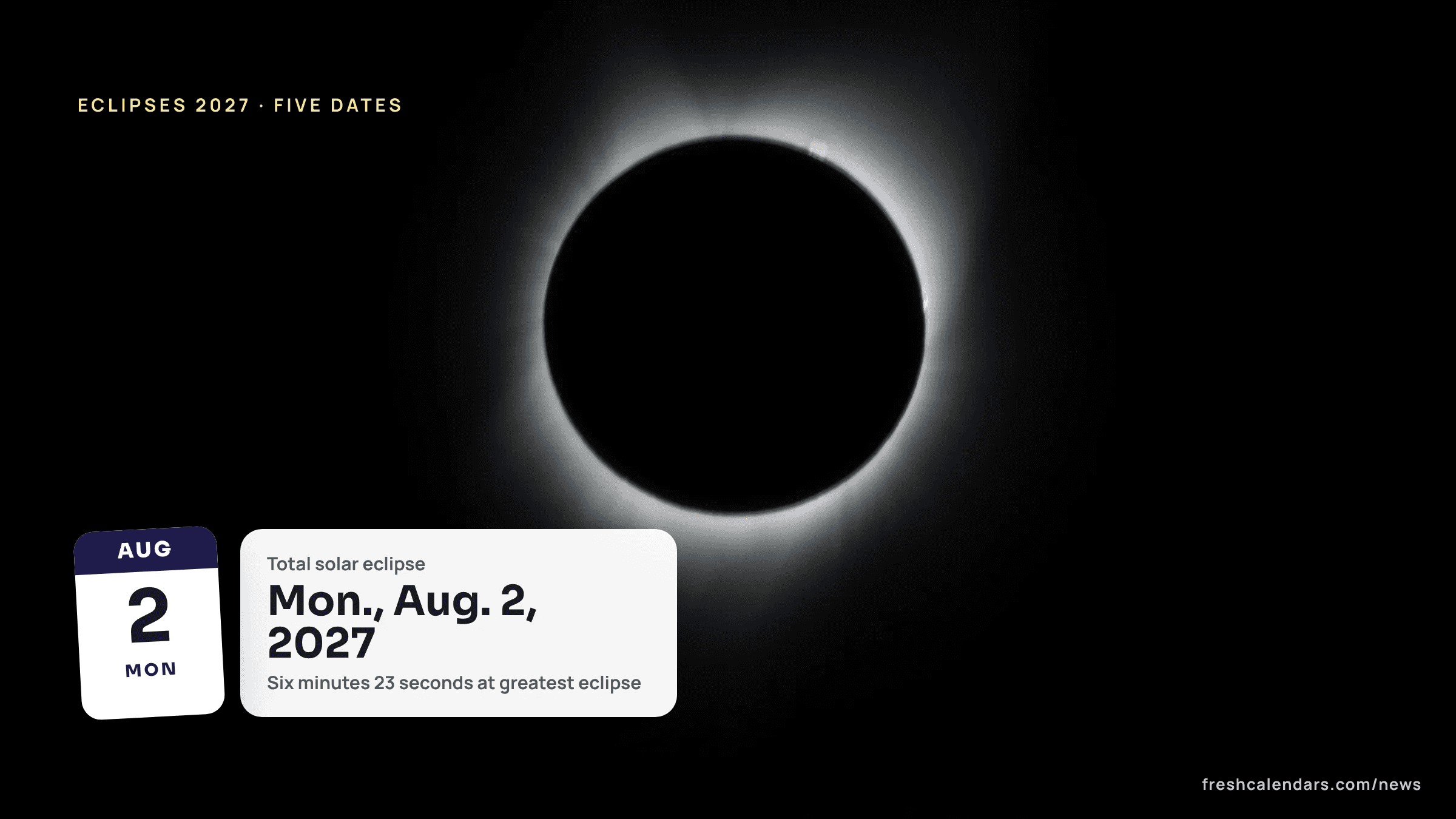
Five eclipses fall in 2027, and the biggest is the total solar eclipse on Monday, Aug. 2, according to the National Aeronautics and Space Administration (NASA) Goddard Space Flight Center’s “Eclipses During 2027” page. Greatest eclipse comes at 10:07 Universal Time (UT), or 6:07 a.m. Eastern Daylight Time (EDT), with 6 minutes 23 seconds of totality. Neither solar eclipse of the year is visible from the United States.
What are the five eclipses of 2027?
Times below are the moment of greatest eclipse from NASA’s tables, in Universal Time (UT). Eastern Time (ET) is UT minus 5 hours in winter (Eastern Standard Time, EST) and minus 4 hours in summer (EDT).
| Date | Type | Greatest eclipse | Magnitude | Length | Where visible | Saros |
|---|---|---|---|---|---|---|
| Sat., Feb. 6 | Annular solar | 16:00 UT, 11:00 a.m. EST | 0.928 | Up to 7 min 51 s of annularity | South America, Antarctica, west and south Africa | 131 |
| Sat., Feb. 20 | Penumbral lunar | 23:13 UT, 6:13 p.m. EST | 0.927 | Penumbral phase 21:12 to 01:13 UT | Americas, Europe, Africa, Asia | 143 |
| Sun., July 18 | Penumbral lunar | 16:03 UT, 12:03 p.m. EDT | 0.001 | Barely touches the penumbra | East Africa, Asia, Australia, Pacific | 110 |
| Mon., Aug. 2 | Total solar | 10:07 UT, 6:07 a.m. EDT | 1.079 | 6 min 23 s of totality | Totality: Morocco, Spain, Algeria, Libya, Egypt, Saudi Arabia, Yemen, Somalia | 136 |
| Tue., Aug. 17 | Penumbral lunar | 07:14 UT, 3:14 a.m. EDT | 0.546 | Penumbral phase 05:24 to 09:03 UT | Pacific, Americas | 148 |
For the solar eclipses the magnitude is NASA’s catalog value for the central eclipse; for the lunar ones it is the penumbral magnitude. The last column is NASA’s Saros series number. The Eastern Time column is our conversion of NASA’s UT times. Mark them on a February 2027 printable calendar and an August 2027 printable calendar.
Where is the Aug. 2, 2027 total solar eclipse visible?
NASA’s catalog lists totality across Morocco, Spain, Algeria, Libya, Egypt, Saudi Arabia, Yemen and Somalia. The path is 258 kilometers wide, and greatest eclipse is at 25.5 degrees north, 33.2 degrees east, in southern Egypt. A partial eclipse is visible across Africa, Europe, the Middle East and west and south Asia.
North America is outside that region, so U.S. readers will not see even a partial eclipse.
What about the Feb. 6 annular eclipse?
The annular eclipse of Saturday, Feb. 6 reaches greatest eclipse at 16:00 UT with a magnitude of 0.928 and up to 7 minutes 51 seconds of annularity, according to NASA. The annular path crosses Chile, Argentina and the Atlantic Ocean. The partial phase can be seen from South America, Antarctica and west and south Africa.
Which lunar eclipses can Americans watch?
All three 2027 lunar eclipses are penumbral. The Moon passes through the faint outer shadow of Earth and does not enter the dark umbra, so the shading is subtle.
- Feb. 20: greatest at 6:13 p.m. EST, with the penumbral phase running from 4:12 p.m. to 8:13 p.m. EST (21:12 to 01:13 UT). NASA lists the Americas, Europe, Africa and Asia.
- July 18: the penumbral magnitude is only 0.001, and greatest eclipse at 12:03 p.m. EDT is in daytime in the U.S. It is not visible from there.
- Aug. 17: greatest at 3:14 a.m. EDT, with the penumbral phase from 1:24 a.m. to 5:03 a.m. EDT (05:24 to 09:03 UT). NASA lists the Pacific and the Americas.
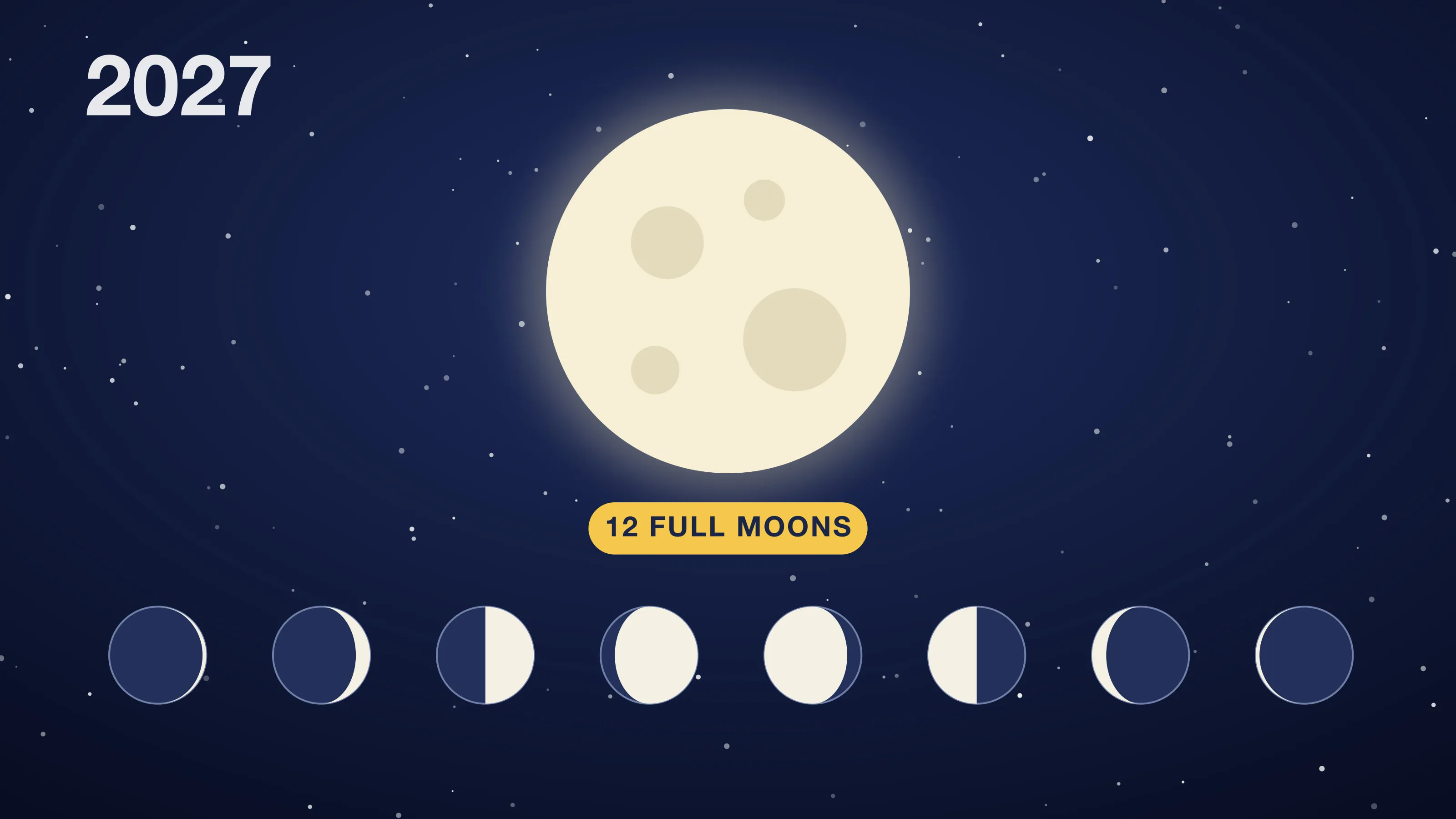
NASA gives the region for each eclipse as whole continents and does not say which U.S. places can see the Feb. 20 and Aug. 17 events. NASA’s Science page lists the dates as “Feb. 20-21” and “Aug. 16-17” because the local date depends on where you are, and that page’s list leaves out the July 18 eclipse, which the Goddard list includes. For a full-moon schedule that fits around these dates, see our moon phases 2027 calendar.
When is the next total solar eclipse in the U.S.?
Not in 2027. NASA’s decade table for 2041 to 2050 has two entries for the contiguous U.S.
| Date in NASA’s table | Totality path | Length at greatest eclipse |
|---|---|---|
| Aug. 23, 2044 | Greenland, northern Canada, Montana, North Dakota | 2 min 4 s |
| Aug. 12, 2045 | Across the southern U.S., then Haiti, Dominican Republic, Venezuela, Guyana, French Guiana, Suriname, Brazil | 6 min 6 s |
The 2044 date trap. NASA lists the 2044 eclipse on Aug. 23 because greatest eclipse is at 01:17 Terrestrial Dynamical Time (TD) on that date. In U.S. time zones that moment is the evening of Aug. 22, 2044. If you search for Aug. 23, 2044, you will find the same event. Alaska comes sooner: NASA’s 2031 to 2040 table lists totality in Russia and Alaska on March 30, 2033.
How do you watch a solar eclipse safely?
NASA advises proper solar eclipse glasses for viewing any partial or annular eclipse. Only during totality is it safe to look at the Sun without them. NASA’s eclipse safety page has the details.
Free printable downloads
Every template is free, needs no sign-up and prints on US Letter paper. Choose PDF for printing or PNG for screens and documents.
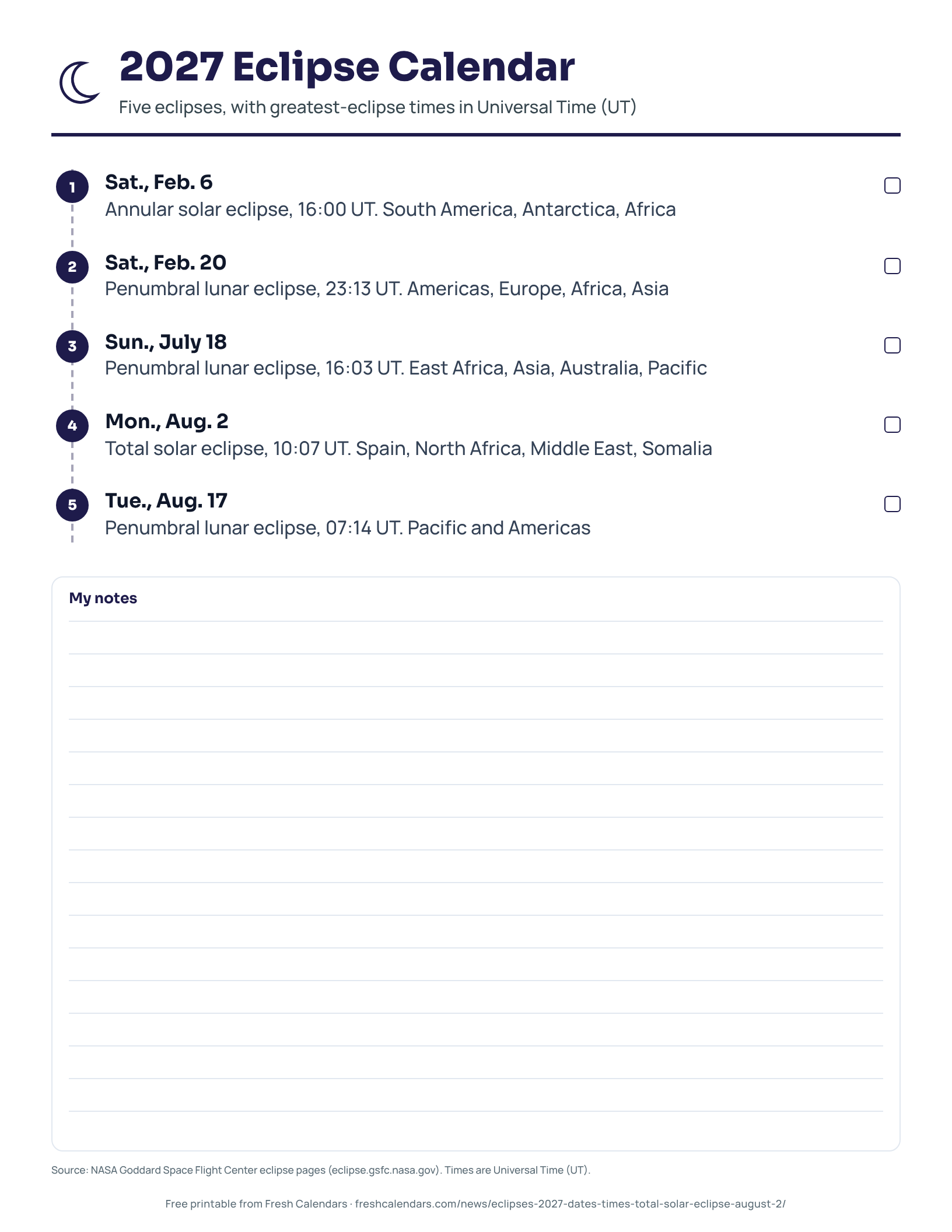
2027 Eclipse Calendar printables
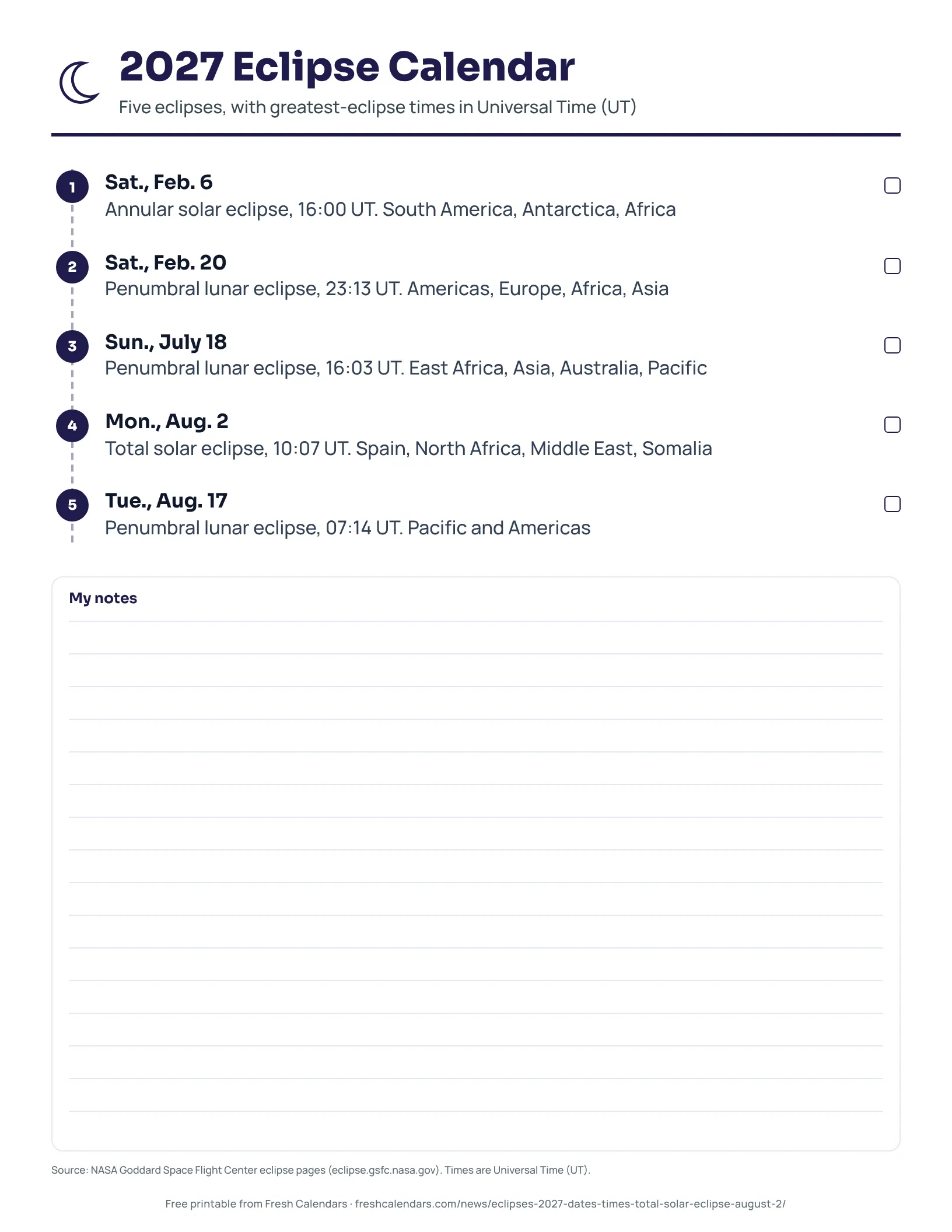
2027 Eclipse Calendar
A one-page list of the five 2027 eclipses with dates, greatest-eclipse times in Universal Time and where each can be seen.
Frequently asked questions
When is the total solar eclipse in 2027?
Monday, Aug. 2, 2027. NASA's catalog puts greatest eclipse at 10:07 Universal Time (UT), with totality lasting 6 minutes 23 seconds at that point.
Can I see the 2027 solar eclipses from the U.S.?
No. NASA's regions for the Feb. 6 annular eclipse and the Aug. 2 total eclipse do not include North America.
Which 2027 lunar eclipses can Americans see?
NASA lists the Feb. 20 and Aug. 17 penumbral eclipses for the Americas. NASA does not say which U.S. places can see them. The July 18 eclipse is in daytime in the U.S.
What is a penumbral lunar eclipse?
The Moon passes through the outer part of Earth's shadow and does not enter the dark umbra, so the shading on the Moon is subtle.
When is the next total solar eclipse in the contiguous U.S.?
NASA's decade table lists Aug. 23, 2044, with totality over Montana and North Dakota, then Aug. 12, 2045, across the southern U.S.
Do I need glasses for a solar eclipse?
NASA advises proper solar eclipse glasses for any partial or annular eclipse. Only during totality is it safe to look without them.
Sources
- Eclipses During 2027 (NASA Goddard Space Flight Center)
- Decade Solar Eclipse Tables: 2021 to 2030 (NASA Goddard Space Flight Center)
- Decade Lunar Eclipse Tables: 2021 to 2030 (NASA Goddard Space Flight Center)
- Decade Solar Eclipse Tables: 2041 to 2050 (NASA Goddard Space Flight Center)
- Future Eclipses (NASA Science)
- Eclipse Safety (NASA Science)