
Two Supermoons Close 2026: Beaver Moon Nov. 24, Cold Moon Dec. 23, Plus Geminids and the Solstice
Two supermoons end 2026: the Beaver Moon Nov. 24 and Cold Moon Dec. 23, plus the Geminids on Dec. 13-14 and the winter solstice Dec. 21, in Eastern Time (ET).

In this article
The last two months of 2026 bring two supermoons, a strong meteor shower and the winter solstice. The Beaver Moon is full on Tuesday, Nov. 24 at 9:53 a.m. Eastern Standard Time (EST), two days before Thanksgiving, and the Cold Moon is full on Wednesday, Dec. 23 at 8:28 p.m. EST, the closest full moon of the year. In between, the Geminid meteor shower peaks the night of Dec. 13-14, and the winter solstice arrives on Monday, Dec. 21 at 3:50 p.m. EST. Full moon times are from the U.S. Naval Observatory (USNO).
Countdown to the Cold Moon and the solstice
Time until the next event
The clock shows each moment in your own time zone, converted from the exact instant the USNO publishes. The Beaver Moon and the Cold Moon reach their full phase at a single instant worldwide, even though the clock time differs by region.
Two supermoons to end 2026
“Supermoon” is a popular term, not an official astronomical one, so different outlets draw the line in different places. BBC Sky at Night Magazine lists three supermoons in 2026: Jan. 3, Nov. 24 and Dec. 23 (Dec. 24 in Coordinated Universal Time). It gives the Beaver Moon a distance of 360,768 kilometers (224,170 miles) and the Cold Moon 356,740 kilometers (221,667 miles), the closest full moon of the year. The timeanddate reference flags only the December full moon as a super full moon. Either way, both moons look large and bright, and the Cold Moon is the nearer of the two.
A supermoon happens when the full phase lands near the Moon’s perigee, its closest point to Earth, so the disc looks slightly bigger and brighter than an average full moon. The difference is hard to judge by eye, but a supermoon low on the horizon, framed by trees or buildings, can look striking.
Beaver Moon and Cold Moon times across the U.S.
Both full moons fall after U.S. clocks go back on Nov. 1, so every zone is on standard time. The table converts the USNO instant for the four mainland time zones.
| Full moon | Eastern | Central | Mountain | Pacific |
|---|---|---|---|---|
| Beaver Moon (Nov. 24) | 9:53 a.m. | 8:53 a.m. | 7:53 a.m. | 6:53 a.m. |
| Cold Moon (Dec. 23) | 8:28 p.m. | 7:28 p.m. | 6:28 p.m. | 5:28 p.m. |
The Beaver Moon reaches its full phase during daylight on Nov. 24, so the best view is the night before or the night of, when the Moon rises around sunset and looks full to the eye. The Cold Moon is full in the evening of Dec. 23, high in the winter sky.
The names are traditional. The November full moon is widely called the Beaver Moon and the December full moon the Cold Moon. The Cold Moon falls in Coordinated Universal Time (UTC) on Dec. 24, which is why calendars in Europe can show it a day later than U.S. calendars do.
A full moon for Thanksgiving week
The Beaver Moon on Nov. 24 lands two days before Thanksgiving on Thursday, Nov. 26. By Thanksgiving night the Moon is still almost full and easy to find, a bright disc rising in the east after dinner. Mark the date on a November 2026 printable calendar if you want to plan an evening walk.
Days until each event
| Date | Event | Days from today |
|---|---|---|
| Nov. 24 | Beaver Moon, full supermoon (9:53 a.m. EST) | 31 |
| Dec. 13-14 | Geminid meteor shower peak night | 50 |
| Dec. 21 | Winter solstice (3:50 p.m. EST) | 58 |
| Dec. 21-22 | Ursid meteor shower peak night | 58 |
| Dec. 23 | Cold Moon, full supermoon (8:28 p.m. EST) | 60 |
The day counts above update to the current date when the page loads.
The Geminids: the best meteor shower of the month
The Geminid meteor shower is active from Dec. 4 to Dec. 17 and peaks the night of Sunday, Dec. 13 into Monday, Dec. 14, 2026, according to the American Meteor Society (AMS). Under a dark, clear sky the AMS puts the rate at roughly 120 to 150 meteors an hour at the peak. This year the timing is kind: the Moon is only about 21% lit on the peak night, so it does little to wash out the fainter meteors.
The Geminid radiant, in the constellation Gemini, rises in the early evening, so you can start watching by about 9 p.m. local time, earlier than for most showers. The meteors are often bright and can appear in any part of the sky.
The Ursids and the solstice
The winter solstice falls on Monday, Dec. 21, 2026, at 3:50 p.m. EST (20:50 UTC), the USNO says. It marks the shortest day and the longest night of the year in the Northern Hemisphere, after which daylight slowly lengthens.
The same night brings a smaller shower. The Ursids are active from Dec. 17 to Dec. 26 and peak the night of Monday, Dec. 21 into Tuesday, Dec. 22, with a modest rate of about 10 meteors an hour. The Moon is about 89 to 94% lit near that peak, so moonlight hides all but the brightest. If you are out for the solstice, the Geminids a week earlier are the better bet.
How to watch
- Get away from lights. A park or rural spot makes more difference than any gear.
- Give your eyes about 20 minutes to adjust, and keep phone screens dim.
- Dress warmly. December nights are cold; a reclining chair and a blanket help you stay out.
- Look up, not at the radiant. Meteors streak across the whole sky.
More sky events
November’s meteor showers come first; see our guide to the Taurids and Leonids. For October’s full moon, read about the Hunter’s Moon. To plan the year ahead, our moon phases 2027 calendar lists every full moon of next year. Print the winter months with our December 2026 printable calendar or a 2027 yearly calendar, and keep the free night sky calendar below on the fridge.
Free printable downloads
Every template is free, needs no sign-up and prints on US Letter paper. Choose PDF for printing or PNG for screens and documents.
Night Sky Calendar printables
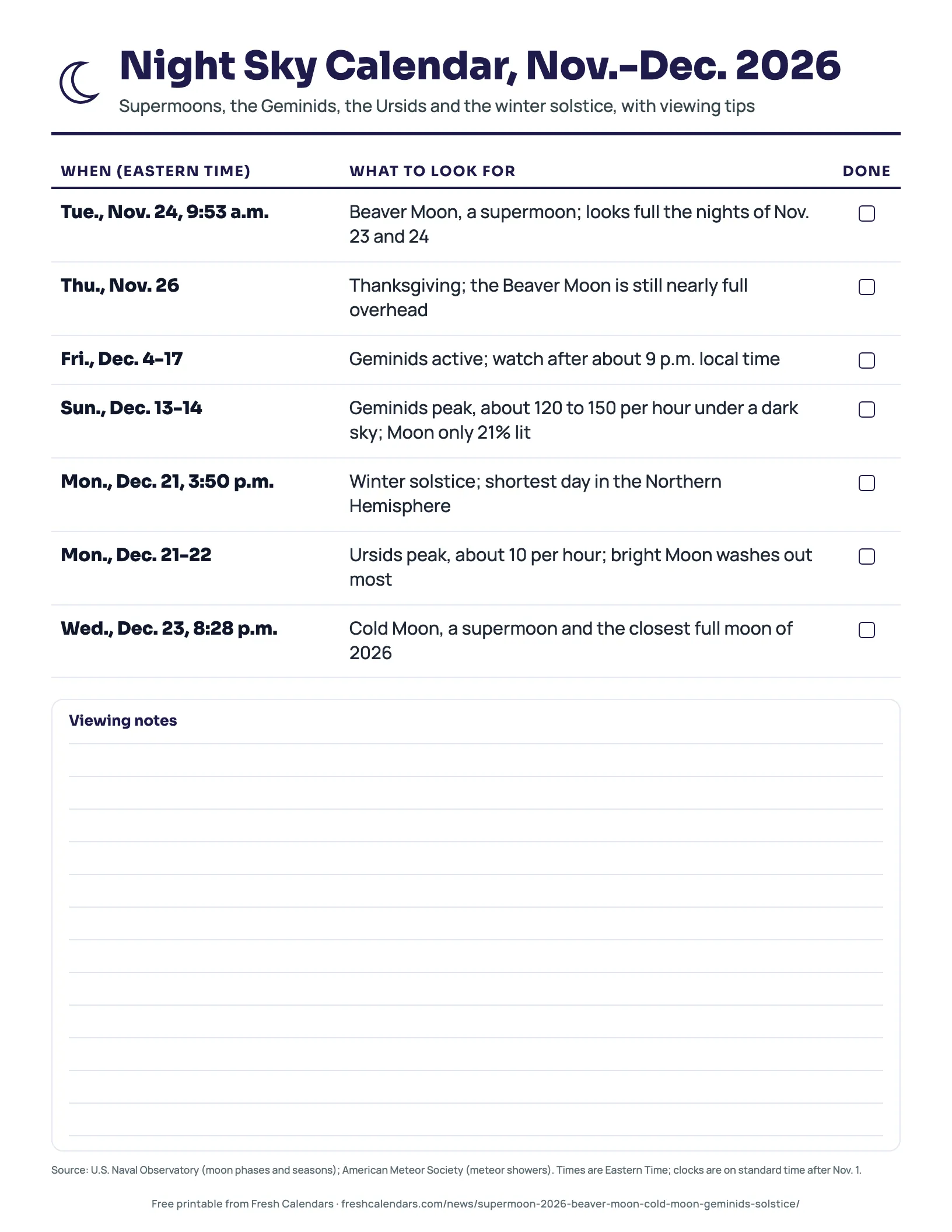
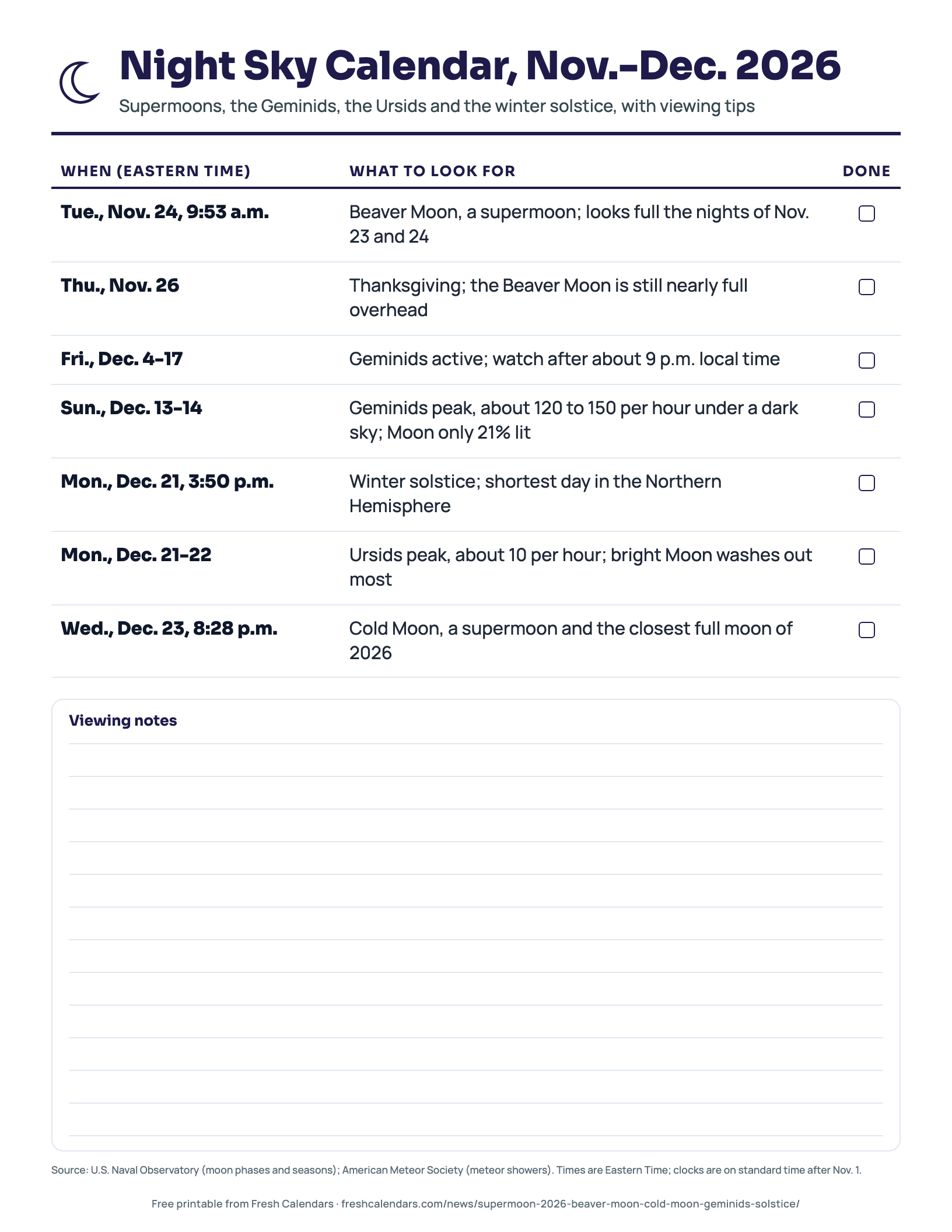
Night Sky Calendar, Nov.-Dec. 2026
Seven dated sky events for November and December 2026 on one page: two supermoons, the Geminids, the Ursids and the winter solstice, with viewing tips.
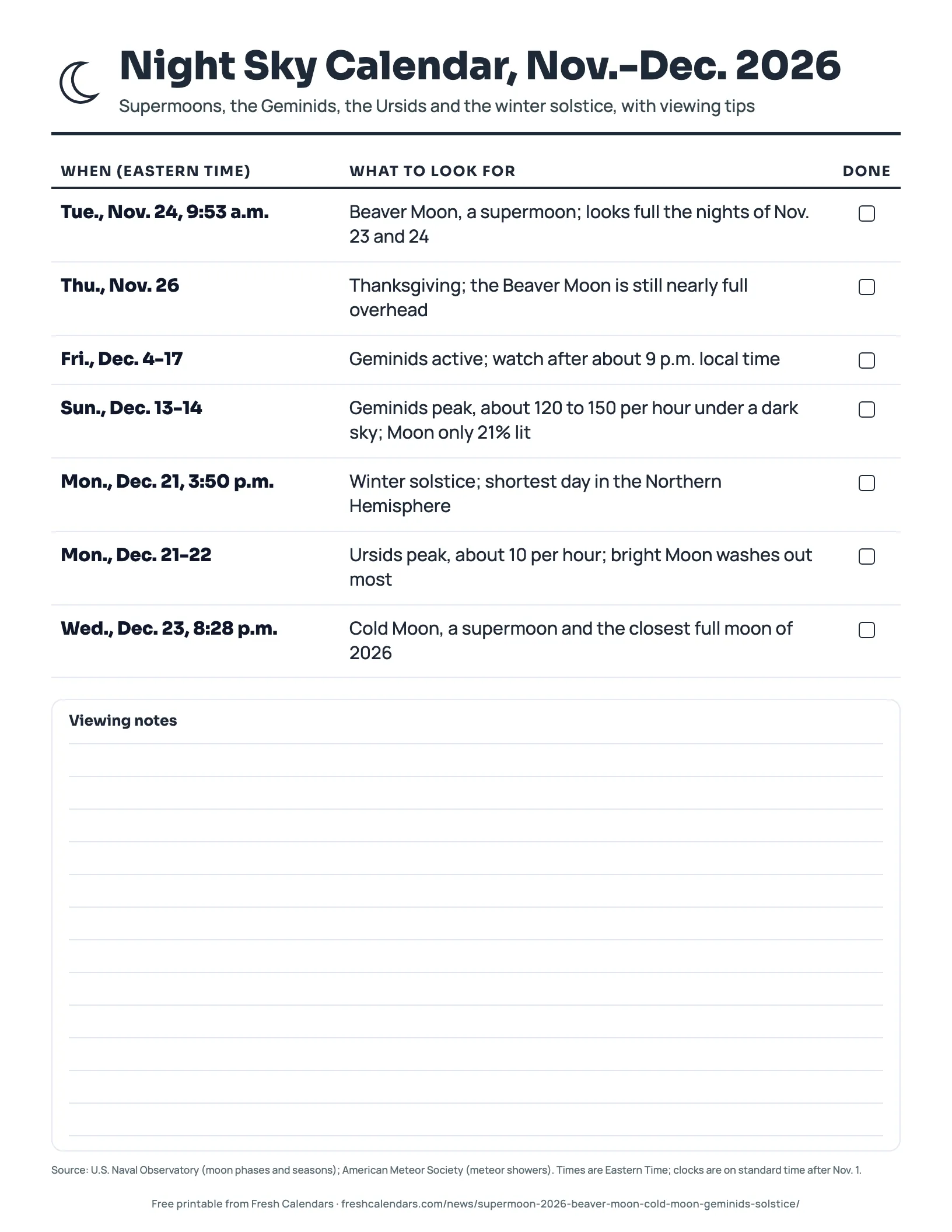
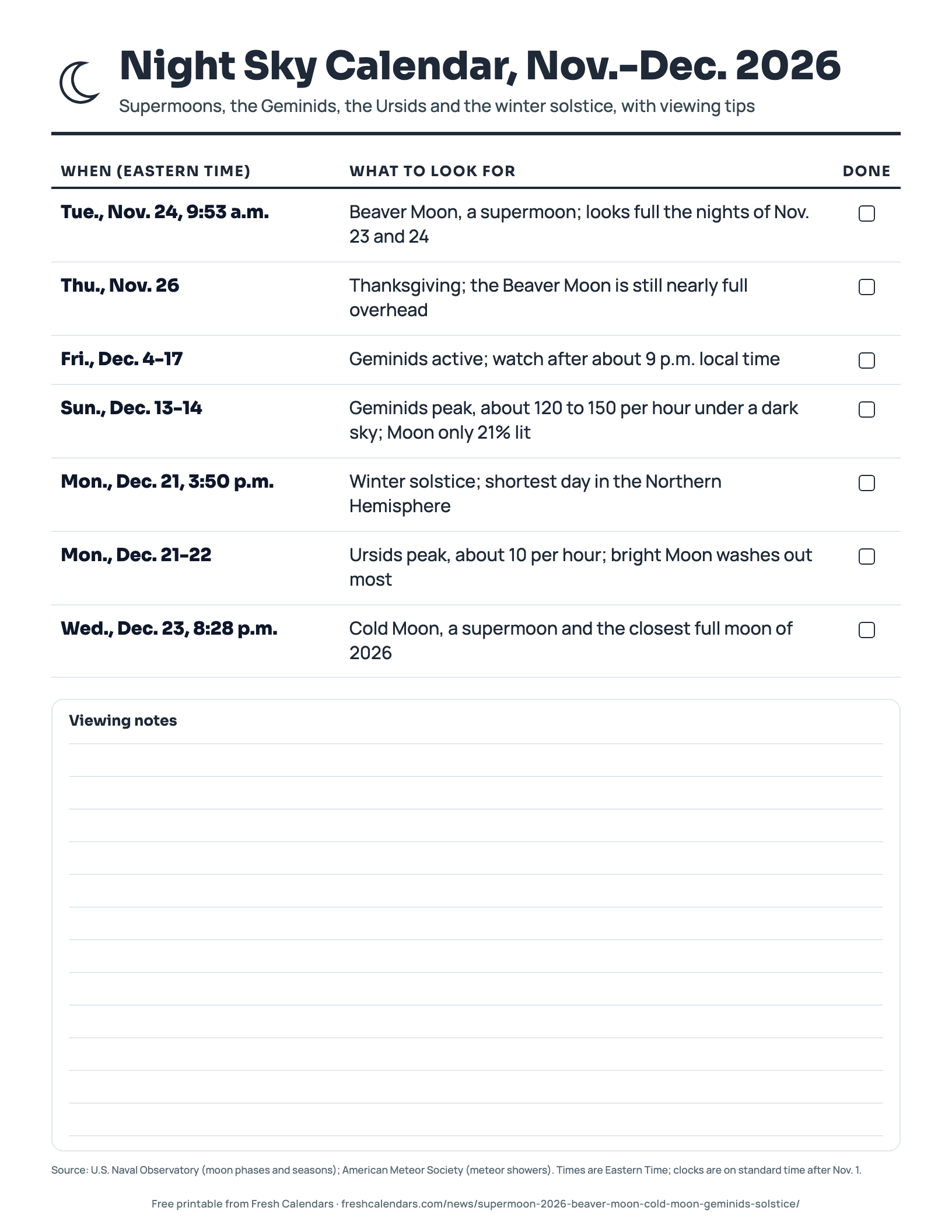
Night Sky Calendar, Nov.-Dec. 2026 (ink saver)
Seven dated sky events for November and December 2026 on one page: two supermoons, the Geminids, the Ursids and the winter solstice, with viewing tips. Ink-saver version.
Frequently asked questions
When is the supermoon in November 2026?
The Beaver Moon is full on Tuesday, Nov. 24, 2026, at 9:53 a.m. Eastern Standard Time (EST), according to the U.S. Naval Observatory. BBC Sky at Night Magazine lists it as one of 2026's three supermoons.
What is the Cold Moon date in December 2026?
The Cold Moon is full on Wednesday, Dec. 23, 2026, at 8:28 p.m. EST. In Coordinated Universal Time (UTC) that instant falls on Dec. 24, so European calendars show the Cold Moon a day later.
Which 2026 supermoon is the closest?
The Dec. 23 Cold Moon. BBC Sky at Night Magazine puts it 356,740 kilometers (221,667 miles) away, the closest full moon of 2026; the Nov. 24 Beaver Moon is 360,768 kilometers (224,170 miles) away.
Is the Beaver Moon really a supermoon?
It depends on the definition, which is not an official astronomical one. BBC Sky at Night Magazine counts both the November and December full moons as supermoons, while timeanddate flags only December. Either way, both look large and bright.
When does the Geminid meteor shower peak in 2026?
The night of Sunday, Dec. 13 into Monday, Dec. 14, 2026, according to the American Meteor Society. Rates reach about 120 to 150 meteors an hour under a dark sky, and the Moon is only about 21% lit this year.
What time is the winter solstice in 2026?
Monday, Dec. 21, 2026, at 3:50 p.m. EST (20:50 UTC), according to the U.S. Naval Observatory. It marks the shortest day and longest night in the Northern Hemisphere.
Sources
- Phases of the Moon, 2026 (U.S. Naval Observatory, Astronomical Applications Department)
- Earth's Seasons and Apsides, 2026 (U.S. Naval Observatory, Astronomical Applications Department)
- We'll get three supermoons in 2026. Here's how to see them all (BBC Sky at Night Magazine)
- Meteor Shower Calendar 2026 (American Meteor Society)
- Moon Phases (timeanddate)
Related news
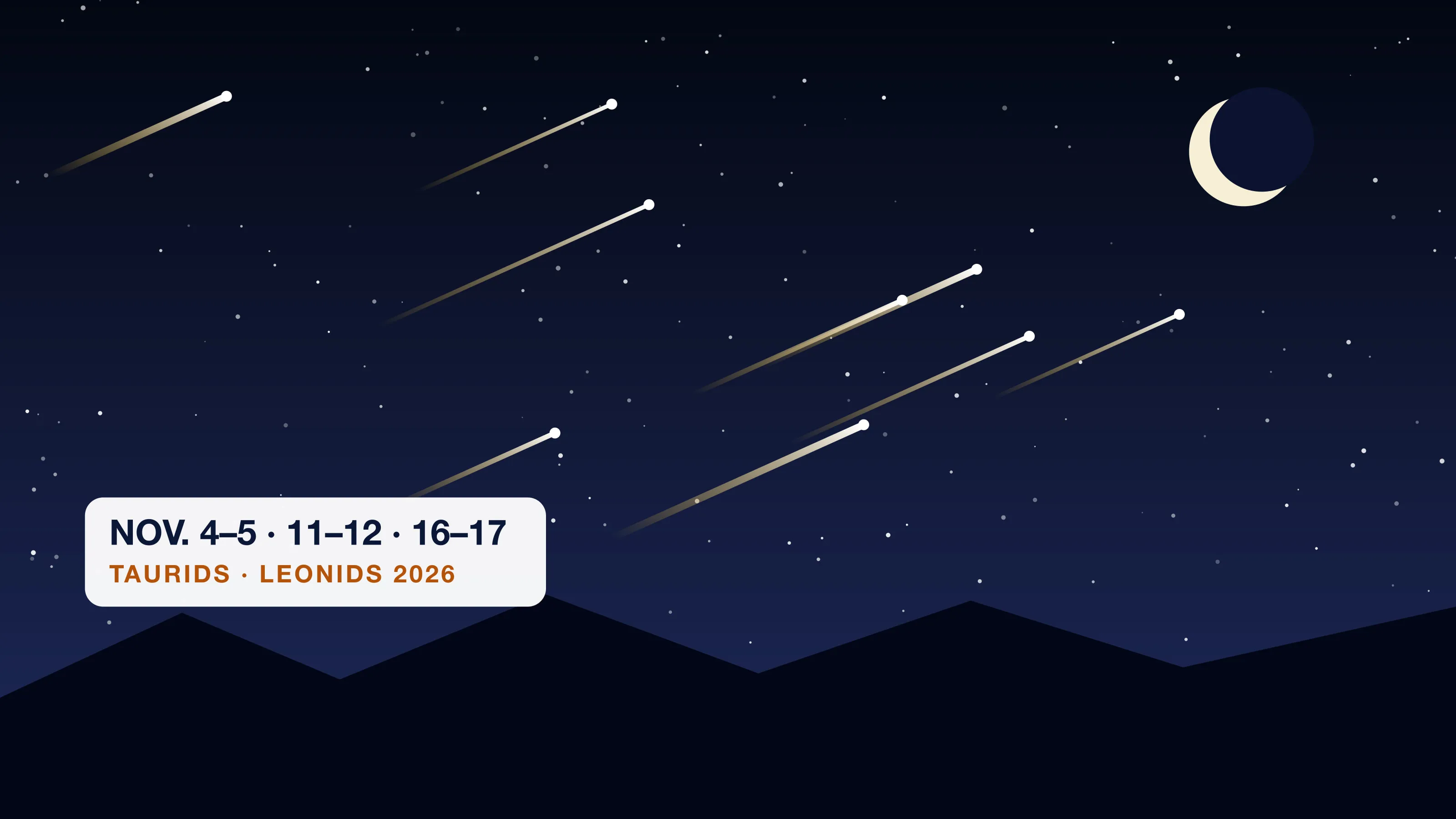 November 2026 Meteor Showers: Taurid Fireballs Under Dark Skies, Then the Leonids on Nov. 16-17
 Moon Phases 2027: Full Moon Calendar With Dates, Times, Names and Eclipses, Plus Free Printables
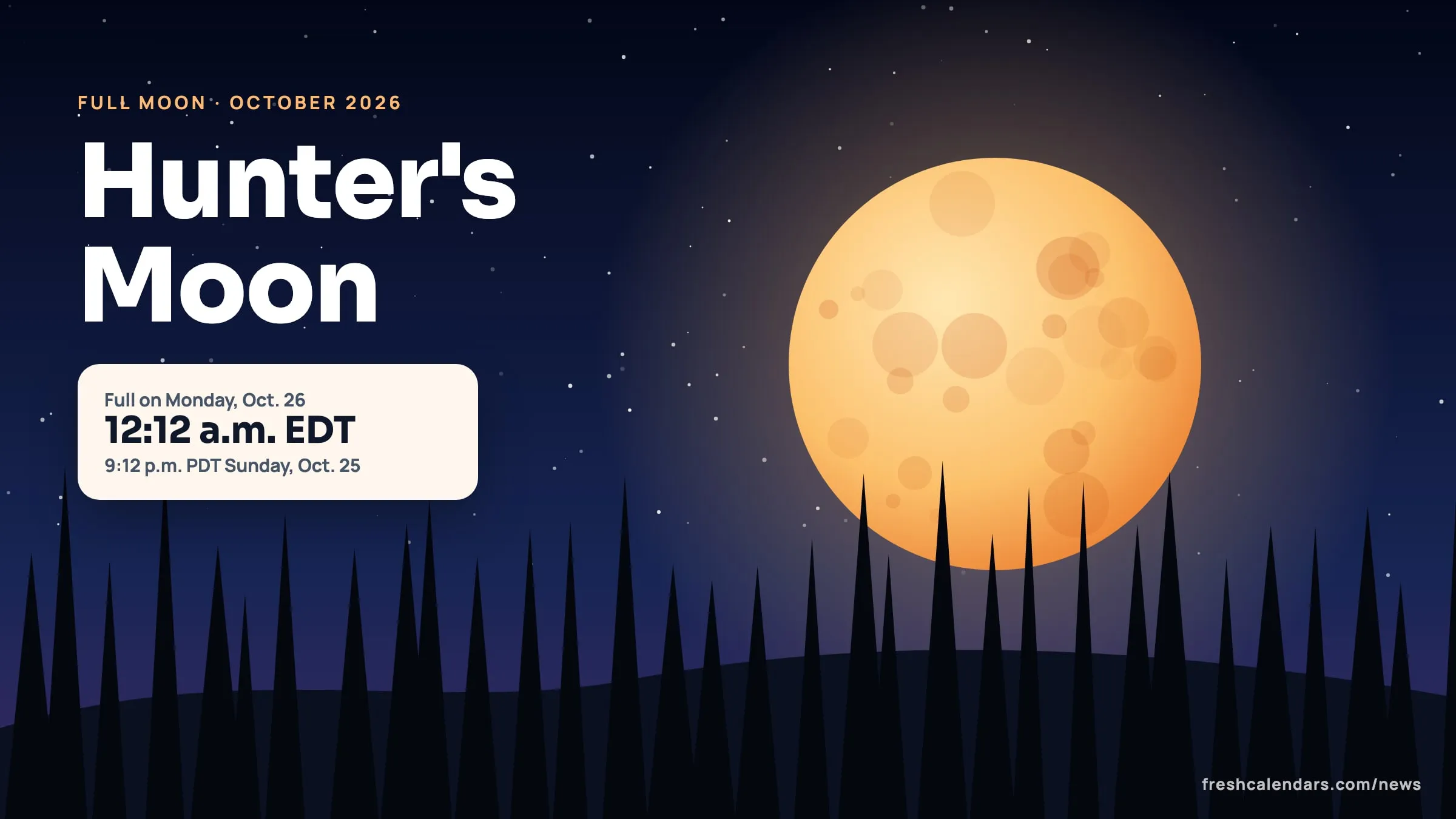 Hunter's Moon 2026: October's Full Moon Peaks at 12:12 a.m. EDT on Oct. 26, With Moonrise Times for 20 Cities