Planets Visible in April 2027: Mars and Jupiter at Dusk, Lyrids
Full Moon Apr. 20, 2027 at 6:27 p.m. EDT, Lyrids peak Apr. 21-22. Sunset table for four cities, Moon times, planet dates and a printable night sky sheet.

Published 4 min read
Key dates
In this article
- April 2027 night sky calendar by date
- Which planets are visible in April 2027?
- What are the Moon phases in April 2027?
- When is sunset in April 2027 in four U.S. cities?
- When does the Moon rise and set on the Full Moon day?
- When do the Lyrids peak in 2027?
- Is there an eclipse in April 2027?
- Where do these dates come from?
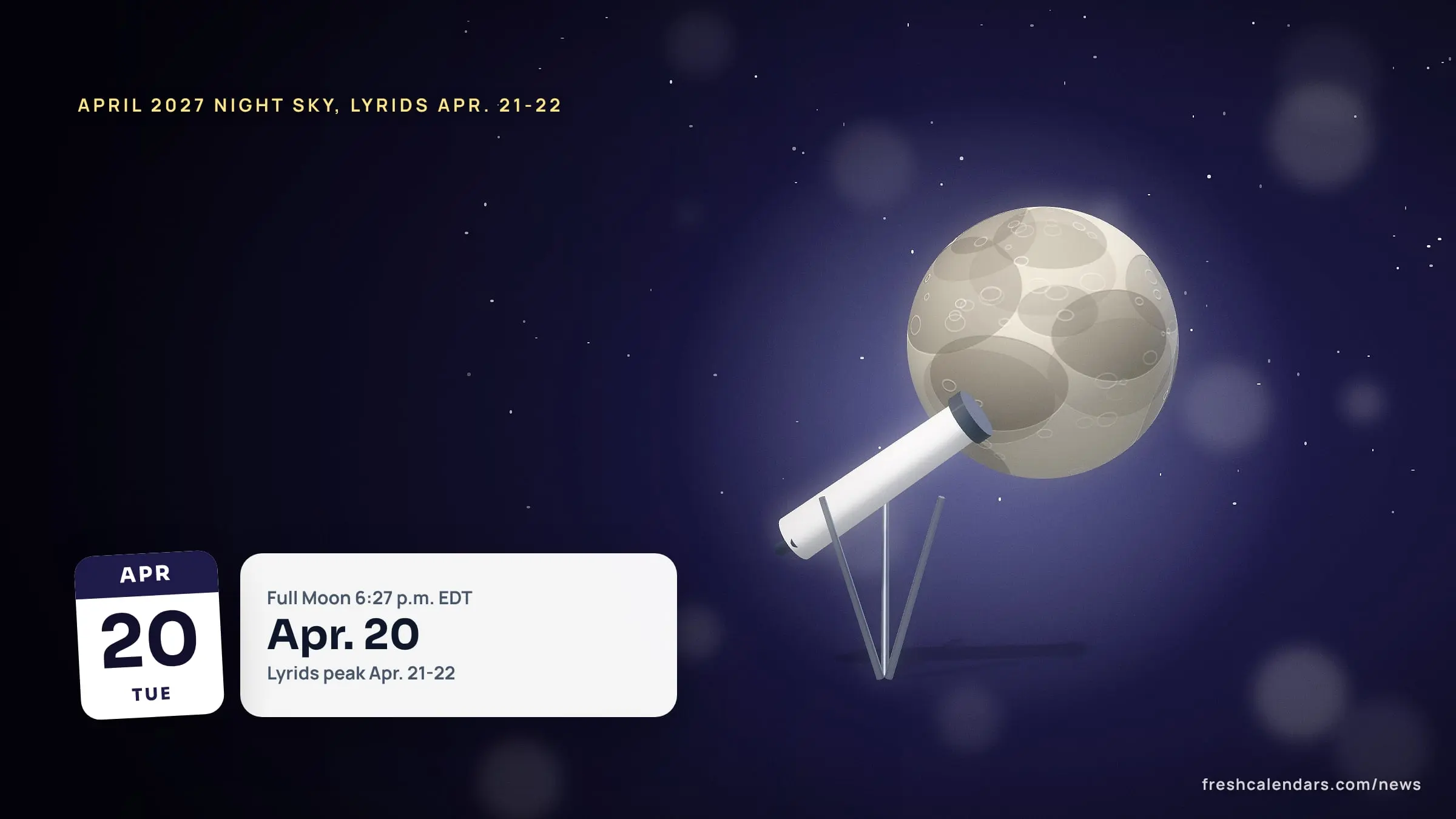
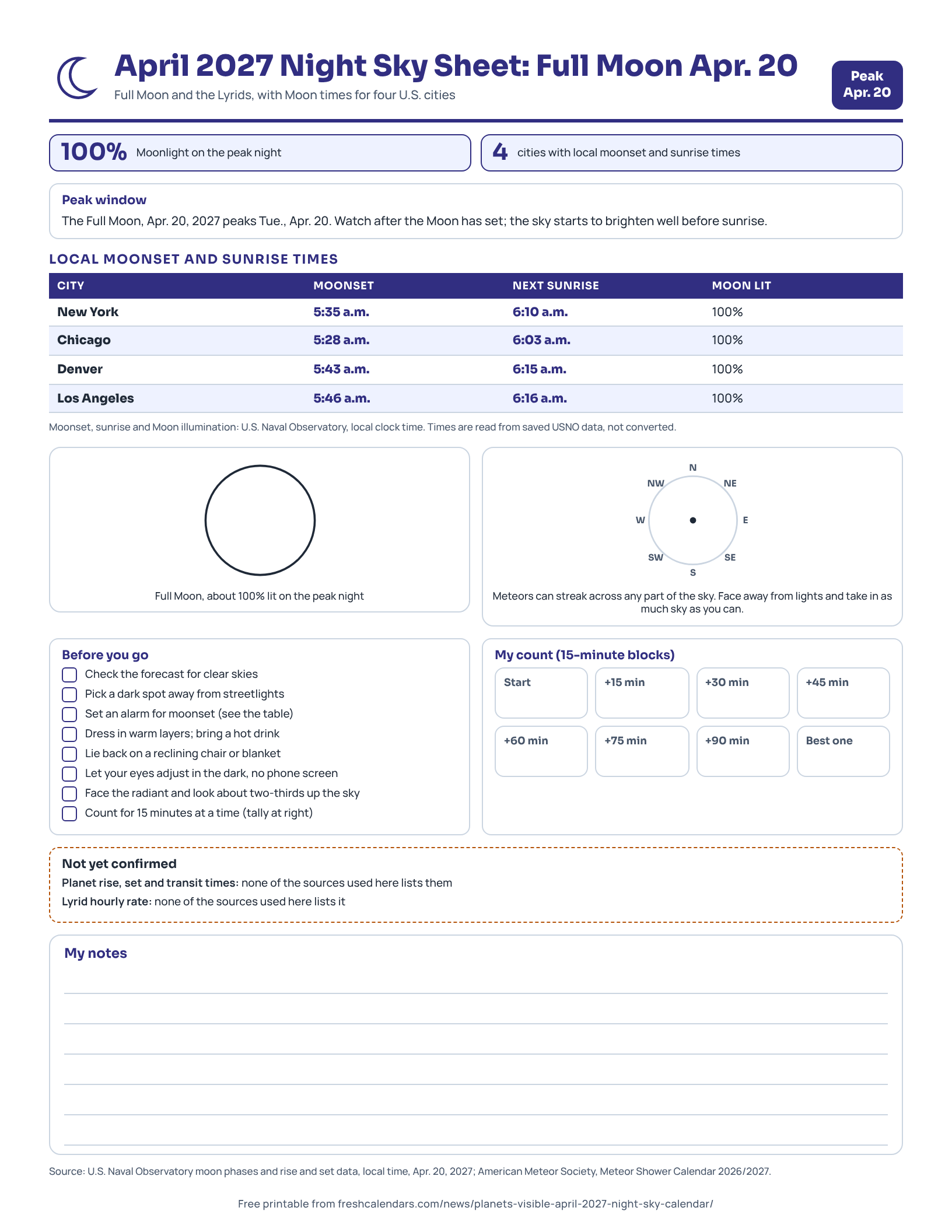
The Full Moon falls on Tuesday, Apr. 20, 2027, at 6:27 p.m. Eastern Daylight Time (EDT), and the Lyrid meteor shower peaks the night of Apr. 21-22, according to the U.S. Naval Observatory (USNO) and the American Meteor Society (AMS). The National Astronomical Observatory of Japan (NAOJ) lists no opposition in April, and Saturn is at conjunction with the Sun on Apr. 7. Print the Full Moon night on one page with the April 2027 night sky sheet.
April 2027 night sky calendar by date
| Date | Event | Time | Source |
|---|---|---|---|
| Fri., Apr. 2 | Mars stationary | 1:33 p.m. EDT | NAOJ |
| Tue., Apr. 6 | New Moon | 7:51 p.m. EDT | USNO |
| Wed., Apr. 7 | Saturn at conjunction with the Sun | 1:18 p.m. EDT | NAOJ |
| Tue., Apr. 13 | Jupiter stationary | 2:17 a.m. EDT | NAOJ |
| Tue., Apr. 13 | First quarter Moon | 6:56 p.m. EDT | USNO |
| Tue., Apr. 20 | Full Moon | 6:27 p.m. EDT | USNO |
| Wed., Apr. 21 to Thu., Apr. 22 | Lyrids peak night | Night of Apr. 21-22 | AMS |
| Wed., Apr. 28 | Last quarter Moon | 4:18 p.m. EDT | USNO |
| Wed., Apr. 28 | Mercury at superior conjunction with the Sun | 5:22 p.m. EDT | NAOJ |
NAOJ publishes in Japan Standard Time (JST), nine hours ahead of Universal Time (UT). We converted every NAOJ time: Mars’s “2027-04-03 02:33” JST is 1:33 p.m. EDT on Apr. 2, and Mercury’s “2027-04-29 06:22” JST is 5:22 p.m. EDT on Apr. 28. The USNO times are in UT, also converted. Daylight saving time began Sunday, Mar. 14, 2027, under 15 U.S. Code 260a, so every April time is in EDT.
Which planets are visible in April 2027?
The NAOJ table has no April row for a greatest elongation or an opposition. The rows it does have, and the dates around them, put the planets in these places.
| Planet | NAOJ rows | Where it sits in April |
|---|---|---|
| Mars | Opposition Feb. 20; stationary Apr. 2; eastern quadrature May 26 | Evening sky |
| Jupiter | Opposition Feb. 11; stationary Apr. 13; eastern quadrature May 9 | Evening sky |
| Uranus | Eastern quadrature Feb. 21; conjunction with the Sun May 27 | Evening sky, low and fading |
| Saturn | Conjunction with the Sun Apr. 7 | Lost in the Sun’s glare |
| Venus | Greatest elongation west Jan. 4; superior conjunction Aug. 12 | Morning sky |
| Mercury | Superior conjunction with the Sun Apr. 28 | Morning sky before Apr. 28, low |
| Neptune | Conjunction with the Sun Mar. 24 | Morning sky after the conjunction |
The “where it sits” column is our reading of the NAOJ rows, not a NAOJ statement. A planet is stationary when it pauses against the stars before reversing course. NAOJ gives dates, not rise and set times or brightness, and the USNO service used here covers only the Sun and Moon, so we do not print planet times. For your city, use a planetarium app. The month before is in the March 2027 night sky calendar, and the whole year is in the meteor showers 2027 calendar.
What are the Moon phases in April 2027?
The USNO lists the new Moon on Tuesday, Apr. 6, first quarter on Tuesday, Apr. 13, the Full Moon on Tuesday, Apr. 20 and last quarter on Wednesday, Apr. 28. For every phase of the year, see the Moon phases 2027 guide.
When is sunset in April 2027 in four U.S. cities?
The USNO gives these times in local clock time. Daylight saving time is in effect on every date.
| Date | New York | Chicago | Denver | Los Angeles |
|---|---|---|---|---|
| Thu., Apr. 1 sunrise | 6:40 a.m. | 6:34 a.m. | 6:44 a.m. | 6:40 a.m. |
| Thu., Apr. 1 sunset | 7:21 p.m. | 7:16 p.m. | 7:24 p.m. | 7:14 p.m. |
| Fri., Apr. 30 sunrise | 5:56 a.m. | 5:48 a.m. | 6:02 a.m. | 6:05 a.m. |
| Fri., Apr. 30 sunset | 7:51 p.m. | 7:48 p.m. | 7:53 p.m. | 7:36 p.m. |
Sunset is 30 minutes later on Apr. 30 than on Apr. 1 in New York, 32 in Chicago, 29 in Denver and 22 in Los Angeles. New York’s sunrise moves 44 minutes earlier over the month.
When does the Moon rise and set on the Full Moon day?
The USNO gives these times for Tuesday, Apr. 20, 2027, in local clock time.
| City | Sunset | Moonrise | Moonset | Sunrise |
|---|---|---|---|---|
| New York | 7:41 p.m. | 7:50 p.m. | 5:35 a.m. | 6:10 a.m. |
| Chicago | 7:37 p.m. | 7:50 p.m. | 5:28 a.m. | 6:03 a.m. |
| Denver | 7:43 p.m. | 7:58 p.m. | 5:43 a.m. | 6:15 a.m. |
| Los Angeles | 7:28 p.m. | 7:42 p.m. | 5:46 a.m. | 6:16 a.m. |
In all four cities the Moon rises after sunset on Apr. 20, between 9 minutes later in New York and 15 minutes later in Denver, and sets before sunrise that morning. In New York the exact Full Moon, 6:27 p.m., comes before the 7:50 p.m. moonrise. The printable lists the same Moon times.
When do the Lyrids peak in 2027?
The AMS calendar lists the Lyrids as active Apr. 14-30, 2027, with a peak the night of Apr. 21-22. The USNO puts the Full Moon at 6:27 p.m. EDT on Apr. 20, so the Moon is one to two days past full at the peak and moonlight hurts the view. The sources used here give no hourly rate, so we print none.
Is there an eclipse in April 2027?
No. NASA’s tables list the annular solar eclipse of Feb. 6, the penumbral lunar eclipse of Feb. 20, the total solar eclipse of Aug. 2 and penumbral lunar eclipses on Jul. 18 and Aug. 17, none in April.
Where do these dates come from?
The Moon phases are from the USNO moon phases data, labeled in UT. The planet events are from the NAOJ Koyomi table. The Sun and Moon times are from the USNO rise, set and transit service. The meteor dates are from the AMS calendar. The eclipses come from NASA’s solar and lunar tables. Mark the dates on an April 2027 printable calendar or a 2027 yearly calendar.
Free printable downloads
Every template is free, needs no sign-up and prints on US Letter paper. Choose PDF for printing or PNG for screens and documents.
April 2027 Night Sky Sheet printables
-
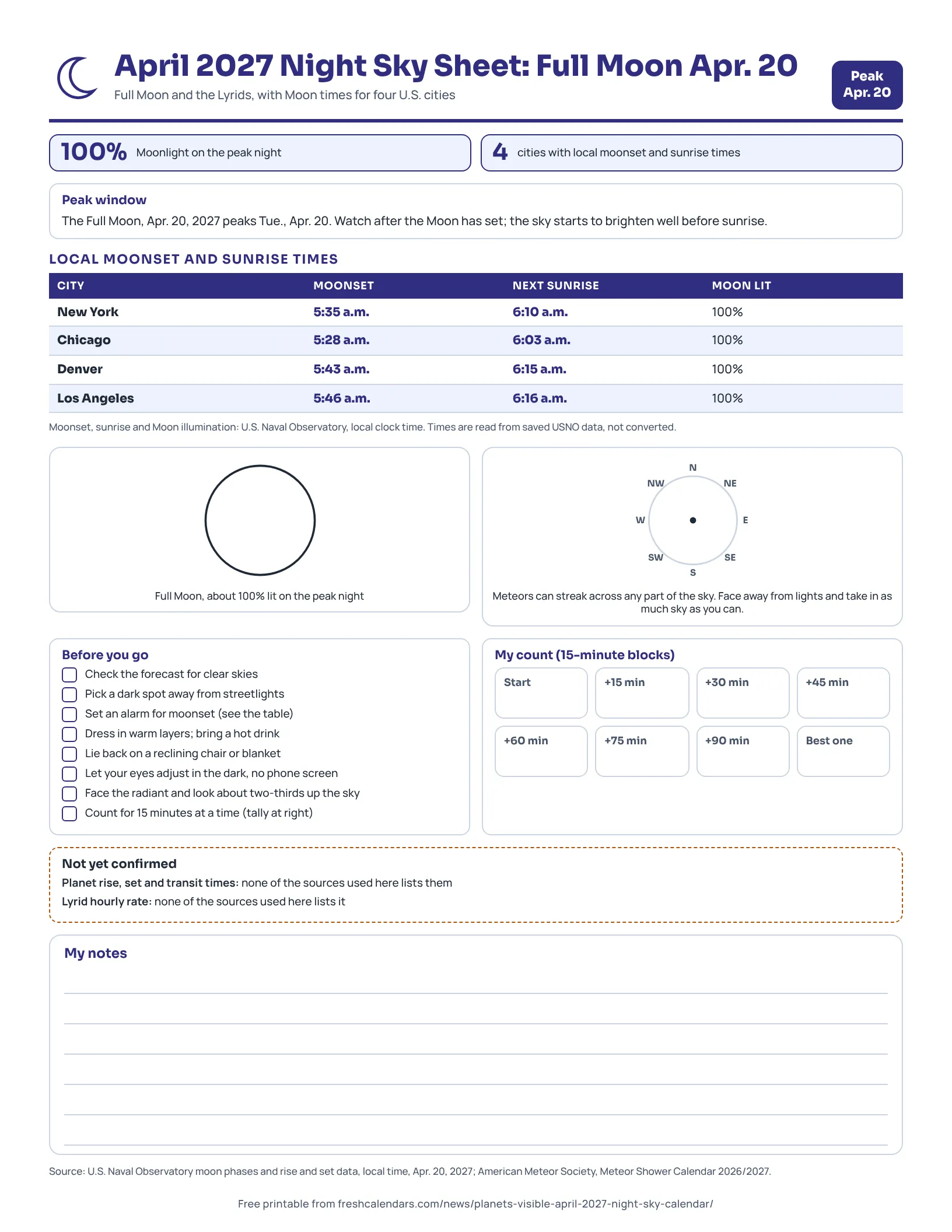
April 2027 Night Sky Sheet: Full Moon Apr. 20
A one-page April 2027 night sky sheet: Full Moon on Apr. 20, Moon times for four U.S. cities, the Lyrids peak, a tally grid and a checklist.
Frequently asked questions
Which planets can I see in April 2027?
Based on the NAOJ table, Mars, Jupiter and Uranus are evening planets, and Venus, Mercury and Neptune are morning planets. Saturn is lost in the Sun's glare around its Apr. 7 conjunction. The sources used here give event dates, not planet rise and set times, so check a planetarium app for your city.
When is the Full Moon in April 2027?
Tuesday, Apr. 20, 2027, at 6:27 p.m. EDT (22:27 Universal Time, UT), according to the USNO.
When do the Lyrids peak in 2027?
The American Meteor Society (AMS) lists the Lyrids as active Apr. 14-30, 2027, with a peak the night of Apr. 21-22. The Moon is one to two days past full then, so moonlight will wash out fainter meteors.
Is there an eclipse in April 2027?
No. NASA's eclipse tables list the next solar eclipse after February's annular one on Aug. 2, 2027, and the next lunar eclipses on Jul. 18 and Aug. 17.
Is daylight saving time in effect in April 2027?
Yes. It began Sunday, Mar. 14, 2027, under the rule in 15 U.S. Code 260a, so every April time here is in daylight time.
Sources
- Moon Phases, 2027 (Astronomical Applications API) (U.S. Naval Observatory, Astronomical Applications Department, 2026-11-24)
- Celestial Phenomena in 2027 (National Astronomical Observatory of Japan (NAOJ), Koyomi, 2026-11-24)
- Sun and Moon Rise/Set/Transit Times for One Day (API) (U.S. Naval Observatory, Astronomical Applications Department, 2026-11-24)
- 15 U.S. Code 260a - Advancement of time (Legal Information Institute, Cornell Law School)
- NASA - Solar Eclipses: 2021 - 2030 (NASA Goddard Space Flight Center)
- NASA - Lunar Eclipses: 2021 - 2030 (NASA Goddard Space Flight Center)
- Meteor Shower Calendar 2026/2027 (American Meteor Society, 2026-11-24)
Related news
More in Sky Events
All Sky Events stories →- Beaver Supermoon 2026 Is Full After It Sets in New York: When to Look
- Moon Phase Tonight: Full Moon Jan. 22, 2027 at 7:17 a.m. EST
- Moon on New Year's Eve 2026: Moonrise 1:46 a.m. in New York
- Leonid Meteor Shower 2026: Peak Nov. 16-17, Moon-Free Hours
- Latest Sunrise 2027: New York 7:20 a.m. Dec. 30-Jan. 10, 20 Cities
Trending now
- Black Friday Ads 2026: Date Is Nov. 27, Walmart Deals Nov. 23-29
- New Movies in Theaters November 2026: Hunger Games on Nov. 20
- Thanksgiving Travel 2026: Best Days to Fly and Drive, Nov. 21 to 30
- Black Friday 2026 Store Hours: Walmart, Target 6 a.m., Kohl's 5 a.m.
- CPKC Holiday Train 2026 Schedule: 182 Stops, Nov. 19 to Dec. 20