Leonid Meteor Shower 2026 Peaks Nov. 16-17: Moonset and Moon-Free Hours in 12 U.S. Cities
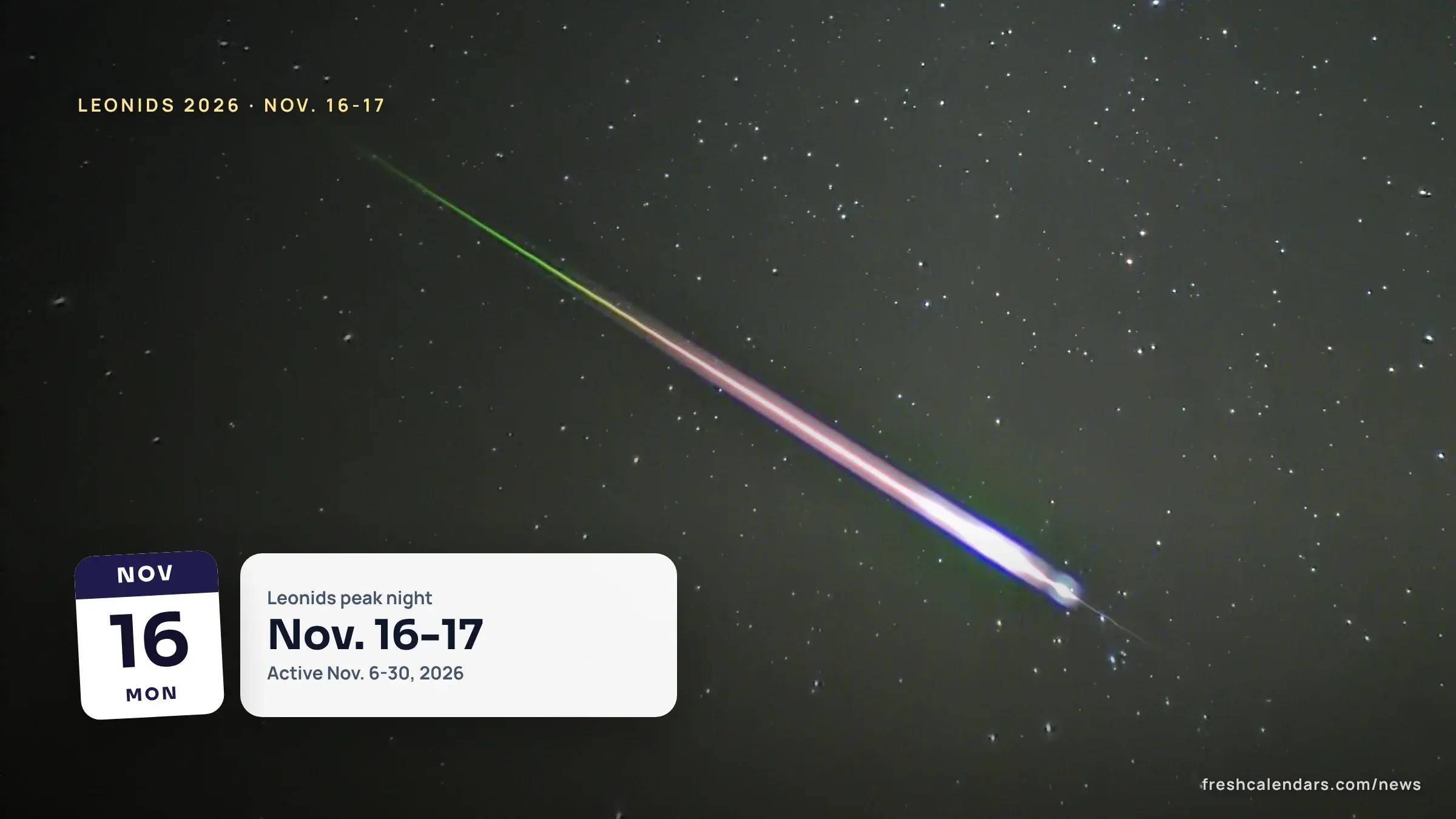
The Leonids peak Nov. 16-17, 2026, per the American Meteor Society (AMS). The Moon sets between 10:37 p.m. and 12:10 a.m. that night in 12 U.S. cities.

Published Updated 5 min read

In this article
- Leonid peak night and active dates in 2026
- How many Leonids can you see per hour in 2026?
- How bright is the Moon on Leonid peak night?
- Moon-free hours on the night of Mon., Nov. 16 to Tue., Nov. 17
- Moon-free hours on the night of Tue., Nov. 17 to Wed., Nov. 18
- When is the Leonid peak hour in 2026?
- Take the Leonid moon-free window with you
The Leonid meteor shower peaks on the night of Monday, Nov. 16 to Tuesday, Nov. 17, 2026, according to the American Meteor Society (AMS), the International Meteor Organization (IMO) and NASA. None of the three lists a peak hour. This story adds what the monthly guides leave out: when the Moon sets on both Leonid nights, Nov. 16-17 and Nov. 17-18, in 12 U.S. cities, from the U.S. Naval Observatory (USNO), and how many moon-free hours that leaves before the morning sky begins to brighten.
Leonid peak night and active dates in 2026
All three organizations give the same active period, Nov. 6 to Nov. 30, and the same peak night.
| Source | Peak night | Active |
|---|---|---|
| AMS, 2026/2027 Meteor Shower Calendar | Nov. 16-17 | Nov. 6-30 |
| IMO, 2026/2027 Meteor Shower Calendar | Nov. 16-17 | Nov. 6-30 |
| NASA Science, Leonids | Nov. 16-17 | Nov. 6-30 |
The sources give a night, not a time, so the table above is all they say about timing. NASA adds that the Leonids are best viewed starting at about midnight local time.
How many Leonids can you see per hour in 2026?
NASA says fewer than 3 meteors per hour under dark skies. The parent of the Leonids is Comet 55P/Tempel-Tuttle, according to NASA. With a rate that low, the hours without moonlight matter more than the exact minute, which is why the tables below count them.
How bright is the Moon on Leonid peak night?
The AMS describes the Moon as a waxing crescent, 39% illuminated, on the peak night. The USNO publishes its own daily illumination values for New York and Washington, D.C.: 43% on Mon., Nov. 16, 52% on Tue., Nov. 17 and 62% on Wed., Nov. 18. The USNO’s Nov. 16 value is a different number from the AMS’s. The USNO puts First Quarter Moon at 6:48 a.m. Eastern Standard Time (EST) on Tue., Nov. 17, which is 11:48 Universal Time (UT).
For viewing, the useful number is when the Moon is below the horizon. The USNO lists moonrise in the afternoon on both nights (12:28 p.m. on Nov. 16 and 12:52 p.m. on Nov. 17 in New York), so the moon-free part of the night starts at moonset.
Moon-free hours on the night of Mon., Nov. 16 to Tue., Nov. 17
We pulled each city’s times from the USNO’s one-day rise and set data service for Nov. 16, 17 and 18, 2026, using the city’s center coordinates and local standard time: Eastern Standard Time (EST), Central Standard Time (CST), Mountain Standard Time (MST), Pacific Standard Time (PST), Alaska Standard Time (AKST) and Hawaii Standard Time (HST). Phoenix is on MST. The moonset and Begin Civil Twilight times are USNO values for each city’s center. The moon-free window, moonset to Begin Civil Twilight, is computed by Fresh Calendars.
| City | Time zone | Moonset, Mon., Nov. 16 | Begin Civil Twilight, Tue., Nov. 17 | Moon-free window |
|---|---|---|---|---|
| New York | EST | 10:53 p.m. | 6:16 a.m. | 7 h 23 min |
| Boston | EST | 10:37 p.m. | 6:07 a.m. | 7 h 30 min |
| Atlanta | EST | 11:48 p.m. | 6:45 a.m. | 6 h 57 min |
| Miami | EST | 11:42 p.m. | 6:16 a.m. | 6 h 34 min |
| Chicago | CST | 10:47 p.m. | 6:13 a.m. | 7 h 26 min |
| Dallas | CST | 11:41 p.m. | 6:33 a.m. | 6 h 52 min |
| Denver | MST | 11:04 p.m. | 6:18 a.m. | 7 h 14 min |
| Phoenix | MST | 11:44 p.m. | 6:35 a.m. | 6 h 51 min |
| Los Angeles | PST | 11:09 p.m. | 6:01 a.m. | 6 h 52 min |
| Seattle | PST | 11:00 p.m. | 6:44 a.m. | 7 h 44 min |
| Anchorage | AKST | 11:09 p.m. | 8:19 a.m. | 9 h 10 min |
| Honolulu | HST | 12:10 a.m. (Nov. 17) | 6:20 a.m. | 6 h 10 min |
On the peak night the Moon sets before midnight in 11 of the 12 cities. Boston has the earliest moonset, 10:37 p.m., and Honolulu the latest, 12:10 a.m. on Nov. 17. Outside Anchorage, where Begin Civil Twilight comes at 8:19 a.m., the windows run from 6 h 10 min in Honolulu to 7 h 44 min in Seattle.
Moon-free hours on the night of Tue., Nov. 17 to Wed., Nov. 18
The Moon sets later and the window gets shorter. The USNO lists a moonset after midnight under the next date, so the Atlanta, Miami, Dallas, Denver, Phoenix, Los Angeles, Seattle, Anchorage and Honolulu times below are Wed., Nov. 18 entries. Only New York, Boston and Chicago have a moonset before midnight on Nov. 17.
| City | Time zone | Moonset | Begin Civil Twilight, Wed., Nov. 18 | Moon-free window |
|---|---|---|---|---|
| New York | EST | 11:56 p.m. (Nov. 17) | 6:17 a.m. | 6 h 21 min |
| Boston | EST | 11:42 p.m. (Nov. 17) | 6:08 a.m. | 6 h 26 min |
| Atlanta | EST | 12:47 a.m. (Nov. 18) | 6:46 a.m. | 5 h 59 min |
| Miami | EST | 12:37 a.m. (Nov. 18) | 6:16 a.m. | 5 h 39 min |
| Chicago | CST | 11:51 p.m. (Nov. 17) | 6:14 a.m. | 6 h 23 min |
| Dallas | CST | 12:39 a.m. (Nov. 18) | 6:34 a.m. | 5 h 55 min |
| Denver | MST | 12:06 a.m. (Nov. 18) | 6:19 a.m. | 6 h 13 min |
| Phoenix | MST | 12:42 a.m. (Nov. 18) | 6:36 a.m. | 5 h 54 min |
| Los Angeles | PST | 12:07 a.m. (Nov. 18) | 6:02 a.m. | 5 h 55 min |
| Seattle | PST | 12:09 a.m. (Nov. 18) | 6:45 a.m. | 6 h 36 min |
| Anchorage | AKST | 12:39 a.m. (Nov. 18) | 8:21 a.m. | 7 h 42 min |
| Honolulu | HST | 1:02 a.m. (Nov. 18) | 6:21 a.m. | 5 h 19 min |
In Washington, D.C., the USNO lists the Moon setting at 12:11 a.m. on Nov. 18. Compared with the first night, the second night’s window is 51 minutes shorter in Honolulu and 1 h 28 min shorter in Anchorage, and 55 to 68 minutes shorter in the other ten cities. The windows end at Begin Civil Twilight, the USNO’s first morning twilight entry, so they are a ceiling; the data we used does not say how many Leonids fall inside them. Times for other places differ, and the USNO’s rise and set page takes any U.S. location.
When is the Leonid peak hour in 2026?
There is no official hour yet. The AMS, the IMO and NASA list the peak as the night of Nov. 16-17. Because the sources give no time, the whole night is the plan, and the table above shows when the Moon stops being a factor in your city. For what else is in the sky that month, see our November 2026 meteor showers guide, the Orionid story from October and the November 2026 night sky calendar. Put the dates on the November 2026 printable calendar or the printable yearly calendar.
Take the Leonid moon-free window with you
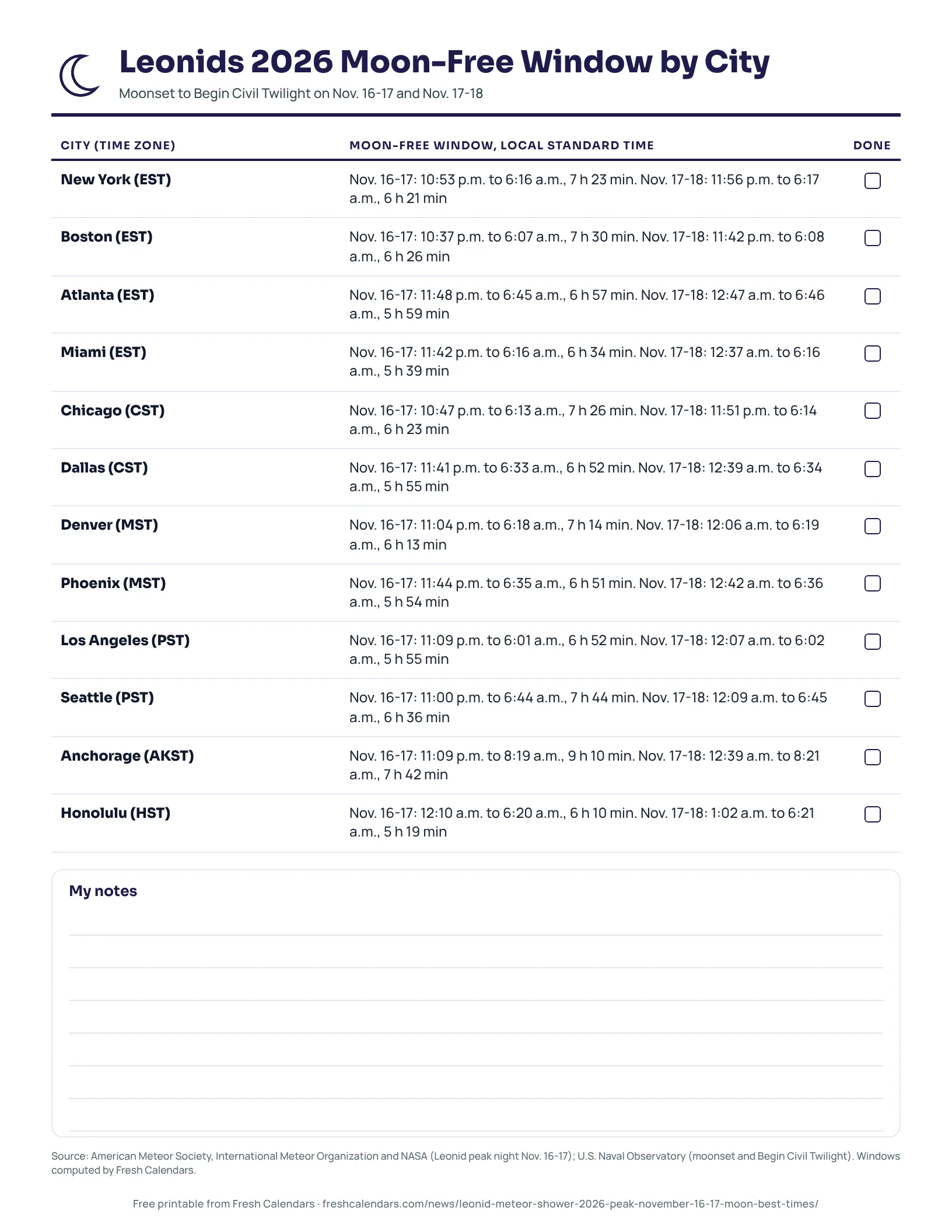
The printable lists both nights’ moonset, Begin Civil Twilight and moon-free hours for all 12 cities on one page, with a Done box for each city.
Free printable downloads
Every template is free, needs no sign-up and prints on US Letter paper. Choose PDF for printing or PNG for screens and documents.
Leonids 2026 Moon-Free Window by City printables
-
Leonids 2026 Moon-Free Window by City
A one-page Leonids 2026 sheet with the moon-free window, from moonset to Begin Civil Twilight, for 12 U.S. cities on Nov. 16-17 and Nov. 17-18.
Frequently asked questions
When is the Leonid meteor shower in 2026?
The AMS, the IMO and NASA list the peak as the night of Nov. 16-17, 2026, which runs from Monday evening to Tuesday morning. The active period is Nov. 6 to Nov. 30 in all three.
What time do the Leonids peak in 2026?
No peak hour has been published. The AMS, the IMO and NASA list the peak as a night, Nov. 16-17, without a time. NASA says the shower is best viewed starting at about midnight local time.
How many Leonids can you see per hour?
NASA says fewer than 3 meteors per hour under dark skies. The parent comet is 55P/Tempel-Tuttle.
Which Leonid night has more moon-free hours, Nov. 16-17 or Nov. 17-18?
Per USNO times, the Moon sets earlier on Nov. 16-17 in all 12 cities in our tables, so that night has more moon-free hours: 51 minutes more in Honolulu and up to 1 h 28 min more in Anchorage.
Is the Moon bright on Leonid peak night?
The AMS puts the Moon at 39% lit, a waxing crescent, on peak night. First Quarter Moon falls at 6:48 a.m. Eastern Standard Time (EST) on Tue., Nov. 17, per the USNO.
Sources
- 2026/2027 Meteor Shower Calendar (American Meteor Society)
- 2026/2027 Meteor Shower Calendar (International Meteor Organization)
- Leonids - NASA Science (NASA, 2026-08-13)
- Complete Sun and Moon Data for One Day (U.S. Naval Observatory)
- Moon phases (U.S. Naval Observatory)
Related news
-
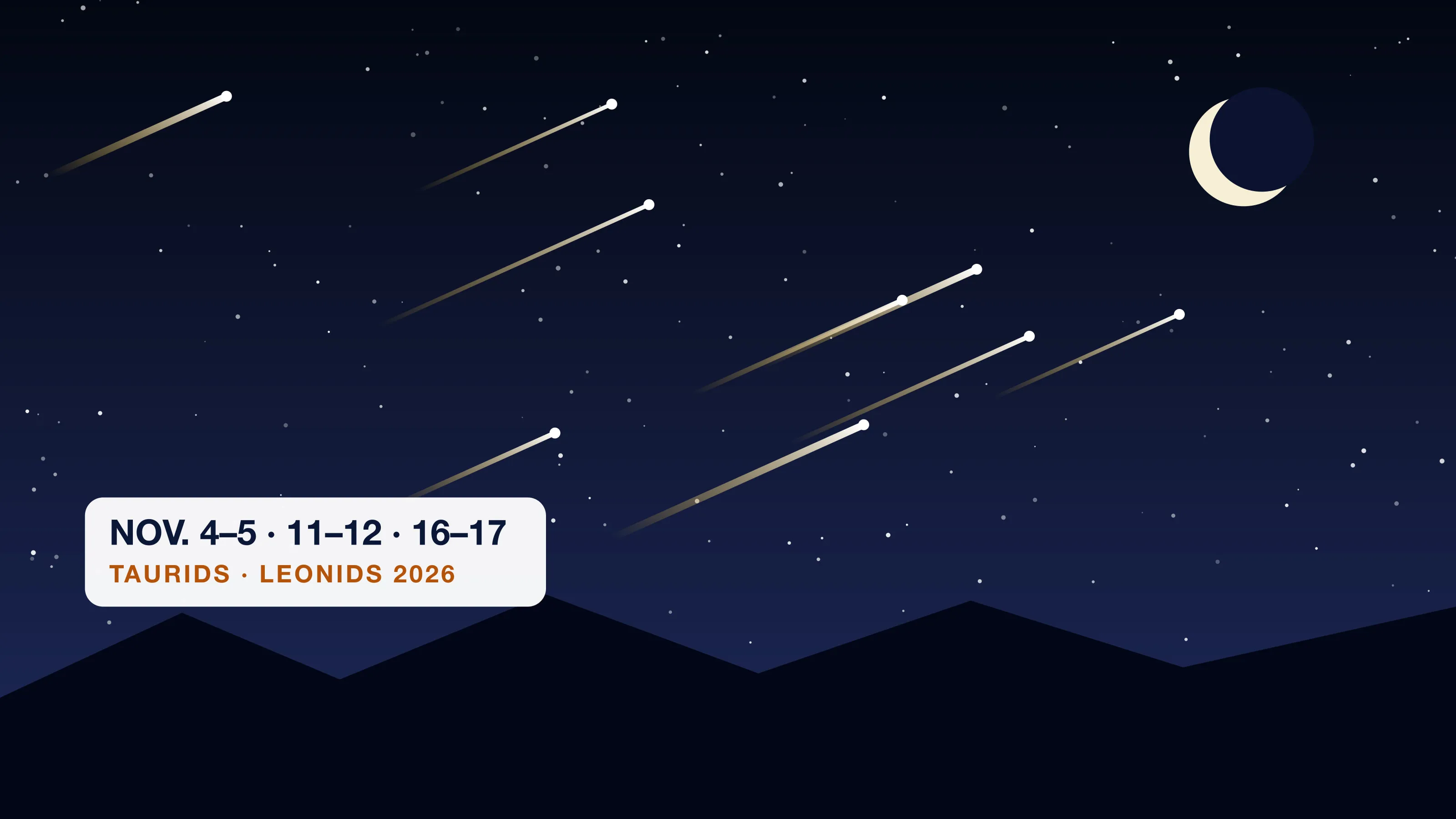 November 2026 Meteor Showers: Taurid Fireballs Under Dark Skies, Then the Leonids on Nov. 16-17
-
 Orionid Meteor Shower 2026 Stays Active Through Nov. 7 After Its Oct. 22 Peak
-
 Planets Visible in November 2026: Night Sky Calendar With the Moon, Venus and Uranus Opposition
-
 Geminid Meteor Shower 2026 Peaks Dec. 13-14: Moonset Times for 12 U.S. Cities
More in Sky Events
All Sky Events stories →- New Year's Eve 2026 Moon: Waning Crescent Rises After Midnight, 1:46 a.m. in New York
- Latest Sunrise 2027: It Comes in Early January, With Dates for 20 U.S. Cities
- Meteor Showers 2027: Peak Dates, Eastern Times and Moon Phase for 12 Showers
- Planets in 2027: Jupiter Opposition Feb. 10, Mars Feb. 19, Saturn Oct. 17 in Eastern Time
- Next Blood Moon in the U.S.: Total Lunar Eclipse June 25, 2029, and Every Eclipse to 2030
Trending now
- When Will We Know the 2026 Election Results? How Counting Works and the Timeline in 17 Key States
- Black Friday Canada 2026: Nov. 27 Date, Canadian Tire Deals From Nov. 5, Who Hasn't Announced
- Black Friday 2026 Deals: Date Is Friday, Nov. 27, Live Countdown and Ad Tracker
- New York Ballot 2026: Sample Ballot, the Governor's Race, NYC's 5 Charter Questions and Key Dates
- Advent Calendar 2026: When to Start, Key Dates, Which Brand Calendars Are Confirmed and 4 Free Printables