Geminid Meteor Shower 2026 Peaks Dec. 13-14: Moonset Times for 12 U.S. Cities
The American Meteor Society (AMS) lists the 2026 Geminid peak as Dec. 13-14, with a 15% lit Moon. Moonset times for 12 U.S. cities and a viewing checklist.

Published 4 min read
In this article
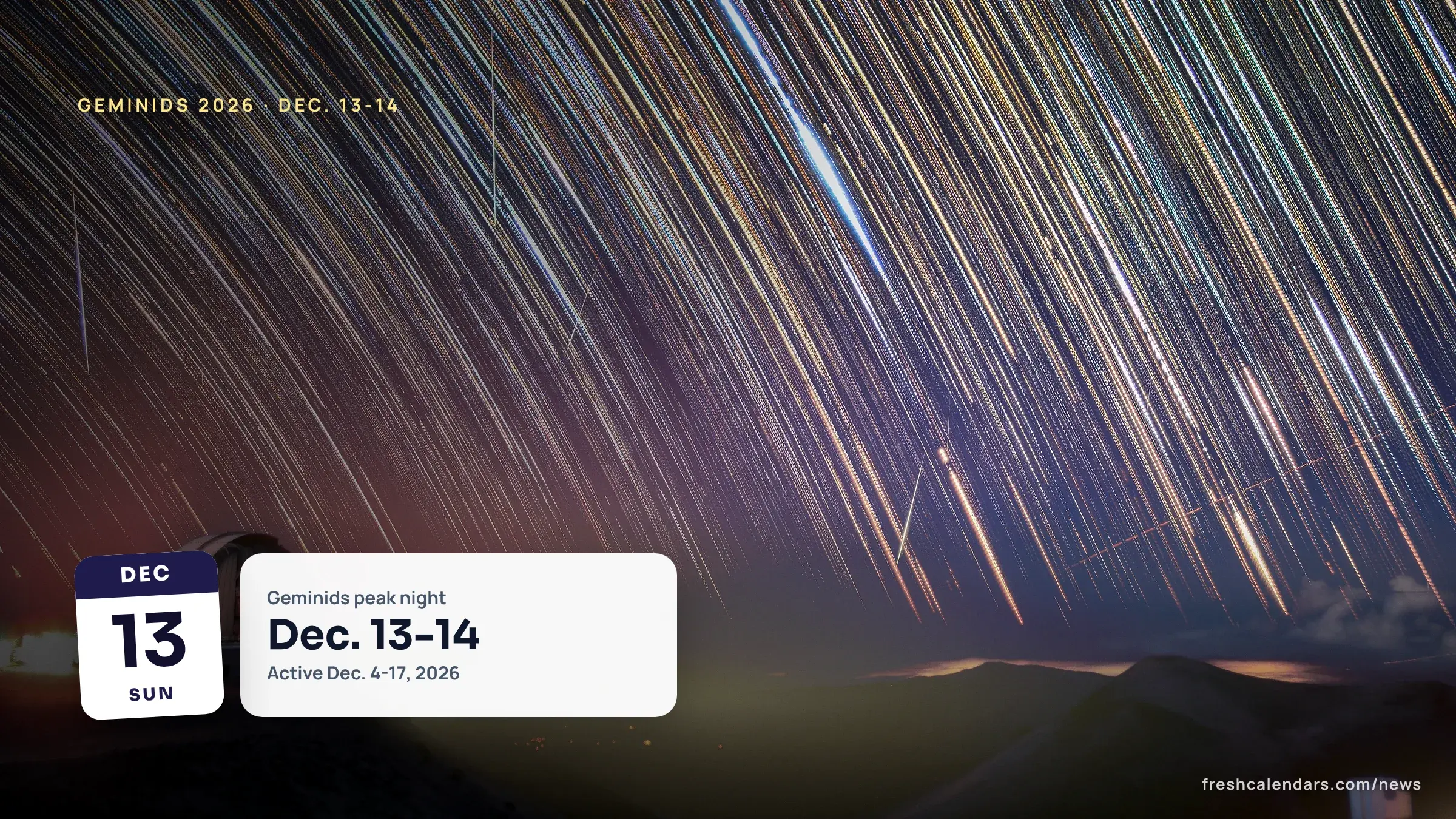
The 2026 Geminid meteor shower peaks the night of Sunday, Dec. 13 to Monday, Dec. 14, according to the American Meteor Society (AMS), the International Meteor Organization (IMO) and the National Aeronautics and Space Administration (NASA). The AMS puts the Moon at 15% lit that night. This story adds the Moon’s setting and rising times for 12 U.S. cities from the U.S. Naval Observatory (USNO), plus a one-page viewing checklist. None of the three sources has published an hour for the peak yet.
Geminid peak and active dates for 2026
All three organizations agree on the dates. The shower runs for two weeks, and the peak night falls on a Sunday into a Monday.
| Source | Peak | Active |
|---|---|---|
| AMS, 2026/2027 Meteor Shower Calendar | Dec. 13-14 | Dec. 4-17 |
| IMO, 2026/2027 Meteor Shower Calendar | Dec. 13-14 | Dec. 4-17 |
| NASA Science, Geminids | Dec. 13-14 | Dec. 4-17 |
Sites that give Dec. 20 as the end date disagree with the AMS, the IMO and NASA, which all list Dec. 17. Mark Dec. 17 on your own calendar, or on the December 2026 printable calendar.
How many Geminids can you see per hour?
NASA says to expect 40 to 50 meteors per hour in dark skies. It adds that 120 Geminid meteors per hour can be seen under perfect conditions.
NASA puts the speed at 22 miles (35 kilometers) per second, and the AMS describes the shower’s velocity as medium-slow.
Moonset and moonrise times for 12 U.S. cities on Geminid peak night
The Moon decides how dark the sky is. The AMS describes the peak night as a 15% lit waxing crescent with “generally favorable lunar conditions, with limited moonlight interference.” The USNO’s listings for the cities below show 18% to 20% lit on Dec. 13 and 26% to 28% on Dec. 14, a different figure from the AMS’s 15%. For viewing, the useful number is when the Moon is below the horizon.
We pulled each city’s times from the USNO rise and set data service for Dec. 13 and Dec. 14, 2026, using the city’s center coordinates and local standard time (December is standard time in every row).
| City | Time zone | Moonset, Sun., Dec. 13 | Sunrise, Mon., Dec. 14 | Moonrise, Mon., Dec. 14 |
|---|---|---|---|---|
| New York | Eastern | 8:43 p.m. | 7:12 a.m. | 10:55 a.m. |
| Boston | Eastern | 8:27 p.m. | 7:06 a.m. | 10:46 a.m. |
| Atlanta | Eastern | 9:40 p.m. | 7:34 a.m. | 11:26 a.m. |
| Miami | Eastern | 9:35 p.m. | 6:59 a.m. | 10:58 a.m. |
| Chicago | Central | 8:37 p.m. | 7:10 a.m. | 10:52 a.m. |
| Dallas | Central | 9:33 p.m. | 7:22 a.m. | 11:15 a.m. |
| Denver | Mountain | 8:54 p.m. | 7:13 a.m. | 10:59 a.m. |
| Phoenix | Mountain | 9:36 p.m. | 7:24 a.m. | 11:18 a.m. |
| Los Angeles | Pacific | 9:00 p.m. | 6:51 a.m. | 10:44 a.m. |
| Seattle | Pacific | 8:48 p.m. | 7:50 a.m. | 11:24 a.m. |
| Anchorage | Alaska | 8:50 p.m. | 10:08 a.m. | 12:54 p.m. |
| Honolulu | Hawaii | 10:04 p.m. | 7:01 a.m. | 11:11 a.m. |
In all 12 cities the Moon has set by 10:04 p.m. on Dec. 13, and it rises after sunrise on Dec. 14. The Moon is therefore below the horizon for the whole night in every city listed. Times for other places differ; the USNO’s rise and set page takes any U.S. location.
How does the 2026 Moon compare with 2025?
At a point near 39.0 degrees north, 95.0 degrees west, the USNO lists the Moon on Dec. 13, 2025 as a 32% waning crescent that rose at 1:34 a.m. and set at 1:10 p.m. (Central Standard Time). On Dec. 13, 2026 at the same point it is a 19% waxing crescent that sets at 9:14 p.m. In 2026 the Moon stays down from 9:14 p.m. on Dec. 13 until moonrise at 11:17 a.m. on Dec. 14 at that point.
How to watch the Geminids: NASA’s tips
NASA’s viewing advice is short and applies to any location:
- Find an area well away from city and street lights.
- Lie flat on your back with your feet facing south.
- Give your eyes about 30 minutes in the dark to adapt.
- Dress for winter, and bring a sleeping bag, blanket or lawn chair.
- Plan for a long watch: NASA says the show lasts until dawn.
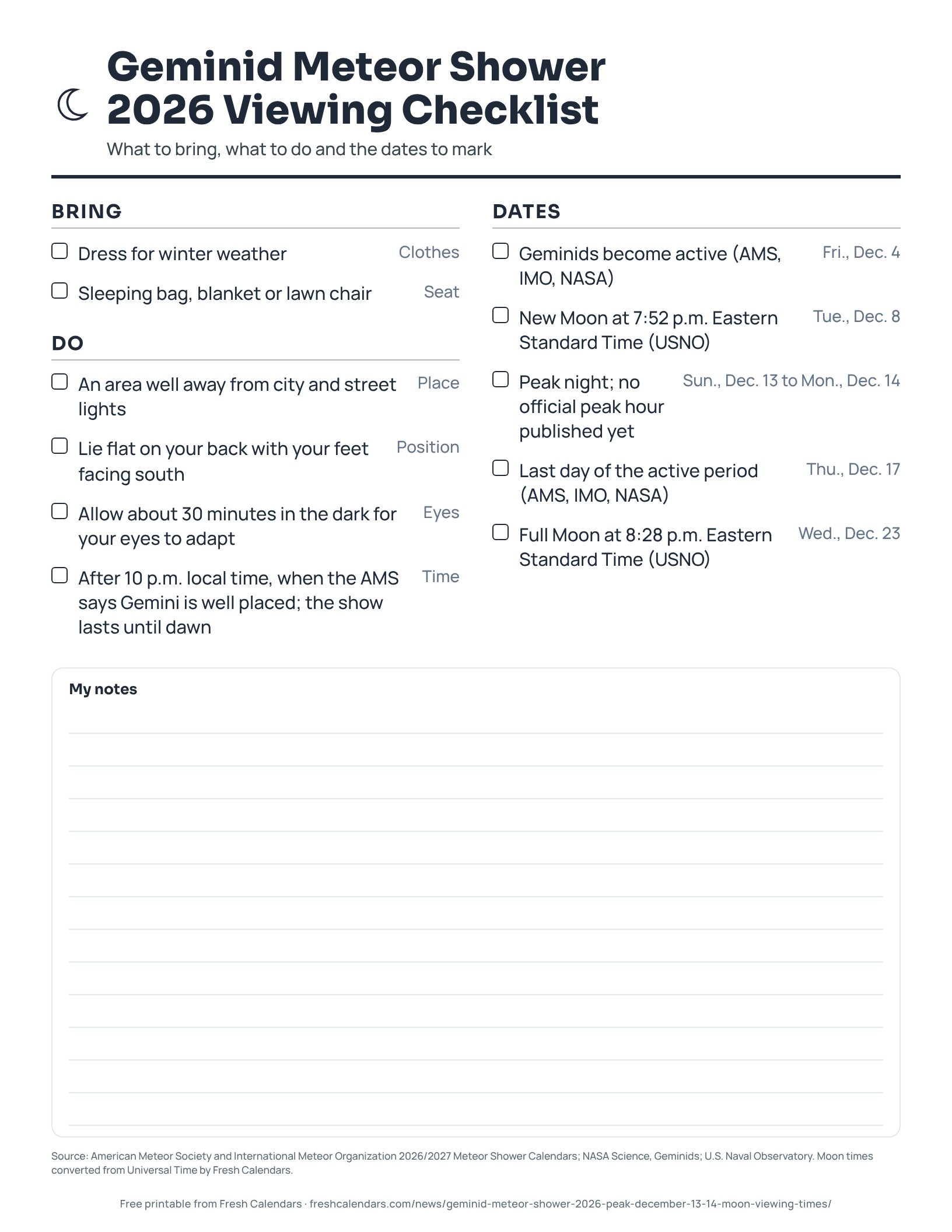
The AMS says the constellation Gemini is well placed from 10 p.m. local time onward. The printable below puts the list on one sheet.
Geminid dates to mark, Dec. 4 to Dec. 23
| Date | What happens | Source |
|---|---|---|
| Fri., Dec. 4 | Geminids become active | AMS, IMO, NASA |
| Tue., Dec. 8 | New Moon at 7:52 p.m. Eastern Standard Time (EST), which is 00:52 Universal Time (UT) on Dec. 9 | USNO |
| Sun., Dec. 13 to Mon., Dec. 14 | Peak night | AMS, IMO, NASA |
| Thu., Dec. 17 | Last day of the active period | AMS, IMO, NASA |
| Wed., Dec. 23 | Full Moon at 8:28 p.m. EST, which is 01:28 UT on Dec. 24 | USNO |
The USNO lists its phase times in UT. The EST conversions are Fresh Calendars’ arithmetic, five hours behind UT. For the full moon on Dec. 23 and what else is in the sky that month, see our Cold Moon, Geminids and solstice story and the December 2026 planets and night sky calendar. The solstice comes a week after the peak; our winter solstice 2026 story has the time and sunset times. Other dates can go on the printable yearly calendar.
Where do the Geminids come from?
NASA says the Geminids come from 3200 Phaethon, which it describes as an asteroid or possibly a “rock comet” that orbits the Sun once every 1.4 years. A Japanese mission to Phaethon is planned. The German Aerospace Center (DLR) said on May 28, 2026 that its launch is scheduled for 2028, and the Japan Aerospace Exploration Agency (JAXA) lists the Phaethon flyby in fiscal year 2030 on its mission page.
Free printable downloads
Every template is free, needs no sign-up and prints on US Letter paper. Choose PDF for printing or PNG for screens and documents.
Geminid Meteor Shower 2026 Viewing Checklist printables
-
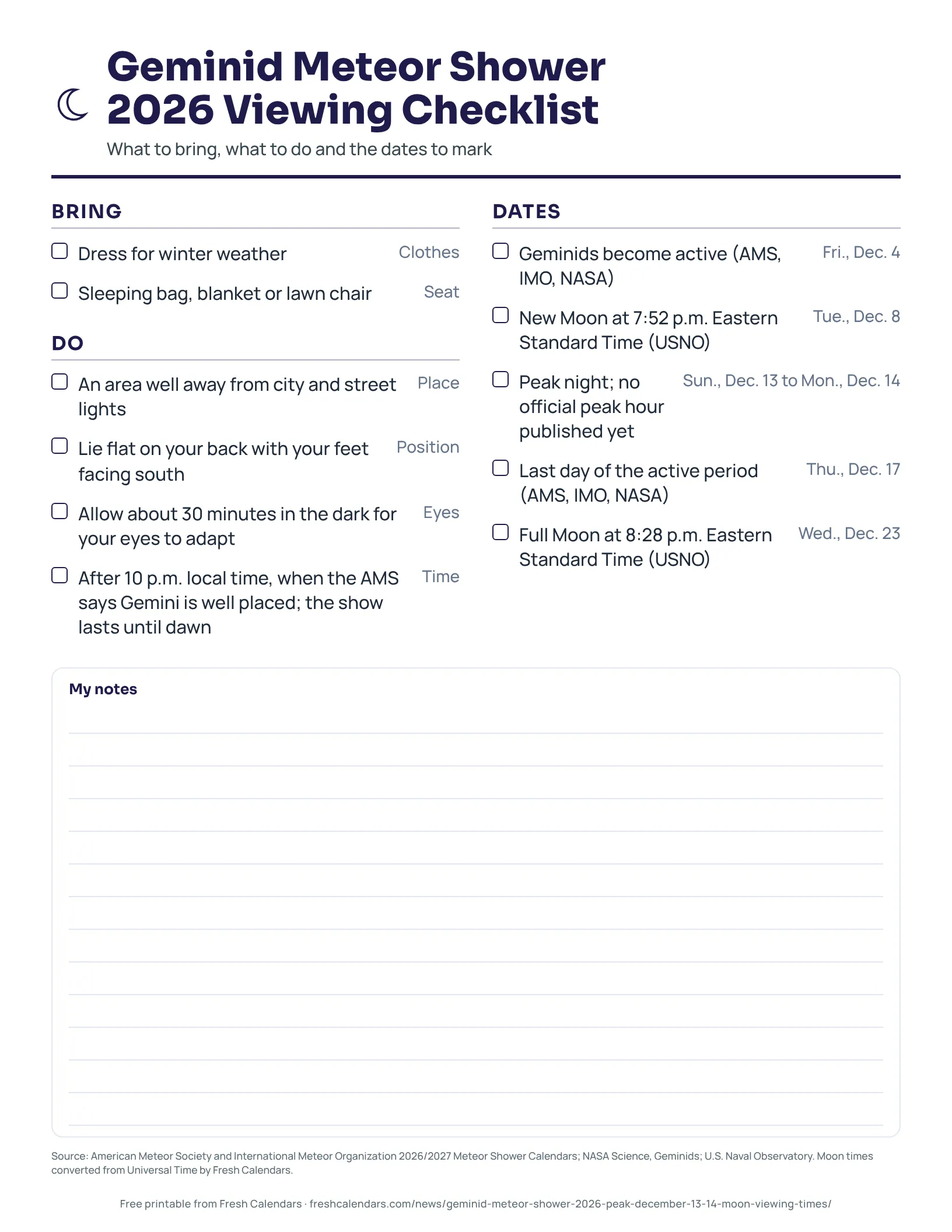
Geminid Meteor Shower 2026 Viewing Checklist
A one-page Geminid meteor shower 2026 checklist: what to bring, how to watch, and the dates from Dec. 4 activity to the Dec. 23 Full Moon.
-
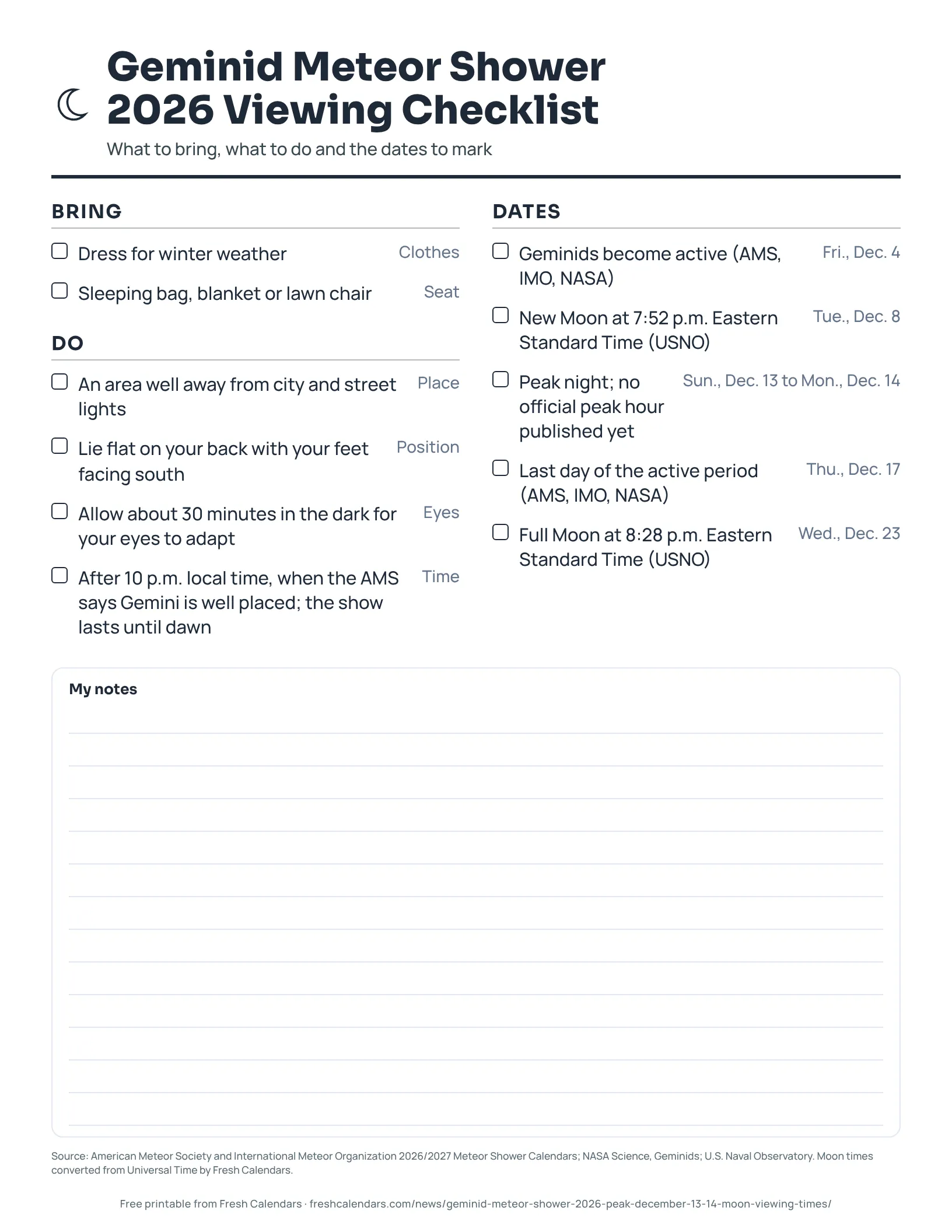
Geminid Meteor Shower 2026 Viewing Checklist (ink saver)
A one-page Geminid meteor shower 2026 checklist: what to bring, how to watch, and the dates from Dec. 4 activity to the Dec. 23 Full Moon. Ink-saver version.
Frequently asked questions
When is the Geminid meteor shower in 2026?
The AMS, the IMO and NASA list the peak as the night of Dec. 13-14, 2026, which runs from Sunday evening to Monday morning. The shower is active from Dec. 4 to Dec. 17.
How many Geminids can you see per hour?
NASA says to expect 40 to 50 meteors per hour in dark skies, and that up to 120 Geminids per hour can be seen under perfect conditions.
Will the Moon interfere with the Geminids in 2026?
The AMS lists the Moon as a 15% lit waxing crescent on the peak night, with generally favorable lunar conditions and limited moonlight interference. USNO times show it setting in the evening of Dec. 13 in the 12 U.S. cities in our table.
Sources
- 2026/2027 Meteor Shower Calendar (American Meteor Society)
- 2026/2027 Meteor Shower Calendar (International Meteor Organization)
- Geminids - NASA Science (National Aeronautics and Space Administration, 2026-08-13)
- Complete Sun and Moon Data for One Day (U.S. Naval Observatory)
- Phases of the Moon 2026 (U.S. Naval Observatory)
- Dust analyzer: understanding the formation of the solar system through cosmic dust (German Aerospace Center (DLR), 2026-05-28)
- Mission to Phaethon (Japan Aerospace Exploration Agency (JAXA))
Related news
-
 Two Supermoons Close 2026: Beaver Moon Nov. 24, Cold Moon Dec. 23, Plus Geminids and the Solstice
-
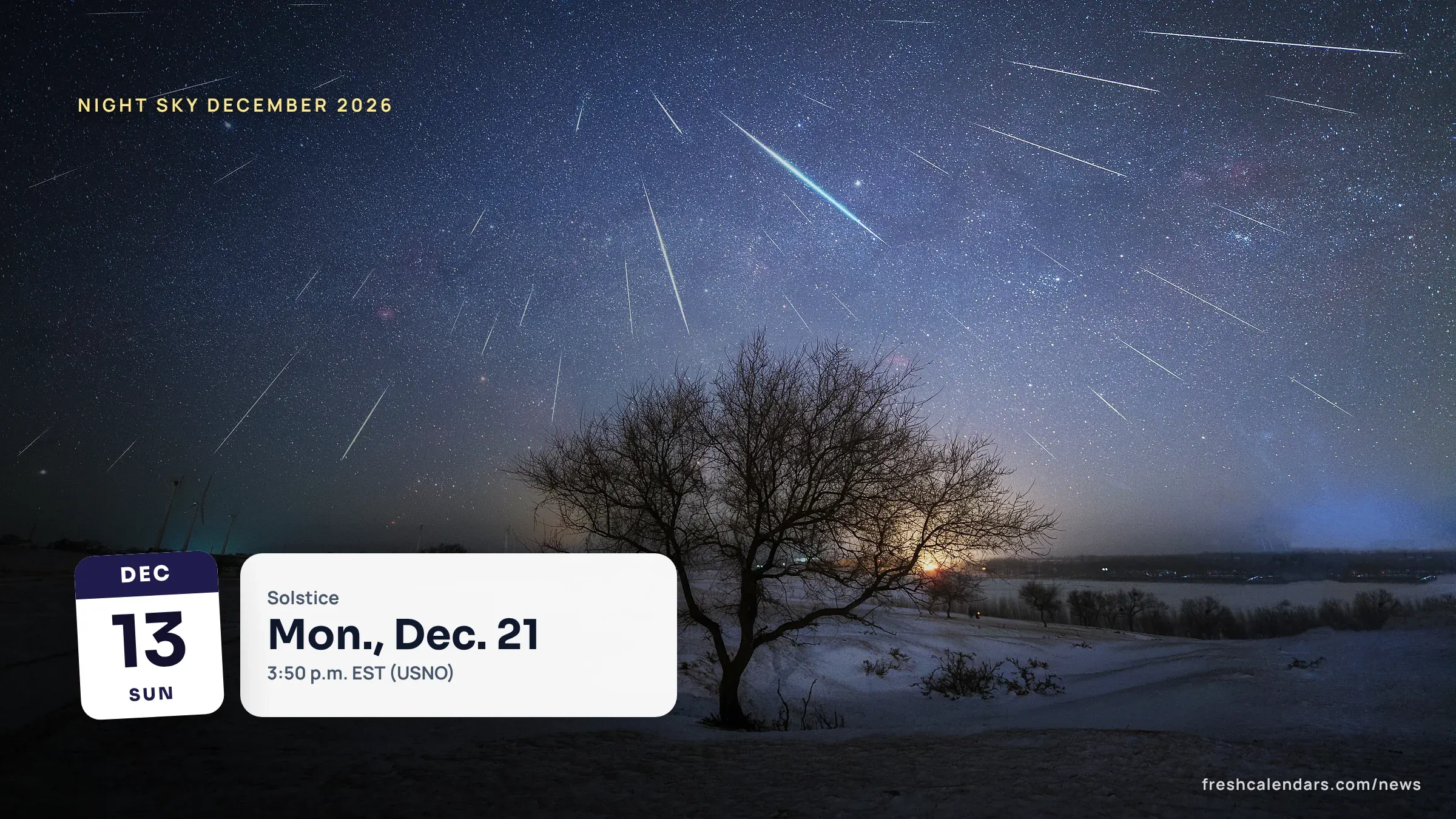 Planets Visible in December 2026: Night Sky Calendar With the Geminids and the Solstice
-
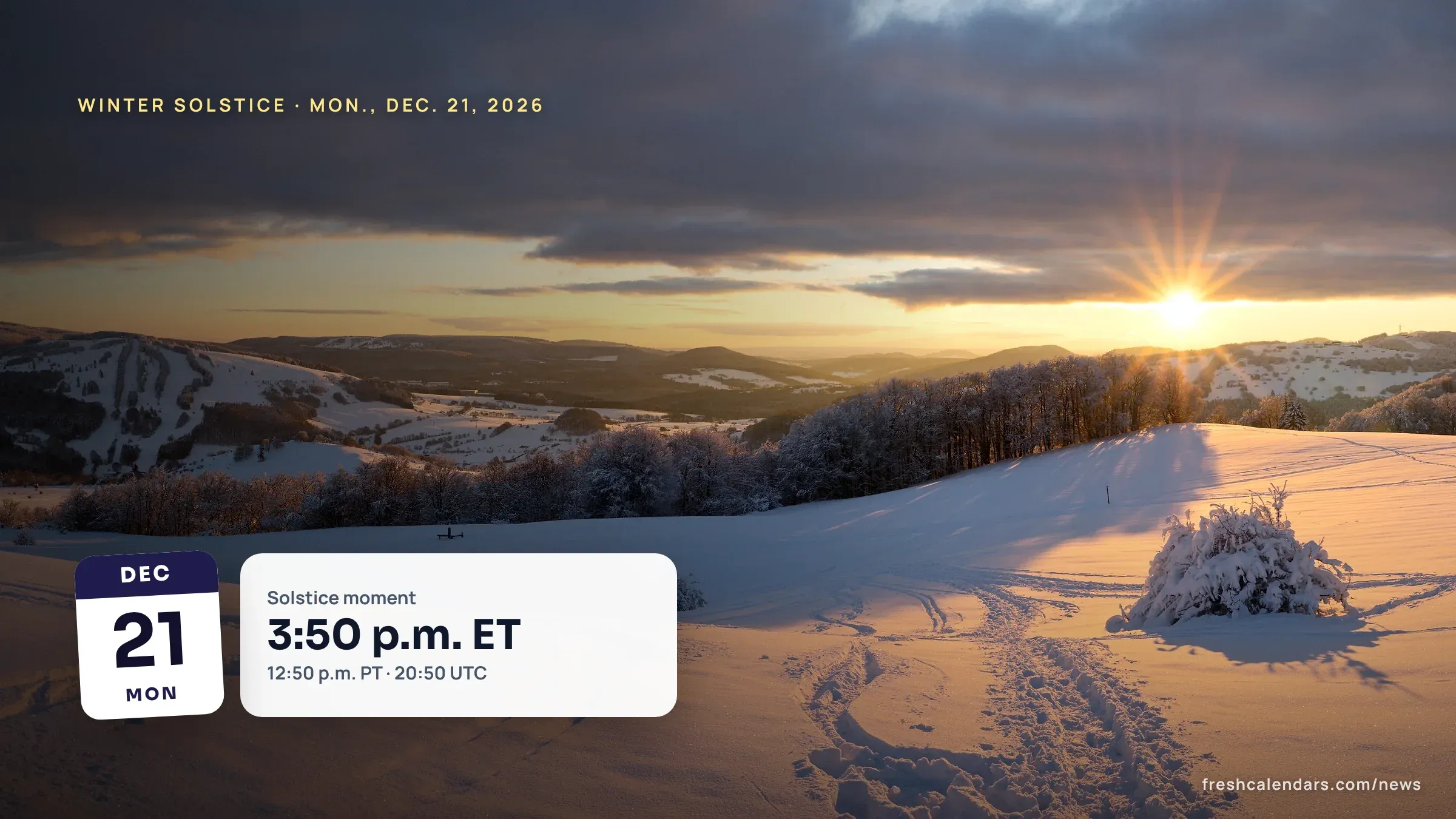 Winter Solstice 2026: Shortest Day Is Dec. 21 at 3:50 p.m. ET, With Sunset Times for 8 U.S. Cities
-
 Orionid Meteor Shower 2026 Stays Active Through Nov. 7 After Its Oct. 22 Peak
More in Sky Events
All Sky Events stories →- Meteor Showers 2027: Peak Dates, Eastern Times and Moon Phase for 12 Showers
- Planets in 2027: Jupiter Opposition Feb. 10, Mars Feb. 19, Saturn Oct. 17 in Eastern Time
- Next Blood Moon in the U.S.: Total Lunar Eclipse June 25, 2029, and Every Eclipse to 2030
- Next Solar Eclipse in the US: Total in Alaska in 2033, Lower 48 on Aug. 22, 2044
- Total Solar Eclipse Aug. 2, 2027: Totality Times by City in Spain and Egypt
Trending now
- Black Friday 2026 Deals: Date Is Friday, Nov. 27, Live Countdown and Ad Tracker
- Day of the Dead 2026: Día de los Muertos Dates, Traditions and Events
- Veterans Day Free Meals 2026: 44 Chains Confirmed, 13 Discounts and a Printable List
- Black Friday Canada 2026: Nov. 27 Date, Canadian Tire Deals From Nov. 5, Who Hasn't Announced
- November 2026 Meteor Showers: Taurid Fireballs Under Dark Skies, Then the Leonids on Nov. 16-17