Planets in December 2026: Geminids Dec. 13-14, Solstice Dec. 21
Planets visible in December 2026: Venus rises about 3:24 a.m. EST in New York on Dec. 15; Jupiter and Mars rise before midnight. Day-by-day sky table.

Published Updated 5 min read
Key dates
In this article
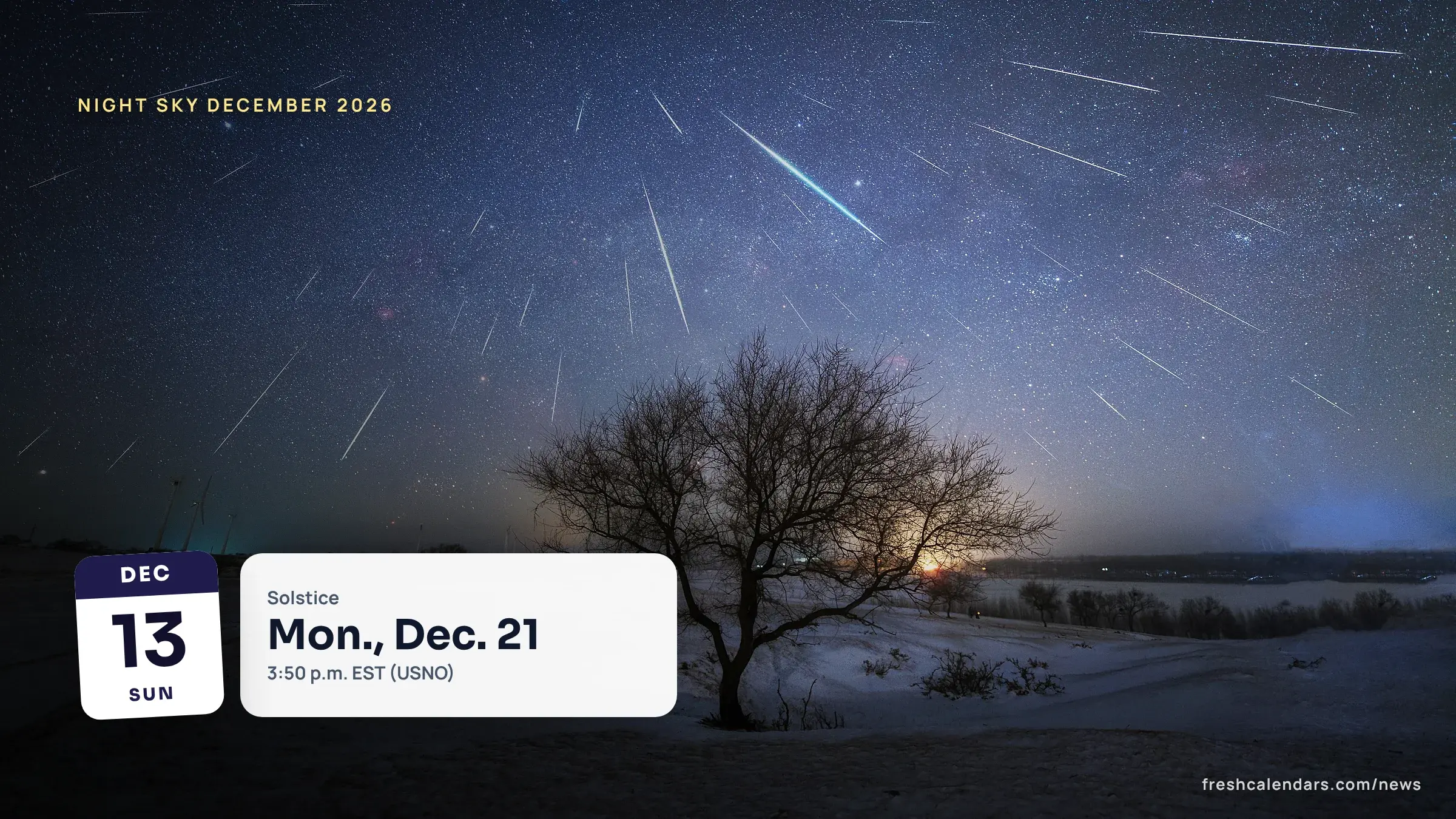
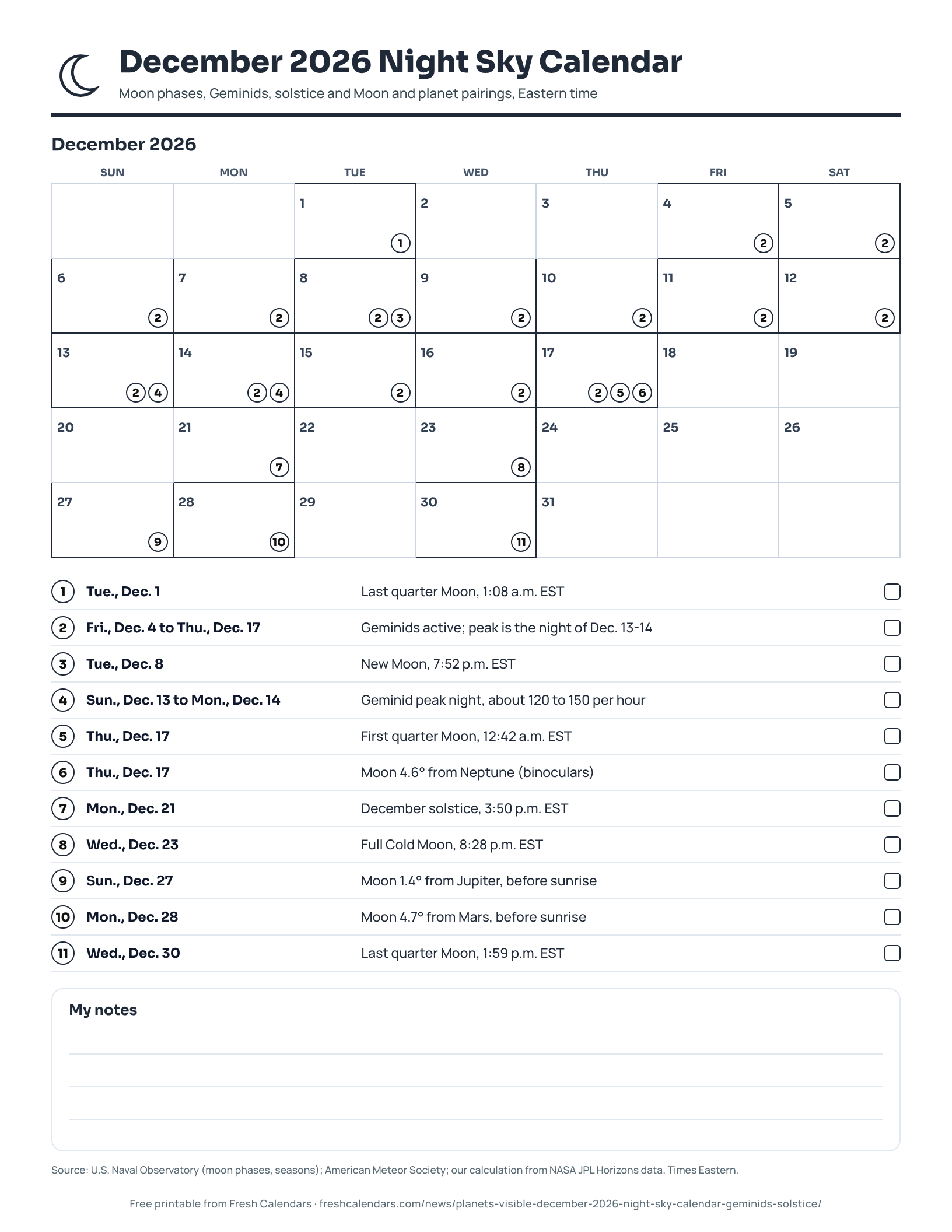
The Moon passes about 1.4° from Jupiter on Sunday, Dec. 27, 2026, the Geminid meteor shower peaks the night of Dec. 13-14 and the December solstice arrives on Monday, Dec. 21 at 3:50 p.m. Eastern Standard Time (EST), according to the U.S. Naval Observatory (USNO) and our night sky calendar computed from NASA Jet Propulsion Laboratory (JPL) Horizons data. NASA’s “What’s Up” guide for December 2026 was not online as of Nov. 16, so we calculated the planet events ourselves and took the Moon phases and the solstice from the USNO.
All times are Eastern Standard Time. Print the same dates on one page with the December 2026 night sky calendar printable.
What is happening in the night sky each day of December 2026?
| Date (Eastern) | Event | When and where to look | How close |
|---|---|---|---|
| Tue., Dec. 1 | Last quarter Moon | 1:08 a.m. EST (06:08 Universal Time, UT) | Moon phase |
| Fri., Dec. 4 to Thu., Dec. 17 | Geminids active | Peak night is Dec. 13-14 | Meteor shower |
| Tue., Dec. 8 | New Moon | 7:52 p.m. EST (00:52 UT on Dec. 9) | Moon phase |
| Sun., Dec. 13 to Mon., Dec. 14 | Geminids peak | After about 10 p.m. local time | 15% waxing crescent Moon |
| Thu., Dec. 17 | First quarter Moon | 12:42 a.m. EST (05:42 UT) | Moon phase |
| Thu., Dec. 17 | Moon and Neptune | About noon; binoculars or a telescope only (magnitude 7.9) | About 4.6° |
| Mon., Dec. 21 | December solstice | 3:50 p.m. EST (20:50 UT) | Shortest day in the Northern Hemisphere |
| Mon., Dec. 21 to Tue., Dec. 22 | Ursids peak | Before dawn | About 5 to 10 per hour; 89% Moon |
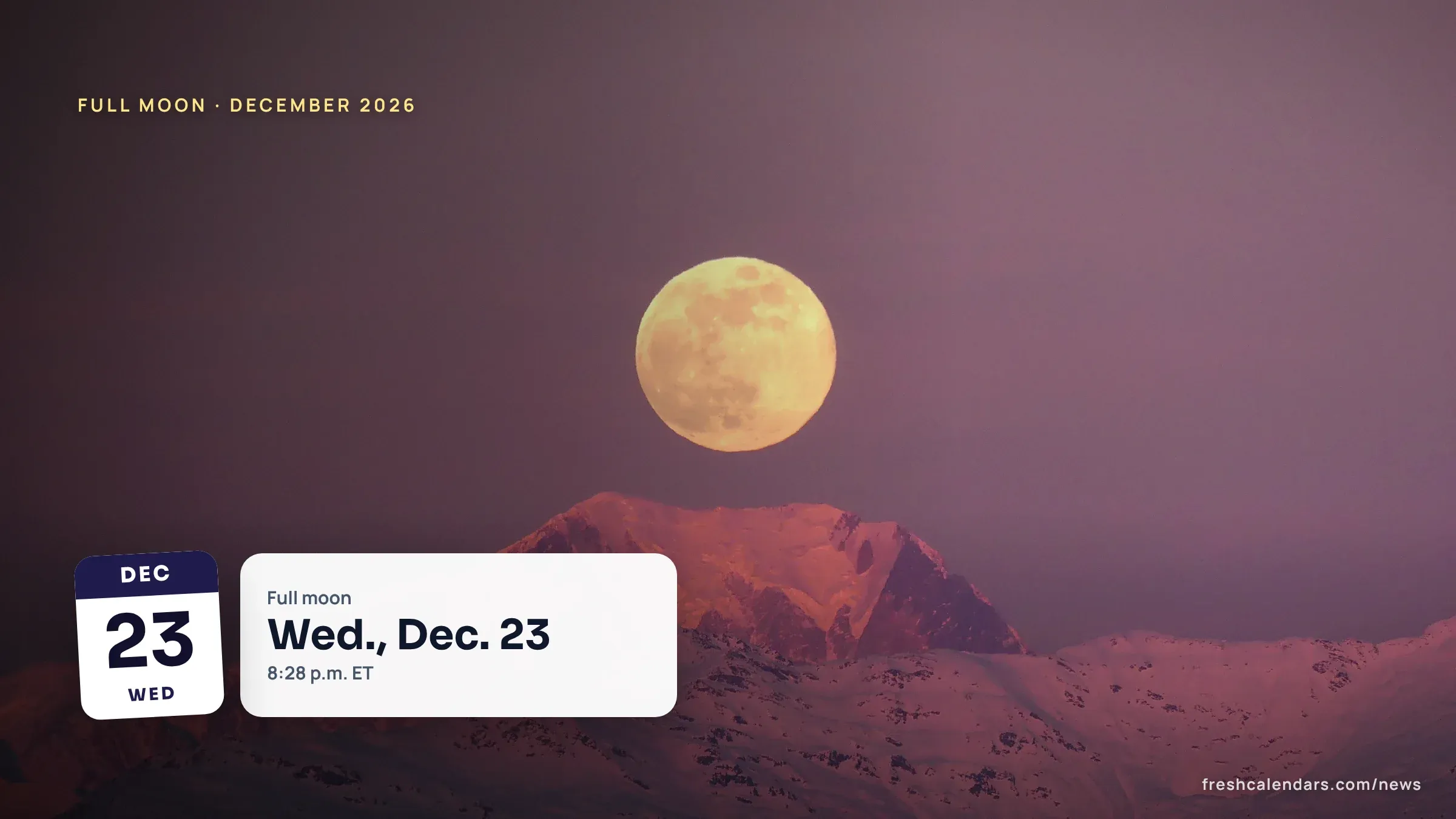
| Wed., Dec. 23 | Full Moon (Cold Moon) | 8:28 p.m. EST (01:28 UT on Dec. 24) | Moon phase |
| Sun., Dec. 27 | Moon and Jupiter | About 11:30 a.m.; look before sunrise, when the gap is about 4.1° at 5 a.m. | About 1.4° |
| Mon., Dec. 28 | Moon and Mars | About 8:30 a.m.; look before sunrise, when the gap is about 5.1° at 5 a.m. | About 4.7° |
| Wed., Dec. 30 | Last quarter Moon | 1:59 p.m. EST (18:59 UT) | Moon phase |
Separations are center to center as seen from Earth’s center. From any one city the Moon’s apparent position can differ by up to about 1°, so every figure is approximate. The planet times come from our calculation with the open-source Astronomy Engine, which we checked against JPL Horizons: for Jupiter on Dec. 27 at 10:00 a.m. EST the two agree on its distance from the Sun in the sky to 0.001° (129.178°), and the Moon’s position matches within 0.005°. The Moon phases and the solstice come from the USNO.
Two Moon pairings fall just outside our 5° cutoff. The waning Moon is about 6.6° from Venus around midnight EST on Dec. 5, and the waxing Moon is about 6.2° from Saturn at about 11:40 p.m. EST on Dec. 17.
Which planets are visible in December 2026?
Venus, Jupiter and Mars are morning planets and Saturn is an evening planet in December, according to our calculation. The rise times are for New York, on Dec. 15.
| Planet | Distance from the Sun in the sky | Brightness (magnitude) | New York, Dec. 15 |
|---|---|---|---|
| Venus | 41° on Dec. 1, 45° on Dec. 15, 47° on Dec. 31 | About -4.9 to -4.6 | Rises about 3:24 a.m. |
| Mars | 97° on Dec. 1, 107° on Dec. 15, 120° on Dec. 31 | About +0.5 to -0.1 | Rises about 10:11 p.m. |
| Jupiter | 103° on Dec. 1, 117° on Dec. 15, 134° on Dec. 31 | About -2.2 to -2.4 | Rises about 9:24 p.m. |
| Saturn | 118° on Dec. 1, 104° on Dec. 15, 88° on Dec. 31 | About +0.6 to +0.7 | Sets about 1 a.m. |
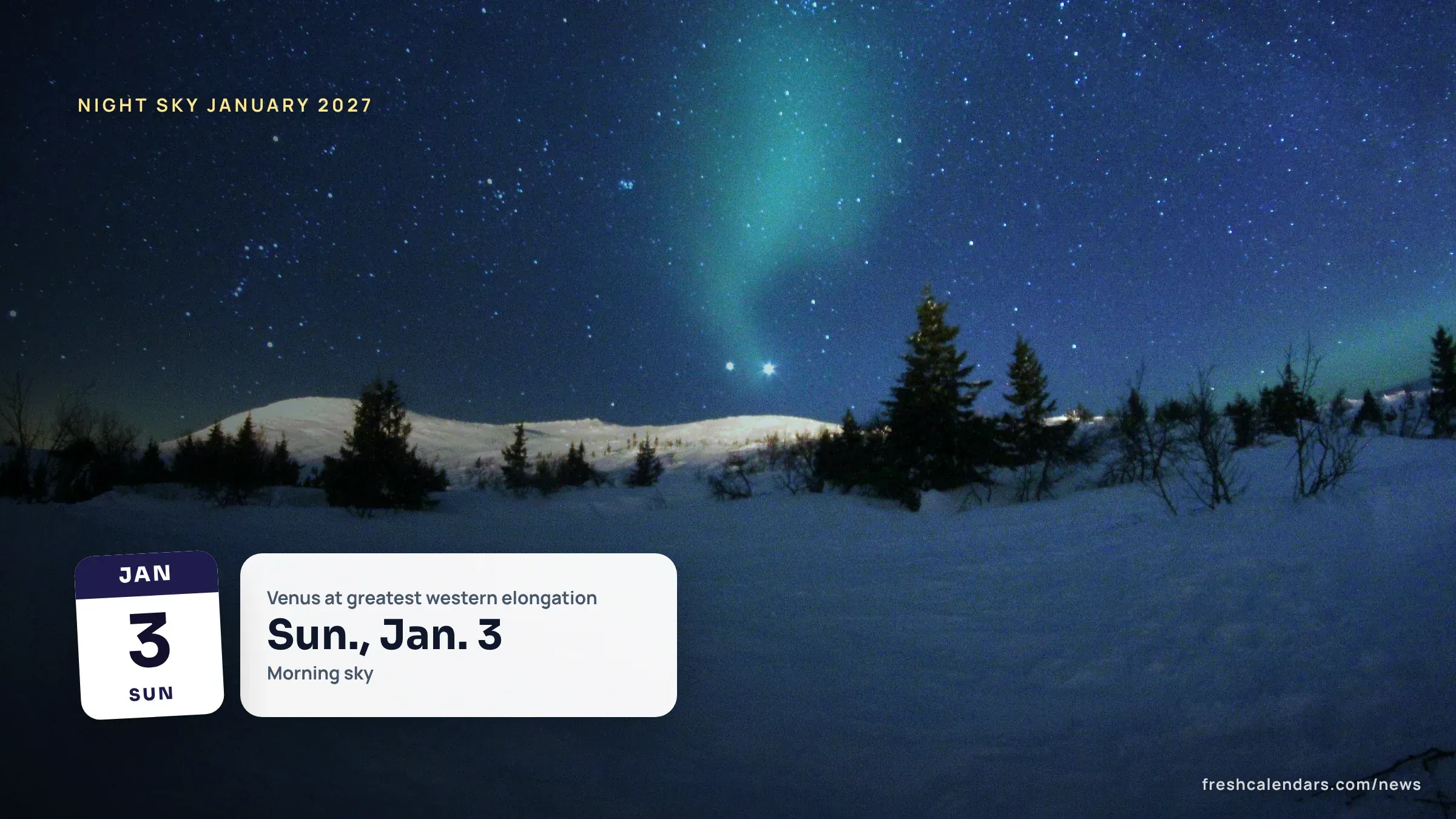
Lower magnitudes are brighter. Venus is the brightest of the four and rises before the Sun; sunrise in New York is at 7:12 a.m. on Dec. 15. Its angle from the Sun keeps growing; Venus reaches its greatest western elongation, 47.0°, at about 12:56 p.m. EST on Jan. 3, 2027, just after this month ends.
Jupiter and Mars rise before midnight and stay up until dawn, so they are the planets to find on a late night or an early morning. Saturn is the evening planet, setting around 1 a.m. in New York in mid-December.
Can I see Mercury, Uranus and Neptune?
Mercury is a poor target. It is in the morning sky but only 16.5° from the Sun on Dec. 1 and 9.4° on Dec. 15, and it rises 85 minutes before the Sun in New York on Dec. 1 and 42 minutes before it on Dec. 15. By Dec. 31 it is 1.8° from the Sun.
Uranus (magnitude 5.6) and Neptune (magnitude 7.9) are evening planets. Uranus is at the edge of naked-eye visibility from very dark sites, and Neptune needs binoculars or a telescope; the Moon passes about 4.6° from Neptune on Dec. 17.
How good are the Geminids in 2026?
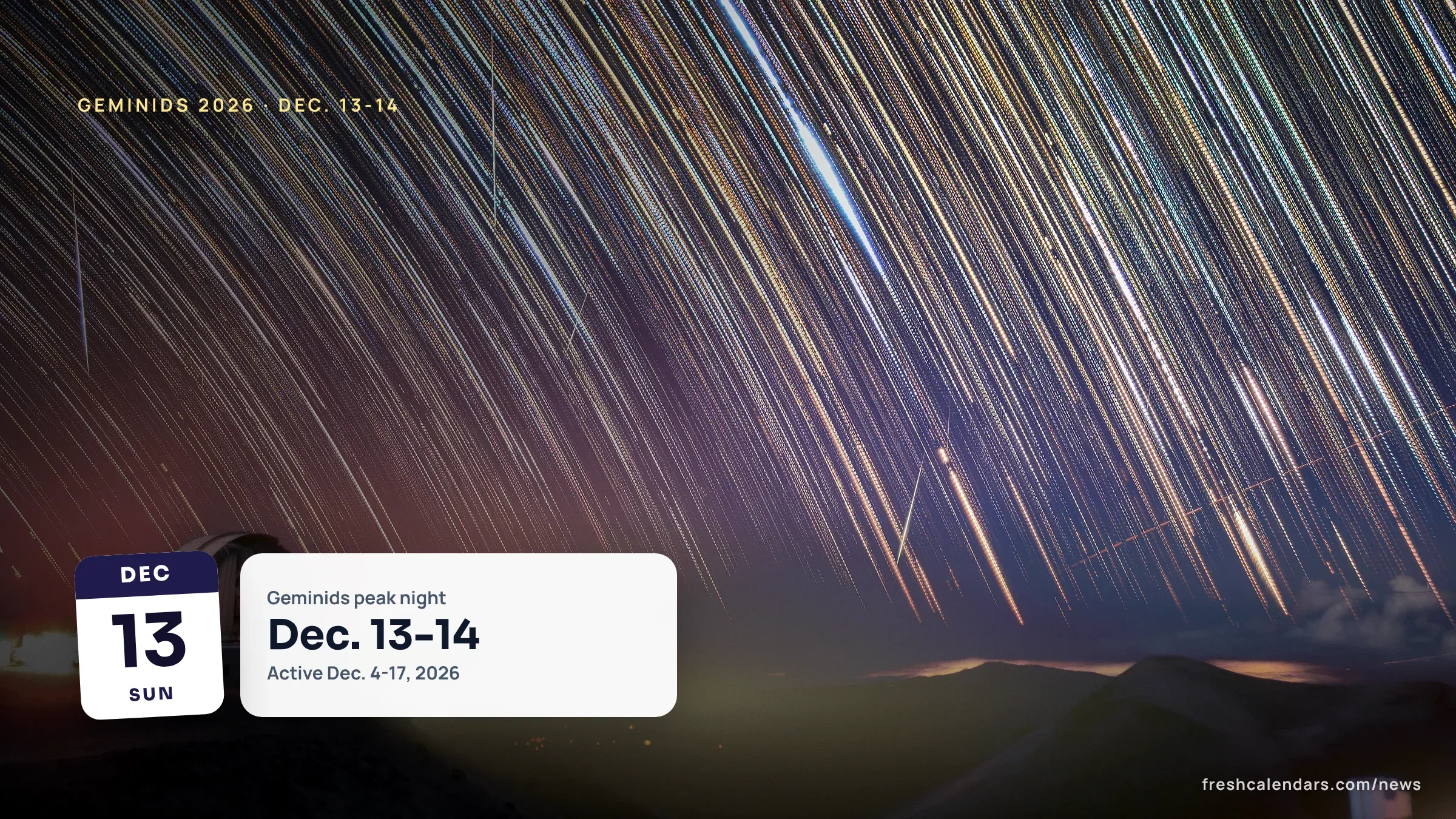
The Geminid meteor shower is active from Dec. 4 to Dec. 17 and peaks the night of Sunday, Dec. 13 into Monday, Dec. 14, 2026, according to the American Meteor Society (AMS). The AMS says the Geminids are usually the strongest meteor shower of the year and the one major shower with good activity before midnight. The Moon is a thin waxing crescent, 15% illuminated, that night, five days after the Dec. 8 new moon in the U.S. Naval Observatory table.
The AMS says the constellation Gemini is well placed from about 10 p.m. local time, so that is when to start watching. Our Cold Moon, Geminids and solstice guide has the viewing tips and the full list of December sky events.
The Ursid meteor shower is active from Dec. 17 to Dec. 26 and peaks the night of Dec. 21-22, the AMS says. Observers normally see 5 to 10 Ursids per hour in the hours before dawn, with occasional outbursts above 25 per hour. The Moon is 89% illuminated that night, so the AMS expects significant interference while it is above the horizon.
What time is the December 2026 solstice?
The December solstice falls on Monday, Dec. 21, 2026, at 3:50 p.m. EST (20:50 UT), the USNO says. For sunset times and the length of the day, see our winter solstice guide. The Cold Moon is full two days later, at 8:28 p.m. EST on Wednesday, Dec. 23, by the same USNO table.
Where do these times come from?
NASA’s skywatching series, “What’s Up,” had not posted a December 2026 edition as of Nov. 16, 2026. We did not copy another site. We computed positions with Astronomy Engine, checked them against the NASA JPL Horizons ephemeris, and converted from UT to Eastern time. Moon phases and the solstice are from the USNO moon phases table and the USNO seasons table, and the Geminid and Ursid dates and Moon conditions are from the AMS meteor shower calendar. Planet events are rounded to the half hour, so an event can fall within an hour of the time shown. For last month’s events, see the November 2026 night sky calendar, and mark December’s dates on a December 2026 printable calendar or a 2027 yearly calendar.
Free printable downloads
Every template is free, needs no sign-up and prints on US Letter paper. Choose PDF for printing or PNG for screens and documents.
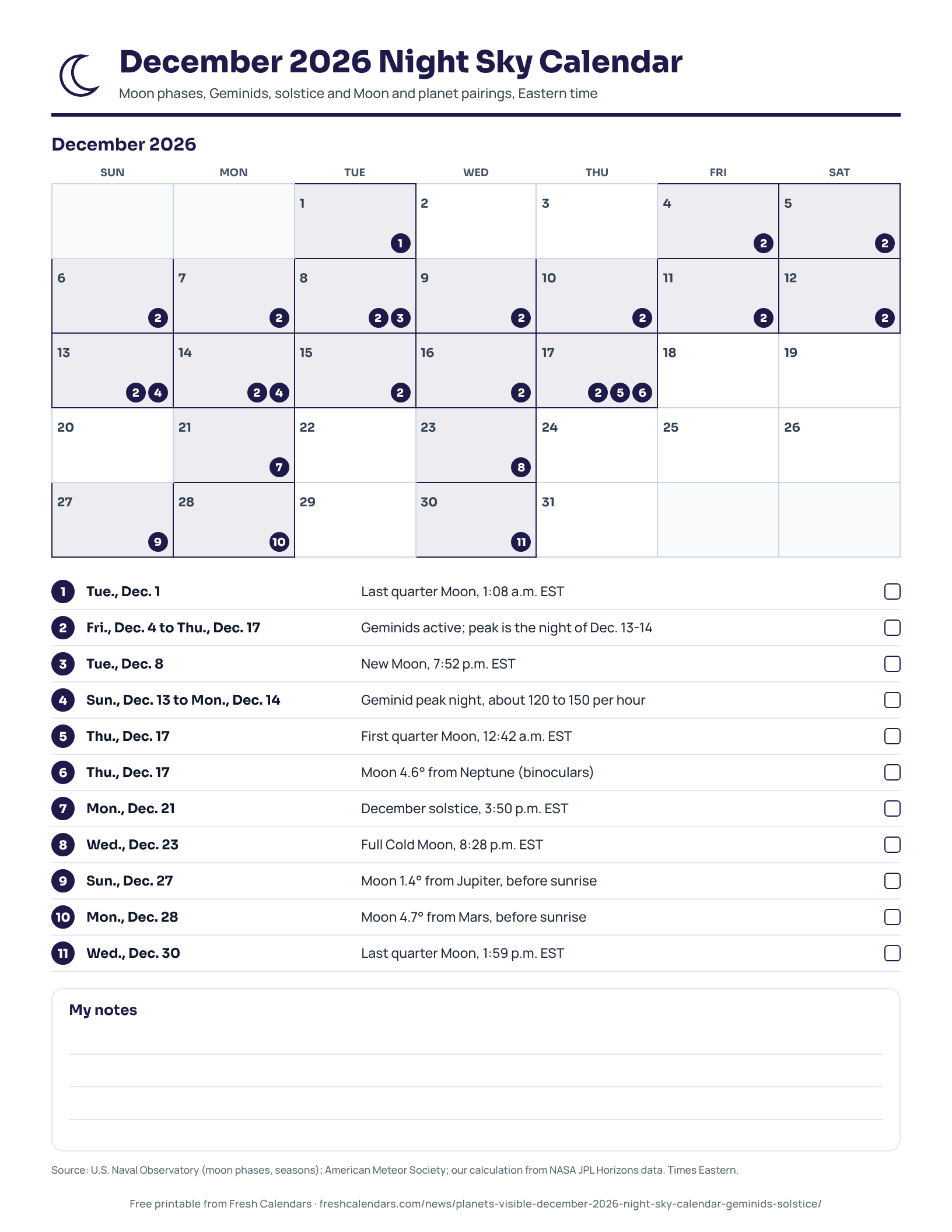
December 2026 Night Sky Calendar printables
-
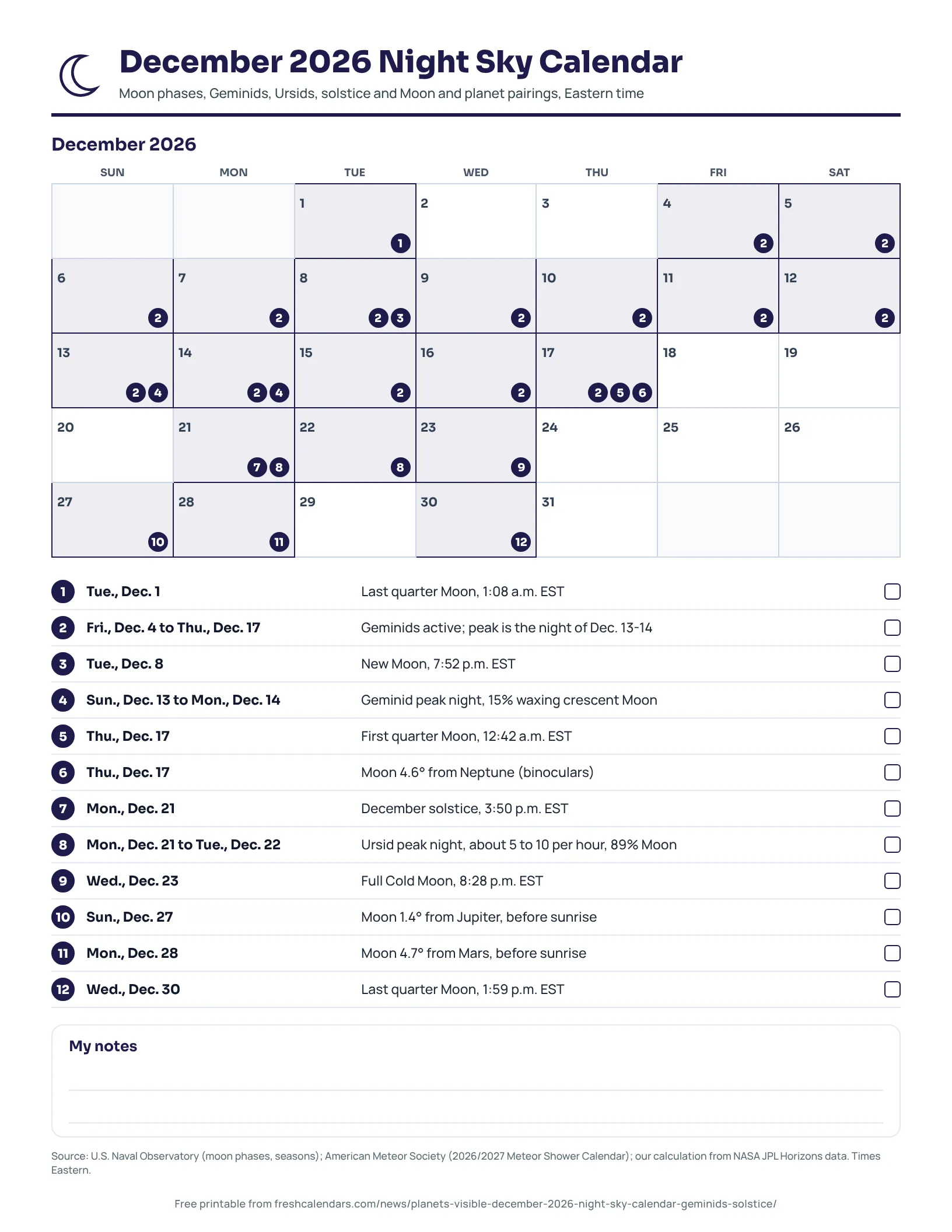
December 2026 Night Sky Calendar
A one-page December 2026 night sky calendar with moon phases, the Geminids, the solstice and Moon pairings with Jupiter, Mars and Neptune.
-
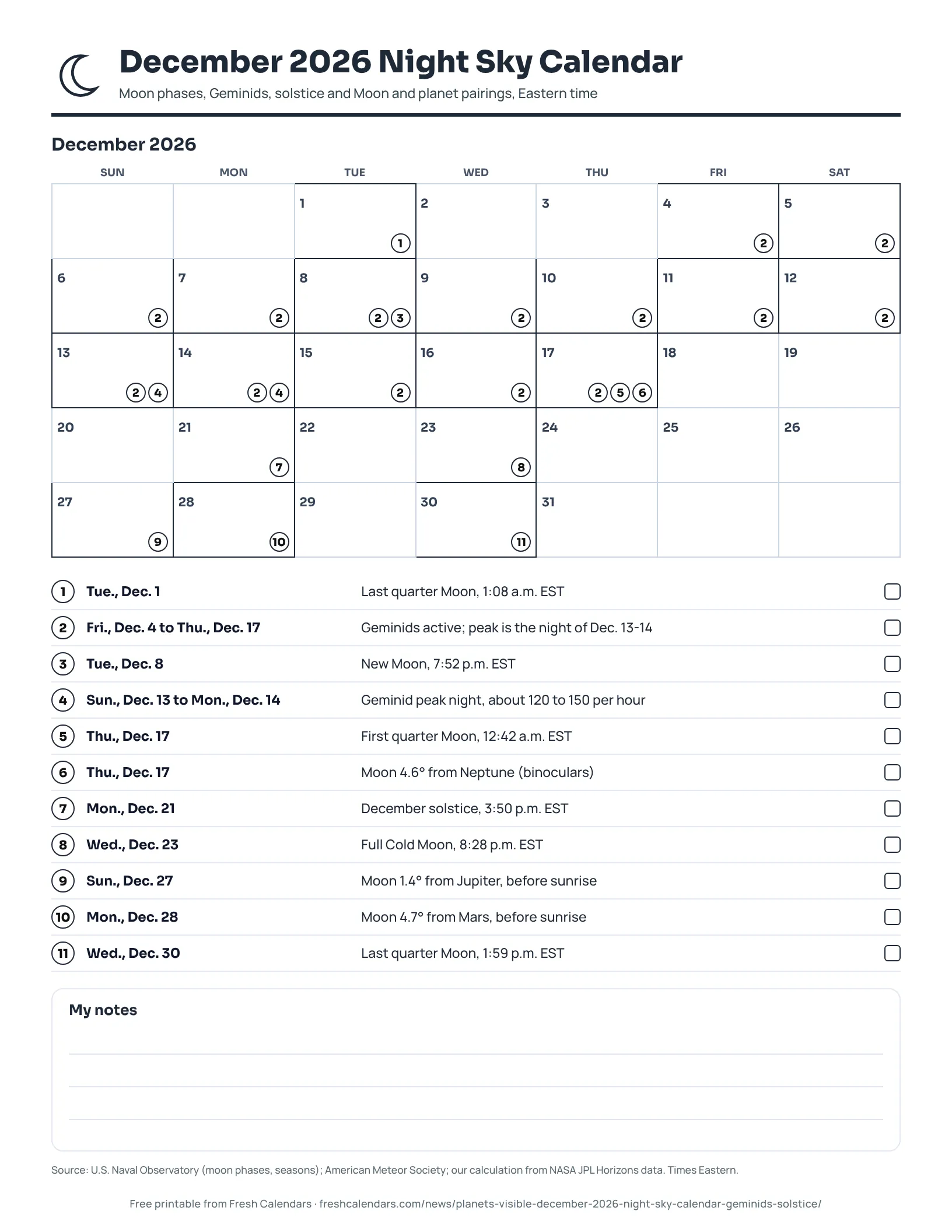
December 2026 Night Sky Calendar (ink saver)
A one-page December 2026 night sky calendar with moon phases, the Geminids, the solstice and Moon pairings with Jupiter, Mars and Neptune. Ink-saver version.
Frequently asked questions
Which planets can I see in December 2026?
Venus before sunrise, Jupiter and Mars late at night and in the morning, and Saturn in the evening. Mercury is lost in the Sun's glare, and Uranus and Neptune need binoculars or a telescope.
When is the Moon closest to Jupiter in December 2026?
At about 11:30 a.m. Eastern Standard Time on Sunday, Dec. 27, when the waning gibbous Moon is about 1.4° from Jupiter, according to our calculation. At 5 a.m. that morning the gap is still about 4.1°.
When do the Geminids peak in 2026?
The night of Sunday, Dec. 13 into Monday, Dec. 14, 2026, according to the American Meteor Society. It calls the Geminids usually the strongest meteor shower of the year, with good activity before midnight, and the Moon is a thin 15% waxing crescent that night.
What time is the December solstice in 2026?
Monday, Dec. 21, 2026, at 3:50 p.m. Eastern Standard Time (20:50 Universal Time), according to the U.S. Naval Observatory.
Why can other sources show different times?
Our separations are measured from Earth's center. From a given city the Moon's apparent position differs by up to about 1°, so treat each separation as approximate.
Sources
- JPL Horizons On-Line Ephemeris System (NASA Jet Propulsion Laboratory, 2026-10-31)
- Astronomy Engine (Don Cross (open source))
- Phases of the Moon, 2026 (U.S. Naval Observatory, Astronomical Applications Department)
- Earth's Seasons and Apsides, 2026 (U.S. Naval Observatory, Astronomical Applications Department)
- 2026/2027 Meteor Shower Calendar (American Meteor Society, 2026-11-16)
- What's Up: skywatching tips from NASA (NASA, 2026-11-16)
Related news

More in Sky Events
All Sky Events stories →- Ursid Meteor Shower 2026: Peak Dec. 21-22, Moonset in 10 Cities
- Moon on New Year's Eve 2026: Moonrise 1:46 a.m. in New York
- Leonid Meteor Shower 2026: Peak Nov. 16-17, Moon-Free Hours
- Latest Sunrise 2027: New York 7:20 a.m. Dec. 30-Jan. 10, 20 Cities
- Meteor Showers 2027: Peak Dates for 12 Showers, Perseids Aug. 13
Trending now
- Costco Black Friday 2026: Nov. 27-30 Savings, Deals From Nov. 16
- Coming to Hulu November 2026: 109 Dated Titles, Percy Jackson Nov. 20
- Black Friday Ads 2026: Date Is Nov. 27, Walmart Deals Nov. 23-29
- Thanksgiving Travel 2026: Best Days to Fly and Drive, Nov. 21 to 30
- CPKC Holiday Train 2026 Schedule: 182 Stops, Nov. 19 to Dec. 20