How Often Does the Calendar Repeat? The 400-Year Cycle and 6, 11 or 28-Year Matches
The Gregorian calendar repeats exactly every 400 years (146,097 days, per NASA), while single years match 6, 11 or 28 years apart. Matches for 2024 to 2035.

Published 6 min read
In this article
- What makes two calendar years identical?
- Why does the Gregorian calendar repeat every 400 years?
- Matching calendar years from 2024 to 2035
- Why does the 28-year repeat break across 2100?
- How do you find a matching calendar year?
- What does not repeat when the calendar does?
- Can you reuse an old printable calendar?
The Gregorian calendar repeats exactly every 400 years, according to the National Aeronautics and Space Administration (NASA). The 400-year cycle holds 146,097 days, and because 146,097 is evenly divisible by 7, the weekdays line up again after the full span. Single years match much sooner: in the table below, a year’s next match comes 6, 11 or 28 years later.
This story gives the method, a computed table of earlier and next matching years for 2024 to 2035, and the point where the shorter 28-year pattern fails. A one-page printable of the table is at the end. For one year in detail, see what calendar year is the same as 2027.
What makes two calendar years identical?
Two years have the same calendar when two things agree. Both must be the same length, either 365 days or 366, and January 1 must fall on the same weekday. If both hold, every month starts on the same weekday in both years and every date has the same weekday.
The first test alone is not enough. A common year and a leap year can both start on a Friday, and they split apart at the end of February, when the leap year adds February 29. The U.S. Naval Observatory (USNO) gives the rule for which years are leap years: years evenly divisible by 4, except centurial years that are not evenly divisible by 400.
A worked check for 2026, which starts on a Thursday and has 365 days. We computed the weekday of the first of each month for 2026, 2015 and 2037 with two separate methods, and the three years agree in all 12 months: Thursday, Sunday, Sunday, Wednesday, Friday, Monday, Wednesday, Saturday, Tuesday, Thursday, Sunday, Tuesday, from January to December.
Why does the Gregorian calendar repeat every 400 years?
NASA’s “Calendars and their History” states that the Gregorian calendar is based on a cycle of 400 years, which comprises 146,097 days, and that since 146,097 is evenly divisible by 7 the civil calendar exactly repeats after 400 years. The arithmetic is short:
- In 400 years, 100 are divisible by 4. Four of those are centurial years not divisible by 400, so they are skipped, and that leaves 97 leap years.
- 303 common years of 365 days plus 97 leap years of 366 days make 146,097 days.
- 146,097 divided by 7 is 20,871 whole weeks, with nothing left over.
We confirmed the day count by counting the days from January 1, 2000 to January 1, 2400 with two methods. The USNO lists 2000 and 2400 as leap years and 1700, 1800, 1900 and 2100 as not.
The Gregorian calendar was first introduced in 1582, the USNO says, and NASA notes that October 4, 1582 was followed by October 15. Countries switched at different times: Royal Museums Greenwich says Britain and its colonies made the change in 1752, when September 2 was followed by September 14. The 400-year cycle is a property of the Gregorian rules, so it says nothing about which calendar a given country was using in a given year.
Matching calendar years from 2024 to 2035
We matched each year from 2024 to 2035 against every other year from 1600 to 2400 using two independent weekday calculations, and then checked the first of every month for each pair. The table lists the closest earlier and next year with an identical calendar.
| Year | Jan. 1 | Type | Earlier match | Next match |
|---|---|---|---|---|
| 2024 | Monday | Leap | 1996 (28 years) | 2052 (28 years) |
| 2025 | Wednesday | Common | 2014 (11 years) | 2031 (6 years) |
| 2026 | Thursday | Common | 2015 (11 years) | 2037 (11 years) |
| 2027 | Friday | Common | 2021 (6 years) | 2038 (11 years) |
| 2028 | Saturday | Leap | 2000 (28 years) | 2056 (28 years) |
| 2029 | Monday | Common | 2018 (11 years) | 2035 (6 years) |
| 2030 | Tuesday | Common | 2019 (11 years) | 2041 (11 years) |
| 2031 | Wednesday | Common | 2025 (6 years) | 2042 (11 years) |
| 2032 | Thursday | Leap | 2004 (28 years) | 2060 (28 years) |
| 2033 | Saturday | Common | 2022 (11 years) | 2039 (6 years) |
| 2034 | Sunday | Common | 2023 (11 years) | 2045 (11 years) |
| 2035 | Monday | Common | 2029 (6 years) | 2046 (11 years) |
The gaps follow the leap cycle. A common year moves the weekday of the next January 1 forward by one day and a leap year moves it by two, which is why a matching year takes 6, 11 or 28 years to come around.
Between 1901 and 2071, every year’s next match was 6, 11 or 28 years away, by our count. Leap years 2024, 2028 and 2032 each have a gap of 28 years in both directions.
Why does the 28-year repeat break across 2100?
The 28-year rule holds only while the leap years come every 4 years without a gap. The USNO states that 2100 is not a leap year, which removes one leap day from the pattern, and the weekdays shift.
| Leap year | Next matching year | Gap | What happens |
|---|---|---|---|
| 2068 | 2096 | 28 years | Both inside 2001 to 2099 |
| 2072 | 2112 | 40 years | 2100 would be 28 years later but is a common year |
| 2092 | 2104 | 12 years | Jan. 1 is a Tuesday in both |
| 2096 | 2108 | 12 years | Jan. 1 is a Sunday in both |
2072 and 2100 both begin on a Friday, but 2072 has 366 days and 2100 has 365. By March 1 they split: Tuesday in 2072, Monday in 2100. The USNO lists 1900 as another year that is not a leap year, so the same kind of break sits around 1900. The only repeat that survives every century is the full 400-year one.
How do you find a matching calendar year?
- Check whether the target year is a leap year: divisible by 4, but a century year only if it is divisible by 400.
- Find the weekday of January 1 for the target year. The guide to finding the day of the week for any date shows the method.
- List other years with the same leap status and the same January 1 weekday. For years inside 1901 to 2099, look 6, 11 or 28 years away first.
- Compare the first day of each month; if all 12 match, the calendars are identical.
- Write down the calendar system and the date range you checked, because the result is for the Gregorian rules only.
The what is a leap year explainer has the rule in more detail, and the February printable calendars show how the 28th or 29th day changes the layout.
What does not repeat when the calendar does?
The weekday grid repeats. Other things you may have printed on the calendar do not follow it.
- Moon phases. The USNO says the same pattern of lunar phase and date in the year repeats every 19 years, a separate cycle from the weekday grid.
- Holiday dates. A holiday list printed on an old calendar belongs to the year it was printed for. Check each holiday against its current official source; the holiday pages list the dates.
- School and fiscal dates. These are not part of the weekday grid either, so each one needs its own check against the current source.
- Dates before adoption. A date written under another calendar, such as Britain’s before 1752, does not follow the Gregorian grid.
Can you reuse an old printable calendar?
Yes, for the weekday layout, once the check above passes. Change the year label, then replace everything that was dated for the old year: holidays, moon phases, school dates and deadlines. Using an old image as the current calendar only because the weekdays match is how a wrong holiday ends up on the wall. A fresh printable yearly calendar skips the problem.
Free printable downloads
Every template is free, needs no sign-up and prints on US Letter paper. Choose PDF for printing or PNG for screens and documents.
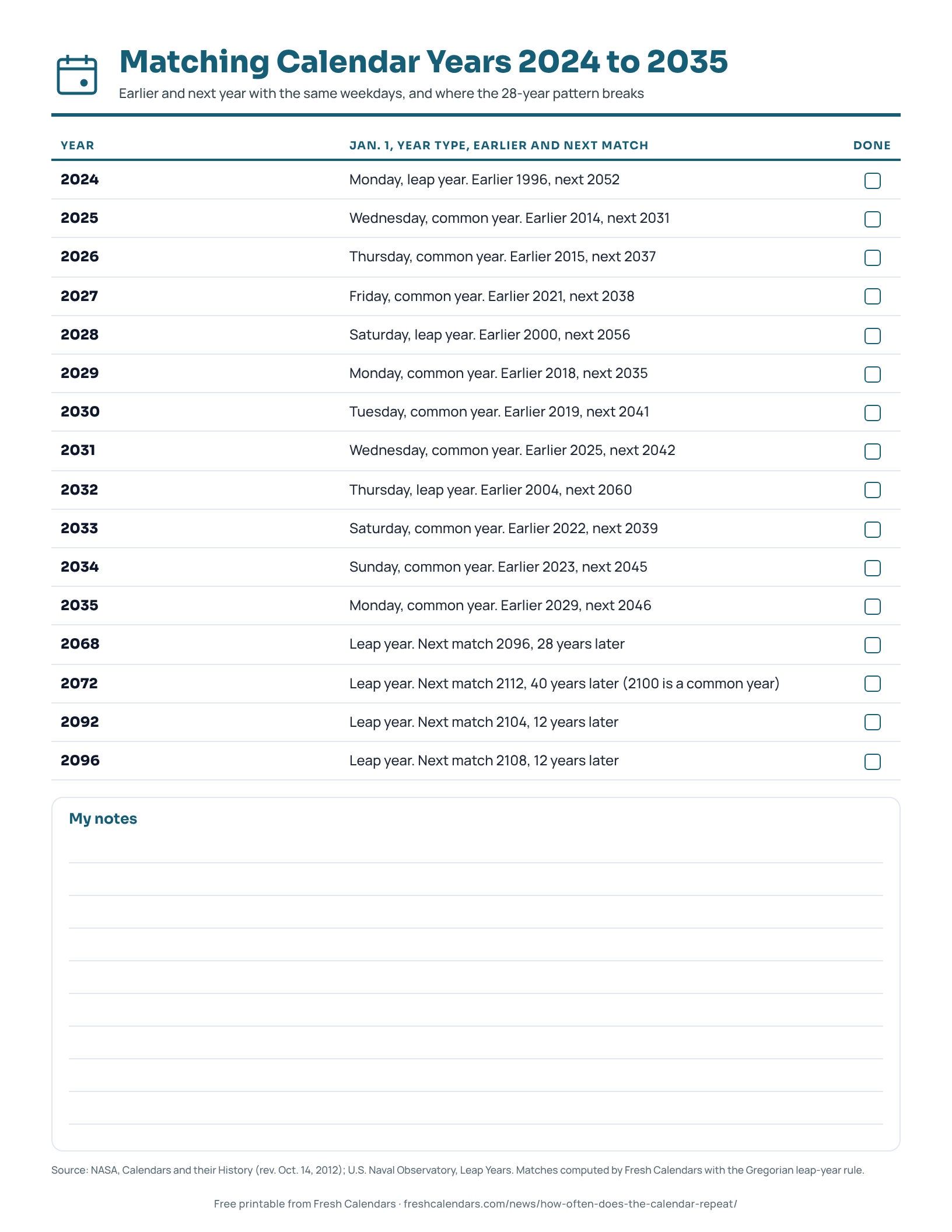
Matching Calendar Years 2024 to 2035 printables
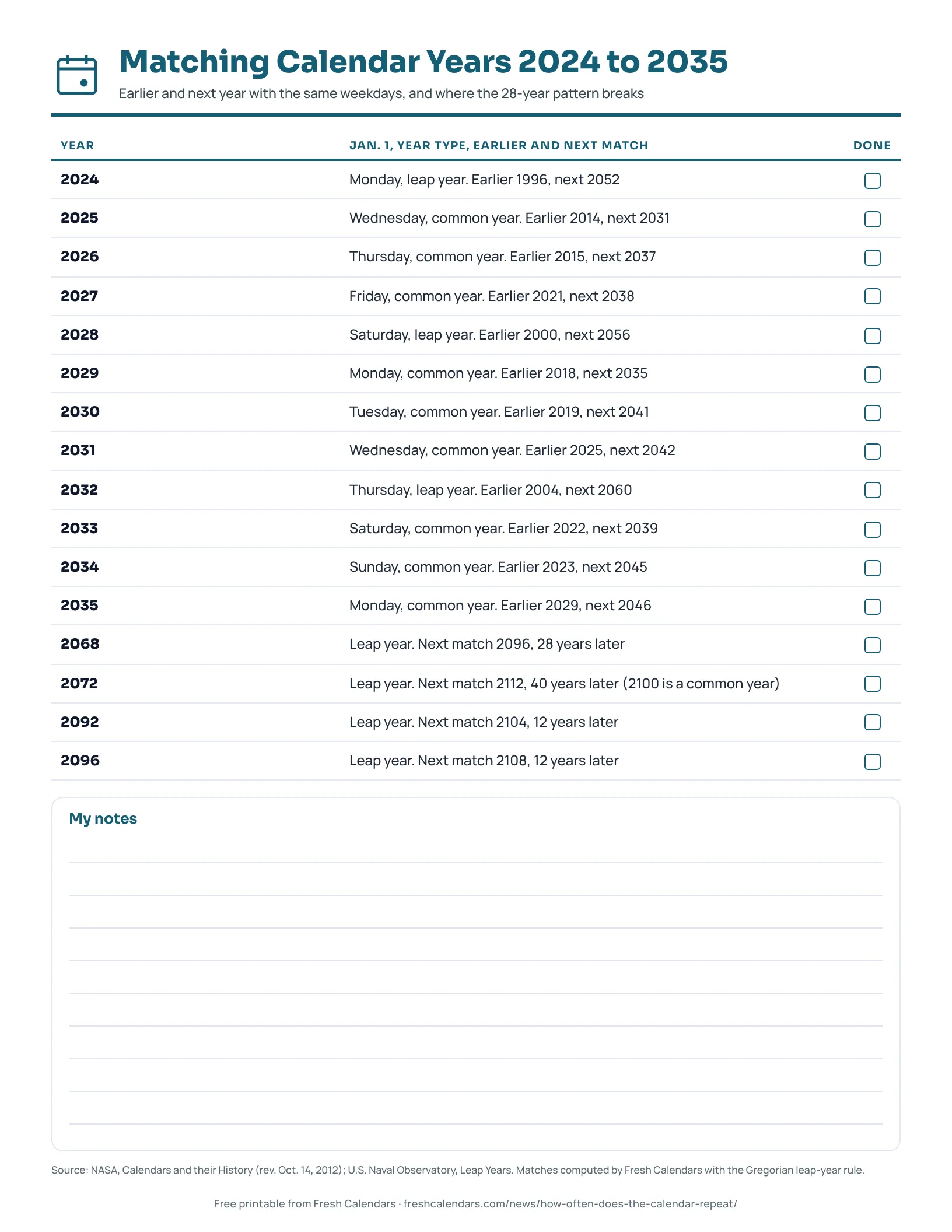
Matching Calendar Years 2024 to 2035
Table of years from 2024 to 2035 with the earlier and next year that has the same calendar, plus the leap years where the 28-year pattern breaks around 2100.
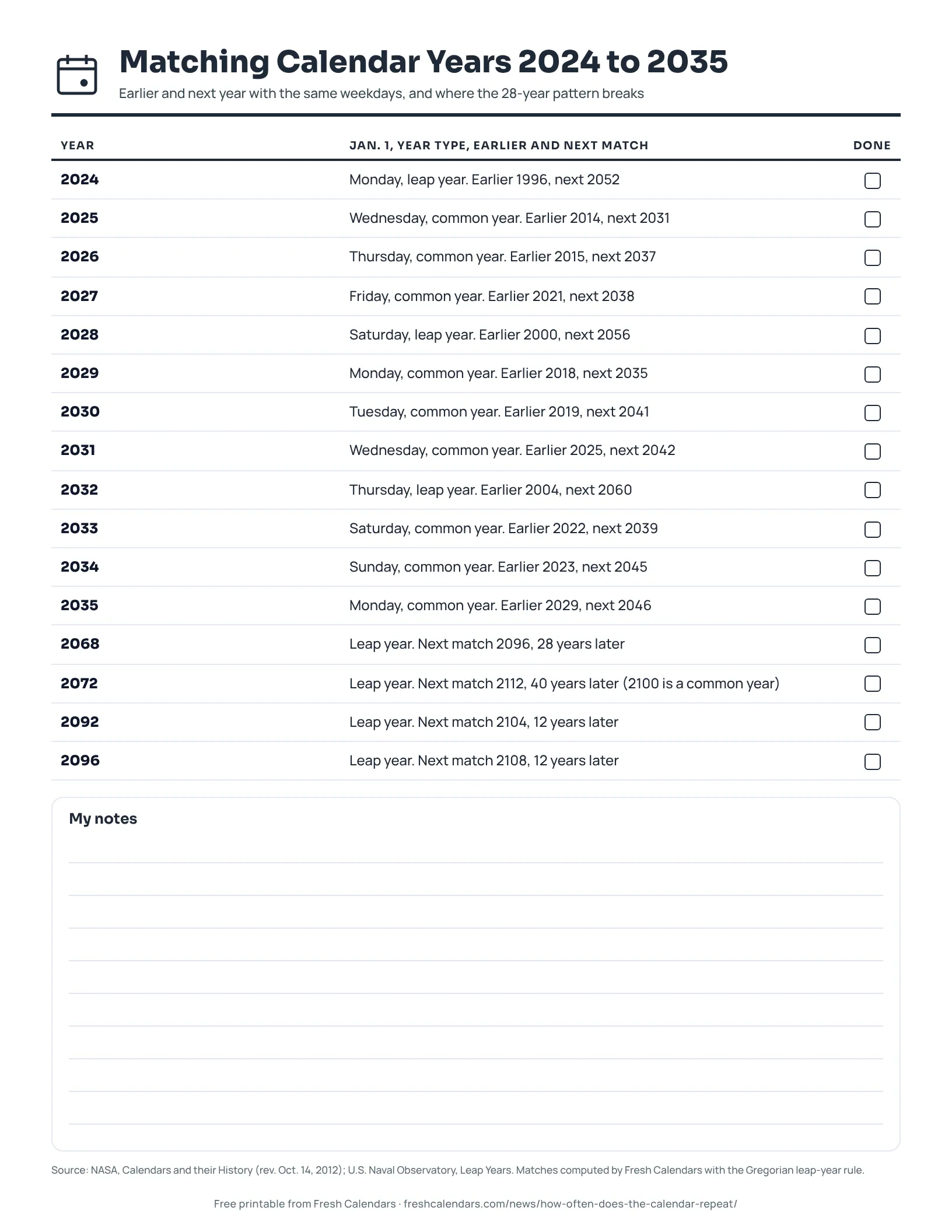
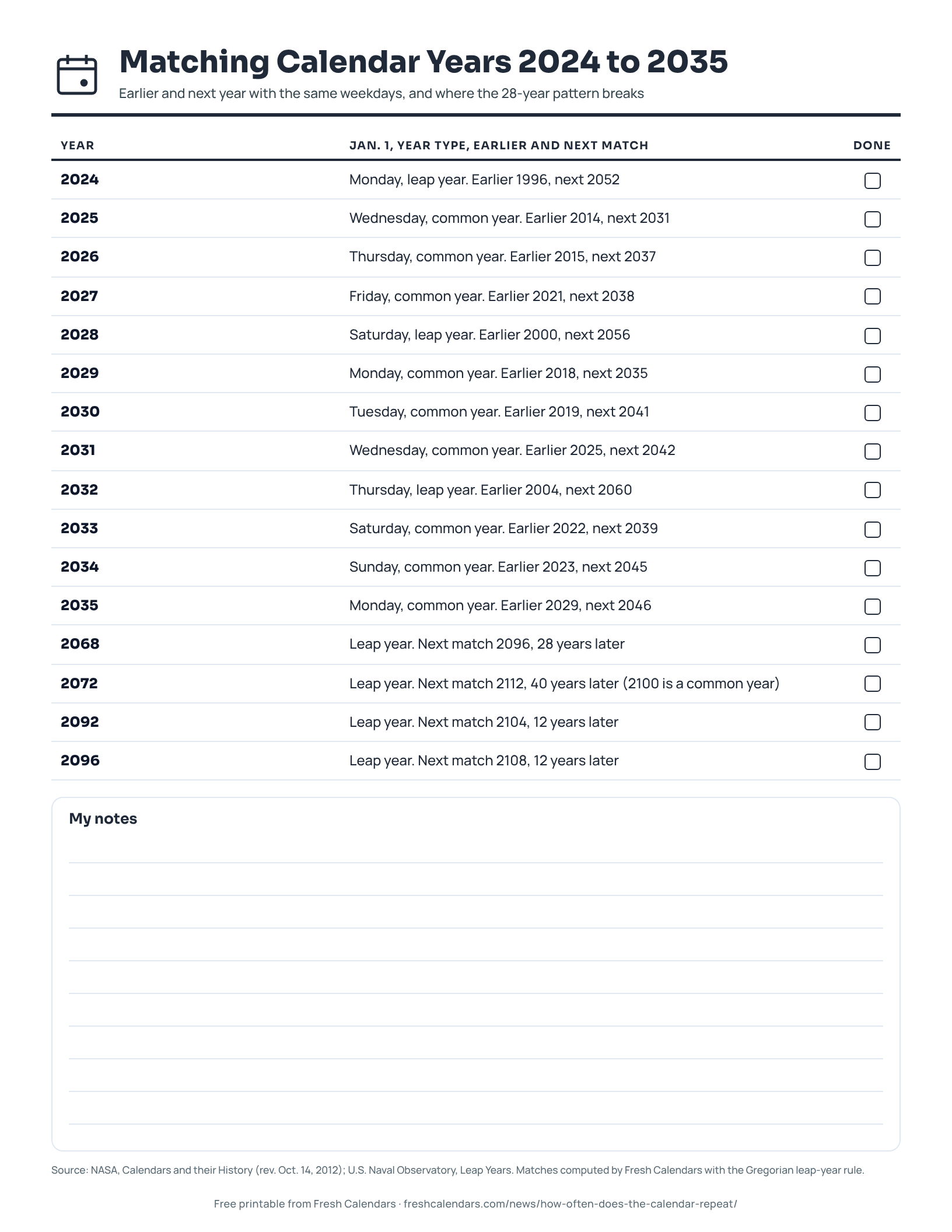
Matching Calendar Years 2024 to 2035 (ink saver)
Table of years from 2024 to 2035 with the earlier and next year that has the same calendar, plus the leap years where the 28-year pattern breaks around 2100. Ink-saver version.
Frequently asked questions
Does the calendar repeat every 28 years?
Only inside a stretch of years with no skipped century leap year. We computed the next matching year for every year from 1901 to 2071, and the gap was 6, 11 or 28 years. Around 2100 the pattern breaks: 2072 next matches 2112, 40 years later.
Why does the Gregorian calendar repeat every 400 years?
NASA states that the Gregorian calendar is based on a cycle of 400 years comprising 146,097 days. Because 146,097 is evenly divisible by 7, the calendar exactly repeats after 400 years.
Can two years have the same calendar?
Yes. Two years have the same calendar when both are common years or both are leap years, and January 1 falls on the same weekday. 2026 and 2037 are one pair; both begin on a Thursday.
Do holidays repeat when calendars match?
The weekday grid repeats, but a holiday list or moon-phase table printed on an old calendar needs its own check. The U.S. Naval Observatory says the same pattern of lunar phase and date in the year repeats every 19 years, which is a different cycle from the weekday grid.
How do I find a year with the same calendar as 2027?
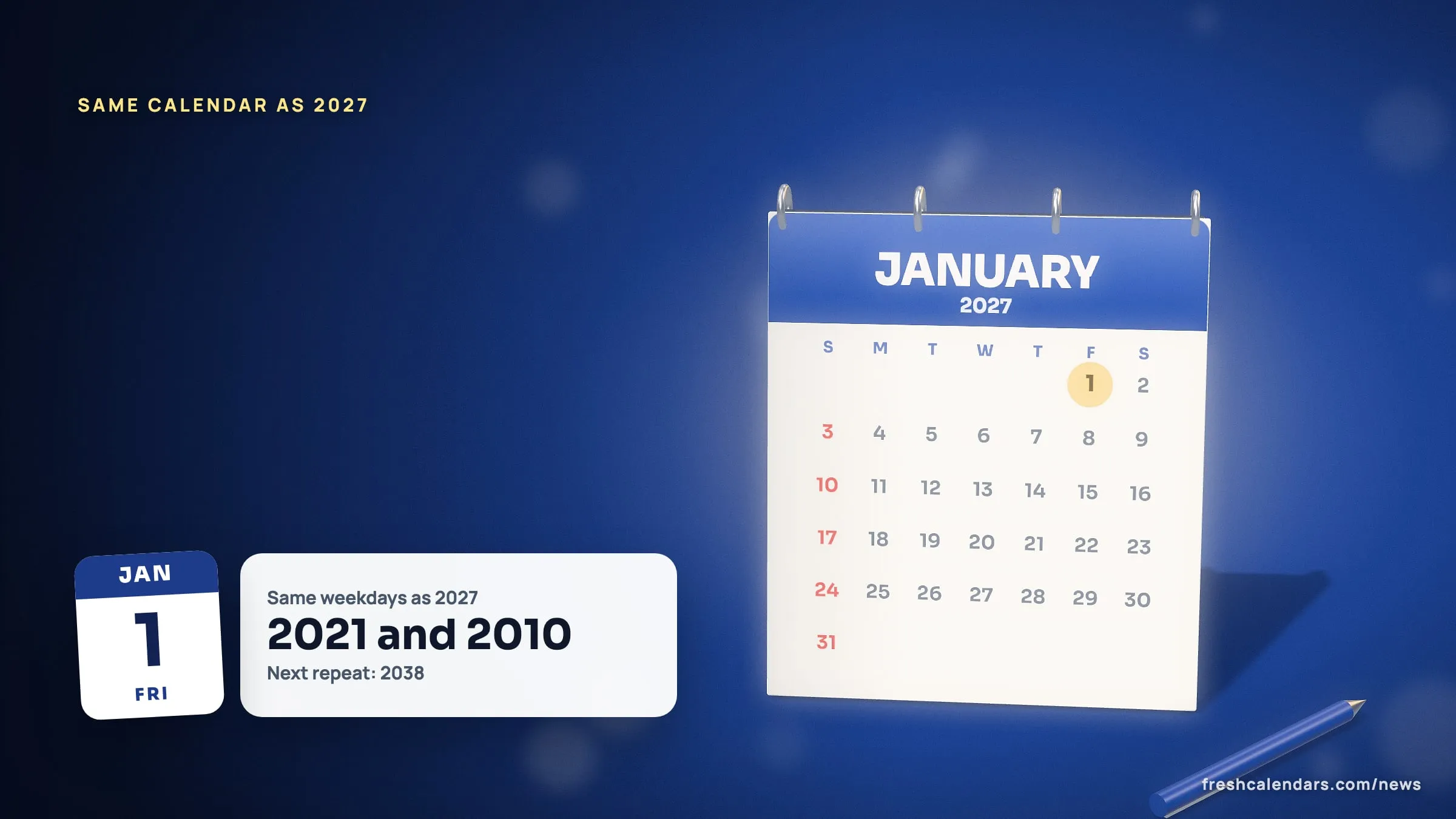
2027 is a common year that begins on a Friday. The most recent match is 2021 and the next is 2038. The story on the same calendar as 2027 lists every match.
Sources
- Calendars and their History (NASA, 2012-10-14)
- Leap Years (U.S. Naval Observatory)
- Introduction to Calendars (U.S. Naval Observatory)
- Which years are leap years and can you have leap seconds? (Royal Museums Greenwich)
Related news

More in Calendar Guides
All Calendar Guides stories →- How to Calculate the Day of the Year, From 001 to 365 or 366, With a Month Table
- What Is the 100th Day of the Year? April 10, or April 9 in Leap Years
- How Many Days Are Left in the Year? The Formula, Plus the Count From Oct. 30, 2026
- How to Print a Calendar PDF at Actual Size: Print Settings for Edge, Mac and Home Printers
- Monday Start vs Sunday Start Calendar: Same Dates, Different First Column