What Is a Fiscal Year? Federal, State and UK Dates With Quarter Tables
A fiscal year is 12 months that end on the last day of any month but December. The U.S. federal one runs Oct. 1 to Sept. 30; quarter dates are in the table.

Published 5 min read

In this article
The U.S. federal fiscal year begins on October 1 and ends on September 30 of the following year, according to 31 U.S.C. 1102, the fiscal-year section of the United States Code as published by Cornell Law School’s Legal Information Institute. A fiscal year, as the Internal Revenue Service (IRS) defines it, is 12 consecutive months ending on the last day of any month except December. This guide compares the main year types side by side and splits each into quarters for 2027; our fiscal year calendar guide covers the printable planners.
Fiscal year and calendar year: what differs
The IRS describes a calendar year as 12 consecutive months beginning January 1 and ending December 31. A fiscal year also has 12 months, but it ends in any month except December. The table lists the year types with a source for each.
| Year type | Dates | Source |
|---|---|---|
| Calendar year | Jan. 1 to Dec. 31 | IRS, Tax years |
| U.S. federal fiscal year | Oct. 1 to Sept. 30 | 31 U.S.C. 1102 |
| State fiscal year (46 states) | July 1 start | National Association of State Budget Officers (NASBO), July 1, 2025 |
| United Kingdom (UK) financial year | April to March | Office for National Statistics (ONS) |
| Microsoft fiscal year | Ended June 30, 2025 | Microsoft Form 10-K |
| Apple fiscal year | 52 or 53 weeks, ending the last Saturday of September | Apple Form 10-K |
NASBO wrote on July 1, 2025 that “forty-six states begin their fiscal year on July 1.” That sentence is about the 2026 budget cycle, and we do not name the other four states here. Companies pick their own year: Microsoft’s annual report reads “For the Fiscal Year Ended June 30, 2025,” and Apple’s covers “the fiscal year ended September 27, 2025.” Each company’s label names the year by the date it ends.
How the federal fiscal year is dated, 2026 to 2030
Fiscal year 2027 began Oct. 1, 2026 and ends Sept. 30, 2027, so the label matches the calendar year in which it ends. It holds 365 days. Fiscal year 2028 starts Oct. 1, 2027 and holds 366, because Feb. 29, 2028 falls inside it. The same is true of a July 1 year: the state year named 2028 runs July 1, 2027 to June 30, 2028.
| Label | Federal year | Days | July 1 state year | Days |
|---|---|---|---|---|
| Fiscal year 2026 | Oct. 1, 2025 to Sept. 30, 2026 | 365 | July 1, 2025 to June 30, 2026 | 365 |
| Fiscal year 2027 | Oct. 1, 2026 to Sept. 30, 2027 | 365 | July 1, 2026 to June 30, 2027 | 365 |
| Fiscal year 2028 | Oct. 1, 2027 to Sept. 30, 2028 | 366 | July 1, 2027 to June 30, 2028 | 366 |
| Fiscal year 2029 | Oct. 1, 2028 to Sept. 30, 2029 | 365 | July 1, 2028 to June 30, 2029 | 365 |
| Fiscal year 2030 | Oct. 1, 2029 to Sept. 30, 2030 | 365 | July 1, 2029 to June 30, 2030 | 365 |
Day counts and the year ranges are our calculation from the start rules above, checked two ways. They are not figures published by the Treasury or NASBO. For counting workdays inside any of these years, see how many business days are in a year and the month-by-month 2027 working days table.
Fiscal quarter dates for 2027
We split each 12-month year into four three-month blocks. The sources above define the year, not the quarters, so treat the quarter edges as our arithmetic and check an organization’s own calendar before relying on them.
| Quarter | U.S. federal fiscal year 2027 | July 1 state fiscal year 2027 | Calendar year 2027 | UK financial year starting April 2026 |
|---|---|---|---|---|
| Q1 | Oct. 1 to Dec. 31, 2026 | July 1 to Sept. 30, 2026 | Jan. 1 to Mar. 31, 2027 | April to June 2026 |
| Q2 | Jan. 1 to Mar. 31, 2027 | Oct. 1 to Dec. 31, 2026 | Apr. 1 to June 30, 2027 | July to September 2026 |
| Q3 | Apr. 1 to June 30, 2027 | Jan. 1 to Mar. 31, 2027 | July 1 to Sept. 30, 2027 | October to December 2026 |
| Q4 | July 1 to Sept. 30, 2027 | Apr. 1 to June 30, 2027 | Oct. 1 to Dec. 31, 2027 | January to March 2027 |
Days per quarter, also our calculation:
| Year | Q1 | Q2 | Q3 | Q4 | Total |
|---|---|---|---|---|---|
| U.S. federal fiscal year 2027 | 92 | 90 | 91 | 92 | 365 |
| July 1 state fiscal year 2027 | 92 | 92 | 90 | 91 | 365 |
| Calendar year 2027 | 90 | 91 | 92 | 92 | 365 |
A federal Q2 is the same set of dates as a calendar-year Q1, which is why a “first quarter” in two reports can describe different months. The ONS says the UK financial year “runs from April to March,” so we give months only for the UK column. A one-page printable version of the quarter table is in the downloads.
Is a fiscal year the same as a tax year?
Not always. The IRS lists three kinds of tax year: a calendar year, a fiscal year, and a 52-53-week year. It describes the last as “a fiscal tax year that varies from 52 to 53 weeks but does not have to end on the last day of a month.” To adopt or change a tax year, the IRS says a business must file Form 1128, “Application To Adopt, Change, or Retain a Tax Year,” to get approval. This is a summary of an IRS page, not tax advice; the IRS page and a tax professional decide what applies to a given business.
The UK keeps two dates. The ONS financial year runs April to March, while GOV.UK says the current Income Tax year “is from 6 April 2026 to 5 April 2027.”
Week-based fiscal years and the 53rd week
Apple’s filing sets its year as the 52- or 53-week period ending on the last Saturday of September. The National Retail Federation (NRF) divides its retail year “based on a 4 weeks – 5 weeks – 4 weeks format” and says it is “sometimes necessary to add a 53rd week to the end of the calendar for sales reporting purposes only.” Our NRF 4-5-4 calendar story lists the 2027 dates, and why some years have 53 weeks explains the extra week.
How to read an FY label
“Fiscal year (FY) 2027” does not tell you which months it covers. Four checks settle it:
- Find the end date in the document, as Apple and Microsoft print it in their annual reports.
- Note whether the year starts in the prior calendar year. A federal FY2027 starts in October 2026.
- Check whether the year is month-based or week-based (52 or 53 weeks).
- Map “Q1” to months from the organization’s own start date, not from January.
Pair the dates with the printable yearly calendar or the broader set of free printable calendars when you plan across years.
Free printable downloads
Every template is free, needs no sign-up and prints on US Letter paper. Choose PDF for printing or PNG for screens and documents.
Fiscal Year 2027 Quarter Dates Reference printables
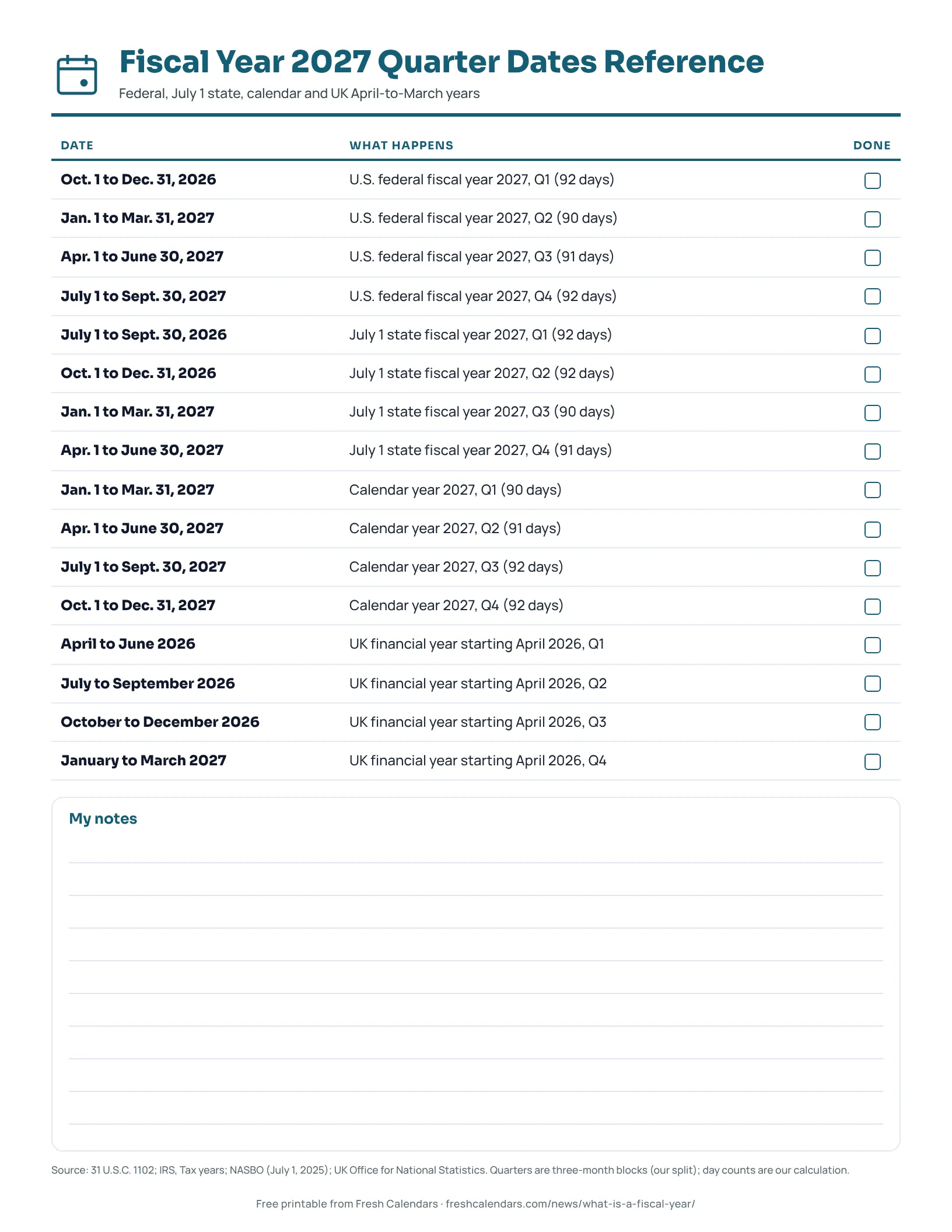
Fiscal Year 2027 Quarter Dates Reference
One-page list of fiscal quarter dates for the U.S. federal year, a July 1 state year, calendar year 2027 and the UK April-to-March year.
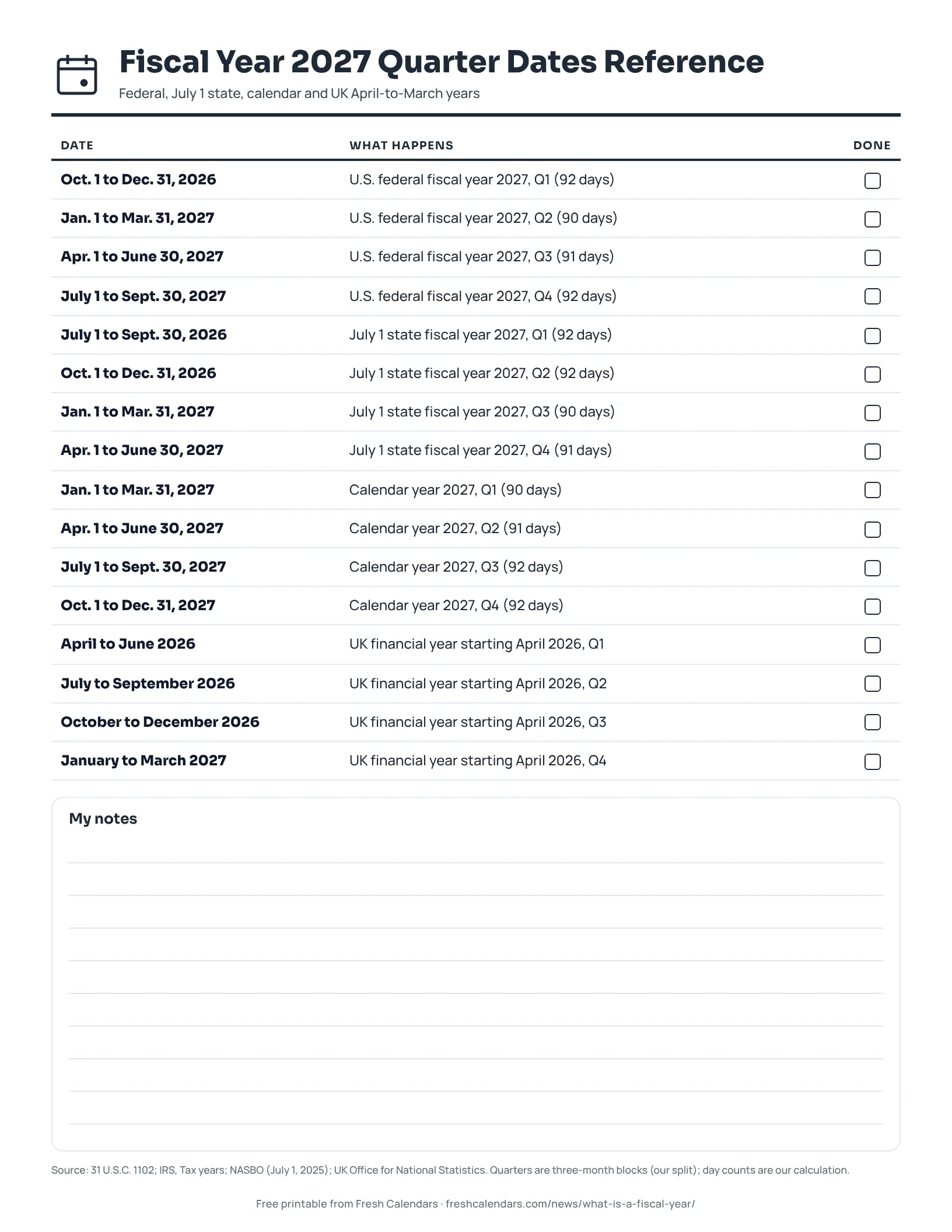
Fiscal Year 2027 Quarter Dates Reference (ink saver)
One-page list of fiscal quarter dates for the U.S. federal year, a July 1 state year, calendar year 2027 and the UK April-to-March year. Ink-saver version.
Frequently asked questions
Does a fiscal year start in January?
It can, but it does not have to. The Internal Revenue Service (IRS) calls a year beginning Jan. 1 and ending Dec. 31 a calendar year. A fiscal year is 12 consecutive months ending on the last day of any month except December.
What is the U.S. federal fiscal year?
Under 31 U.S.C. 1102, the fiscal year of the Treasury begins on October 1 of each year and ends on September 30 of the following year. Fiscal year 2027 began Oct. 1, 2026.
Is fiscal year 2027 the same as calendar year 2027?
No. The federal fiscal year 2027 runs Oct. 1, 2026 to Sept. 30, 2027, so its first three months fall in 2026. A July 1 state fiscal year 2027 runs July 1, 2026 to June 30, 2027.
How many quarters are in a fiscal year?
Four. This guide splits each 12-month year into four three-month blocks, so the federal Q1 is October to December. A company on a 52- or 53-week year, such as Apple, follows its own week-based dates, so check the company's filing.
Can a fiscal year have 53 weeks?
Yes. The IRS describes a 52-53-week tax year as a fiscal tax year that varies from 52 to 53 weeks and does not have to end on the last day of a month. Apple's fiscal year is the 52- or 53-week period that ends on the last Saturday of September.
Sources
- 31 U.S. Code 1102 - Fiscal year (Cornell Law School Legal Information Institute (U.S. Code), 2026-10-30)
- Tax years (Internal Revenue Service, 2026-10-30)
- States Finalize Fiscal 2026 Budgets Amid Tightening Conditions (National Association of State Budget Officers, 2025-07-01)
- Public sector finances glossary (Office for National Statistics, 2026-10-30)
- Income Tax rates and Personal Allowances (GOV.UK, 2026-10-30)
- Apple Inc. Form 10-K for the fiscal year ended September 27, 2025 (U.S. Securities and Exchange Commission, 2025-10-31)
- Microsoft Corporation Form 10-K for the fiscal year ended June 30, 2025 (U.S. Securities and Exchange Commission, 2025-07-30)
- 4-5-4 Calendar (National Retail Federation, 2026-10-30)
Related news




More in Calendar Guides
All Calendar Guides stories →- How to Calculate the Day of the Year, From 001 to 365 or 366, With a Month Table
- What Is the 100th Day of the Year? April 10, or April 9 in Leap Years
- How Many Days Are Left in the Year? The Formula, Plus the Count From Oct. 30, 2026
- How to Print a Calendar PDF at Actual Size: Print Settings for Edge, Mac and Home Printers
- Monday Start vs Sunday Start Calendar: Same Dates, Different First Column