How to Calculate the Day of the Year, From 001 to 365 or 366, With a Month Table
Day of the year is the days in completed months plus the day of the month: Oct. 30, 2026 is day 303. Get the month table, formula and leap-year shift.

Published 5 min read
In this article
- What does a day-of-the-year number mean?
- How do you work out the day of the year?
- Day number of the 1st of each month
- What formula gives the day of the year in Excel or Google Sheets?
- How do you turn a day number back into a date?
- Is day of the year the same as a Julian date?
- Printable day of the year chart
The day of the year is a date’s position in its calendar year: Jan. 1 is day 001, and Dec. 31 is day 365 in a common year or day 366 in a leap year. To calculate it, add the days in every completed month to the day of the month. Oct. 30, 2026, for example, is day 303, because January through September hold 273 days and 273 + 30 = 303.
This guide gives the month table for common and leap years, a spreadsheet formula, and the steps to turn a day number back into a date. For printable charts of every day, see our Julian date calendar 2027 and 2026; this story is the method behind them.
What does a day-of-the-year number mean?
It counts days within one year, starting at 001 on Jan. 1. The same idea has other names: ordinal date, day number and, in some industries, “Julian date.”
The numbers are written with three digits. A summary of the International Organization for Standardization (ISO) date standard, ISO 8601, hosted by NASA, shows the ordinal format with the example 1995-035 and describes day numbers as 001 to 365, or 366 in leap years. The U.S. Department of Agriculture (USDA) Agricultural Marketing Service uses the same style on its shell egg chart, where egg cartons show the pack date as a day number from 001 for Jan. 1.
Whether a year has 365 or 366 days follows the U.S. Naval Observatory (USNO) rule: years evenly divisible by 4 are leap years, except century years that are not evenly divisible by 400. Our leap year guide lists the leap years to 2100.
How do you work out the day of the year?
Use one formula:
Day of the year = days in completed months + day of the month
- Take the month of your date and add up the days of all the months before it.
- Add the day of the month.
- In a leap year, February counts 29 days, so any date from March 1 on gains one.
Worked example for today, Oct. 30, 2026. January to September have 31 + 28 + 31 + 30 + 31 + 30 + 31 + 31 + 30 = 273 days, and 2026 is a common year. Add 30 and the answer is day 303. We checked every month of the table below against JavaScript’s Date object and against an independent Julian-day-number formula, and both agree.
| Date | Common year (2026) | Leap year (2028) |
|---|---|---|
| Jan. 1 | 001 | 001 |
| Feb. 28 | 059 | 059 |
| Feb. 29 | does not exist | 060 |
| Mar. 1 | 060 (31 + 28 + 1) | 061 (31 + 29 + 1) |
| Apr. 10 | 100 | 101 |
| Oct. 30 | 303 | 304 |
| Dec. 31 | 365 | 366 |
Day 100 is April 10 in a common year and April 9 in a leap year; our 100th day of the year story has the details.
Day number of the 1st of each month
Find the month, add your day of the month to the “add” number, and you have the answer. The “1st is day” columns give the first day of each month.
| Month | Common year: add | Common: 1st is day | Leap year: add | Leap: 1st is day |
|---|---|---|---|---|
| January | 0 | 001 | 0 | 001 |
| February | 31 | 032 | 31 | 032 |
| March | 59 | 060 | 60 | 061 |
| April | 90 | 091 | 91 | 092 |
| May | 120 | 121 | 121 | 122 |
| June | 151 | 152 | 152 | 153 |
| July | 181 | 182 | 182 | 183 |
| August | 212 | 213 | 213 | 214 |
| September | 243 | 244 | 244 | 245 |
| October | 273 | 274 | 274 | 275 |
| November | 304 | 305 | 305 | 306 |
| December | 334 | 335 | 335 | 336 |
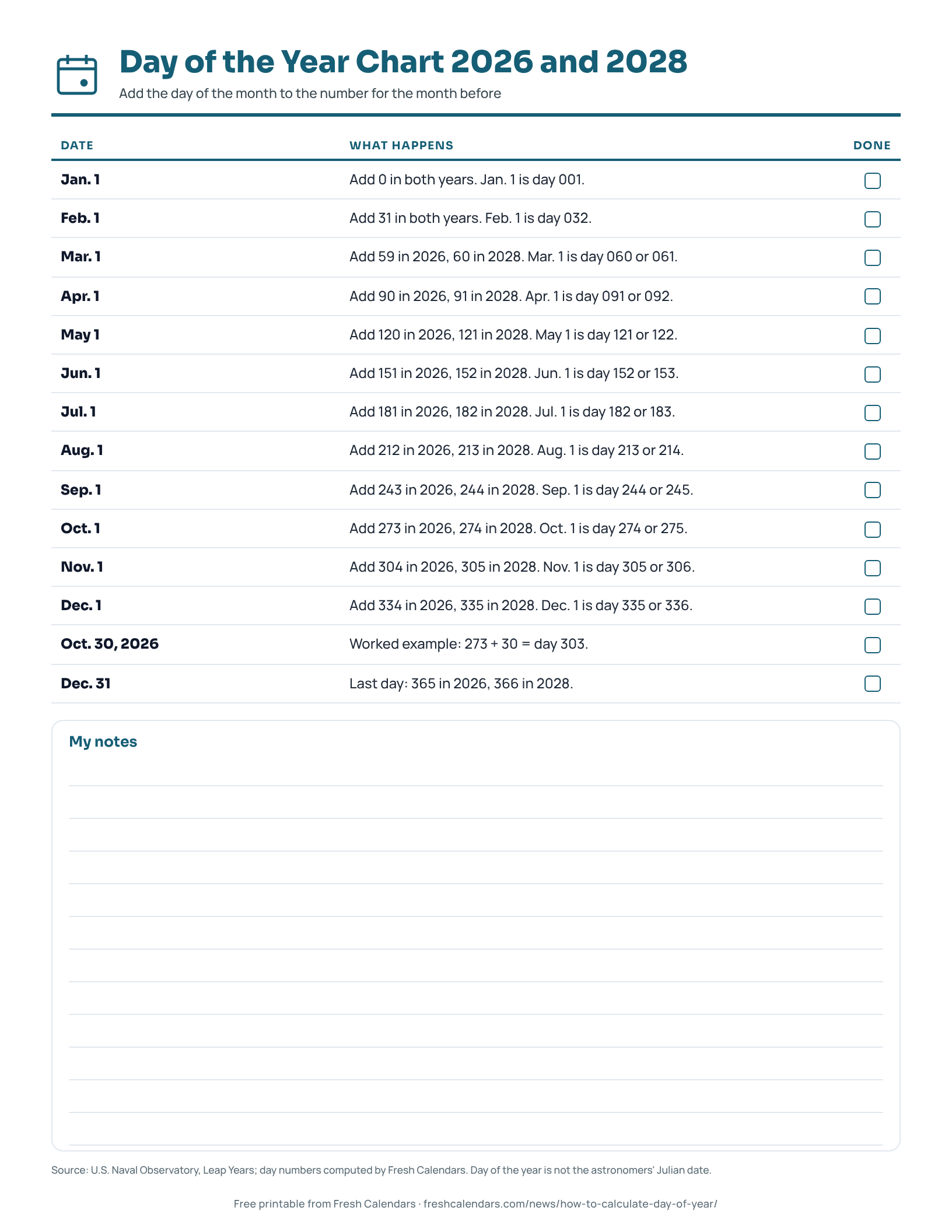
The two columns are identical through February. From March 1, the leap-year number is one higher, because Feb. 29 is already behind you. The same table is on the free printable below, set for 2026 and 2028.
What formula gives the day of the year in Excel or Google Sheets?
With the date in cell A1, use the function that builds a date from a year, month and day (DATE) and the function that reads the year from a date (YEAR) like this:
=A1-DATE(YEAR(A1),1,0)
Microsoft Support says a day value below 1 in the DATE function subtracts that many days, plus one, from the first day of the month. So DATE(YEAR(A1),1,0) is Dec. 31 of the previous year, and subtracting it from A1 leaves the day number. Microsoft does not publish this formula as such; it is our formula built on the documented DATE behavior. Google Docs Editors Help says DATE silently recalculates values outside the valid month or day range, so the same approach applies in Google Sheets. Set the result cell to a number format, or the sheet may show it as a date.
A second route uses the days-between function (DAYS), which Microsoft describes as returning the number of days between two dates. Its example of Dec. 31, 2021 minus Jan. 1, 2021 gives 364, a difference that leaves out one end. Add 1 to get a day number: =DAYS(A1,DATE(YEAR(A1),1,1))+1.
How do you turn a day number back into a date?
Reverse the steps, and check the limit first.
- Confirm the year is common or leap. A day number above 365 is valid only in a leap year.
- Find the last month whose “add” number in the table is smaller than your day number.
- Subtract that “add” number from the day number. The result is the day of the month.
Example: 2026-300. The “add” number for October is 273, and 300 - 273 = 27, so the date is Oct. 27, 2026. In 2028, October’s number is 274, so day 300 is Oct. 26, 2028. Day 366 is Dec. 31, 2028, but 2026-366 does not exist: the year has 365 days.
Is day of the year the same as a Julian date?
No, and mixing them up causes wrong dates. The day of the year is the 001 to 366 count above. Some industries call the day number a “Julian date” in everyday use, and our Julian date calendar charts use that label for the same reason.
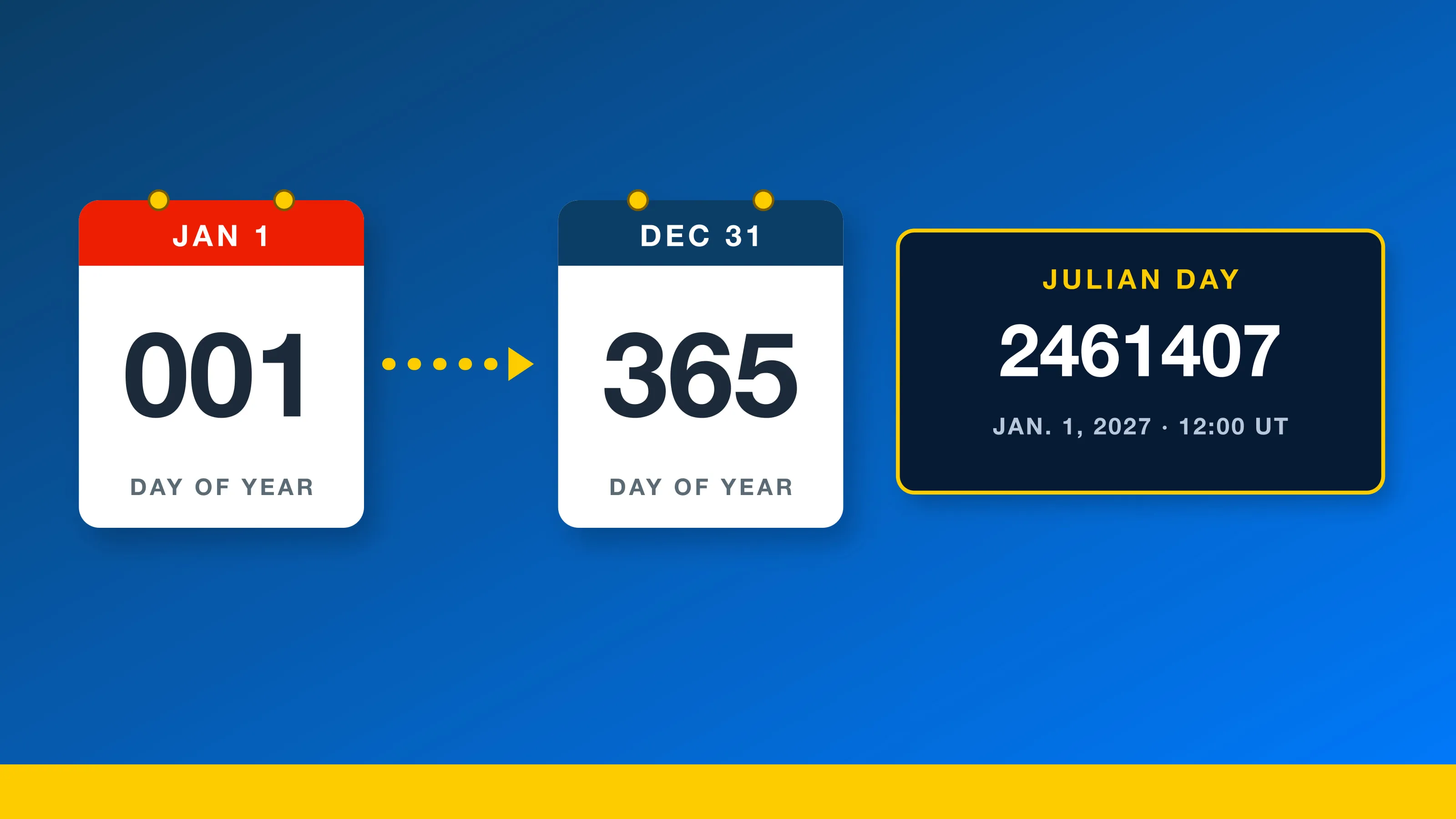
The astronomers’ Julian date is a different measure. The USNO says Julian dates are a continuous count of days and fractions since noon Universal Time on Jan. 1, 4713 BC. It never restarts on Jan. 1, so it runs to numbers in the millions. If a form asks for a Julian date, check whether it wants the three-digit day number or the astronomical count.
Printable day of the year chart
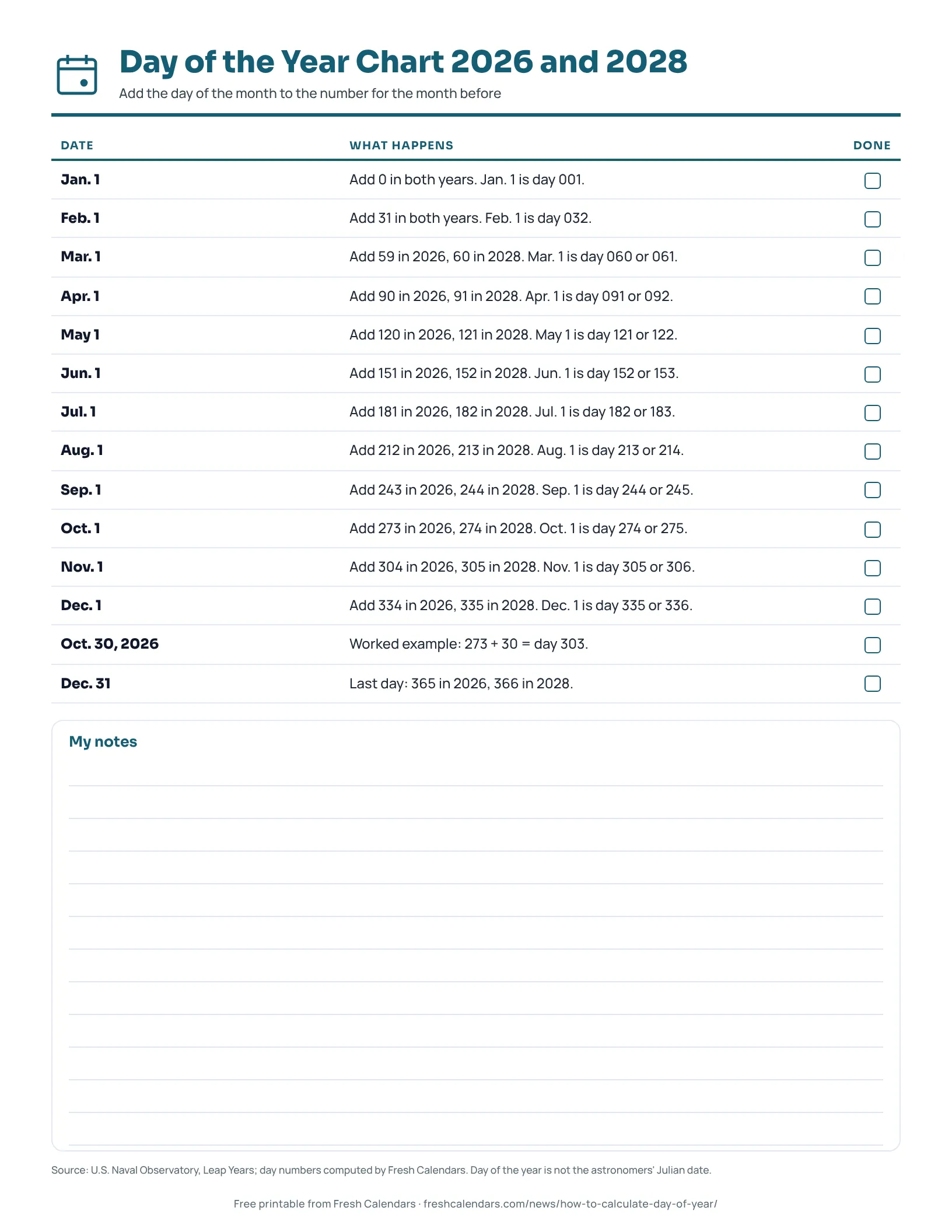
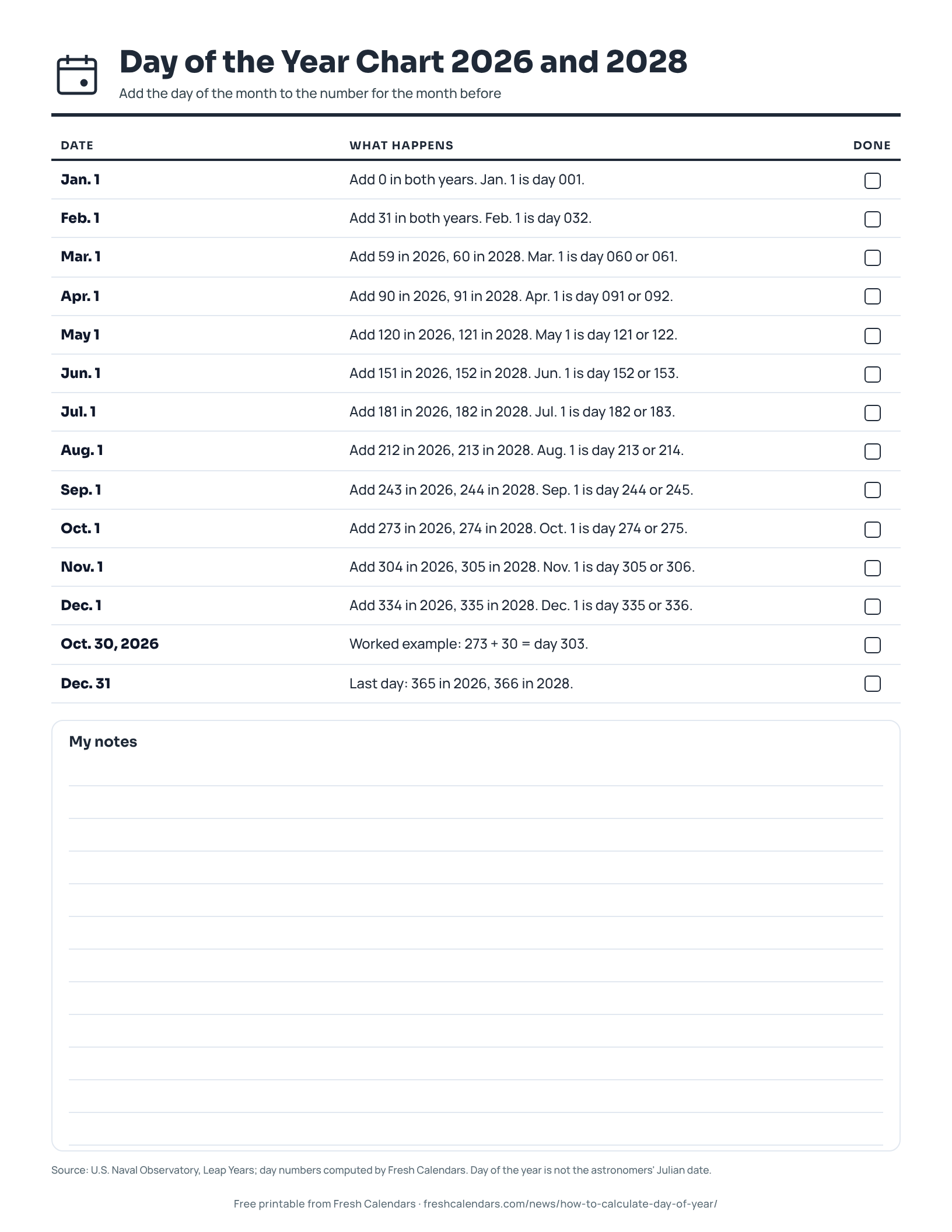
The one-page chart lists the number to add for every month in 2026 (a common year) and 2028 (a leap year), plus the Oct. 30, 2026 example. It comes in a standard and an ink-saver version. For whole-year pages, use our printable yearly calendar or the February calendars when checking a leap day.
Free printable downloads
Every template is free, needs no sign-up and prints on US Letter paper. Choose PDF for printing or PNG for screens and documents.
Day of the Year Chart 2026 and 2028 printables
Day of the Year Chart 2026 and 2028
One-page chart of the number to add for each month in a common year (2026) and a leap year (2028), with a worked example for converting a date to its day of the year.
Day of the Year Chart 2026 and 2028 (ink saver)
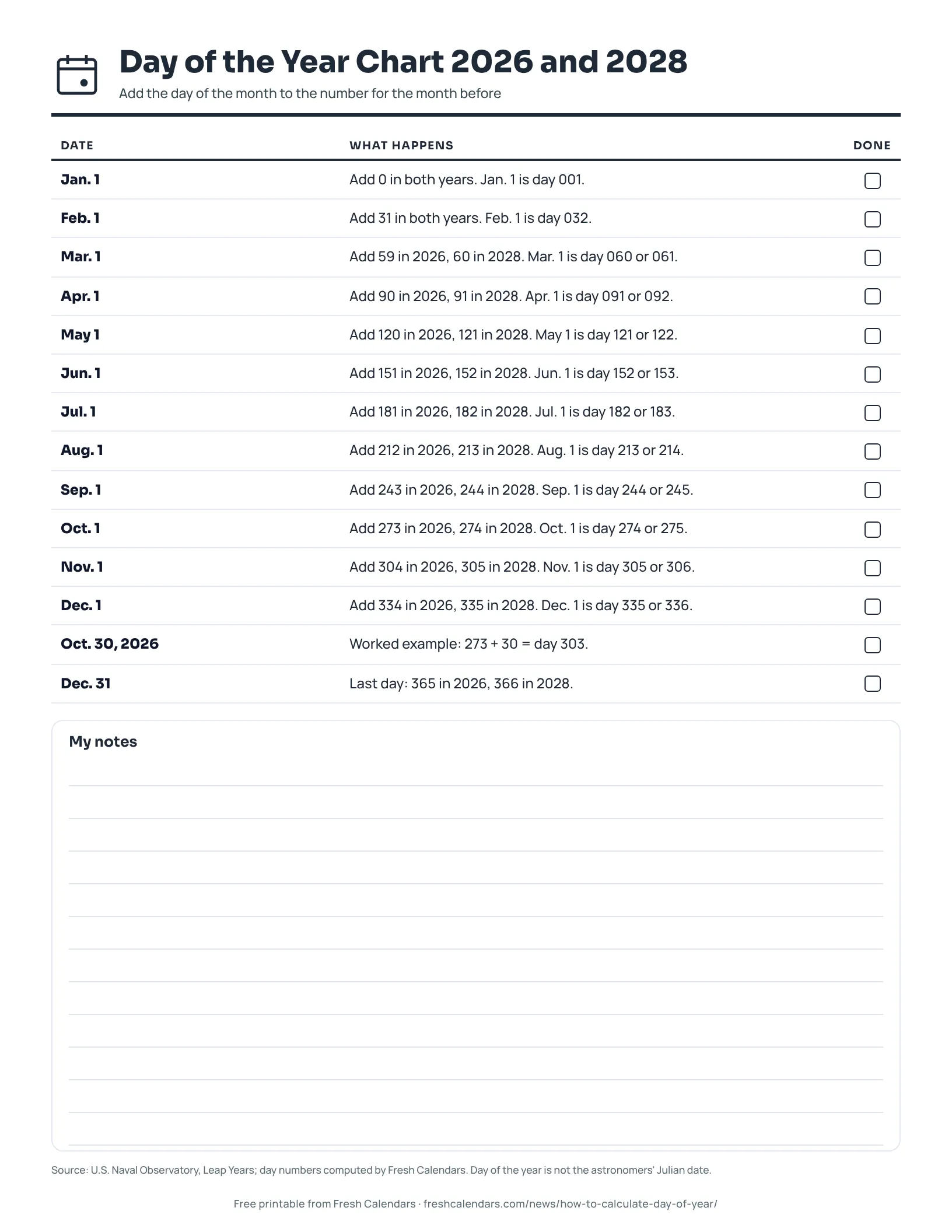
One-page chart of the number to add for each month in a common year (2026) and a leap year (2028), with a worked example for converting a date to its day of the year. Ink-saver version.
Frequently asked questions
What is day 001?
Jan. 1. The day number is the position of a date in its year, so Jan. 1 is 001 in every year, common or leap.
Is day 366 possible every year?
No. Day 366 exists only in a leap year, as a summary of ISO 8601 hosted by NASA says. In 2026 the year ends on day 365; in 2028 it ends on day 366.
What is the 100th day of the year?
April 10 in a common year and April 9 in a leap year. March 31 is day 090 or 091, so adding 10 or 9 reaches 100. The full story is in our 100th day of the year explainer.
Is day of year the same as a Julian date?
Only in the loose sense some industries use. The USNO defines Julian dates as a continuous count of days and fractions since noon Universal Time on Jan. 1, 4713 BC, which is a different number.
How do I convert 2026-300 to a calendar date?
2026 is a common year, and 273 days are complete by the end of September. 300 minus 273 is 27, so 2026-300 is Oct. 27, 2026. In leap year 2028, day 300 is Oct. 26.
Sources
- Leap Years (U.S. Naval Observatory)
- Julian Date Converter (U.S. Naval Observatory)
- Shell Egg Day of the Year Chart (U.S. Department of Agriculture, Agricultural Marketing Service)
- A Summary of the International Standard Date and Time Notation (NASA (hosted summary of ISO 8601 by Markus Kuhn))
- Date function (Microsoft Support)
- Days function (Microsoft Support)
- Date (Google Docs Editors Help)
Related news


More in Calendar Guides
All Calendar Guides stories →- How Many Days Are Left in the Year? The Formula, Plus the Count From Oct. 30, 2026
- How to Print a Calendar PDF at Actual Size: Print Settings for Edge, Mac and Home Printers
- Monday Start vs Sunday Start Calendar: Same Dates, Different First Column
- What Is a Fiscal Year? Federal, State and UK Dates With Quarter Tables
- How to Find the Day of the Week for Any Date: Zeller, Doomsday and Spreadsheet Codes