Planets Visible in November 2026: Uranus Opposition Nov. 25
Planets visible in November 2026: Uranus reaches opposition Nov. 25 and the Moon passed about 1° from Venus Nov. 7. A day-by-day sky table.

Published Updated 6 min read
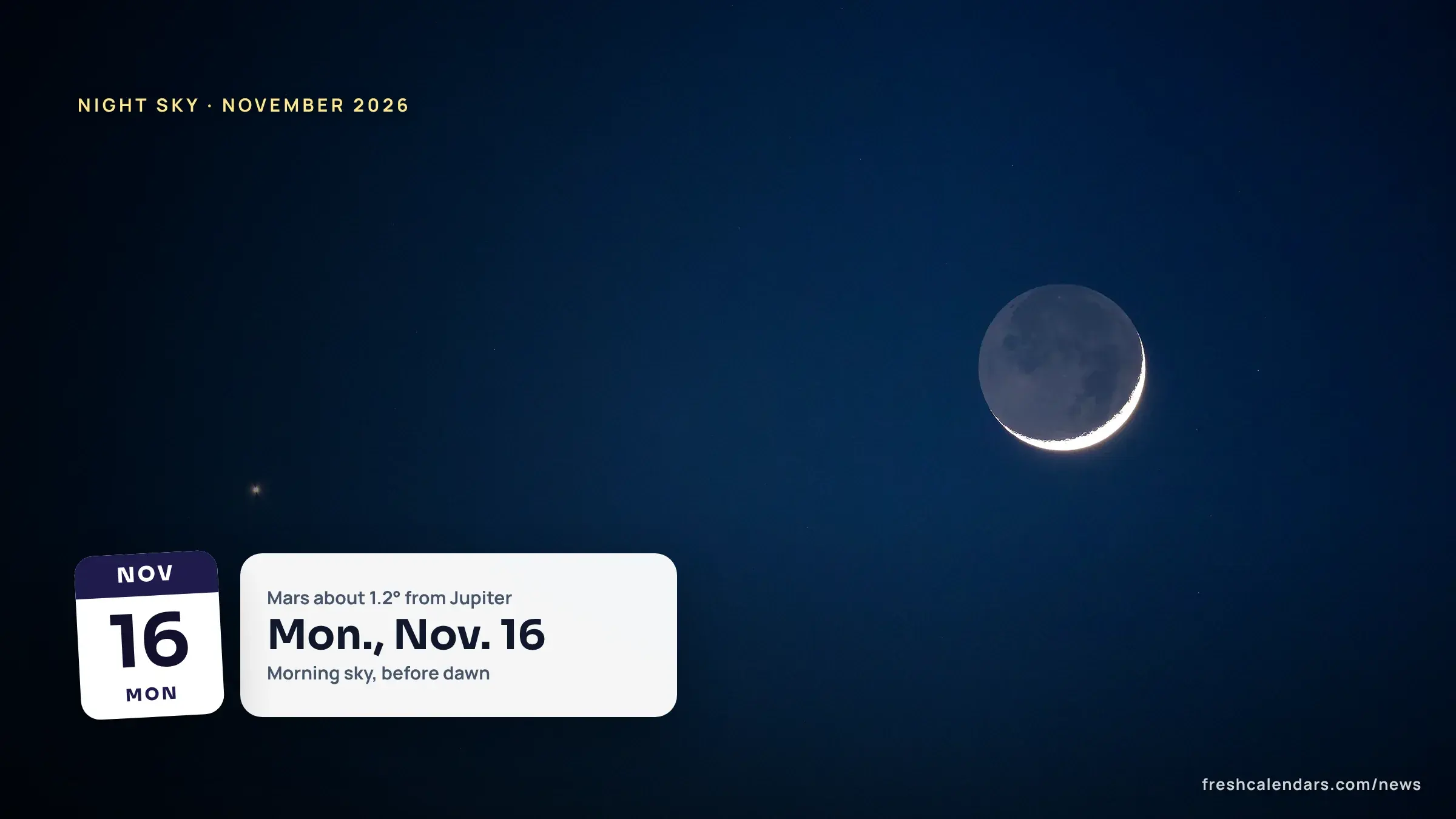
Key date
- Nov 25Wed Uranus at opposition In 8 days + Google
In this article
Mars comes within about 1.2° of Jupiter in the morning sky on Monday, Nov. 16, and Uranus reaches opposition on Wednesday, Nov. 25; a thin crescent Moon passed about 1° from Venus on Saturday, Nov. 7, according to our night sky calendar computed from NASA Jet Propulsion Laboratory (JPL) Horizons data. NASA published its “What’s Up” guide for November 2026 on Nov. 2; we calculated the month’s planet events ourselves and took the Moon phases from the U.S. Naval Observatory (USNO).
Clocks fell back at 2 a.m. on Nov. 1, so every time below is Eastern Standard Time (EST) unless marked; see when daylight saving time ends.
What is happening in the night sky each day of November 2026?
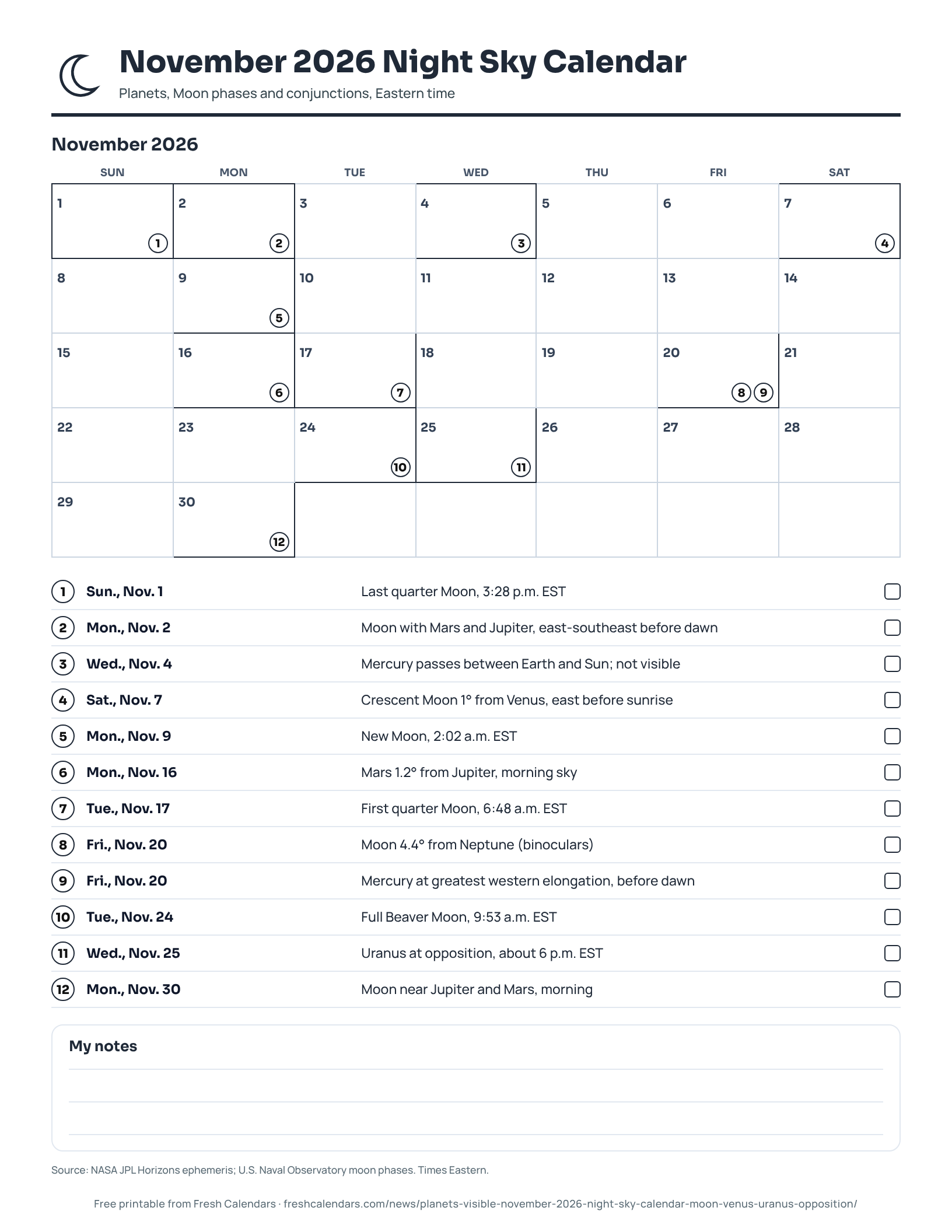
| Date (Eastern) | Event | When and where to look | How close |
|---|---|---|---|
| Sun., Nov. 1 | Last quarter Moon | 3:28 p.m. EST (20:28 Coordinated Universal Time, UTC) | Moon phase |
| Mon., Nov. 2 | Moon with Mars and Jupiter | East-southeast before dawn on Nov. 2 and 3; Mars is closest at 9 a.m., Jupiter at 6 p.m. | Mars about 1.0°, Jupiter about 0.5° |
| Wed., Nov. 4 | Mercury at inferior conjunction | About 10 a.m.; Mercury passes between Earth and Sun and cannot be seen | About 0.4° from the Sun |
| Sat., Nov. 7 | Crescent Moon and Venus | About 6 a.m., low in the east-southeast before sunrise | About 1.0° |
| Sun., Nov. 8 | Moon and Mercury | About 8 a.m.; Mercury is too low to see | About 5.7° |
| Mon., Nov. 9 | New Moon | 2:02 a.m. EST (07:02 UTC) | Moon phase |
| Mon., Nov. 16 | Mars and Jupiter | About 9 p.m. on Nov. 15; look before dawn on Nov. 16 in the morning sky | About 1.2° |
| Tue., Nov. 17 | First quarter Moon | 6:48 a.m. EST (11:48 UTC) | Moon phase |
| Fri., Nov. 20 | Moon and Neptune | About 3 a.m.; binoculars or a telescope only (magnitude 7.7) | About 4.4° |
| Fri., Nov. 20 | Mercury at greatest western elongation | About 7 p.m.; best seen before dawn on Nov. 20-22 | 19.6° from the Sun |
| Tue., Nov. 24 | Full Moon (Beaver Moon) | 9:53 a.m. EST (14:53 UTC) | Moon phase |
| Tue., Nov. 24 | Full Moon and Uranus | About noon; Moon glare hides Uranus | About 5.1° |
| Wed., Nov. 25 | Uranus at opposition | About 6 p.m.; in Taurus, visible all night | Magnitude 5.6 |
| Mon., Nov. 30 | Moon near Jupiter and Mars | Jupiter about 3 a.m., Mars about noon; look at the waning gibbous Moon in the morning | Jupiter about 1.1°, Mars about 3.0° |
Separations are center to center as seen from Earth’s center. From any one city the Moon’s apparent position can differ by up to about 1°, so every figure is approximate. The planet times come from hourly JPL Horizons positions for Oct. 31 to Dec. 2, 2026; the Moon phases come from the USNO. Print the same dates on one page with the November 2026 night sky calendar printable, or mark them on a November 2026 printable calendar.
Which planets are in the morning sky?
Venus, Jupiter and Mars all rise before the Sun in November, according to JPL Horizons.
| Planet | Distance from the Sun in the sky | Brightness (magnitude) |
|---|---|---|
| Venus | 13° on Nov. 1, 30° on Nov. 15, 40° on Nov. 30 | About -4.2 on Nov. 1 to -4.9 at month’s end |
| Jupiter | 74° on Nov. 1, 87° on Nov. 15, 101° on Nov. 30 | About -2.0 to -2.2 |
| Mars | 80° on Nov. 1, 87° on Nov. 15, 96° on Nov. 30 | About +0.8 to +0.4 |
Lower magnitudes are brighter. Venus is the brightest of the three and climbs higher before sunrise every day of the month, from only 13° from the Sun on Nov. 1 to 40° by Nov. 30. Venus stayed fairly low on Nov. 7 and keeps climbing, so find an open view to the east-southeast.
Jupiter and Mars are the other pair to find. The Moon, a day past last quarter, was near both in the east-southeast before dawn on Nov. 2 and again on Nov. 3. On Nov. 16 the planets themselves are about 1.2° apart, with Jupiter at magnitude -2.1 and Mars at +0.7; NASA’s guide lists the pair close together on the mornings of Nov. 15 and 16, in the southeast before sunrise. On Nov. 30 the waning gibbous Moon returns to the same part of the sky, about 1.1° from Jupiter and 3.0° from Mars.
Can I see Mercury, Saturn and Neptune?
Mercury passed between Earth and the Sun on Nov. 4 and was lost in the glare. It moves into the morning sky after about Nov. 10 and reaches its greatest western elongation, 19.6° from the Sun, at about 7 p.m. on Nov. 20. The best view is before dawn on Nov. 20-22, at about magnitude -0.1 to -0.7 in late November. Our guide to Mercury retrograde lists every date and time through 2027.
Saturn is in the evening sky, 151° from the Sun on Nov. 1 and 120° by Nov. 30, at magnitude +0.5 to +0.6. It is best in the early evening in the south. Neptune is also an evening planet but shines at only magnitude 7.7, so it needs binoculars or a telescope; the Moon passes about 4.4° from it on Nov. 20.
What is Uranus at opposition?
Opposition means Earth sits between the Sun and Uranus, so the planet is up all night. Uranus reaches it at about 6 p.m. EST on Wednesday, Nov. 25 (about 23:00 UTC), when it is 179.85° from the Sun in the sky. It is in Taurus near the Pleiades, at magnitude 5.6.
That brightness is at the limit of naked-eye visibility from very dark sites; binoculars from dark skies are the realistic tool. The timing is awkward: the Beaver Moon is full on Nov. 24 and still nearly full on Nov. 25, so its glare washes out faint objects. For the full moon details see our Beaver Moon and Cold Moon guide, and for every phase of the month the moon phase calendar for late October and November.
What else is in the sky this month?
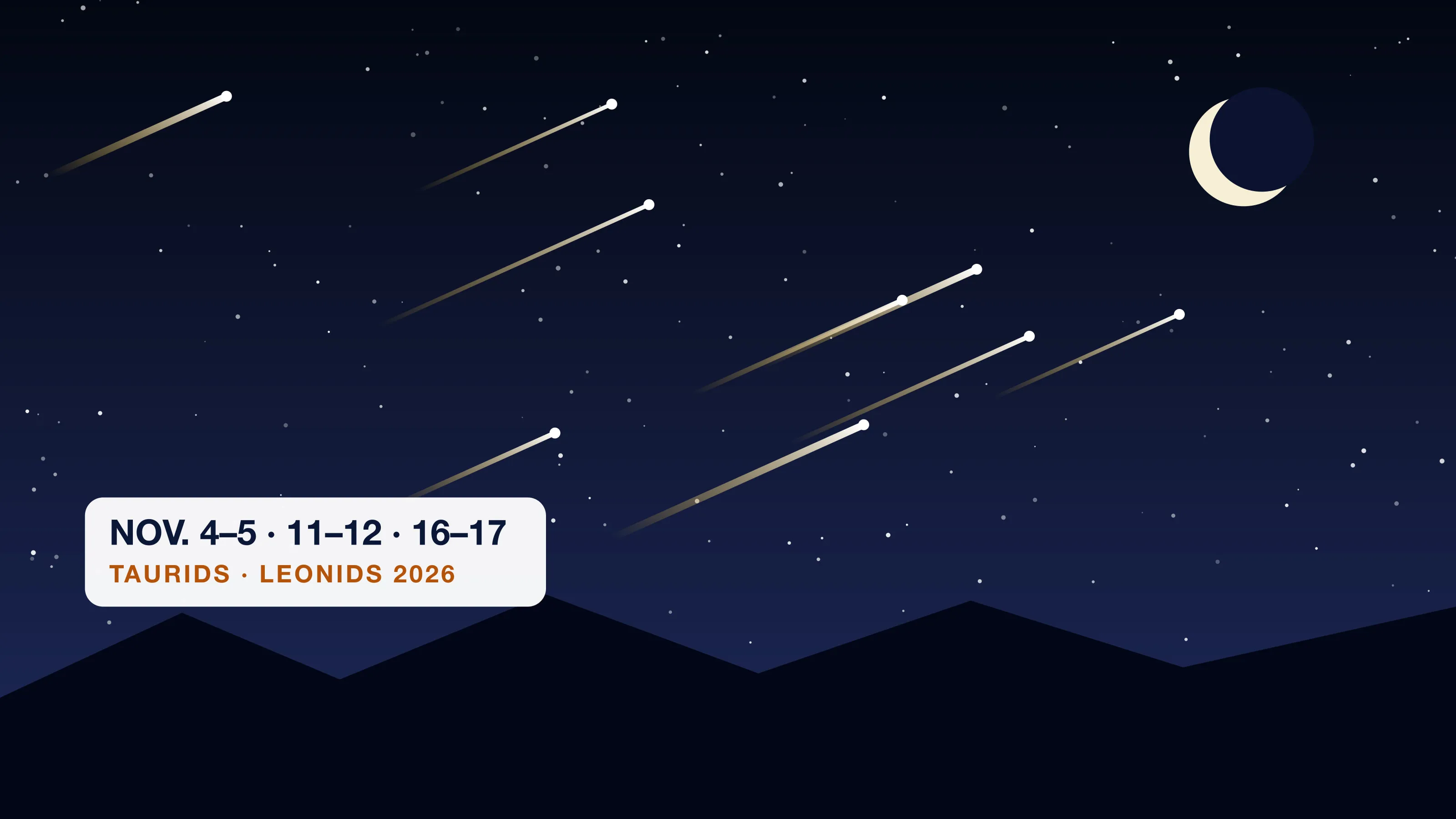
The Southern Taurids peak on the night of Nov. 4-5, the Northern Taurids on Nov. 11-12 and the Leonids on Nov. 16-17, according to the American Meteor Society; NASA’s November guide says the Southern Taurids peak around Nov. 5 and the Northern Taurids around Nov. 12, with the Leonids in the early mornings of Nov. 17 and 18 after the Moon sets. The details are in our November 2026 meteor shower guide.
Before dawn on Tue., Nov. 24, the nearly full Moon passes in front of stars of the Pleiades as seen from the western United States, by our calculation with the open-source Astronomy Engine. In Denver, Maia is hidden from about 5:22 to 6:04 a.m. Mountain Standard Time (MST); in Salt Lake City from 5:21 to 6:01 a.m. MST; in Seattle from 4:05 to 4:55 a.m. Pacific Standard Time (PST). Los Angeles sees only the fainter Taygeta, from 4:14 to 4:52 a.m. PST. From the East the Moon has set or the sky is light. Binoculars help next to such a bright Moon. Looking ahead, the December 2026 printable calendar has room to add next month’s sky events.
Where do these times come from?
NASA’s skywatching series, “What’s Up,” posted its November 2026 edition on Nov. 2, 2026, after we had computed these events on Oct. 28; we did not copy it. Our times come from the NASA JPL Horizons ephemeris (a geocentric calculation at hourly steps), converted from UTC to Eastern time. Moon phases are from the USNO Astronomical Applications moon phases data. Times are rounded to the hour for planet events, so an event can fall within an hour of the time shown.
Free printable downloads
Every template is free, needs no sign-up and prints on US Letter paper. Choose PDF for printing or PNG for screens and documents.
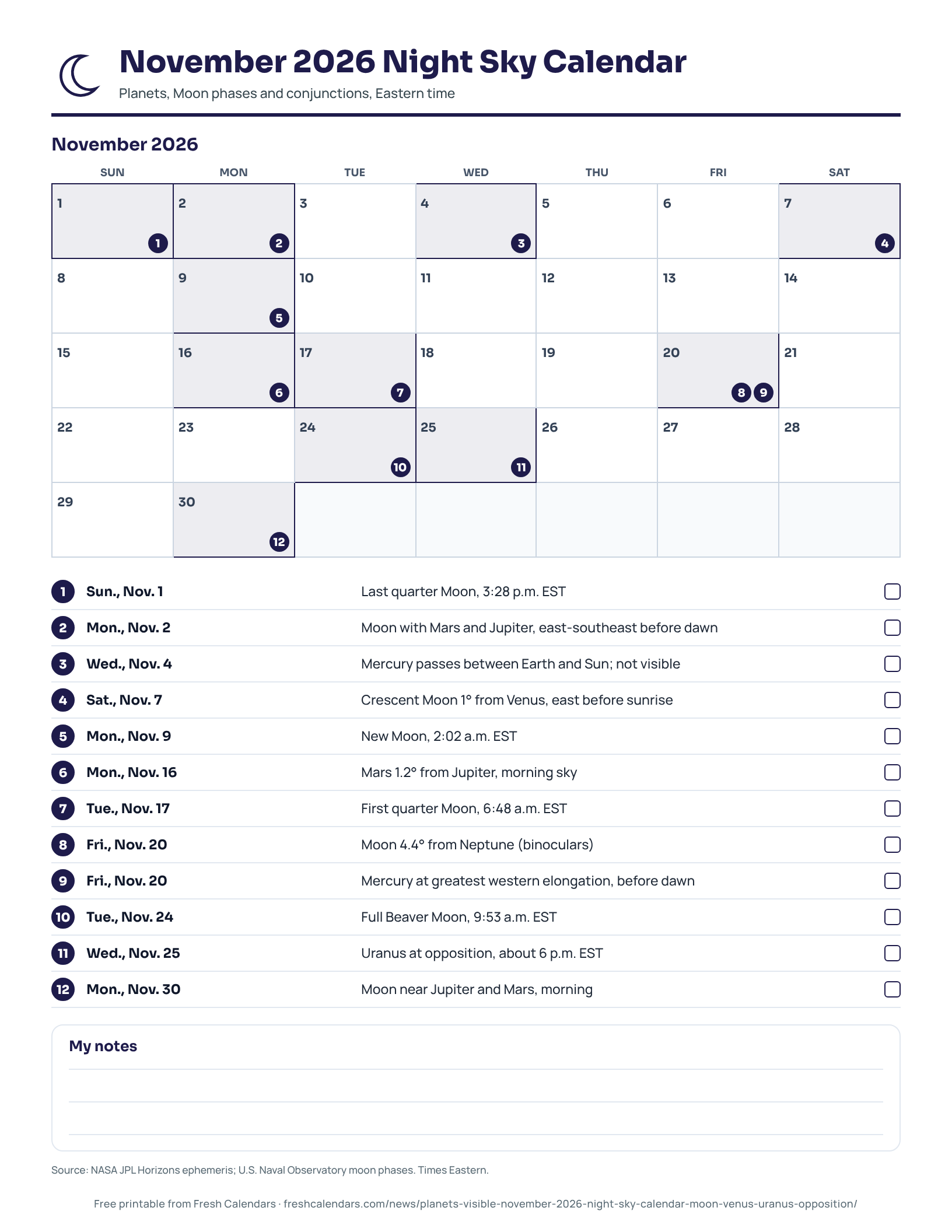
November 2026 Night Sky Calendar printables
-
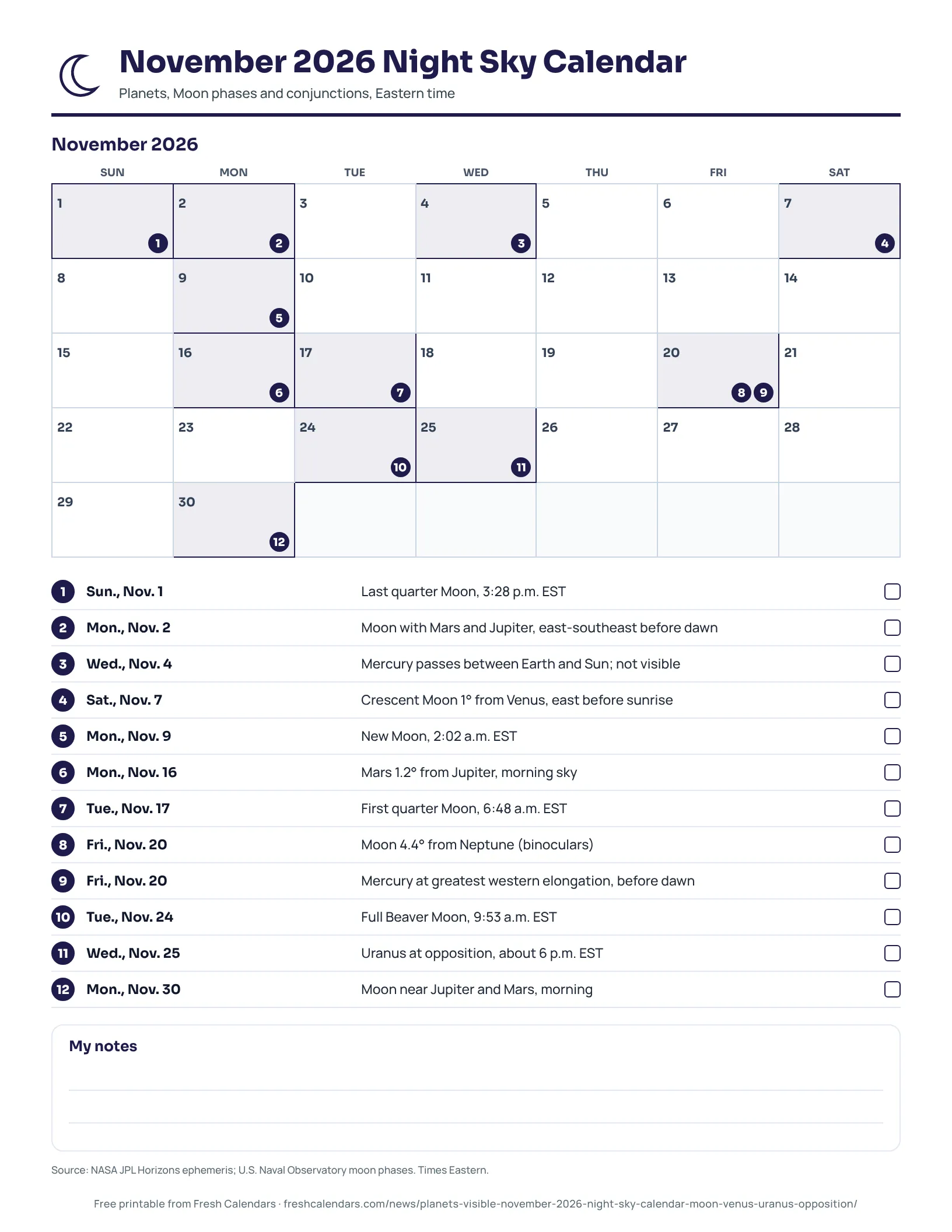
November 2026 Night Sky Calendar
A one-page November 2026 night sky calendar with moon phases, Moon and planet pairings, Mercury's best morning and Uranus at opposition.
-
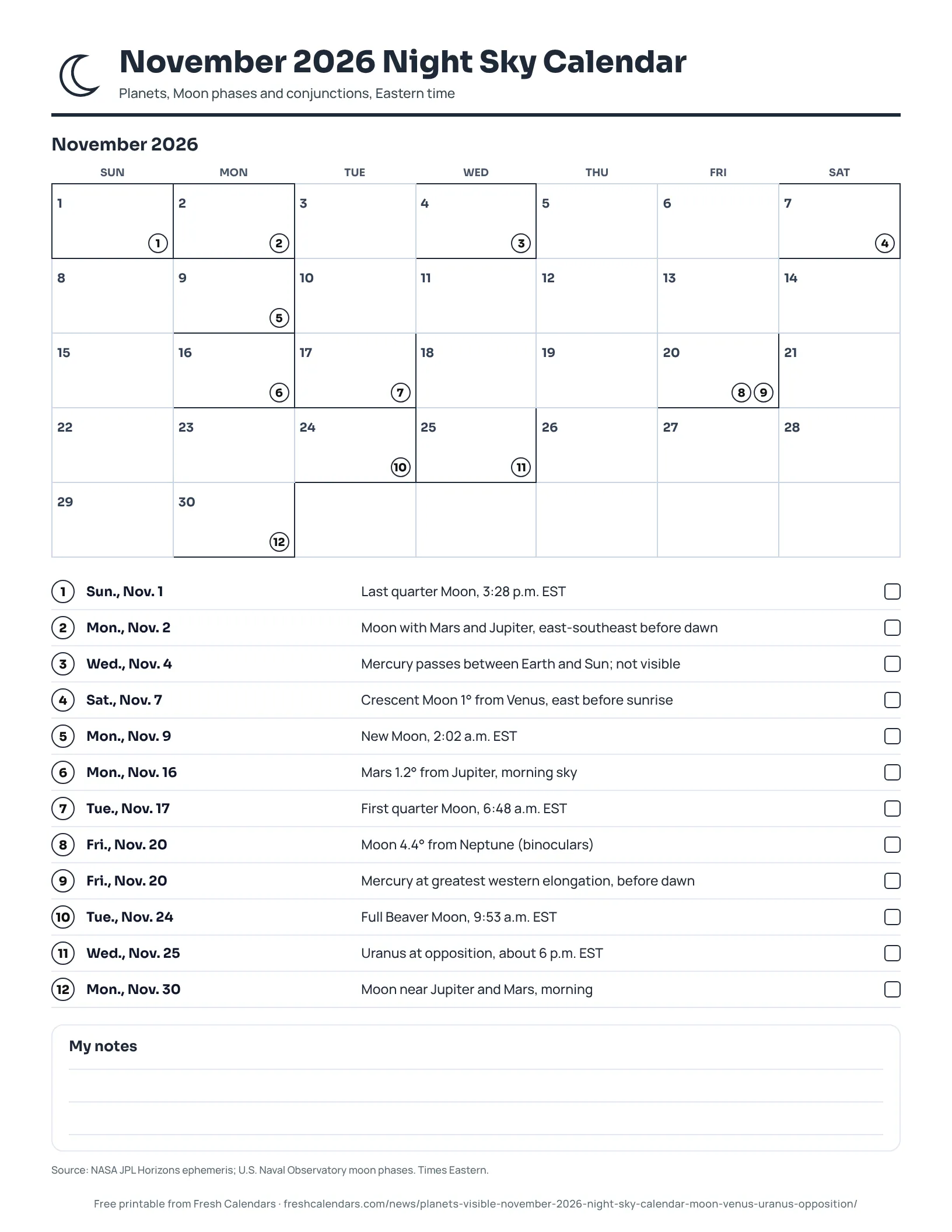
November 2026 Night Sky Calendar (ink saver)
A one-page November 2026 night sky calendar with moon phases, Moon and planet pairings, Mercury's best morning and Uranus at opposition. Ink-saver version.
Frequently asked questions
Which planets can I see in November 2026?
Venus, Mars and Jupiter in the morning sky, Saturn in the evening sky and Mercury before dawn in the second half of the month. Uranus and Neptune need binoculars or a telescope.
When is Uranus at opposition in 2026?
At about 6 p.m. Eastern Standard Time on Wednesday, Nov. 25, 2026, according to our calculation from NASA Jet Propulsion Laboratory Horizons data. That is 23:00 Coordinated Universal Time.
Can I see Uranus without a telescope?
At magnitude 5.6 it sits at the limit of naked-eye visibility from very dark sites. Binoculars from dark skies show it more easily, but the nearly full Moon adds glare.
When is the Moon closest to Venus in November 2026?
Around 6 a.m. Eastern Standard Time on Saturday, Nov. 7, when a thin crescent Moon is about 1° from Venus, low in the east-southeast before sunrise.
Why do the times differ from other sources?
Our separations are measured from Earth's center. From a given city the Moon's apparent position differs by up to about 1°, so treat each separation as approximate.
Sources
- Meteor Shower Calendar (American Meteor Society)
- Astronomy Engine (Don Cross (open source))
- JPL Horizons On-Line Ephemeris System (NASA Jet Propulsion Laboratory, 2026-10-28)
- Moon Phases by Year (Astronomical Applications data service) (U.S. Naval Observatory, Astronomical Applications Department)
- What's Up: November 2026 Skywatching Tips from NASA (NASA, 2026-11-02)
Related news
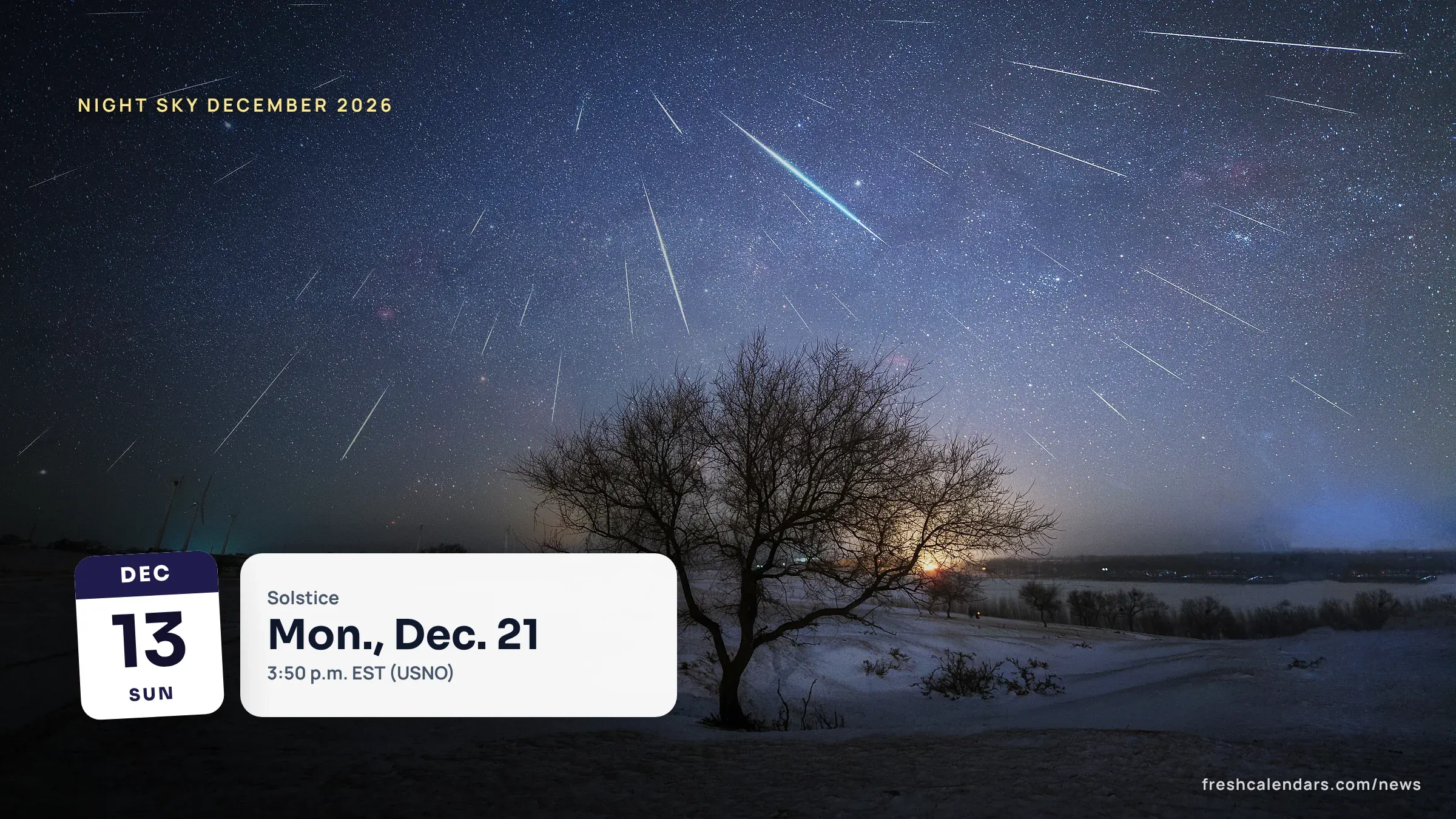
More in Sky Events
All Sky Events stories →- Ursid Meteor Shower 2026: Peak Dec. 21-22, Moonset in 10 Cities
- Moon on New Year's Eve 2026: Moonrise 1:46 a.m. in New York
- Leonid Meteor Shower 2026: Peak Nov. 16-17, Moon-Free Hours
- Latest Sunrise 2027: New York 7:20 a.m. Dec. 30-Jan. 10, 20 Cities
- Meteor Showers 2027: Peak Dates for 12 Showers, Perseids Aug. 13
Trending now
- Thanksgiving Travel 2026: Best Days to Fly and Drive, Nov. 21 to 30
- Black Friday Ads 2026: Date Is Nov. 27, Walmart Deals Nov. 23-29
- Botanical Garden Holiday Lights 2026: Opening Dates at 5 Gardens
- New Movies in Theaters November 2026: Hunger Games on Nov. 20
- Thanksgiving 2026 School Break: 52 of 81 Districts Off Nov. 23-27