Meteor Showers 2027: Peak Dates, Eastern Times and Moon Phase for 12 Showers
The International Meteor Organization (IMO) puts the 2027 Perseid peak at 4-6 a.m. Eastern Time (ET) on Aug. 13, under an 89% Moon. All 12 showers, with Moon.

Published 9 min read

In this article
- Meteor shower peak dates and times for 2027 in Eastern Time
- Which five nights are best for meteor watching in 2027?
- Perseids 2027: peak time, moonset and model encounters
- Quadrantids, Eta Aquariids, Southern Delta Aquariids and Ursids: the dark-sky showers
- Which 2027 meteor showers have a bright Moon?
- Meteor showers 2027 printable calendar
The International Meteor Organization (IMO) lists the 2027 Perseid meteor shower peak for Friday, Aug. 13, from 08h to 10h Universal Time (UT), which is 4 to 6 a.m. Eastern Daylight Time (EDT), and the Moon will be 89% lit that day, per the U.S. Naval Observatory (USNO). The IMO’s 2027 Meteor Shower Calendar has 39 entries in its working list of visual showers, including the Antihelion Source. This story converts the 12 that readers search for to Eastern Time (ET), adds each shower’s zenithal hourly rate (ZHR) and the Moon’s lit share on the peak date, rates the Moon as good, fair or poor, and ranks the best five nights of the year with the method shown below.
Meteor shower peak dates and times for 2027 in Eastern Time
The IMO gives peaks in UT. Eastern Time is UT minus 5 hours in Eastern Standard Time (EST) and minus 4 hours in EDT, and daylight time runs from Mar. 14 to Nov. 7 in 2027. The IMO states that its maximum dates are “accurate only for 2027” and that its table reflects the information available in June 2026.
| Shower | Peak night (ET) | IMO peak (UT) | ZHR | Moon lit (USNO) | Moon verdict |
|---|---|---|---|---|---|
| Quadrantids | Sun., Jan. 3, about 10:25 p.m. EST | Jan. 4, 03:25 | 80+ | 9% | Good |
| Lyrids | Thu., Apr. 22, about 9:40 p.m. EDT | Apr. 23, 01:40 | 18 | 92% | Poor |
| Eta Aquariids | Thu., May 6, about 5 a.m. EDT | May 6, 09:00 | 50 | 0% | Good |
| Southern Delta Aquariids | Sat., July 31 (no hour given) | July 31 | 25 | 5% | Good |
| Perseids | Fri., Aug. 13, 4 to 6 a.m. EDT | Aug. 13, 08:00 to 10:00 | 110+ | 89% | Poor |
| Draconids | Sat., Oct. 9, about 3 a.m. EDT | Oct. 9, 07:00 | 5 | 70% | Poor |
| Orionids | Fri., Oct. 22 (no hour given) | Oct. 22 | 20 | 51% | Fair |
| Southern Taurids | Sat., Nov. 6 (no hour given) | Nov. 6 | 5-10 | 53% | Fair |
| Northern Taurids | Sat., Nov. 13 (no hour given) | Nov. 13 | 5 | 100% | Poor |
| Leonids | Thu., Nov. 18, about 1 a.m. EST | Nov. 18, 06:00 | 15+ | 75% | Poor |
| Geminids | Tue., Dec. 14, about 3 p.m. EST | Dec. 14, about 20:00 | 150 | 98% | Poor |
| Ursids | Wed., Dec. 22, about 11 p.m. EST | Dec. 23, 04:00 | 10 | 17% | Good |
How to read it:
- ZHR is the IMO’s calculated maximum number of meteors an ideal observer would see per hour in perfectly clear skies with the shower’s radiant overhead. The IMO’s Table 5 lists 150 for the Geminids; the calendar’s text gives no rate for them.
- Moon lit is the illuminated share of the Moon on the peak date, from USNO data for Washington, D.C., rounded to a whole percent. It shifts by a point or two over the day.
- Moon verdict is a Fresh Calendars rule: good at 25% or less, fair at 26% to 60%, poor above 60%.
- The Eastern Time column is our conversion of the IMO’s UT peak. Where the IMO gives only a date, no hour is shown.
Which five nights are best for meteor watching in 2027?
The method is simple. Take the first number in the IMO’s ZHR (80 for “80+”) and multiply it by the unlit share of the Moon on the peak date (100% minus the USNO’s lit share). The result is a Fresh Calendars score for comparing nights, not an IMO or USNO figure, and it ignores clouds, your latitude and the hour the Moon rises or sets where you live.
| Rank | Night | Shower | ZHR | Moon lit | Score |
|---|---|---|---|---|---|
| 1 | Sun., Jan. 3 to Mon., Jan. 4 | Quadrantids | 80+ | 9% | 73 |
| 2 | Wed., May 5 to Thu., May 6 (before dawn) | Eta Aquariids | 50 | 0% | 50 |
| 3 | Around Sat., July 31 | Southern Delta Aquariids | 25 | 5% | 24 |
| 4 | Thu., Aug. 12 to Fri., Aug. 13 | Perseids | 110+ | 89% | 12 |
| 5 | Around Fri., Oct. 22 | Orionids | 20 | 51% | 10 |
The next-highest score is the Ursids at 8 (10 times 83%). Every other peak in the table scores 4 or lower.
Three cautions go with the ranking:
- The Quadrantid peak is narrow and uncertain. The IMO puts the timing uncertainty at about 2.5 hours, and it says rates have varied: in 2022, 2023 and 2025 the highest visual ZHR was in the lower range of the 60 to 200 it quotes.
- The Eta Aquariid ZHR of 50 is the IMO’s table value. The IMO says the last six years yielded roughly 40, and 2026 is listed at 35 (preliminary).
- The score understates the Perseids for anyone who can watch after moonset, as the next section shows.
Perseids 2027: peak time, moonset and model encounters
The IMO’s maximum for the Perseids is Aug. 13, 08h to 10h UT, with a ZHR of 110 or more. In Eastern Time that is 4 to 6 a.m. EDT on Friday. The IMO adds that past observations put the traditional broad maximum anywhere from 03h to 16h UT on Aug. 13 for 2027, which is 11 p.m. EDT on Aug. 12 to noon EDT on Aug. 13, so treat the 08h to 10h window as the center of a wider peak.
The Moon is the problem. The IMO writes that it “lies midway between first quarter and full on August 12 and 13, so the moon-free period will be quite short for the expected maxima, depending on the observers’ latitude.” USNO’s figures for Washington, D.C. show an 82% Moon on Aug. 12 and 89% on Aug. 13, with moonset at 2:36 a.m. EDT on Aug. 13 and civil twilight beginning at 5:51 a.m. EDT. The IMO says the Perseid radiant has reached a reasonable height from 22h to 23h local time onward. In D.C., the dark stretch from 2:36 a.m. to dawn holds most of the 4 to 6 a.m. peak window. Our sources give moonset times for Washington only, so check a local moonset time before you plan.
The IMO also credits a Jupiter-shifted part of the stream. It cites Mikhail Maslov’s finding that the shift is about 0.006 astronomical units and may raise activity by 10 to 20 percent, a ZHR of 110 to 120, and says the shift grows into the 2028 return, with a good chance of substantially higher rates then.
The IMO lists three Perseid encounters from model tables in a 2006 work by Jenniskens. These are predictions, not confirmed events:
- Aug. 12, 19h 18m UT (3:18 p.m. EDT), probably weak, ZHR about 20.
- Aug. 12, 23h 46m UT (7:46 p.m. EDT), possibly stronger, with a ZHR listed as 280. USNO has sunset at 8:07 p.m. EDT that evening in Washington, so the time falls before dark there.
- Aug. 13, 07h UT (3 a.m. EDT), a filament encounter with a ZHR of 50.
Quadrantids, Eta Aquariids, Southern Delta Aquariids and Ursids: the dark-sky showers
The IMO’s announcement of its 2027 calendar names the Quadrantids, the main Eta Aquariid peak, the Southern Delta Aquariids, the Aurigids and the Ursids as having favorable viewing conditions.
Quadrantids (Jan. 3-4). The IMO’s maximum is Jan. 4 at 03h 25m UT, or about 10:25 p.m. EST on Sunday, Jan. 3, with a ZHR of 80 or more (it can vary from about 60 to 200). The IMO says conditions are “perfect” concerning moonlight, and it notes that Jérémie Vaubaillon emphasizes the stream is slightly shifted toward the Sun in 2027, which might cause enhanced activity. In Washington, D.C., USNO has the Moon setting at 1:28 p.m. EST on Jan. 3 and rising at 5:02 a.m. EST on Jan. 4, so it is below the horizon at the predicted peak. The IMO says the 5 to 7 days after the peak can still be used for undisturbed optical observations. Our Quadrantid story has the peak time for every U.S. time zone.
Eta Aquariids (May 6). The peak is at 09h UT, about 5 a.m. EDT on Thursday, May 6, and the New Moon is the same morning at 10:58 UT (6:58 a.m. EDT). The IMO says the maximum and its decline “can be well observed without moonlight interference.” These meteors show only in the hours shortly before dawn, and the IMO says useful results come from places south of about 40 degrees north. In Washington, civil twilight begins at 5:35 a.m. EDT that day, per USNO.
Southern Delta Aquariids (July 31). The IMO gives a ZHR of 25 for about two days around July 31, with a 5% Moon, and the Alpha Capricornids (ZHR 5) peak the same day. At mid-northern latitudes only a small part of the shower is visible, the IMO says, and conditions improve toward southern latitudes. The IMO also lists the Aurigids for Sept. 1 at 15h 30m UT (11:30 a.m. EDT, after sunrise in Washington), ZHR 6, near the Aug. 31 New Moon at 17:41 UT.
Ursids (Dec. 22-23). The IMO’s peak is Dec. 23 at 04h UT, or about 11 p.m. EST on Wednesday, Dec. 22, with a ZHR of 10 and no predicted dust trail or filament encounters. The IMO calls the shower moon-free in 2027. USNO shows a 17% waning crescent on Dec. 23 that rises at 3:25 a.m. EST in Washington, after the peak hour.
Which 2027 meteor showers have a bright Moon?
Lyrids (Apr. 22-23). The IMO’s peak is Apr. 23 at 01h 40m UT, about 9:40 p.m. EDT on Apr. 22, with a ZHR of 18. The IMO says the April Lyrid maximum, shortly after the Apr. 20 Full Moon, “has the worst conditions” among the showers it names. USNO has the Moon 97% lit on Apr. 22 and 92% on Apr. 23, rising at 10:13 p.m. EDT in Washington, 33 minutes after the IMO’s peak time.
Draconids (Oct. 9). The IMO’s peak is 07h UT, about 3 a.m. EDT on Saturday, with a ZHR of 5 and a 70% waxing Moon (first quarter is Oct. 7). The IMO has no prediction of enhanced rates for 2027. It says the Moon is most problematic before local midnight, when the radiant is highest. In Washington the Moon sets at 1:18 a.m. EDT on Oct. 9, before the peak hour.
Orionids (Oct. 22). The ZHR is 20, and Last Quarter Moon falls on Oct. 22 at 17:29 UT (1:29 p.m. EDT). USNO has the Moon 51% lit. The IMO notes that the bright waning Moon lights the sky while the radiant is above the horizon.
Taurids (Nov. 6 and 13). The Southern Taurids peak on Nov. 6 (ZHR 5 to 10, Moon 53%) and the Northern Taurids on Nov. 13 (ZHR 5). The Full Moon is Nov. 14 at 03:26 UT, which is 10:26 p.m. EST on Nov. 13, so the Northern Taurid peak night has a 100% Moon.
Leonids (Nov. 18). The IMO’s nodal peak is 06h UT, about 1 a.m. EST on Thursday, with a ZHR of 15 or more and a 75% waning gibbous Moon. In Washington the Moon rises at 8:08 p.m. EST on Nov. 17 and sets at 11:22 a.m. EST on Nov. 18, so it is up at the peak hour. The IMO also lists model-based possibilities: Nov. 17 at 22h UT (5 p.m. EST) with a ZHR of 40 to 50, and Nov. 20 at 04h UT (11 p.m. EST on Friday, Nov. 19) with a ZHR of 40 to 50 from a very old trail whose encounter details the IMO calls “really uncertain.” Neither is a confirmed event.
Geminids (Dec. 14). The IMO centers the peak “around 20h UT” on Dec. 14, which is about 3 p.m. EST, before sunset in Washington (USNO has sunset at 4:47 p.m.). The Full Moon is Dec. 13 at 16:09 UT, and USNO has the Moon 98% lit on Dec. 14, rising at 4:41 p.m. EST on Dec. 13 and setting at 8:26 a.m. EST on Dec. 14, so it is up all night in D.C. The IMO says the full Moon, near its northernmost position, “severely disturbs visual observations.” In 2026 the picture is different: the American Meteor Society (AMS) lists a 15% lit waxing crescent for the Dec. 13-14 peak night, covered in our 2026 Geminid story.
Meteor showers 2027 printable calendar
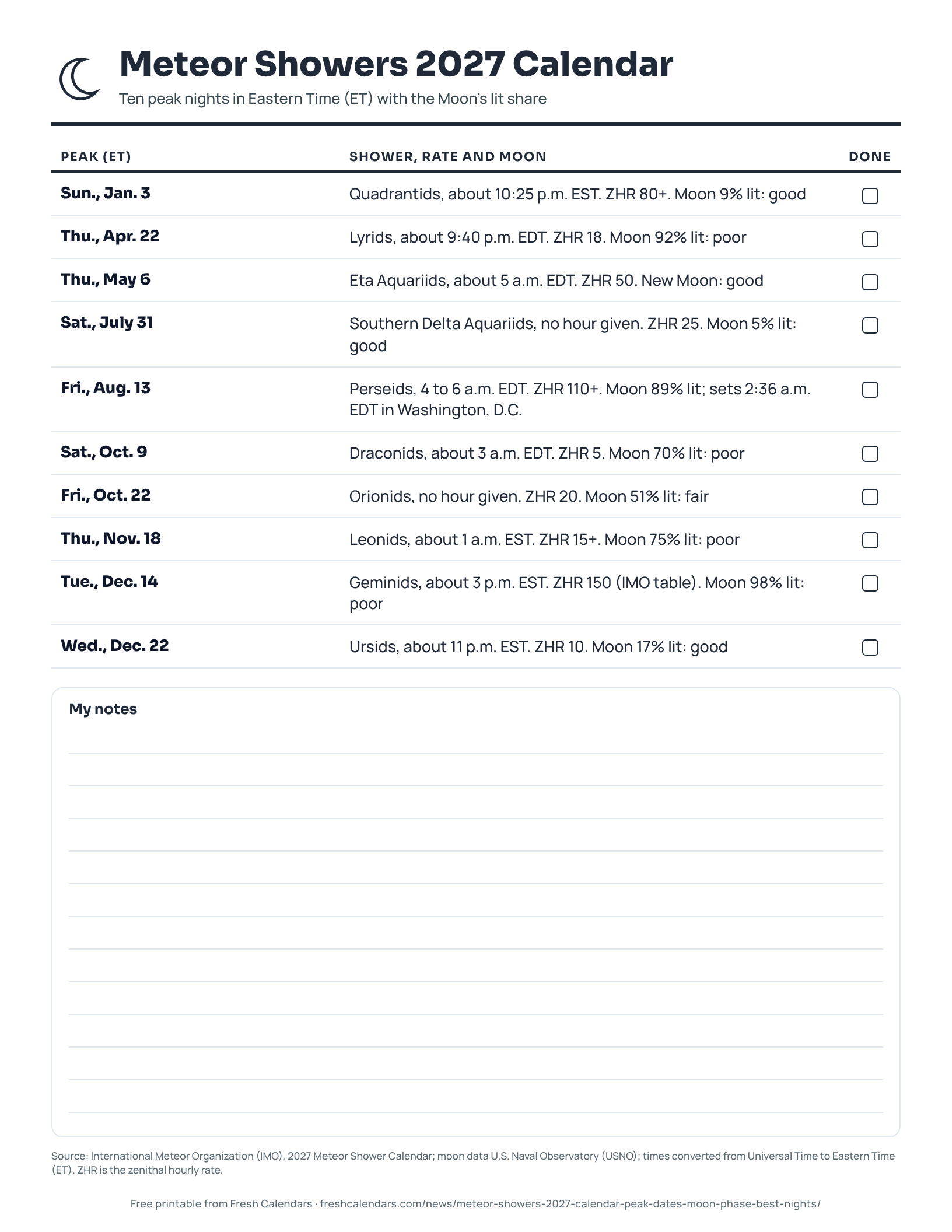
The one-page printable lists ten peaks with the Eastern Time, ZHR and Moon share from the table above, in an ink-saver version too. Moon dates and times for the rest of the year are in our 2027 full moon calendar, and the year’s five eclipses are in our 2027 eclipse dates story. To mark a peak night on paper, use the 2027 printable yearly calendar, or the August 2027 printable calendar for the Perseids.
Free printable downloads
Every template is free, needs no sign-up and prints on US Letter paper. Choose PDF for printing or PNG for screens and documents.
Meteor Showers 2027 Calendar printables
-
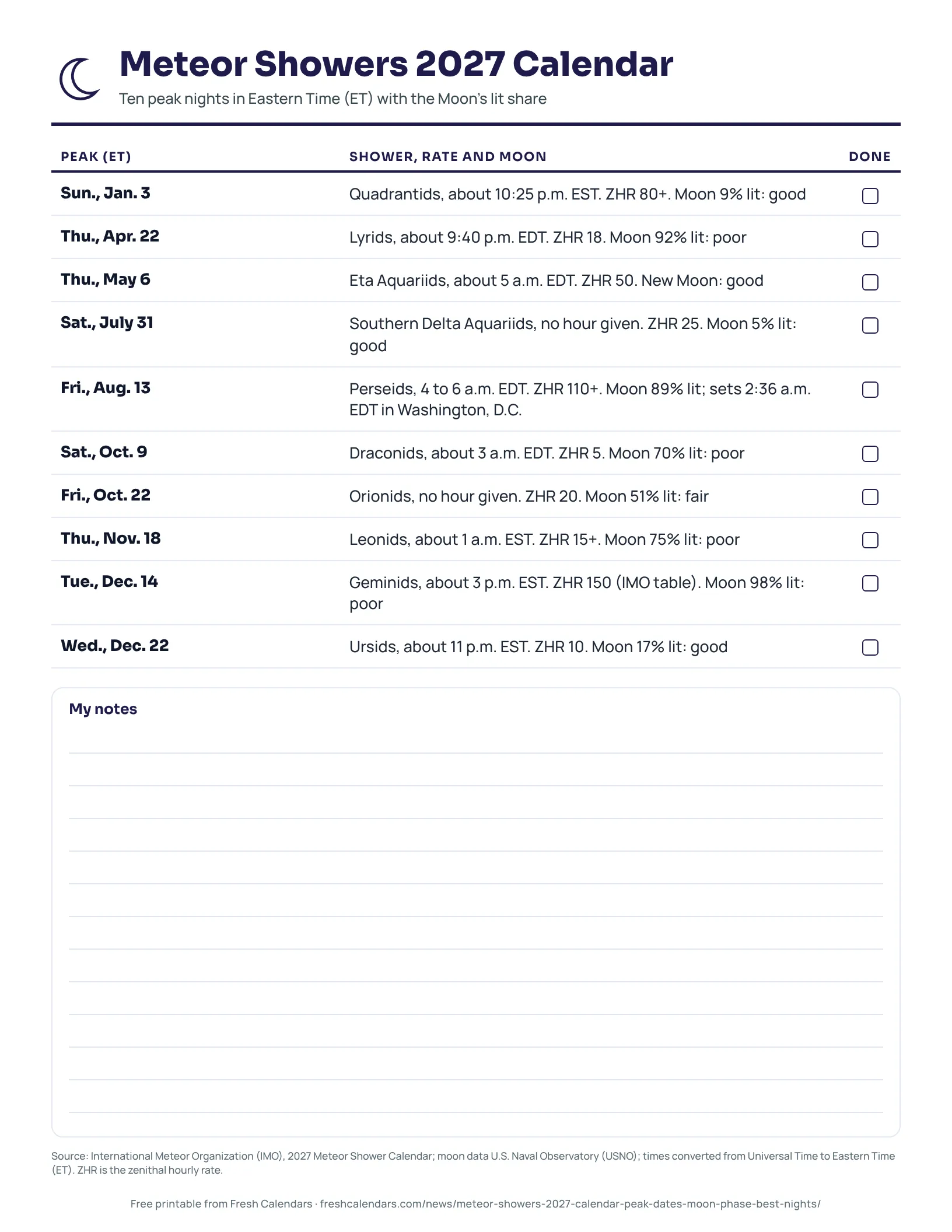
Meteor Showers 2027 Calendar
A one-page 2027 meteor shower calendar with ten peak dates in Eastern Time, each shower's hourly rate and the Moon's lit share.
-
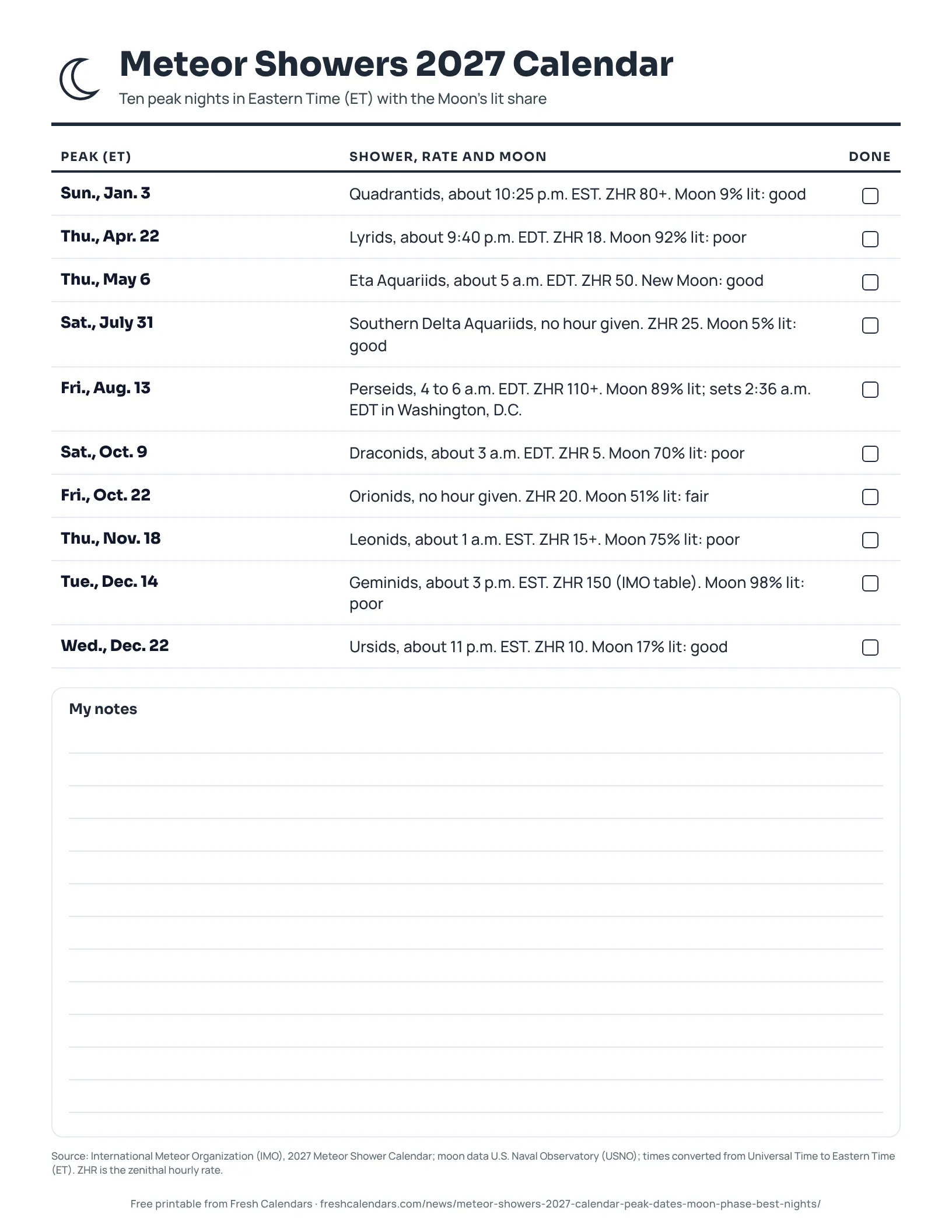
Meteor Showers 2027 Calendar (ink saver)
A one-page 2027 meteor shower calendar with ten peak dates in Eastern Time, each shower's hourly rate and the Moon's lit share. Ink-saver version.
Frequently asked questions
What are the best meteor showers of 2027?
By the method in this story (the IMO's zenithal hourly rate times the unlit share of the Moon, with USNO moon data), the best five nights are the Quadrantids (Jan. 3-4), the Eta Aquariids (May 6), the Southern Delta Aquariids (July 31), the Perseids (Aug. 13) and the Orionids (Oct. 22). The IMO itself lists the Quadrantids, the main Eta Aquariid peak, the Southern Delta Aquariids, the Aurigids and the Ursids as having favorable moonlight.
When do the Perseids peak in 2027?
The IMO gives Friday, Aug. 13, 2027, from 08h to 10h UT, which is 4 to 6 a.m. EDT. Its zenithal hourly rate is 110 or more. The Moon is 89% lit that day, and in Washington, D.C. it sets at 2:36 a.m. EDT, per USNO.
Will the Moon spoil the Geminids in 2027?
Yes. The Full Moon is Dec. 13 at 16:09 UT, the IMO centers the Geminid peak around 20h UT on Dec. 14 (3 p.m. EST), and the Moon is 98% lit. The IMO says the full Moon severely disturbs visual observations.
Sources
- 2027 Meteor Shower Calendar (IMO INFO 3-26) (International Meteor Organization, 2026-07-06)
- Meteor Shower Calendar 2027 (International Meteor Organization, 2026-07-06)
- Phases of the Moon, 2027 (U.S. Naval Observatory)
- Sun and Moon data for one day, Washington, D.C. (U.S. Naval Observatory)
Related news
-
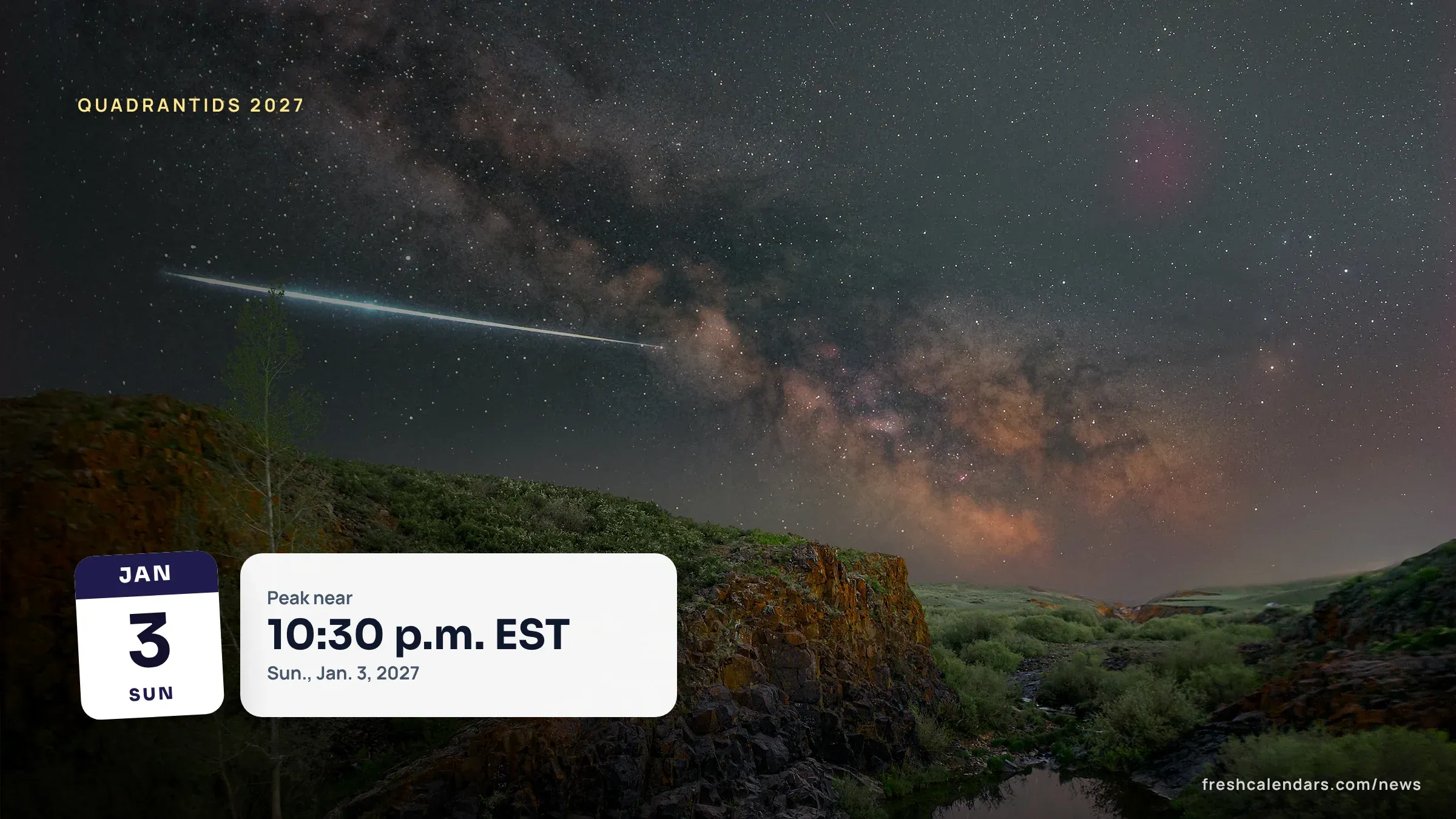 Quadrantid Meteor Shower 2027 Peaks the Night of Jan. 3-4, Then the Wolf Moon Jan. 22
-
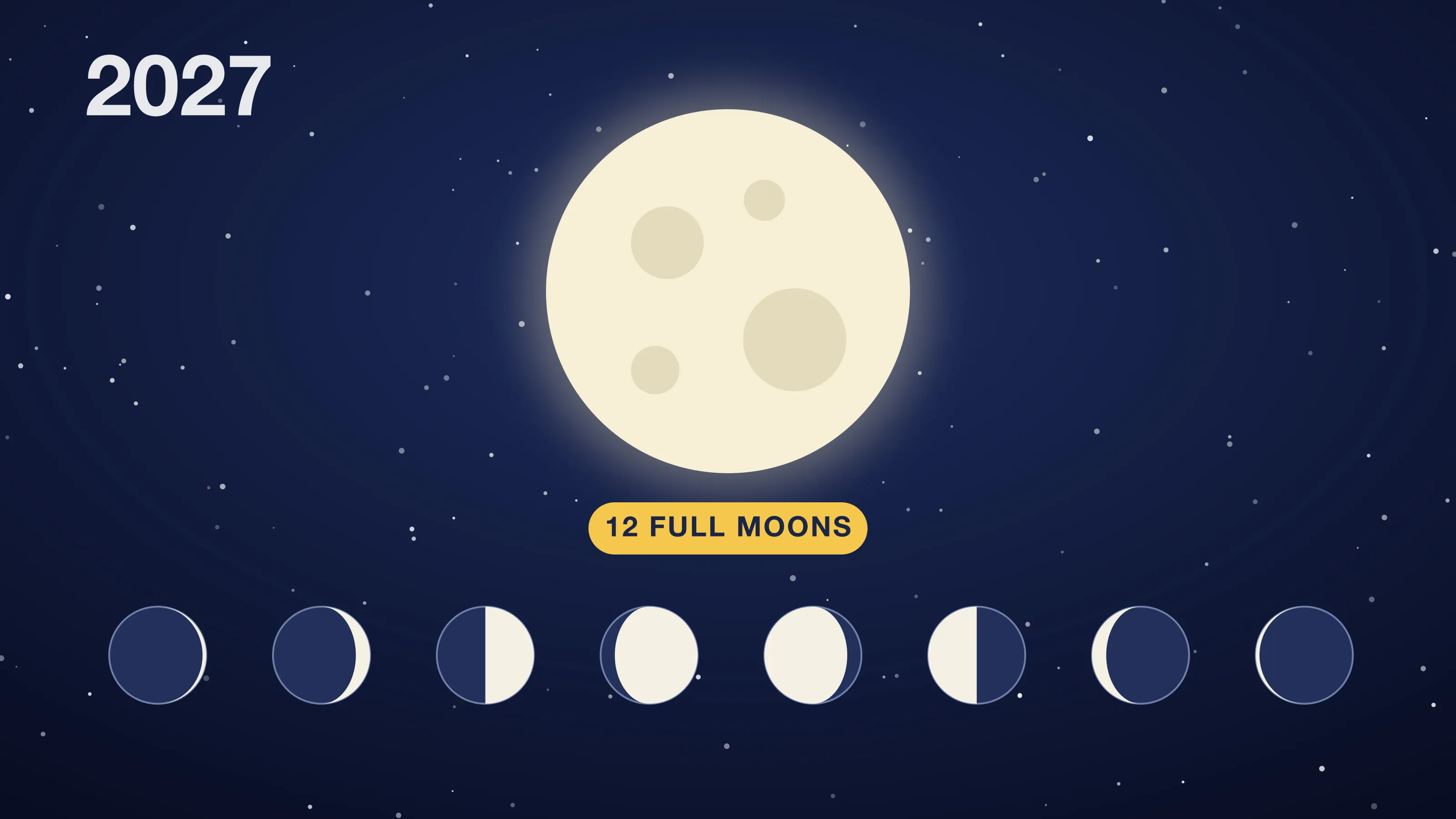 Moon Phases 2027: Full Moon Calendar With Dates, Times, Names and Eclipses, Plus Free Printables
-
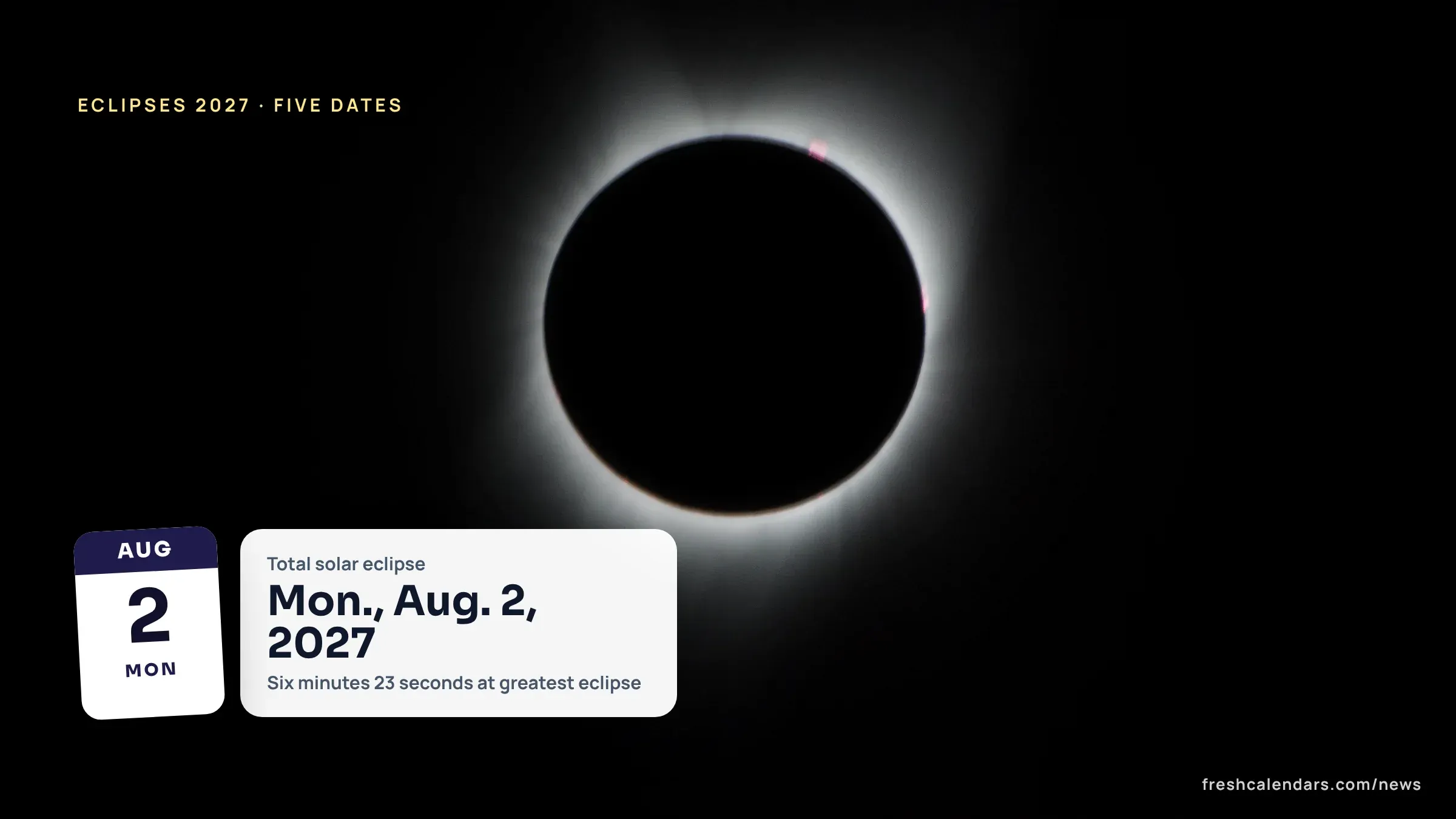 Eclipses 2027: Five Dates and Times, Led by the Total Solar Eclipse on Aug. 2
-
 Orionid Meteor Shower 2026 Stays Active Through Nov. 7 After Its Oct. 22 Peak
More in Sky Events
All Sky Events stories →- Planets in 2027: Jupiter Opposition Feb. 10, Mars Feb. 19, Saturn Oct. 17 in Eastern Time
- Next Blood Moon in the U.S.: Total Lunar Eclipse June 25, 2029, and Every Eclipse to 2030
- Next Solar Eclipse in the US: Total in Alaska in 2033, Lower 48 on Aug. 22, 2044
- Geminid Meteor Shower 2026 Peaks Dec. 13-14: Moonset Times for 12 U.S. Cities
- Planets Visible in December 2026: Night Sky Calendar With the Geminids and the Solstice
Trending now
- Black Friday 2026 Deals: Date Is Friday, Nov. 27, Live Countdown and Ad Tracker
- Day of the Dead 2026: Día de los Muertos Dates, Traditions and Events
- Veterans Day Free Meals 2026: 44 Chains Confirmed, 13 Discounts and a Printable List
- Black Friday Canada 2026: Nov. 27 Date, Canadian Tire Deals From Nov. 5, Who Hasn't Announced
- November 2026 Meteor Showers: Taurid Fireballs Under Dark Skies, Then the Leonids on Nov. 16-17