Mercury Retrograde 2026 Dates: Ends Nov. 13 at About 11 a.m. ET
Mercury retrograde 2026 ended Nov. 13 at about 11 a.m. ET. Start and end times for all six 2026 and 2027 periods in ET and PT, plus a printable list.

Published Updated 4 min read
Key date
- Nov 20Fri Mercury at greatest western elongation, best pre-dawn view In 2 days + Google
In this article
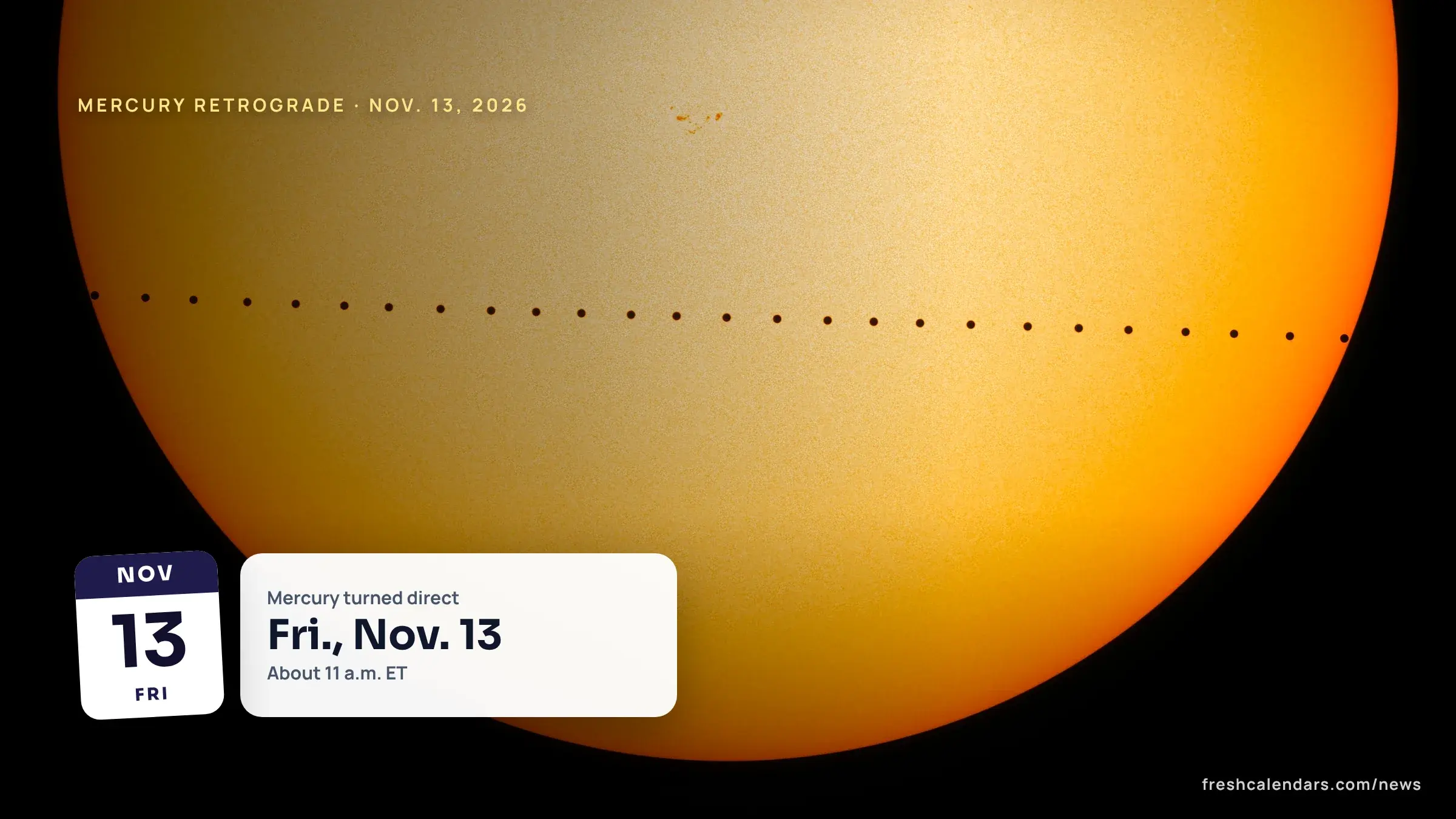
Mercury turned direct at about 11 a.m. Eastern Standard Time (EST) on Friday, Nov. 13, 2026, ending its retrograde, according to our calculation from the NASA Jet Propulsion Laboratory (JPL) Horizons System. That period began about 3 a.m. Eastern Daylight Time (EDT) on Saturday, Oct. 24, and lasted 20 days. Below are all six periods for 2026 and 2027 in Eastern Time (ET) and Pacific Time (PT), and a printable list to keep.
This is an astronomy story. Retrograde describes where Mercury appears against the stars, and nothing more here.
What does Mercury retrograde mean?
Mercury retrograde is an apparent backward drift of Mercury, westward against the background stars as seen from Earth. NASA’s “Mercury: Facts” page says Mercury “speeds around the Sun every 88 days, traveling through space at nearly 29 miles (47 kilometers) per second, faster than any other planet.” Because Mercury circles the Sun faster than Earth does, it periodically catches up with Earth and passes between Earth and the Sun. During that pass, our line of sight makes Mercury seem to reverse direction for a few weeks. It never stops orbiting the Sun in the same direction.
A “station” is the moment the apparent motion changes from eastward to westward (retrograde station) or back (direct station). Our times are those stations.
When is Mercury retrograde in 2026 and 2027?
Mercury has three retrograde periods in 2026 and three in 2027. Daylight saving time ends on Nov. 1, 2026, so the end of the latest period fell on Eastern Standard Time.
| Period | Retrograde starts (ET) | Retrograde starts (PT) | Retrograde ends (ET) | Retrograde ends (PT) | Days |
|---|---|---|---|---|---|
| 2026, first | Thu., Feb. 26, about 2 a.m. EST | Wed., Feb. 25, about 11 p.m. PST | Fri., Mar. 20, about 4 p.m. EDT | Fri., Mar. 20, about 1 p.m. PDT | 22 |
| 2026, second | Mon., June 29, about 2 p.m. EDT | Mon., June 29, about 11 a.m. PDT | Thu., July 23, about 7 p.m. EDT | Thu., July 23, about 4 p.m. PDT | 24 |
| 2026, third (ended) | Sat., Oct. 24, about 3 a.m. EDT | Sat., Oct. 24, about midnight PDT | Fri., Nov. 13, about 11 a.m. EST | Fri., Nov. 13, about 8 a.m. PST | 20 |
| 2027, first | Tue., Feb. 9, about 1 p.m. EST | Tue., Feb. 9, about 10 a.m. PST | Wed., Mar. 3, about 8 a.m. EST | Wed., Mar. 3, about 5 a.m. PST | 22 |
| 2027, second | Thu., June 10, about 2 p.m. EDT | Thu., June 10, about 11 a.m. PDT | Sun., July 4, about 4 p.m. EDT | Sun., July 4, about 1 p.m. PDT | 24 |
| 2027, third | Thu., Oct. 7, about 11 a.m. EDT | Thu., Oct. 7, about 8 a.m. PDT | Thu., Oct. 28, about 10 a.m. EDT | Thu., Oct. 28, about 7 a.m. PDT | 21 |
The first 2026 period starts at 07:00 Coordinated Universal Time (UTC) on Feb. 26, which is still the evening of Feb. 25 on the Pacific coast. Days are counted between the two station dates in Eastern Time. Mark the dates on a November 2026 printable calendar or lay out next year on a 2027 printable yearly calendar.
Is Mercury still in retrograde?
No. Mercury was between its Oct. 24 and Nov. 13 stations for 20 days. In that time its ecliptic longitude, the position measured along the Sun’s path through the sky, went from about 231.0 degrees back to about 215.0 degrees. That was a drift of about 16 degrees, roughly 32 full-Moon widths, since the full Moon is about half a degree wide.
What happened in the sky during this retrograde?
Two dates fell inside or just after the period, both from the same Horizons table:
| Date | Event | What to know |
|---|---|---|
| Wed., Nov. 4, 2026, about 10 a.m. EST (7 a.m. PST) | Inferior conjunction (passed) | Mercury was between Earth and the Sun, about 0.4 degrees from the Sun, and could not be observed |
| Fri., Nov. 20, 2026, about 6 p.m. EST (3 p.m. PST) | Greatest western elongation | Mercury is 19.6 degrees from the Sun; look for it before sunrise in the days that follow |
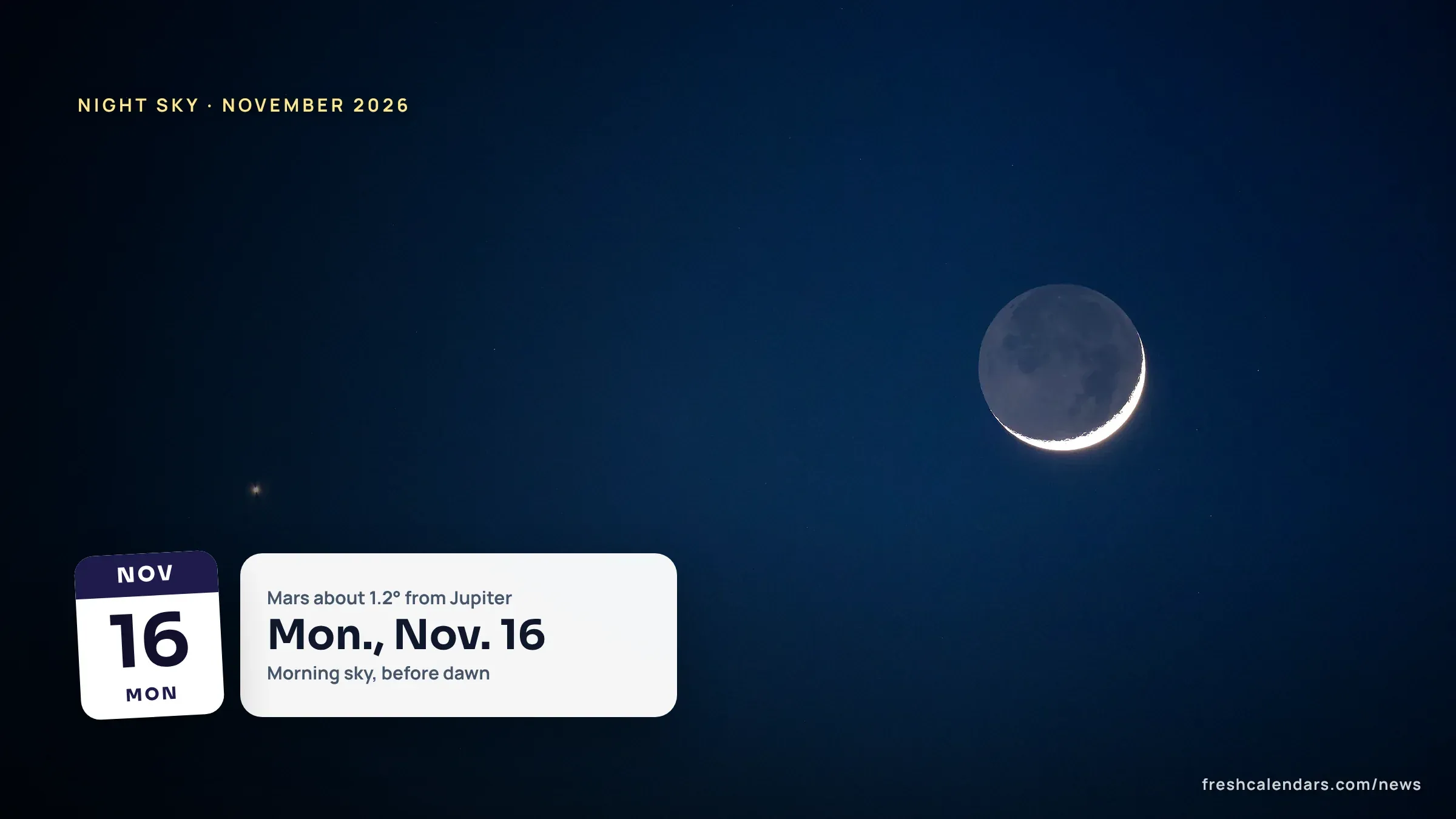
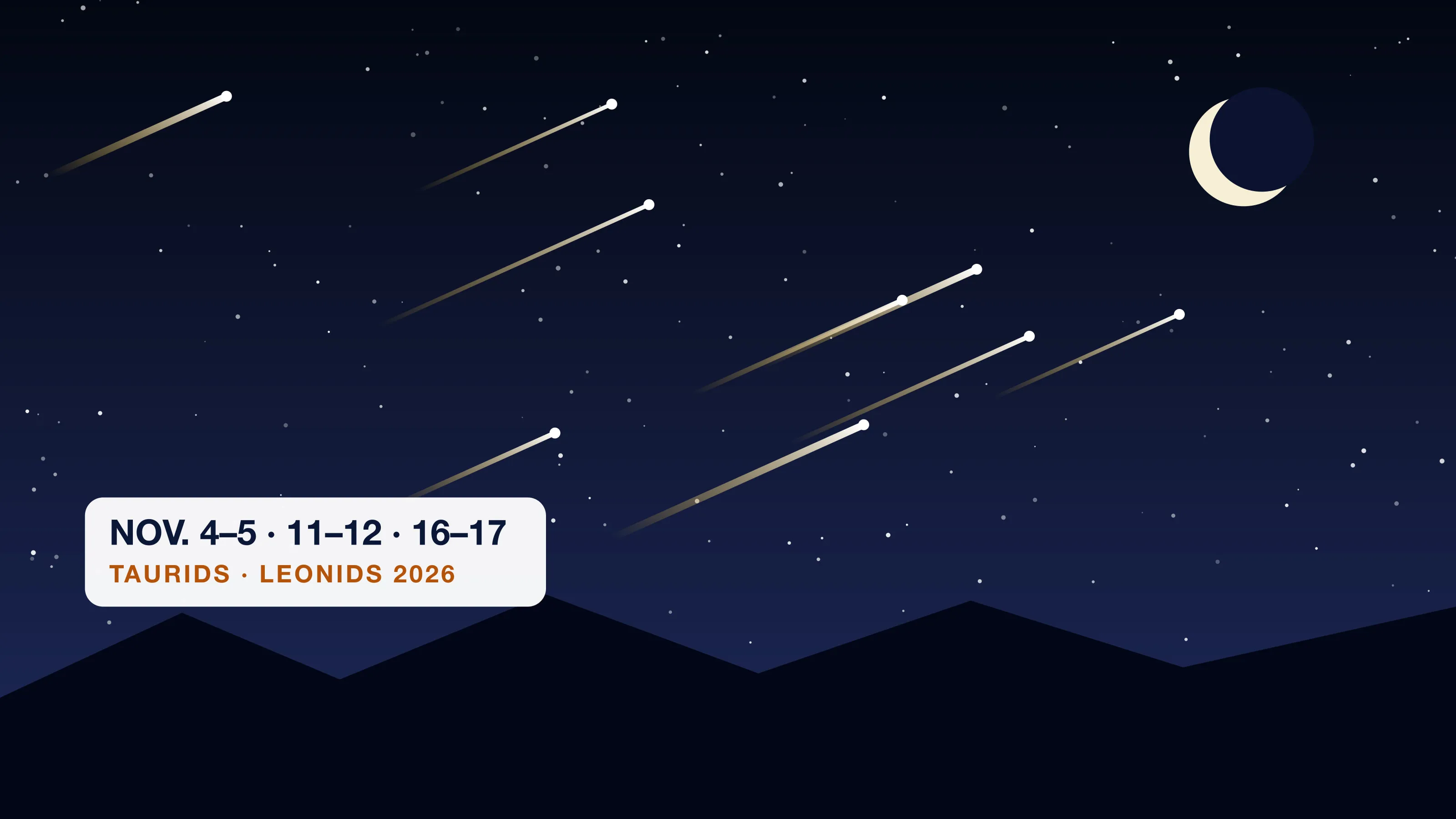
Mercury turned direct on Nov. 13, a week before it is farthest from the Sun in the morning sky. For the other planets and the Moon that month, see our November 2026 night sky calendar and the November 2026 meteor shower guide. Looking further ahead, the 2027 eclipse dates and times are also computed.
How were these times calculated?
We used the NASA JPL Horizons System: an observer table for Mercury (target 199) from Earth’s center, with observer ecliptic longitude at 1-hour steps, computed by Fresh Calendars on Oct. 29, 2026. A station is the hour in which the daily change in ecliptic longitude switches sign. Times are rounded to the hour, so published almanac times can differ from ours by an hour or so. The Mercury figures on speed come from NASA’s Mercury: Facts page.
Free printable downloads
Every template is free, needs no sign-up and prints on US Letter paper. Choose PDF for printing or PNG for screens and documents.
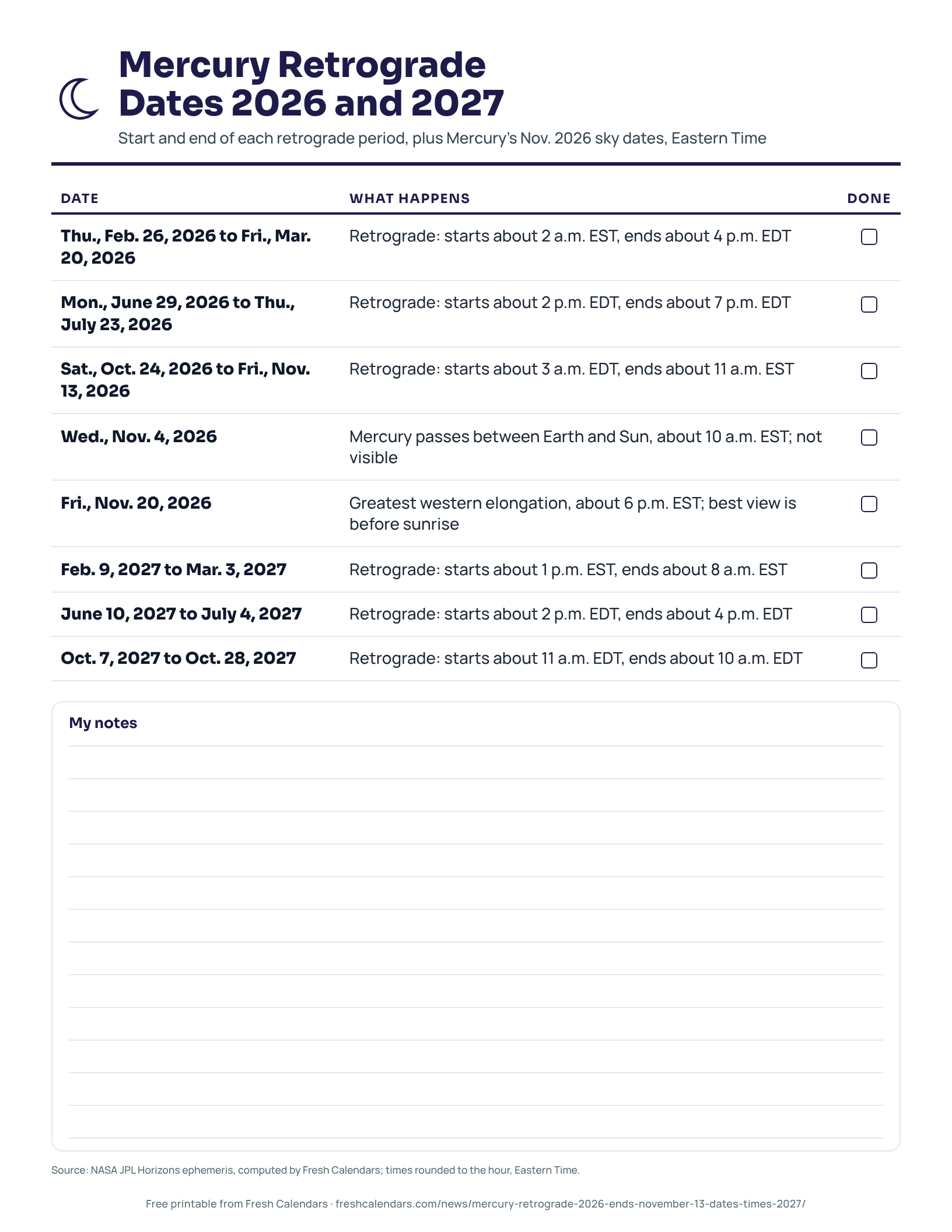
Mercury Retrograde Dates 2026 and 2027 printables
-
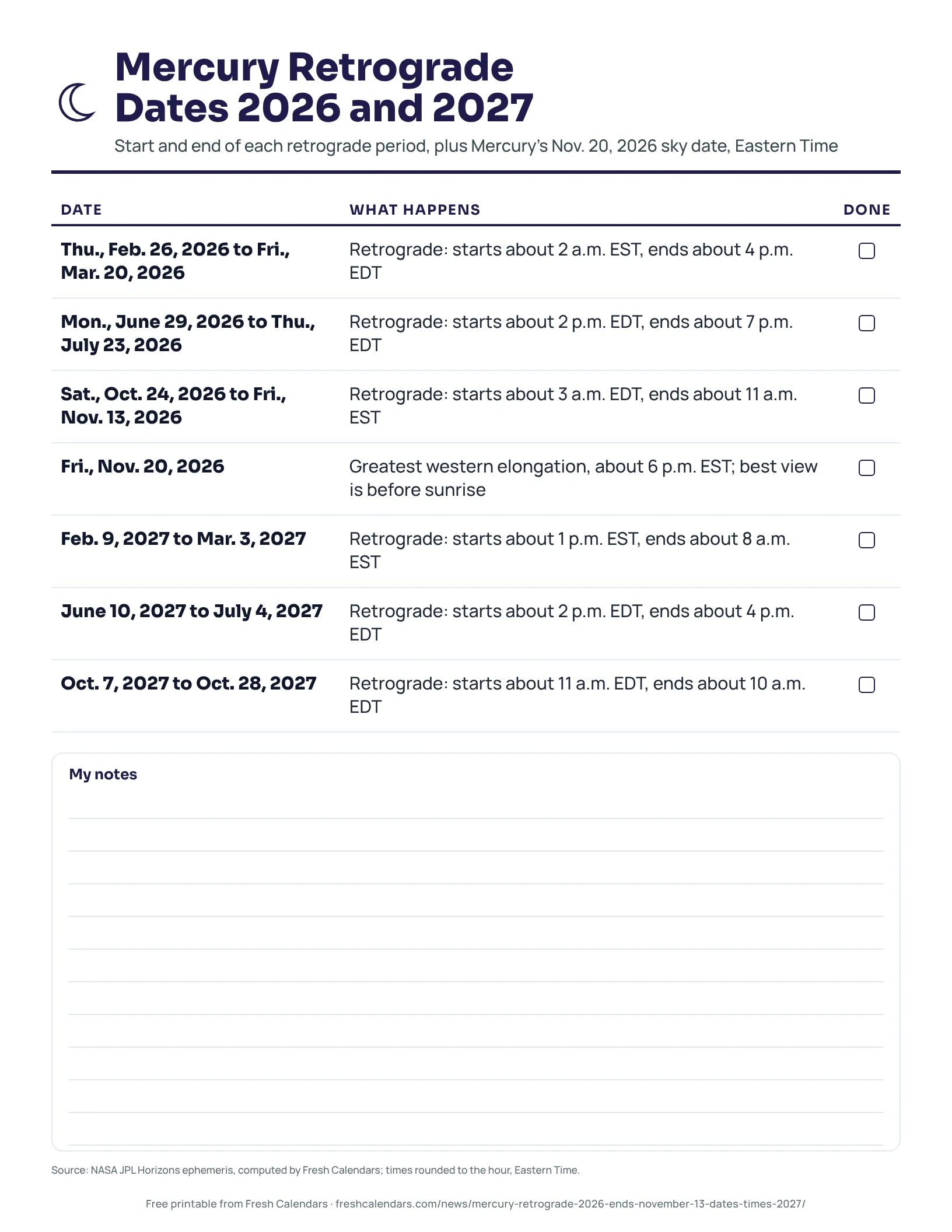
Mercury Retrograde Dates 2026 and 2027
A one-page list of Mercury retrograde start and end dates for 2026 and 2027 in Eastern Time, plus Mercury's Nov. 20, 2026 sky date.
Frequently asked questions
Is Mercury still in retrograde?
No. The period began about 3 a.m. Eastern Daylight Time on Sat., Oct. 24, 2026, and ended about 11 a.m. Eastern Standard Time on Fri., Nov. 13. The next one starts in 2027.
When does Mercury retrograde end in 2026?
At about 16:00 Coordinated Universal Time (UTC) on Fri., Nov. 13, 2026, which is about 11 a.m. Eastern Standard Time and 8 a.m. Pacific Standard Time.
What are the Mercury retrograde dates in 2027?
The next period starts Feb. 9, 2027. The three are Feb. 9 to Mar. 3, June 10 to July 4, and Oct. 7 to Oct. 28, 2027, by our calculation from NASA Jet Propulsion Laboratory Horizons data.
Does Mercury really move backward?
No. It keeps orbiting the Sun in the same direction. The backward motion is a line-of-sight effect as seen from Earth while Mercury passes between Earth and the Sun.
Why do other sites list slightly different times?
A station is the moment Mercury's apparent motion reverses, and it changes very slowly. We rounded to the hour from hourly data, so published almanac times can differ by an hour or so.
Sources
- Horizons System (NASA Jet Propulsion Laboratory, 2026-10-29)
- Mercury: Facts (NASA)
Related news

More in Sky Events
All Sky Events stories →Trending now
- Black Friday Ads 2026: Date Is Nov. 27, Walmart Deals Nov. 23-29
- Thanksgiving Travel 2026: Best Days to Fly and Drive, Nov. 21 to 30
- CPKC Holiday Train 2026 Schedule: 182 Stops, Nov. 19 to Dec. 20
- Pumpkin Carving Templates PDF: 18 Free Printable Stencils
- Thanksgiving 2026 School Break: 52 of 81 Districts Off Nov. 23-27