Planets Visible in January 2027: Night Sky Calendar With Moon and Quadrantids
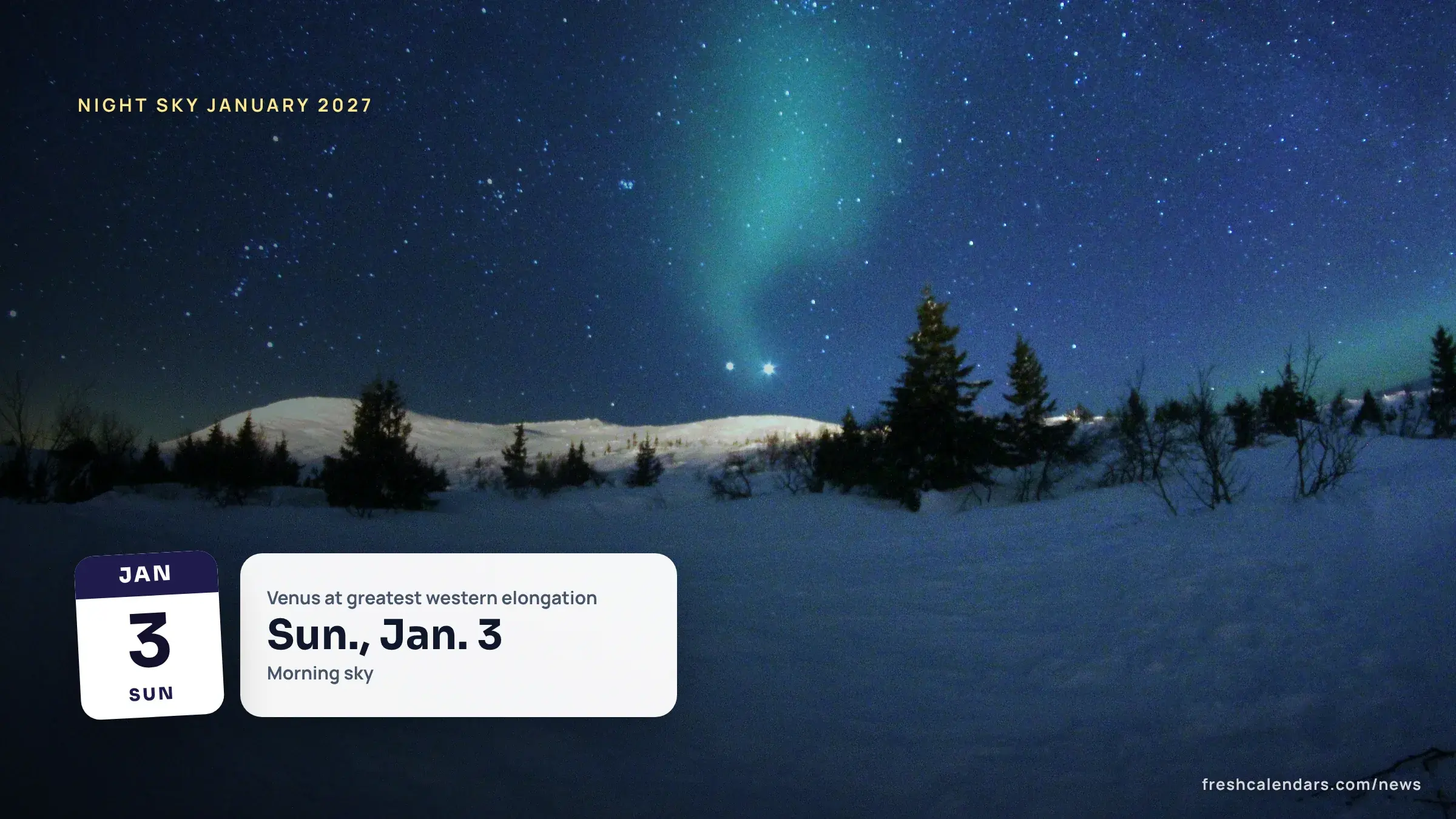
Venus reaches greatest western elongation Jan. 3, 2027, about 1 p.m. Eastern Standard Time (EST), and the Quadrantids peak that night. Full sky table.

Published 4 min read

Key dates
In this article
Venus reaches its greatest western elongation, 46° 57’, on Sunday, Jan. 3, 2027, at about 1 p.m. Eastern Standard Time (EST), and the Quadrantid meteor shower peaks near 10:30 p.m. EST that same day, according to the National Astronomical Observatory of Japan (NAOJ) and the American Meteor Society (AMS). The Moon phases come from the U.S. Naval Observatory (USNO). This guide puts them in one table, with the planets that are in the morning and evening sky.
All times are Eastern Standard Time, which applies all of January. Print the Quadrantid night on one page with the January 2027 night sky sheet.
January 2027 night sky calendar by date
| Date | Event | Time (EST) | Source |
|---|---|---|---|
| Fri., Jan. 1 | Mercury at superior conjunction | 12:08 p.m. | NAOJ |
| Sun., Jan. 3 | Venus at greatest western elongation, 46° 57’ | About 1 p.m. | NAOJ |
| Sun., Jan. 3 | Quadrantid meteor shower peak (3:30 UT on Jan. 4) | About 10:30 p.m. | AMS |
| Thu., Jan. 7 | New Moon | 3:24 p.m. | USNO |
| Mon., Jan. 11 | Mars stationary | 11:10 a.m. | NAOJ |
| Tue., Jan. 12 | Last day of the Quadrantid activity window | All day | AMS |
| Fri., Jan. 15 | First quarter Moon | 3:34 p.m. | USNO |
| Fri., Jan. 22 | Full Moon | 7:17 a.m. | USNO |
| Fri., Jan. 29 | Last quarter Moon | 5:55 a.m. | USNO |
The NAOJ publishes its table in Japan Standard Time (JST), nine hours ahead of Universal Time (UT), and lists the Venus event by the hour only (“03h” on Jan. 4 JST). We converted every NAOJ time to EST, so Venus is “about 1 p.m.” The USNO and AMS times are in UT, which we also converted. For what comes next, the NAOJ table has Jupiter’s opposition on Feb. 10 at 7:29 p.m. EST and Mars’s on Feb. 19 at 10:51 a.m. EST, and the USNO has the next new Moon on Feb. 6 at 10:56 a.m. EST.
Which planets are visible in January 2027?
NAOJ gives dates for conjunctions, elongations and oppositions, not rise and set times. The evening and morning column below is our reading of those dates, not a sourced visibility claim.
| Planet | NAOJ date | Where to look, our reading |
|---|---|---|
| Venus | Greatest elongation west, Jan. 3 | Morning sky, before sunrise |
| Mars | Stationary Jan. 11; opposition Feb. 19 | Evening and night sky, heading toward opposition |
| Jupiter | Opposition Feb. 10 | Evening and night sky, heading toward opposition |
| Saturn | Opposition Oct. 17 | Morning sky |
| Mercury | Superior conjunction Jan. 1 | Lost in the Sun’s glare early in the month |
An elongation is the angle between a planet and the Sun in the sky. A planet “west” of the Sun rises before it, which is why Venus belongs to the dawn. A planet near opposition is opposite the Sun, so it is up most of the night. We did not publish rise or set times for the planets, because the USNO service we use covers only the Sun and Moon. For exact rise and set times in your city, use a planetarium app.
Are the Quadrantids worth watching in 2027?
The AMS lists the Quadrantids as active from Dec. 28, 2026 through Jan. 12, 2027, with a peak predicted near 3:30 UT on Jan. 4, which is 10:30 p.m. EST on Sunday, Jan. 3. It puts the average rate under dark skies at 25 an hour. The AMS says the Moon is 18% illuminated and a waning crescent on the peak night, so moonlight is low. The printable lists the USNO’s Jan. 3 moonset for New York, Chicago, Denver and Los Angeles. Its “Moon up all night” cell is the sheet’s wording for a Moon that sets after sunrise; on Jan. 3 the USNO has it setting around 1 p.m. in each city, so the evening is Moon-free. Peak times for Central, Mountain and Pacific time are in our Quadrantid 2027 guide.
What are the Moon phases in January 2027?
The USNO table lists four primary phases. They are the table above: new Moon Thursday, Jan. 7, first quarter Friday, Jan. 15, full Moon Friday, Jan. 22 and last quarter Friday, Jan. 29. Dark-sky observing is easiest around the new Moon on Jan. 7, and the Quadrantid peak comes four days before it. For all of 2027, see the Moon phases 2027 guide.
What time are sunrise and sunset in New York in January 2027?
The USNO gives these Sun times for New York in January 2027, in EST.
| Date | Sunrise | Sunset |
|---|---|---|
| Fri., Jan. 1 | 7:20 a.m. | 4:39 p.m. |
| Fri., Jan. 15 | 7:18 a.m. | 4:53 p.m. |
| Sun., Jan. 31 | 7:07 a.m. | 5:12 p.m. |
Venus is a morning planet, so the sunrise time is your deadline. On Jan. 1 the USNO has civil dusk in New York at 5:10 p.m., the time the evening planets start to show.
Where do these dates come from?
The Moon phases are from the USNO table for 2027, labeled in Universal Time. The planet events are from the NAOJ Koyomi table, and the Quadrantid dates and rate are from the AMS meteor shower calendar. NASA’s “What’s Up” guide for January 2027 was not online on Nov. 4, 2026. For the whole year of planet events, see our planets in 2027 calendar, and the earlier December 2026 night sky calendar. Mark the dates on a January 2027 printable calendar or a 2027 yearly calendar.
Free printable downloads
Every template is free, needs no sign-up and prints on US Letter paper. Choose PDF for printing or PNG for screens and documents.
January 2027 Night Sky Sheet printables
-
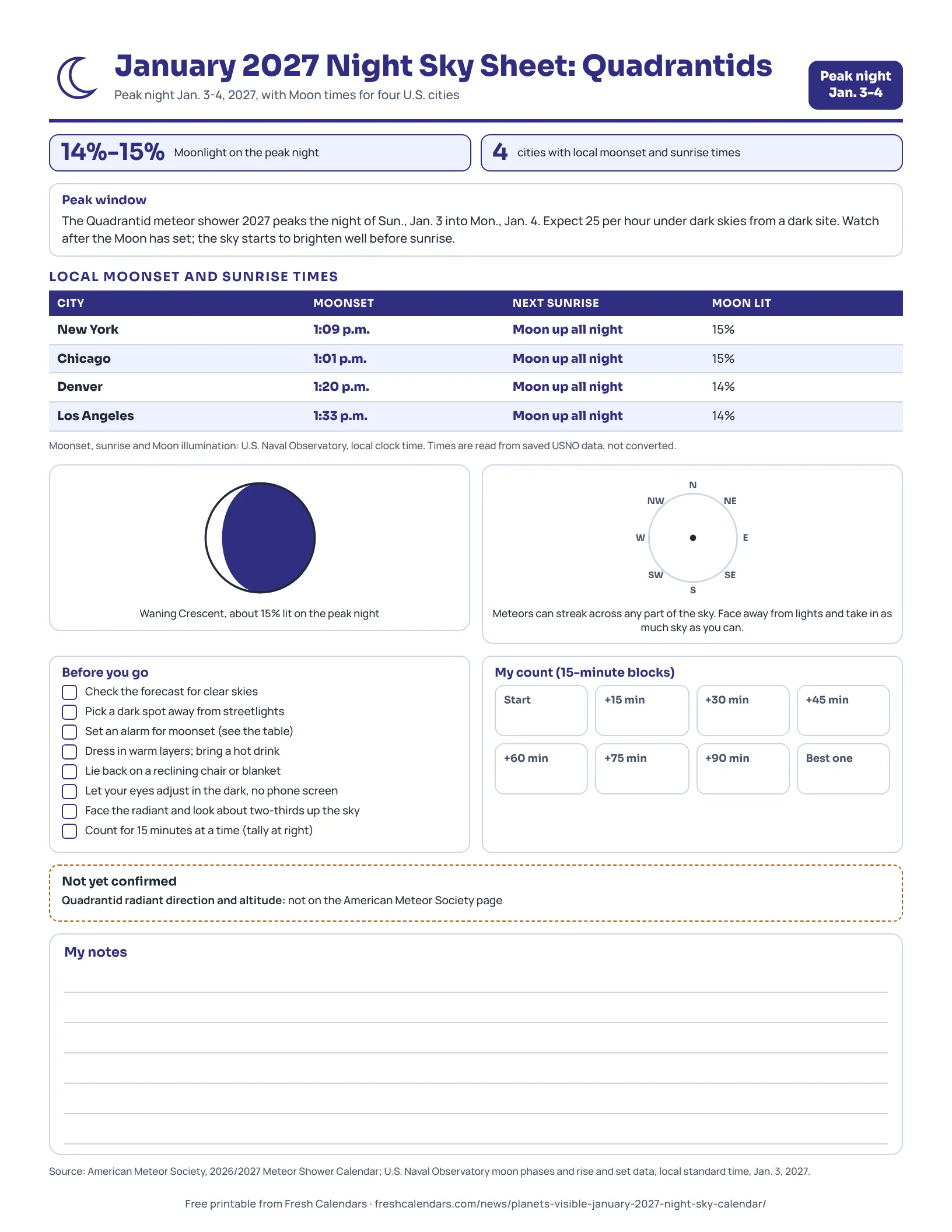
January 2027 Night Sky Sheet: Quadrantids
A one-page January 2027 night sky sheet: Quadrantid peak night Jan. 3-4, Moon times for four U.S. cities, a tally grid and a checklist.
Frequently asked questions
Which planets can I see in January 2027?
By our reading of the NAOJ dates: Venus and Saturn in the morning sky, Jupiter and Mars in the evening and night sky. Mercury is lost in the Sun's glare early in the month because it is at superior conjunction on Jan. 1.
When is Venus at its greatest elongation in January 2027?
On Sunday, Jan. 3, 2027, at about 1 p.m. Eastern Standard Time, when Venus is 46° 57' west of the Sun, according to NAOJ.
When do the Quadrantids peak in 2027?
The AMS predicts a peak near 3:30 Universal Time (UT) on Jan. 4, which is 10:30 p.m. EST on Sunday, Jan. 3. The AMS puts the average rate under dark skies at 25 meteors an hour.
What are the Moon phases in January 2027?
New Moon on Thursday, Jan. 7 at 3:24 p.m. EST; first quarter on Friday, Jan. 15 at 3:34 p.m.; full Moon on Friday, Jan. 22 at 7:17 a.m.; last quarter on Friday, Jan. 29 at 5:55 a.m., all from the USNO.
When does Mars stop moving against the stars in January 2027?
Mars is stationary on Monday, Jan. 11, 2027, at 11:10 a.m. EST, according to NAOJ.
Sources
- Meteor Shower Calendar 2026/2027 (American Meteor Society)
- Dates of Primary Phases of the Moon, 2027 (U.S. Naval Observatory, Astronomical Applications Department)
- Celestial Phenomena in 2027 (National Astronomical Observatory of Japan (NAOJ), Koyomi, 2026-11-04)
- Sun and Moon Rise/Set/Transit Times for One Day (API) (U.S. Naval Observatory, Astronomical Applications Department, 2026-11-04)
Related news
-
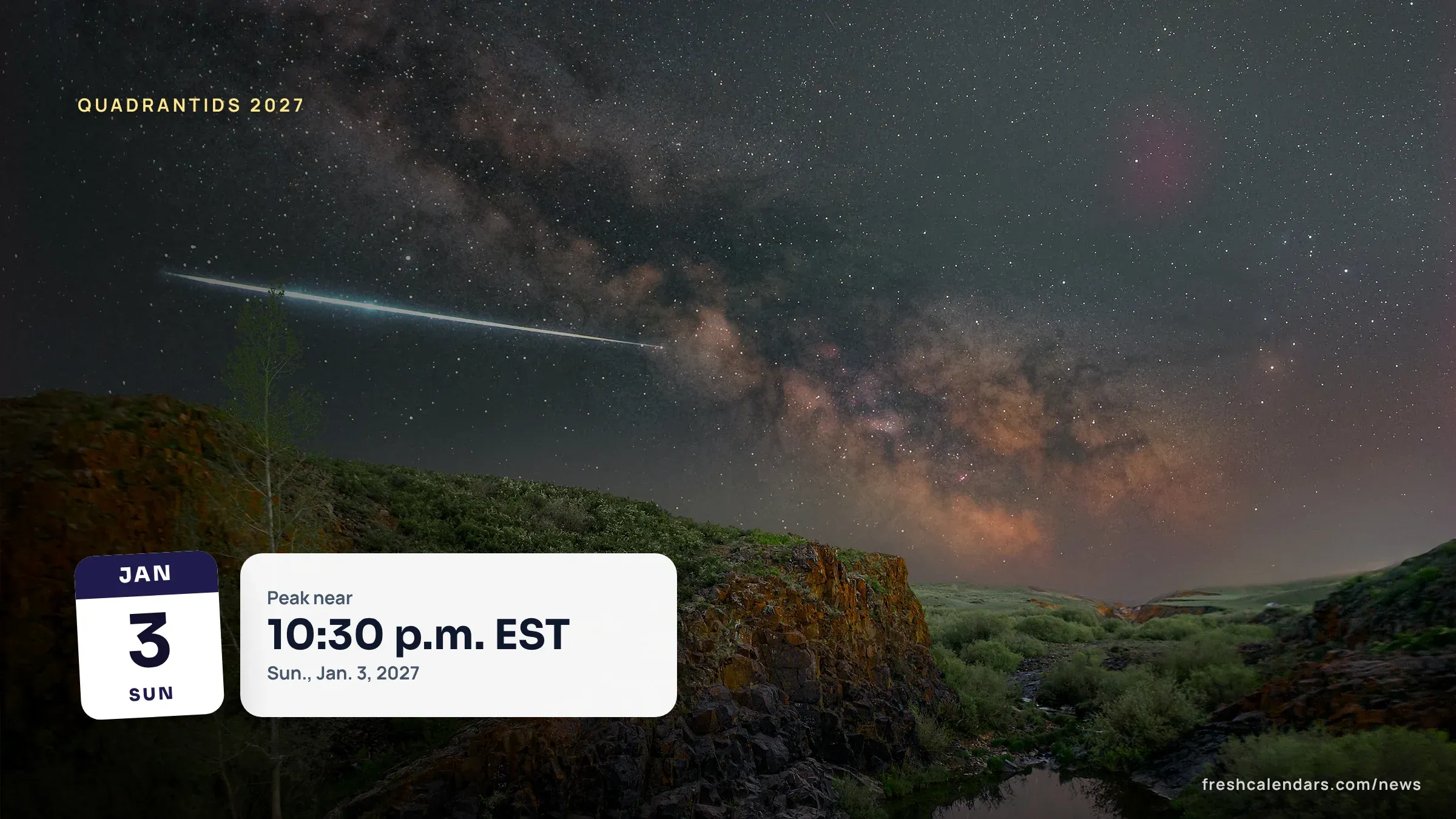 Quadrantid Meteor Shower 2027 Peaks the Night of Jan. 3-4, Then the Wolf Moon Jan. 22
-
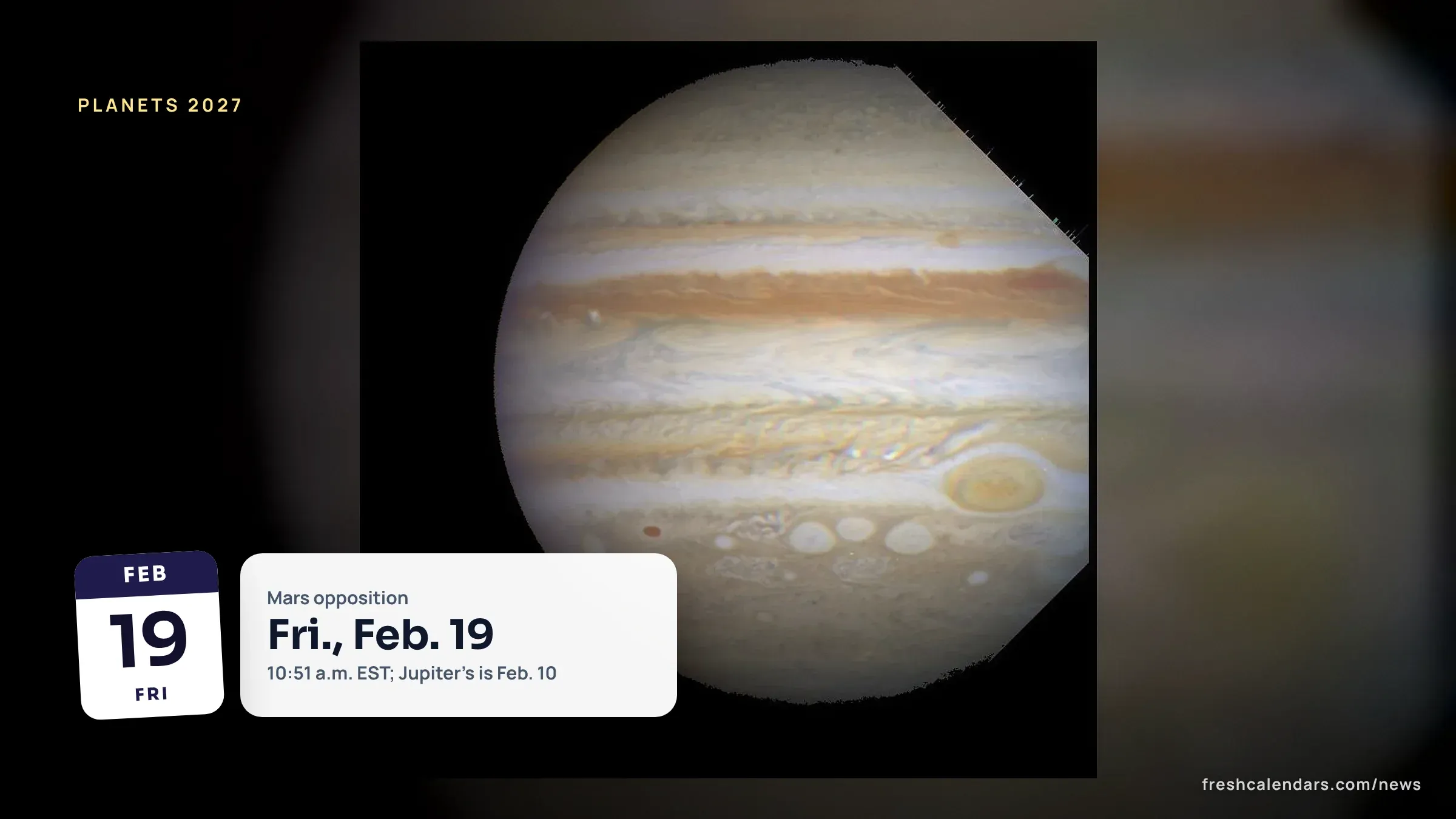 Planets in 2027: Jupiter Opposition Feb. 10, Mars Feb. 19, Saturn Oct. 17 in Eastern Time
-
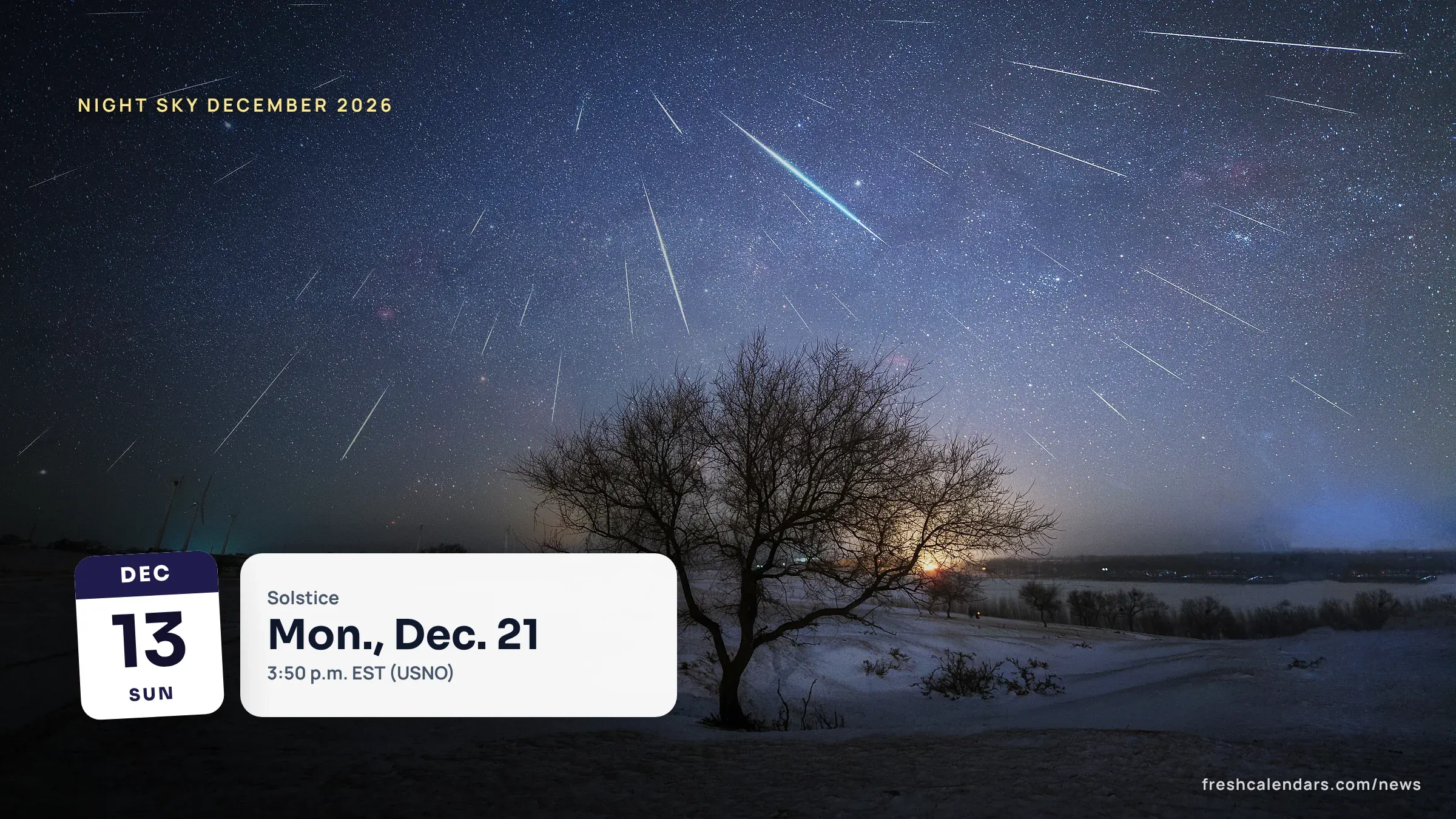 Planets Visible in December 2026: Night Sky Calendar With the Geminids and the Solstice
-
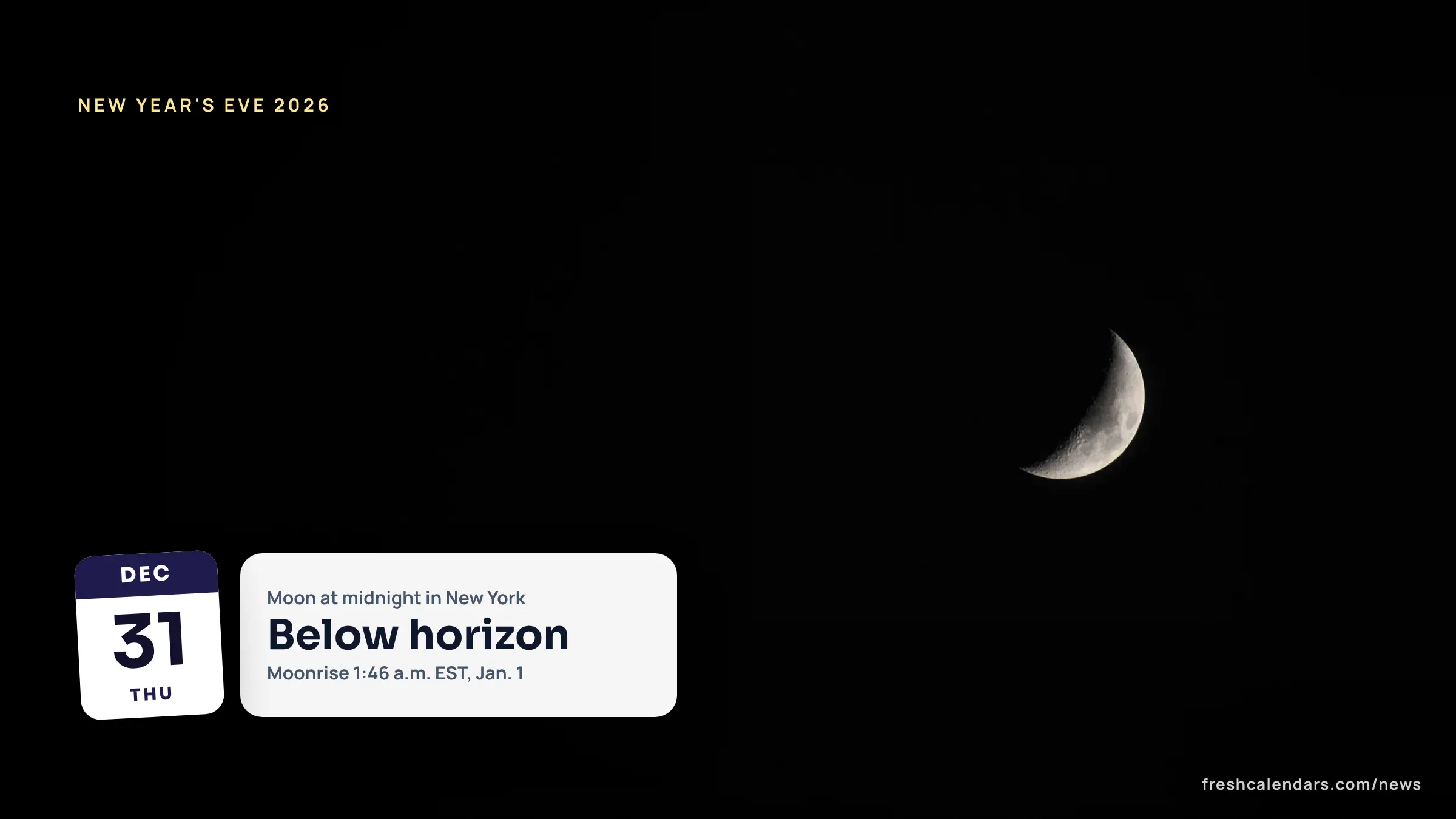 New Year's Eve 2026 Moon: Waning Crescent Rises After Midnight, 1:46 a.m. in New York
More in Sky Events
All Sky Events stories →- Moon Phase Tonight: December 2026 Moon Calendar With Every Phase, Full Moon Dec. 23
- Ursid Meteor Shower 2026: Peak Night Dec. 21-22, Moonset Times for 10 U.S. Cities
- Leonid Meteor Shower 2026 Peaks Nov. 16-17: Moonset and Moon-Free Hours in 12 U.S. Cities
- Latest Sunrise 2027: It Comes in Early January, With Dates for 20 U.S. Cities
- Meteor Showers 2027: Peak Dates, Eastern Times and Moon Phase for 12 Showers
Trending now
- Black Friday Canada 2026: Nov. 27 Date, Canadian Tire Deals From Nov. 5, Who Hasn't Announced
- November 2026 Meteor Showers: Taurid Fireballs Under Dark Skies, Then the Leonids on Nov. 16-17
- Election Night 2026 Live Blog: Results Map, Senate, House and Governor Races
- SNAP Payment Schedule November 2026: Deposit Dates for Every State, With Weekend Days Flagged
- Black Friday 2026 Deals: Date Is Friday, Nov. 27, Live Countdown and Ad Tracker