Next Blood Moon in the U.S.: Total Lunar Eclipse June 25, 2029, and Every Eclipse to 2030
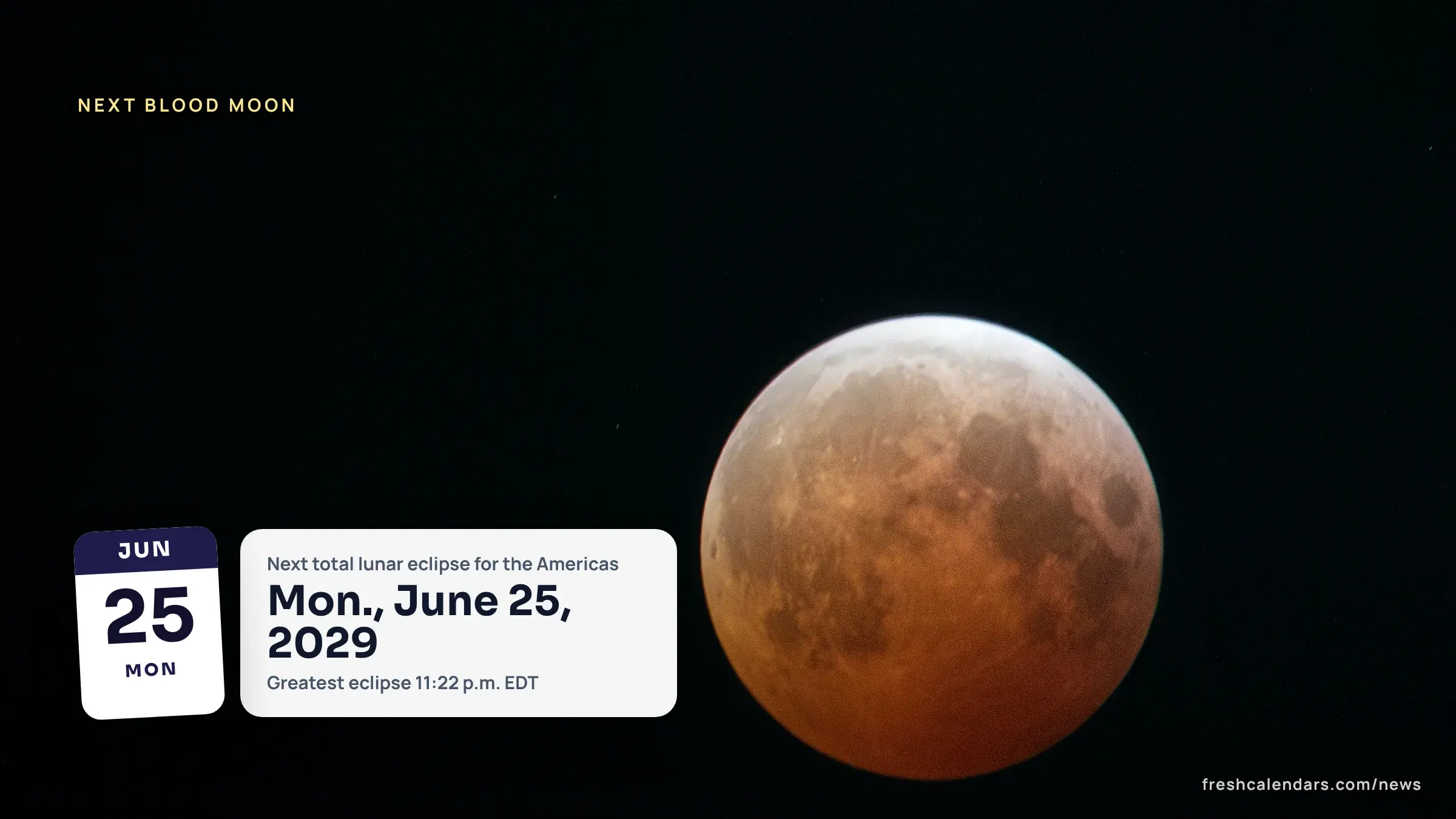
The National Aeronautics and Space Administration (NASA) lists the next total lunar eclipse for the Americas on June 25, 2029, at 11:22 p.m. Eastern Time (ET).

Published 5 min read
In this article
The next blood moon visible from the United States is the total lunar eclipse of Monday, June 25, 2029, according to the National Aeronautics and Space Administration (NASA) Goddard Space Flight Center’s decade table of lunar eclipses for 2021 to 2030. Greatest eclipse is at 11:22 p.m. Eastern Daylight Time (EDT), and NASA lists the Americas in that eclipse’s region. No total lunar eclipse falls in 2027, and the only one before 2029, on Dec. 31, 2028, is outside the Americas.
NASA’s table also lists a total eclipse on March 3, 2026 and a partial one on Aug. 28, 2026. Both are past. This story uses “blood moon” for a total lunar eclipse, the type NASA says turns the Moon dark red or orange. The table below covers every lunar eclipse from today through 2030.
Which lunar eclipses through 2030 are a blood moon?
Three of the ten lunar eclipses in NASA’s table are total: Dec. 31, 2028, June 26, 2029 and Dec. 20, 2029. In NASA’s wording, “during a total lunar eclipse, the Moon appears dark red or orange” because “the light that does reach the lunar surface is filtered through a thick slice of Earth’s atmosphere.” NASA adds: “It’s as if all of the world’s sunrises and sunsets are projected onto the Moon.”
The other seven are penumbral or partial. NASA’s catalog defines a penumbral eclipse as the Moon crossing Earth’s penumbral shadow while missing the umbral shadow, so the Moon only dims slightly. A partial eclipse has the Moon in the umbra without passing completely into it.
Every lunar eclipse from Nov. 2, 2026 to 2030
Greatest-eclipse times are in Eastern Time (ET): Eastern Standard Time (EST) is Universal Time (UT) minus 5 hours, and EDT is UT minus 4 hours. Times are rounded to the nearest minute and are our conversion of NASA’s data. The last column counts from today, Nov. 2, 2026, to the U.S. date.
| NASA date (UT) | U.S. date | Type | Greatest eclipse (ET) | Totality | From the contiguous U.S.? | Time from today |
|---|---|---|---|---|---|---|
| Feb. 20, 2027 | Sat., Feb. 20, 2027 | Penumbral | 6:13 p.m. EST | None | Americas listed | 110 days |
| July 18, 2027 | Sun., July 18, 2027 | Penumbral | 12:03 p.m. EDT | None | No, region leaves out the Americas | 258 days |
| Aug. 17, 2027 | Tue., Aug. 17, 2027 | Penumbral | 3:14 a.m. EDT | None | Americas listed | 288 days |
| Jan. 12, 2028 | Tue., Jan. 11, 2028 | Partial | 11:13 p.m. EST | None | Americas listed | 1 year 70 days |
| July 6, 2028 | Thu., July 6, 2028 | Partial | 2:20 p.m. EDT | None | No, region leaves out the Americas | 1 year 247 days |
| Dec. 31, 2028 | Sun., Dec. 31, 2028 | Total | 11:52 a.m. EST | 1 h 11 min | No, region leaves out the Americas | 2 years 59 days |
| June 26, 2029 | Mon., June 25, 2029 | Total | 11:22 p.m. EDT | 1 h 42 min | Americas listed | 2 years 235 days |
| Dec. 20, 2029 | Thu., Dec. 20, 2029 | Total | 5:42 p.m. EST | 54 min | Americas listed | 3 years 48 days |
| June 15, 2030 | Sat., June 15, 2030 | Partial | 2:33 p.m. EDT | None | No, region leaves out the Americas | 3 years 225 days |
| Dec. 9, 2030 | Mon., Dec. 9, 2030 | Penumbral | 5:28 p.m. EST | None | Americas listed | 4 years 37 days |
“Americas listed” means NASA’s region for that eclipse includes the Americas. NASA’s decade table gives regions as whole continents and does not say which U.S. states or cities see each phase. “No” means the region does not include the Americas. Totality lengths are from NASA’s catalog (71.3, 101.9 and 53.7 minutes). Put the dates you want on a printable yearly calendar or the February 2027 printable calendar.
Why do NASA’s eclipse dates differ from U.S. dates?
NASA’s decade table gives each date in Universal Time. Two entries land on a different day in the Eastern time zone. The June 2029 total eclipse is June 26 in NASA’s table but is June 25 in the evening on U.S. clocks, and the Jan. 12, 2028 partial eclipse is Jan. 11 at 11:13 p.m. EST. NASA’s “Future Eclipses” page works the other way and lists local dates as ranges: “Feb. 20-21, 2027” and “Aug. 16-17, 2027.”
The decade table’s times are in Terrestrial Dynamical Time (TD). NASA’s catalog gives a delta T value for each eclipse, 76 to 78 seconds for the eclipses in the table above, and subtracting it gives UT. For the June 2029 eclipse, 03:23:22 TD minus 77 seconds is 03:22:05 UT, which is 11:22 p.m. EDT on June 25.
June 25, 2029: the next total lunar eclipse in the U.S.
NASA’s catalog gives an umbral magnitude of 1.844 for the June 2029 eclipse, the deepest of the three, and a totality of 101.9 minutes. NASA’s decade table lists the partial phases at 3 hours 40 minutes and the region as the Americas, Europe, Africa and the Middle East.
Centering NASA’s totality length on the greatest-eclipse time gives these times in EDT, our calculation:
| Phase | Time (EDT) |
|---|---|
| Partial phase begins | About 9:32 p.m., June 25 |
| Totality begins | About 10:31 p.m., June 25 |
| Greatest eclipse | 11:22 p.m., June 25 |
| Totality ends | About 12:13 a.m., June 26 |
| Partial phase ends | About 1:12 a.m., June 26 |
The June 2029 eclipse crosses midnight on U.S. clocks, so the date changes during totality. NASA’s table does not say which U.S. places see every phase, so check your own moonrise time before planning around it.
What about the Dec. 20, 2029 total lunar eclipse?
About six months later NASA lists another total eclipse, with an umbral magnitude of 1.117, greatest eclipse at 5:42 p.m. EST on Thursday, Dec. 20, 2029 and 54 minutes of totality. The region is the Americas, Europe, Africa and Asia. The earlier Dec. 31, 2028 total eclipse lasts 1 hour 11 minutes, with greatest eclipse at 11:52 a.m. EST, and NASA’s region for it is Europe, Africa, Asia, Australia and the Pacific.
What are the lunar eclipses before 2029?
None of them is total. The three 2027 eclipses (Feb. 20, July 18, Aug. 17) are penumbral, and the July 18 eclipse is out of the Americas’ region. Our 2027 eclipse dates and times story has the penumbral phase times, and the 2027 full moon calendar fits each date into the month. The Jan. 11, 2028 partial eclipse, in the table above, has an umbral magnitude of 0.066 in NASA’s table, meaning 6.6 percent of the Moon’s diameter enters the umbra, and NASA lists the Americas. The July 6, 2028 and June 15, 2030 partial eclipses are outside the Americas’ region.
For other sky dates before then, see the supermoons and meteor showers that close 2026.
Free printable downloads
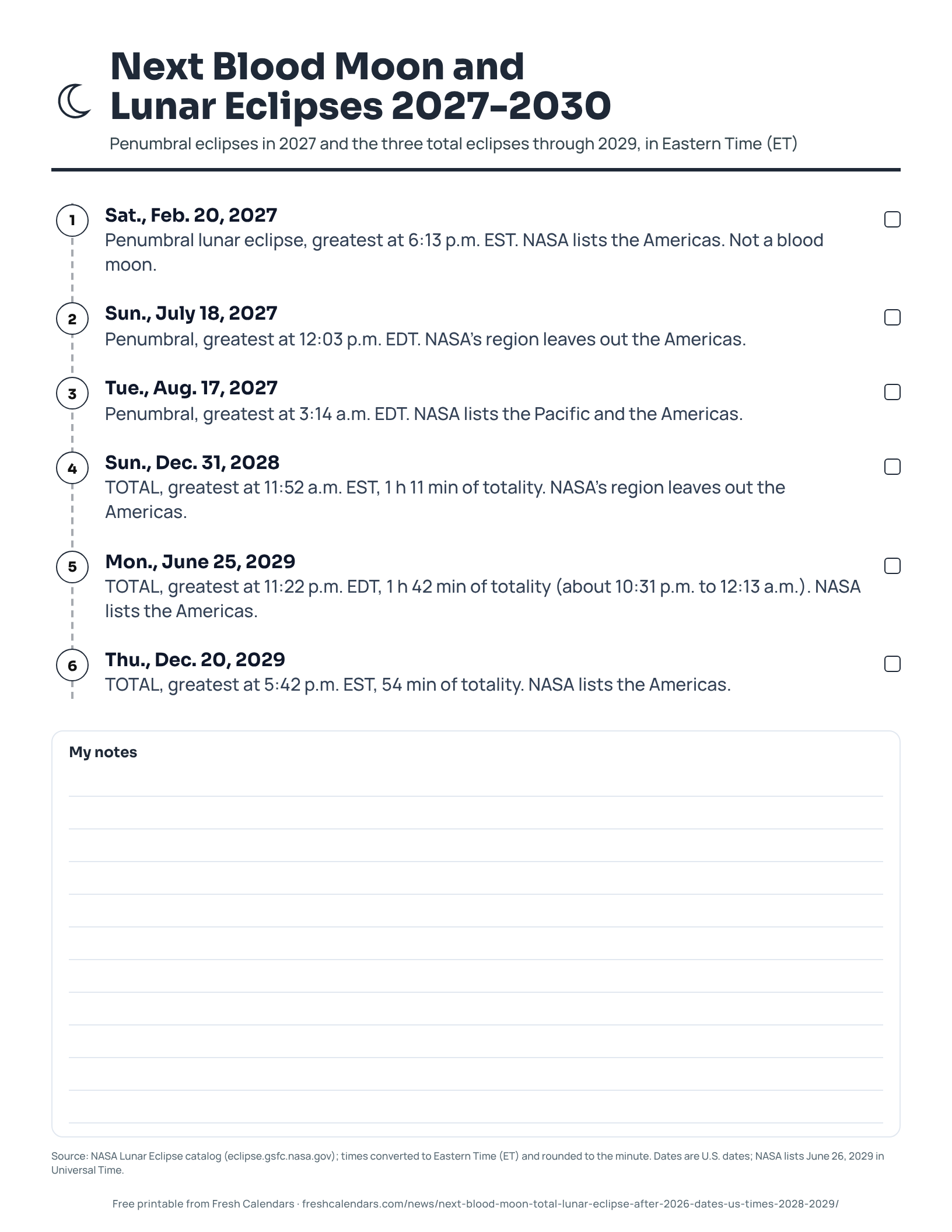
Every template is free, needs no sign-up and prints on US Letter paper. Choose PDF for printing or PNG for screens and documents.
Next Blood Moon and Lunar Eclipses 2027-2030 printables
-
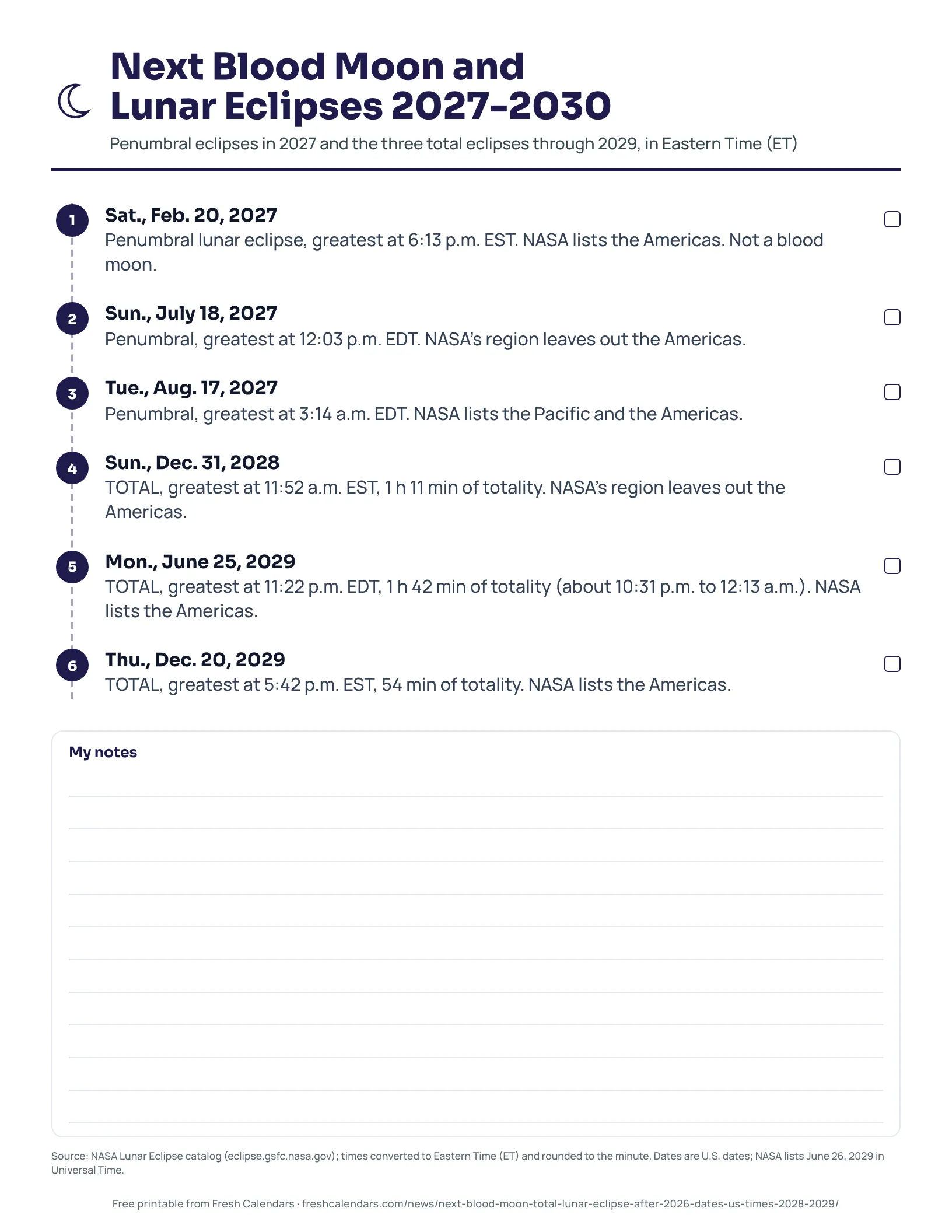
Next Blood Moon and Lunar Eclipses 2027-2030
A one-page list of the penumbral lunar eclipses of 2027 and the three total lunar eclipses through 2029, with U.S. dates and Eastern Time.
-
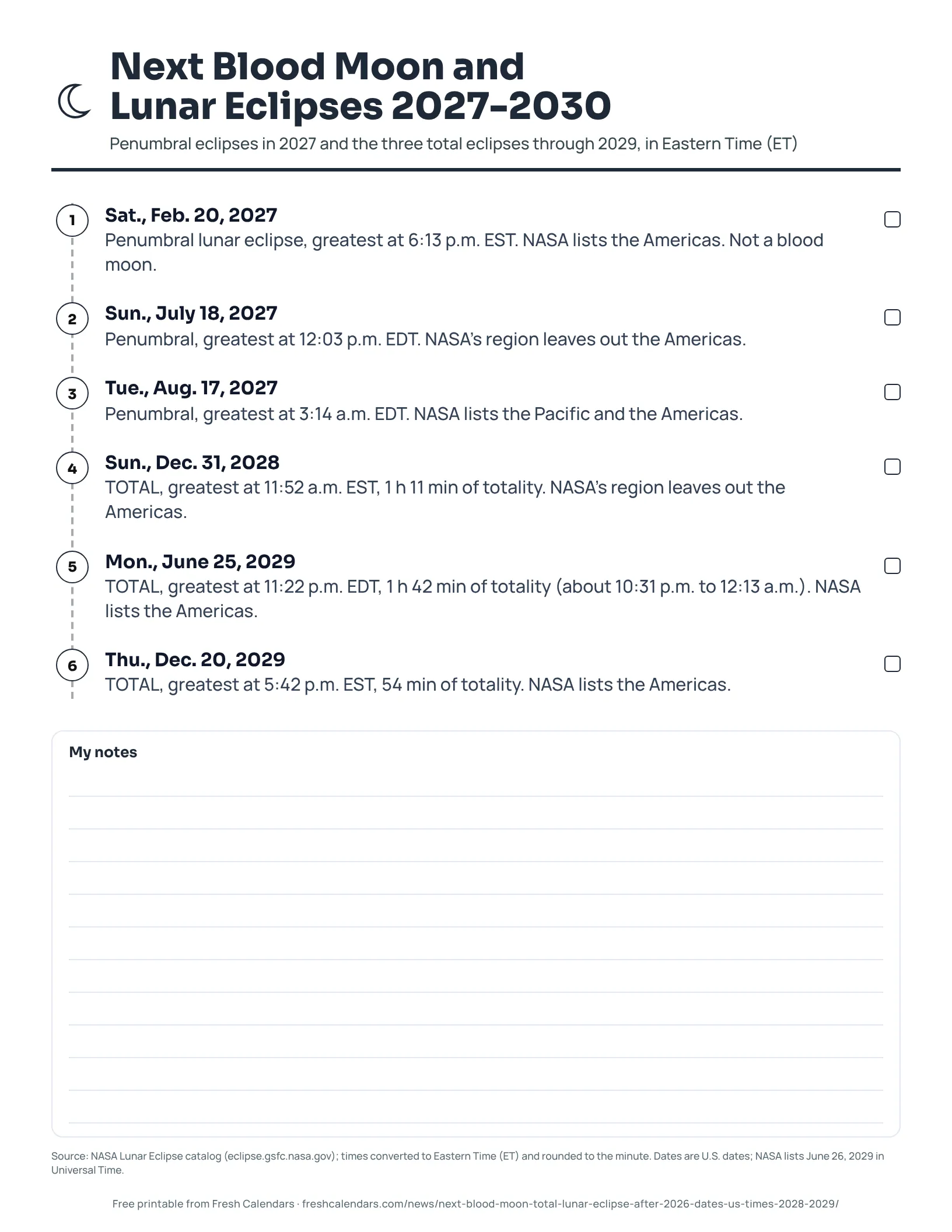
Next Blood Moon and Lunar Eclipses 2027-2030 (ink saver)
A one-page list of the penumbral lunar eclipses of 2027 and the three total lunar eclipses through 2029, with U.S. dates and Eastern Time. Ink-saver version.
Frequently asked questions
When is the next total lunar eclipse?
NASA's next total lunar eclipse is Dec. 31, 2028, but its region (Europe, Africa, Asia, Australia, Pacific) does not include the Americas. The next one NASA lists for the Americas is June 26, 2029 by NASA's Universal Time (UT) date, which is Monday, June 25 on U.S. clocks.
Is there a blood moon in 2027?
No. NASA lists three lunar eclipses in 2027 (Feb. 20, July 18 and Aug. 17) and all are penumbral. NASA describes the dark red or orange Moon as what appears during a total lunar eclipse.
What is the difference between a penumbral and a total lunar eclipse?
In a penumbral eclipse the Moon crosses Earth's outer shadow and misses the dark inner shadow, the umbra, according to NASA's catalog. In a total eclipse the Moon passes completely into the umbra.
Sources
- NASA - Lunar Eclipses: 2021 - 2030 (NASA Goddard Space Flight Center)
- Catalog of Lunar Eclipses: 2001 to 2100 (NASA Goddard Space Flight Center)
- Five Millennium Catalog of Lunar Eclipses (type definitions) (NASA Goddard Space Flight Center)
- Future Eclipses (NASA Science)
- March 2026 Total Lunar Eclipse: Your Questions Answered (NASA Science, 2026-02-27)
Related news
-
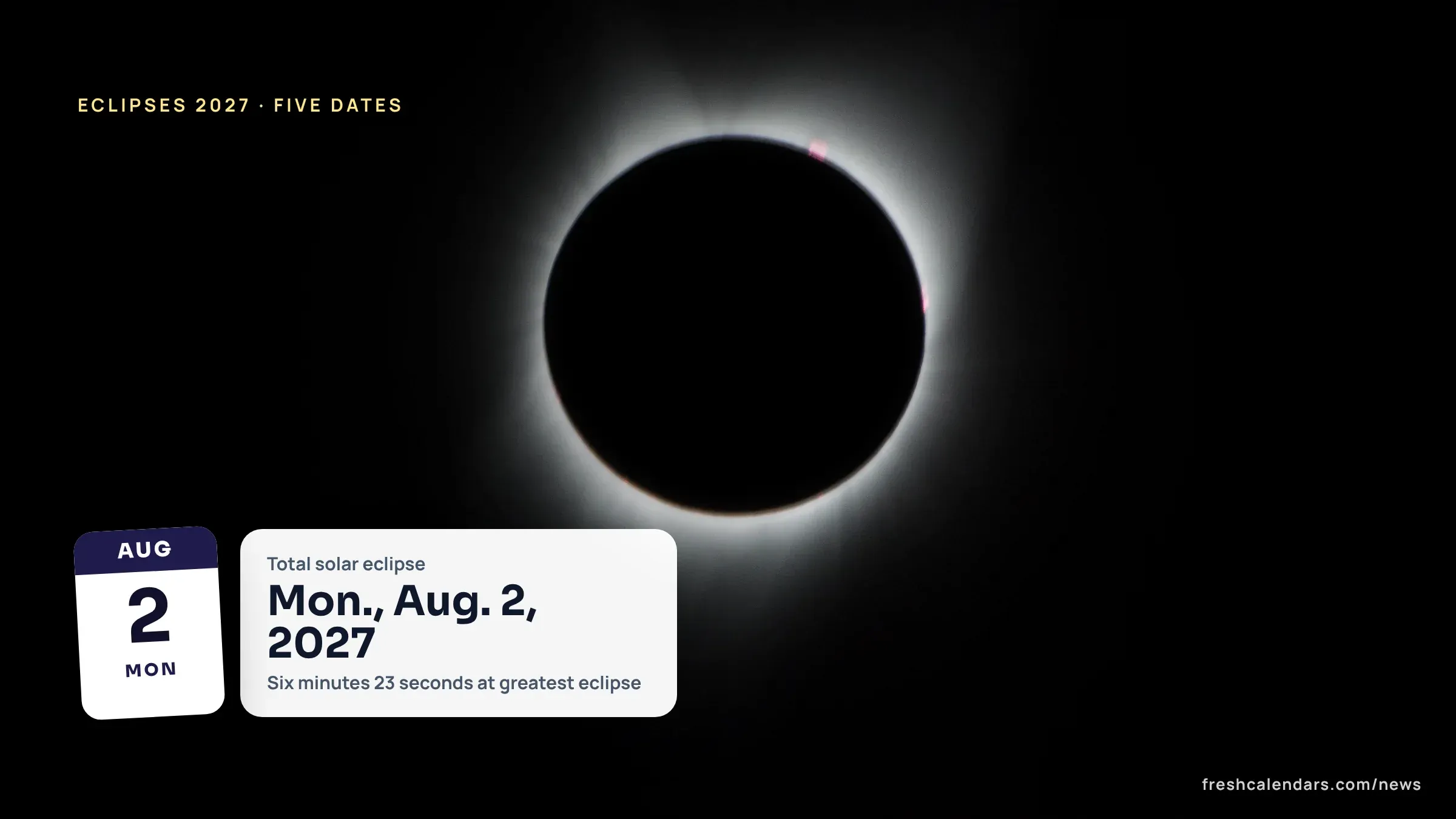 Eclipses 2027: Five Dates and Times, Led by the Total Solar Eclipse on Aug. 2
-
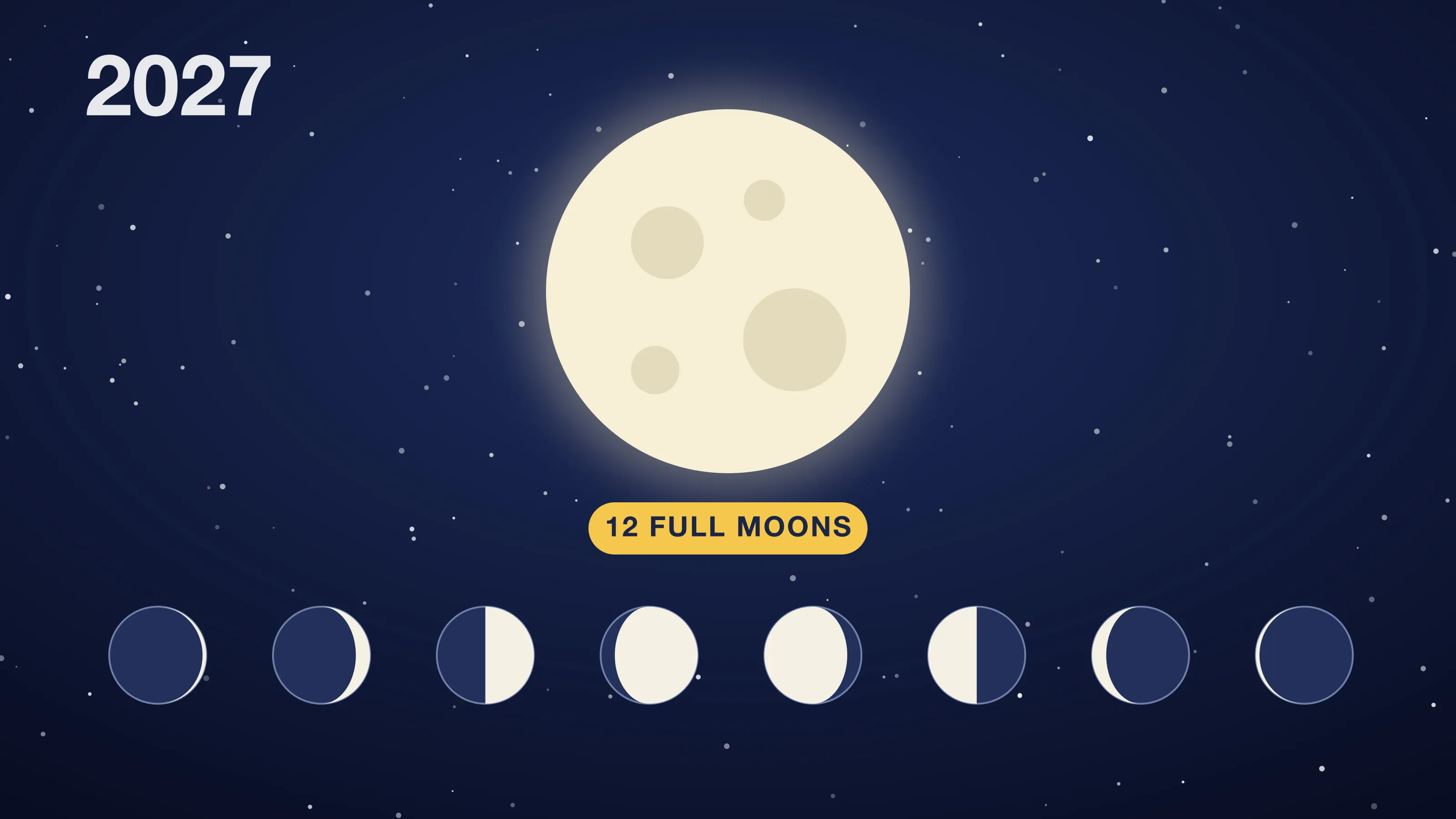 Moon Phases 2027: Full Moon Calendar With Dates, Times, Names and Eclipses, Plus Free Printables
-
 Two Supermoons Close 2026: Beaver Moon Nov. 24, Cold Moon Dec. 23, Plus Geminids and the Solstice
-
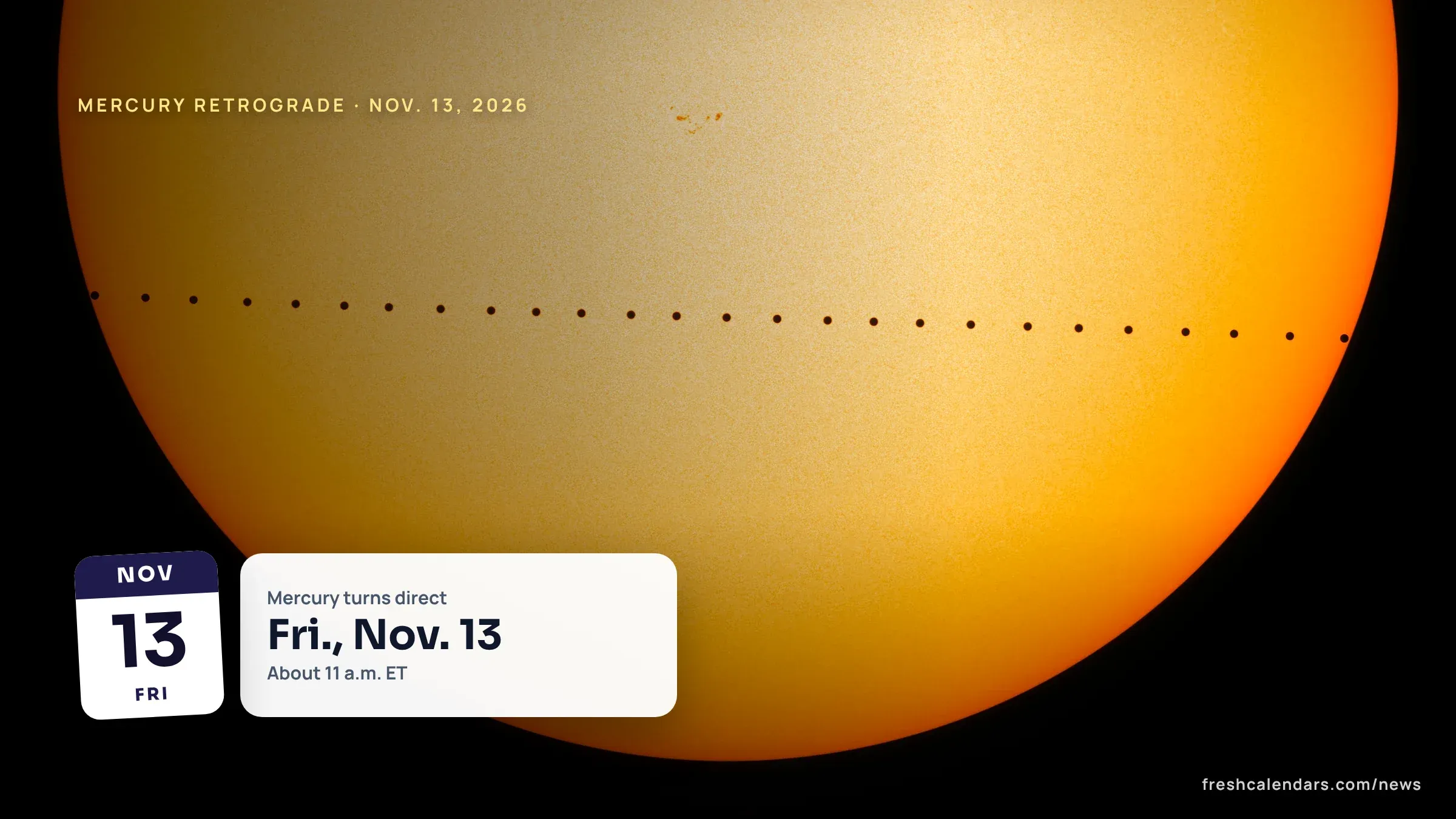 Mercury Retrograde 2026: Ends Nov. 13 at About 11 a.m. ET, With Every Date and Time Through 2027
More in Sky Events
All Sky Events stories →- Meteor Showers 2027: Peak Dates, Eastern Times and Moon Phase for 12 Showers
- Planets in 2027: Jupiter Opposition Feb. 10, Mars Feb. 19, Saturn Oct. 17 in Eastern Time
- Next Solar Eclipse in the US: Total in Alaska in 2033, Lower 48 on Aug. 22, 2044
- Geminid Meteor Shower 2026 Peaks Dec. 13-14: Moonset Times for 12 U.S. Cities
- Planets Visible in December 2026: Night Sky Calendar With the Geminids and the Solstice
Trending now
- Black Friday 2026 Deals: Date Is Friday, Nov. 27, Live Countdown and Ad Tracker
- Day of the Dead 2026: Día de los Muertos Dates, Traditions and Events
- Veterans Day Free Meals 2026: 44 Chains Confirmed, 13 Discounts and a Printable List
- Black Friday Canada 2026: Nov. 27 Date, Canadian Tire Deals From Nov. 5, Who Hasn't Announced
- November 2026 Meteor Showers: Taurid Fireballs Under Dark Skies, Then the Leonids on Nov. 16-17