Northern Lights in November 2026: Next Dates Nov. 17 and 18
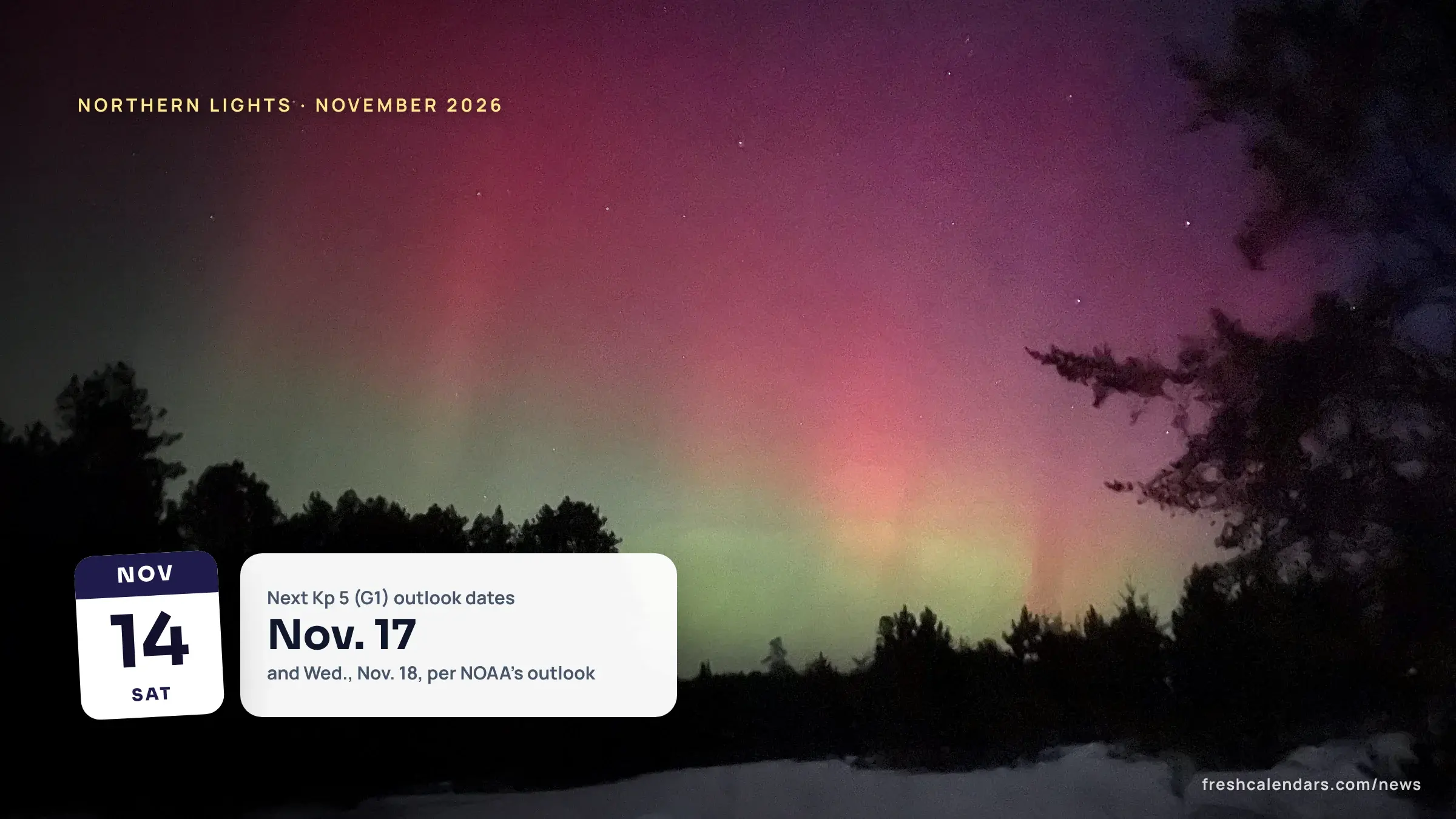
The next northern lights dates in November 2026 are Nov. 17 and 18, each with a planetary K-index of 5 (G1) in the 27-day outlook, after Halloween's storm.

Published Updated 4 min read
In this article
The National Oceanic and Atmospheric Administration’s (NOAA) Space Weather Prediction Center (SWPC) forecast a G1 (Minor) geomagnetic storm on Halloween night, Saturday, Oct. 31, 2026, with the strongest period from 11 p.m. Eastern Daylight Time (EDT) Saturday to 1 a.m. Eastern Standard Time (EST) Sunday, Nov. 1. That Halloween window has now passed. The strongest period was the 03:00 to 06:00 Coordinated Universal Time (UTC) block of SWPC’s 3-day forecast, issued at 00:30 UTC on Oct. 31, which put the planetary K-index (Kp) at 4.67. Below is the forecast as it stood for Halloween night, converted to Eastern Time (ET) and Pacific Time (PT) across the clock change, followed by the next dates to watch in November.
Northern lights forecast for Halloween night by time zone
SWPC publishes its forecast in three-hour UTC blocks. U.S. clocks fell back at 2 a.m. EDT on Sunday, Nov. 1 (06:00 UTC, which was 1 a.m. EST), so the same forecast read differently on either side of that moment. Our conversion of the evening and overnight blocks:
| UTC block | Eastern Time | Pacific Time | Forecast Kp |
|---|---|---|---|
| Oct. 31, 21:00-24:00 | Sat., 5-8 p.m. EDT | Sat., 2-5 p.m. PDT | 4.00 |
| Nov. 1, 00:00-03:00 | Sat., 8-11 p.m. EDT | Sat., 5-8 p.m. PDT | 3.67 |
| Nov. 1, 03:00-06:00 | Sat., 11 p.m. EDT to 1 a.m. EST Sun. | Sat., 8-11 p.m. PDT | 4.67 (G1) |
| Nov. 1, 06:00-09:00 | Sun., 1-4 a.m. EST | Sat., 11 p.m. PDT to Sun., 2 a.m. PDT | 3.33 |
| Nov. 1, 09:00-12:00 | Sun., 4-7 a.m. EST | Sun., 1-4 a.m. PST | 2.67 |
Source: SWPC 3-Day Forecast issued Oct. 31, 2026, 00:30 UTC; time-zone conversion by Fresh Calendars. PDT is Pacific Daylight Time (UTC minus 7 hours) and PST is Pacific Standard Time (UTC minus 8 hours); Pacific clocks fell back at 2 a.m. PDT, 09:00 UTC.
The highest Kp in the whole forecast, 5.00 (G1), sat in the 00:00 to 03:00 UTC block on Oct. 31, which was Friday, Oct. 30, 8 to 11 p.m. EDT. SWPC’s 3-day forecast gave the Oct. 31-Nov. 2 maximum as 5.00 (NOAA Scale G1) and the greatest observed Kp over the previous 24 hours as 4, below NOAA scale levels.
Why SWPC expected a G1 storm on Halloween
SWPC’s rationale said the geomagnetic field was likely to reach G1 (Minor) storm levels on Oct. 31-Nov. 1 because of a positive-polarity coronal hole (CH) high speed stream (HSS), a fast flow of solar wind. Unsettled conditions were likely on Nov. 2 as the stream’s influence waned. SWPC’s G1 watch listed G1 (Minor) as the highest level for both Oct. 31 and Nov. 1.
The alerts confirm the build-up. SWPC issued a G1 watch on Oct. 29 at 19:10 UTC, a warning for a K-index of 5 on Oct. 30 at 23:11 UTC (valid to 06:00 UTC on Oct. 31), and an alert that the K-index of 4 threshold had been reached at 22:35 UTC on Oct. 30.
Where can the aurora be seen at G1?
NOAA’s Space Weather Scales page says that at G1 (Kp 5) aurora is commonly visible at high latitudes, with northern Michigan and Maine given as examples. At G2, the next level up, it can reach as low as New York and Idaho. The Halloween forecast was G1, not G2, and SWPC did not name any city where the aurora would appear. For a live read, SWPC runs an experimental aurora dashboard.
Generic tips apply: get away from city lights, face north, and try a phone camera, which can pick up faint aurora the eye misses.
How will the Moon affect the view on Oct. 31?
The Moon was a waning gibbous on Halloween, 63% lit, according to the U.S. Naval Observatory (USNO). It rose late in the evening: 11:52 p.m. Central Daylight Time (CDT) in Chicago, by USNO’s calculation for Chicago’s coordinates. Moonlight arrived after that and could wash out faint aurora, so the hours before moonrise were the darker ones. The full Moon was Oct. 26; our moon phase calendar lists every night through November.
Northern lights dates to mark in November 2026
SWPC’s 27-day outlook, issued Nov. 9, lists the largest forecast Kp for each UTC date. The planetary K-index that SWPC reported for Nov. 7 and Nov. 8 reached 5.33 and 5.00, the G1 level. The next dates with a forecast Kp of 5 are below, with USNO moon phases (converted to EST).
| Date | Outlook Kp | Moon |
|---|---|---|
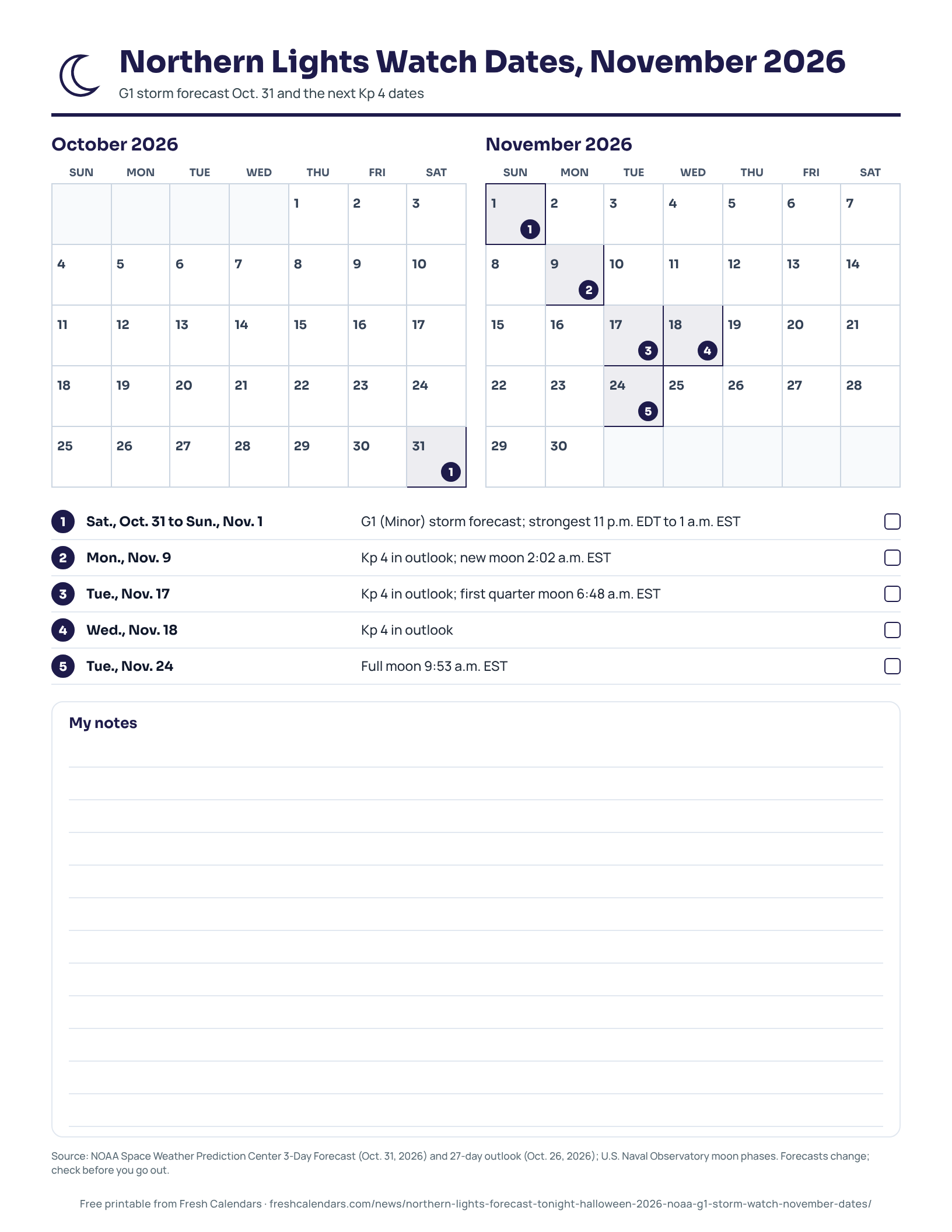
| Tue., Nov. 17 | 5 | First Quarter, 6:48 a.m. EST |
| Wed., Nov. 18 | 5 | No phase change listed |
The outlook also lists a Kp of 5 on Fri., Nov. 27 and Sat., Nov. 28, near the end of the month. The Full Moon falls on Tue., Nov. 24 at 9:53 a.m. EST, so those two nights have a bright, waning Moon. The 27-day outlook is a long-range product and changes, so check the 3-day forecast before going out. The one issued Nov. 14 expects no G1 storm through Nov. 16. Print the dates on the November 2026 printable calendar or our free Northern Lights Watch Dates sheet.
What else is in the November sky?
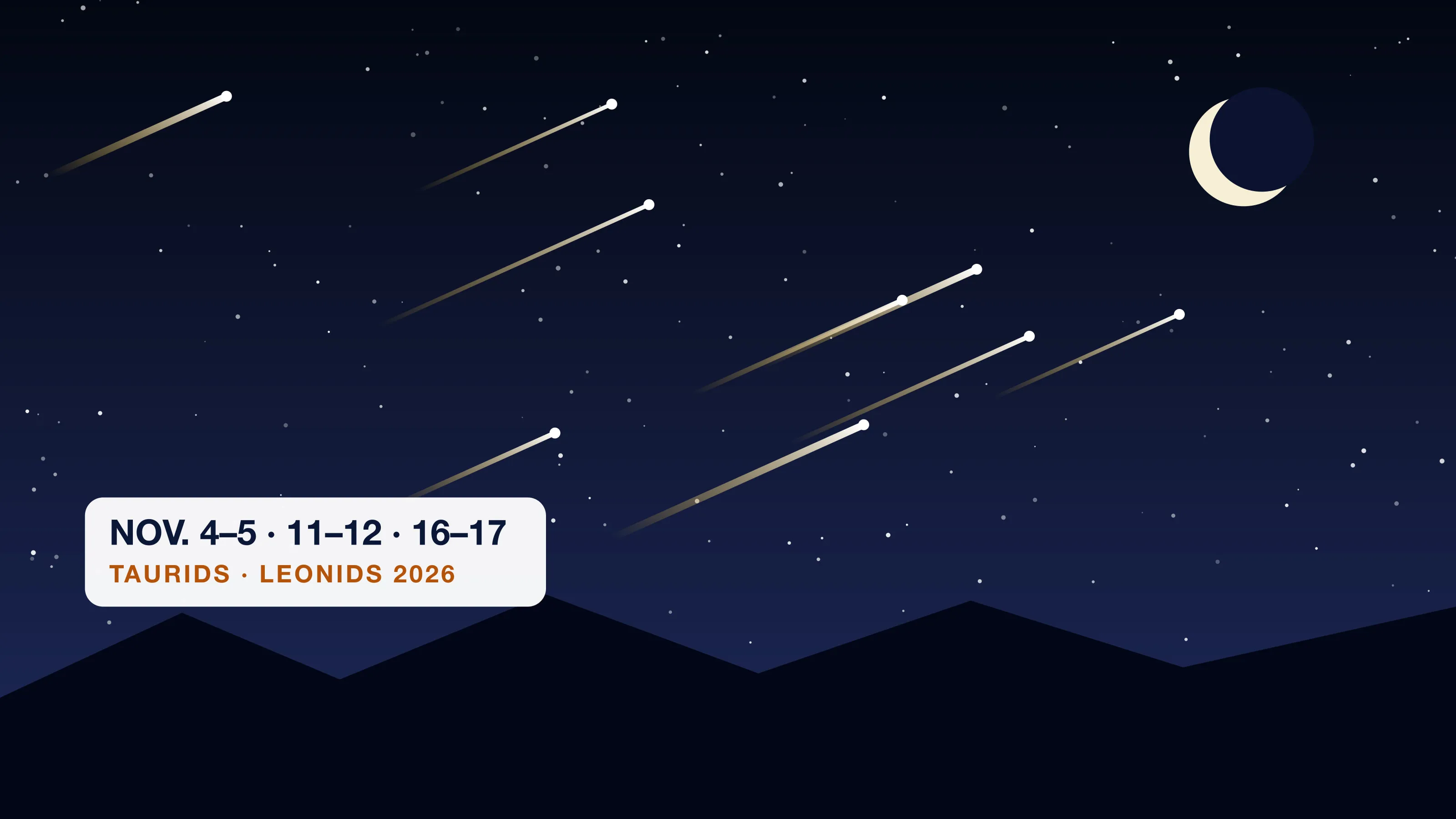
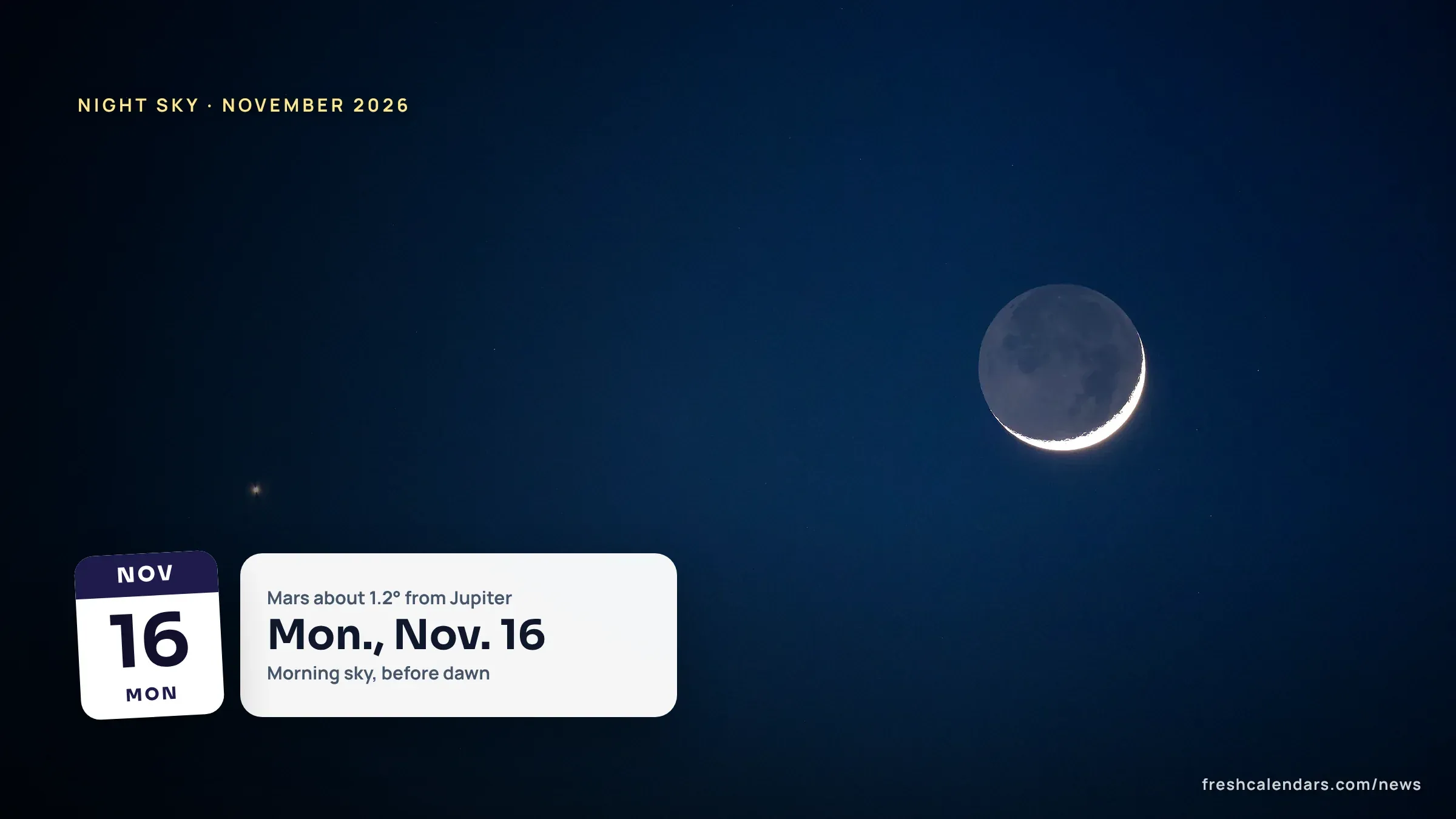
For meteors and planets this month, see our November 2026 meteor shower guide and the night sky calendar for planets and the Moon. If you stay out past the clock change, see when daylight saving time ends.
Free printable downloads
Every template is free, needs no sign-up and prints on US Letter paper. Choose PDF for printing or PNG for screens and documents.
Northern Lights Watch Dates printables
-
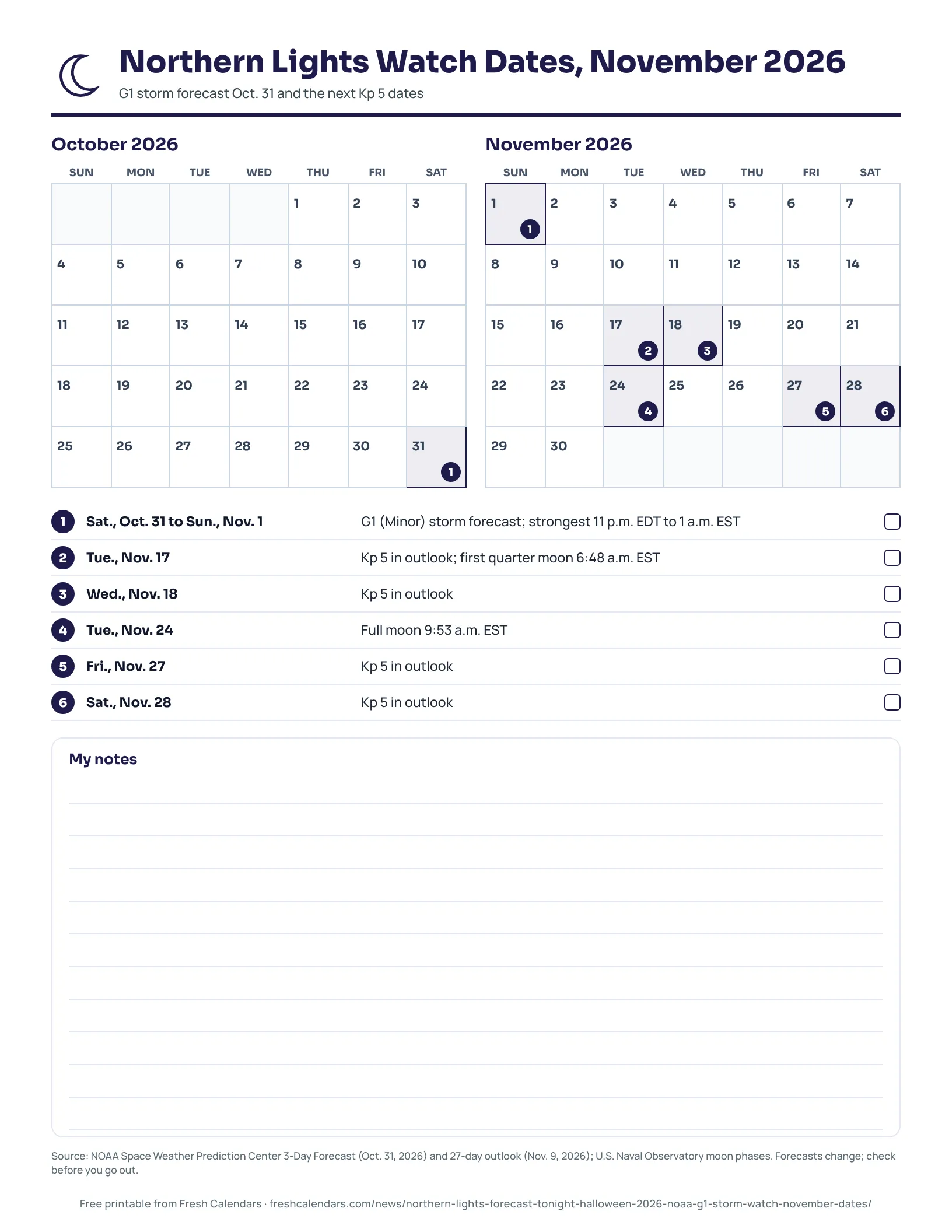
Northern Lights Watch Dates, November 2026
A one-page November 2026 northern lights watch calendar with the Oct. 31 G1 forecast, the next Kp 5 outlook dates and moon phases.
Frequently asked questions
Did NOAA promise northern lights on Halloween night?
NOAA did not promise a sighting anywhere. For a G1 storm its Space Weather Scales page says aurora is commonly visible at high latitudes, such as northern Michigan and Maine. Clouds, city lights and moonlight all matter.
What time is the best window on Halloween night?
The 3-day forecast gave its highest Kp for Halloween night, 4.67 (G1), in the block from 03:00 to 06:00 Coordinated Universal Time. That is 11 p.m. Eastern Daylight Time Saturday to 1 a.m. Eastern Standard Time Sunday, or 8 to 11 p.m. Pacific Daylight Time.
Does the clock change affect the forecast?
No, but it changes how you read it. U.S. clocks fell back at 2 a.m. EDT on Sunday, Nov. 1, which was 1 a.m. EST, so the 1 a.m. hour happened twice on the clock.
When is the next chance for northern lights after Halloween?
In SWPC's 27-day outlook issued Nov. 9, the next largest forecast Kp of 5 (G1) falls on Nov. 17 and Nov. 18, then on Nov. 27 and Nov. 28. The 3-day forecast issued Nov. 14 expects no G1 storm through Nov. 16. A long-range outlook changes, so check the 3-day forecast before you go out.
Sources
- 3-Day Forecast (NOAA Space Weather Prediction Center, 2026-11-14)
- Space Weather Alerts, Watches and Warnings (NOAA Space Weather Prediction Center, 2026-10-30)
- NOAA Space Weather Scales (NOAA Space Weather Prediction Center)
- 27-Day Space Weather Outlook Table (NOAA Space Weather Prediction Center, 2026-11-09)
- Observed Planetary K-index (NOAA Space Weather Prediction Center, 2026-11-14)
- Phases of the Moon (U.S. Naval Observatory, Astronomical Applications Department)
Related news


More in Sky Events
All Sky Events stories →Trending now
- Costco Black Friday 2026: Nov. 27-30 Savings, Deals From Nov. 16
- CPKC Holiday Train 2026 Schedule: 182 Stops, Nov. 19 to Dec. 20
- Coming to Hulu November 2026: 109 Dated Titles, Percy Jackson Nov. 20
- Black Friday Ads 2026: Date Is Nov. 27, Walmart Deals Nov. 23-29
- Best Buy Black Friday 2026: Deals Start Nov. 19, Cyber Week Dec. 1-6