Northern Lights UK Nov. 1: Scotland Aurora Chance, Darkness Times
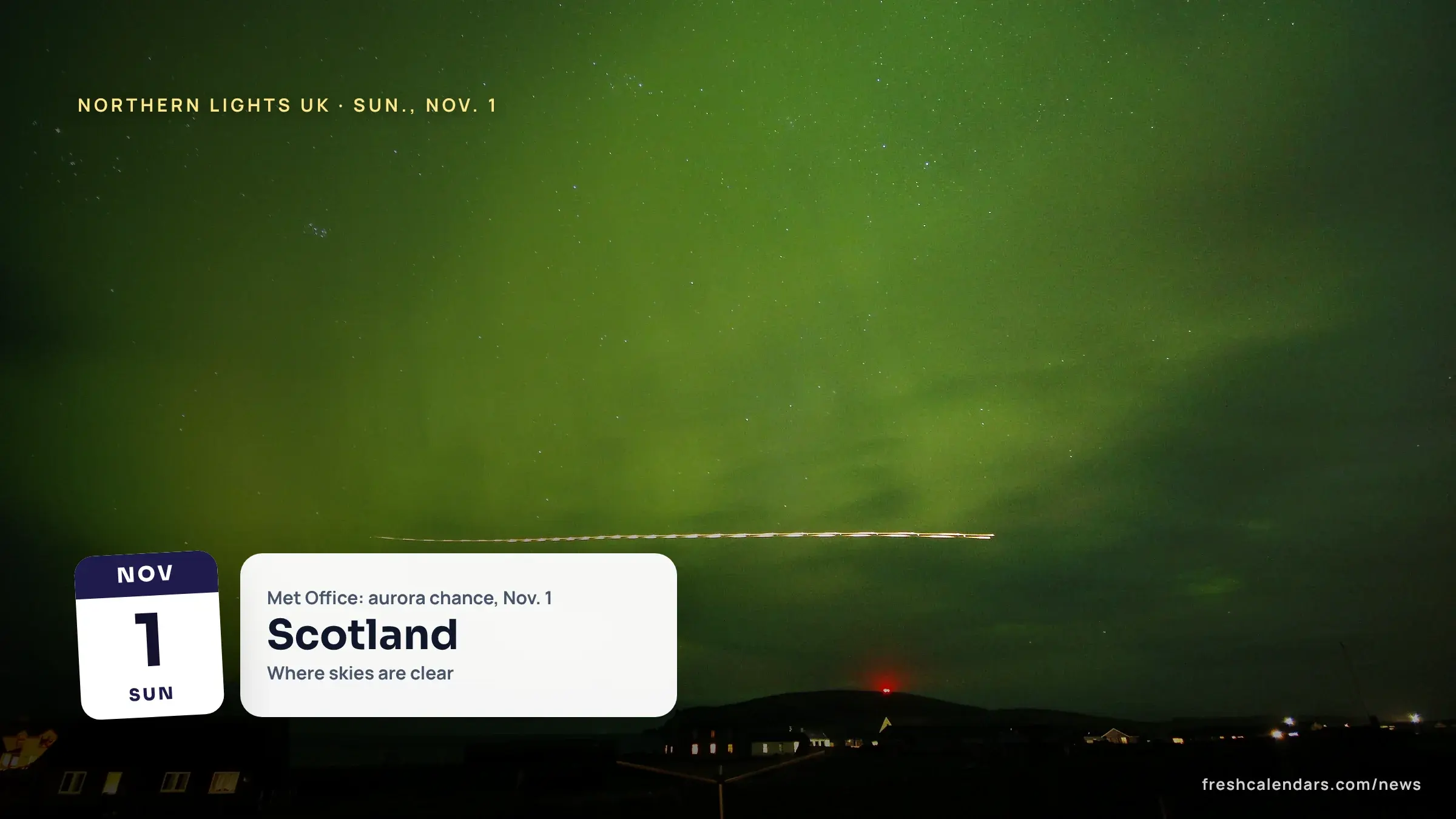
The Met Office gave a chance of aurora over northern Scotland on Sunday 1 November 2026. Darkness times for eight UK cities and that night's forecast.

Published Updated 4 min read
In this article
- What did the Met Office say about aurora on 1 November?
- When did it get dark in Scotland and northern England on 1 November?
- What did NOAA’s numbers show for 1 November in the UK?
- When was aurora activity expected to fade after 1 November?
- How will the Moon affect the view?
- Where can you keep the aurora dates?
On Sunday 1 November 2026, from full darkness around 6:30 to 6:50 p.m. Greenwich Mean Time (GMT) in Scotland, the Met Office gave a chance of aurora sightings across northern Scotland where skies were clear. The forecast, issued at 14:42 GMT, said a solar wind enhancement arrived on Saturday 31 October and increased auroral activity. Below are darkness times for eight UK cities, the National Oceanic and Atmospheric Administration (NOAA) numbers for the evening, and when activity was expected to fade.
What did the Met Office say about aurora on 1 November?
The Met Office Space Weather page, the UK’s official forecast, read: “A chance of Aurora sightings during the hours of darkness on Sunday across northern Scotland, where skies are clear. Monday night onwards auroral activity is expected to reduce towards background levels.” It named northern Scotland and no other part of the UK.
Its overview, issued at 12:54 GMT, headlined a continued chance of G1/Minor geomagnetic storms on Day 1 (1 November) with elevated solar winds. In the past 24 hours it recorded a G2/Moderate storm (Kp6) interval between 18:00 and 21:00 UTC on 31 October and a G1/Minor storm (Kp5) from 00:00 to 03:00 on 1 November. Solar wind peaked briefly above 600 km/s and was then near 500 km/s. The source was a coronal hole high speed stream, and the Met Office listed no Earth-directed coronal mass ejections (CMEs).
When did it get dark in Scotland and northern England on 1 November?
Aurora needs a dark sky, so the start of astronomical darkness is the earliest useful time. Times are Greenwich Mean Time, which equals Coordinated Universal Time (UTC) in November, computed by Fresh Calendars from the NOAA solar calculation.
| City | Sunset, Sun. 1 Nov | Darkness begins | Darkness ends, Mon. 2 Nov |
|---|---|---|---|
| Lerwick | 16:09 | 18:32 | 05:05 |
| Kirkwall | 16:21 | 18:39 | 05:13 |
| Inverness | 16:32 | 18:44 | 05:18 |
| Aberdeen | 16:24 | 18:35 | 05:10 |
| Edinburgh | 16:33 | 18:40 | 05:14 |
| Glasgow | 16:38 | 18:44 | 05:18 |
| Belfast | 16:48 | 18:50 | 05:25 |
| Newcastle | 16:30 | 18:33 | 05:08 |
Monday night, 2 November, is a few minutes different:
| City | Sunset, Mon. 2 Nov | Darkness begins | Darkness ends, Tue. 3 Nov |
|---|---|---|---|
| Lerwick | 16:06 | 18:30 | 05:07 |
| Kirkwall | 16:18 | 18:37 | 05:15 |
| Inverness | 16:29 | 18:42 | 05:20 |
| Aberdeen | 16:22 | 18:33 | 05:12 |
| Edinburgh | 16:31 | 18:38 | 05:16 |
| Glasgow | 16:35 | 18:42 | 05:20 |
| Belfast | 16:46 | 18:49 | 05:27 |
| Newcastle | 16:28 | 18:31 | 05:10 |
Newcastle and Belfast are listed for planning only. The Met Office forecast for 1 November named northern Scotland.
What did NOAA’s numbers show for 1 November in the UK?
NOAA’s Space Weather Prediction Center (SWPC) issued its 3-day forecast at 12:30 UTC on 1 November. The greatest observed 3-hour planetary K-index (Kp) over the past 24 hours was 6, NOAA Scale G2. The greatest expected Kp for 1 to 3 November is 4.67 (G1), and SWPC said periods of G1 (Minor) storming were likely on 1 November because of positive polarity coronal hole high speed stream influences.
That G1 period was the 00:00 to 03:00 UTC block on 1 November, which had ended before darkness fell. The evening numbers were lower, so the window could be short and the best chance was the far north of Scotland. SWPC’s blocks in GMT:
| Date | UTC block (same as GMT) | Forecast Kp |
|---|---|---|
| Sun. 1 Nov | 00:00-03:00 | 4.67 (G1) |
| Sun. 1 Nov | 18:00-21:00 | 2.67 |
| Sun. 1 Nov | 21:00-00:00 | 2.67 |
| Mon. 2 Nov | 18:00-21:00 | 1.67 |
| Mon. 2 Nov | 21:00-00:00 | 2.00 |
| Tue. 3 Nov | 18:00-21:00 | 1.67 |
| Tue. 3 Nov | 21:00-00:00 | 1.33 |
Source: SWPC 3-Day Forecast issued 1 November 2026, 12:30 UTC. Neither agency promised a sighting.
After the night, NOAA’s daily geomagnetic data gave an estimated planetary Kp of 3.00 for 18:00-21:00 UTC and 2.00 for 21:00-00:00 UTC on 1 November, against forecasts of 2.67 for both. On 2 November the same two blocks were 1.00 and 0.33. The data gives no sighting reports, so it cannot say whether anyone saw aurora.
When was aurora activity expected to fade after 1 November?
The Met Office four-day outlook expected ongoing Unsettled to Active conditions (Kp3-4) at first, with a chance of occasional G1/Minor storms (Kp5) and a slight chance of an isolated G2/Moderate (Kp6) interval. By Day 2 (2 November) it expected activity to decline to Quiet to Unsettled (Kp2-3), then mostly Quiet (Kp1-2) by the end of the period. Solar wind was expected to return to background by 3 to 4 November. The Met Office also said that, in the Southern Hemisphere, aurora sightings were likely across the far south of New Zealand on Sunday night UTC.
How will the Moon affect the view?
The Moon reached last quarter at 3:28 p.m. Eastern Standard Time (EST) on 1 November, which is 20:28 GMT, according to the U.S. Naval Observatory (USNO). A half-lit Moon rises late in the evening, so the early dark hours were moon-free. For the rest of the month, see our night sky calendar for planets and the Moon.
Where can you keep the aurora dates?
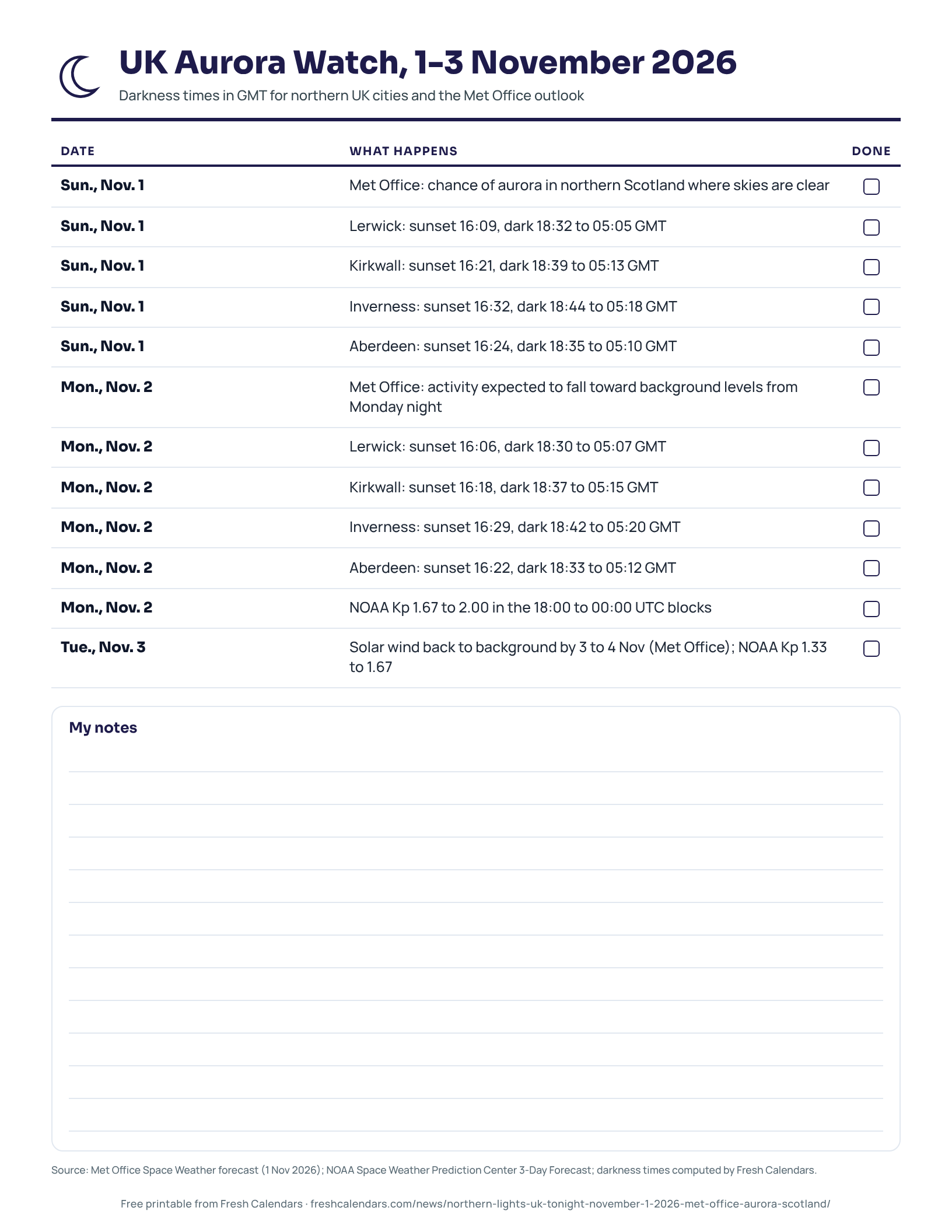
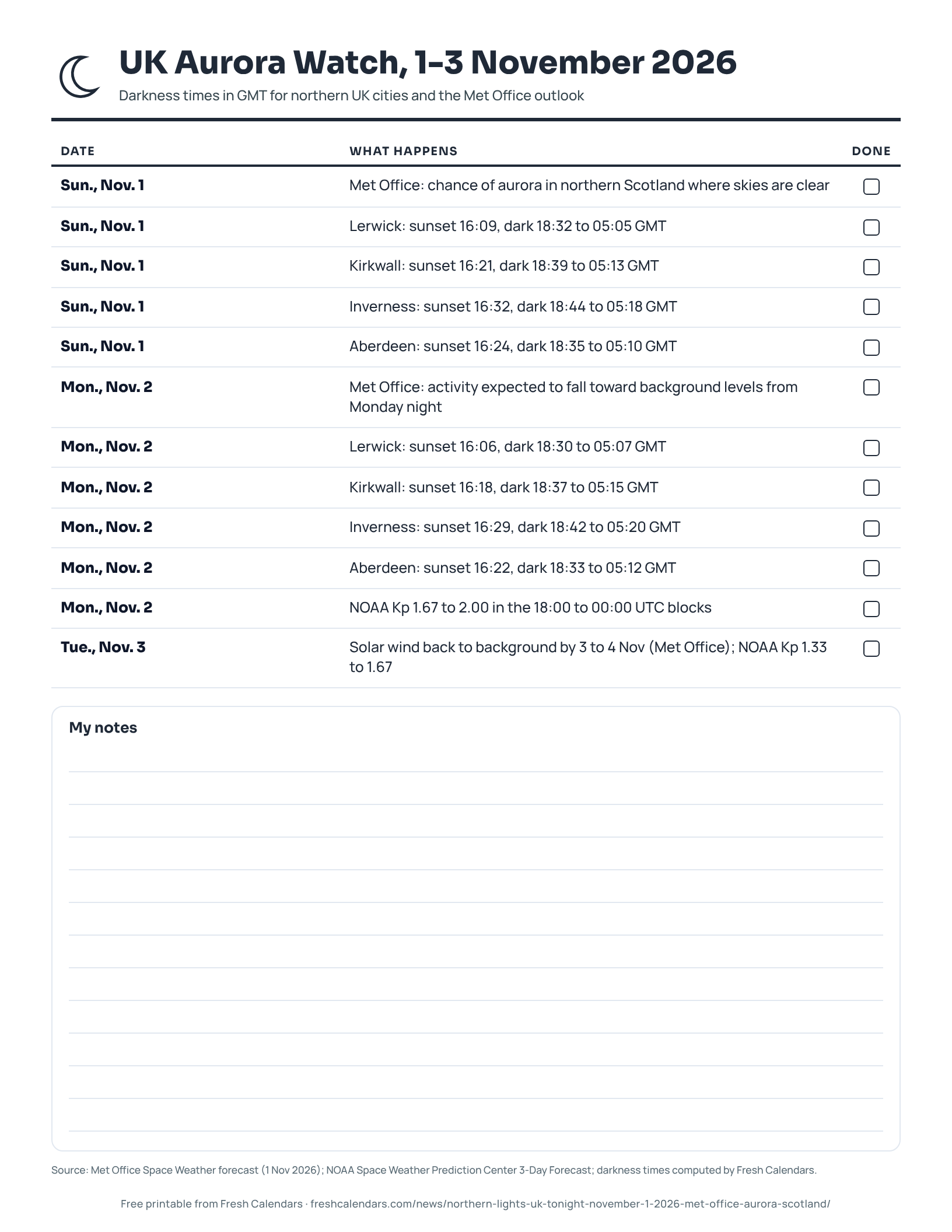
Print the UK Aurora Watch sheet with the darkness times for Lerwick, Kirkwall, Inverness and Aberdeen and the Met Office outlook. The US view of the same storm, with NOAA’s dates for later in November, is in our northern lights forecast for the US. Meteors are covered in the November 2026 meteor shower guide, and the November 2026 printable calendar holds the month. For the US clock change, see when daylight saving time ends.
Free printable downloads
Every template is free, needs no sign-up and prints on US Letter paper. Choose PDF for printing or PNG for screens and documents.
UK Aurora Watch printables
-
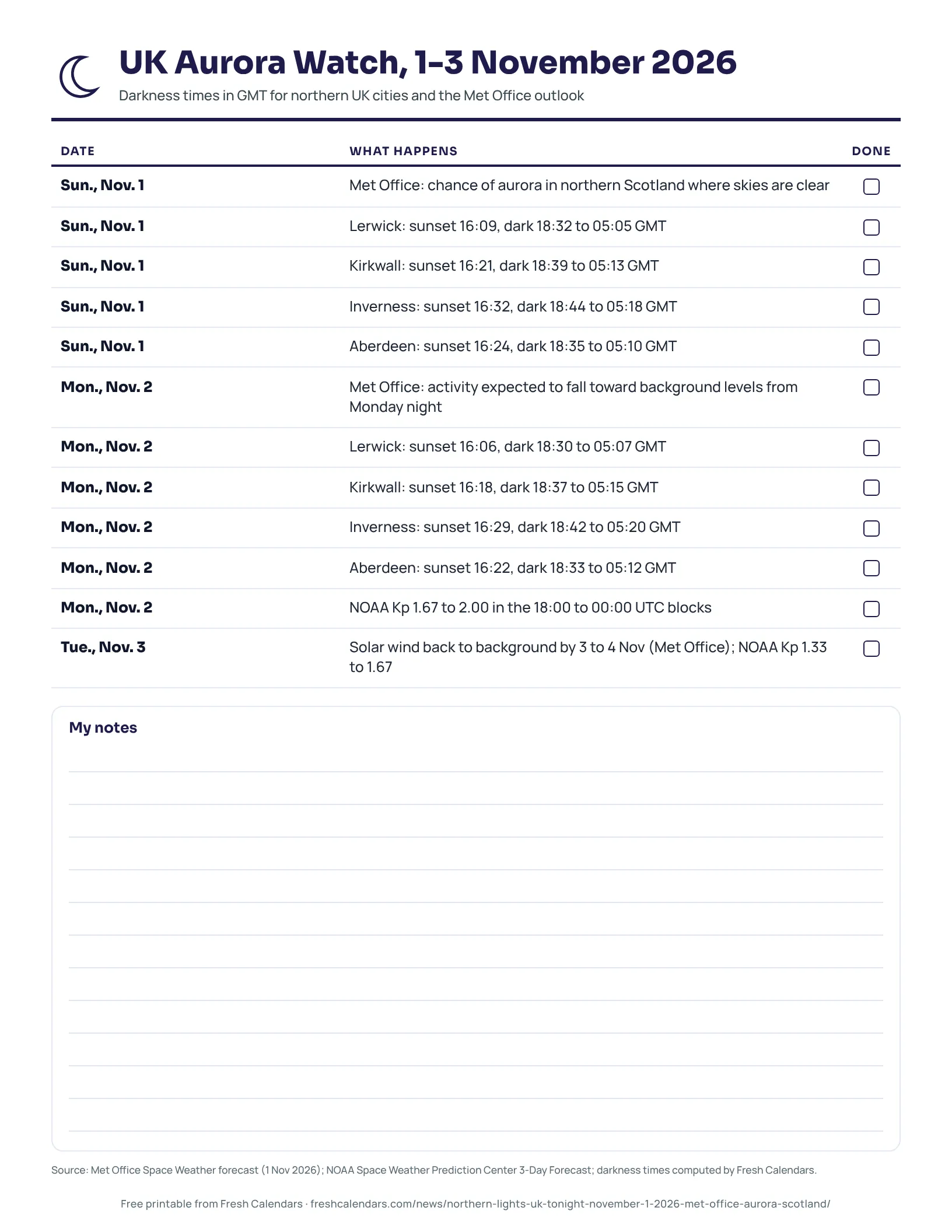
UK Aurora Watch, 1-3 November 2026
A one-page UK aurora watch sheet with darkness times for northern Scottish cities on 1 and 2 November 2026 and the Met Office outlook.
-
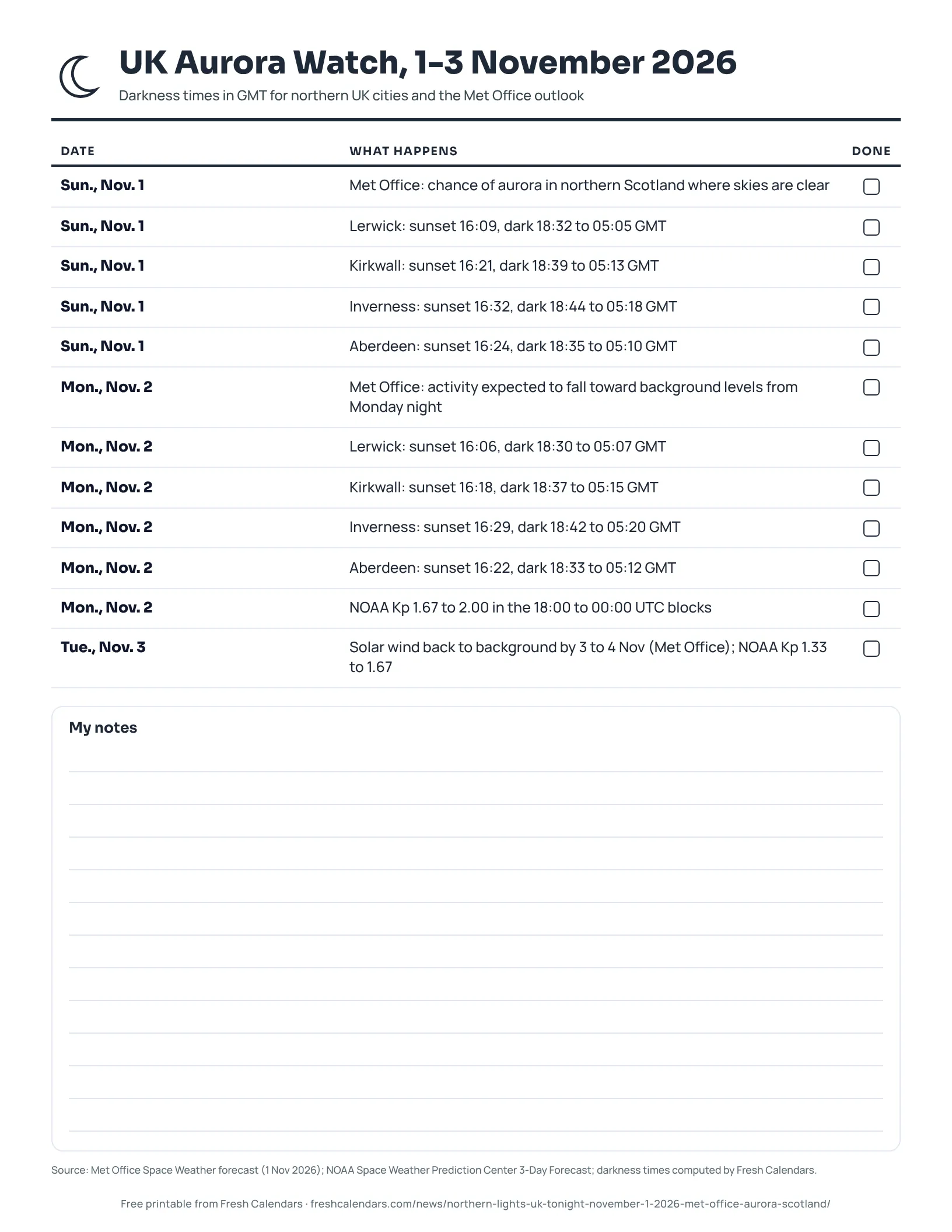
UK Aurora Watch, 1-3 November 2026 (ink saver)
A one-page UK aurora watch sheet with darkness times for northern Scottish cities on 1 and 2 November 2026 and the Met Office outlook. Ink-saver version.
Frequently asked questions
Could you see the northern lights in England or Wales on 1 November?
The Met Office forecast named northern Scotland only. It did not give a chance of sightings elsewhere in the UK for 1 November.
What time was the best window on 1 November?
The Met Office said during the hours of darkness on Sunday. Astronomical darkness started between 18:32 and 18:50 GMT in the cities in our table. NOAA's evening numbers were lower than its overnight G1 period, so the window could be short.
Why was activity expected to fade after 1 November?
The Met Office and NOAA both tied the activity to a coronal hole high speed stream, a fast flow of solar wind. The Met Office expected solar wind to return to background levels by 3 to 4 November and reported no Earth-directed coronal mass ejections.
Did the Moon get in the way?
The Moon was at last quarter at 20:28 GMT on 1 November, according to the U.S. Naval Observatory. A half-lit Moon rises late in the evening, so the early dark hours were moon-free.
Sources
- Space weather (Met Office, 2026-11-01)
- 3-Day Forecast (NOAA Space Weather Prediction Center, 2026-11-01)
- Daily Geomagnetic Data (NOAA Space Weather Prediction Center, 2026-11-14)
- Phases of the Moon (U.S. Naval Observatory, Astronomical Applications Department)
Related news

More in Sky Events
All Sky Events stories →Trending now
- Thanksgiving Travel 2026: Best Days to Fly and Drive, Nov. 21 to 30
- Black Friday Ads 2026: Date Is Nov. 27, Walmart Deals Nov. 23-29
- CPKC Holiday Train 2026 Schedule: 182 Stops, Nov. 19 to Dec. 20
- Stores Open on Thanksgiving 2026? Walmart, Costco, Target Closed
- Little Debbie Christmas Tree Cakes 2026: Mid-October Rollout