How Many Weeks Are in a Year? 52 Weeks Plus 1 or 2 Days, and When 53 Appear
A common year is 52 weeks plus 1 day and a leap year 52 weeks plus 2 days. See which years from 2024 to 2040 reach 53 numbered weeks, with a table.

Published 5 min read
In this article
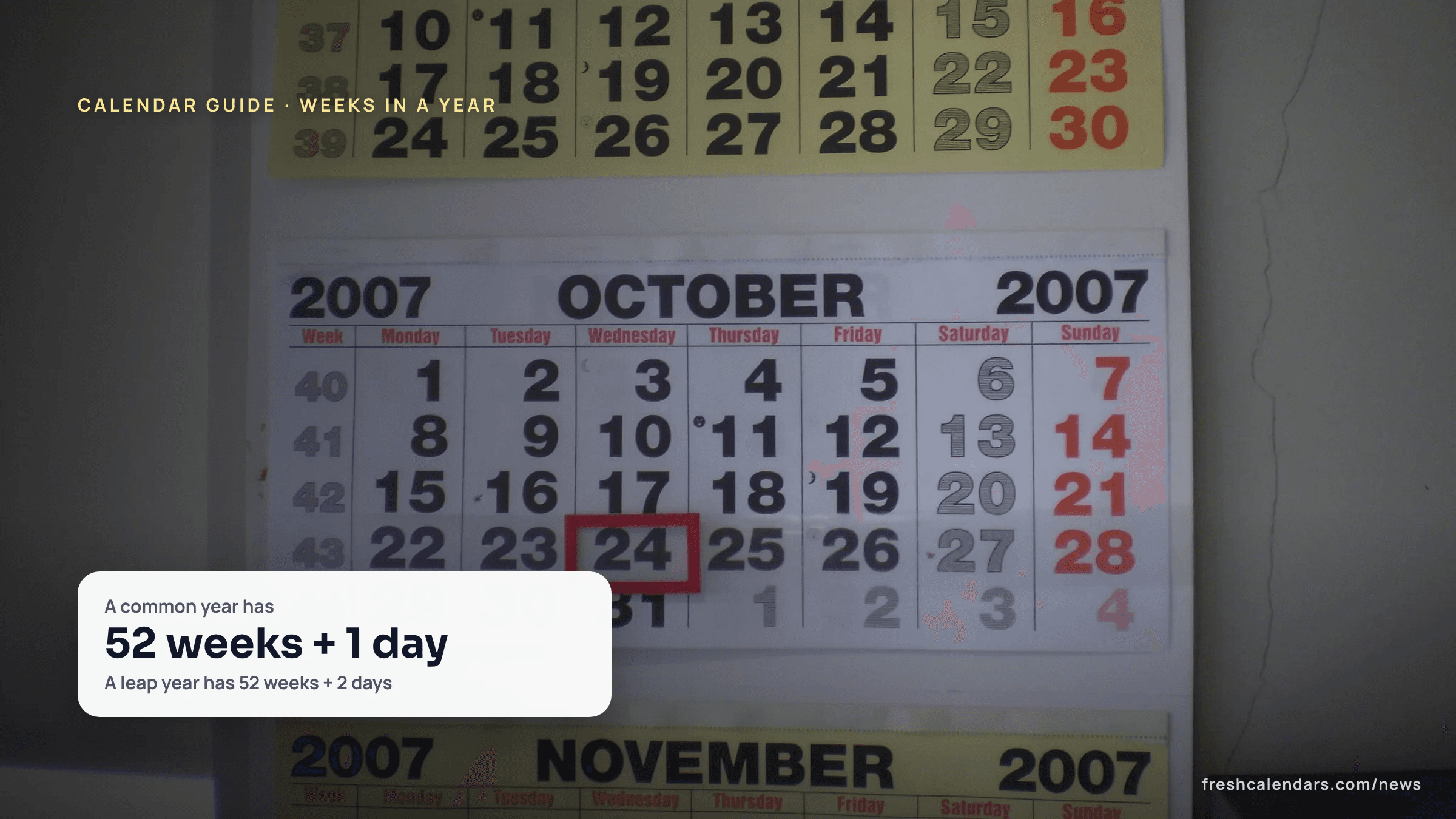
A common year has 365 days, which is 52 full seven-day weeks plus 1 day, and a leap year has 366 days, or 52 weeks plus 2 days, using the year lengths in NASA’s calendar reference. Some years still number 53 weeks under the International Organization for Standardization (ISO) 8601 week rule. The table below, computed by Fresh Calendars for 2024 to 2040, shows which ones.
Weeks in a common year and a leap year
Divide the days by 7 and keep the remainder. The remainder is the reason “52 weeks” is shorthand and never the whole answer.
| Year type | Days | Full 7-day weeks | Extra days | Math |
|---|---|---|---|---|
| Common year | 365 | 52 | 1 | 52 x 7 = 364, plus 1 |
| Leap year | 366 | 52 | 2 | 52 x 7 = 364, plus 2 |
This table counts complete seven-day periods, not week numbers. The leap-year rule comes from the U.S. Naval Observatory (USNO): years evenly divisible by 4 are leap years, except century years not evenly divisible by 400. The USNO gives the Gregorian average year as 365.2425 days, which is about 52.18 weeks. Over the full 400-year Gregorian cycle of 146,097 days, which NASA lists, the weeks do come out even: 146,097 divided by 7 is exactly 20,871.
Why Jan. 1 moves one or two weekdays each year
Because 364 days is a whole number of weeks, the extra day or days decide everything. After a common year, the next Jan. 1 falls one weekday later. After a leap year, it falls two weekdays later.
Jan. 1, 2026 is a Thursday, so Jan. 1, 2027 is a Friday. Jan. 1, 2028 is a Saturday, and because 2028 is a leap year, Jan. 1, 2029 jumps two days to a Monday. The extra weekday is also why a given date does not land on the same weekday twelve months later. That shift is why a printable yearly calendar is a new page each year.
Weeks in a year, 2024 to 2040
The columns for days and full weeks follow from the year lengths above. The ISO column applies the week rule described in the next section. The last column counts week numbers when weeks start on Sunday and the week containing Jan. 1 is week 1, the “System 1” method that Microsoft documents for its WEEKNUM function.
| Year | Jan. 1 is a | Days | Full weeks + extra days | ISO 8601 weeks | Highest Sunday-start week number |
|---|---|---|---|---|---|
| 2024 (leap) | Monday | 366 | 52 + 2 | 52 | 53 |
| 2025 | Wednesday | 365 | 52 + 1 | 52 | 53 |
| 2026 | Thursday | 365 | 52 + 1 | 53 | 53 |
| 2027 | Friday | 365 | 52 + 1 | 52 | 53 |
| 2028 (leap) | Saturday | 366 | 52 + 2 | 52 | 54 |
| 2029 | Monday | 365 | 52 + 1 | 52 | 53 |
| 2030 | Tuesday | 365 | 52 + 1 | 52 | 53 |
| 2031 | Wednesday | 365 | 52 + 1 | 52 | 53 |
| 2032 (leap) | Thursday | 366 | 52 + 2 | 53 | 53 |
| 2033 | Saturday | 365 | 52 + 1 | 52 | 53 |
| 2034 | Sunday | 365 | 52 + 1 | 52 | 53 |
| 2035 | Monday | 365 | 52 + 1 | 52 | 53 |
| 2036 (leap) | Tuesday | 366 | 52 + 2 | 52 | 53 |
| 2037 | Thursday | 365 | 52 + 1 | 53 | 53 |
| 2038 | Friday | 365 | 52 + 1 | 52 | 53 |
| 2039 | Saturday | 365 | 52 + 1 | 52 | 53 |
| 2040 (leap) | Sunday | 366 | 52 + 2 | 52 | 53 |
Computed by Fresh Calendars with two independent methods (JavaScript dates and a day-of-week formula) that agree on every row. The same rows are on the free one-page printable for this story, in a black-and-white version too.
When does a year have 53 ISO week numbers?
ISO 8601 is the ISO date and time standard. Markus Kuhn’s summary of the standard, hosted by NASA, says a week starts on Monday, “Week 01 of a year is per definition the first week that has the Thursday in this year,” and “Possible ISO week numbers are in the range 01 to 53.” Google’s documentation for its ISOWEEKNUM function says the same: weeks begin Monday and week 1 contains the year’s first Thursday.
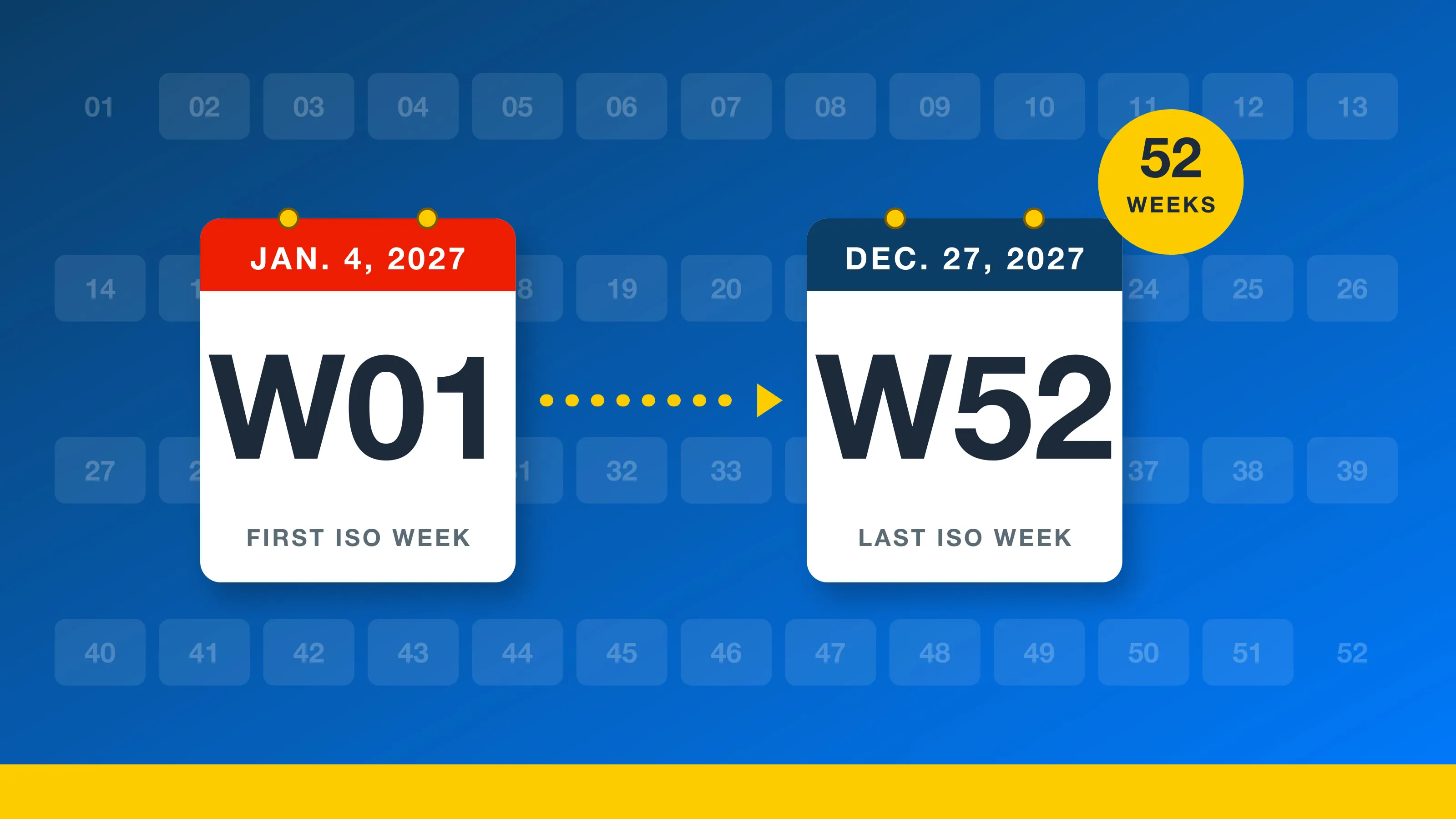
From that rule we computed an equivalent test: a year has 53 ISO weeks when it starts on a Thursday, or when it is a leap year that starts on a Wednesday. Equivalently, Jan. 1 or Dec. 31 is a Thursday. In the table, 2026 starts on a Thursday, 2032 is a leap year that starts on a Thursday, and 2037 starts on a Thursday. The 2026 case has a visible effect: Jan. 1, 2027, a Friday, still belongs to week 53 of 2026, and week 1 of 2027 starts Monday, Jan. 4. Our 2027 week numbers story lists every week of that year.
Two sibling stories cover the rule in depth: why some years have 53 weeks and ISO week numbers explained. A 53-week ISO year is still 365 or 366 days long. It only means the numbering reaches 53 because the first and last weeks are shared with neighboring years.
Why a calendar page can show 53 or 54 week rows
A week row is a line on a grid, not a block of seven days from Jan. 1. A year that starts on a Saturday and has 366 days, like 2028, touches 54 Sunday-start weeks: one partial week at the start, 52 full ones, and a partial week at the end. Counting every week the year touches always gives 53 or 54 for Sunday-start numbering, even though no year has more than 52 weeks and 2 days.
The same logic applies to single months. A month grid with Sunday as the first column has 4 rows when February has 28 days and starts on a Sunday (February 2026), 5 rows for October 2026, and 6 rows for August 2026, which has 31 days and starts on a Saturday. Our printable weekly calendar and Monday-start printable calendars put the first day of the week where you choose.
How to calculate the weeks in any year
- Count the days: 365, or 366 if the year is a leap year.
- Divide by 7. The whole number is the count of full weeks (52 every time) and the remainder is the extra days (1 or 2).
- For a numbered-week count, find the weekday of Jan. 1. If it is a Thursday, or a Wednesday in a leap year, the year has 53 ISO weeks. Otherwise it has 52.
- If you use a spreadsheet, check the function. Google Sheets and Excel offer ISOWEEKNUM for the ISO number, while Microsoft’s WEEKNUM defaults to Sunday-start System 1 and can return a different number for the same date.
The Internal Revenue Service adds one more meaning of the phrase: a 52-53-week tax year is a fiscal tax year that varies from 52 to 53 weeks, as opposed to a calendar year of 12 consecutive months from Jan. 1 to Dec. 31. A fiscal year tied to weeks follows its own rules, which is a separate question from how many weeks the calendar year holds.
Free printable downloads
Every template is free, needs no sign-up and prints on US Letter paper. Choose PDF for printing or PNG for screens and documents.
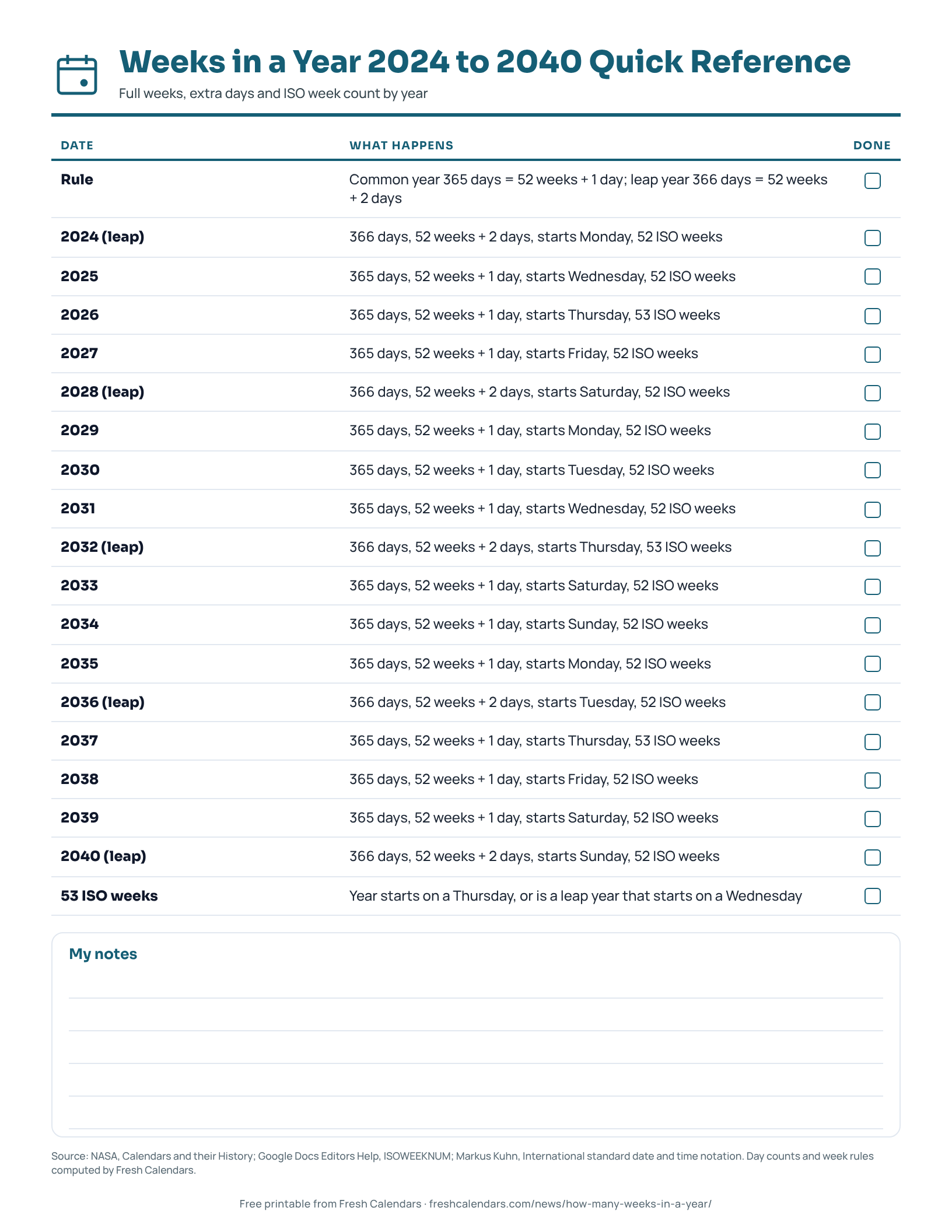
Weeks in a Year 2024 to 2040 Quick Reference printables
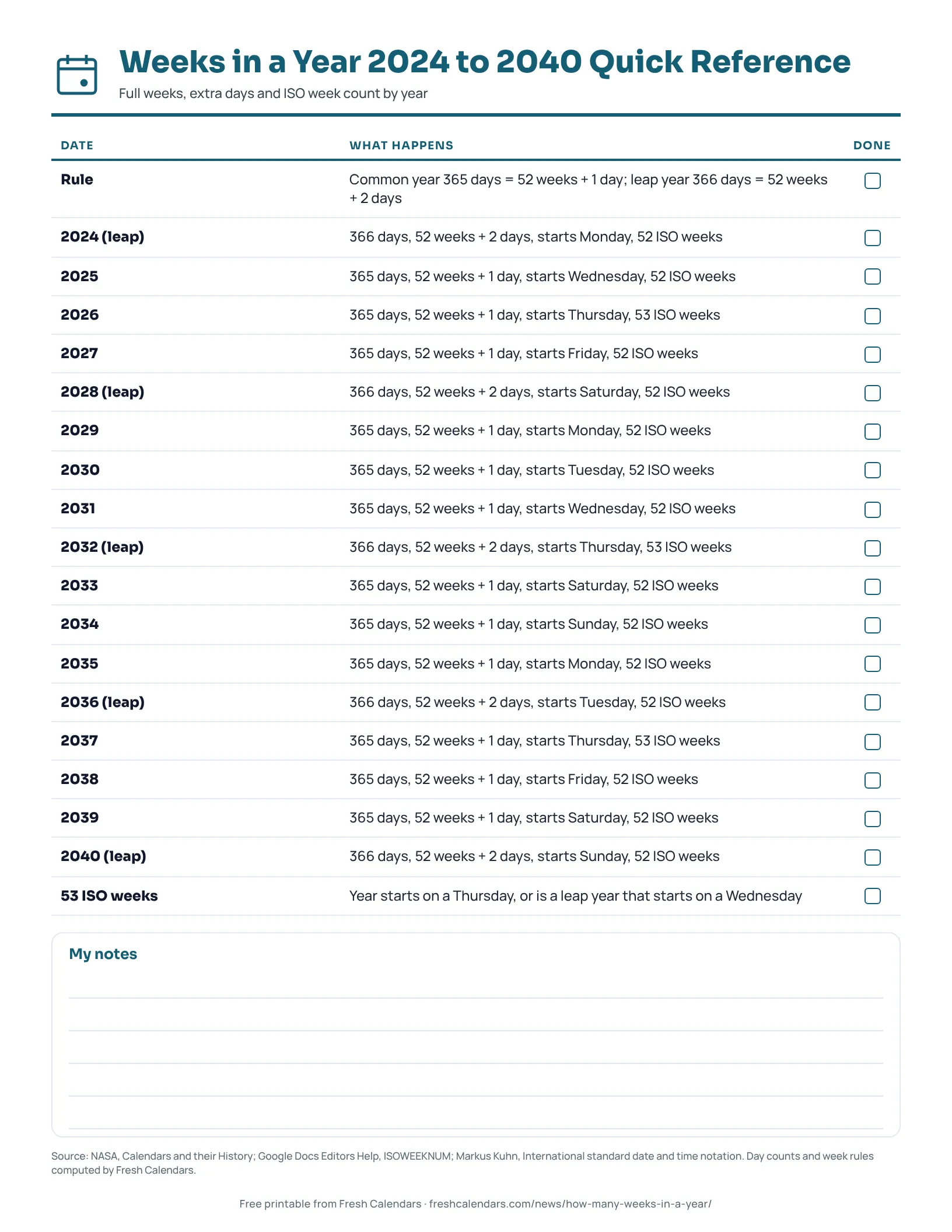
Weeks in a Year 2024 to 2040 Quick Reference
One-page reference of days, full weeks plus extra days, start weekday and International Organization for Standardization (ISO) week count for each year from 2024 to 2040.
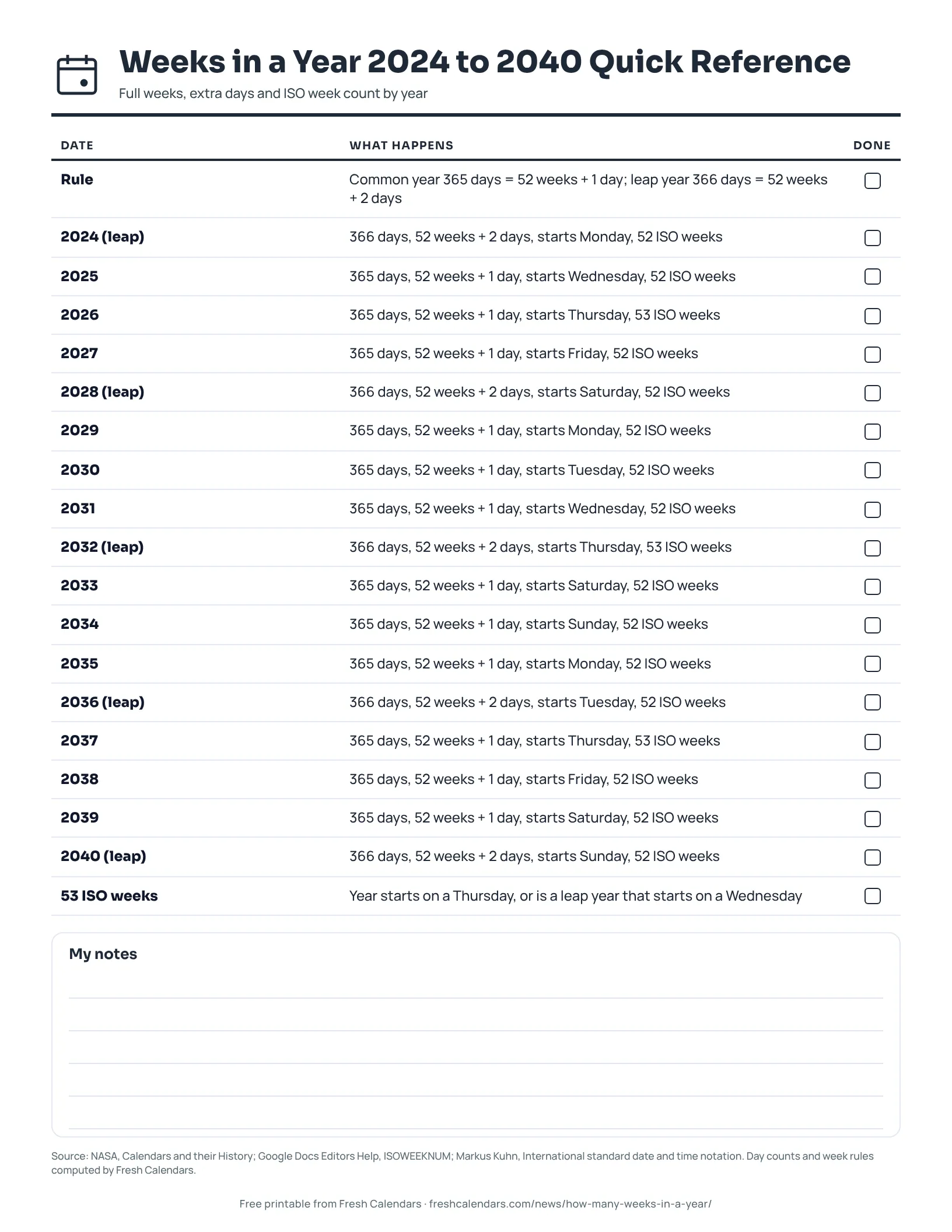
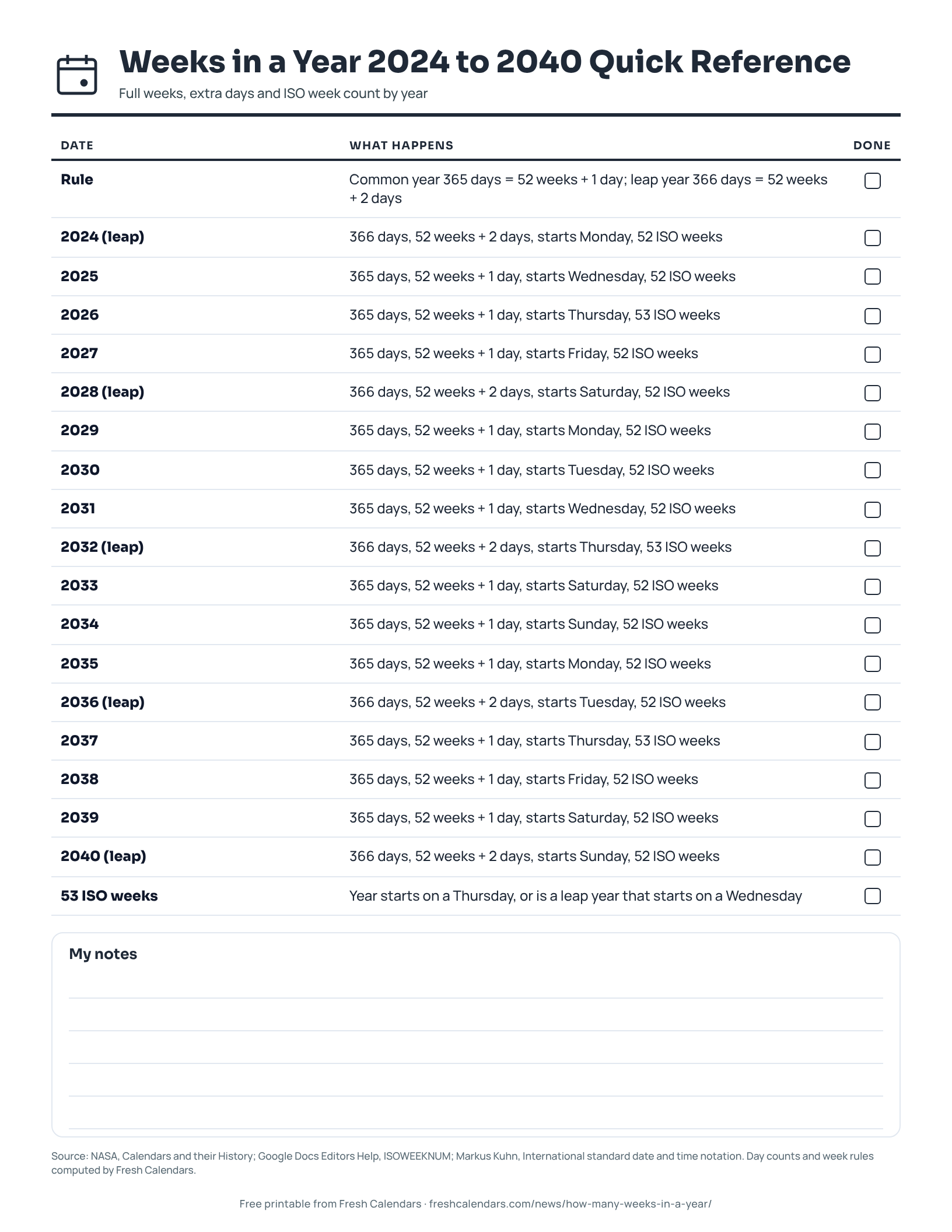
Weeks in a Year 2024 to 2040 Quick Reference (ink saver)
One-page reference of days, full weeks plus extra days, start weekday and International Organization for Standardization (ISO) week count for each year from 2024 to 2040. Ink-saver version.
Frequently asked questions
Is every year 52 weeks long?
No. A year is 52 weeks plus 1 day (365 days) or 52 weeks plus 2 days (366 days), so it never equals 52 weeks exactly. Saying a year has 52 weeks is shorthand for the 52 full weeks it contains.
Can a year have 53 weeks?
As a count of numbered weeks, yes. Under the ISO 8601 rule a year has 53 weeks when it starts on a Thursday, or is a leap year that starts on a Wednesday. Among 2024 to 2040 those years are 2026, 2032 and 2037. The year still has only 365 or 366 days.
Does a leap year have 53 weeks?
A leap year always has 52 full weeks plus 2 days. It reaches 53 ISO weeks only when it starts on a Wednesday or a Thursday, as 2032 does (Thursday). 2024, 2028, 2036 and 2040 have 52 ISO weeks.
Why do some calendars show 53 weeks?
Calendars count weeks that touch the year, not blocks of seven days. If weeks start on Sunday and the week holding Jan. 1 is week 1, 2026 runs to week 53 and 2028 to week 54.
Is 52 weeks exactly one year?
No. 52 weeks is 364 days, which is 1 day short of a common year and 2 days short of a leap year. The Gregorian average year is 365.2425 days, per the U.S. Naval Observatory, or about 52.18 weeks.
How many weeks are in a fiscal year?
It depends on the company. The Internal Revenue Service describes a 52-53-week tax year as a fiscal tax year that varies from 52 to 53 weeks, while a calendar tax year is 12 consecutive months from Jan. 1 to Dec. 31.
Sources
- Calendars and their History (NASA, 2012-10-14)
- Leap Years (U.S. Naval Observatory)
- ISOWEEKNUM function (Google Docs Editors Help)
- International standard date and time notation (Markus Kuhn, hosted by NASA, 2004-01-01)
- WEEKNUM function (Microsoft Support)
- Tax years (Internal Revenue Service, 2026-01-27)
- ISO 8601 Date and time format (International Organization for Standardization)
Related news



More in Calendar Guides
All Calendar Guides stories →- How to Calculate the Day of the Year, From 001 to 365 or 366, With a Month Table
- What Is the 100th Day of the Year? April 10, or April 9 in Leap Years
- How Many Days Are Left in the Year? The Formula, Plus the Count From Oct. 30, 2026
- How to Print a Calendar PDF at Actual Size: Print Settings for Edge, Mac and Home Printers
- Monday Start vs Sunday Start Calendar: Same Dates, Different First Column